Distinctions and Theological and Philosophical Rules.
James Dodson
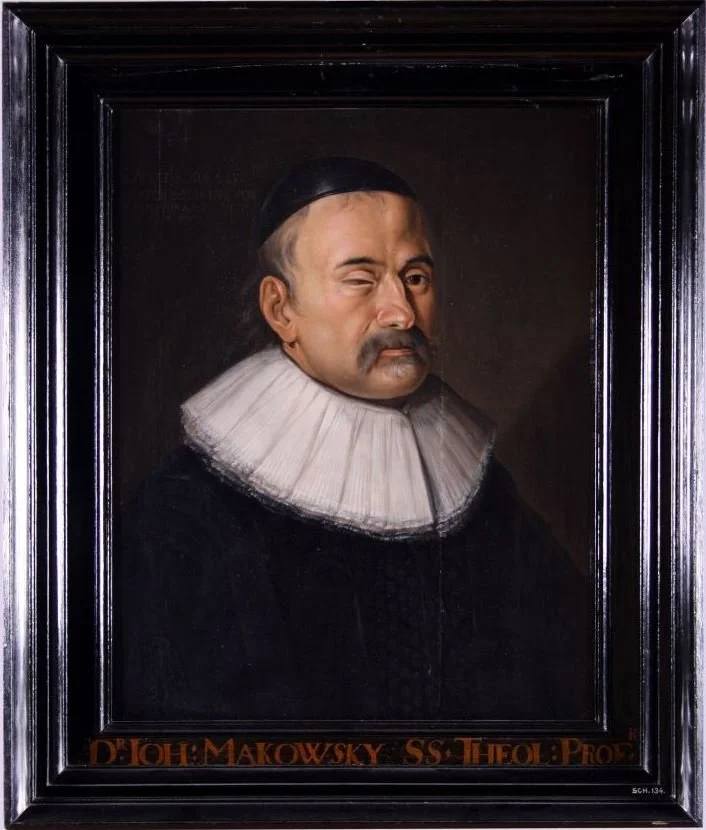
JOHANNES MACCOVIUS,
Doctor and Professor of Sacred Theology,
Published by the labor and study
of
NICOLAUS ARNOLDUS,
Doctor and Professor of Sacred Theology in the Academy of Franeker.
[printer’s device]
AMSTERDAM,
At Louis Elzevir’s,
1656.
With privilege.
[Dedication]
To the noble young men, sprung from noble and generous ancestry, and conspicuous by no lesser nobility of virtues:
Lord Stanislaus de Sbaszyn Sbaski;
Lord Christopher de Gruzew Gruzewski, judge of Samogitia;
Lord John Melchior Bielewicz;
Lord George Bielewicz;
noble Poles.
Most generous, magnificent, and most noble lords:
All men have drawn their origin from one man; this is certain. Scripture testifies, Acts 17:26: “And he made from one blood the whole race of men.” Reason subscribes to this, because unity is the principle of multitude. Virtue alone distinguishes us who were born equal; and those whom it exalts by its own work it renders noble and illustrious. Though this virtue is moral in nature, and therefore is not transmitted to posterity by natural propagation, yet experience teaches that the brave are begotten of the brave, although the sons of heroes are sometimes a reproach and make an exception to the rule. And although, as Seneca says, nothing is more cruel to those who were not born noble but made noble than that saying, “Nothing is harsher than a low man when he rises high,” nevertheless, virtue is more pleasing when it comes from a noble body.
[Dedication, continued]
More pleasing, I say, is that virtue which is born with nobility and, together with goods, is transmitted to a long succession of posterity, being possessed as if by hereditary right. That nobility excels which strives to cultivate by art what nature has bestowed. For, as the poet rightly sings: “To have faithfully learned the liberal arts softens manners and does not allow them to be savage.”
They are twice, indeed thrice noble, whose nobility of birth is crowned with knowledge of divine and human things; and, glittering as it were with certain radiant jewels, it draws all men to love and desire it. But since nobility of the earth is nothing unless that which is of heaven accompanies it in this life and follows it in the future, they seem to me to arrange their affairs according to the divine prescription, and to carry every point, who mingle the useful with the sweet; who, I say, join to their studies, by which they become good citizens of their fatherland, the queen of all sciences—that is, Theology.
Reason dictates that noble men, the nursing fathers of the Church, ought to be imbued with knowledge of those things which concern the Church. For as there is no desire for what is unknown, so also there is no care for it. Hence those tears with which the Church laments the apostasy of many. This has arisen from no other cause than that such men were altogether ignorant of divine things.
Scripture commends kings of three orders: Melchizedek, a king and priest; David, a king and prophet; and other kings simply as kings. The union of political dignity with sacred orders in the same persons, according to the judgment of the learned, intimates that noble men ought to be bound by care, study, and solicitude for sacred things.
[Dedication, continued]
Even paganism itself, irradiated only by the light of nature, congratulated itself on such men: “King Anius, the same priest of men and of Phoebus.” Virgil, Aeneid, Book 3. And Trismegistus was called thrice greatest because he was the greatest philosopher, the greatest priest, and the greatest king. Alexander of Naples, Book 2, chapter 6.
But there is no need for me to run on into the praises of the Gentiles. The Christian Church had Alfonso, king of Aragon, most celebrated even for this, that he read through the sacred Bible with the Ordinary Gloss ten times from head to foot. It had the emperor Theodosius, who placed the greatest part of his glory not in the fact that he ruled, but in the fact that, as a member of the Church, he was subject to the rule of Christ.
Nor is there need to search the monuments of antiquity on this point. The most exalted prince of Transylvania, George Rákóczi, while prudently holding the helm of the republic, was devoted to divine things, so that, according to the testimony of the Reverend Lord George Thulaeus, superintendent in Transylvania, in his funeral sermon, and of the illustrious Bisterfeld in his memorial oration, he read through the sacred volume from alpha to omega twenty-seven times. This was a deed worthy of a Christian prince, one equal to which not even Diogenes, with his torch lit at noonday, could find.
The most illustrious and generous Lord Zbigniew de Goray Gorayski, castellan of Chełm, in the charitable Colloquy of Thorn, administered so skillfully on the side of the Reformed, acquired for himself an immortal name and for his family an ornament, and erected a trophy both political and theological.
Of such men, you, most noble young men, the flower of Polish nobility, are the offspring and heirs of ancestral nobility and virtue. It is no small praise that Titan formed your hearts from better clay, and that you are illustrious by noble lineage. But it is greater that you adorn the things which are of nature by your own Minerva.
Therefore I judged it part of my office to add a spur to you, who of your own accord are running in this course, and to summon you to the imitation of your illustrious ancestors. It has seemed good to God to appoint me, a foreigner, over the Church and Academy in these regions. But if I forget the Church of my fatherland, let my right hand forget itself; let my tongue cleave to my palate, if I do not remember thee, if I do not exalt the Polish Church, which has cherished me in her bosom through so many five-year periods, above the head of my joy. With Daniel, praying toward Jerusalem, I often turn myself toward the east, repeating that Davidic word: Let peace be within thy bulwark, O Poland! tranquility within thy palaces, for the sake of my brethren and my friends, for the sake of the house of Jehovah our God.
By prayers and vow I add my own labor, however small it may be, to the godly endeavors of those who dwell here for the hope of the Church of the fatherland, in order to advance them. Finally, to all, of whatever order they may be, I commend the cultivation of orthodox religion and theological study. Although I know that this has already been well commended to you, most noble young men, nevertheless I could not refrain from fixing this spur even upon you, who are spontaneous in this matter, and from honoring your names with this dedication of the Maccovian remains. You have thus far proved your affection toward me; let this same affection be experienced also by this slight little gift dedicated to your name.
I humbly pray God that from on high he may most abundantly bless your studies, appoint a guardian angel over you while you sojourn abroad, and at length bring you back and make you good citizens of your fatherland and firm pillars of the Church. Thus vows,
Franeker,
16 April 1652.
Your most devoted fellow-countryman,
NICOLAUS ARNOLDUS,
Minister of the Word of God, Doctor and Professor of Sacred Theology in the Academy of Franeker.
To the Reader
I do not snatch from your hands distinctions hitherto worn smooth and commonly used in Sacred Theology and Philosophy; rather, I contend, so far as I can, that there should be a place for these alongside others. Perhaps, if any defect is discovered in the rest, these will serve as supplements; if there is any obscurity in others, these will explain it. They are not unjust, nor are they works of reasoning contrived to put a deceptive gloss upon simpler men, but they have arisen from the things themselves, and have been happily applied for expressing briefly and clearly the conceptions of the mind. They have been desired and sought by many until now; by this edition I have labored to satisfy their wish and have studied to please them.
I compared various manuscript copies with my own; I corrected errors perhaps introduced by the negligence of copyists; I supplied the defects of one copy from all the others, so that this compendium of distinctions might be complete in every number, restored to its former brightness, and serve as a kind of forerunner to a reprinting of Maccovius Revived. For the rest, as the Praetor does not concern himself with trifles, so I do not concern myself with the mutterings of those who look upon such things only with envy, and to whom nothing is beautiful except their own, like apes. You, reader, if you are good, farewell, and favor the studies
of yours,
ARNOLDUS.