Contact Us

Use the form on the right to contact us.

You can edit the text in this area, and change where the contact form on the right submits to, by entering edit mode using the modes on the bottom right. 

Form Block
This form needs a storage option. Double-click here to edit this form, and tell us where to save form submissions in the Storage tab. Learn more
         

123 Street Avenue, City Town, 99999

(123) 555-6789

email@address.com


You can set your address, phone number, email and site description in the settings tab.
Link to read me page with more information.

Database

An Authorized Psalmody.

James Dodson

1900-James G. Carson (1833-1908).-This tract defends the United Presbyterian Church’s position of exclusive psalmody—the belief that only the songs contained in the Book of Psalms should be sung in corporate worship, to the exclusion of uninspired hymns. Carson structures his argument around a syllogism: (1) Only what God has appointed should be used in formal worship; (2) God has appointed only the Psalms for praise; therefore (3) only the Psalms should be used. He supports the first premise by arguing that obedience to God’s will is the essence of acceptable worship, that God is jealous of his prerogative to prescribe worship (citing Nadab and Abihu’s punishment), and that divine appointment is necessary as the foundation for faith in worship. He supports the second premise by noting the Psalms’ lyrical form and titles indicating they were designed to be sung, their approved use in the Old Testament, Christ and the apostles’ continued use of them, and the absence of any new inspired songs or commission to compose them in the New Testament. Carson addresses the key objection—Paul’s reference to “psalms, hymns, and spiritual songs” in Ephesians and Colossians—by arguing these terms refer to existing compositions within the Book of Psalms, not a license to create new uninspired hymns.

Read More

Memoir of William Orr,

James Dodson

1814-William Orr [Preface by Thomas Henderson].-This spiritual autobiography, related by William Orr himself in his final years, chronicles his lifelong religious journey from the bondage of legalism to the liberty of the gospel of free grace. Born in 1729 and raised under a “legal ministry” that taught salvation by moral duty, Orr recounts his deep spiritual distress upon realizing the inadequacy of such doctrine to relieve a sin-burdened conscience, and his subsequent conversion upon hearing a dissenting minister clearly distinguish between the Law and the Gospel. Compelled by conscience, he separated from the Established Church—despite the cost to his social standing—and, after examining the various denominations, joined the Reformed Presbytery, the only body he found faithful to the Covenanted work of Reformation. The memoir also candidly details his providential transitions from affluence to poverty, his struggles with debt and failed farming ventures, and his determination to maintain integrity and faith through adversity. Concluding with a series of doctrinal testimonies, observations on the Christian life, and earnest counsels to his children, the pamphlet stands as both a personal narrative of divine grace and a polemical witness against the corruptions of the Established, Secession, and Relief churches.

Read More

A Short Survey of a Pamphlet, Entituled, A Friendly Conference betwixt a Countrey-Man and his Nephew.

James Dodson

ca. 1712-Anonymous.-This pamphlet is a vigorous rebuttal of a dialogue titled A Friendly Conference, which had criticized the dissenting Cameronian societies for withdrawing from the established Church of Scotland. The anonymous author defends the Dissenters’ separation, arguing that the post-Revolution settlement is fundamentally flawed due to its Erastian encroachments, its failure to renew the Solemn League and Covenant, and its incorporation of unrepentant malignants and toleration-accepters. He systematically refutes the dialogist’s charges, defending the Dissenters’ conduct in withdrawing, their refusal to pay the cess, and their disowning of uncovenanted magistrates. The latter half of the pamphlet vigorously defends Mr. John M’Millan and Mr. M’neil against personal calumnies, arguing that their testimony is consistent with that of the martyred Mr. James Renwick, and that the real schism lies with the established church’s defection from covenanted reformation.

Read More

A Modest Reply to a Pamphlet, Entitled;

James Dodson

1710-Hugh Clark.-This is a polemical defense of the Rev. John Macmillan, written in response to a series of queries and remarks by ministers of the established Church of Scotland. The author systematically answers fifteen queries, arguing that the established Church has defected from the covenanted principles of the Church of Scotland’s purest era. He contends that the Church has abandoned the National Covenant and Solemn League and Covenant, submitted to Erastian state control, failed to censure perjury and compliance with past tyrannical oaths, and embraced an unlawful union with England and an Oath of Abjuration contrary to the Covenants. Against these charges, the author defends Macmillan’s continued preaching after deposition as both lawful and necessary, arguing that an unjust sentence from a backsliding judicatory cannot invalidate a minister’s divine commission. He further justifies separation from the established Church by appeal to Scripture (e.g., 2 Cor. 6:17, 2 Thess. 3:6) and Reformed divines like Rutherford and Durham, and defends the Dissenters’ refusal to own the present civil magistrate (Queen Anne) on the grounds that she is oath-bound to uphold Prelacy, which violates the nation’s covenanted obligations.

Read More

Donald Cargill (c. 1619–1681)

James Dodson

Donald Cargill was a Scottish Covenenting preacher born in Rattray, Perthshire. Educated at Aberdeen and St. Andrews, he was ordained in 1655 and became minister of the Barony parish in Glasgow. A man of deep conviction, Cargill first gained prominence upon the Restoration in 1660, when he publicly denounced the event as a calamity and pronounced woe upon Charles II for treachery and tyranny. Deprived of his benefice and banished beyond the Tay in 1662, he defied the sentence and became a field preacher, fiercely criticizing ministers who accepted the 1672 “indulgence.”

Following the Battle of Bothwell Bridge in 1679, where he was wounded, Cargill joined Richard Cameron in establishing the Cameronian movement. He helped draft the Queensferry Covenant and the Sanquhar Declaration of 1680, which declared war on the king. His most notorious act came in September 1680 at Torwood, where he unilaterally pronounced a solemn excommunication against the king, the Duke of York, and several other royal officials. A large reward was subsequently offered for his capture. After numerous escapes, he was seized at Covington Mill on 12 September 1681. Tried for high treason, he was executed at the Cross of Edinburgh on 27 July 1681, facing death with jubilant defiance.

Though his extreme views were not universally shared, Cargill commanded immense popular respect for his fearlessness and self-denying devotion. Contemporaries remembered him as amiable and kind-hearted, with his spoken sermons leaving a far deeper impression than his printed works.

Read More

A Lecture and Sermon

James Dodson

ca. 1678-Donald Cargill.-In these two pieces, Cargill uses biblical narratives to deliver a fierce indictment against compromising with ungodly rulers and a sobering warning of divine judgment. In the lecture on Jehoshaphat, he argues that the king's alliance with Ahab was a sinful association that halted reformation, drawing a direct parallel to Scotland’s compromise with the “Malignant Party.” He contends that true reformation must encompass the people, the civil state, and the ministry, insisting that judges rule for God rather than man and that kings are not above God’s law. He boldly asserts that hatred of God nullifies all earthly obligations, making it a duty to reprove even monarchs. In the sermon from Isaiah, Cargill poses three terrifying questions to those who enact unrighteous laws: what will they do in the day of visitation, to whom will they flee for help, and where will they leave their glory? He warns that both the makers and obedient followers of wicked laws will face God’s tribunal, where no earthly power can shelter them and their ill-gotten glory will only testify against them.

Read More

Douglas Water Kirk.

James Dodson

1896-A.H. Gilruth.-This work chronicles the history of the Douglas Water Kirk and its Reformed Presbyterian (Cameronian) congregation in Douglasdale, Scotland. The book traces the church’s lineage from the persecuted Covenanters of the 17th century, detailing their adherence to the Solemn League and Covenant, the formation of the Cameronian Regiment in 1689, and their struggle to maintain religious ordinances after their ministers conformed to the Established Church.

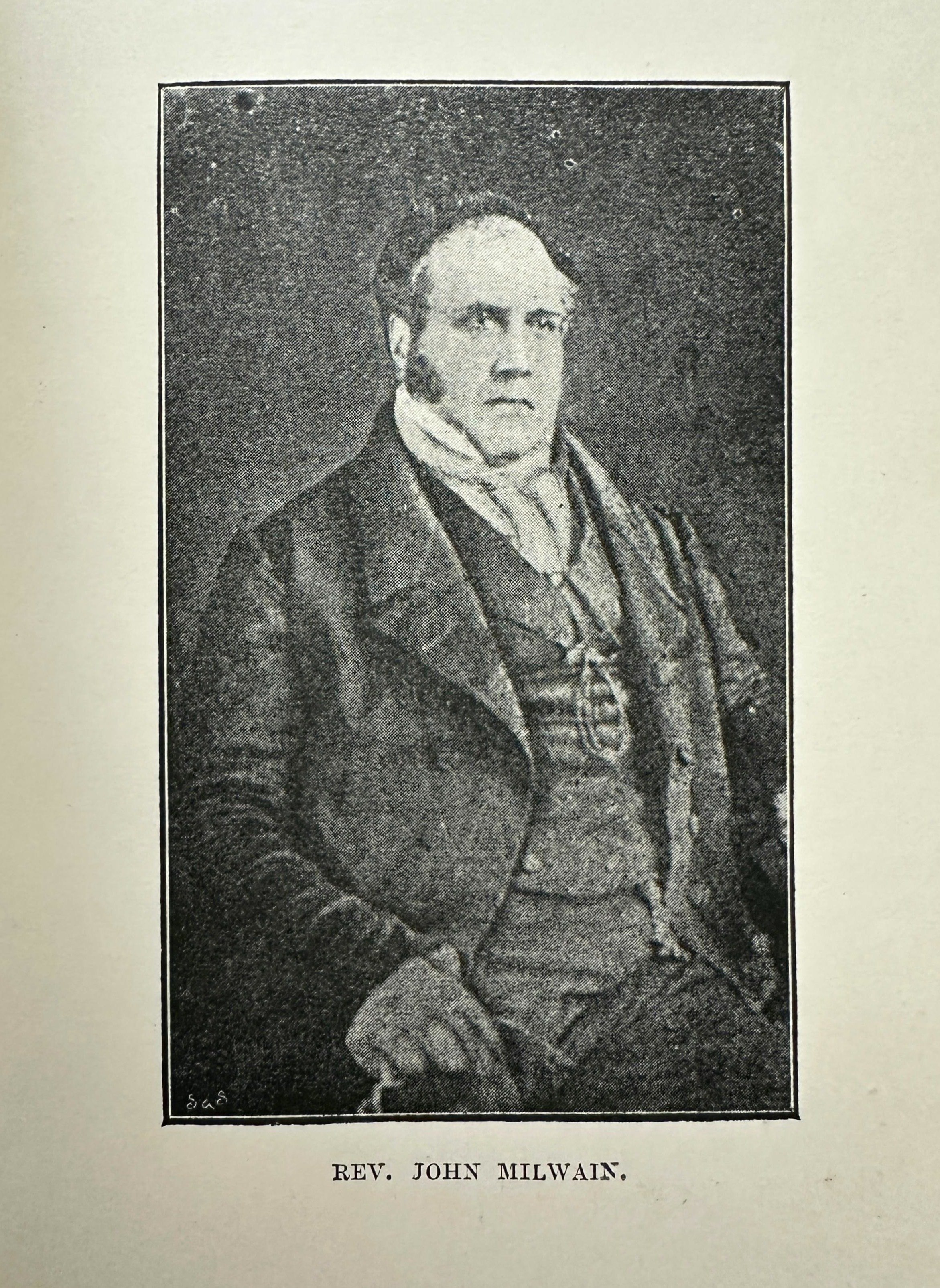
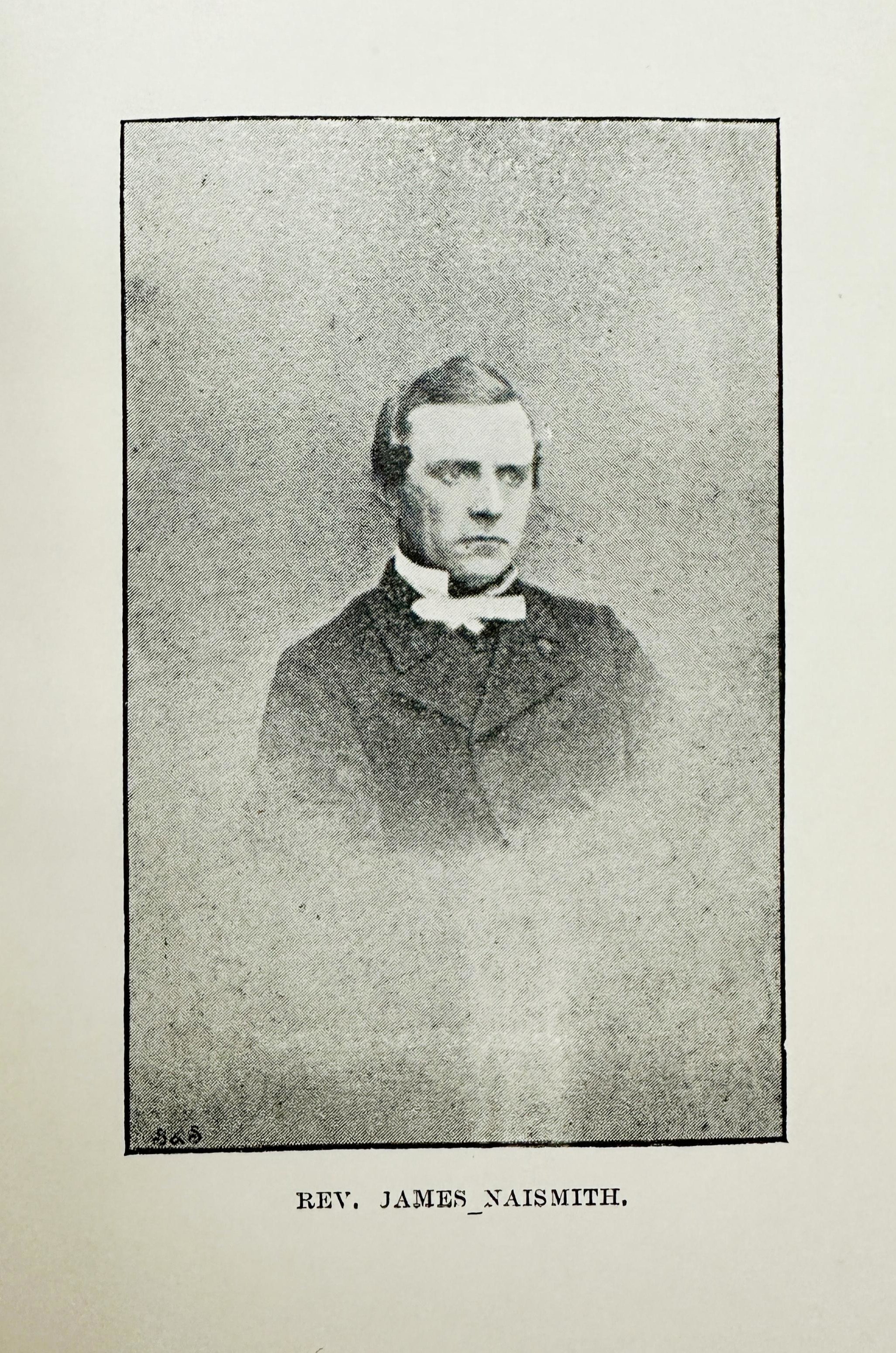
The narrative highlights the pivotal role of Rev. John M’Millan of Balmaghie, who accepted a call from the Societies in 1706 after a 16-year period without a minister, and the subsequent formation of the Reformed Presbytery in 1743. It then provides biographical sketches of the congregation’s subsequent ministers—John Fairley, John Milwain, and James Naismith—illustrating the austere worship practices, the physical construction of the church and manse, and the protective patronage of the House of Douglas. The history concludes with the internal strife of the late 19th century, specifically the 1863 denominational split over political franchise and the 1876 union with the Free Church, which resulted in a legal battle over property rights and the eventual absorption of the remaining congregation into the Church of Scotland as a quoad sacra parish in 1892. The appendix includes historical religious testimonies and personal covenants from the era of the Covenanters.

Read More

I. Douglas Water Kirk.

James Dodson


[Illustration: DOUGLAS WATER KIRK.]


DOUGLAS WATER KIRK stands about two hundred yards to the north of the banks of the river from which it derives its name, and not more than six hundred yards from the point where the parishes of Lesmahagow, Douglas, and Carmichael meet. To strangers, however, its position may be better understood by describing it as six miles from the ancient burgh of Lanark, and about the same distance from the town of Douglas and the village of Abbey Green, Lesmahagow. The reader is aware that Lanarkshire is sub-divided into Upper, Middle, and Lower Wards. The Upper Ward is said to contain more than one-half of the county, and consists in a great measure of hills and moorish ground, with here and there fertile valleys of surpassing beauty. Foremost among these, for historical interest and beauty of landscape, is that stretch of country extending from the base of Cairntable to the banks of the Clyde, called Douglasdale. The valley is about seventeen miles in length, and the river which flows through it is called Douglas Water. It receives in its course various rivulets—Glespin, Monks, Poniel, and other burns—and finally mingles itself with the waters of

12

the Clyde. On the banks of the river, about seven miles below its source, stands the old picturesque village of Douglas. About a mile below the village, and on the same side of the river, stands Douglas Castle, the seat of the Earl of Home, surrounded by extensive grounds, and plantations of great beauty. Towards the lower part of the valley, the ground is more cultivated, and consequently less wooded. Here the river is spanned by three bridges. The one furthest up the river, and near the main entrance to Douglas Castle, is called Happendon Bridge, while the one furthest down is called Douglas Mouth. Between these two, and about two miles from each, is Douglas Water Bridge, very similar in construction to its upper and lower neighbours. At the head of the road which passes over this bridge, stands Douglas Water Kirk. The edifice itself is not old, having been opened for public worship on the 4th February, 1844, but it is the second or rather the third place of worship which has stood in the same district in connection with the same communion. This church was the centre of a widely-scattered congregation of Cameronians or Reformed Presbyterians, who maintained that they could trace their descent to the dawn of the Reformation and the early days of the Gospel. But, latterly, their number was very much reduced, and, after a noble struggle to maintain ordinances, they made application and were received into the Established Church. With consent of the superior, the Earl of Home, the buildings were soon afterwards transferred to the Church of Scotland. In this new connection, their place of worship was re-opened on the 17th March, 1885. The following year, they selected a minister of their own, and after seven years’ experience as a mission church, they were erected into a church and parish quoad sacra [with respect to sacred things].

13

Close to the church, between it and the public road, and almost concealing it from view, is a neat little cottage—the Manse—erected somewhat over thirty years ago. The site on which the church and manse are built extends to about an imperial acre, held by feu from the Earl of Home at the nominal rate of one shilling per annum. The church itself, looked at externally, is a plain, humble structure, without tower, spire, or belfry. Strangers, however, on entering its walls, are surprised to find the interior so different from its outside appearance. This change was effected in the year 1887, after it came into the possession of the Church of Scotland, when the whole wood-work was renewed, stained, and varnished, from designs prepared and supervised by Mr James Kerr, then architect on the Douglas Estate. The joiner work was executed by Mr Wood, Stablestone, and reflects great credit upon him, both for its comfort and artistic appearance.

A new heating apparatus, on the low-pressure system, was at the same time added to the church, and the ventilation of the building made most complete. The windows were renewed with cathedral-tinted glass, and fitted with fresh-air inlets. Sitting accommodation, including both area and gallery, is provided for about three hundred worshippers.

During the time of the persecution, Douglas and Douglasdale escaped many of the hardships to which other parts of the south-west of Scotland were severely exposed. This circumstance seems to show very clearly the hand of Providence, for the wild hills around, with their woods and glens, moors and mosses, became a place of refuge for the homeless wanderers who had fled for their lives. It is supposed that during the “killing time,” as this period

14

has been called, the peace of this neighbourhood could be partly accounted for by the fact that the minister of the parish of Douglas had accepted the Indulgence. In those parishes where an Indulged minister officiated, the persecution was never so severely felt, and indeed could not be carried out to the same extent. It was different, however, where a curate occupied the pulpit. These hirelings of the Government acted the part of informers, while they occupied the pulpits of the ejected ministers. They knew every house in the parish, and kept a roll of all the parishioners. Frequently, before dismissing the congregation, the curate would call the names of the parishioners, and if any did not answer, they were transferred to his “black book,” which he handed to the troopers, who during the week searched out and abused or apprehended them at their will. But notwithstanding all this vigilance, the people in vast numbers flocked away to conventicles, gathering from every quarter to “hear the words of eternal life.” The churches were left empty, which very much irritated the curates, and sometimes led them to express themselves in unseemly language. It is told of the curate of Lesmahagow that, on entering the pulpit one Sabbath morning, and seeing the pews empty, he exclaimed—“Black be my fa’, but they’re a’ aff to the hill folk thegither; sorra gin I dinna tell, and they’ll be a’ shot or hangit by Yule!”

Another, and perhaps the chief cause, which kept the families in Douglasdale in comparative peace during those days of oppression, was the protection afforded them by the house of Douglas. No one has ever been able to say that the family of Douglas has at any time shown a persecuting spirit. Certainly the Marquis of Douglas took no part in the measures of the Council, although frequently urged to

15

do so, but allowed every man to worship God according to his conscience. Instead of molesting the Covenanters, he protected them to his utmost ability—obtaining pardon for some, and an alleviation of the punishment of others. The attitude of this nobleman must have had a powerful influence upon the neighbourhood, to restrain them from manifesting a persecuting disposition. Nothing caused more disaster among the peaceful families of the Covenanters than a persecuting nobleman, backed up by the smaller proprietors in the midst of whom he dwelt.

In these circumstances, it is not to be regarded as a matter of surprise, although we have no martyrs’ graves to which we can point, and few deeds of cruelty to relate, neither are we to conclude that there were few or no Covenanters to be found in this locality, simply because little or no mention is made of them, seeing that it was simply the condition of things that prevented them being brought into notice. It is a far better proof of their existence than martyr’s grave or thrilling story, to find a congregation whose history can be traced through many generations back to the time of these events.

The descriptive boundaries of the Quoad Sacra parish are as follows:—“Starting from the old bridge which spans the Poniel Water on the old Carlisle Road, along said road to the boundary between the property of the Earl of Home and Annfield, thence along the march between Annfield, Boghill, Auchtool, Auchmeddan, Montmains Brae, Greenshiels, and Birkhill, and the above-mentioned property, thence along the march between a portion of the farm of Birkhill and that of Leelaw, and the farms of Coranna, Corriemore, and Langside, on the road which passes the farmhouses of Langside, thence along the boundary of Kirkfieldbank parish to

16

Tillieford on the Clyde, thence up the River Clyde to Douglas Water, thence up Douglas Water to the march between Dyke and Ponfeigh Townfoot, thence along the march between Blinkie and Ponfeigh Townfoot and Townhead, thence along the march between Shiels and Ponfeigh Place to the point where Carmichael and Wiston parishes meet, thence along said boundary to the point at which it turns westwards, thence to the source of Craigburn, and along said burn to Douglas Water, thence down Douglas Water to the wooden bridge near High Tofts, and thence along the footpath and across the railway in a straight line to the old Poniel Bridge.”

The new parish, as thus constituted, is composed of portions of the parishes of Lesmahagow, Douglas, and Carmichael.

II. The Cameronians.

James Dodson


DURING the reign of Charles the Second, the Presbyterians in Scotland became divided into two parties. They were both opposed to the Church of England, and with equal bitterness opposed to one another. The Resolutionists or Broadchurch party were willing to treat with the King if he would allow the Kirk of Scotland to enjoy her freedom and privileges in Church Courts as ratified by the laws of the land. The Protesters, on the other hand, not only abjured the King because he had set aside the Solemn League and Covenant, but claimed to themselves a large dominion of spiritual power with which no civil authority could interfere. At the Revolution Settlement these two bodies for the most part became one, and formed what is now known as the Kirk of Scotland. A considerable number of Protesters, however, refused to join her communion, and would admit of no settlement that did not embody the Solemn League and Covenant.

In reference to Christian doctrine they did not differ to any material extent from the Church of Scotland. They held to the teaching of the Westminster Confession of Faith, and also to the Presbyterian form of Church Government. They also maintained the principle of a State Church. But at the time of the Revolution Settlement they did not think that the freedom and liberty of the Church were sufficiently provided for, and on this account they took up a separate position, which they still maintain. It is clear that a body of Christians, whose creed in no way differs from the recognized standards of the Church of the

18

land, except in a matter of church polity, must have recourse to some special means of vindicating their attitude and keeping themselves in evidence. Accordingly, we find them publishing, from time to time, various protests, declarations, and testimonies, setting forth the national sins and defections of the times, and many a polished shaft was hurled at the head of Popery and Prelacy, while the Church of Scotland came in for a good deal of wholesome criticism.

They were also called Covenanters, because of their adherence to the Solemn League and Covenant. They held covenanting to be a moral duty, based on the moral law, commanded in Scripture, and exemplified in the history of the Church. They renewed the Covenant from time to time to preserve their own fidelity, and as a testimony for the work of reformation. Large multitudes, simultaneously, and with the utmost formality and solemnity, took an oath to maintain and promote the ends of these covenants.

After the battle of Bothwell Bridge they separated themselves, under the ministry of Richard Cameron and Donald Cargill, from their brethren who had accepted the benefit of the Indulgence, and in return the latter nicknamed them Cameronians.

About this time they were frequently called “Society-men,” but after Cameron, who fell at Airdsmoss in 1680, the name of Cameronians became fixed and was continually applied to them. At his death he obtained the martyr’s crown, transmitted his name to them as a religious sect, and also to a regiment in the British army. The following year Donald Cargill fell into the hands of the Government. He was apprehended at Covington Mill, taken through Lanark in great haste to Glasgow, brought to Edinburgh and executed. The day after Cargill’s execution “The Test

19

Act” was passed. It was applied to all suspected persons, and demanded an acknowledgment of the King’s supremacy in all matters, ecclesiastic as well as civil, and a renunciation of the Covenants and the Presbyterian establishment. “For many years,” says Wodrow, “it became a handle for persecuting, even to the death, great numbers, and some of them of considerable rank; and oppressing multitudes of noblemen, gentlemen, and others who could not comply with it.”

After the death of Cameron and Cargill, the Society people continued to meet for prayer and conference, but without any other ordinances, as they were now left without a duly qualified person to administer the sacraments among them. The “Test Act” was hard upon them. Indeed, its professed object was to clear the land of all Papists and rebellious fanatics, and the latter term was continually applied to them. They formed themselves into corresponding societies from about the year 1680. They resolved to have a general meeting of their societies to consider what ought to be done. The circumstances of the time had led to a most complete organization. They had “correspondencies,” as these local associations were called, in Fife, Teviotdale, Nithsdale, Annandale, Galloway, Ayrshire, and Clydesdale. At these subordinate centres, arrangements were made for a general meeting and time and place fixed. How many were present is not stated, but on the 15th December, 1681, the Cameronians met for the first time as a representative body at Logan House, in the parish of Lesmahagow. The chief purpose of the meeting was to draw up a public testimony against this “Test Act,” so lately passed, and to make arrangements for future correspondence among themselves. They drew up a declaration to be published at Lanark, and

20

also resolved to have four general meetings in the year, all the societies throughout the land being entitled to send delegates. It was agreed, likewise, to establish a general correspondence by running a circular letter of news through the whole societies every fortnight, or, at least, once a month. Another matter which came under consideration was a resolution to put themselves, if possible, in touch with foreign Reformed Churches. After appointing several days for fasting and prayer to be observed by their brethren, the next meeting was fixed for the 15th of March at Priesthill.

From this time the General Meetings conducted all important affairs belonging to the societies. They claimed no ecclesiastical power, nor exercised any church discipline, but in order to protect themselves they had to take steps to exclude from their meeting such as came without authority. One chief duty which devolved upon them was to endeavour to obtain a faithful ministry. Through their influence the Church of Holland ordained the Rev. James Renwick, who was the last to suffer death in Scotland on account of religion. On the death of Mr Renwick they were again left without an ordained minister. Mr Alexander Shields, who had been licensed by the Presbyterian ministers in England, having previously joined himself to their number, continued to preach among them as opportunity offered. Mr Thomas Linning, who had been maintained by the Societies at his studies abroad, about this time returned home, with testimonials of his ordination by the “classes” at Embden. Another of their students, Mr William Boyd, now also returned from Holland, having received ordination from the Church in that country.

In the month of March, 1689, these three ministers renewed the Covenants at Borland Hill, in the parish of

21

Lesmahagow. The attendance was very large, the people having come from many distant places. Owing to the arrival of the Prince of Orange and the consequent flight of James VII., they could now meet without fear of molestation. On Saturday, 2nd March, Mr Shields began by preaching in the Kirk of Lesmahagow, but as it could not contain the congregation, they came out to a place not far from Milton, where a tent was set up. Here he preached from the words of Deuteronomy xxix. 25:—“Then men shall say, because they have forsaken the covenant of the Lord God of their fathers, which He made with them when He brought them forth out of the land of Egypt.” In his discourse, he went over the breaches of the covenant, and pointed out to the people several of the steps of defection this land was guilty of, and continued the acknowledgment of sin until the darkness came down upon them. The following day the people met at Borland Hill, about two miles from the kirk, when two sermons were preached, one by Mr Boyd and another by Mr Linning. When Mr Linning concluded his sermon, he read out the names of several people who wished to make public confession of defection and scandals of which they were guilty, such as hearing the curates, paying the cess, and taking the oath. As he named them they stood up, one by one, and were openly rebuked by him. Others, whose names were not given in, followed their example, and made confession.

After an acknowledgment of sin and an engagement to duty, the Covenants were brought forward, both National and Solemn League. These were written at full length, with only a slight alteration, that is, where the name of the king occurred civil magistrate was used instead. After warning all against holding up their hand, unless they had made a conscience mourning before God for their defections,

22

he administered the oath, which many at the meeting took with uplifted hands and tears running down their cheeks. Mr Shields again preached in the Kirk of Lesmahagow in the evening.

Between the time of James’ flight and the assumption of royal authority by William, Prince of Orange, the country was in a very disturbed state. The Convention of Estates had met in Edinburgh on the 14th of March, 1689; and on the 4th of April they passed a vote declaring that King James had forfeited his right to the crown, and that the throne had thus become vacant. Claverhouse, now Viscount Dundee, was present in the Convention when this vote was passed. Soon after he abruptly left the meeting, and went out at the West Port at the head of his troopers, on his way to the North to raise an army among the clans, to support the cause of his royal master King James. Sir Walter Scott fixes the scene in the following lines:—

To the Lords of Convention ’twas Claverhouse spoke—

Ere the King’s crown go down there are crowns to be broke;

Then each cavalier that loves honour and me

Let him follow the bonnets o’ Bonnie Dundee.

Scotland was now threatened with an invasion from Ireland, besides the danger arising from Claverhouse in the North. In these circumstances, the Estates resolved upon making an effort to raise an army for defence of the country should necessity arise. The Laird of Blackwood had offered to form a regiment out of the Western shires. The offer was accepted, and commission granted to do so. Several members of the Society people were staying in Edinburgh at the time, and on hearing of this proposal called a General Meeting to be held at Douglas to take this into further consideration. This meeting led to the formation of the Cameronian Regiment.

III. The Cameronian Regiment.

James Dodson


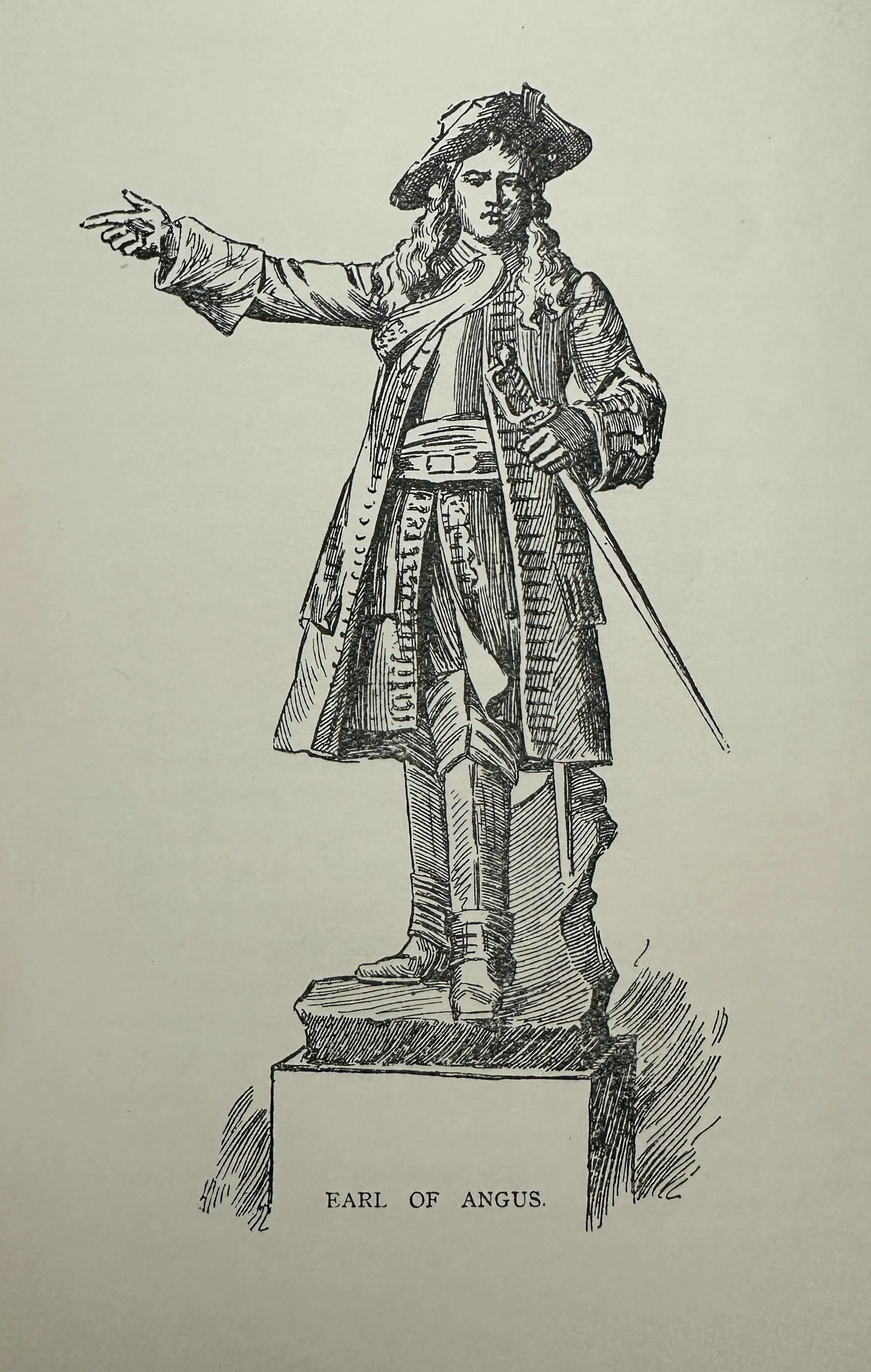
[Illustration: EARL OF ANGUS.]


23

ON the 30th of April, 1689, the Cameronians met in the Parish Church of Douglas. It was one of the General Meetings of the Societies, and was very largely attended. The special subject of consideration was whether it would be right for them to take up arms, and form themselves into a regiment, since there was great danger of an invasion from Ireland, and of intestine wars in the land. It was acknowledged that the country was likely to be in danger, and that it was very expedient for them to take some action in its defence. Some, however, thought that to form themselves into a regiment under pay would be nothing less than a sinful association, seeing their officers would have to sit in council with men who differed from them, and, at the same time, “fight under a general—viz., Mackay—whom they knew not, what he was for, or against.” The debate was long and animated. When a vote was taken, it was found that a majority had voted against the proposition; but before the votes were fully counted, the meeting was in a state of great confusion. At this juncture, a paper addressed to the Earl of Angus, Lieutenant-Colonel of the proposed regiment, was handed in and read. In it they asked to be allowed to choose their own officers, to choose their own ministers, to serve only within the three kingdoms, and to have their persecutors brought to justice. By the reading of this paper, order was restored, and some said, “that if

24

these proposals were granted, they could not say much against the raising of a regiment.” When this paper was submitted to the Lieutenant-Colonel, he told them that some of these proposals could only be granted by the King and Meeting of Estates. This they regarded as an unsatisfactory answer. Another paper was drawn up and sent to General Mackay, but it never reached him, for by the time the messenger arrived in Edinburgh, he had left for the North to meet Claverhouse at the Pass of Killiecrankie. These stipulations went on for some time further, until Sir Patrick Hume of Polwarth, who happened to be staying at Douglas Castle, proposed that the men should make a brief statement of the objects for which they took up arms. He expressed it in the following terms:—

“To declare that you engage in this service of purpose to resist Popery and Prelacy and arbitrary power; and to recover and establish the work of Reformation in Scotland, in opposition to Popery, Prelacy, and arbitrary power in all the branches and steps thereof, till the government in Church and State be brought to that lustre and integrity which it had in the best times.”

As Burton says—“It was rather cunningly devised, since it might infer that they were to carry out the principles of the Covenant in all parts of the United Kingdom, and establish the reign of righteousness; while another interpreter could restrict it to mere hostility within Scotland to the dethroned Government and Church.”

Those who objected to the raising of a regiment were now more bitterly opposed than ever, although their number was considerably reduced. The whole Societies were divided into three parties, namely, those who were opposed to the raising of a regiment, those who were in favour, and those who had not light enough to take either

25

side. Notwithstanding these divisions, the Earl of Angus, eldest son of the second Marquis of Douglas, raised a regiment twelve hundred strong, from among the Cameronians without beat of drum, or expense of levy. The first muster took place on the Braidly Holms, on the banks of Douglas Water. It is supposed that his youth (being only nineteen years of age) prevented the Earl of Angus from taking command of the regiment at once, which devolved upon Colonel Clelland. This brave young officer was the son of the factor on the Douglas Estate, and a most intimate friend of the young Earl. He was educated at St. Andrews University. He was a man of humanity and moderation, an accomplished scholar, a gentleman of refined manners, and a brave soldier. Although he was still under thirty, he had seen some active service, and had proved himself worthy of trust and command. He was present at the Battle of Drumclog, and took command of the infantry, while they attacked the dragoons of Claverhouse, and put them to flight. He was a captain in the army of the Covenanters at the Battle of Bothwell Bridge, but escaped to the Continent immediately after that disastrous defeat.

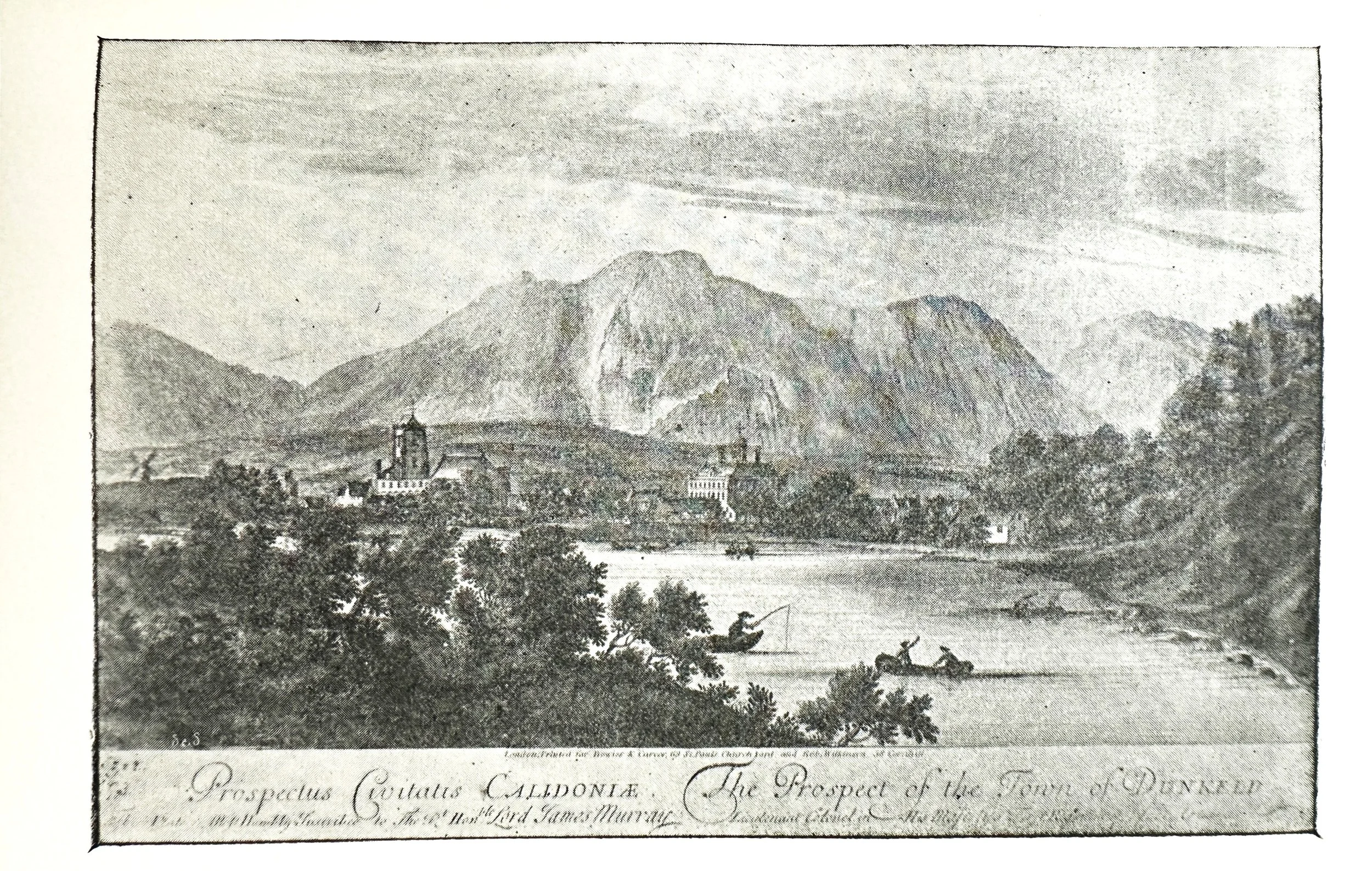
Contrary to the opinion of General Mackay, Commander of the Forces in Scotland, the Cameronians were sent first to garrison Dunkeld. This “little city” is situated about fifteen miles north of Perth, on the banks of the Tay. It lies in a hollow of the hills, by which it is surrounded. There was at that time a ford a little below the town, by which the river at certain seasons could be crossed; but by the very nature of the place, all possibility of a retreat was easily cut off. They reached Dunkeld on Saturday, 17th August, and on the following day began to prepare their defence. The other forces seemed to avoid the

26

Cameronians, and leave them to their fate. In fact, it was generally said that they were betrayed. At Coupar Angus, about fourteen miles from Dunkeld, there was a large force stationed, but although their leader was informed of the danger in which the Cameronians stood, he took no action, on the ground that he had no orders. On Monday morning, a body of dragoons arrived at Dunkeld to aid the garrison in their defence, but after being twice commanded, they reluctantly obeyed orders, and on Tuesday night marched on to Perth. When the Highlanders began to gather, there were only a few wild figures to be seen on the hills above. They were the men from Athole, out watching the Cameronians at work. As they increased in number, they sent a message down from the hills in the following words—“We, the shentlemen assembled, peing informed that ye intend to purn the town, desire to know whether ye come for peace or war, and to certify you, that if ye purn any house, we will destroy you.” The Cameronians, in reply, said—“We are faithful subjects of King William and Queen Mary, and enemies to their enemies, and if you who send these threats shall make any hostile appearance, we will burn all that belongs to you, and otherwise destroy you as ye deserve.”

Colonel Clelland thus describes the Highland army:—

Some might have judged they were the creatures

Called selphies, whose customs and features,

Paracelsus doth decry,

In his occult philosophy,

Or fauns, or brownies, if ye will,

Or Satyrs, come from Atlas Hill.

But those who were their chief commanders,

As such, who wear the pirnie standards

27

Who led the van, and drove the rear,

Were richt weel mounted in their gear;

With brogues, trews, and pirnie plaids,

With guid blue bonnets on their heads,

Which on the one side had a flype,

Adorned with a tobacco pipe;

With dirk, and snapwork, and snuff mill;

A bag, which they with onions fill;

And their strict observers say,

A tup horn filled with usquebae;

A slashed-out coat, beneath her plaids;

A targe of timber, nails, and hides;

With a long two-handed sword.

In nothing they’re accounted sharp,

Except in bagpipes and in harp.

. . . . . . .

More different postures

Than sewed on hangings, beds, or bolsters;

More varied actings, modes, and stances,

Than’s read in poems or romances.

Pipes were playing, drums were beating,

Some sneeshin’ from their fellows getting;

Trumpets sounding, skenes were glancing,

Some were “Tonald Cowper” dancing.

By daybreak on Wednesday morning the hills above the town were crowned with the whole host of the Highland army, consisting of more than five thousand men. The Highlanders began to make preparations for an attack. They posted their cavalry to keep the fords. Col. Clelland withdrew his outposts, and with great skill confined his defence to the Cathedral, to Dunkeld House, and to the wall surrounding the Park. The Highlanders came rushing down the hills, following their usual mode of warfare, namely, a short run, a discharge of firearms, which they immediately let fall to the ground, and then, with drawn swords and wild war-cries, attacked the men lining the walls. They expected to get over the walls at

28

their first onset, and begin the slaughter at once, but they were met with pikes and halberts, and beaten back again and again. The Church and the Mansion house made two strong fortresses. Meantime, however, they had got possession of the houses in the streets, and from the windows of these, a continual fire was kept up against both the Church and Mansion-house.

The Cameronians now made a bold attack upon their enemies. With burning torches fixed upon long poles, they rushed out and set fire to the thatch of the houses in which the Highlanders had taken refuge. It is said that, on seeing the keys of the door on the outside, they turned them in the lock, and so shut up those within to a certain and horrible death. In one house, as many as sixteen are said to have perished. The Dean’s house (one of the three that escaped the fire) still stands, is inhabited, and in a good state of repair. It is recorded that the smoke of the burning town kept clear of both the Cathedral and the Mansion-house. Col. Clelland, having exposed himself to give some orders, fell by a shot from the enemy while he was returning to the garrison. The battle continued until about eleven o’clock at night. The Highlanders, failing of the success they expected, did not wait for the command to retreat, but scampered off to the hills, and made tracks for home, taking what they could pick up on the way. When the Cameronians saw them retreating, they gave a great shout, and threw up their caps in the air, and then all joined in praising God for such a wonderful victory. This decided the campaign, and may be said to have secured the success of the Revolution in Scotland.

This regiment still exists in the British army, and is known as the 26th Cameronian Regiment. Seven years

29

ago, they celebrated the second centenary of their formation. They were then stationed in Ireland. It was resolved at that time by the officers, past and present, to have some fitting and permanent memorial of the event. A committee was formed to collect subscriptions, with the result that a magnificent memorial in the form of a statue of the Earl of Angus is erected at Douglas, upon a site near the bank of the river, and on the very spot where, upwards of two hundred years ago, the regiment was first mustered. This statue was unveiled by the Right Honourable the Earl of Home, in presence of the officers and friends of the regiment, on the 8th September, 1892. The inscription on the front is—“James, Earl of Angus, son of the Marquis of Douglas; born 1671, killed at the Battle of Steinkirk when in command of the Cameronian Regiment, 1692.” On the right side—“The Twenty-Sixth or Cameronian Regiment, raised by the Earl of Angus, was first mustered near this spot, May 14, 1689.” On the left side—“This statue, to commemorate the two hundredth anniversary of the raising of the Twenty-Sixth or Cameronian Regiment, which became in 1881 the First Battalion the Cameronians (Scottish Rifles), was erected 1892.—Thomas Brock, R.A., sculptor.”

Extract of a Letter from the Societies to Lord Angus’s Regiment, dated Douglas, March 27th, 1690.

“We earnestly request ye would keep up your Christian Societies. Be much in private prayer. Cry mightily that the Lord will bless you and us with the knowledge of the times and our own duty. If ye grow slack and remiss in secret prayer and public witnessing, ye have ground to fear that next your hands wax feeble in the day of battle. Consider under what character ye go, as a people more strict, zealous, and religious than others. Small faults in you are

30

more heinous and will do more hurt than in others; and wherever ye come, let your light shine before men, and have no fellowship with the unfruitful works of darkness, but rather reprove them both in yourselves and others. Forbear these things to which soldiers are much addicted. Pray that ye be not led into temptation, but delivered from evil. Abstain from sinful and scandalous games as cards, dice, &c., the first of which we hear some of you are guilty of, which is not a little wounding to us. Refrain from duels and fighting and quarrelling, either among yourselves or with others, and from drunkenness, which often occasions these unmanly and un-Christian actions. Forbear, and forgive one another. Be not of a revengeful but of a gospel spirit.”

. . . . . . .

“You may remember, at the raising of the regiment, it was thought convenient that there should be elders and a session in it, to exhort and reprove for faults; and that fast-days should be appointed and observed among you: the omission of these things is unpleasant.”*

_____

(*) Faithful Contendings.


[Illustration: The Prospect of the Town of Dunkeld.]

IV. Call to the Rev. John M‘Millan of Balmaghie.

James Dodson


TO return to the Cameronians left in Douglasdale. Their meetings at this time were very numerous, but far from being harmonious. There were at least ten meetings held in Douglas, besides several elsewhere, during the years 1689-1690, and some of these lasted for two or three days. It was proposed to raise a second regiment, but this came to nothing. It is, however, worth mentioning, as showing the strength of the party, and the martial spirit with which they were inspired from the times of the persecution through which they had passed.

It was about this time also that a strong feeling existed among the Societies, especially on the part of their ministers, for union with the Established Church. At a General Meeting held in Douglas on the 4th of June, 1690, it was resolved that a paper should be drawn up, and presented to the General Assembly expressing their grievances, the reasons for their standing apart, and their desire for union on good terms. Mr Shields, who was chaplain to the Cameronian Regiment, was asked to put it into proper form, which he ultimately did. While it was being brought before the Societies for its final consideration, Messrs Shields, Linning, and Boyd prepared a paper for themselves to submit to the Church of Scotland, framed on the same lines as the one the Societies were considering. Their paper was read in the Committee on Overtures, but

32

the Assembly refused to allow it to be read in open court. The ministers were satisfied with this, and were at the same time received into the Established Church. Mr Linning afterwards became the first minister of the first charge of Lesmahagow, after the Revolution. Mr Boyd became minister of the parish of Dalry in Kirkcudbrightshire. Mr Shields was settled minister at St. Andrew’s, where he continued till 1699, when he went to America, and died of fever the following year.

During the sitting of the same Assembly, Thomas Latimer, James Muir, William Swanson, William Woodburn, and Robert Cowan were sent with a letter of commission, to lay before the Assembly the Societies’ petition for union. The Committee on Overtures, through which it had to pass, considered it to differ very little from the one given in by the ministers, and so refused to submit it to the house. The societies were dissatisfied with this treatment, and continued as a body to remain apart.

From this date they were without a stated ministry for a period of sixteen years, and during that time had no organisation as a church, but continued to meet as societies for Bible reading, Scripture conference, and prayer. To them we are indebted for the “Testimony of the Martyrs,” as contained in the “Cloud of Witnesses,” the first edition of which was published in 1714. The General Meetings were not now so numerous, but they do not seem ever to have been given up. In these years a large number left them for the want of ordinances, and joined the National Church. For a long time they resented keenly the step taken by their ministers, especially Linning and Boyd, whom they had educated at their own expense. They blamed Linning, probably with justice, for spoiling their influence with the Church of Holland.

33

Passing over many things which happened during these sixteen years, we come now to consider the prominent part taken, in connection with the Societies, by one who has excelled in Cameronian history even the far-famed Mr Alexander Shields, namely, the Rev. John M‘Millan of Balmaghie.

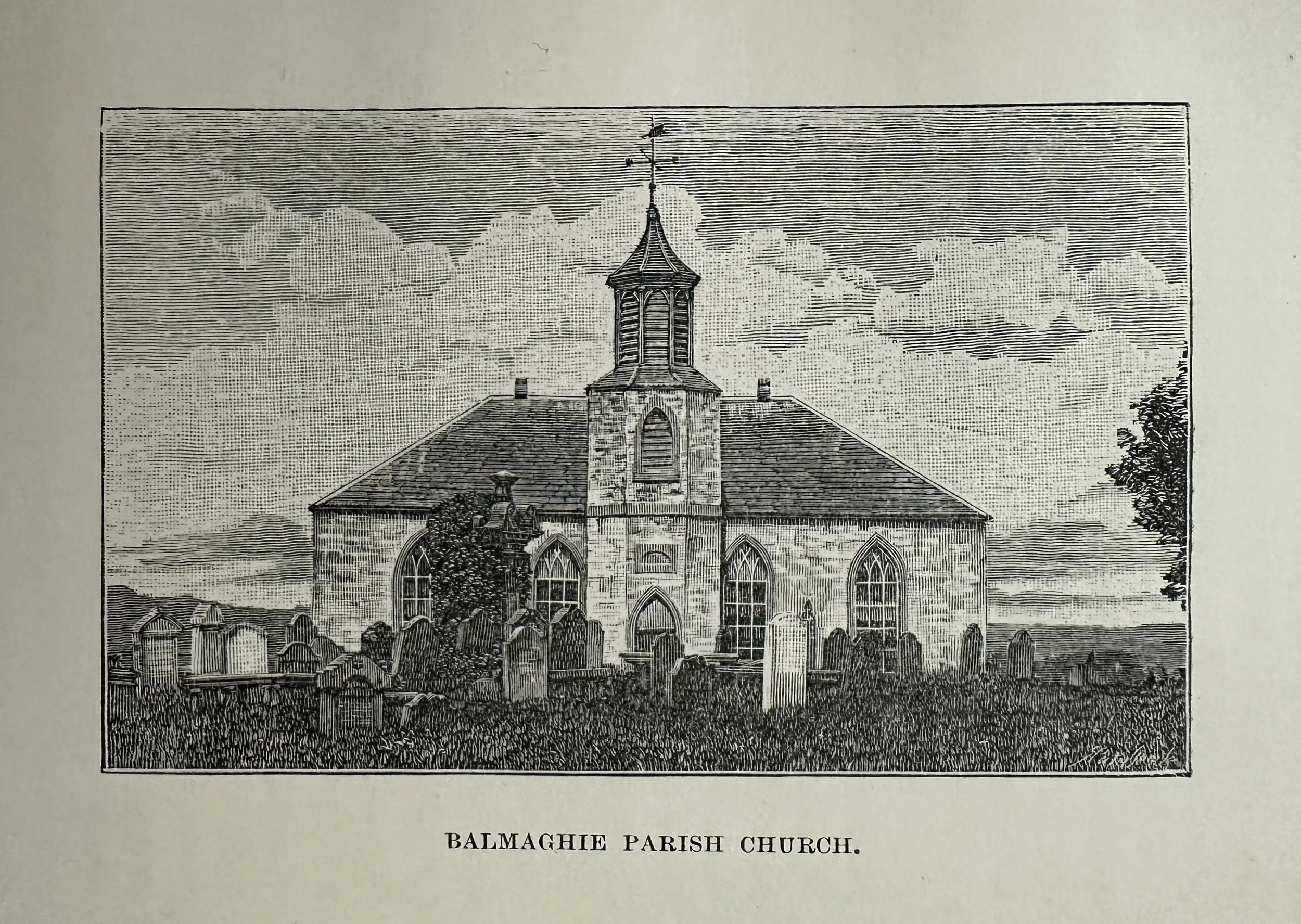
Mr M‘Millan was born in the parish of Minnigaff. Very little is known of his early days, or parentage. Before he became a student at the University of Edinburgh, he had grown up to manhood. He took his degree of Master of Arts in June, 1697. He was thirty-one years of age when he was licensed by the Presbytery of Kirkcudbright. He was called to the parish of Balmaghie in the month of May, 1701, and on the 18th September he was ordained to that charge. In October of the following year the Synod of Galloway passed an act, in which they professed their adherence to the true principles of the true covenanted reformation, and appointed all ministers within the bounds to explain the National Covenant to their people. To this injunction Mr M‘Millan took exception, as he thought he saw a design in the resolution to push aside the later national deed, the Solemn League and Covenant. He at once proceeded to explain both covenants to his people, by preaching on the obligation and duty of covenanting, as well as the sin of breaking the covenants. With the concurrence of his kirk-session, a day of humiliation and fasting was appointed, when the covenants were solemnly sworn to “in way of adherence,” and that they adhered to the State as far as the State adhered to the covenants. This gave rise to nothing beyond the limits of the parish. But in July, 1703, he sent in a petition to the Presbytery of Kirkcudbright, signed by himself and two of his co-Presbyters—Mr Tod of Buittle and Mr Reid of Carsphairn—

34

asking the removal of certain grievances. These consisted of approbation of the covenanted work of reformation, and regret at the national departure from them, craving the Presbytery to devise some means of redress. Instead of dealing with the petition, the Presbytery dealt with the petitioners. They were asked to be satisfied with recording their petition in the minutes of the Presbytery. This seems to have satisfied the others, but Mr M‘Millan would not accept it as sufficient. He refused to be silent, but continued to give utterance to his convictions in the most public manner.

The Presbytery then tried to make short work with him. They appointed a meeting to be held at Balmaghie, under pretence of a visitation, Mr M‘Millan to preach the opening sermon. Without letting him know, they drew up a libel against him, and sent the Presbytery officer to summon him to the bar, and to read the libel at the church door. But hearing of it, he got hold of the libel, and read it himself before the congregation, “obtesting every one of them to produce whatever they had to lay to his charge, either doctrinally or practically.” After the sermon was finished, they went on to prove the libel, but not one of the charges could be established. The Presbytery then offered to give up their libel if he would cease to press his petition on them, but in this matter he would not yield. It is said that, “considering that his grievances were weighty, and matters of conscience to him, and no appearance of any redress to be obtained, but matters still growing worse and worse, he therefore protested and declined the Presbytery, and appealed to the first free and faithful General Assembly of the Church of Scotland.” The Presbytery immediately after this appeal broke up, and it is said one half of the members went home. The


[Illustration: BALMAGHIE PARISH CHURCH.]


35

others, with two corresponding members from the Presbytery of Wigton, went to some neighbouring church, and constituted themselves anew. Here, without acquainting either Mr M‘Millan or his congregation with their purpose, they passed their sentence of deposition upon him. They grounded their finding, not on his life and doctrine, but on what they called “irregularities and disorderly courses.”

Mr M‘Millan regarded the Presbytery’s decision as illegal, and accordingly continued his work among his parishioners, all of whom adhered to him except two. As the meeting which had deposed him was a small one, owing to the season of the year—it being mid-winter—he, with some of his people, went to the next meeting of Presbytery, and asked them if their sentence was unanimous, and if they continued to approve it or would reverse it. To this they gave him no answer, but the Moderator summoned him “to appear before the General Assembly in March, 1704, and answer for his conduct; adding that he knew that his appeal upon which he stood was to none of their assemblies, and that he had perverted the people of Balmaghie into schism.” Mr M‘Millan did not obey the summons of the Presbytery. He was, however, regularly cited to appear before the Commission in June. This he obeyed. Before the Commission he acknowledged that he was wrong in not submitting to the sentence of the inferior court, until he had sought redress from the higher courts of the church. His son says this admission was drawn from him on the promise that “he should have justice done to him, and be reponed back to his congregation.”

Between the meetings of Commission Mr M‘Millan remained in Edinburgh. The next Commission did not reverse the sentence, and after waiting several months in

36

expectation of something being done, he returned home. He appealed to the Presbytery, to the Commission, and Assembly, but nothing more was done on his behalf. He continued to hold the church and manse, and also the glebe for many years, indeed, until he voluntarily left the parish.

In the month of August, 1706, the Societies sent a deputation to him to obtain his views, and further to consult with him as to taking them under his ministerial supervision. At this meeting they came to an understanding with one another. About the end of October that same year, they harmoniously agreed in the matter of testimony, and then signed a call to him, which he accepted. On the second day of December, 1706, he made his first public appearance in connection with the Societies, at Crawfordjohn, before a large audience. His preaching gave satisfaction to all. Mr M‘Neil, a licentiate of the Church of Scotland, soon after became associated with Mr M‘Millan in his work among the Societies. Mr M‘Neil was never ordained, because there was no Presbytery to do so.

In the records of the Presbytery of Lanark, there is a reference to Mr M‘Millan and John M‘Neely holding meetings, and preaching within the bounds; but, although frequently referred to afterwards, no action seems to have been taken in connection with the matter.

At Auchensaugh, a lonely moorish place on the hills, about three miles above Douglas, the communion was dispensed and the covenants renewed on the 27th of July, 1712. It must have been a source of comfort and joy to many to have once more ordinances dispensed among them. One writes from the parish of Dalry in Kirkcudbrightshire, in a personal covenant transaction:—“Who would have thought, O Lord! that the next Sabbath thou


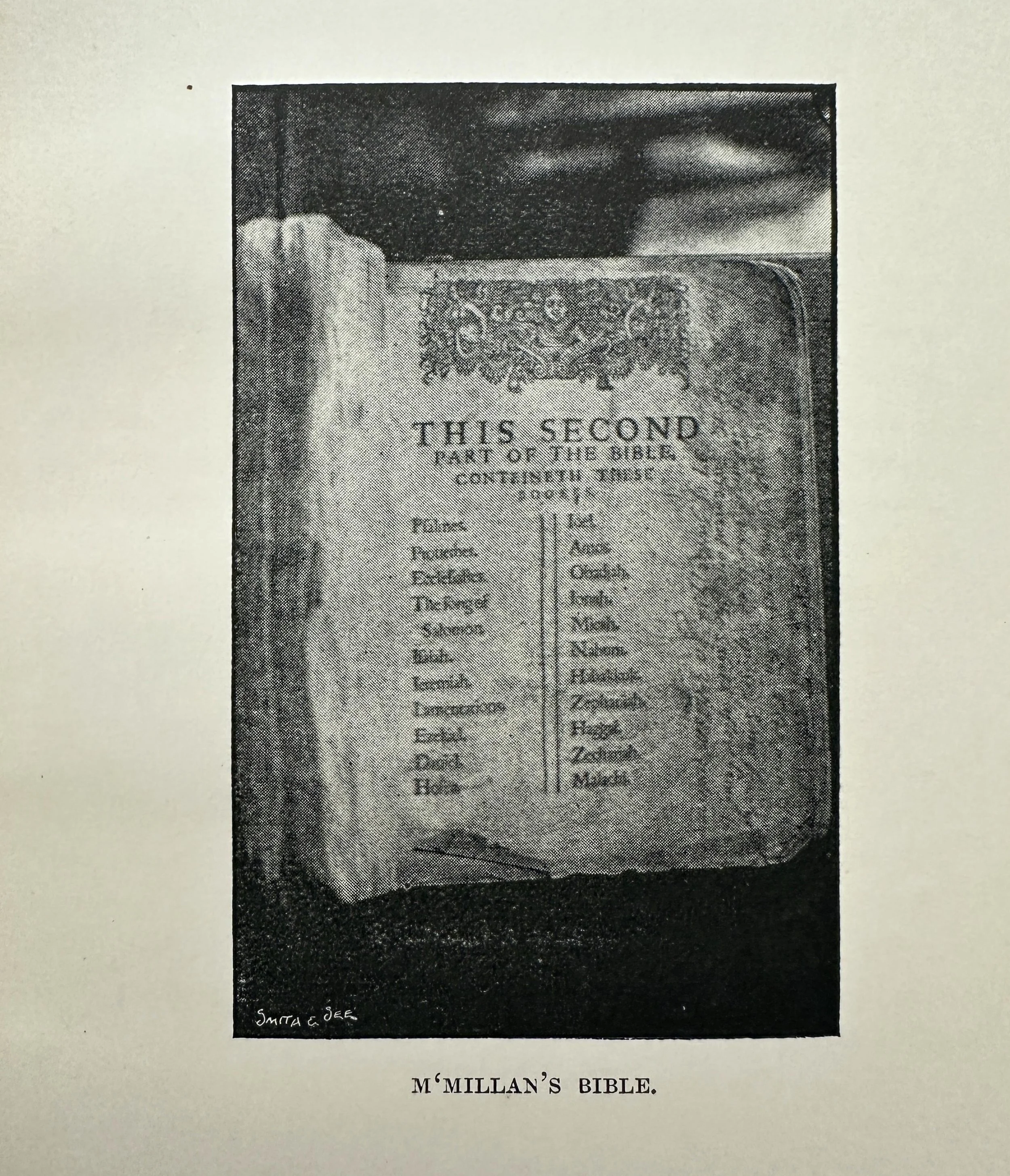
[Illustration: M‘MILLAN’S BIBLE.]


37

would’st be offering us the participation of that holy ordinance of Thy supper; an ordinance, Lord, that the generality of this generation said we would never get. And many of ourselves, a while before, could scarcely believe it; that we should have this privilege, with the renovation of our covenants and solemn acknowledgment of sins, and engagement to duties in a solemn manner.” There is an old Bible in this district, belonging to Mr M‘Kinlay, Hillhouse, which is said to have been M‘Millan’s Bible. On the top of a leaf is written, as far as can be made out, the following words:—

. . . . . . .

(The first line can’t be read.)

“Exchanged by Mr John M‘Millan, sometime minister of the parish of Balmaghie, who, being deposed some years before, gave the Sacrament on the Sabbath after leaving there, 27th June, 1712.

Jo. Macmillan.”

We are not able to say whether this is in Mr M‘Millan’s handwriting or not, but on the margin of every page there are copious notes, which show the book to have been very much used.

Mr Nairn, an ordained minister of the Secession Church, left that body and joined himself to the Society people.

Communion seasons were often times of great blessing among these people. At such times there were many solemn and impressive scenes. It was no uncommon thing for the hearers to come many of them from thirty to fifty miles. The night before, men, wearied and travel-stained, began to arrive at the appointed place of meeting. After mutual enquiries, they would form themselves into small companies, and spend the whole night together in social prayer. On the following day the table of communion was placed on the green sward in the hollow of some glen

38

surrounded by rocks, whose rugged faces looked down upon the worshippers with majestic awe. The elements of communion were placed at the head of the table, where the minister took his stand with Bible in hand, and the people, closely packed, gathered around him, often to the number of several thousands. The service began by the singing of a Psalm, and as the strains arose to the blue welkin of heaven, the tears fell from many a weather-beaten countenance.

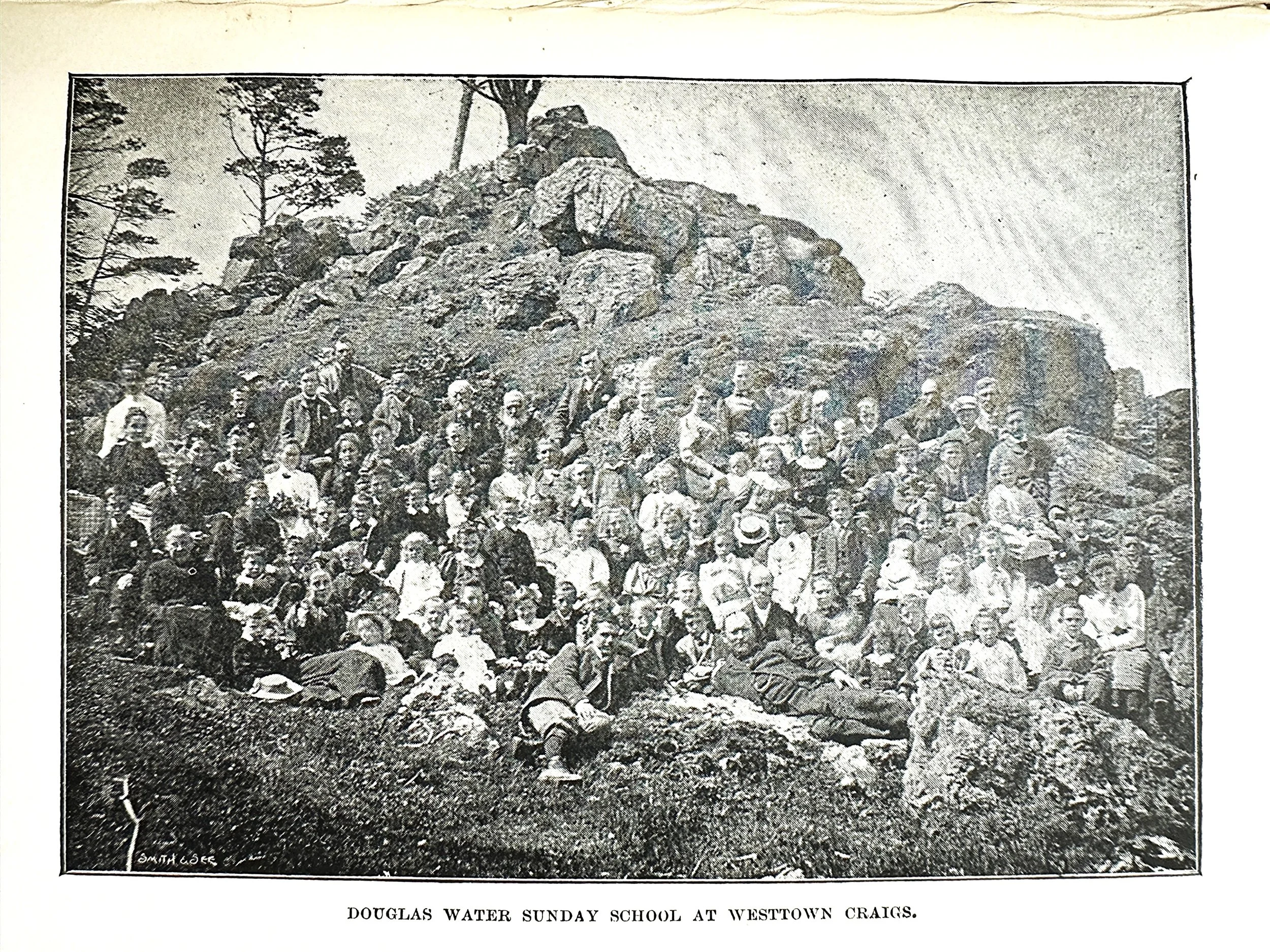
The first communion after the accession of Mr Nairn was held at the Craigs, on the farm of Westtown, between the parishes of Lesmahagow and Douglas. There was a very large gathering of people present on that day. It was noticed that the people were slow in coming forward to the first table; but when Mr Nairn had given an address upon the words, “Wilt thou go with this man? and she said I will go,” the table was full. Table after table was served, until all had communicated who wished to do so. Daylight was beginning to appear the following morning before all was concluded. It was a time long remembered by the inhabitants of Douglasdale.

Soon after this communion, a large number had assembled to hear Mr M‘Millan preach. Their place of meeting was within sight of Douglas Castle. The Duke of Douglas was there at the time, and seeing the gathering inquired who they were, and what they were doing. On being informed that it was M‘Millan of Balmaghie dispensing the sacrament to a lot of rebels, he replied, “That M‘Millan of Balmaghie! he is no more a rebel than you or I.” So he ordered refreshments to be taken out to him, and a message that his Grace would be glad to see him to-morrow, when his work was concluded. Mr M‘Millan was from that time a frequent visitor at the Castle. The


[Illustration: DOUGLAS WATER SUNDAY SCHOOL AT WESTTOWN CRAIGS.]


39

only description we have of him is given by one who lived at the Castle gate. He is said to have been “a stout, fresh, gentlemanly-looking person, with a cocked three-cornered hat, and used to ride on a beautiful dark bay horse.”


“The old order changeth, yielding place to new,

And God fulfils Himself in many ways,

Lest one good custom should corrupt the world.”

Tennyson.

V. Presbyterial and Congregational Life.

James Dodson


FOR a period of over sixty years, the General Meetings conducted all business transactions in connection with the body. It does not appear that their ministers had any say in the affairs brought under discussion at these meetings, as they were never appointed to represent any local society. On several occasions, when they had any matter to bring before the meeting, they were admitted to make their statement, then they immediately retired; after it had been considered, and a finding come to by the delegates, they were re-admitted, and the judgment of the meeting intimated. At first, these meetings were a source of great power in keeping the people together, and no doubt, for many a long year, did good work; but they were now about to give place to a new organisation, whereby they were to become constituted into a regular Presbyterian Church, and form one of the many branches into which that Church in Scotland is deplorably divided.

On the first day of August, 1743, Mr M‘Millan and Mr Nairn, along with some elders, gave each other the right hand of fellowship, and constituted themselves into a Church court. They took the name of the Reformed Presbytery.

This meeting was held at a place called Braehead, in Lanarkshire. There are, however, two places of that name in the county. Some hold it to be Braehead in the parish of Carnwath, while others maintain that it is Braehead in the parish of Dalserf. It is to be feared there are now no

42

means of definitely deciding between the two places. The only thing that can be said in favour of Dalserf is that Mr M‘Millan lived there for many years after he left Balmaghie, and the house in which he lived was called Braehead. On the other hand, oral tradition has always called it Braehead in the parish of Carnwath. Besides, there was a large number of Cameronians in that village, and a preaching station was kept in it for a long time by the minister of Pentland. It is worth noting that such a change in the constitution of the body was not likely to take place in a private house.

At Bothwell, on the 20th September, 1750, the Presbytery ordained the son of Mr M‘Millan, also called John M‘Millan, to the office of the holy ministry; and three years after, the father and founder of the Reformed Presbyterian Church breathed his last in the parish of Dalserf, in the full assurance of faith and hope of the glory of God. It must have been a source of great comfort for him, even in the trying hour of death, to see his son standing by his bedside ready to take up and carry on the work which lay so near his heart. His last words were—“My Lord, my God, my Redeemer, yea, mine own God is He.”

The Presbytery at first met at various places, such as Braehead, Bothwell, Poniel, Peebles, Crawfordjohn, Wanlockhead, and Pentland, near Edinburgh. Douglas was ultimately the headquarters and the chief seat of the Presbytery. The meetings were held in the Mason Lodge, and the members usually found accommodation for themselves in the inn. It was to this same inn that the head and hands of Richard Cameron were brought, while being taken to Edinburgh. The window is still pointed out where they were laid till the troopers were ready to resume their journey. When there was to be a meeting of the

43

Presbytery, several of the members arrived the night before, and certain bedrooms were retained for favourite ministers. The younger men, to try the landlord, would sometimes ask if they might have such and such a bedroom, when he would reply—“Weel, ye may have it if Mr So-and-so doesn’t come; but if he does, you must turn out.” The evening was spent in friendly conversation. It is said that they were sedate and grave, but neither gloomy nor severe, that they all relished a friendly chat and enjoyed a hearty laugh. A more contented and cheerful set of men could scarcely be met. The minister and his elder usually travelled together—the elder paying the travelling expenses of his pastor, as they had a saying among them that ministers should keep open mouths, but shut purses. The evening and the tavern closed with family worship. On one occasion, the minister who was to conduct the worship asked the landlord where he was reading at family prayers. He looked rather put out for a second or two, and, when pressed for an answer, replied—“Conscience! just where ye left off when ye were here last.” This blunt reply nearly upset the gravity of the company, and the story was long kept up on “mine host.”

For nearly twenty years after the formation of the Presbytery, although there were several ordained ministers, the adherents of the body were regarded as only one congregation, the work being overtaken by means of preaching stations. The services were conducted in the centre of some wide-spread district, and there, on the mountain or on the moor, they assembled themselves for worship, and were called “hill men.” They had their tent preachings in the field when the ground was white with snow, and at such times, the voice of prayer and praise had a peculiar solemnity.

44

Ultimately they became divided into two congregations—the Northern and the Southern—and as time went on, these were again sub-divided. The district assigned to the Northern congregation extended from Glasgow to Pentland, near Edinburgh, and the oversight of this charge was undertaken by the Rev. John M‘Millan, with the Rev. John Thorburn as his colleague. The Southern congregation lay between Douglasdale and Quarrelwood, near Dumfries. It was also a collegiate charge, with the Rev. John Curtis and the Rev. John Fairley ministers. They were familiarly known as “The four Johns,” and their time was regarded as the golden era of Cameronian history. The vigorous intellect of John Thorburn, the mild dignity of John M‘Millan, the homely but forcible eloquence of John Fairley, and the affectionate disposition of John Curtis, were topics of familiar conversation among the Cameronians long after they had passed away.

Each congregation had several preaching stations, and in order to reach these, ministers had to make long journeys on horseback. They were frequently away from home for several weeks at a time. In those days, the word of the Lord was precious with them. The difficulty of reaching the place where members were wont to assemble, the long interval before a preacher could come round again, enhanced the value of the services when they had the opportunity. We can easily imagine the warm and hearty welcome which would be bestowed upon some father of the Church when, in those simple, patriarchal times, he found his way, after a weary ride, into some of the remote and sequestered districts. There were no newspapers, no postal communication, and religious periodicals were not even thought of. No wonder, then, that they should welcome the long-looked-for preacher, for,

45

besides being the servant of Christ to them, he was the only visible link between them and their widely-scattered brethren of the same testimony.

The services of public worship, especially on Communion days, were always prolonged to an undue length. The people, however, were themselves to blame for this, as they regarded with most favour the minister who could preach the longest sermon from the shortest text, and could use arguments with unsparing force in defending himself against other denominations. Five or six hours of worship was no uncommon experience, and often before the last psalm would be sung, the dew-drops were on their plaids, and the stars visible overhead. It was a great trial for the young to remain quiet through all these weary hours.

A young minister who came to preach at Douglas Water on one occasion, had brought with him a sermon which would take about forty minutes to deliver. The service then began at eleven o’clock forenoon. He asked how long the service usually lasted, and what time they expected him to conclude. He was told that they would expect to get away between three and four in the afternoon. “But,” said he, “I have only one sermon; I cannot keep you all that length of time. What am I to do?” The elders, however, gave him no sympathy. “We canna help it; ye’ll ha’e to stan’ yer time,” they said, as they walked away. The order of service, however, was quite in keeping with this long sederunt. They usually prefaced the psalm before singing it, explained the chapters while reading them, and lectured for fifty minutes or an hour, frequently on the history of the Kings of Judah or Israel; a sermon followed, nearly twice as long as the lecture; and, before concluding,

46

there was a recapitulation of the whole service. In those circumstances, a sermon on the text, “Tarry ye at Jericho until your beards be grown,” would not have been out of place.

The people to whom these men ministered were no less remarkable than themselves. They were men of conscience and true piety. Some of them had uncommon gifts in prayer, and seemed to live far above earth or earthly things. They were strict observers of the Christian Sabbath as a day of rest to be kept holy. It was the privilege of their children to enjoy special religious instruction, and have the same enforced by a hallowed example. “Let me be anything in the Day of Judgment,” says a powerful writer, “rather than the irreligious child of religious parents.” The text-book for religious instruction was the Shorter Catechism, with easier questions for the young. This brief compendium of Christian doctrine divides itself into two parts—first, “What man is to believe concerning God,” up to and including the thirty-eighth question; the second, “The duty which God requires of man,” from the thirty-ninth to the end. These became the subject of examination on alternate Sabbath evenings, and this was called “Speerin’ the questions.” Children and servants committed these questions to memory, and although not fully understood at the time, they became the groundwork of a manly Christian character. There can be no doubt that the Shorter Catechism is the most wonderful production which we Presbyterians possess. Its logical sequence, the doctrine it teaches, the moral principles it enforces, have gone far to make Scotchmen the power they are felt to be, in every quarter of the globe.

The questions to the young were of a simpler nature—

“Who made you?”

47

“God.”

“Who redeemed you?”

“Christ.”

“Who sanctifies you?”

“The Holy Ghost.”

“What are we made of?”

“Dust.”

“What does that teach us?”

“To be humble and mindful of death.”

After a few more such questions—

“Ay, ye’re gettin’ sleepy noo; ye’ll better gang to yer bed, an’ mind an’ say yer prayers.”

Then the mother would be occupied for a few minutes undressing the children and teaching the infant lips to say—

“This night, when I lie down to sleep,

I pray the Lord my soul to keep;

If I should die before I wake,

I pray the Lord my soul to take.”

“What was it the Presbyterians contended for in the time of the Stuart dynasty, Jamie?”

“The Church’s freedom from Popery, Prince, and Prelacy.”

“Yes. What means did they use to protect themselves?”

“The Covenants—the National Covenant and the Solemn League and Covenant.”

“What was the difference between the Covenants?”

“The National Covenant applied to Scotland only, while the Solemn League and Covenant included all the three kingdoms.”

“Could you tell me the date of the ‘killing time,’ Robbie?”

“During 1684 and 1685.”

48

“Yes. That was the sorest time of the persecution; but, both before and after, many sealed their testimony with their blood, and obtained the martyr’s crown.”

Then would follow some interesting story of adventure and providential escape through which some Covenanter had passed. After singing a psalm, and prayer for family protection and divine grace, they retired to rest, at peace with God and man. From these homes there came forth a band of upright, trustworthy, God-fearing sons and daughters.

In the earlier days of the “four Johns,” there were no ecclesiastical buildings in connection with the denomination. It is generally supposed that the first building they possessed was a thatched cottage at Pentland; but it could scarcely be called a church, although it was used for the purpose of worship. It is impossible to say anything about the first church in Douglas Water, further than that it was covered with thatch. However, this much is known, that about the year 1789 it was re-built in a corner of the wood opposite Collierhall farmhouse. It was a plain structure with a slated roof, having a gallery at one end approached by an outside stone stair. Here the Rev. John Fairley for many years ministered to his little flock, until called to his rest and reward.

VI. The Rev. John Fairley.

James Dodson


“The good John Fairley, a man whom I knew and loved!

I think I see him now, with his long white hair, and his look

mild, eloquent, and sagacious. He was a giver of good counsel,

a sayer of wise sayings, with wit at will, learning in abundance,

and a gift in sarcasm which the wildest dreaded.”

The Ettrick Shepherd.

THE Rev. John Fairley, the first minister of Douglas Water, was born in the parish of Carnwath in the year 1729. His father had a small farm somewhere between the villages of Braehead and Forth, and was in comfortable although not affluent circumstances. In the village of Braehead there was a considerable number of Cameronians, but the elder Fairley had no sympathy with them. Neither was he pleased at his son being so much engaged with his books—a taste which he had early acquired; but like a great many others who have left their mark in the history of the Church, he was blessed with a praying mother, who encouraged the bent of his inclinations. Very little is known of his early days, further than that he was of a pious turn of mind from his childhood. Like most country boys of his time, he was occasionally sent to herd the cattle—a very lonely occupation, but one which gave a good opportunity for reflection. At such times he used to carry his Bible and other books with him in the fold of his plaid. One Sabbath-day, while thus engaged, a neighbour farmer whom he had for some time avoided came up to him and said—“If you have a knife, give it me.” When he had done so, the man set the two edges of the knives together, and, looking at the boy, said—“As iron sharpeneth iron, so a man sharpeneth the

50

countenance of his friend.” From that hour they understood each other, and after this a life-long intimacy subsisted between them. No authentic information can now be obtained as to how he got the rudiments of his education and qualified for college, but we are sure he did not find any “royal road to learning,” any more than thousands of Scottish youths who have followed in his steps. He was at one time, either before he became a student or during the vacation months, engaged in teaching at a place called Millheugh, near Larkhall, in the parish of Dalserf, where the first Mr M‘Millan lived and died. This much can be said, that it was by teaching he chiefly supported himself while he passed through his academical course. The records of the Presbytery show that he passed his examinations with credit, and at a meeting held at Poniel on 13th April (Old Style), 1760, he was taken on trials for license. He was not licensed, however, until the following year. Mr Fairley was first sent to Ireland to supply vacant congregations, and while there received a call from the Presbyterian Covenanters of Londonderry, Donegal, and Tyrone. This call was actually presented and accepted, and trials for ordination appointed, but the settlement never took place. He asked to be allowed to go home for a short time before ordination, which was granted; and although he did return to Ireland with the intention of taking up the work there, the Presbytery, considering their other appointments, wrote requiring him to repair home with as much expedition as possible. While still a probationer, he was appointed Presbytery Clerk; and at the same meeting he returned the call given him from the vacant congregation in Ireland, which the court accepted, and returned to the people there. The following year, 1763, there were two calls to Mr Fairley laid on the table

51

of the Presbytery—one from America by the hand of a commissioner, and another from the Southern congregation in Scotland. On the Moderator offering both calls, Mr Fairley accepted the latter. His ordination took place at Leadhills on the 21st December, 1763. On this date the Reformed Presbytery met, and was constituted by prayer. Present:—The Rev. Mr John Thorburn, moderator; Messrs John M‘Millan and John Curtis, ministers; Thomas Henderson, John Rodgers, and John Mathers, ruling elders; John Fairley, Clk. Presby.

Inter Alia.—“The members of Presbytery formerly appointed to serve the edict reported that they had done it in two different places a sufficient time before the meeting, whereupon they appoint John Wilson pro. tem. as their officer, to read over the edict three several times at the tent when the congregation was convened, who reported that he had accordingly done so; and the Presbytery waiting some time, and no objections appearing, the Presbytery agreed immediately to repair to the tent for the public work of the day, and continue the meeting till it was over.

“The Presbytery being repaired to the tent, the Moderator, according to appointment, preached the ordination sermon from 1 Cor. i. 13; and having concluded the sermon with prayer and singing, he then proceeded to intimate to the congregation the design of their meeting, viz., that a petition being given in to the Presbytery by the Southern congregation, craving the moderation of a call to fill up the collegiate charge, being granted, the Rev. Mr Curtis was appointed to moderate in a meeting of the electors for that end; at which meeting, a blank call being prepared, it was unanimously desired by the electors present to be filled up with Mr Jo. Fairley’s name,

52

probationer; which call being given unto the Presbytery, and by them offered to the candidate, was accepted and returned again, and the ordinary pieces of trial assigned him and delivered at a former meeting, in all which he was sustained, and the Presbytery appointed this day for his ordination, and all other previous steps being now taken, the Presbytery was immediately to proceed to the ordination; and after proposing the ordinary questions agreed to by the Presbytery, to be put to candidates before ordination, was done, and satisfying answers returned by the candidate, then the Moderator desired all the people concerned in the foresaid election should signify their continued adherence to the call which they had given by stretching their right hand; which being done, the Moderator, coming down from the tent, proceeded to the solemn work. Accordingly, Mr Jo. Fairley was, in the name and by the authority of the Lord Jesus Christ, the glorious and alone Head of the Church, by solemn prayer and imposition of the hands of the Presbytery, set apart to the office of the ministry,—then the members of the Presbytery gave to said Mr Jo. Fairley the right hand of fellowship, to take part with them in the work of the ministry; and the Moderator, having returned to the tent, desired such of the people as were present, and could have access, to take their minister by the hand, and then resumed the application of his doctrine in a way of suitable exhortations to both minister and people, and then concluded the public work with prayer and singing. The Presbytery, having returned to their former place of meeting, gave to the Rev. Mr John Fairley the right hand of fellowship as co-presbyter, and he accordingly took his seat, together with Francis Halliday, chosen as elder to him.”

John Fairley was a tall man, being fully six feet in

53

height during the days of his prime. He had a splendid constitution, and a stout, well-built figure, with a stern, clear, blue eye. His complexion was ruddy, and his expression pleasant and grave. His voice was deep, rich, and musical; and altogether he had a prepossessing and commanding appearance whether seen on foot or on horseback, in tent or in pulpit. Had he not been a man of extraordinary strength he never could have endured the toil, or stood the severity of the weather to which he was exposed.

After his ordination, he took up his abode at a place within sight of Douglas Castle. There was a small piece of land attached to the place, which he cultivated. This was his home for about twelve or thirteen years. He must have married soon after he took up house. His wife was called Janet Allison, second daughter of Mr Allison, flax merchant and landowner, at Thornhill, near Stirling. She was a loving, prudent, godly woman, and was a great comfort to him during their long married life. His family consisted of five sons and one daughter. Two of them, James and Matthew, died in infancy, and his little daughter Janet at four years of age, while he was away from home on some of his long journeys. John became a minister of the Reformed Presbyterian Church, and Ralph and Josias were manufacturers in Glasgow. These all survived their parents.

At the beginning of his ministry there was not a single house for worship, throughout the whole of his wide-spread sphere of labour, but at home or in distant places far across the mountains and moors, when a barn could not be obtained, he preached to a congregation squatted on the ground, having no protection but their plaids, and with the cold sleet and drifting snow falling thick around them. It was then generally believed that these people were the only

54

legitimate successors and representatives of the martyrs, and this popular belief contributed to the drawing of the multitudes that crowded to hear them. The first communion held in the Southern congregation was at Bushabield, about four miles from Castle-Douglas. On that day the “four Johns” were present, and took part in the services. There was an extraordinary crowd of people, and the attendance was so large in the evening that two tents had to be erected, one man’s voice being unable to reach them. There was another very large gathering at a communion held by Mr Fairley on the side of the old Carlisle road between Poneil and Douglas-Water. The younger Mr M‘Millan assisted him, and preached from the text—“But I will see you again, and your heart shall rejoice.” The day was breaking next morning before all was concluded. Among those great assemblages were people who had come long distances, and to accommodate them with provisions, large tents were erected, sometimes as many as five or six; at such times it can be easily understood that there was something more going than the mere “staff of life.” This fact alone would draw to these meetings people of great diversity of character, and it has been often remarked how few were the improprieties committed in such circumstances.

About the year 1776, Mr Fairley removed to another place of residence further down the parish called How-Gill. Here he spent the last thirty years of his busy life. The cottage, with its outhouses, was pleasantly situated on a grassy bank lying to the south, surrounded by trees and wild flowers; while the water of Douglas might be seen flowing slowly down through a valley of surpassing beauty. Here he lived and laboured in the midst of classic covenanting ground. Auchensaugh, Westtown Craigs,

55

Skellyhill, and Borlandhill stood around him like monuments of the past. Here scarce a sound could reach him save that of nature in the song of the lark, the hum of the bee, the murmur of the stream, or the roar of the Falls of Clyde faintly heard in the distance.

Along with his house he had a piece of ground which enabled him to keep five cows, several sheep, and three horses. For this he paid in rent the sum of £12. One of the horses he used in making his annual circuit of fifteen or sixteen weeks’ duration over the extensive district of Nithsdale and Galloway. The other two were used in the work of the farm. He kept a man-servant and a boy for outdoor labour, and a housemaid, besides occasional workers, and latterly he required a man to travel with him. He took but little interest in the management of the farm, although he might be seen, after returning from a long journey, riding round the fields and having a look at the crops before turning in to dismount. But, as an old woman sagely remarked, “The farm kept him in mind of the weather.”

A story is told of Mr M‘Cubbin, minister of the parish of Douglas, and Mr Fairley, who was very intimate and friendly with him, although they differed in their views on some points. Mr M‘Cubbin was a great wit, and hearing that Mr Fairley was indisposed, and confined to bed, he paid him a pastoral visit at How-Gill. Mr Fairley saw him pass the window, and said to his wife, “There’s that body M‘Cubbin; what will he be seeking?” Mr M‘Cubbin overheard the remark, and, smiling to himself, knocked at the door, which was opened by the housemaid. On her asking whom she would announce, Mr M‘Cubbin said, loud enough for Mr Fairley to hear, “Oh! tell him its just a body they call M‘Cubbin looking for a ‘fairley.’”

56

On the preaching days in connection with the sacraments, the coal mines in the neighbourhood stopped working, and most of the people attended the services; while others came from Penpont, and many other distant places. It was no uncommon thing for farm servants in the feeing market—when hiring themselves for the year—to stipulate with the farmer that they be allowed to attend the Douglas Water sacrament. Accordingly, the attendance at such times was often very large; but, as one remarked who knew the traditions of the place, the attraction was more in the refreshment tent than in the powers of piety or preaching. At any rate the meeting-house could not hold more than two hundred, and on ordinary days it was never more than half filled, although there were no dissenters but themselves anywhere around, except latterly a few seceders in Lanark. He often preached at a small village called Uddington, about half a mile from his own house, and the people of the village gossiped about the doors without going near the tent to hear him—as he said, “living within the sounding of Aaron’s bells.” He had, however, a very different experience in the South of Scotland. In Nithsdale and Galloway thousands flocked to hear him. When preaching in the parish of Buittle, near Polnackie, on an ordinary Sabbath day, there were seven hundred horses, with the bridles taken off and cast over the saddles, enclosed in a little park that was filled to the gate.

Mr Fairley was greatly respected by those who knew him best. The miners used to say, “If our guid auld minister were awa’, the like o’ him will ne’er be amang us again; we’ll gi’e him a day’s shearing the year yet.” Then they would all turn out and reap his corn. Some officious, mean-spirited people would go to the manse of Douglas and tell Mr

57

M‘Cubbin what they had heard said in the meeting house against the Kirk and the Government, thinking to please the minister; but he just told them they had entirely misunderstood the subject, that he did not believe any such things, and that he would hear no more of them.

After the congregation became separated from Penpont, they required the loan of communion utensils. Application was made to Mr M‘Cubbin, when he frankly said—“O yes! On account of the high esteem I had for Mr Fairley, I am most happy to supply his people with whatever they need.”

The Rev. Mr Gray, minister of Lanark, was also on very intimate terms with Mr Fairley. He was a minister of the strictly evangelical school, and by natural and acquired accomplishments he was well fitted to excel in pulpit oratory. It is said, when he got warm in the pulpit, he used to strip off the gown and bundle it down, paying no attention where it fell. It is whispered that when he stood alone, without a single dissenting place of worship, the lieges and officials of that good, ancient burgh were in a much better state of religious training and moral subordination than they have ever been since. Three such men as M‘Cubbin, Fairley, and Gray could rarely be found within a radius of ten miles in any part of Scotland.

Mr Fairley never was a rich man, but it is at the same time impossible to think of him as poor. His exact stipend was only thirty pounds, and if there happened to be a balance of a few pounds, it was added to this modest sum. Douglas Water raised the fourth part, while Penpont, Quarrelwood, and other places, raised the remainder. In his old age, when Mr Rowatt was called as his colleague to Penpont, and the people expressed a fear that they would not be able to pay both stipends, he stood up in the Presbytery at

58

Douglas, and said—“By all means go on with the ordination, though part of my stipend should go to assist.” And go it did, for from this time his stipend was only twenty-five pounds. It should be noted, however, that these ministers were during many months of the year from home, and also received many handsome gifts, called “gifts of grace,” which, as one has remarked, “are now as rare in the church as gifts of miracles.”

He was most faithful in all his work as a minister of the gospel. A man who had been for several years a member of his congregation applied to him for a certificate of disjunction. He wrote that he had been for so many years a member of the congregation, he had seldom attended worship during that time, had done nothing in the way of duty he could avoid, or given anything to support the gospel. The man was indignant, and said—“I will not take such a certificate.” The minister replied—“Take it or want it; I can give you no other.”

It was a very common practice for people in sickness to send in their names to be prayed for in the church, during public worship. Mr Fairley never refused to do this, but sometimes he said—“Many seek our prayers in trouble who think little of them in health; they can live, but cannot die without us.”

His mind, well-stored with Scripture truth, and the lofty flights of his imagination, supported by a child-like faith, often made his expressions in prayer sublime; but, on other occasions, although never ridiculous, they were frequently very singular. When preaching at Glentuen, he prayed for “the dry bones of Crawfordjohn,” and he seldom neglected to remember “that poor man sitting on the throne of Britain.”

The nature of his pastoral work prevented him from

59

doing much house-to-house visitation, but he was very attentive to the sick, and occasionally assembled his people for public examination. At such times, probably to keep them humble, he seldom allowed them to pass through his hands until he had taken the conceit thoroughly out of them. Most of the people dreaded the questions, and looked forward to the ordeal with fear; but others prided themselves on their ability not only to answer the questions, but to ask others in return. When examining on one occasion, he was told of a man belonging to the latter class, who would be likely to come forward for examination. When he had finished examining his own people, he asked any strangers who chose to stand up. Among a few others, this man stood up. Mr Fairley asked him—

“Who made you?”

No answer.

“What are you made of?”

No reply.

“How many gods are there?”

An indignant look, but still no answer.

Mr Fairley then said—“Poor man, I am truly sorry for you; you are very ignorant, and certainly a great child. Every child present can answer these little questions but yourself. Sit down!” It was the last time he ever tried to show off his knowledge.

Mr Fairley had a good collection of books such as were in use among divines of that period. Belonging to the old Calvinistic school, the writings of the Reformers, Puritans, and Nonconformists formed the larger portion of his library. In the study of these he took great delight. He was also well acquainted with the workings of the human heart, but his greatest power lay in his knowledge of the

60

Holy Scriptures, and his apt quotation of them in private and public discourse. In the year 1770, he published a book entitled “An Humble Attempt in Defence of Reformation Principles,” printed by David Paterson, Edinburgh. It extends to 284 pages of closely-printed matter, and is written in a clear, forcible style. The perusal of that book gives one a very good idea of the man.

Old age coming upon him, his energies began to fail. His head was white with the snow of years. He was no longer able for those long journeys which duty called upon him to undertake. Accordingly, the Rev. Thomas Rowatt was, in the autumn of 1796, ordained his colleague at a place called Scarbridge, in the parish of Penpont. From this time his labours were mostly confined to Douglas Water, while Mr Rowatt ministered to the Penpont district. They were always on the most agreeable terms, and assisted one another at sacramental seasons.

In the year 1800, his wife, not much over sixty years of age, was called to her rest. She died late on a Saturday night. Notwithstanding this sad event, Mr Fairley appeared in the pulpit next day, and gave out as his text—“At even my wife died, and I did in the morning as I was commanded” (Ezekiel xxiv. 18). He alluded to his loss with that feeling and emotion which the prophet was not allowed to evince.

He continued his public work until about two years before his death. By this time he had lost his sight, and could not read the text, but his hearing remained good. His memory too had gone, so that he used to ask what he had preached on the previous day, lest he should take the same text again. Sometimes he fainted in the pulpit and dropped down, and after a heavy perspiration breaking over him, he would rest a little, and then go on with the service.

61

Much were made of death-bed sayings, or dying testimonies, as they were called, in those days; but no record of his sayings has been kept. About a week before he died, there was a meeting of the Presbytery at Douglas. The ministers came down to see him after the meeting. One of them engaged in a long prayer. At last he said—“Stop! I can follow you no longer. Sick beds and death-beds do not do for long prayers. Duties should be pointed, but not lengthened out.” At fifteen minutes past one o’clock on the morning of Sabbath, 18th day of April, 1806, he entered upon that eternal Sabbath, which the redeemed enjoy with God in heaven.

His remains lie in the churchyard in Douglas, under a horizontal stone bearing the following inscription:—

“Nevertheless I live.”

Erected to the Memory

of the

Reverend John Fairley,

By the Congregation of Old Dissenters formerly under his Charge.

He Died 18th April, 1806,

In the 77th Year of his Age, and 44th of his Ministry.

“The Memory of the Just is Blessed.”

Also, to the Memory of Janet Allison,

His Spouse, who Died 18th January, 1800,

Aged 60;

And of Matthew, James, and Janet Fairley,

Their Children.

“Them who sleep in Jesus will God bring with Him.”

“For all the saints to live is Christ,

For them to die is gain;

Death brings to them a glorious rest,

Freedom from sin and pain.”
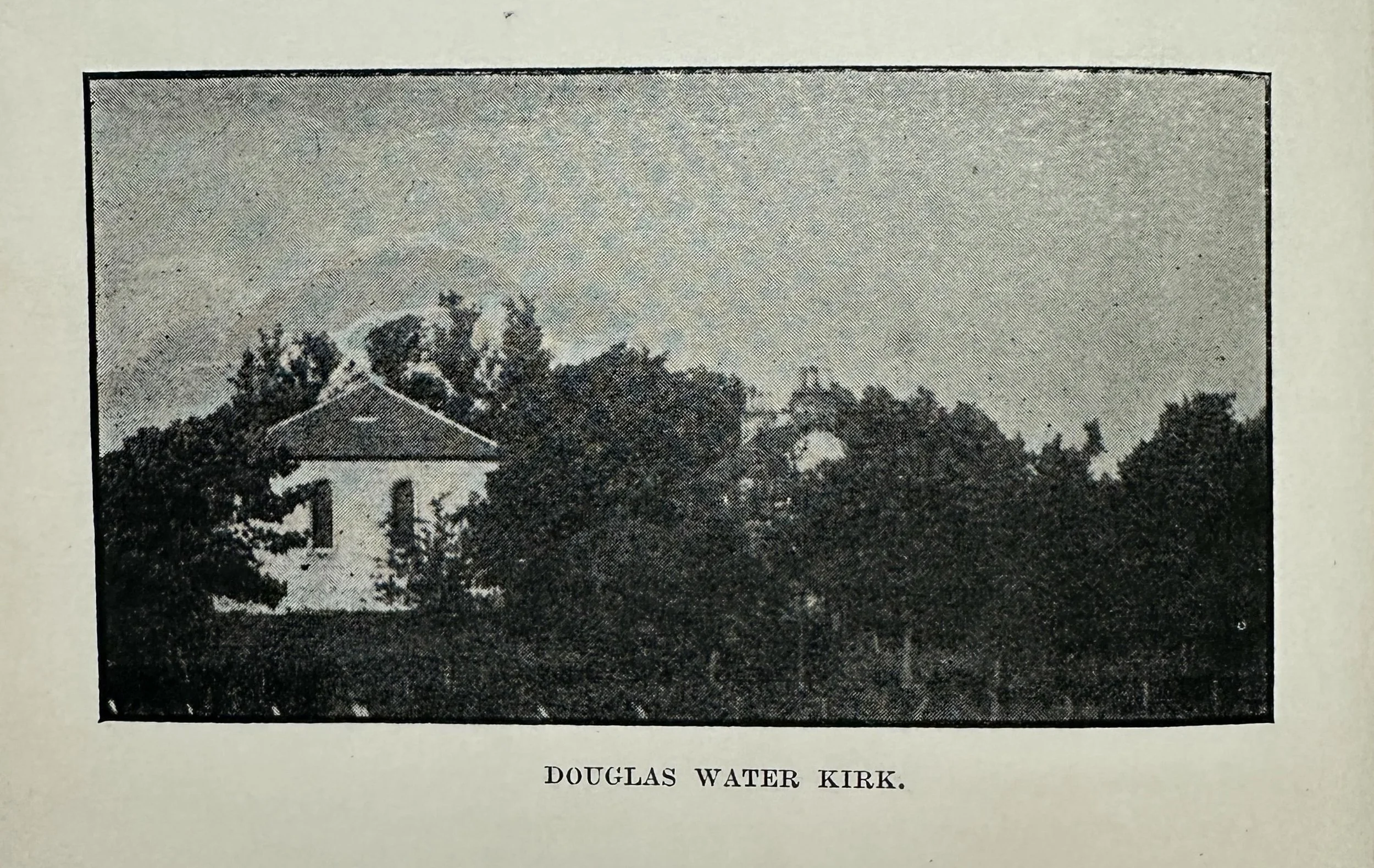
VII. Rev. John Milwain.

James Dodson


AFTER Mr Fairley’s death, the Rev. Thomas Rowatt had all the work of the congregation to attend to, both at Douglas Water and at Penpont. His place of residence was at Penpont; and as there was no dwelling-house for the minister at Douglas Water, nor any prospect of one being obtained, he had to continue to live there, and supply both places as best he could. An arrangement was entered into whereby he was to give Douglas Water a fourth part of his time—that is, he was to preach every fourth Sunday. It is impossible to say how long this order of things lasted, but ultimately Douglas Water was left without a minister.

In the absence of Church Records, we are not able to trace any congregational events for several years.

The Rev. John Milwain was born in the parish of Stoneykirk, Wigtownshire, 1793. By the influence of a sister, he was brought under the ministry of Mr Cowan of Stranraer, and in this way became connected with the Reformed Presbyterian Church. All through his life, he cherished the greatest respect for Mr Cowan, and spoke of him as an able, amiable, and pious minister of the gospel.

During his probation, he had three calls from different congregations. He accepted the call from Douglas Water. His ordination took place in the year 1822. He was a man of medium height, of a retiring disposition, and lived a life of quietness and peace. Much of his time was spent in reading, writing, and research, and there is reason to


[Plate: REV. JOHN MILWAIN.]


65

believe that he sometimes applied himself too diligently to these for his strength, which never was very robust. He took an active part in the work of the Synod, the superior court of the denomination, and was appointed by it, in 1841, to give the ninth of a course of lectures on “The Principles of the Reformed Presbyterian Church.” This lecture was allowed to be the ablest of the whole course.

In the end of August of this year, Mr Milwain preached a sermon at Priesthill, where John Brown, the godly carrier, lies buried. There was a very large multitude of people present. A collection was made at the close for the purpose of erecting a stone and putting the grave in proper order. The collection came to a little over eleven pounds. With this sum, a wall and iron railing was put round the grave, and a small stone monument erected. The superscription on the stone tells that the Rev. John Milwain of Douglas Water preached the sermon, and that with the collection the stone was erected, and so on. We cannot think that Mr Milwain was conscious of it himself, but as a friend said, when standing at the grave—“Good for Milwain, but rather hard on the martyrs!”

During the whole history of the Douglas Water congregation, it appears that there was never any feu-charter or title deeds for the place of worship occupied by them. They were simply tenants-at-will, but there is nothing to show that they ever paid, or were asked to pay, any rent. In the end of the year after his ordination, Mr Milwain drew the attention of Lord Douglas’s agent to this matter, and in reply received the following letter:—

Douglas, 21st October, 1822.

Revd. Sir,—I now do myself the pleasure of acquainting you that, in a conversation I had a few days ago with Lord Douglas on

66

the subject of your place of worship, his Lordship was pleased to say that, although he had no power and would not be inclined to give a legal title to it, as I indeed supposed, yet that he has no intention, during his lifetime, of preventing you and your congregation from using it for religious purposes.—I have the honour to be, Rev. Sir, your very obt., hum. servant,

John Dick.

The Rev. John Milwain, Newtonhead.

The estate being then entailed by what is called a strict entail, there was no power either to feu or sell.

About the year 1843, owing to mining operations underneath, the ground on which the church stood subsided, and the building became uninhabitable. The minister and his people were very much distressed over this. They did not know whether they could get another site, nor where the money would come from to erect a new building. It was even whispered that it would be better to let the congregation dissolve. After a time, however, they gathered spirit, and sent a petition to Lord Douglas asking for a new site, and in a few days received the following hearty, liberal reply:—

Castlemains, 13th June, 1843.

The Rev. John Milwain.

Dear and Reverend Sir,—I had the honour to lay your petition asking a new site for a place of worship for your congregation before Lord Douglas; and his Lordship, impressed with a sense of the high respectability of yourself, and the quiet and exemplary conduct of your congregation, at once granted your request.

Lord Douglas further directed me to give £10 and £5 worth of wood towards the erection of the church, under the following conditions, which the present agitation renders, in my opinion, necessary:—

That the place of worship to be erected shall be confined solely to the use of the Cameronians or Reformed Presbyterian Church, and that it shall on no account be given for the use of those reverend

67

agitators who, from conscientious motives, are determined to use every means in their power to pull down an Establishment they had sworn to uphold.

And further, should Lord Douglas or his successors at any time wish to remove this church from the situation now to be fixed on, that they shall have it in their power to do so by giving one year’s notice of their intention, and paying £200, or, in the option of the congregation, such value as shall be ascertained by arbiters mutually chosen.

Permit me to add that it will afford me much pleasure to be allowed personally to contribute towards the object you have in view,—And I am, dear and rev. Sir, yours very faithfully,

Thos. R. Scott.

P.S.—If in the meantime you require accommodation, the School-house at Rigside is at your service, and Mr Johnstone will deliver the key to you on producing this.

T. R. S.

The place fixed on for the new church was the site where church and manse now stand. Mr Scott, factor for Lord Douglas, sent for Robert Gold, a leading member of the congregation, to meet him at the place, and to bring a spade with him, as they were going to stake off the ground. Robert was going to be satisfied with a very small space, when Mr Scott smiled and said—“Take in another rig, and give yourselves plenty of room.” The material of the old church was used in building the new one. The farmers in the neighbourhood, who have always been very obliging, did all the carting free of expense.

The new church was opened for public worship on Sunday, 4th February, 1844. The services were conducted by Mr Milwain, the pastor of the congregation, and the Rev. Professor Symington, D.D. That morning the ground was deeply covered with snow, but notwithstanding, the building was crowded to its utmost capacity with a respectable and attentive audience. Dr Symington preached from the text—“The temple of God was opened

68

in heaven, and there was seen in His temple the ark of His testament,” (Rev. xi. 19). Applying his words with great aptness to the solemn occasion, a deep impression was produced, and the event became an outstanding landmark in the annals of the congregation.

Mr Milwain was married to a daughter of the Rev. John Thorburn, minister at Pentland. She was of a delicate constitution, but lived to a good old age. She had a lady-like, refined appearance—probably refined through suffering.

Mr Milwain, like his predecessor, Mr Fairley, rented and cultivated a small farm about a mile from the church, on the northern side of Douglas Water. The place was called Redshead, now part of the farm of Hillhouse. There was a good dwelling-house and outhouses, and a splendid enclosed garden full of fruit trees. It is now greatly altered, but from accounts given of it by old residenters, there can be no doubt it was at one time one of the most lovely spots to be found in all Douglasdale.

During Mr Milwain’s ministry, the stipend was much the same as in the time of his predecessor. One year he got £26 and no dwelling-house, and the last year of his ministry he was paid with £24 12s 9d. That year, 1858, the communicants were returned at 55.

Robert Gold, who had officiated as precentor for forty years, giving his services gratuitously, was in the spring of this year presented with a handsome overcoat, a Psalm-book, and a purse containing surplus subscriptions.

Mr Milwain resigned his charge, owing to failing health, in 1859. During the few months of his retirement, he lived at Wheatbank, in Lanark. He spent this time in reading, writing, and Christian converse with friends. He was confined to his room for about four weeks, and

69

thought himself dying, but seemed to have no fear. He took great delight in praising God during his last illness. Three days before his death, he asked his wife to join him in singing the 23rd Psalm. In this he joined with all his strength, and his voice was clear and distinct, which was very wonderful, considering the nature of his ailment—one of his lungs being all but gone. After this he often asked them to sing, but he was seldom able to join, through weakness, and his strength soon became exhausted. He fell asleep in peace on the 2nd August, 1860, at the age of sixty-eight years.

His remains lie in Lanark Churchyard, close to the wall, and just a few steps from the entrance gate. An upright stone marks the spot, with the following inscription:—

Sacred,

To the Memory of the

Reverend John Milwain,

Minister of the Reformed Presbyterian Church at

Douglas Water, Lesmahagow,

Who Died at Wheatbank, Lanark, on 2nd August, 1860,

Aged 68 Years;

And of Ann Thorburn, his Widow,

Who Died at Wheatbank, on 15th April, 1861,

Aged 80 Years.

Grace Thorburn or Learmouth,

Of Wheatbank, their Niece,

Died 30th October, 1863,

Aged 64 Years.

VIII. Rev. James Naismith.

James Dodson


THE Rev. James Naismith was born on 21st February, 1827, at Mossneuk, near Wishaw. He was the sixth son of Mr John Naismith, who afterwards resided with him and survived him. When he was thirteen years of age he became a junior clerk in the office of Messrs Stewart & Sons, writers, Glasgow. His brother, the Rev. Robert Naismith, of Chirnside, had previously occupied the same position. From his earliest days, James showed a decided inclination to live a humble, pious life. While living in Glasgow he connected himself with West Campbell Street congregation, and successively filled the offices of Secretary to the Young Men’s Society, Secretary to the Sabbath School, and Session Clerk. When the elders were chosen, he was the youngest among them, but, notwithstanding, he had the most votes. For about twenty years, from his first entering the law office, he continued with the same firm, and rose to the responsible position of cashier. Indeed he may be said never to have wholly broken with the firm, for he was all his life in the habit of going to Glasgow, and assisting in the office at such busy seasons as May and November terms. Mr Stewart, speaking of him, said—“We never thought him brilliant, but he was always good and faithful.”

“Kind hearts are more than coronets,

And simple faith than Norman blood.”

While he was connected with the law office, he attended private classes, and afterwards the University. He studied


[Plate: REV. JAMES NAISMITH.]


71

theology under Dr. Symington and Dr. Gold, in the Reformed Presbyterian Hall, and was licensed to preach the Gospel on the 6th May, 1861. The congregation of Douglas Water gave him a unanimous call, which he accepted, and was ordained on the 14th July, 1862. His brother, the Rev. Robert Naismith, of Chirnside, was present, as was also his father, an uncle, and a cousin, all elders in the Presbytery of Glasgow.

When Mr Naismith was settled at Douglas Water, he took up house at a cottage near Birkhill, about two miles from the church. There was as yet no manse or dwelling-house for the minister, and it is much to Mr Naismith’s credit that he set before himself the arduous task of having one provided. He got his cousin, Mr Morton, to prepare plans, and on a site close to the church, the little cottage, as it now stands, was built the year after his ordination at a cost of about £500. Most of this sum was raised among Mr Naismith’s friends outside the congregation.

At the meeting of the Synod in 1863, a split occurred in the Cameronian or Reformed Presbyterian Church over the question of the franchise. Up to this date, the members of the denomination had held it as a fundamental principle, that they should abstain from voting for a member of Parliament, or accepting any office which would entail them taking an oath of allegiance to the State, seeing the State had set aside the Solemn League and Covenant. But for several years prior to this, a majority of the members of Synod had been anxious to make a change in respect to these matters. Throughout Scotland companies of Rifle Volunteers had been formed, and several members and office-bearers had entered into these companies; and there was a wide-spread feeling that the oath as administered to Members of

72

Parliament, Town Councillors, or Rifle Volunteers, did not prevent them seeking constitutional reform, and could not be construed into consenting or in any way committing them to the Coronation oath. Accordingly, an overture was sent down from the Synod to Kirk-Sessions and Presbyteries on the question of the franchise and the oath of allegiance. The Synod came to the finding—“That while recommending the members of the church to abstain from the use of the franchise and from taking the oath of allegiance, discipline to the effect of suspension and expulsion from the church shall cease.” An amendment to reject the overture was lost. The minority tabled a protest, withdrew from the meeting, and on the following day met in a different place and constituted themselves the Synod of the Reformed Presbyterian Church of Scotland. Thus, on the 8th May, 1863, the church of the wilderness, the church of the mountain and the moor, the church of the covenants and testimonies, became divided and broken, and that, too, upon the very question which constituted the ground of their existence. Both claimed to be the true Cameronian or Reformed Presbyterian Church, and were afterwards distinguished as the “Church of the Majority” and the “Church of the Minority.”

Mr Naismith adhered to the Church of the Majority, and his congregation at that time stood by him without a single dissenting voice.

From this time he maintained a broad, liberal spirit towards ministers of other denominations, especially those of other dissenting churches, and had them frequently in his pulpit. In conversation with those people living near his church, he advocated union of all the different Presbyterian denominations, and maintained that there was now no difference between the Cameronian and the Established,

73

Free, and U.P. Churches. The result of this was that, during his comparatively short ministry, the congregation increased to nearly three times its original number; but, of course, it was now only “Cameronian” in name, the increase being made up of members from other churches.

The stipend paid to Mr Naismith was considerably larger than that paid to any of his predecessors. It was during his time, and also during the time of his successors, £80 per annum, and a manse. This, however, did not all come from the congregation; it included £30 from the Ferguson Bequest Fund.

He took a leading part in all temperance and educational movements. There were two small schools in the neighbourhood, neither of them very largely attended. Mr Naismith used his influence to get them united, so as to get a more permanent staff of teachers appointed.

A few weeks before his death he attended the meeting of the Synod in Glasgow, and appeared to be in his usual health. He conducted the singing in the devotional exercises of the Synod, a duty which had frequently devolved upon him. He preached for the last time in his own pulpit on 22nd May, on the text—“But the Comforter, which is the Holy Ghost, whom the Father will send in My name, He shall teach you all things, and bring all things to your remembrance, whatsoever I have said unto you,” John xiv. 26. He took ill during the week, and on Saturday was confined to bed. Medical aid was brought from Douglas, and his ailment was pronounced to be congestion of the liver. Neither he nor his medical attendant expected a fatal issue, but he calmly passed away in sleep, late on Tuesday night, the last day of May, 1870, in the 44th year of his age, and the eighth of his ministry. His remains were interred on the following Monday in the

74

churchyard of Lesmahagow. There were over thirty ministers in the large company that attended his funeral. He left a widow and five children.

Erected by the R.P. Congregation of Douglas Water.

To the Memory of

The Rev. James Naismith,

Who, as their Loving and Beloved Pastor, for nearly eight years laboured

among them with the greatest faithfulness and acceptance.

He was born at Mossneuk, Cambusnethan, on 21st February, 1827;

Ordained on 14th July, 1862, and Died on 31st May, 1870.

“Though I be free from all, yet have I made myself servant unto all,

that I might gain the more.”—1 Cor. ix. 10.

IX. Conclusion.

James Dodson


ON the 26th January, 1871, the congregation elected the Rev. Nathan Cosh. The call was signed by 82 members and 55 adherents. Mr Cosh accepted the appointment, and was ordained on the 3rd day of May following. There is nothing special to mention during the two years of Mr Cosh’s ministry. He received a call to Strathmiglo, which he accepted on the 25th July, 1873. He made many friends in the district, and not a few have kindly remembrances of him still.

We come now to consider the events which took place during the time of the last minister of the Reformed Presbyterian Church of Douglas Water.

The Rev. Thomas Ramage was ordained minister of the Cameronian Church at Kilmarnock, on the 8th December, 1856; and after a period of about seventeen years, he was translated to the Church of Douglas Water.

The call was a very harmonious one, being signed by 96 members and 68 adherents. From the age and experience of Mr Ramage, the settlement was looked forward to as one full of hope and promise; and it is pleasant to be able to say that these prospects were not disappointed, until an unforeseen event happened which threw the congregation into a state of conflict and turmoil, the effects of which have not yet wholly passed away.

After the split in the Reformed Presbyterian Synod in 1863, the “Church of the Majority,” of which Douglas Water congregation formed a part, hailed with pleasure the negotiations for union into which they entered with

76

two different denominations at the same time, viz., the Free and United Presbyterian Churches. After eight or nine years, these negotiations were broken off, and a meeting of the R.P. Synod was held in Glasgow on the 11th April, 1874, to find out, through returns from their various sessions, what ought to be done in the existing circumstances.

From these returns, it was brought out that two congregations were for dissolving their Union Committee; five for delay; one minister for delay for one year; ten congregations for union with the Free Church; and nineteen for union with the United Presbyterian Church. They afterwards agreed to seek union with the Free Church, and this was finally accomplished in May, 1876.

At the time of the union with the Free Church, it was stated that Douglas Water Kirk-Session unanimously approved of the overture on union, but it was afterwards shown that one at least of the elders objected to it. The minister, acting on what he considered constitutional lines, did not call a meeting of the congregation, and put the matter before them as parties who had an interest in what was about to take place, but having obtained a majority of his Session, he considered it his duty to enter into the union along with the other congregations of the body to which he belonged. However, on his return from the Assembly of the Free Church after the union had taken place, he found a strong under-current of feeling in the congregation, against their being, as they said, “dragged into the Free Church against their will.” Days passed on, and the people became more and more divided. At length a meeting of the congregation was called, but it did not mend matters. At this meeting, the minister explained his position, and said he had been advised to adopt the

77

course he had taken; that they did not cease to be Reformed Presbyterians, and that the Synod would meet every year as a Church Court to deal with and protect their “civil rights and property.” But this explanation only confused them. One member asked—“What are we now? Are we Free Churchmen, or are we Reformed Presbyterians?” “We are both,” replied the minister. “We are Free Churchmen ecclesiastically, and Reformed Presbyterians civilly.” “I cannot understand that,” replied the man; “we cannot possibly be piebalds.” Another remarked—“Jonah fled from the presence of the Lord, and the whale swallowed Jonah.”

Several meetings of the different parties after this were held, and their position as a congregation fully discussed. But the point around which the whole difficulty finally turned was that neither party had any title-deeds for the ground on which the church and manse stood. The only semblance of a title which the congregation had to occupy the ground was the letter to Mr Milwain from Mr Scott, factor to Lord Douglas, dated 13th June, 1843.* Previous to the date of the Countess of Home’s succession to the property as heiress of entail in 1859, no feudal title ever was granted, or could have been granted, because the estate was held under the fetters of a strict entail. The Countess, after her succession, however, disentailed the estates, and executed a new entail. She allowed the congregation to remain in possession of the subjects, as her predecessors had done, and in 1874 she was asked to grant a feudal title in favour of the congregation. Mr Scott’s letter of 1843 was also submitted to her. The Countess and her husband, the Earl of Home, agreed to

_____

(*) See page 66.

78

grant a title, but resolved that it should contain conditions similar to those expressed in Mr Scott’s letter. In August, 1874, a feu charter was drawn up and sent to the agent of the Reformed Presbyterian Church. This deed was never revised or returned, and the reason was not far to seek. Its terms were not such as would make the congregation favourable to the approaching union with the Free Church.

Thus matters stood when the union did take place. The party who were opposed to the union now made application, and obtained a feu-charter. It was the same in substance as the one which the agent of the R.P. Church had neglected or refused to take, two years before. Thereafter, they raised an action against the minister and his session holding the subjects for which they now held a title. While this case was pending, the minister and others raised an action to have the title-deed reduced. On the latter, proof was led at considerable length before Lord Curriehill, in the month of February, 1879. His Lordship took the case into avizandum, and on 28th March, issued the following interlocutor:—

“The Lord Ordinary having considered the cause, repels the reasons of reduction; sustains the defences; assoilzies the defenders from the whole conclusions of the summons, and decerns: finds the whole defenders entitled to expenses; appoints accounts thereof to be lodged, and remits the same to the auditor to tax and to report.

(Signed) John Marshall.”

The Free Church party had to leave the buildings after this decision, and seek accommodation for themselves elsewhere.

Those left in possession made application to the “Church of the Minority,” as they were called—that is, those who had protested against the finding of the R.P. Synod in 1863, and were received back into their connection. The

79

first Communion which they had dispensed to them, after their sad experience, was presided over by Mr Dick, then minister at Wishaw. Thirty-two communicants sat down at the table. Truly, they had been sifted as wheat!

After this, they made a strenuous effort to keep up ordinances, and when it was found this could be no longer done, they cast in their lot with the Church of Scotland. On the 28th November, 1892, by decree of the Court of Teinds, they were erected into a church and parish quoad sacra, and here modesty demands that we let the curtain fall.

“Hail to the Covenant banner!

When bloweth the loud rising gale;

Let it float in the good olden manner,

And the cheek of the foe shall be pale.

Why should ye fear to unfold it?

Let your enemies fear to behold it!

In days that are past,

It rallied us fast,

And will bind us together if battle prevail.

Be it still the ensign that gathers!

Blood red are the folds as they spread;

And the blood is the blood of our fathers—

The martyrs who speak from the dead.

Why was it stained in this manner?

Because it is heaven’s own banner!

Thus bequeath’d, if it fall,

Alas! for us all,

Since shame everlasting shall cover our head!”

Appendix.

James Dodson


THE DYING TESTIMONY OF JAMES CARMICHAEL.

Who Lived at Ponfeigh, Douglas-Water.


I, under subscriber, being now very weak in my condition, through the affliction and sickness of my body, and in all appearance drawing near to the time of my dissolution; I think it my duty, for truth’s vindication, and for friends their satisfaction, to leave this short word of testimony to the truths of Jesus Christ, which I have been endeavouring (although in much weakness) to adhere to through this dark, declining time wherein my lot hath fallen; and that because of the many reproaches that I have lain under, as being a man misled, and maintaining strange and unwarrantable principles, &c., I do hereby declare that I do adhere with my soul and heart to the holy and sweet scriptures of truth contained in the Old and New Testaments, and to the Confession of Faith, Larger and Shorter Catechisms, our Covenants, Nation and Solemn League, causes of God’s wrath, and to the whole of our covenanted work of reformation, and to all the testimonies for the same truths, whether of martyrs or faithful contenders, particularly these contained in our Informatory vindication and testimony against toleration; and our last three testimonies since the Revolution. And, likewise, I leave my testimony against, and declair my detestation and abhorrence of the long-continued tract of the nation’s backslidings and defection since the covenanted work of reformation began to be overturned. Particularly against

81

the public resolutions, which laid the foundation of all these defections that hath since ensued; against Cromwell’s usurpation, and the toleration of heresies and sects in his time. Against the usurpation and tyranny of Charles the Second, his overturning, and by his act rescinding, our whole covenanted work of reformation; the burning of our holy covenants, an unparalleled act of heaven-daring wickedness. His imposing contradictory oaths, to debauch the conscience of the people; his divisive and church renting indulgence. As likewise, I leave my testimony against the nation’s concurring and complying with these abominable courses; particularly against ministers and professors, and that because they are neither judicially condemned, nor any resentment of them apparent in a national way. But on the contrary a practical approving of them; by suffering these covenants to be buried, by complying with all the mandates of the state, in their practical erastianism; and their professing to retain the name of presbyterianism and yet practising the contrary, makes their course and way the more hateful; it being but a mocking of God, and cheating and blindfolding the generations. All which courses and practices in ministers and professors, I, as a dying man (who expects shortly to stand before my judge), testify against and declare my detestation of.

And now, my dear friends, my last advice to you is, that you continue fixed and steadfast in your adherence to these truths, and witnessing against the courses of defection and backsliding. Wherein, I declare, I have sweet peace and satisfaction; and not a doubting nor a hesitating thought to the contrary. But, O! study to be more serious in the substantials of religion and godliness; and to be diligent in the use of the means that is left you. Be much in reading the holy scriptures; much in secret prayer, and

82

prayer in your families and societies; much in godly conference, wherein you may be mutually edified. And think not your straightness in the Lord’s cause, the word of his patience; and public matters will do your turn, or satisfy the law and justice of God for you. Except ye savingly close with God by faith in Jesus Christ; be interested in the new covenant, and have union and communion with him. Now, my dear friends, farewell; the blessing of the Lord be with you all, and the good will of him that dwelt in the burning bush, yet not consumed, be with you henceforth, to lead, guide, and direct you in every step of your wilderness journey.

Now, because of my weak condition, I add no more. Subscribed before these witnesses, the 2nd day of April, 1707, at my own house.

Sic subscribitur,

JAMES CARMICHAEL.

Francis Graham, Witness.

William Symington, Witness.

James Thomson, Witness.

John Young, Witness.

John Curry, Witness.

John Carmichael, Witness.


The following illustrates the spiritual life of the time:—

PERSONAL COVENANT.

O great and dreadful Jehovah, for as much as Thou hast, of Thy bottomless mercy, offered to me, a wretched sinner, to be a God and Guide to me through Jesus Christ, if I accept of Thee, I call heaven and earth to record this day that I do here solemnly avouch Thee for the Lord my God; and with all possible veneration,

83

bowing the knees of my soul under the feet of Thy Majesty, even of Thy most sacred Majesty. And I do here take Thee, the Lord Jehovah, Father, Son, and Holy Ghost, for my portion and chief good; and do give up myself, soul and body, to Thy service, vowing and promising to serve Thee all the days of my life, in holiness and righteousness. And since Thou hast granted the Lord Jesus Christ as the only mids or means of coming unto Thee, I do. with all my heart, and on the very knees of my soul, accept of Him as the only true and living way by which sinners may have access unto Thee. And hereby I join myself in marriage unto Thee, and covenant with Thee. in Him. O, blessed Lord! I do come to Thee, being both hungry and hard bestead; a poor, wretched, miserable, and blind, yea, a most loathsome and polluted creature; and justly condemned if Thou should deal so with me, as I am sinful in myself and in Thy sight. I am small, and for ever unworthy to wipe the feet of the servants of the Lord; but far more unworthy to be solemnly married to the King of Glory. But since such is Thy unparalleled love, I do here with all my power accept Thee, and do take Thee for my head and husband, for better and for worse; for richer and for poorer cases, yea, and for times, cases, and conditions to love, honour, and obey Thee before and above all others. And thus, to the death, I embrace Thee in all Thy three offices. I renounce my own worthiness, and do here avouch Thee to be the Lord, my righteousness. I renounce my own wisdom, and do flee unto Thee as my only guide. I renounce my own will, and take Thy will for my law. And since Thou hast told me that I must suffer in the world if I would reign, I do here covenant with Thee to take my lot as it pleases Thee; and, by Thy grace assisting me, to run all hazards with Thee, my Lord: as supposing that neither death nor life shall part between Thee and me. And because Thou hast been pleased to give me Thy holy law, as the rule of my life and the way in which I may walk to Thy kingdom, I do here come under Thy yoke and put my shoulder under Thy burden; and so I subscribe to Thy holy laws, as holy, just, and good. And I solemnly take them as the rule of my thoughts, words, and actions. Promising Thee, though my flesh contradict and rebel, yet will I endeavour to order and govern my whole life according to Thy direction therein; and will not allow myself in the neglect of anything I know to be duty. Only because through the frailty of the flesh I am subject to many

84

failings; I am bold here to protest that all my unallowed miscarriages, contrary to the settled bensil and inclination of my heart, shall not make void this covenant with Thee, which I make this day; for then who should in Thy sight be justified.

And now, O Almighty One! Thou knowest that I make this covenant with Thee this day without any known guile or reservation. Beseeching Thee, that if Thou seest any flaw or falsehood herein, that Thou wouldest discover it to me and help me to perform it aright. And now glory to Thee, O Father, Son, and Holy Ghost! whom I shall be bold to look upon, from this time forward, as my God and Father. Glory to Thee that Thou hast found such a way for the recovery of lost and undone sinners. And glory to Thee, O God, the Son! who hast loved, saved, and washed me from my sin in Thine own blood, and art become my Saviour and Redeemer. Glory be to Thee, O God, the Holy Ghost! who, by the finger of Thy almighty power, hast turned about my heart from sin unto God. O, Dreadful Jehovah, Thou who art the Lord God Omnipotent! Father, Son, and Holy Ghost! Thou art now become my covenanted husband and friend; and I, through Thy infinite grace, am become Thy covenanted servant. Amen! Even so be it. And this covenant which I have made on earth let it be ratified in heaven.

Sic subscribitur,

JOHN WILSON.

May 29, 1682.

June 24, 1710.

July 18, 1711.

Note.—These dates lead us to infer that he had covenanted with the Lord three times in the same words.

Calendar-Reformation.

James Dodson

1648-John Brinsley, the younger (1600-1665).-This pamphlet, by an English non-conformist minister, deprived of office at the Restoration for his non-conformity, petitions the English Parliament to reform the calendar by replacing the pagan-derived names of weekdays and months with language fitting for Christians. The author argues that current names—rooted in Norse, Saxon, and Roman deities—violate the biblical prohibition against making honorable mention of other gods. He anticipates and refutes several objections, including the claims of long custom, mere civil usage, and the insignificance of the issue, citing scriptural commands, Augustine's similar critique, and the precedent of Pope Sylvester I’s earlier reformation. As a remedy, he proposes adopting numbered designations for days and months, following biblical practice, or alternatively using innocuous names derived from natural properties, similar to the Hebrew calendar.

Read More

An Answer to the Question

James Dodson

1658-Anonymous.-This 1658 pamphlet argues against English military assistance to Sweden in the Second Northern War, asserting that such aid would unjustly support an oppressor against the oppressed. It contrasts Sweden’s formidable, conquering position with Denmark’s desperate state, having been invaded and besieged at Copenhagen. The text justifies Dutch intervention on Denmark’s behalf as a moral and legal obligation under a defensive alliance, as well as a necessary measure to protect Baltic trade and the balance of power. It concludes that England has no justifiable grounds to support Sweden against the Dutch or the Danes, but should instead cooperate to restore peace, maintain free commerce in the Baltic, and uphold the Protestant interest.

Read More

Principles and Position of the Reformed Presbyterian Church.

James Dodson

1858-John Graham.-This work outlines the foundational testimony of the Reformed Presbyterian Church, emphasizing its commitment to Scripture, evangelical doctrine, and Presbyterian polity as divinely instituted. It strongly protests against Popery and Prelacy while asserting that civil magistrates and nations are morally obligated to submit to Christ and the Word of God. A primary focus is the enduring, binding authority of the National Covenant of Scotland and the Solemn League and Covenant, which the authors argue were sinfully abandoned. Graham justifies the Covenanter’s position of dissent from the established church, arguing that the 1688 Revolution compromised the Reformation by re-establishing Episcopacy, allowing state supremacy over the church, and neglecting the covenant obligations sealed by the blood of martyrs. Ultimately, it presents these distinct principles not as narrow or unpatriotic, but as the essential groundwork for a future, comprehensive reformation of both church and society under the headship of Christ.

Read More