I. Douglas Water Kirk.
James Dodson
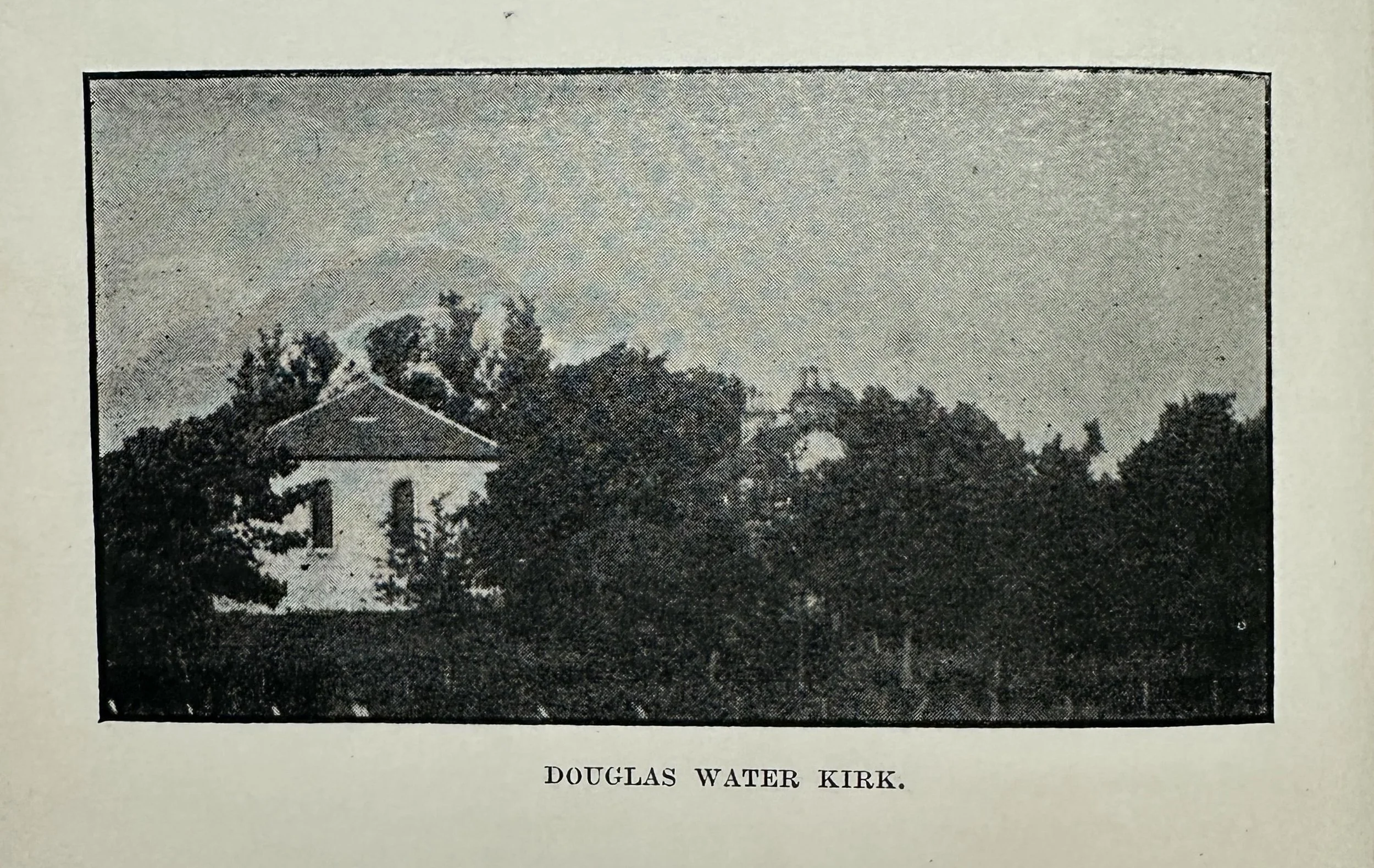
[Illustration: DOUGLAS WATER KIRK.]
DOUGLAS WATER KIRK stands about two hundred yards to the north of the banks of the river from which it derives its name, and not more than six hundred yards from the point where the parishes of Lesmahagow, Douglas, and Carmichael meet. To strangers, however, its position may be better understood by describing it as six miles from the ancient burgh of Lanark, and about the same distance from the town of Douglas and the village of Abbey Green, Lesmahagow. The reader is aware that Lanarkshire is sub-divided into Upper, Middle, and Lower Wards. The Upper Ward is said to contain more than one-half of the county, and consists in a great measure of hills and moorish ground, with here and there fertile valleys of surpassing beauty. Foremost among these, for historical interest and beauty of landscape, is that stretch of country extending from the base of Cairntable to the banks of the Clyde, called Douglasdale. The valley is about seventeen miles in length, and the river which flows through it is called Douglas Water. It receives in its course various rivulets—Glespin, Monks, Poniel, and other burns—and finally mingles itself with the waters of
12
the Clyde. On the banks of the river, about seven miles below its source, stands the old picturesque village of Douglas. About a mile below the village, and on the same side of the river, stands Douglas Castle, the seat of the Earl of Home, surrounded by extensive grounds, and plantations of great beauty. Towards the lower part of the valley, the ground is more cultivated, and consequently less wooded. Here the river is spanned by three bridges. The one furthest up the river, and near the main entrance to Douglas Castle, is called Happendon Bridge, while the one furthest down is called Douglas Mouth. Between these two, and about two miles from each, is Douglas Water Bridge, very similar in construction to its upper and lower neighbours. At the head of the road which passes over this bridge, stands Douglas Water Kirk. The edifice itself is not old, having been opened for public worship on the 4th February, 1844, but it is the second or rather the third place of worship which has stood in the same district in connection with the same communion. This church was the centre of a widely-scattered congregation of Cameronians or Reformed Presbyterians, who maintained that they could trace their descent to the dawn of the Reformation and the early days of the Gospel. But, latterly, their number was very much reduced, and, after a noble struggle to maintain ordinances, they made application and were received into the Established Church. With consent of the superior, the Earl of Home, the buildings were soon afterwards transferred to the Church of Scotland. In this new connection, their place of worship was re-opened on the 17th March, 1885. The following year, they selected a minister of their own, and after seven years’ experience as a mission church, they were erected into a church and parish quoad sacra [with respect to sacred things].
13
Close to the church, between it and the public road, and almost concealing it from view, is a neat little cottage—the Manse—erected somewhat over thirty years ago. The site on which the church and manse are built extends to about an imperial acre, held by feu from the Earl of Home at the nominal rate of one shilling per annum. The church itself, looked at externally, is a plain, humble structure, without tower, spire, or belfry. Strangers, however, on entering its walls, are surprised to find the interior so different from its outside appearance. This change was effected in the year 1887, after it came into the possession of the Church of Scotland, when the whole wood-work was renewed, stained, and varnished, from designs prepared and supervised by Mr James Kerr, then architect on the Douglas Estate. The joiner work was executed by Mr Wood, Stablestone, and reflects great credit upon him, both for its comfort and artistic appearance.
A new heating apparatus, on the low-pressure system, was at the same time added to the church, and the ventilation of the building made most complete. The windows were renewed with cathedral-tinted glass, and fitted with fresh-air inlets. Sitting accommodation, including both area and gallery, is provided for about three hundred worshippers.
During the time of the persecution, Douglas and Douglasdale escaped many of the hardships to which other parts of the south-west of Scotland were severely exposed. This circumstance seems to show very clearly the hand of Providence, for the wild hills around, with their woods and glens, moors and mosses, became a place of refuge for the homeless wanderers who had fled for their lives. It is supposed that during the “killing time,” as this period
14
has been called, the peace of this neighbourhood could be partly accounted for by the fact that the minister of the parish of Douglas had accepted the Indulgence. In those parishes where an Indulged minister officiated, the persecution was never so severely felt, and indeed could not be carried out to the same extent. It was different, however, where a curate occupied the pulpit. These hirelings of the Government acted the part of informers, while they occupied the pulpits of the ejected ministers. They knew every house in the parish, and kept a roll of all the parishioners. Frequently, before dismissing the congregation, the curate would call the names of the parishioners, and if any did not answer, they were transferred to his “black book,” which he handed to the troopers, who during the week searched out and abused or apprehended them at their will. But notwithstanding all this vigilance, the people in vast numbers flocked away to conventicles, gathering from every quarter to “hear the words of eternal life.” The churches were left empty, which very much irritated the curates, and sometimes led them to express themselves in unseemly language. It is told of the curate of Lesmahagow that, on entering the pulpit one Sabbath morning, and seeing the pews empty, he exclaimed—“Black be my fa’, but they’re a’ aff to the hill folk thegither; sorra gin I dinna tell, and they’ll be a’ shot or hangit by Yule!”
Another, and perhaps the chief cause, which kept the families in Douglasdale in comparative peace during those days of oppression, was the protection afforded them by the house of Douglas. No one has ever been able to say that the family of Douglas has at any time shown a persecuting spirit. Certainly the Marquis of Douglas took no part in the measures of the Council, although frequently urged to
15
do so, but allowed every man to worship God according to his conscience. Instead of molesting the Covenanters, he protected them to his utmost ability—obtaining pardon for some, and an alleviation of the punishment of others. The attitude of this nobleman must have had a powerful influence upon the neighbourhood, to restrain them from manifesting a persecuting disposition. Nothing caused more disaster among the peaceful families of the Covenanters than a persecuting nobleman, backed up by the smaller proprietors in the midst of whom he dwelt.
In these circumstances, it is not to be regarded as a matter of surprise, although we have no martyrs’ graves to which we can point, and few deeds of cruelty to relate, neither are we to conclude that there were few or no Covenanters to be found in this locality, simply because little or no mention is made of them, seeing that it was simply the condition of things that prevented them being brought into notice. It is a far better proof of their existence than martyr’s grave or thrilling story, to find a congregation whose history can be traced through many generations back to the time of these events.
The descriptive boundaries of the Quoad Sacra parish are as follows:—“Starting from the old bridge which spans the Poniel Water on the old Carlisle Road, along said road to the boundary between the property of the Earl of Home and Annfield, thence along the march between Annfield, Boghill, Auchtool, Auchmeddan, Montmains Brae, Greenshiels, and Birkhill, and the above-mentioned property, thence along the march between a portion of the farm of Birkhill and that of Leelaw, and the farms of Coranna, Corriemore, and Langside, on the road which passes the farmhouses of Langside, thence along the boundary of Kirkfieldbank parish to
16
Tillieford on the Clyde, thence up the River Clyde to Douglas Water, thence up Douglas Water to the march between Dyke and Ponfeigh Townfoot, thence along the march between Blinkie and Ponfeigh Townfoot and Townhead, thence along the march between Shiels and Ponfeigh Place to the point where Carmichael and Wiston parishes meet, thence along said boundary to the point at which it turns westwards, thence to the source of Craigburn, and along said burn to Douglas Water, thence down Douglas Water to the wooden bridge near High Tofts, and thence along the footpath and across the railway in a straight line to the old Poniel Bridge.”
The new parish, as thus constituted, is composed of portions of the parishes of Lesmahagow, Douglas, and Carmichael.