VII. Rev. John Milwain.
James Dodson
AFTER Mr Fairley’s death, the Rev. Thomas Rowatt had all the work of the congregation to attend to, both at Douglas Water and at Penpont. His place of residence was at Penpont; and as there was no dwelling-house for the minister at Douglas Water, nor any prospect of one being obtained, he had to continue to live there, and supply both places as best he could. An arrangement was entered into whereby he was to give Douglas Water a fourth part of his time—that is, he was to preach every fourth Sunday. It is impossible to say how long this order of things lasted, but ultimately Douglas Water was left without a minister.
In the absence of Church Records, we are not able to trace any congregational events for several years.
The Rev. John Milwain was born in the parish of Stoneykirk, Wigtownshire, 1793. By the influence of a sister, he was brought under the ministry of Mr Cowan of Stranraer, and in this way became connected with the Reformed Presbyterian Church. All through his life, he cherished the greatest respect for Mr Cowan, and spoke of him as an able, amiable, and pious minister of the gospel.
During his probation, he had three calls from different congregations. He accepted the call from Douglas Water. His ordination took place in the year 1822. He was a man of medium height, of a retiring disposition, and lived a life of quietness and peace. Much of his time was spent in reading, writing, and research, and there is reason to
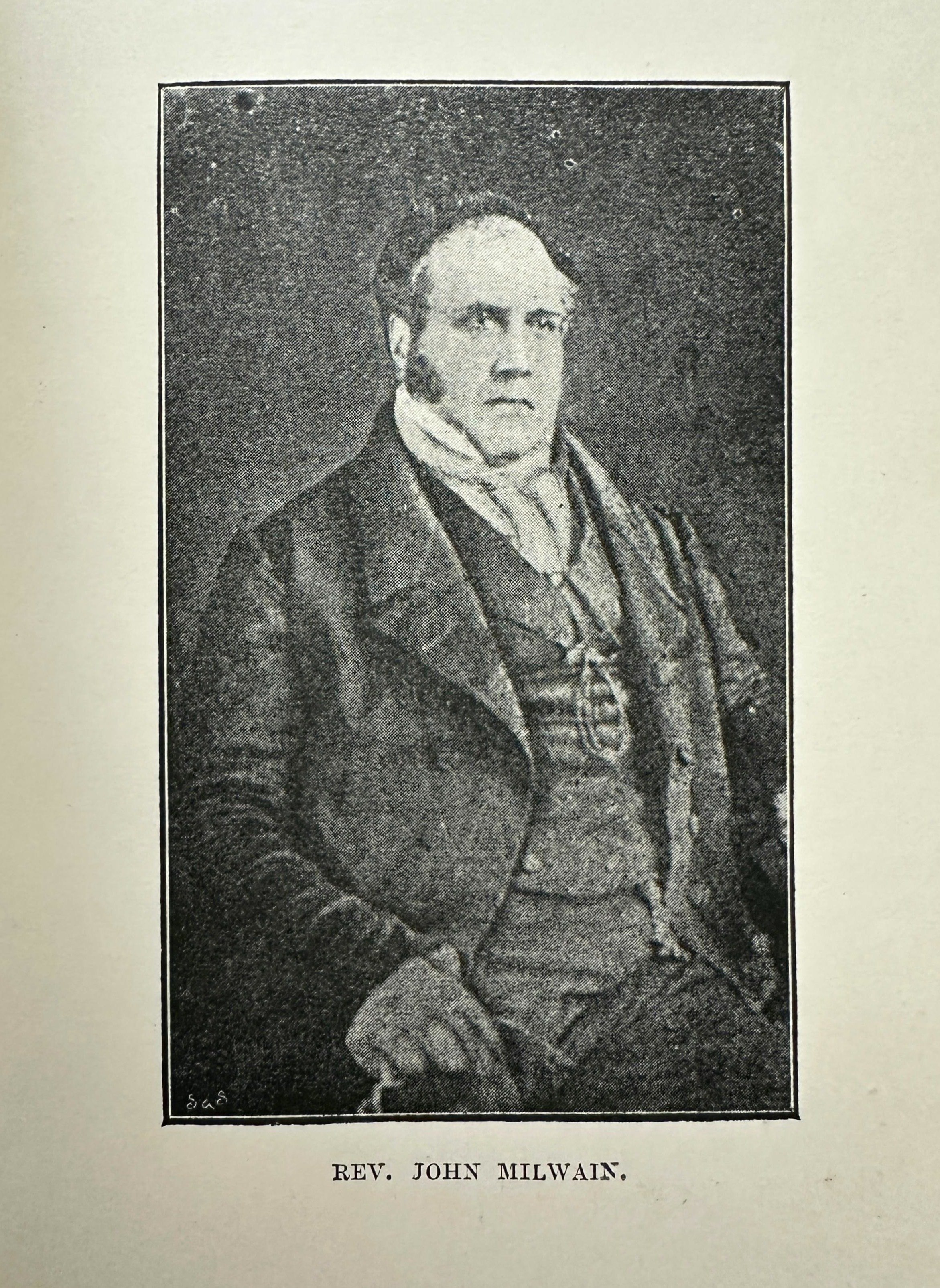
[Plate: REV. JOHN MILWAIN.]
65
believe that he sometimes applied himself too diligently to these for his strength, which never was very robust. He took an active part in the work of the Synod, the superior court of the denomination, and was appointed by it, in 1841, to give the ninth of a course of lectures on “The Principles of the Reformed Presbyterian Church.” This lecture was allowed to be the ablest of the whole course.
In the end of August of this year, Mr Milwain preached a sermon at Priesthill, where John Brown, the godly carrier, lies buried. There was a very large multitude of people present. A collection was made at the close for the purpose of erecting a stone and putting the grave in proper order. The collection came to a little over eleven pounds. With this sum, a wall and iron railing was put round the grave, and a small stone monument erected. The superscription on the stone tells that the Rev. John Milwain of Douglas Water preached the sermon, and that with the collection the stone was erected, and so on. We cannot think that Mr Milwain was conscious of it himself, but as a friend said, when standing at the grave—“Good for Milwain, but rather hard on the martyrs!”
During the whole history of the Douglas Water congregation, it appears that there was never any feu-charter or title deeds for the place of worship occupied by them. They were simply tenants-at-will, but there is nothing to show that they ever paid, or were asked to pay, any rent. In the end of the year after his ordination, Mr Milwain drew the attention of Lord Douglas’s agent to this matter, and in reply received the following letter:—
Douglas, 21st October, 1822.
Revd. Sir,—I now do myself the pleasure of acquainting you that, in a conversation I had a few days ago with Lord Douglas on
66
the subject of your place of worship, his Lordship was pleased to say that, although he had no power and would not be inclined to give a legal title to it, as I indeed supposed, yet that he has no intention, during his lifetime, of preventing you and your congregation from using it for religious purposes.—I have the honour to be, Rev. Sir, your very obt., hum. servant,
John Dick.
The Rev. John Milwain, Newtonhead.
The estate being then entailed by what is called a strict entail, there was no power either to feu or sell.
About the year 1843, owing to mining operations underneath, the ground on which the church stood subsided, and the building became uninhabitable. The minister and his people were very much distressed over this. They did not know whether they could get another site, nor where the money would come from to erect a new building. It was even whispered that it would be better to let the congregation dissolve. After a time, however, they gathered spirit, and sent a petition to Lord Douglas asking for a new site, and in a few days received the following hearty, liberal reply:—
Castlemains, 13th June, 1843.
The Rev. John Milwain.
Dear and Reverend Sir,—I had the honour to lay your petition asking a new site for a place of worship for your congregation before Lord Douglas; and his Lordship, impressed with a sense of the high respectability of yourself, and the quiet and exemplary conduct of your congregation, at once granted your request.
Lord Douglas further directed me to give £10 and £5 worth of wood towards the erection of the church, under the following conditions, which the present agitation renders, in my opinion, necessary:—
That the place of worship to be erected shall be confined solely to the use of the Cameronians or Reformed Presbyterian Church, and that it shall on no account be given for the use of those reverend
67
agitators who, from conscientious motives, are determined to use every means in their power to pull down an Establishment they had sworn to uphold.
And further, should Lord Douglas or his successors at any time wish to remove this church from the situation now to be fixed on, that they shall have it in their power to do so by giving one year’s notice of their intention, and paying £200, or, in the option of the congregation, such value as shall be ascertained by arbiters mutually chosen.
Permit me to add that it will afford me much pleasure to be allowed personally to contribute towards the object you have in view,—And I am, dear and rev. Sir, yours very faithfully,
Thos. R. Scott.
P.S.—If in the meantime you require accommodation, the School-house at Rigside is at your service, and Mr Johnstone will deliver the key to you on producing this.
T. R. S.
The place fixed on for the new church was the site where church and manse now stand. Mr Scott, factor for Lord Douglas, sent for Robert Gold, a leading member of the congregation, to meet him at the place, and to bring a spade with him, as they were going to stake off the ground. Robert was going to be satisfied with a very small space, when Mr Scott smiled and said—“Take in another rig, and give yourselves plenty of room.” The material of the old church was used in building the new one. The farmers in the neighbourhood, who have always been very obliging, did all the carting free of expense.
The new church was opened for public worship on Sunday, 4th February, 1844. The services were conducted by Mr Milwain, the pastor of the congregation, and the Rev. Professor Symington, D.D. That morning the ground was deeply covered with snow, but notwithstanding, the building was crowded to its utmost capacity with a respectable and attentive audience. Dr Symington preached from the text—“The temple of God was opened
68
in heaven, and there was seen in His temple the ark of His testament,” (Rev. xi. 19). Applying his words with great aptness to the solemn occasion, a deep impression was produced, and the event became an outstanding landmark in the annals of the congregation.
Mr Milwain was married to a daughter of the Rev. John Thorburn, minister at Pentland. She was of a delicate constitution, but lived to a good old age. She had a lady-like, refined appearance—probably refined through suffering.
Mr Milwain, like his predecessor, Mr Fairley, rented and cultivated a small farm about a mile from the church, on the northern side of Douglas Water. The place was called Redshead, now part of the farm of Hillhouse. There was a good dwelling-house and outhouses, and a splendid enclosed garden full of fruit trees. It is now greatly altered, but from accounts given of it by old residenters, there can be no doubt it was at one time one of the most lovely spots to be found in all Douglasdale.
During Mr Milwain’s ministry, the stipend was much the same as in the time of his predecessor. One year he got £26 and no dwelling-house, and the last year of his ministry he was paid with £24 12s 9d. That year, 1858, the communicants were returned at 55.
Robert Gold, who had officiated as precentor for forty years, giving his services gratuitously, was in the spring of this year presented with a handsome overcoat, a Psalm-book, and a purse containing surplus subscriptions.
Mr Milwain resigned his charge, owing to failing health, in 1859. During the few months of his retirement, he lived at Wheatbank, in Lanark. He spent this time in reading, writing, and Christian converse with friends. He was confined to his room for about four weeks, and
69
thought himself dying, but seemed to have no fear. He took great delight in praising God during his last illness. Three days before his death, he asked his wife to join him in singing the 23rd Psalm. In this he joined with all his strength, and his voice was clear and distinct, which was very wonderful, considering the nature of his ailment—one of his lungs being all but gone. After this he often asked them to sing, but he was seldom able to join, through weakness, and his strength soon became exhausted. He fell asleep in peace on the 2nd August, 1860, at the age of sixty-eight years.
His remains lie in Lanark Churchyard, close to the wall, and just a few steps from the entrance gate. An upright stone marks the spot, with the following inscription:—
Sacred,
To the Memory of the
Reverend John Milwain,
Minister of the Reformed Presbyterian Church at
Douglas Water, Lesmahagow,
Who Died at Wheatbank, Lanark, on 2nd August, 1860,
Aged 68 Years;
And of Ann Thorburn, his Widow,
Who Died at Wheatbank, on 15th April, 1861,
Aged 80 Years.
Grace Thorburn or Learmouth,
Of Wheatbank, their Niece,
Died 30th October, 1863,
Aged 64 Years.