III. The Cameronian Regiment.
James Dodson
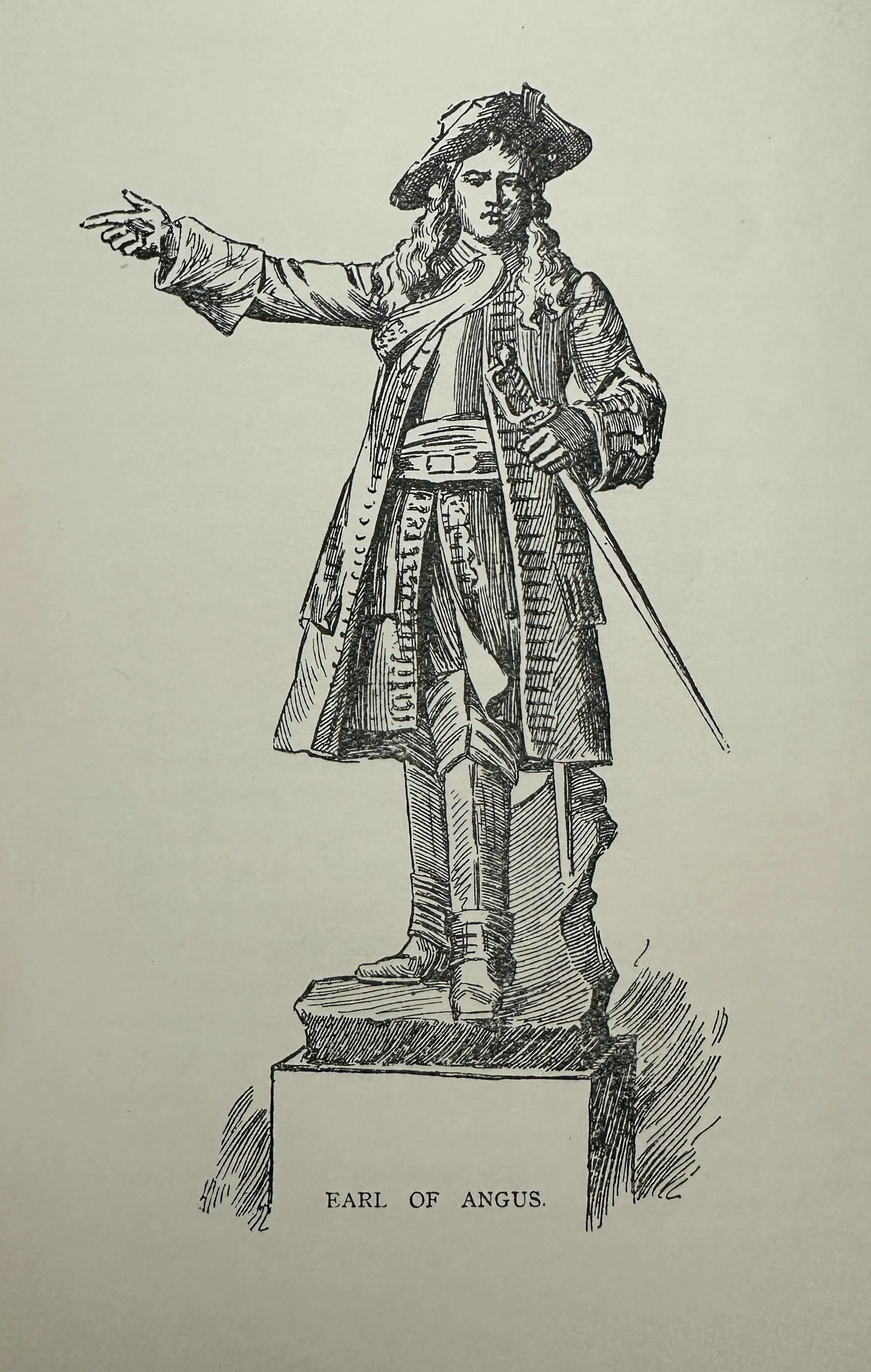
[Illustration: EARL OF ANGUS.]
23
ON the 30th of April, 1689, the Cameronians met in the Parish Church of Douglas. It was one of the General Meetings of the Societies, and was very largely attended. The special subject of consideration was whether it would be right for them to take up arms, and form themselves into a regiment, since there was great danger of an invasion from Ireland, and of intestine wars in the land. It was acknowledged that the country was likely to be in danger, and that it was very expedient for them to take some action in its defence. Some, however, thought that to form themselves into a regiment under pay would be nothing less than a sinful association, seeing their officers would have to sit in council with men who differed from them, and, at the same time, “fight under a general—viz., Mackay—whom they knew not, what he was for, or against.” The debate was long and animated. When a vote was taken, it was found that a majority had voted against the proposition; but before the votes were fully counted, the meeting was in a state of great confusion. At this juncture, a paper addressed to the Earl of Angus, Lieutenant-Colonel of the proposed regiment, was handed in and read. In it they asked to be allowed to choose their own officers, to choose their own ministers, to serve only within the three kingdoms, and to have their persecutors brought to justice. By the reading of this paper, order was restored, and some said, “that if
24
these proposals were granted, they could not say much against the raising of a regiment.” When this paper was submitted to the Lieutenant-Colonel, he told them that some of these proposals could only be granted by the King and Meeting of Estates. This they regarded as an unsatisfactory answer. Another paper was drawn up and sent to General Mackay, but it never reached him, for by the time the messenger arrived in Edinburgh, he had left for the North to meet Claverhouse at the Pass of Killiecrankie. These stipulations went on for some time further, until Sir Patrick Hume of Polwarth, who happened to be staying at Douglas Castle, proposed that the men should make a brief statement of the objects for which they took up arms. He expressed it in the following terms:—
“To declare that you engage in this service of purpose to resist Popery and Prelacy and arbitrary power; and to recover and establish the work of Reformation in Scotland, in opposition to Popery, Prelacy, and arbitrary power in all the branches and steps thereof, till the government in Church and State be brought to that lustre and integrity which it had in the best times.”
As Burton says—“It was rather cunningly devised, since it might infer that they were to carry out the principles of the Covenant in all parts of the United Kingdom, and establish the reign of righteousness; while another interpreter could restrict it to mere hostility within Scotland to the dethroned Government and Church.”
Those who objected to the raising of a regiment were now more bitterly opposed than ever, although their number was considerably reduced. The whole Societies were divided into three parties, namely, those who were opposed to the raising of a regiment, those who were in favour, and those who had not light enough to take either
25
side. Notwithstanding these divisions, the Earl of Angus, eldest son of the second Marquis of Douglas, raised a regiment twelve hundred strong, from among the Cameronians without beat of drum, or expense of levy. The first muster took place on the Braidly Holms, on the banks of Douglas Water. It is supposed that his youth (being only nineteen years of age) prevented the Earl of Angus from taking command of the regiment at once, which devolved upon Colonel Clelland. This brave young officer was the son of the factor on the Douglas Estate, and a most intimate friend of the young Earl. He was educated at St. Andrews University. He was a man of humanity and moderation, an accomplished scholar, a gentleman of refined manners, and a brave soldier. Although he was still under thirty, he had seen some active service, and had proved himself worthy of trust and command. He was present at the Battle of Drumclog, and took command of the infantry, while they attacked the dragoons of Claverhouse, and put them to flight. He was a captain in the army of the Covenanters at the Battle of Bothwell Bridge, but escaped to the Continent immediately after that disastrous defeat.
Contrary to the opinion of General Mackay, Commander of the Forces in Scotland, the Cameronians were sent first to garrison Dunkeld. This “little city” is situated about fifteen miles north of Perth, on the banks of the Tay. It lies in a hollow of the hills, by which it is surrounded. There was at that time a ford a little below the town, by which the river at certain seasons could be crossed; but by the very nature of the place, all possibility of a retreat was easily cut off. They reached Dunkeld on Saturday, 17th August, and on the following day began to prepare their defence. The other forces seemed to avoid the
26
Cameronians, and leave them to their fate. In fact, it was generally said that they were betrayed. At Coupar Angus, about fourteen miles from Dunkeld, there was a large force stationed, but although their leader was informed of the danger in which the Cameronians stood, he took no action, on the ground that he had no orders. On Monday morning, a body of dragoons arrived at Dunkeld to aid the garrison in their defence, but after being twice commanded, they reluctantly obeyed orders, and on Tuesday night marched on to Perth. When the Highlanders began to gather, there were only a few wild figures to be seen on the hills above. They were the men from Athole, out watching the Cameronians at work. As they increased in number, they sent a message down from the hills in the following words—“We, the shentlemen assembled, peing informed that ye intend to purn the town, desire to know whether ye come for peace or war, and to certify you, that if ye purn any house, we will destroy you.” The Cameronians, in reply, said—“We are faithful subjects of King William and Queen Mary, and enemies to their enemies, and if you who send these threats shall make any hostile appearance, we will burn all that belongs to you, and otherwise destroy you as ye deserve.”
Colonel Clelland thus describes the Highland army:—
Some might have judged they were the creatures
Called selphies, whose customs and features,
Paracelsus doth decry,
In his occult philosophy,
Or fauns, or brownies, if ye will,
Or Satyrs, come from Atlas Hill.
But those who were their chief commanders,
As such, who wear the pirnie standards
27
Who led the van, and drove the rear,
Were richt weel mounted in their gear;
With brogues, trews, and pirnie plaids,
With guid blue bonnets on their heads,
Which on the one side had a flype,
Adorned with a tobacco pipe;
With dirk, and snapwork, and snuff mill;
A bag, which they with onions fill;
And their strict observers say,
A tup horn filled with usquebae;
A slashed-out coat, beneath her plaids;
A targe of timber, nails, and hides;
With a long two-handed sword.
In nothing they’re accounted sharp,
Except in bagpipes and in harp.
. . . . . . .
More different postures
Than sewed on hangings, beds, or bolsters;
More varied actings, modes, and stances,
Than’s read in poems or romances.
Pipes were playing, drums were beating,
Some sneeshin’ from their fellows getting;
Trumpets sounding, skenes were glancing,
Some were “Tonald Cowper” dancing.
By daybreak on Wednesday morning the hills above the town were crowned with the whole host of the Highland army, consisting of more than five thousand men. The Highlanders began to make preparations for an attack. They posted their cavalry to keep the fords. Col. Clelland withdrew his outposts, and with great skill confined his defence to the Cathedral, to Dunkeld House, and to the wall surrounding the Park. The Highlanders came rushing down the hills, following their usual mode of warfare, namely, a short run, a discharge of firearms, which they immediately let fall to the ground, and then, with drawn swords and wild war-cries, attacked the men lining the walls. They expected to get over the walls at
28
their first onset, and begin the slaughter at once, but they were met with pikes and halberts, and beaten back again and again. The Church and the Mansion house made two strong fortresses. Meantime, however, they had got possession of the houses in the streets, and from the windows of these, a continual fire was kept up against both the Church and Mansion-house.
The Cameronians now made a bold attack upon their enemies. With burning torches fixed upon long poles, they rushed out and set fire to the thatch of the houses in which the Highlanders had taken refuge. It is said that, on seeing the keys of the door on the outside, they turned them in the lock, and so shut up those within to a certain and horrible death. In one house, as many as sixteen are said to have perished. The Dean’s house (one of the three that escaped the fire) still stands, is inhabited, and in a good state of repair. It is recorded that the smoke of the burning town kept clear of both the Cathedral and the Mansion-house. Col. Clelland, having exposed himself to give some orders, fell by a shot from the enemy while he was returning to the garrison. The battle continued until about eleven o’clock at night. The Highlanders, failing of the success they expected, did not wait for the command to retreat, but scampered off to the hills, and made tracks for home, taking what they could pick up on the way. When the Cameronians saw them retreating, they gave a great shout, and threw up their caps in the air, and then all joined in praising God for such a wonderful victory. This decided the campaign, and may be said to have secured the success of the Revolution in Scotland.
This regiment still exists in the British army, and is known as the 26th Cameronian Regiment. Seven years
29
ago, they celebrated the second centenary of their formation. They were then stationed in Ireland. It was resolved at that time by the officers, past and present, to have some fitting and permanent memorial of the event. A committee was formed to collect subscriptions, with the result that a magnificent memorial in the form of a statue of the Earl of Angus is erected at Douglas, upon a site near the bank of the river, and on the very spot where, upwards of two hundred years ago, the regiment was first mustered. This statue was unveiled by the Right Honourable the Earl of Home, in presence of the officers and friends of the regiment, on the 8th September, 1892. The inscription on the front is—“James, Earl of Angus, son of the Marquis of Douglas; born 1671, killed at the Battle of Steinkirk when in command of the Cameronian Regiment, 1692.” On the right side—“The Twenty-Sixth or Cameronian Regiment, raised by the Earl of Angus, was first mustered near this spot, May 14, 1689.” On the left side—“This statue, to commemorate the two hundredth anniversary of the raising of the Twenty-Sixth or Cameronian Regiment, which became in 1881 the First Battalion the Cameronians (Scottish Rifles), was erected 1892.—Thomas Brock, R.A., sculptor.”
Extract of a Letter from the Societies to Lord Angus’s Regiment, dated Douglas, March 27th, 1690.
“We earnestly request ye would keep up your Christian Societies. Be much in private prayer. Cry mightily that the Lord will bless you and us with the knowledge of the times and our own duty. If ye grow slack and remiss in secret prayer and public witnessing, ye have ground to fear that next your hands wax feeble in the day of battle. Consider under what character ye go, as a people more strict, zealous, and religious than others. Small faults in you are
30
more heinous and will do more hurt than in others; and wherever ye come, let your light shine before men, and have no fellowship with the unfruitful works of darkness, but rather reprove them both in yourselves and others. Forbear these things to which soldiers are much addicted. Pray that ye be not led into temptation, but delivered from evil. Abstain from sinful and scandalous games as cards, dice, &c., the first of which we hear some of you are guilty of, which is not a little wounding to us. Refrain from duels and fighting and quarrelling, either among yourselves or with others, and from drunkenness, which often occasions these unmanly and un-Christian actions. Forbear, and forgive one another. Be not of a revengeful but of a gospel spirit.”
. . . . . . .
“You may remember, at the raising of the regiment, it was thought convenient that there should be elders and a session in it, to exhort and reprove for faults; and that fast-days should be appointed and observed among you: the omission of these things is unpleasant.”*
_____
(*) Faithful Contendings.
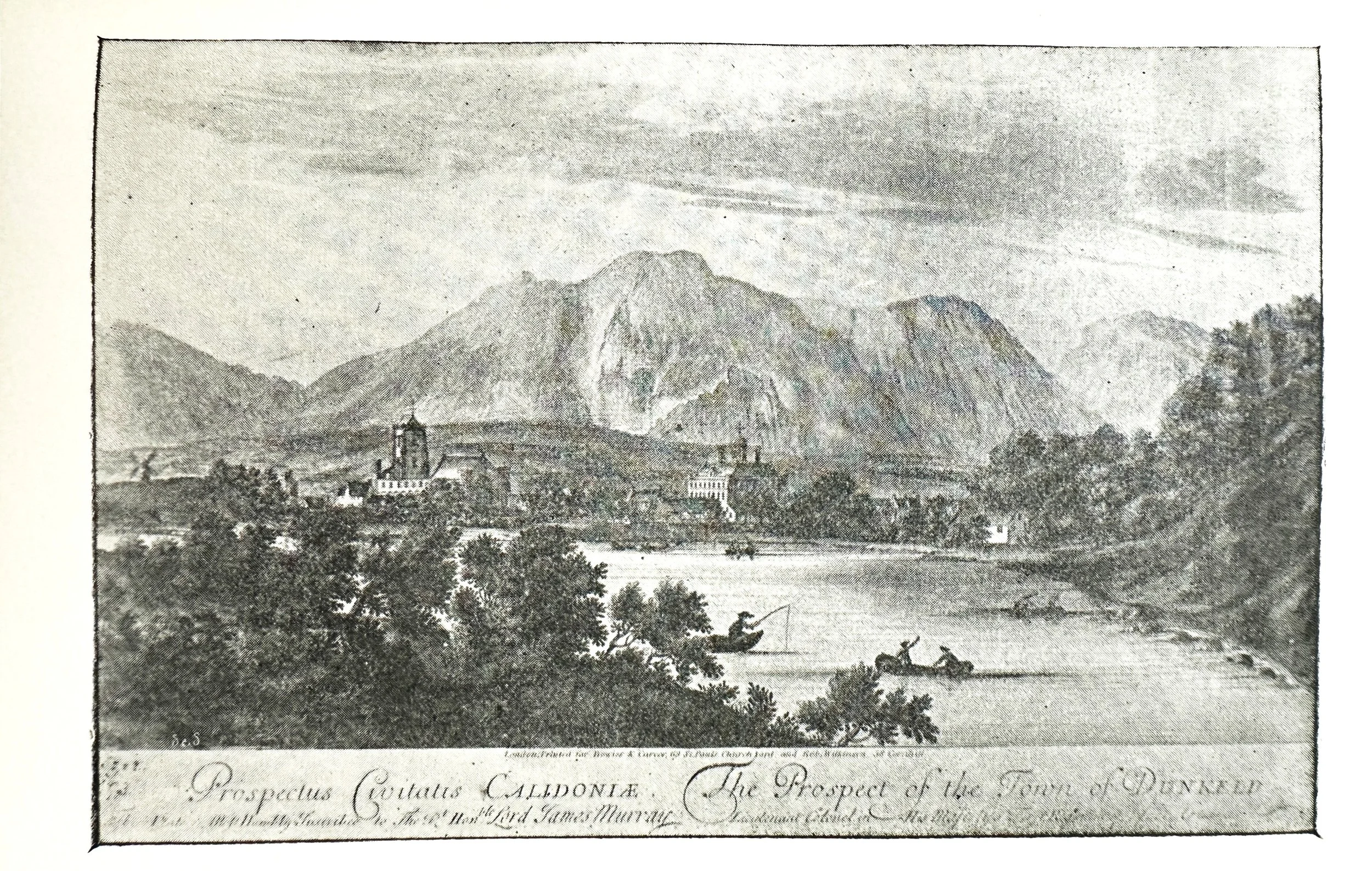
[Illustration: The Prospect of the Town of Dunkeld.]