IV. Call to the Rev. John M‘Millan of Balmaghie.
James Dodson
TO return to the Cameronians left in Douglasdale. Their meetings at this time were very numerous, but far from being harmonious. There were at least ten meetings held in Douglas, besides several elsewhere, during the years 1689-1690, and some of these lasted for two or three days. It was proposed to raise a second regiment, but this came to nothing. It is, however, worth mentioning, as showing the strength of the party, and the martial spirit with which they were inspired from the times of the persecution through which they had passed.
It was about this time also that a strong feeling existed among the Societies, especially on the part of their ministers, for union with the Established Church. At a General Meeting held in Douglas on the 4th of June, 1690, it was resolved that a paper should be drawn up, and presented to the General Assembly expressing their grievances, the reasons for their standing apart, and their desire for union on good terms. Mr Shields, who was chaplain to the Cameronian Regiment, was asked to put it into proper form, which he ultimately did. While it was being brought before the Societies for its final consideration, Messrs Shields, Linning, and Boyd prepared a paper for themselves to submit to the Church of Scotland, framed on the same lines as the one the Societies were considering. Their paper was read in the Committee on Overtures, but
32
the Assembly refused to allow it to be read in open court. The ministers were satisfied with this, and were at the same time received into the Established Church. Mr Linning afterwards became the first minister of the first charge of Lesmahagow, after the Revolution. Mr Boyd became minister of the parish of Dalry in Kirkcudbrightshire. Mr Shields was settled minister at St. Andrew’s, where he continued till 1699, when he went to America, and died of fever the following year.
During the sitting of the same Assembly, Thomas Latimer, James Muir, William Swanson, William Woodburn, and Robert Cowan were sent with a letter of commission, to lay before the Assembly the Societies’ petition for union. The Committee on Overtures, through which it had to pass, considered it to differ very little from the one given in by the ministers, and so refused to submit it to the house. The societies were dissatisfied with this treatment, and continued as a body to remain apart.
From this date they were without a stated ministry for a period of sixteen years, and during that time had no organisation as a church, but continued to meet as societies for Bible reading, Scripture conference, and prayer. To them we are indebted for the “Testimony of the Martyrs,” as contained in the “Cloud of Witnesses,” the first edition of which was published in 1714. The General Meetings were not now so numerous, but they do not seem ever to have been given up. In these years a large number left them for the want of ordinances, and joined the National Church. For a long time they resented keenly the step taken by their ministers, especially Linning and Boyd, whom they had educated at their own expense. They blamed Linning, probably with justice, for spoiling their influence with the Church of Holland.
33
Passing over many things which happened during these sixteen years, we come now to consider the prominent part taken, in connection with the Societies, by one who has excelled in Cameronian history even the far-famed Mr Alexander Shields, namely, the Rev. John M‘Millan of Balmaghie.
Mr M‘Millan was born in the parish of Minnigaff. Very little is known of his early days, or parentage. Before he became a student at the University of Edinburgh, he had grown up to manhood. He took his degree of Master of Arts in June, 1697. He was thirty-one years of age when he was licensed by the Presbytery of Kirkcudbright. He was called to the parish of Balmaghie in the month of May, 1701, and on the 18th September he was ordained to that charge. In October of the following year the Synod of Galloway passed an act, in which they professed their adherence to the true principles of the true covenanted reformation, and appointed all ministers within the bounds to explain the National Covenant to their people. To this injunction Mr M‘Millan took exception, as he thought he saw a design in the resolution to push aside the later national deed, the Solemn League and Covenant. He at once proceeded to explain both covenants to his people, by preaching on the obligation and duty of covenanting, as well as the sin of breaking the covenants. With the concurrence of his kirk-session, a day of humiliation and fasting was appointed, when the covenants were solemnly sworn to “in way of adherence,” and that they adhered to the State as far as the State adhered to the covenants. This gave rise to nothing beyond the limits of the parish. But in July, 1703, he sent in a petition to the Presbytery of Kirkcudbright, signed by himself and two of his co-Presbyters—Mr Tod of Buittle and Mr Reid of Carsphairn—
34
asking the removal of certain grievances. These consisted of approbation of the covenanted work of reformation, and regret at the national departure from them, craving the Presbytery to devise some means of redress. Instead of dealing with the petition, the Presbytery dealt with the petitioners. They were asked to be satisfied with recording their petition in the minutes of the Presbytery. This seems to have satisfied the others, but Mr M‘Millan would not accept it as sufficient. He refused to be silent, but continued to give utterance to his convictions in the most public manner.
The Presbytery then tried to make short work with him. They appointed a meeting to be held at Balmaghie, under pretence of a visitation, Mr M‘Millan to preach the opening sermon. Without letting him know, they drew up a libel against him, and sent the Presbytery officer to summon him to the bar, and to read the libel at the church door. But hearing of it, he got hold of the libel, and read it himself before the congregation, “obtesting every one of them to produce whatever they had to lay to his charge, either doctrinally or practically.” After the sermon was finished, they went on to prove the libel, but not one of the charges could be established. The Presbytery then offered to give up their libel if he would cease to press his petition on them, but in this matter he would not yield. It is said that, “considering that his grievances were weighty, and matters of conscience to him, and no appearance of any redress to be obtained, but matters still growing worse and worse, he therefore protested and declined the Presbytery, and appealed to the first free and faithful General Assembly of the Church of Scotland.” The Presbytery immediately after this appeal broke up, and it is said one half of the members went home. The
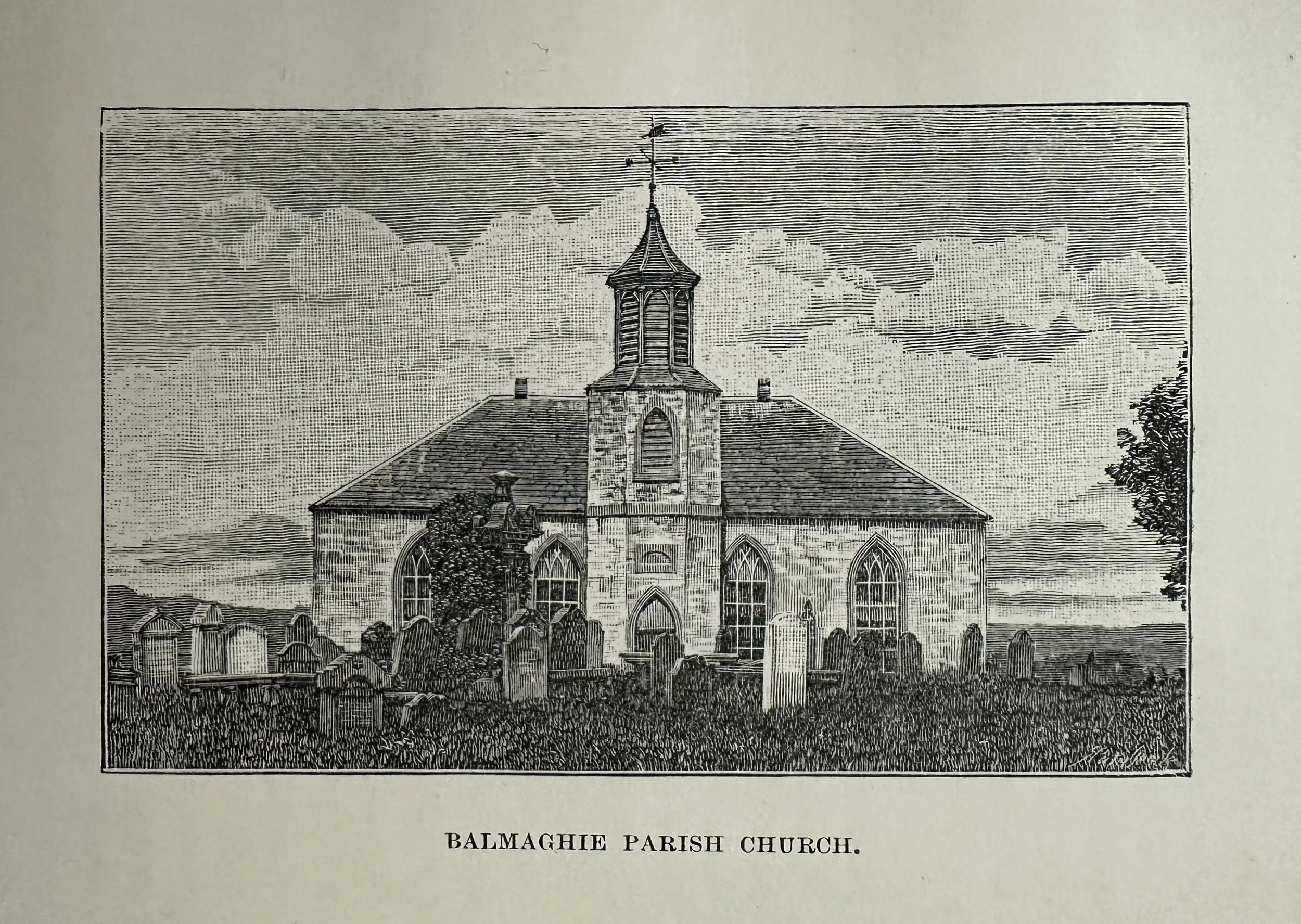
[Illustration: BALMAGHIE PARISH CHURCH.]
35
others, with two corresponding members from the Presbytery of Wigton, went to some neighbouring church, and constituted themselves anew. Here, without acquainting either Mr M‘Millan or his congregation with their purpose, they passed their sentence of deposition upon him. They grounded their finding, not on his life and doctrine, but on what they called “irregularities and disorderly courses.”
Mr M‘Millan regarded the Presbytery’s decision as illegal, and accordingly continued his work among his parishioners, all of whom adhered to him except two. As the meeting which had deposed him was a small one, owing to the season of the year—it being mid-winter—he, with some of his people, went to the next meeting of Presbytery, and asked them if their sentence was unanimous, and if they continued to approve it or would reverse it. To this they gave him no answer, but the Moderator summoned him “to appear before the General Assembly in March, 1704, and answer for his conduct; adding that he knew that his appeal upon which he stood was to none of their assemblies, and that he had perverted the people of Balmaghie into schism.” Mr M‘Millan did not obey the summons of the Presbytery. He was, however, regularly cited to appear before the Commission in June. This he obeyed. Before the Commission he acknowledged that he was wrong in not submitting to the sentence of the inferior court, until he had sought redress from the higher courts of the church. His son says this admission was drawn from him on the promise that “he should have justice done to him, and be reponed back to his congregation.”
Between the meetings of Commission Mr M‘Millan remained in Edinburgh. The next Commission did not reverse the sentence, and after waiting several months in
36
expectation of something being done, he returned home. He appealed to the Presbytery, to the Commission, and Assembly, but nothing more was done on his behalf. He continued to hold the church and manse, and also the glebe for many years, indeed, until he voluntarily left the parish.
In the month of August, 1706, the Societies sent a deputation to him to obtain his views, and further to consult with him as to taking them under his ministerial supervision. At this meeting they came to an understanding with one another. About the end of October that same year, they harmoniously agreed in the matter of testimony, and then signed a call to him, which he accepted. On the second day of December, 1706, he made his first public appearance in connection with the Societies, at Crawfordjohn, before a large audience. His preaching gave satisfaction to all. Mr M‘Neil, a licentiate of the Church of Scotland, soon after became associated with Mr M‘Millan in his work among the Societies. Mr M‘Neil was never ordained, because there was no Presbytery to do so.
In the records of the Presbytery of Lanark, there is a reference to Mr M‘Millan and John M‘Neely holding meetings, and preaching within the bounds; but, although frequently referred to afterwards, no action seems to have been taken in connection with the matter.
At Auchensaugh, a lonely moorish place on the hills, about three miles above Douglas, the communion was dispensed and the covenants renewed on the 27th of July, 1712. It must have been a source of comfort and joy to many to have once more ordinances dispensed among them. One writes from the parish of Dalry in Kirkcudbrightshire, in a personal covenant transaction:—“Who would have thought, O Lord! that the next Sabbath thou
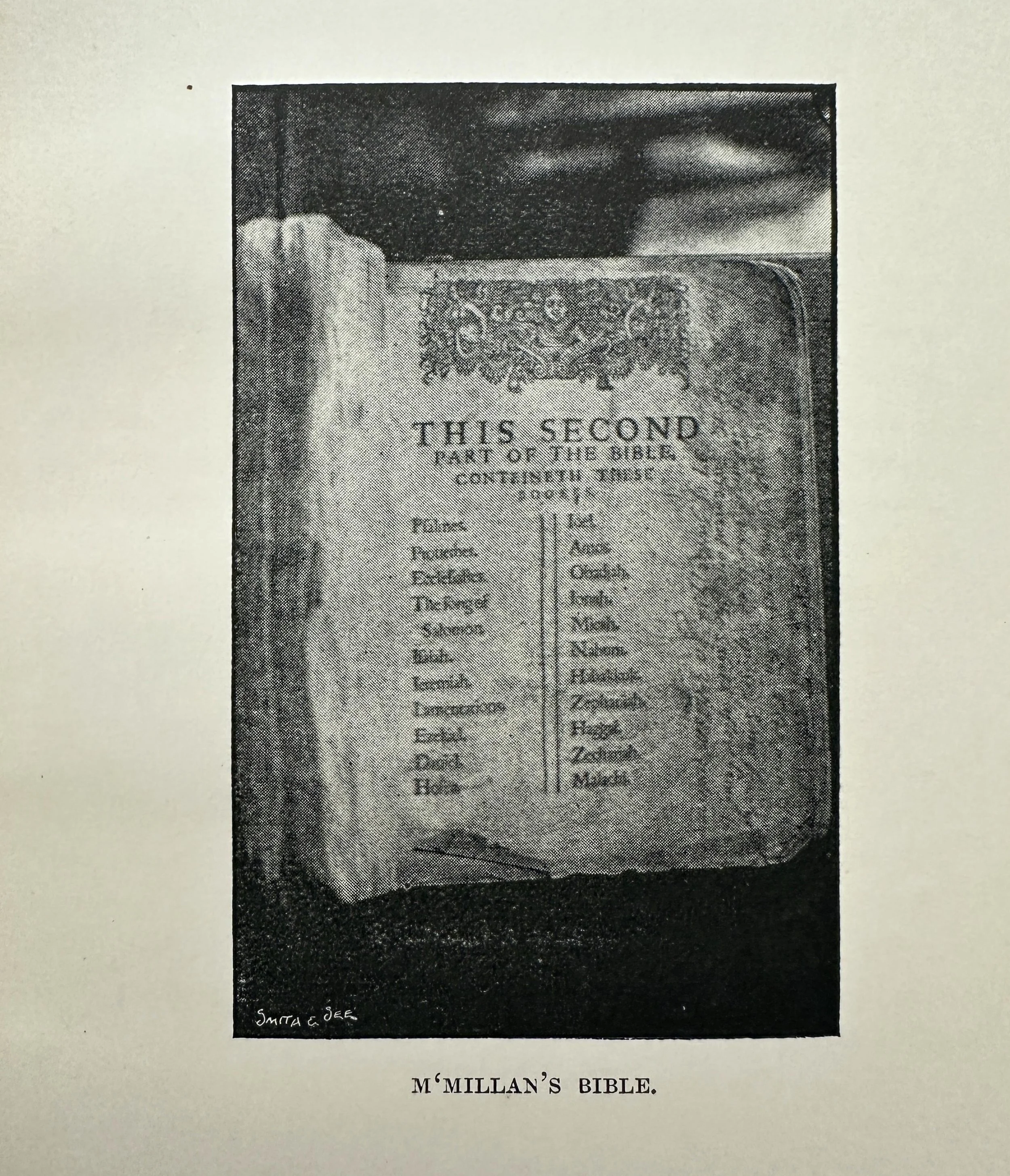
[Illustration: M‘MILLAN’S BIBLE.]
37
would’st be offering us the participation of that holy ordinance of Thy supper; an ordinance, Lord, that the generality of this generation said we would never get. And many of ourselves, a while before, could scarcely believe it; that we should have this privilege, with the renovation of our covenants and solemn acknowledgment of sins, and engagement to duties in a solemn manner.” There is an old Bible in this district, belonging to Mr M‘Kinlay, Hillhouse, which is said to have been M‘Millan’s Bible. On the top of a leaf is written, as far as can be made out, the following words:—
. . . . . . .
(The first line can’t be read.)
“Exchanged by Mr John M‘Millan, sometime minister of the parish of Balmaghie, who, being deposed some years before, gave the Sacrament on the Sabbath after leaving there, 27th June, 1712.
Jo. Macmillan.”
We are not able to say whether this is in Mr M‘Millan’s handwriting or not, but on the margin of every page there are copious notes, which show the book to have been very much used.
Mr Nairn, an ordained minister of the Secession Church, left that body and joined himself to the Society people.
Communion seasons were often times of great blessing among these people. At such times there were many solemn and impressive scenes. It was no uncommon thing for the hearers to come many of them from thirty to fifty miles. The night before, men, wearied and travel-stained, began to arrive at the appointed place of meeting. After mutual enquiries, they would form themselves into small companies, and spend the whole night together in social prayer. On the following day the table of communion was placed on the green sward in the hollow of some glen
38
surrounded by rocks, whose rugged faces looked down upon the worshippers with majestic awe. The elements of communion were placed at the head of the table, where the minister took his stand with Bible in hand, and the people, closely packed, gathered around him, often to the number of several thousands. The service began by the singing of a Psalm, and as the strains arose to the blue welkin of heaven, the tears fell from many a weather-beaten countenance.
The first communion after the accession of Mr Nairn was held at the Craigs, on the farm of Westtown, between the parishes of Lesmahagow and Douglas. There was a very large gathering of people present on that day. It was noticed that the people were slow in coming forward to the first table; but when Mr Nairn had given an address upon the words, “Wilt thou go with this man? and she said I will go,” the table was full. Table after table was served, until all had communicated who wished to do so. Daylight was beginning to appear the following morning before all was concluded. It was a time long remembered by the inhabitants of Douglasdale.
Soon after this communion, a large number had assembled to hear Mr M‘Millan preach. Their place of meeting was within sight of Douglas Castle. The Duke of Douglas was there at the time, and seeing the gathering inquired who they were, and what they were doing. On being informed that it was M‘Millan of Balmaghie dispensing the sacrament to a lot of rebels, he replied, “That M‘Millan of Balmaghie! he is no more a rebel than you or I.” So he ordered refreshments to be taken out to him, and a message that his Grace would be glad to see him to-morrow, when his work was concluded. Mr M‘Millan was from that time a frequent visitor at the Castle. The
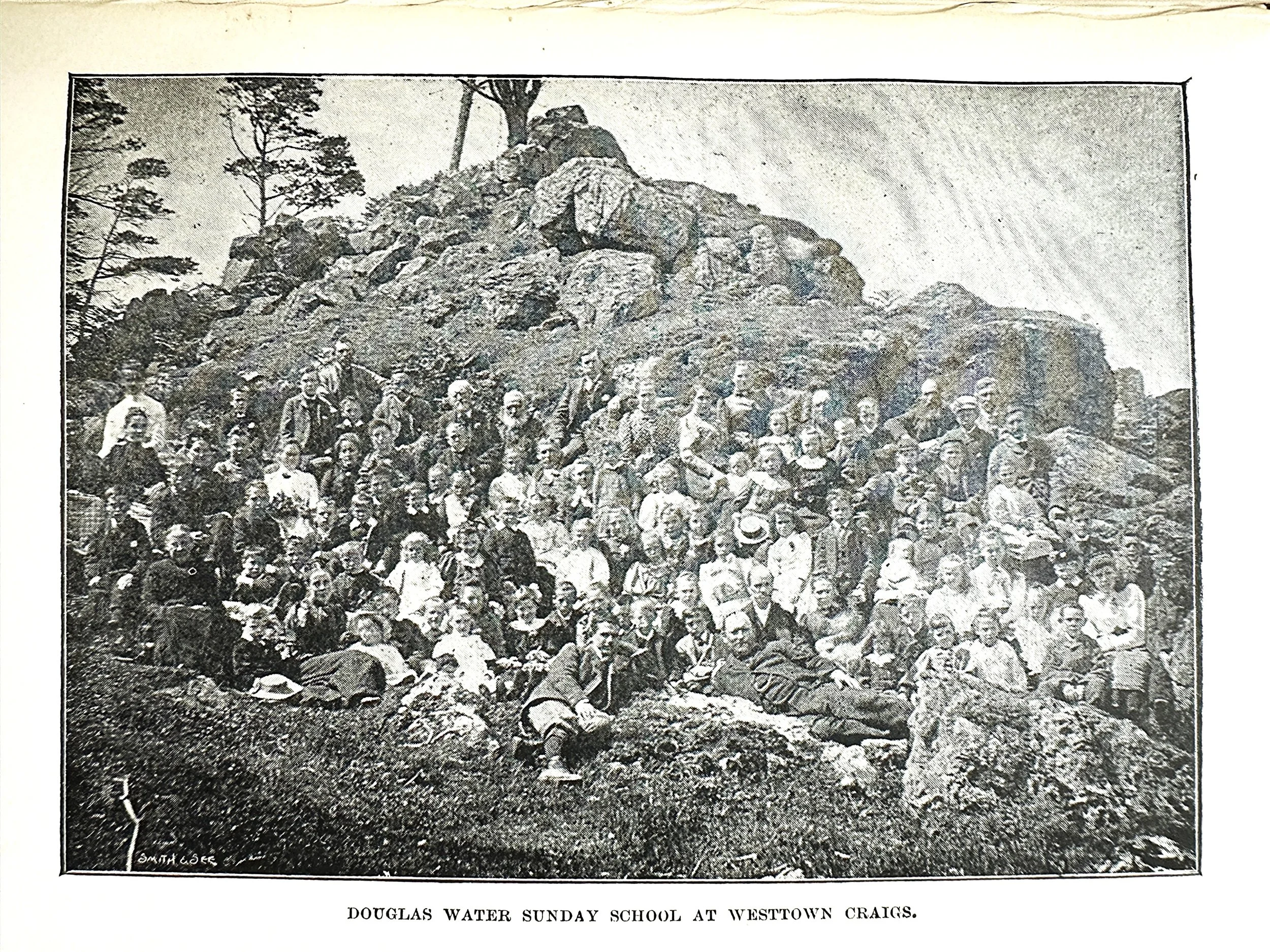
[Illustration: DOUGLAS WATER SUNDAY SCHOOL AT WESTTOWN CRAIGS.]
39
only description we have of him is given by one who lived at the Castle gate. He is said to have been “a stout, fresh, gentlemanly-looking person, with a cocked three-cornered hat, and used to ride on a beautiful dark bay horse.”
“The old order changeth, yielding place to new,
And God fulfils Himself in many ways,
Lest one good custom should corrupt the world.”
—Tennyson.