Douglas Water Kirk.
James Dodson
BY THE
REV. A. H. GILRUTH.
With Ten Illustrations.
LANARK: D. A. V. THOMSON.
1896.
Dedication
Dedicated
TO
CHARLES HOWATSON, ESQ.
OF GLENBUCK.
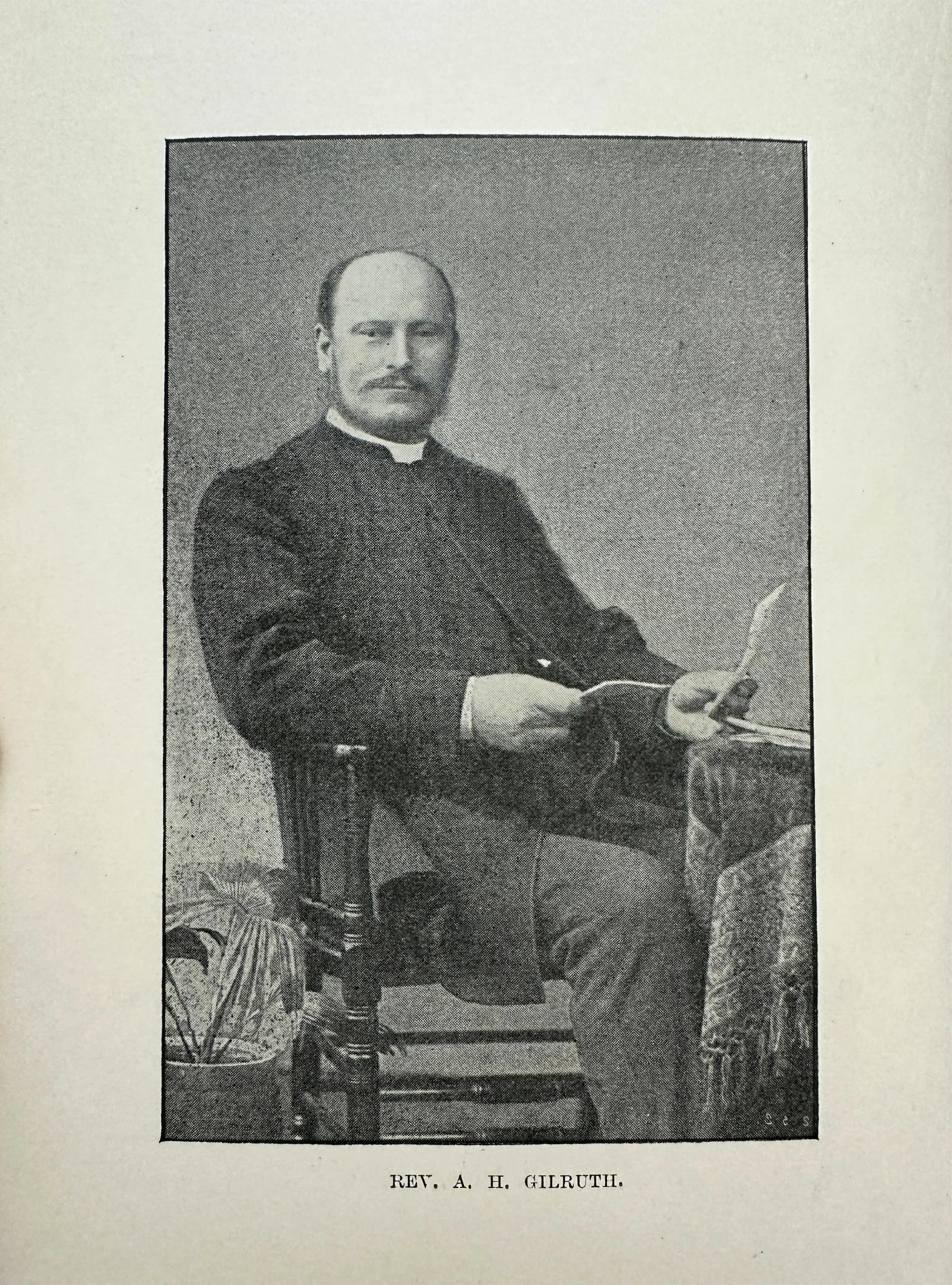
[Illustration: portrait of REV. A. H. GILRUTH.]
PREFACE.
THE following pages have been written with the purpose of preserving the traditions of this Church in its connection with the Reformed Presbyterian body. In carrying out this idea, the chief difficulty was to know where to begin, because the Reformed Presbyterians are connected with the Cameronians, the Cameronians with the Covenanters, and the memory of the Covenanters is entwined with the history of the nation. In their connection with Douglasdale an attempt has been made to trace the events which led to the formation of this congregation.
Many of the facts are drawn from magazines, pamphlets, and manuscripts now rarely to be met with. For some of these I am indebted to Mr John Tudhope, Abbeygreen, Lesmahagow, who placed his valuable collection at my service.
DOUGLAS WATER MANSE,
May, 1896.
INTRODUCTION.
THE Rev. A. H. Gilruth has done me the honour of asking me to write a few lines of introduction to his History of Douglas Water Kirk. I have pleasure in complying with his request because of my connection with the district by birth, as my native village is now included in the new parish of Douglas Water. This pleasure is enhanced because of early associations with the little “Meeting House,” and pleasing reminiscences of many of the people who were forty years ago the leading lights in the congregation which assembled there. Owing to the situation of the “Meeting House,” it provided religious ordinances for the extreme parts of the parishes of Lesmahagow, Carmichael, and Douglas, and many of the people who were members of the Parish Churches frequently worshipped in it. The parish ministers of that time did not give much attention to these outlying districts, and the minister and congregation of the “Meeting House” ministered both to the old and the young by Church services and Sabbath Schools. To the Sabbath Schools all the young were sent, and though my memory has no very pleasing associations connected with the long and weary services of the Church, I have most vivid recollections of good received and religious impressions made by the Christian instruction imparted in the Sabbath School.
Mr Gilruth, in his History, gives a very interesting description of Douglasdale, which will commend the book to all who hail from that district. He gives also a minute and vivid account of the rise and progress of the Societies, whose members formed themselves into the Reformed Presbyterian Church. This part of the History should attract the attention of all who are interested in the ecclesiastical and religious life of Scotland. Most Scotsmen have a profound reverence for our Covenanting forefathers. All the Churches claim them as their ancestors, but the Reformed
x.
Presbyterians make a special claim to descent from them. Mr Gilruth shews on what that claim rests, and traces the rise of the congregation of Douglas Water to the services performed by those Covenanters who adhered to Cameron’s views as to the Covenants. Of such men we are still proud. On some points they were narrow in their views—on other points they went to extremes; but we must acknowledge their real earnestness, their love of freedom, their zeal for the liberty of the Kirk, and their readiness to suffer and die for the upholding of the Crown rights of the Lord Jesus Christ and the glory of God. To them we owe much for the possession of the religious privileges which we now enjoy.
Mr Gilruth writes in a fine spirit regarding the work of his predecessors in the charge. The liberal views and the catholic spirit displayed by Mr Naismith and Mr Cosh, who both associated readily with the ministers of other Churches and did pastoral work over the whole district, helped much to break down the narrowness which was commonly connected with the name of “Cameronian.” Their teaching and example, I doubt not, made it easier for the congregation who still worshipped in the “Meeting House” to return to the Church of Scotland when the manse and church were transferred by the Earl of Home in 1885.
The whole History is interesting, but it is incomplete, as the author’s modesty prevents him from carrying it down to date. The church has flourished under the ministry of Mr Gilruth. It is now a fully-equipped parish, and provides spiritual superintendence and religious ordinances for a district which was formerly partially neglected by the Church of Scotland. It has a Sabbath School and Bible Class, and has a membership of nearly 150 on the Communion roll. The union with the Church of Scotland has been a real benefit to all concerned, and at no time in its history was Douglas Water Kirk more prosperous than at the present.
THOMAS MARTIN, M.A.
THE MANSE, LAUDER, April, 1896.
Contents
Douglas Water Kirk, ................................ 11
The Cameronians, .................................... 17
The Cameronian Regiment, ............................. 23
Rev. John M‘Millan, of Balmaghie, .................... 31
Presbyterial and Congregational Life, ................ 41
Rev. John Fairley, ................................... 49
Rev. John Milwain, ................................... 64
Rev. James Naismith, ................................ 70