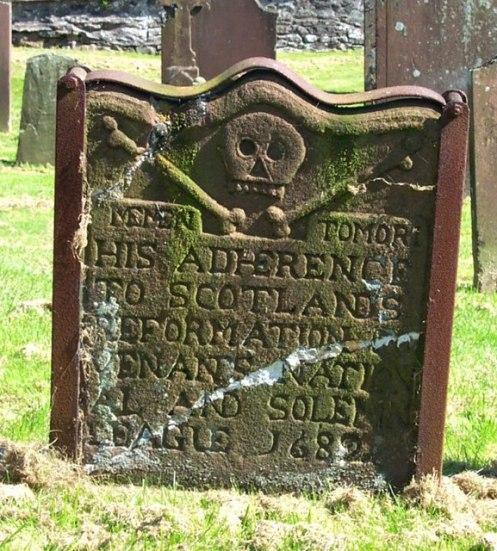
Memoir of William Orr,
James Dodson
LATE FARMER, IN KILBIRNIE PLACE,
Who departed this life, 25th Oct. 1814.
AGED 85 YEARS.
RELATED BY HIMSELF.
The righteous hath hope in his death, PROV. xiv. 32.
Paisley:
PRINTED BY STEPHEN AND ANDREW YOUNG.
1814.
[Verso]
THE following Memoir, originally intended for the Author’s own family, is published with his approbation, and at his desire, expressed to the Editor, last time that he was in company with him, before his death; in the hope that it might be useful to others labouring under the unspeakable disadvantage and danger of not hearing the blessed gospel of divine grace.
T[homas]. H[enderson].
MEMOIR
OF
WILLIAM ORR.
I. WILLIAM ORR, was born at Jairstown, in the Parish of Kilbirnie, in the year 1729. For the first twenty years of my life I thought little more about religion, than to attend the parish Church on Sabbath, along with my neighbours, and to keep from all acts of injustice towards my fellow-creatures. I occupied the station of a servant, under Lord Crawford, for a considerable time, and got so much into his Lordship’s favour, that he put me into the possession of the farm of the Place of Kilbirnie, and, as I had not money wherewith to stock it, he left me his stock upon it, to the value of £700, on the condition that I was to leave stock to the same amount upon the farm, when I left it. There I married, had a family of children, and lived in affluence, respected by all around me. I was brought up under what is called a legal Ministry, where I was instructed to do the best that I could for my own salvation, and that what I could not do Christ would do for me. As Mr B. taught the doctrine of works to qualify for salvation, he himself was quite regular in his own life and conversation, and was a pattern of that morality which he taught; and this is more than can be said of many who teach that doctrine. As I never heard
A 2
4
the doctrines of free grace taught, from my youth up, I knew of no other way of salvation, but by performing duties, to gain the favour of God; and accordingly I went through the ordinary course of them, private, and public, for this end. I had been taught from my earliest life, that Christ had performed his part, and that, if man performed his also, all would be well. I began to lay this seriously to heart, and was anxious to know what my part was, and whether I had performed it or not; that I might be satisfied in my own mind, that I was come that length, where Christ was to meet me, with the part which he had done. As the Minister and I were intimate I went to him, and asked him how far I behoved to go, before Christ would meet me. He told me to do the best that I could, and what I could not do Christ would do for me: he advised me to attend ordinances, as I had done, to be a good neighbour, to take the sacrament of the Lord’s Supper: but this afforded no relief to my mind. My distress rather increased for a time, and the great difficulty with me was to fix the point, where Christ and I were to meet. Matters came that length with me, that I was convinced that I must be for ever lost, unless I arrived at that point, where Christ was to meet me. I went again to Mr B. and laid before him the additional distress of my mind on that head. He endeavoured to divert me from such a scrupulous nicety on the subject, and wished me to be satisfied with the general doctrine. Having paused a little, and thought on the conversation that had passed, I said to Mr B. that God knew I was acquainted with no other doctrine, than what he had taught me, on that subject; but, as sure as God was in heaven, there was a defect in it somewhere, whether I should ever find it out or not. At this he seemed dissatisfied, and I left him for the time. My entire unacquaintance with the gospel of Christ prevented me from receiving any aid, that it was calculated to af-
5
ford. About this time, I once went to a sacramental occasion in the neighbourhood, where there was an evangelical Minister of the Established Church from Glasgow assisting, who preached on the Sabbath evening; but, as his doctrine was quite different from what I had been accustomed to hear, I did not understand it, and therefore could make no use of it. When I was in a state of real perplexity about my condition, I was led out to a consideration of the Law and the Gospel; but this was a subject entirely above my comprehension. I was convinced, that unless obedience was given to the moral Law, I could not be saved; but, how its demands were to be answered, I had no knowledge. I applied again to the Minister for advice, about my obedience to the Law. Although he told me many good things about human duties, I obtained no satisfaction that could give any relief to my mind. I then set about reading some books of Mr [Thomas] Boston’s on man’s fallen and corrupt state [i.e., Fourfold State]; but, as they were quite different from the scheme I had been taught, I could make no sense of them; and consequently could reap no benefit from them. I mentioned this to the Minister also. His answer was, that it was no wonder I did not understand Mr Boston, as he did not understand himself. This perplexed me more and more. I now thought of an acquaintance of a very sober character, who was a Dissenter from the Established Church, whom I had heard speak of man’s inability to keep God’s Law, or to perform any religious duty aright, without the grace of God. I also knew, that some Ministers of his Profession came occasionally into the bounds, and I desired this man to send me notice the first time, that any of his Ministers came into the West Country, which he accordingly did. I went twenty miles to hear him, and was surprised, that the doctrine which he taught was so very different from what I had been accustomed to hear; but my views of it were very
6
obscure, and I may truly say, as the man in the gospel said, ‘I see men like trees walking.’ After following said Minister, from place to place, for three successive Sabbaths, and hearing him lecture in the Epistle to the Galatians, when he distinguished clearly between the Law and the Gospel; and also opened up the character and mediatorial work of Christ, as answering all the demands of the Law, in the room of sinners; the nature of that righteousness, which fulfilled the Law; the act of Jehovah, in the imputation of it, and placing it to the sinner’s account in Law-reckoning; and the suitableness of the grace of Faith, for accepting of this righteousness, the light of truth then shone into my mind, and I attained a clear view of the gospel method of salvation, through Christ alone: and I was fully satisfied in my own mind, that I, and many others, had lived, all our life-time, entire strangers to the glorious Gospel of the blessed God. After I had obtained the knowledge of the truth myself, I thought that it would afford great satisfaction to our parish Minister, Mr B. to have the light of it communicated to him also; but alas! in this I was greatly mistaken; for when I told him, that it came instrumentally by means of a dissenting Minister, he at once replied, that it came from a bad quarter, verifying the saying of old, ‘Can any good thing come out of Nazareth.’ I then told Mr B. honestly, that there was a real defect in his doctrine, whether he believed it or not, which I had found to my sad experience: and, though he were to preach eternally according to his plan, his doctrine would never be the mean of saving a single soul, as it wanted the very substance of the Gospel. Although this language was strong, yet he, being of a calm and mild temper, and disposition, did not take it so much amiss as might have been expected. We continued to have correspondence and had frequent conversa-
7
tions afterwards, but each maintained his own sentiment.
As I had now undergone a change as to my religious views, respecting the way of salvation by Christ, my mind was next taken up about my duty, in professing the truth. Here I found myself at a great loss, as I was not acquainted with the history of the Church, and with the peculiar principles of the different denominations in her. I was sensible, that the Established Church was become very corrupt in doctrine, and although I made no doubt, but there were Ministers in her, who preached the doctrines of salvation by Christ, yet I knew, that there were a great number of opposite sentiments, who hold a kind of mongrel communion together, though they were not at all agreed. In course of reading, I came to understand, that the constitution of the Established Church was corrupted, as well as her doctrine, and that she was not upon the same foundation, as the old covenanted Church of Scotland, in the time of her purest Reformation. I also examined the principles of different denominations, as far as I had access; but the more I became acquainted with Reformation principles, according to the word of God; and the sentiments of the faithful witnesses and Martyrs of Christ, I found the greater difficulty in joining with any of them that were near me. In hearing the Secession I was satisfied with the doctrines, which the Ministers of that Church taught, concerning the free grace of the Gospel, in the salvation of guilty sinners: but as they did not state their Testimony faithfully, against the constitution and administration of a corrupt civil state, as well as those of a corrupt Church, I had no freedom in mind to join with them. I never could reconcile their principles anent civil government with the second Petition of the Lord’s Prayer, concerning the coming of Christ’s kingdom, the promises made to the Church, that Kings shall be her
8
nursing Fathers, and the principles of our most famous Reformers and Martyrs. Their prayers particularly proved a stumbling block to me, when, in one part of that duty, they prayed for the revival of a Covenanted work of Reformation, and the downfall of Popery and Prelacy; and in a short time thereafter prayed formally for a blessing on that very government, which supported both; and, which themselves had declared to be ‘an insuperable bar in the way of a Covenanted work of Reformation, yea a grave-stone laid on it.’ The more I thought on this, my scruples became the greater; and, although they had a congregation, and meeting house, not far distant, I could not in conscience connect in Church fellowship with them.
As to the Relief [Church], and any other profession of Christians, with which I was acquainted, I did not think of joining with them, as I had by this time acquired some knowledge of the Church’s attainments, in the time of the second Reformation, when these Nations entered into covenant with God, and solemnly engaged to maintain, profess, and defend, the true Presbyterian Religion, in opposition to Popery, Prelacy, and every thing contrary to sound doctrine, and the power of godliness: and as the different parties approved of the present civil government as lawful, and prayed in form for a blessing upon it, notwithstanding of its opposition to the word of God, and to the Covenanted work of Reformation, the great glory of these Lands, I declined joining with any of them.
I continued about three years searching into the path of duty, with various exercises of mind during that time. Sometimes I thought that I might continue where I was, in connexion with the Established Church, and take the good, and leave the bad, as many others professed to do. To this I had strong inducements, as my situation in the world proved a bar to
9
my separation from the Church. I was got into easy, and rather affluent circumstances, and well esteemed among my neighbours. I had now been a long time married, and had had several children baptized in the Established Church: and I was sensible, that I would meet with reproach, if I left it. But, upon serious reflection, I still thought that I was called upon to do something in my generation, for the declarative glory of God in the world. When my mind was perplexed, between a sense of duty on the one hand, and difficulties which I saw in my way on the other, I went over to Kilmacolm one Sabbath to hear Sermon, and as a diet of examination was intimated to be on Monday, I waited upon it, and was then urged by one of the Dissenters who resided there, to join the Testimony, as I had been a hearer for a considerable time. But this I positively refused for the present. However immediately after, great darkness and horror seized upon my mind, from the thought of having refused to join the Lord’s cause, when I had a call and opportunity, and I was afraid that the Lord might never honour me to be a witness for Him, and his declarative glory in the world. When a sense of difficulties and fear were like to overwhelm me, two passages of Scripture were brought into my mind with great power, ‘O thou of little faith wherefore dost thou doubt,’ and ‘I will never leave thee nor forsake thee.’ These afforded such encouragement to my mind, that I durst no longer confer with flesh and blood: but having formerly perused, and being satisfied with the Testimony, emitted by the Reformed Presbytery [in 1761], I went and joined that community, at a time when I had little prospect of enjoying the public ordinances of the Gospel; as very few Members of that denomination were then in the West Country, and Ministers came seldom that way.
I had great pleasure and satisfaction in my connexion with the Reformed Presbytery, and though
A 3
10
I travelled far to hear the Gospel, I was much pleased and edified, with the sound and substantial truths which I heard, as they proved solid food to my soul. After this I occasionally obtained the favour of Sermon at my own house, by Messrs [John] M‘Millan and [John] Thorburn, who, at that time, had the whole of the West and North of Scotland for their district, in a Collegiate charge. I found much advantage in having the Ministers about the house, as I had the opportunity of conversing with them, and asking questions about such things, as were matters of difficulty to me, concerning doctrine, or principle, by which I found my knowledge greatly to increase. In progress of time, new congregations were formed, to prepare the way for some young men, who had been licensed by the Presbytery; and were, at that time, travelling through the whole church, as Probationers. In consequence of this arrangement, a call was given to, and accepted by, Mr [William] Steven; and he was ordained Minister to the Shires of Ayr, Renfrew, and part of Dumbarton. I was well satisfied under his Ministry, and I hope was edified by it: but he laboured only nine years among us, until another disjunction took place, when he made choice of the southern division; and the north side was left vacant. A call was next given to, and accepted by, Mr [Thomas] Henderson, and he was ordained among us, on this side. The congregation increased under his Ministry, and another disjunction took place of Paisley from the West and North side, when he gave up his relation to Paisley, and has continued his labours on our side. I have been equally happy, and I hope edified, under his Ministry. And I can say, with satisfaction, that I found the same scriptural doctrine, and unity of principle, prevailing among the whole Ministers of this church. They had one Faith, one Lord, one Baptism, were all firm friends to the Reformation cause,
11
and contended with one heart, and one mind, for the faith of the Gospel.
In my outward lot, I went through various scenes in Providence. I have enjoyed days of prosperity; and I have been brought to see days of adversity. From a very common station in life, I was advanced by Lord Crawford, to the possession of one of his principal farms, and lived in the midst of plenty for thirty-five years. About that time I was seized with a rupture, which greatly prevented me from being able to go and manage my civil affairs as formerly. On this account, I gave up the management of the farm to William, my youngest son, who was then only about seventeen years of age. He appeared active, and, except his youth, seemed well enough qualified to manage it to advantage. While markets kept up, all things prospered to our wish; but by a great and sudden change in the prices of cattle and scarcity of provision for them; as well as by dealing too extensively in Bank bills, all things went to confusion, before I was aware. When Lord Crawford came to know our embarrassed condition, he sent for me, and assured me, that if I could keep the farm, so as to do me any good, he would never distress me for a shilling of the £700 that I owed him. From the many favours, which I received from the family of Crawford, and the various transactions I had with them, I must say in commendation of both father and son, that I ever found them generous and humane, morally honest in all their dealings, and their word as sure as their write, at all times. I have often thought, what a blessing it would be to the country at large, if all landlords were equally faithful to their promises, as they were. However, notwithstanding of the kind proposal made by his Lordship, I found, that in my advanced life, and the circumstances into which I was now brought, I could not manage said farm to advantage. Therefore William and I were reduced to the necessity of mak-
12
ing a composition with our creditors, and of giving up the tack for their benefit. I can now say to their commendation, when the time is long passed, that more easy and more moderate creditors never man had, as they cheerfully accepted what we had to give, and even allowed a part of the farm to live upon. I found, that although this might have been a kind of support to myself and wife, yet it could do nothing for the family; and, as I considered William sufficiently capable to do business, I felt a strong inclination to put him again into some way of doing. A farm happened then to cast up in the Highlands, and by the help of friends I got it stocked: but, after trial, it was found, that it would not answer expectation, as it lay entirely open, without any fence, and neighbours’ sheep and cattle could not be kept from trespassing to that degree, as must have ruined us in time. I therefore gave it up, and went into the county of Sutherland, and took another farm, which I thought had all the probability of doing well. I expected from this to be relieved from any debt that I had, and to have a comfortable subsistence for myself. But in this I was also disappointed, for although, to outward appearance, the ground looked well enough, yet it was infested with foxes, which destroyed my lambs, and thereby completely reduced my stock. I was now again brought into straits and difficulties; and a stranger in a strange country, without friends; so that I was obliged to give up this farm also. To me the words of Naomi were now applicable, ‘I went out full and the Lord hath brought me home again empty;’ for, after my expenses of travelling from Sutherland, I had only one shilling and four-pence left, when I arrived at Leith. I borrowed a little money from an acquaintance in Edinburgh, to go over to Fife, to see my old benefactor Lord Crawford: but he unfortunately was not at home, so that I had to come away without seeing him at that
13
time. I was afterwards informed, that his Lordship was returned, and went over again to see him, and obtained from him a temporary relief: and, while he lived, he allowed me £20 a year. I then returned to Kilbirnie, and have resided ever since, in sight of the place, where I had spent the prime of my days in affluence, without murmuring, or repining at the changes of Providence.
During my residence in the Highlands, I was deprived of public ordinances. As I had made a total separation from the Established Church, on account of unfaithfulness, I had not freedom to hear any of the Ministers, belonging to it; although I heard, that there were some in the North, who preached evangelical doctrine. I viewed them all one in their constitution, all sitting in the same courts of judicature, and all coming into office in the same unscriptural way, viz. by the law of patronage, I therefore thought it safest not to touch, taste, nor handle with them. I spent the Sabbath, along with my family, in reading the Scriptures, and sound authors, that cast light on them; and in conversation about matters of religion, for the instruction, and edification of one another.
I experienced the truth of the common proverb, The rich man has many friends. Whilst I flourished in the world, I was held in general esteem, by my neighbours and acquaintances; but, when my substance failed, I became liable to reproach. Yet, whatever may have been rumoured concerning my misfortunes, I can say, from the integrity of my heart, that I never intended to defraud any man of a shilling; and that I never borrowed money, but with a design to pay it honestly, if matters had succeeded according to my rational expectation. It has often been matter of grief and sorrow to me, that ever any man lost by me, and that I could not pay my just and lawful debts; but I hope my creditors will take the
14
will for the deed, when they know, that it is completely out of my power, to satisfy them.—I am now, in my advanced life, reduced to days of adversity, which, in the days of my prosperity, I never expected to see; but I desire to be thankful, that by the liberality of friends, and benefactors, I have food and raiment, in some comfortable measure, with which I study to be content.
I have been especially concerned about the reproach brought on religion on my account, and I sincerely wish, that no person would impute that to my particular profession of religion, which has only been my own personal misfortune. Before I knew any thing of real religion, I endeavoured to perform all the duties of moral honesty, between man and man, with great care, hoping thereby to recommend myself to the favour of God: and, since I became a believer of the precious Gospel of Christ, I have from principles of faith and love studied to do justly towards all men, so far as in my power; and as an important part of that duty, which I owed to my redeeming Lord and Saviour.—As my misfortunes and failure brought a reproach on my profession of religion, I continued a number of years out of actual communion with the church, for fear of giving offence to any of her members. But as I had long been a professor of the Reformation-cause, and had never intentionally done any thing to its injury, I was desirous of an opportunity to make a declaration of my misfortunes, and the causes of them, together with my own present views, before a session, so as to have matters accommodated with the church; and to be readmitted as a full member in her. And, although I had no present prospect of enjoying the solemn privileges of the house of God, yet I wished to be in a condition of doing so, if Providence should afford an opportunity; and at any rate I wished to live and die in her communion; and this privilege I obtained.
15
Observations from the Preceding Narrative.
1. I desire to have it particularly noticed, that the counsel of no man on earth ever influenced me to leave the Established Church. I was as firmly attached to her, as a man could be, and I believed the doctrine, that I heard in her, as firmly as the Minister who preached it. If I could have enjoyed peace in my own mind, and have obtained satisfaction in the time of my perplexity and distress, I had never likely changed my profession. But then I could get no relief for my soul, when brought under a concern about my salvation. At this time I had no farther light, and I knew nothing about the Scriptural constitution and order of churches; or the difference between one church and another. This was a matter of future consideration and inquiry.
2. I can attribute my change in sentiment to nothing but the Spirit and Word of God, as I had nothing earthly, to be an inducement to alter my opinion; but every thing externally against me. I foresaw difficulties very great. The reproach of the world, the contempt of my neighbours, and even the reflections of my own family, all stood in my way. So that I am satisfied in my own mind, that, by the same means, by which I was brought to change my sentiments about the doctrines of the Gospel, I was led out to leave the Church of Scotland, on account of her corruptions; and my conscience bears me witness, that I acted according to the light given me from the word of God.
3. There is a real defect in legal doctrine, that it cannot give relief unto a troubled soul, because it does not distinctly state the proper difference between the Law and the Gospel, between man’s guilty condition by nature, and the way of recovery by Jesus Christ, who has satisfied the Law, in the room and stead of
16
elect sinners, and open up the nature of faith, as the free gift of God, by which we receive, and improve Christ, as our alone security, against the curse and condemnation of a broken law, who is the end of the Law for righteousness to every one that believeth.
4. Such Ministers, as are unacquainted with the scheme of free grace themselves, can never administer relief to a sin-sick soul under deep and serious convictions for sin, because they are strangers to the perfect righteousness of the Redeemer, which alone answers all the demands of law and justice. Grace as it reigns through the obedience and death of Christ is not the grand theme of their doctrine, so that they cannot say with the apostle Paul, ‘we preach Christ crucified,’ and therefore it must be another gospel, than the Gospel of Christ.
5. Persons, brought up under a legal Ministry, where the grace of the Gospel is not preached, are in a pitiable situation, when brought under distress of soul, because they are grossly ignorant of the nature, holiness, and spirituality of God’s law, of their own guilt, as transgressors of that law, and of the only way, that God has appointed, for saving sinners, through the righteousness of his own Son, the divine Saviour.
6. When persons obtain relief to their souls, from the guilt and pollution, from the power and dominion, of sin, by the imputation of Christ’s perfect righteousness, and living faith in him, as their personal security, against the wrath to come, they are under the greatest obligations to glorify him, by making a public profession of his name and truths, before the world.
7. Amidst the diversity of sentiments of the various churches, Christians ought always to prefer and espouse that system, which is most agreeable to the word of God, which maintains the greatest number of Scripture-truths, and testifies against the greatest
17
number of abounding errors. The Church, which is most careful to observe this, is the true Church of Christ, is God’s own house, and here his people ought to desire to remain all the days of their life.
8. Christians may undergo various changes, as to their outward lot. Sometimes they may be in great prosperity, and again may be reduced to a state of adversity. This world often changes masters, and at best it cannot be a proper portion for a true Christian. The immoderate love of it has a tendency to lead off the mind from more important objects, and the saints must be taught to look for a better country, that is, an heavenly.
9. Parents ought to keep the management of their affairs in their own hands, and to look carefully after their own business in the world, while they are able. Giving up the management of matters to children is always dangerous, although they be active. Want of caution and foresight, rash bargains, and contracting debts, without due consideration of the many changes to which markets are liable, bring many to ruin before they are aware. It is therefore prudent, that every parent should retain full power in managing his own concerns. I do not by this mean to cast any injurious reflection on my son William, more than any other young man, placed in similar circumstances; but simply as a caution to parents in general, whatever talents their children may possess.
10. In all the adverse changes that befal saints, they ought to look above the creature, to learn the language of every trying dispensation of Providence, to avoid repining against God in their meanest condition, to believe that all shall work together for good, and that goodness and mercy shall follow them all the days of their life, and that their dwelling place shall be in the house of the Lord for ever.
As to my present views.
1. I desire cordially to believe the Scriptures of the Old and New Testaments
18
to be the word of God, and the infallible rule of faith and practice, and the great standard, by which all doctrines and opinions are to be tried.
2. I adhere to the doctrines contained in the Westminster Confession of Faith, and Catechisms Larger and Shorter, taken in their proper connected state.
3. I approve of the precious doctrines and truths concerning Christ crucified and glorified, viz. God’s everlasting love, particular election in Christ, absolute predestination, spiritual and vital union to Christ, effectual calling, particular redemption, regeneration, free justification, gracious adoption, universal sanctification, death unstinged in the death of Christ, a happy resurrection, and eternal life through Jesus Christ our Lord.
4. I approve of the spiritual and true worship of God, according to the Presbyterian plan, having Gospel Ministers, and ruling Elders, lawfully ordained, for its office-bearers; and sessions, presbyteries, synods, and general assemblies, for the Scriptural courts of judgment, in which said rulers are to sit, and judge ecclesiastical affairs, according to the word of God.
5. I adhere to the whole of a Covenanted work of Reformation, as attained to in these lands between the years 1638 and 1650, in opposition to popery, prelacy, and all corrupt doctrine, and false worship whatever;—and to all the faithful contendings of Christ’s faithful witnesses, for the royal prerogatives of Christ, and the liberties wherewith Christ hath made his Church and people free.
6. I leave my testimony in favours of a faithful Ministry and godly Magistracy; both constituted, qualified, and administered, according to God’s holy word, having it for their great object to promote the Divine glory, the advancement of Christ’s kingdom on earth, and the best interests of men, each office keeping its own proper sphere.
19
7. I leave my testimony in favours of the principles of the Reformed Presbytery, as most agreeable to the word of God, and to all the attainments in religion and reformation, to which the Church has arrived in her purest times. The longer I have been acquainted with this community, I esteem them the more, because they have maintained the testimony of Jesus, from the time that faithful Mr [James] Renwick sealed it with his blood, down to the present time, in a regular succession, without joining with any Society that has proved unfaithful, by their treachery, or apostasy from the cause of Zion’s Head and Lord.
8. I leave my testimony against the Established Church, and warn my children, and all into whose hands these pages may come against hearing, or joining in communion with its Ministers, on account of their unfaithfulness, in taking the oath of allegiance to the present civil government, which has it as an essential article in the constitution, that the King be supreme head over all persons and causes, civil and ecclesiastic, to the great dishonour of Christ, who alone is given by his Father, to be Head over all things to the Church;—on account of their entering into Parishes by Patronage, thereby robbing the Christian people of a privilege, purchased to them by the blood of the Redeemer;—on account of the unsound and dangerous doctrine, taught by many of them, concerning man’s free will, and ability to save himself, by his own works, and those reckoned evangelical, joining in the Lord’s supper, and sitting in Church courts, with them, so as to be incorporated in one corrupt system, in opposition to the true Religion, and Scriptural worship of the blessed Jesus;—their lax admission to the Seals of the Covenant, ignorant and unconverted sinners, enemies to the Gospel, and who do not so much as maintain the form of religion in their families.
9. I leave my testimony against the Secession and Relief [churches], because they are not faithful to the whole
20
truth of God revealed in his word, and do not lift up a testimony in favours of the whole of a Covenanted work of Reformation, according to the Holy Scriptures, which teach, ‘whereunto we have already attained, let us walk by the same rule, and mind the same thing;’—because they are not sound in the doctrine of Magistracy, but acknowledge the lawfulness of civil rulers, set up and administering, contrary to the word of God, and offer up public prayers for a government, acting in opposition to the second commandment, contrary to the Solemn League and Covenant, the testimony of Christ’s faithful witnesses and martyrs, against the coming of Christ’s visible kingdom, and his will being done on earth as it is in heaven.
I now come to conclude this Narrative with an Advice to my Children.
My dear Children, for whom I desire to travail as in birth till Christ be formed in you, I beseech you in the bowels of love and pity, to attend to the advice, perhaps the last advice of an aged Parent, who has no higher wish concerning any of you, than to know, that you are wise and good. You all are sensible of my affection for you, and you may be assured, that I am earnestly desirous of your everlasting Salvation. Suffer therefore a word of Exhortation from me. O consider the corruption of your nature, and the unbelief, hardness, deceitfulness, and desperate wickedness of your hearts. O flee, from the wrath to come, while the door of mercy is open, and while it is the accepted time, and the day of Salvation. Believe the Gospel with application to your own souls, and receive a whole Christ, as made of God unto you wisdom, righteousness, sanctification, and redemption. Seek after a Scriptural knowledge of the doctrine of the blessed Trinity, as the foundation of all true religion. Receive it with humility as a
21
mystery, which you cannot comprehend, but yet a truth that you are called to believe, on the authority of God, revealing it. Pray for the application of the knowledge of it to yourselves, that you may have an interest in Jehovah the Father, as your Covenant God and Father; in Jehovah the Son, as your redeeming Lord and Saviour; and in Jehovah the Holy Ghost, as your divine and Almighty Sanctifier. Along with this great doctrine, believe all the truths of the Gospel, concerning Christ crucified and glorified, such as vital union to Christ, effectual calling, spiritual illumination, free justification, special adoption, universal sanctification, death unstinged, and everlasting glory. See that you be satisfied with, and interested in God’s way of saving sinners, through the merits and Mediation of Christ alone, and examine carefully and frequently, how matters stand between God and your souls. Study to improve all the grace you have received, to the glory of God, by walking in all his commandments and ordinances blamelessly. O cease to hear the instruction which causeth to err, and beware of depending on your own free-will, the general mercy of God, or your religious performances, for your salvation; because God hath solemnly declared in his word, that ‘by grace you are saved, through faith, and that not of yourselves, it is the gift of God; not of works, lest any man should boast.’—It is my serious advice to all of you, who hear the Gospel, and attend upon the ordinances of it, that you freely and generously give a part of your property for the support of it. You know that it cannot be otherwise maintained, and although you may not have clearness for the time, to join the cause and testimony of Jesus, yet this is a principal way of honouring the Lord with your substance; and, doing this in the name of disciples, you shall in no wise lose your reward. I observed this way myself, and I have much pleasure upon the reflection of it.—I now take
22
farewell of you all, and beseech you, to give all diligence to make your calling and election sure. O attend to the things, that belong to your everlasting peace, before it be too late. Pray for regeneration and conversion, without which you cannot enter the kingdom of heaven. And I charge you before God, and his holy angels, that you do not meet me at the Tribunal of the great day, in a graceless and Christless condition; otherwise be assured that I will be an awful witness against you, and will give a full consent to the sentence of condemnation, which will then be passed upon you, for refusing and despising the Gospel of Christ. Think on these things, and may the Lord prepare you for his heavenly kingdom.
The preceding Narrative, taken from time to time, from my own lips by a friend, and arranged by him into its present form, and read different times in my hearing, I declare to be a faithful account of my real sentiments, and that there is not a single sentence in it, but what is fully agreeable to my mind. I also wish this addition to be made as a conclusion to the whole, which was formerly an anecdote of Mr Renwick. Why he should make such ado about his religion, and give himself so much trouble in dispensing the ordinances of it, when surely he would only get heaven at last. His reply was, that he would be honoured to glorify God on earth, and this is more than heaven.
In witness of my approbation of the whole, I subscribe it at Kilbirnie, this sixth day of September one thousand, eight hundred, and thirteen years, before these witnesses, William Shedden, Gavin Riddet, and Robert Knox, residing at Kilbirnie.
WILLIAM ORR.
WILLIAM SHEDDEN, Witness.
GAVIN RIDDET, Witness.
ROBERT KNOX, Witness.
23
THE Author of the preceding Memoir, when he expressed his desire to have it printed, wished the following instances of the remarkable interposition of Divine Providence, to be recorded to the honour of the great Preserver of Men, and they are given according to his own Narration.
1st Instance. My daughter Jean, when about three years of age, was walking her alone, in an avenue, a little distant from the house, when a horse took fright and run off with a cart on his back; and after he had got free of it, he was joined by three young horses, that all galloped in full speed, by the sides of one another, towards the child who was straight before them on the road, and, as they were running furiously, they had every appearance of driving her over, and trampling her under their feet. But an over-ruling Providence so ordered it, that when they got quite near to her, the one towards the right pushed the rest to the opposite side of the road, and left the small space where she stood like a semicircle, and so passed by, without touching her.
2d Instance. My wife and I were riding, both on one horse, upon the road to the Largs, when we met two horses, that had run off with a chaise, in spite of what the driver could do, and coming straight towards us in full speed, in a place of the road, where we could not get out of the way, we saw no mode of escape: and indeed my wife was thrown over a dyke, and a small hedge, on the side of the road, and yet was mercifully preserved as to life, and only slightly hurt. She often said, that she never knew, how she got over; but that it was surely a great Providence to her. I passed without any injury at all.
3d Instance. When my wife and I were returning from a Sacrament at Crookedholm, my wife riding upon one horse, and myself upon another, we arrived safe at the foot of the avenue, on our own farm. I went forward to open the wooden gate, and meant to hold it, until my wife passed through. But the horse which I rode becoming restless, I was obliged to let go the gate, before she got quite through: and the gate, falling on the tail of her horse, affrighted it, so that she lost her balance, fell, and continued hanging with her foot in the stirrup, without being able to relieve herself. And I, being in that situation,
24
that I could scarcely manage my own horse, could afford her no help. But it so happened in Providence, that her buckle broke, and she got free, without sustaining any real injury. These instances of preservation I ascribe to the superintending care of the holy providence of God.
The Author, in the last stage of his life, when conversing with his religious acquaintances, was much disposed to extol the riches of divine grace, in the salvation of sinners, and to contend earnestly against the opinion of being saved by works. The following striking sentiment of his is worthy to be preserved. ‘Upon mature consideration, I am persuaded, that, whatever legal teachers may say, the doctrine of man’s doing a part to procure his own salvation is dishonouring to all the Persons in the blessed Trinity. It is dishonouring to God the Father, to contrive a scheme of salvation, so uncertain in its effects, as to depend on the free-will and works of man, whether any shall be the subjects of it or not—It is dishonouring to God the Son, to execute a work so imperfectly, as to require the filthy rags of the righteousness of a fallen sinner to be added to his Divine and perfect Righteousness—It is dishonouring to the Holy Ghost, to apply what the Scriptures call a Law-magnifying and everlasting righteousness; and yet so deficient, as to need what is called man’s part, to render it complete. But the truth is, this opinion is subversive of the whole plan of the Gospel of Christ, and is truly destructive to the souls of men.’
As the Author lived, so he died, a steady friend to the Reformation-cause; a firm believer of the precious Doctrines of the Gospel; and, in his last moments, placed his hopes of life and salvation, solely in the merits and mediation of Jesus Christ, the Saviour and Surety of lost sinners. He died in peace, 25th Oct. 1814, aged 85 years.
S. & A. YOUNG, PRINTERS.