VIII. Rev. James Naismith.
James Dodson
THE Rev. James Naismith was born on 21st February, 1827, at Mossneuk, near Wishaw. He was the sixth son of Mr John Naismith, who afterwards resided with him and survived him. When he was thirteen years of age he became a junior clerk in the office of Messrs Stewart & Sons, writers, Glasgow. His brother, the Rev. Robert Naismith, of Chirnside, had previously occupied the same position. From his earliest days, James showed a decided inclination to live a humble, pious life. While living in Glasgow he connected himself with West Campbell Street congregation, and successively filled the offices of Secretary to the Young Men’s Society, Secretary to the Sabbath School, and Session Clerk. When the elders were chosen, he was the youngest among them, but, notwithstanding, he had the most votes. For about twenty years, from his first entering the law office, he continued with the same firm, and rose to the responsible position of cashier. Indeed he may be said never to have wholly broken with the firm, for he was all his life in the habit of going to Glasgow, and assisting in the office at such busy seasons as May and November terms. Mr Stewart, speaking of him, said—“We never thought him brilliant, but he was always good and faithful.”
“Kind hearts are more than coronets,
And simple faith than Norman blood.”
While he was connected with the law office, he attended private classes, and afterwards the University. He studied
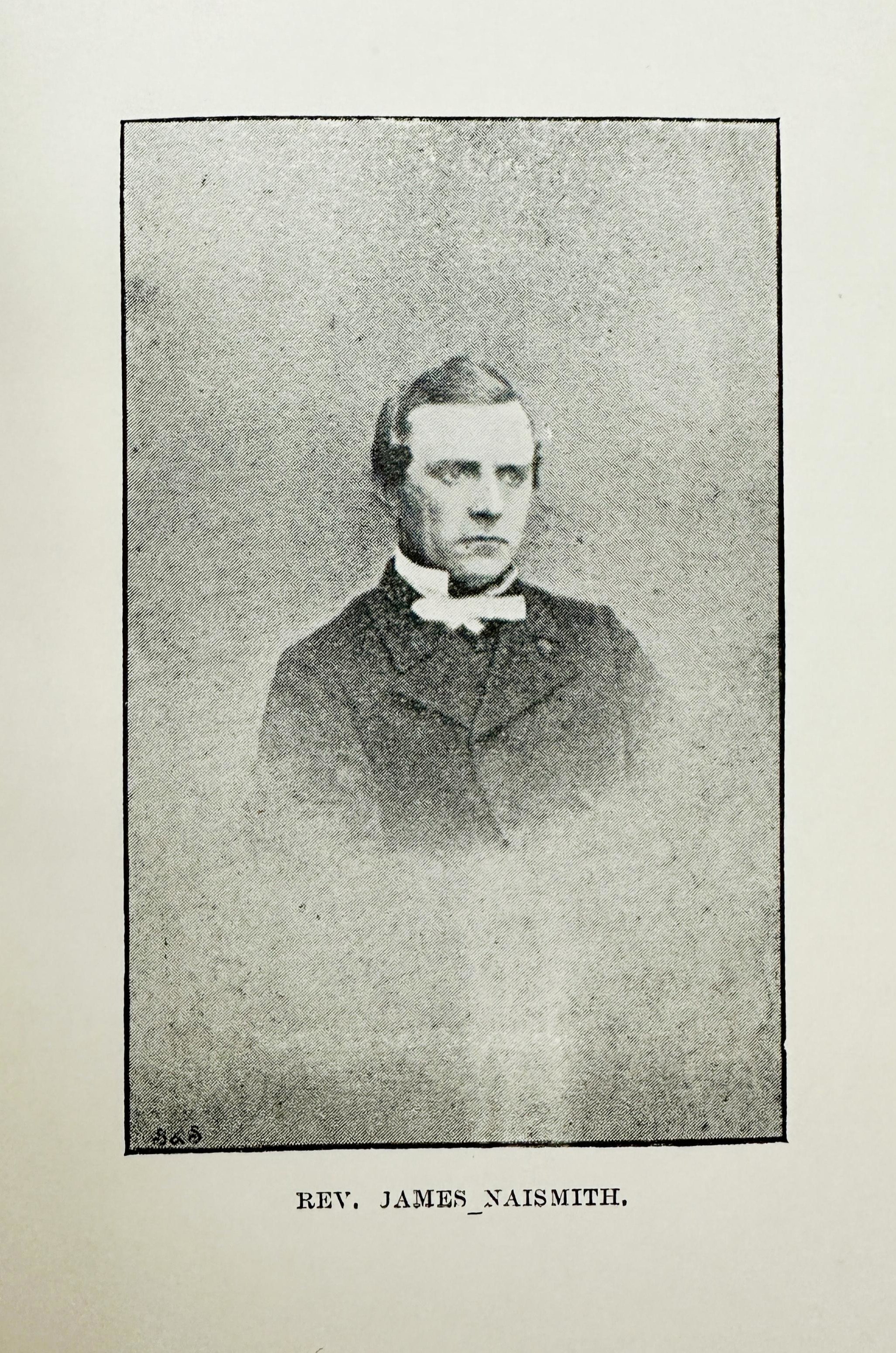
[Plate: REV. JAMES NAISMITH.]
71
theology under Dr. Symington and Dr. Gold, in the Reformed Presbyterian Hall, and was licensed to preach the Gospel on the 6th May, 1861. The congregation of Douglas Water gave him a unanimous call, which he accepted, and was ordained on the 14th July, 1862. His brother, the Rev. Robert Naismith, of Chirnside, was present, as was also his father, an uncle, and a cousin, all elders in the Presbytery of Glasgow.
When Mr Naismith was settled at Douglas Water, he took up house at a cottage near Birkhill, about two miles from the church. There was as yet no manse or dwelling-house for the minister, and it is much to Mr Naismith’s credit that he set before himself the arduous task of having one provided. He got his cousin, Mr Morton, to prepare plans, and on a site close to the church, the little cottage, as it now stands, was built the year after his ordination at a cost of about £500. Most of this sum was raised among Mr Naismith’s friends outside the congregation.
At the meeting of the Synod in 1863, a split occurred in the Cameronian or Reformed Presbyterian Church over the question of the franchise. Up to this date, the members of the denomination had held it as a fundamental principle, that they should abstain from voting for a member of Parliament, or accepting any office which would entail them taking an oath of allegiance to the State, seeing the State had set aside the Solemn League and Covenant. But for several years prior to this, a majority of the members of Synod had been anxious to make a change in respect to these matters. Throughout Scotland companies of Rifle Volunteers had been formed, and several members and office-bearers had entered into these companies; and there was a wide-spread feeling that the oath as administered to Members of
72
Parliament, Town Councillors, or Rifle Volunteers, did not prevent them seeking constitutional reform, and could not be construed into consenting or in any way committing them to the Coronation oath. Accordingly, an overture was sent down from the Synod to Kirk-Sessions and Presbyteries on the question of the franchise and the oath of allegiance. The Synod came to the finding—“That while recommending the members of the church to abstain from the use of the franchise and from taking the oath of allegiance, discipline to the effect of suspension and expulsion from the church shall cease.” An amendment to reject the overture was lost. The minority tabled a protest, withdrew from the meeting, and on the following day met in a different place and constituted themselves the Synod of the Reformed Presbyterian Church of Scotland. Thus, on the 8th May, 1863, the church of the wilderness, the church of the mountain and the moor, the church of the covenants and testimonies, became divided and broken, and that, too, upon the very question which constituted the ground of their existence. Both claimed to be the true Cameronian or Reformed Presbyterian Church, and were afterwards distinguished as the “Church of the Majority” and the “Church of the Minority.”
Mr Naismith adhered to the Church of the Majority, and his congregation at that time stood by him without a single dissenting voice.
From this time he maintained a broad, liberal spirit towards ministers of other denominations, especially those of other dissenting churches, and had them frequently in his pulpit. In conversation with those people living near his church, he advocated union of all the different Presbyterian denominations, and maintained that there was now no difference between the Cameronian and the Established,
73
Free, and U.P. Churches. The result of this was that, during his comparatively short ministry, the congregation increased to nearly three times its original number; but, of course, it was now only “Cameronian” in name, the increase being made up of members from other churches.
The stipend paid to Mr Naismith was considerably larger than that paid to any of his predecessors. It was during his time, and also during the time of his successors, £80 per annum, and a manse. This, however, did not all come from the congregation; it included £30 from the Ferguson Bequest Fund.
He took a leading part in all temperance and educational movements. There were two small schools in the neighbourhood, neither of them very largely attended. Mr Naismith used his influence to get them united, so as to get a more permanent staff of teachers appointed.
A few weeks before his death he attended the meeting of the Synod in Glasgow, and appeared to be in his usual health. He conducted the singing in the devotional exercises of the Synod, a duty which had frequently devolved upon him. He preached for the last time in his own pulpit on 22nd May, on the text—“But the Comforter, which is the Holy Ghost, whom the Father will send in My name, He shall teach you all things, and bring all things to your remembrance, whatsoever I have said unto you,” John xiv. 26. He took ill during the week, and on Saturday was confined to bed. Medical aid was brought from Douglas, and his ailment was pronounced to be congestion of the liver. Neither he nor his medical attendant expected a fatal issue, but he calmly passed away in sleep, late on Tuesday night, the last day of May, 1870, in the 44th year of his age, and the eighth of his ministry. His remains were interred on the following Monday in the
74
churchyard of Lesmahagow. There were over thirty ministers in the large company that attended his funeral. He left a widow and five children.
Erected by the R.P. Congregation of Douglas Water.
To the Memory of
The Rev. James Naismith,
Who, as their Loving and Beloved Pastor, for nearly eight years laboured
among them with the greatest faithfulness and acceptance.
He was born at Mossneuk, Cambusnethan, on 21st February, 1827;
Ordained on 14th July, 1862, and Died on 31st May, 1870.
“Though I be free from all, yet have I made myself servant unto all,
that I might gain the more.”—1 Cor. ix. 10.