Histories and Biographies Pertaining to Reformed Presbyterianism
James Dodson
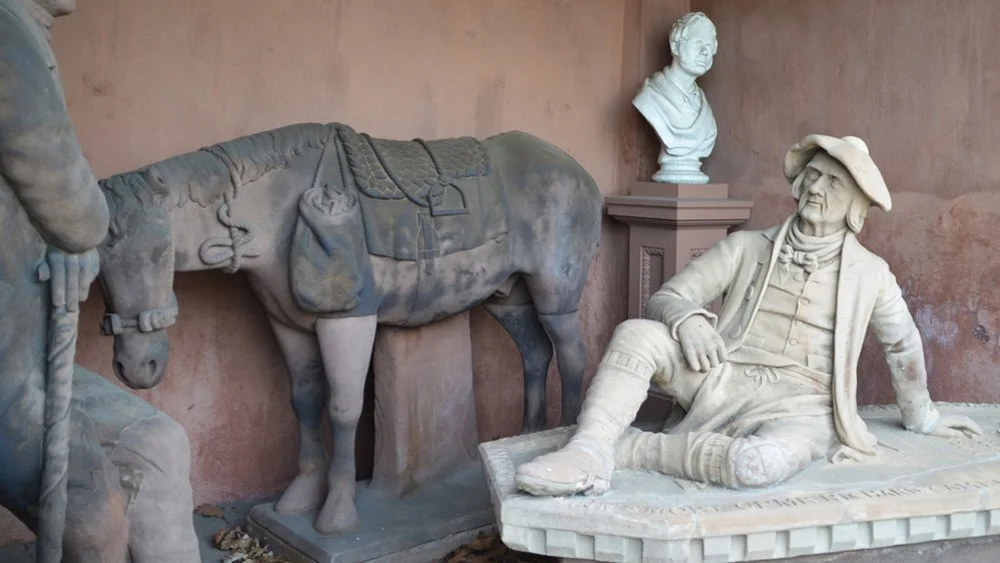
“Old Mortality” and his trusted side-kick.
“Old Mortality” used to re-engrave the tombstones of Covenanters.
“[B]oth Scripture and Humane Histories do shew, That though it hath been so almost in all times [there has been a general defection of ministers]; yet the Lord hath guided the matter so, that he hath still keep’d a Church to Himself. … [Yet] the Lord, amongst all the most general Defections of Ministers, hath ever keeped some straight: So as the Way of Truth and Piety is not left without a Witness, and some encouragement to those who walk in it.”—James Fergusson, A Brief Refutation of the Errors.
WORKS OF INTEREST TO REFORMED PRESBYTERIAN/COVENANTER HISTORY:
Memoirs of the Life of John Howie: Who Lived in Lochgoin, Parish of Fenwick, and died January 5th, 1793. Containing a Series of Religious Exercises, Soul Soliloquies, Meditations, and an Account of the Lord’s Goodness to him in general.-1796-John Howie.-This spiritual autobiography chronicles the intense religious exercises, physical afflictions, and profound inner turmoil of John Howie of Lochgoin during the final years of his life. Howie meticulously records his struggles with “predominate evils,” his fear of death, and his oscillations between spiritual despair and the comforting application of specific scripture promises—such as Micah 7:18-19 and Mark 2:5—culminating in a solemn covenant renewal in 1792. Throughout his narrative, he reflects on the duties of prayer, praise, and testimony-bearing, lamenting the widespread defection and deadness of the contemporary church while adhering to the strict principles of the Covenanted Reformation. The volume is supplemented by the dying testimony and persecution narrative of his great-grandfather, James Howie, which connects John’s personal piety to the family’s legacy of suffering during the “Killing Times,” and concludes with a list of subscribers who funded the publication. How to Read Howie’s Memoirs, and Why They Remain Valuable Today.
Memoir of William Orr, LATE FARMER, IN KILBIRNIE PLACE, Who departed this life, 25th Oct. 1814. AGED 85 YEARS. RELATED BY HIMSELF.-1814-William Orr [Preface by Thomas Henderson].-This spiritual autobiography, related by William Orr himself in his final years, chronicles his lifelong religious journey from the bondage of legalism to the liberty of the gospel of free grace. Born in 1729 and raised under a “legal ministry” that taught salvation by moral duty, Orr recounts his deep spiritual distress upon realizing the inadequacy of such doctrine to relieve a sin-burdened conscience, and his subsequent conversion upon hearing a dissenting minister clearly distinguish between the Law and the Gospel. Compelled by conscience, he separated from the Established Church—despite the cost to his social standing—and, after examining the various denominations, joined the Reformed Presbytery, the only body he found faithful to the Covenanted work of Reformation. The memoir also candidly details his providential transitions from affluence to poverty, his struggles with debt and failed farming ventures, and his determination to maintain integrity and faith through adversity. Concluding with a series of doctrinal testimonies, observations on the Christian life, and earnest counsels to his children, the pamphlet stands as both a personal narrative of divine grace and a polemical witness against the corruptions of the Established, Secession, and Relief churches.
Rev. John M‘Millan, A.M., Balmaghie.-1869-71-John H. Thomson (1824-1901).-These articles, from the Reformed Presbyterian Magazine, details the life and ministry of Rev. John M’Millan, a pivotal figure in the early Reformed Presbyterian Church. Ordained in the Established Church at Balmaghie in 1701, M’Millan quickly came into conflict with his Presbytery for demanding the revival of the National Covenant and Solemn League and Covenant, and for protesting the Church’s Erastianism and compromise. Deposed in 1703 for these “irregularities,” he briefly submitted to the General Assembly's Commission in 1704—a decision he later retracted as a rash mistake—before formally appealing to a “free and faithful General Assembly.” After lengthy negotiations, he accepted a call from the United Societies in 1706, becoming the minister for this remnant group that had been without an ordained pastor since the death of Renwick. He was later joined by Rev. John M’Neil, and together they protested the Union of 1707 as a breach of the Covenants. In 1712, M’Millan led the historic renovation of the Covenants at Auchensaugh. He died in 1753, firmly reaffirming his lifelong adherence to the covenanted work of reformation, his opposition to universal atonement, and his assurance of salvation in Christ. Reading John H. Thomson’s Articles on M‘Millan with Proper Perspective.
Historical Sketch of the Reformed Presbyterian Church of Scotland, to its Union with the Free Church in 1876.-1877-Robert Naismith (1822-1891).-This is a book that preserves the Covenanter testimony even as it documents its surrender. Naismith writes as a lover of the old Church, not as her enemy, and his narration of the Covenanters’ sufferings, their separation from the defective Revolution Settlement, and their maintenance of covenanted attainments is genuine and valuable. But he writes from the position of one who has already concluded that union with the Free Church was a consummation rather than a retreat, and this governs the whole book. The result is a work that honors the vocabulary of testimony, covenant obligation, and political dissent while explaining away their practical abandonment as Christian liberty. Naismith is strong where he defends why the Covenanters acted as they did; he is weak where he justifies why their successors ceased to act so. He preserves the old terms while normalizing their demotion from binding public testimony to tolerated private opinion. The careful reader must therefore receive gratefully what Naismith narrates about the Reformed Presbyterian Church’s principles, while recognizing that his account of their dissolution into the Free Church is not a vindication of the testimony but a record of its loss. How to Read Naismith’s Historical Sketch of the Reformed Presbyterian Church of Scotland.
The Rise and Progress of the Southern Reformed Presbyterian Congregation, Now Called the Renwick Free Church: Two Lectures.-1887-John MacMillan Robertson.-This congregational history, delivered as two lectures in 1885 by the founding clerk of the Southern Reformed Presbyterian Church in Glasgow, preserves valuable firsthand records of the congregation’s formation from the Great Hamilton Street church in 1853, its building campaigns, the calling of Rev. John M’Dermid, and the 1863 schism when six elders and forty members seceded over the Synod’s relaxation of discipline regarding political participation—but its narrative purpose is to justify both that relaxation and the 1876 union with the Free Church as natural progress rather than what they were: the abandonment of the covenanted testimony that constituted the Reformed Presbyterian Church’s reason for separate existence, a fact the author inadvertently confirms by titling his work after the congregation’s new name in the Free Church rather than the distinctive principles it surrendered. Reading Robertson’s Rise and Progress with Discernment.
Sketch of the History of the First Reformed Presbyterian Congregation, Noe the Great Hamilton Street Free Church, Glasgow.-1888-Thomas Binnie.-This congregational history of Glasgow’s First Reformed Presbyterian Church preserves valuable documentary records—ministry accounts, elder biographies, persecution-era membership questions, and the evolving terms of communion—but its narrative purpose is to justify the 1876 union with the Free Church as a happy consummation rather than what it was: the abandonment of the covenanted testimony that constituted the church’s reason for existence. How to Read Binnie’s Sketch of the History of the First Reformed Presbyterian Congregation with Proper Perspective.
The Kirk Above Dee Water.-1895-H.M.B. Reid.-This chronicles the rich ecclesiastical history of the Galloway parish of Balmaghie, anchored by its church on the banks of the River Dee. The narrative centers on the dramatic 26-year schism beginning in 1703, when the deposed Covenanter minister John Macmillan defiantly held his pulpit against Church and State, forcing his rival, William M’Kie, to minister from a makeshift “House of Rimmon.” Subsequent chapters profile later pastors—such as the ideal “Moderate” Samuel Martin and the misunderstood, unpopular factor-minister James Henderson—exploring the enduring tension between rigid principle and pastoral gentleness. Interwoven with vivid local lore and contrasts between the “Old Style” and “New Style” of Scottish rural worship, the book ultimately uses the ever-flowing river as a metaphor for the enduring life of the parish and the quiet rest that awaits its people. While useful for Covenanter history, it also chronicles the sad downfall of the RP Church, of Scotland, through laxity, unwarranted ecumenism and a general distain for the “old paths”. How to Read Reid’s The Kirk above Dee Water.
A Cameronian Apostle Being Some Account of John Macmillan of Balmaghie.-1896-H.M.B. Reid.-This book chronicles the life of John Macmillan, a Scottish minister whose rugged Galloway upbringing forged his resolute and conscientious character. Troubled by the Church of Scotland’s Erastian compromises following the Revolution Settlement, Macmillan presented a list of “Grievances” against the Church’s laxity and subordination to the state, leading to his hasty and unjust deposition by the Presbytery of Kirkcudbright. Defending his continued ministry in his True Narrative, Macmillan argued that unjust ecclesiastical sentences are void before God and do not bind the conscience. Ultimately, he aligned with the United Societies, serving as their dedicated pastor for forty-six years, a figure driven by deep piety, occasional self-distrust, and an unwavering commitment to the Covenanted Reformation. How to Read Reid’s A Cameronian Apostle.
Douglas Water Kirk.-1896-A.H. Gilruth.-This work chronicles the history of the Douglas Water Kirk and its Reformed Presbyterian (Cameronian) congregation in Douglasdale, Scotland. The book traces the church’s lineage from the persecuted Covenanters of the 17th century, detailing their adherence to the Solemn League and Covenant, the formation of the Cameronian Regiment in 1689, and their struggle to maintain religious ordinances after their ministers conformed to the Established Church. The narrative highlights the pivotal role of Rev. John M’Millan of Balmaghie, who accepted a call from the Societies in 1706 after a 16-year period without a minister, and the subsequent formation of the Reformed Presbytery in 1743. It then provides biographical sketches of the congregation’s subsequent ministers—John Fairley, John Milwain, and James Naismith—illustrating the austere worship practices, the physical construction of the church and manse, and the protective patronage of the House of Douglas. The history concludes with the internal strife of the late 19th century, specifically the 1863 denominational split over political franchise and the 1876 union with the Free Church, which resulted in a legal battle over property rights and the eventual absorption of the remaining congregation into the Church of Scotland as a quoad sacra parish in 1892. The appendix includes historical religious testimonies and personal covenants from the era of the Covenanters. How to Read Gilruth’s Douglas Water Kirk.
Brief Biographical Sketches of Some Irish Covenanting Ministers Who Laboured During the Latter Half of the Eighteenth Century.-1897-Samuel Ferguson.-This work provides biographical sketches of seven Reformed Presbyterian (Covenanter) ministers who laboured in Ulster during the latter half of the eighteenth century: William James, Thomas Hamilton, William Stavely, Samuel Aikin, Robert Young, Samuel Alexander, and William Gamble. The longest and most detailed sketch is of Stavely, “the apostle of the Covenanting Church in Ireland,” whose eventful ministry spanned over fifty years and included imprisonment during the 1798 rebellion on suspicion of United Irishmen sympathies, though he consistently denied involvement. The book, prompted by a request for historical information about the Reformed Presbyterian Church in the Derry area, takes a biographical approach on the principle that the denomination's history during this period is largely the history of its ministers. Ferguson drew laboriously on oral traditions, surviving relatives, presbytery records, and the earlier research of Rev. Professor Chancellor and Rev. W. J. Stavely, acknowledging that many important links to the past had been broken by recent deaths with no written histories to fall back on. Illustrated with photographs of churches at Bready, Knockbracken, Kellswater, Creevagh, and Faughan, the volume also includes a list of ministers, probationers, and students under the care of the presbyteries. How to Read Ferguson’s Brief Biographical Sketches of Some Irish Covenanting Ministers.
A Kirk and a College in the Craigs of Stirling.-1897-D.D. Ormond.-This work is a comprehensive history of the Craigs Reformed Presbyterian congregation in Stirling, Scotland, interwoven with a robust theological defense of the Scottish National Covenant and Solemn League and Covenant. It traces the congregation from its origins among the “Old Dissenters” through the long ministry of Reverend John McMillan—who also served as Professor of Theology training students in the Session-house from 1803 to 1819—and subsequent pastors including William Stevenson, Professor William Binnie, and D.D. Ormond. The narrative details the building of the church, the scattered “quarters” of members, the strict standards for ministerial training, notable students and laymen (most prominently publisher Thomas Nelson), and the congregation’s eventual union with the Free Church of Scotland in 1876, all while maintaining that the covenants bind posterity in perpetual obligation to the covenanted reformation. How to Read Ormond’s A Kirk and a College in the Craigs of Stirling.
Kilbirnie West.-1923-W.J. Couper.-This book it traces a congregation with Reformed Presbyterian/Cameronian origins through its later ecclesiastical transitions. It covers the 1824 disjunction from Kilmacolm, the building of the church, the first session, and the ministerial succession, including: Rev. James Ferguson; Rev. Peter Macindoe Martin; Rev. Alexander Davidson; Rev. Henry Tod Gillison, B.D.; and Rev. James Anderson, M.A. It preserves useful local RP memory, but also needs to be read carefully because the later United Free framing can soften or reinterpret the older Covenanter testimony. It discusses matters like the franchise/voting controversy, hymns and paraphrases, choir, harmonium, and union developments—precisely the kinds of details that show the congregation’s movement away from the stricter older position.
The Reformed Presbyterian Church in Scotland Its Congregations Ministers and Students.-1925-W.J. Couper.-This volume is of considerable value as a historical and biographical register of the Reformed Presbyterian Church in Scotland, preserving many names, dates, congregational details, disciplinary cases, publications, and institutional changes. It should, however, be read with discernment. The author writes from within, or at least under the shadow of, the post-Union Presbyterian settlement, and therefore often assumes that the 1876 Union with the Free Church represented a legitimate continuation of the Covenanter tradition. A strict Covenanter reader must distinguish carefully between the factual material preserved and the author’s implied judgments concerning union, separation, ecclesiastical continuity, public testimony, and the binding obligation of the Covenants. The book is most useful as a repository of data; it is less reliable as a guide to the principles by which that data ought to be interpreted.