The Rise and Progress of the Southern Reformed Presbyterian Congregation
James Dodson
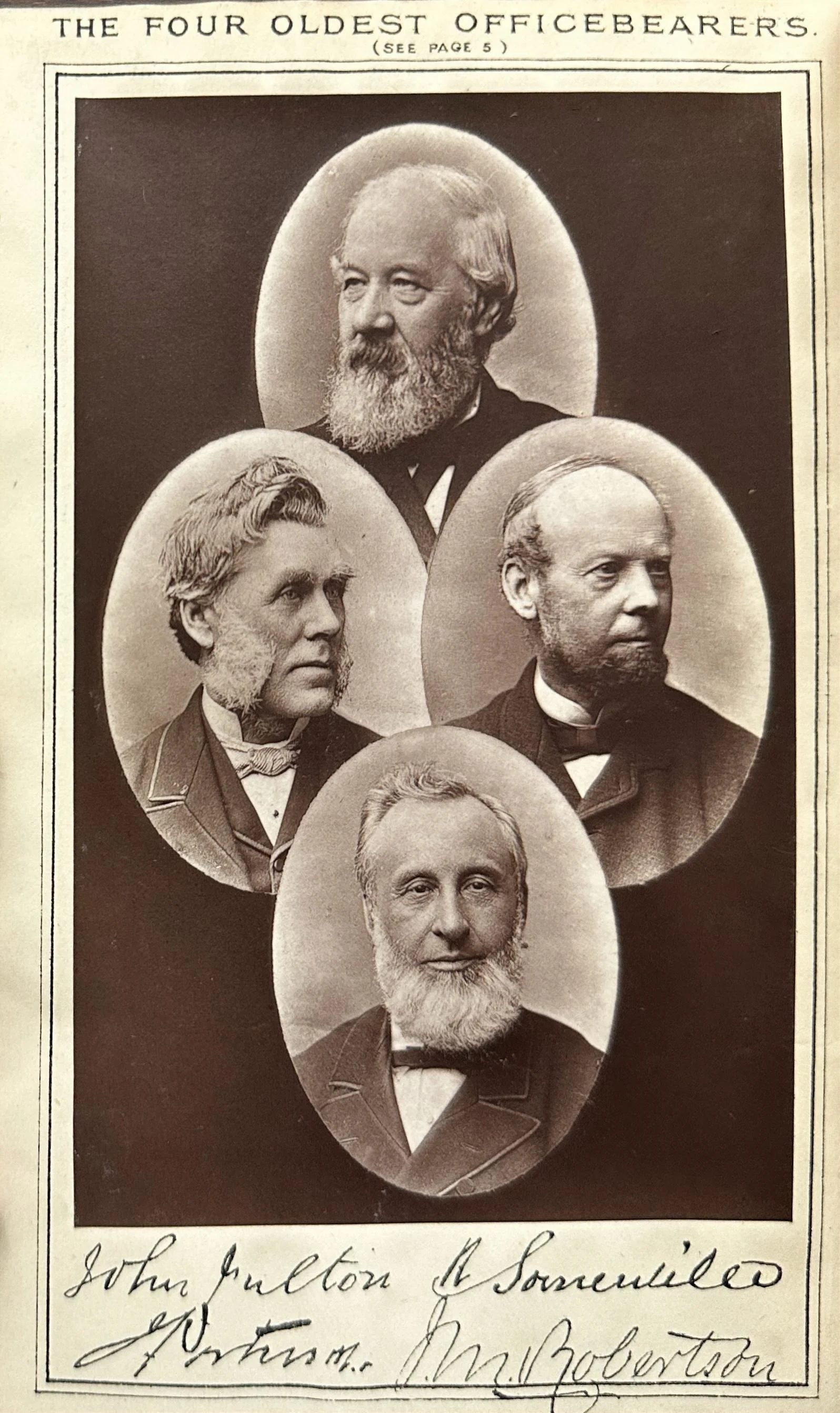
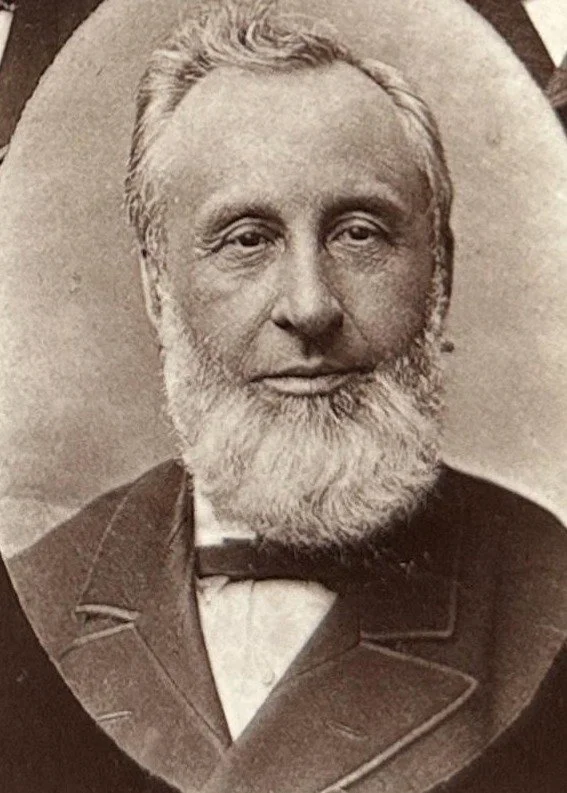
[Photograph of John Fulton (top); William Somerville (center-left); James Paterson, sen. (center-right); John MacMillan Robertson (bottom).]
[Handwritten inscription:] John Fulton, W. Somerville; J. Paterson; J.M. Robertson.
THE RISE AND PROGRESS
OF THE
Southern Reformed Presbyterian Congregation,
NOW CALLED
The Renwick Free Church:
TWO LECTURES
BY
JOHN MACMILLAN ROBERTSON,
CROSSHILL HOUSE, CROSSHILL.
With Appendix and Photographs.
DELIVERED AND PUBLISHED BY REQUEST.
GLASGOW:
PRINTED BY JAMES C. ERSKINE, 140 HOPE STREET.
1887.
PREFACE.
The preparation of these Lectures is due to the desire of Members of the “Renwick” Congregation to have the story of its origin and progress told by some one who could speak from personal knowledge.
It was at first thought that the “simple annals” of the Congregation could have been compressed into one Lecture; but the interest of the subject, and my desire to give such measure of detail as would enable my hearers to form a fair conception of the circumstances under which the incidents narrated took place, led to the subject being expanded into two Lectures.
Their publication is also by request; and is now resolved on, in order that the proceeds of their sale may be applied in aid of the effort presently being made to liquidate a portion of the Congregational Debt.
In the Appendix will be found various documents and statistics which, it is hoped, will be of interest to the Members, and of use for future reference. There has also been included that chapter of the unpublished “Chronicles” of the Great Hamilton Street Reformed Presbyterian Congregation which narrates, in the graphic style of the Old Testament, the disjunction from that Congregation of the founders of the “Renwick” Congregation. Though the chief actors are designated, in this quaint piece of contemporary history, by Scripture names, their identification will not be difficult to those who knew them.
CROSSHILL HOUSE, December, 1886.
INDEX.
Page
Lecture I., Delivered 22nd April, 1885,
5
Lecture II., Delivered 4th November, 1885,
27
PHOTOGRAPHS.
The Four Oldest Office-Bearers,
Frontispiece
Rev. Dr. William Symington,
To face page 6
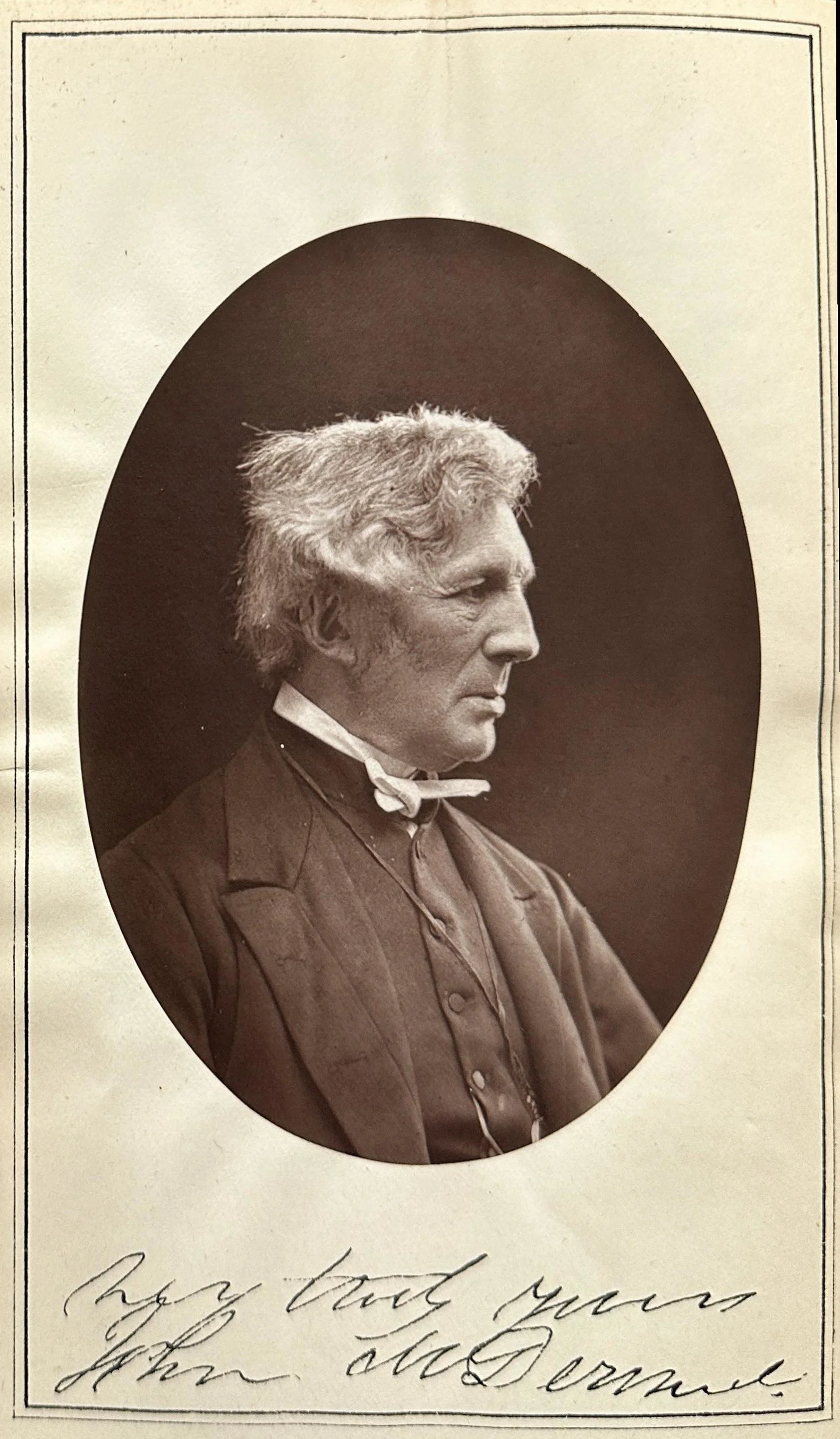
Rev. John M‘Dermid,
27
Rev. J. Fairley Daly,
47
APPENDIX.
Page
1. Minute of Meeting held on 7th March, 1853,
49
2. Preamble to Subscription Sheet,
50
3. Minute of Meeting held on 16th May, 1853,
51
4. Petition for Disjunction, presented to Glasgow Reformed Presbyterian Presbytery on 12th July, 1853,
52
5. Deliverance of the Presbytery thereanent,
55
6. Minute of First Congregational Meeting, held on 2nd August, 1853,
56
7. List of Additions to the Membership of the Congregation prior to the call to Mr. M‘Dermid, on 11th September, 1855,
58
8. Managers’ First Report to Congregation, 4th August, 1856,
60
9. Ministers and Office-bearers,
63
10. Missionaries and Assistants,
64
11. Summary of Congregational Income since its formation in 1853 to 1886,
65
12. “Chronicles” of Great Hamilton Street Reformed Presbyterian Congregation,
65
5
LECTURE I.
Delivered in Renwick Free Church, on 22nd April, 1885.
I am forcibly reminded, by the duty which I am now to endeavour to perform, of the words of the Preacher, the Son of David, King of Jerusalem—“One generation passeth away, and another generation cometh.” Though I am very far short of the years of my father, and though I cannot say that the grasshopper has become a burden, nor that desire has failed, my task to-night leaves me no alternative but to rank myself among the old men. I therefore crave the indulgence so universally granted to age in speaking of the past, when I endeavour to relate some of the leading incidents connected with the formation and progress of this congregation.
It was with a feeling of surprise, almost of sadness, that I heard my old and valued friend, Mr. James Paterson, state at our last congregational soiree that, of all who took part as church members in the formation of this congregation, only ten (of whom four are and have been office-bearers from the very beginning) now remain in its membership to tell the tale of its early struggles. I happen to be one of these “upper ten,” as also one of the four, having held the office of Clerk to the congregation from the time it was formed, down till a comparatively recent period; and hence my selection to give the new generation a brief outline of the leading facts of our congregational history.
6
It was in 1851 that the idea of a Reformed Presbyterian Congregation on the south side of Glasgow was first suggested. At that time the Church of the Second Reformation was represented in Glasgow by two congregations—Dr. Wm. Symington being minister of what was known as the Great Hamilton Street Congregation, and Dr. Bates of the West Campbell Street Congregation. Of the two congregations that of Dr. Symington was by far the larger, having then a membership of about 1000. The dignity of his manner, the eloquence of his preaching, and the soul-stirring nature of his enunciation of the great cardinal doctrines of the Second Reformation, led to the “Cameronians” being regarded with a degree of favour to which, for many years, they had been utter strangers. Men flocked from all quarters of the city to listen to the charm of his voice; and, in the course of a very few years, the Great Hamilton Street Church, which had long shewn “a beggarly account of empty” pews, became filled to overflowing.* With all his popularity Dr. Symington went strictly upon the old lines; and no one having any acquaintance with the old Reformed Presbyterian Church requires to be told, that it has ever relied upon its Fellowship Meetings as one of the best tokens of its vitality, and as one of the most effective preservatives against declension. These meetings were generally held in the houses of members, and they were to be found scattered all over the city.
_____
* Dr. Symington commenced his ministry in 1819, at Stranraer, where he so laboured that “his fame as a preacher, distinguished by talent of the first order, and by powerful eloquence, no less than by soundness of the faith, spread in a short time over the whole south of Scotland.” He was translated to Glasgow in 1839, and died there on 26th January, 1862, in the 67th year of his age, and 43rd of his ministry.
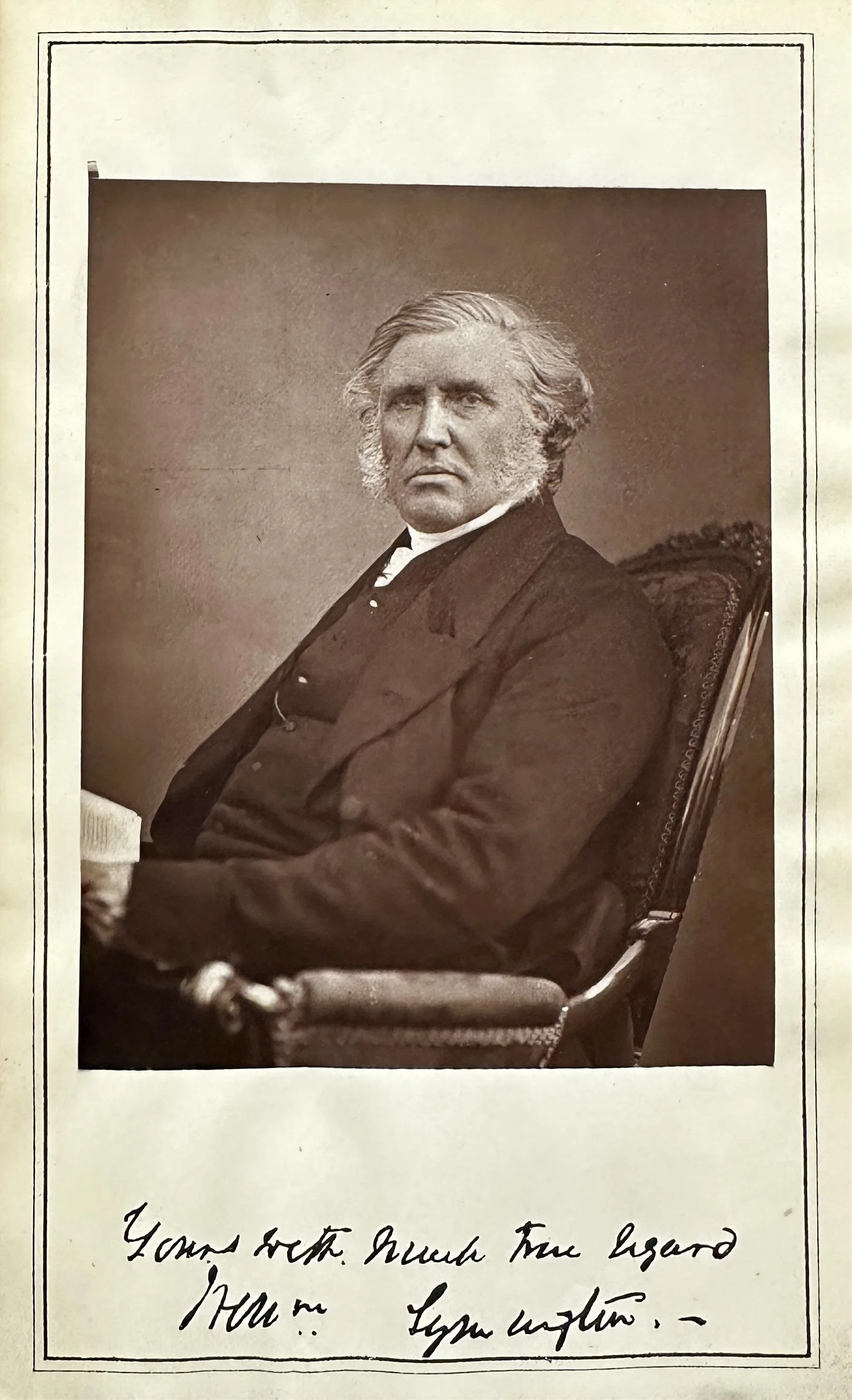
[Photograph of Rev. Dr. William Symington.]
[Handwritten inscription:] Yours with much true regard, Wm. Symington.
7
Three such meetings existed on the south side, and in the course of time the deepening interest in divine things, and the desire to promote the cause of “Christ’s Crown and Covenant,” combining with the friendship and esteem arising from the weekly intercourse connected with these meetings, gave birth to the idea of attempting the formation of a New Congregation on this side of the river. Which of the individual members first suggested it I cannot say, but I remember well that when the matter was first mentioned to me it was not a pleasant thought; for while I fully assented to the importance of the proposal, I also fully realized that there was but one Dr. William Symington. Gradually, however, our minds got accustomed to the thought of separation from him, and claiming, as we did, to be the descendants of Martyrs, we came to regard it as some evidence that we partook of their spirit in thus sacrificing our own feelings for the good of the noble cause for which they suffered so much.
After many preliminary conversations, mostly on our way going to or returning from church, and sometimes in the Glasgow Green during “the interval,” it was resolved to hold a meeting of those attending the prayer meetings on the south side, to consider the subject.
This meeting was held in the house of Captain Paul, in Cook Street, on the 7th March, 1853; and as the minute of it is the oldest record of the movement, perhaps you may prefer that I should read it in its entirety.—(See Appendix, No. I., page 49.)
As arranged, the next meeting was held in Buchanan’s Temperance Hotel, upon the evening of the 11th of March, 1853. The preamble (see Appendix No. II., page 50) which the Committee were appointed to pre-
8
pare having been submitted and approved of, each one present was invited to state the amount he was prepared to give; and it was found that the united subscriptions of the parties present who subscribed amounted to £246 10s.
This was deemed very encouraging, and it was resolved to remit to a Committee to endeavour to obtain further contributions.
The result of the labours of this Committee was, that the subscription sheet ultimately shewed a total of £750 5s. 4d. from 220 individuals. This gives an average subscription of a little less than three pounds ten shillings a-head. And small though the average was, the subscribers were allowed to pay by instalments spread over a period of three years.
By the 16th of May, 1853, the promises of support received from members of the Church resident on the South Side of the Clyde led to the belief that the time had now arrived for applying to be disjoined from the Great Hamilton Street congregation, and to be formed into a separate congregation. Accordingly, at a meeting held on that date, it was resolved to apply to the Presbytery for a disjunction, and instructions were given to have the necessary documents prepared. I may mention, in passing, that the minute of this meeting is the first record of our friend Mr. Paterson’s connection with the movement. At the meeting referred to he was put upon the Committee for obtaining additional subscriptions. This was the commencement of what has proved to be a life-long service to the congregation; and we all know with what devotion and ability he has invariably discharged his duties as Treasurer of the congregation, and as one of its Managers and Elders.
9
The Draft Petition for Disjunction having been afterwards prepared and approved of, the “testing time” arrived when it had to be signed. This was deemed to be too trying an ordeal to be undertaken at an ordinary meeting, and it was therefore resolved to hold a special social meeting for the purpose.
This was accordingly done, and the minute of the meeting bears that it was a very happy and interesting one. I cannot tell, as I have no notes to shew, the exact number of persons who were present at the social meeting; but I observe that, while the preamble to the subscription sheet bears that there were then 130 members on the South Side of Glasgow, “the most of whom had agreed to join in the scheme,” only 67 signed the Petition for Disjunction.—(See Appendix, No. IV., page 52.)
You will thus see that our numbers, like Gideon’s army, were considerably reduced by the taking of this decisive step; but our courage remained unabated, and we resolved to “go on, relying on Him who said, ‘Where two or three are gathered together in my name, there am I in the midst of them.’”
The Commissioners appointed by the Petitioners appeared at the meeting of Presbytery, held 12th July, 1853, and were very cordially received. Their statements in support of the Petition being concurred in by a deputation from the Great Hamilton Street Session (the only parties who might be supposed to have any interest to object), the Presbytery very heartily granted the prayer of the Petition; and as its deliverance on this subject constitutes our Charter as a Congregation, I will read it to you.—(See Appendix, No. V., page 55.)
10
The Deacons’ Court of Knox’s Free Church kindly granted the use of that Church for the day appointed for the Opening Services, being 24th July, 1853. But we found it easier to get a place of meeting than we did to get a Minister to conduct the services. Not only was Dr. Symington, who had been specially appointed by the Presbytery to conduct public worship, unable to do so, in consequence of his being from home, but several other Ministers of our Church who were afterwards applied to, were also unable, from various causes, to undertake the duty. Ultimately, Dr. Goold, of Edinburgh, kindly consented; and the admirable and appropriate sermons he delivered, notwithstanding the shortness of the notice, must, I am sure, be still fresh in the recollection of every member who was present in the congregation at the time. There was a large attendance, and the collection amounted to £24 11s. 0¾d.
Though Dr. Symington was unable to fulfil the presbyterial appointment of preaching to us on the first occasion of our meeting together for public worship, he fulfilled the appointment of attending the meeting held to constitute us as a separate congregation, on the 2nd August, 1853. At that meeting he was accompanied by several of the Elders of the Great Hamilton Street congregation, in order that a Session might be constituted for the transaction of any sessional work required on the occasion. By this arrangement members from other congregations who desired to join the new congregation were admitted by certificate. There were thus added to our number on that occasion, Andrew Donald, from the Ayr congregation; Alexander Leckie, his wife, his son, and his daughter, from the
11
Eaglesham congregation; Mr. James Pagan and his wife from the same; also, Mrs. S. Fulton, from the West Campbell Street congregation. These, with the 67 who signed the Petition for Disjunction, constituted the membership of the congregation at its first meeting. As the Minute of this, our first congregational meeting, not only gives the names of those who took a prominent part in its formation, but affords some means of estimating their aims and powers, I think you will desire to hear it read.—(See Appendix, No. VI., page 56.)
The first meeting of Managers was held two days afterwards, in the house of Mr. Robert Logan. At that meeting a Committee was appointed to look out for a site for a Church. The Committee consisted of Mr. Samuel Fulton, Mr. Logan, Mr. A. Leckie, Mr. Paterson (sen.), and myself,—Mr. Logan being made Convener.
The selection of a site gave rise to considerable difficulty. Several sites were looked at and considered, but ultimately the choice seemed to lie betwixt one in Wallace Street (between the Railway and Eglinton Street) and a vacant stance in Pollokshaws Road (just immediately above Cumberland Street). At last opinion generally came to be in favour of the site in Pollokshaws Road, which was therefore agreed upon. This site, though suitable in point of situation, was so peculiar in configuration as not to admit of a Church of the shape then almost universally adopted in Glasgow. It was therefore resolved to consult a firm of Architects, who, though having their head-quarters in Liverpool, had, about that time, obtained great repute in Scotland in connection with several Churches they had designed, particularly that of the Free North of Stirling (Dr. Beith’s).
12
They accordingly prepared a design specially adapted to the site; and so well did they succeed, that one would have imagined that the ground was laid off to suit the building, rather than the building to suit the ground.
It would have been a singularly beautiful and, I believe, suitable building, had it been erected; but the site had other peculiarities besides its shape. Its title was also peculiar, and was at that time so doubtful, that the authority of the Dean of Guild Court could not be obtained for the erection of the building within a reasonable time; and after considerable delay, and with not a little regret, the congregation resolved to look elsewhere for a site. In this dilemma our good friend, the late Mr. Thomas Binnie, who, as one of the Elders of Great Hamilton Street congregation, had taken a kindly interest in the promotion of the new congregation, came to our aid by purchasing a large piece of vacant ground fronting Cumberland Street and Salisbury Street, part of which he offered for a site on reasonable terms. This new site had the advantage—no small one for us with our humble means—of being adapted for a building of the very plainest description, requiring neither special construction nor architectural skill, or, as the architects referred to tersely expressed it, “No architect was required to design a square box.”
In closing my reminiscences on the selection of a site for the Church, I cannot help remarking how it formed a signal instance of what has often been observed, that work done in God’s service is sure to bring a reward in some form or another. Troublesome and perplexing as the subject proved to be, I do not think any one who devoted time and effort to aid in its satisfactory accomplishment had any reason to regret the efforts
13
so made. I have reason to know that it was the desire to aid us in getting a suitable site which led our old friend, Mr. Binnie, to purchase the vacant ground I have referred to,—on part of which the Church was ultimately built,—and the transaction proved to be a very profitable one for him.
Two of our members—Mr. Samuel Fulton and Mr. John Fulton—both of whom took a deep interest in the site question, were led, by doing so, to think of acquiring the ground between the Church and Cumberland Street, which proved a very fortunate investment for them; and as for myself, though the site selected left me to do the best I could with the Wallace Street site, which I had acquired entirely at my own risk, in order to keep it in the option of the congregation, I am bound to say I was successful in getting it resold at a price which left a small balance of profit.
Another observation I desire to make in this connection is, that our efforts in Church building developed a wonderful amount of latent architectural talent.
Not one nor two, but several members, became so interested in it that many an hour was spent in examining other churches, and utilizing the information thus obtained in the planning of designs for our own; and I am told that not a few good turnips were used for modelling some of the bright conceptions thus arrived at.
When at last the building was actually resolved upon, like prudent cautious folk, we passed a resolution fixing a limit as to the cost, beyond which the Managers were not to go. £900 was the amount to be aimed at, though a margin of £100 was allowed. But, alas! notwithstanding our best efforts, the almost invariable experience of every one who puts his hand into the lime tub
14
proved to be ours also; for when the total cost was summed up, it was found to be but little under £1400.
Now-a-days, for any one to suggest that a Church to contain upwards of 500 sittings, with a hall capable of holding 150, a Session-house, a Vestry, and having heating, ventilating, and lighting appliances of the most approved description, and with an elevation at once chaste and massive, could be erected for anything like that amount, would be deemed very foolish. But we accomplished it, and I think we had no occasion to be ashamed of having overstepped, to some extent, the limit laid down for our guidance.
The Church was opened for public worship on Sabbath, 18th March, 1855. Professor Wm. Symington, D.D., preached in the forenoon, Dr. Bates in the afternoon, and the Rev. Mr. Winning in the evening. The collections amounted to £80.
This Church, as you are all aware, ceased some years ago, in consequence of circumstances I will afterwards refer to, to be the property of this congregation; but it is matter of satisfaction to know that, hallowed as it is to some of us by many endearing associations, it is still used for the main purpose for which it was designed—the preaching of the Gospel. Long may it be so used; and if ever a time should come when anything “contrary to sound doctrine” be attempted to be taught within its walls, may the wish with which Dr. Symington concluded the powerful discourse he delivered at its opening, be fulfilled, by “the stone crying out of the wall, and the beam out of the timber answering it,” (Habakkuk ii. 11.)
I have perhaps dwelt too long on what, after all, are merely temporal matters. Much as these concerned us
15
at the time, they by no means so engrossed us as to lead us to neglect the fundamental objects of congregational life. One of the essential conditions for this is a settled ministry; and with a view to obtaining it, a list was drawn up of nine ministers, who were invited to preach to the congregation. These were—
The Rev. William Symington, of Castle-Douglas.
” James M‘Gill, of Hightae.
” John Kay, of Airdrie.
” Thomas Easton, of Stranraer.
” John M‘Dermid, of Dumfries.
” Robert Winning, of Eaglesham.
” John Graham, of Ayr.
” Thomas Neilson, of Rothesay.
” Professor Symington, of Paisley.
Of these nine ministers all have passed to their rest with the exception of two,—namely, the Rev. Dr. John Kay, now of Edinburgh, and the Rev. Thomas Easton, of Stranraer.*
While we thus sought help from all quarters of the Church, we were not entirely dependent on such supply, having had the good fortune to secure the services, for several months, of the Rev. David Berry, then a licentiate of the Church, and afterwards minister of the congregation at Wick, and latterly of the congregation in Airdrie. For a time we assembled for worship in Laurieston Hall, Bedford Street; thereafter in the Rev. Mr. Bremner’s church, Commerce Street; and latterly in Gorbals Youths’ School, now the Greenside
_____
* While these sheets are passing through the Press, the Rev. Mr. Easton has also gone to his rest, having died at Stranraer, on 12th March, 1887, in the 62nd year of his age.
16
Public School, which we continued to occupy till our church in Salisbury Street was ready.
Our first election of Elders took place on the 30th August, 1853. At that meeting it was resolved that three should be appointed. Five were nominated,—viz., Mr. David M‘Guire, Mr. James Paterson, sen., Mr. Alexander Leckie, Mr. Robert Logan, and Mr. Samuel Fulton. Mr. M‘Guire, Mr. Logan, and Mr. Leckie were chosen; and I am sure all of us know how faithfully and affectionately they discharged their duties.
Our first communion was held at the end of 1853, the services being conducted by the Rev. Thomas Neilson. On that occasion Dr. Symington presented the congregation with a communion roll and a baptismal register. This was the first present given to the congregation, and it is gratifying to reflect that it came from our former esteemed minister.
We have not, as a congregation, received many gifts, but we did get some. Amongst others we received the marble table, which still does duty in the large hall, from Mr. Duncan Wright, and the ornamental chair, which stands on the platform for the minister’s use, from Mr. Johnstone. I think our baptismal font was also a present to the congregation from Mr. Robert Tudhope.
We now come to the giving of a call to a Minister. It having been ascertained that there was a consensus of feeling in the congregation in favour of the Rev. James M‘Gill, of Hightae, application was made to the Presbytery to moderate in a call. After the usual notice, the meeting of the congregation for this purpose was held on the 18th November, 1853, Dr. Bates
17
presiding. The result was, that Mr. M‘Gill was unanimously elected. I have in my hand the original call, which contains the signatures of almost all the then members of the congregation. Few of those who signed the call still survive, and still fewer remain in connection with the congregation. I shall not take time to go over all these signatures. I may just say, that the number of members who signed the call was 94, and the number of adherents 43. After the call was completed, it was forwarded to the Dumfries Presbytery, under whose jurisdiction Mr. M‘Gill was, to be dealt with by them. Having been appointed by the congregation commissioner to prosecute the call before the Presbytery of Dumfries, I attended the meeting of Presbytery at which the first step in order to the presentation of the call was to be taken; but it got no farther. Mr. M‘Gill was not at the meeting, and I was very sad indeed to find, as I did immediately afterwards, what was the reason of his absence. Mr. M‘Gill had been thinking very seriously of the matter, and with that consideration for the feelings and interests of others which was a distinguishing feature of his character, he had resolved to prevent delay and save us needless trouble, by intimating that, having decided not to accept the call, his desire was that no further proceedings should be taken in regard to it. What led him to this conclusion is so well expressed in the letter he wrote to me on the subject, that I am sure you will be pleased to hear it read:—
SHAWFIELD, 30th November, 1853.
MY DEAR SIR,
I thank you most sincerely for the very full and satisfactory statement regarding your congregation, and the call it has given to me, contained in your kind letter of the 22nd;
18
and I thank the elders and managers for the very interesting paper which they also have sent me. I am glad to have received these documents, because they make me feel that I have not to decide with an imperfect knowledge of the past.
It has been my prayer, that if it was the Lord’s will that I should be your minister, He would open the way, so that I should clearly see it to be His will. For I need not tell you that, in such matters, the first thing to be sought is to have no will of our own.
I mentioned to you before that I would not keep the congregation in suspense; and although prevented by a bad cold from attending the Presbytery of Dumfries to-day, I have written to the Moderator, to say that I have taken the subject into serious consideration, and that, while I feel there are many encouraging circumstances connected with the congregation, I yet cannot see my way to accept the call. Some of the considerations that have weight with me I cannot express in writing; but I may say that, in comparing the claims of my present charge with those of your congregation, I do not feel that the latter so preponderate as to justify the dissolution of my existing ties. The life, activity, and spirit which your congregation possesses, whilst they would be a great inducement in coming to you, do, at the same time, give the pleasing assurance that you can have no difficulty in obtaining an able and suitable minister.
I have signified my decision to the Presbytery to-day, because longer delay is quite unnecessary, and would only produce in this neighbourhood a great deal of unprofitable excitement.
I ought to add, that my thanks are due to Dr. Symington and Dr. Bates for the kind manner in which they have both assured me of a cordial welcome, had I seen it to be my duty to accept your call.
With every good wish; and with many thanks to the congregation for the kind and respectful manner towards myself in which this whole matter has been conducted,—I remain, my dear sir, yours very sincerely,
JAMES M‘GILL.
J. M. ROBERTSON, ESQ.
P.S.—The kind manner in which you have written to me makes me feel that it is from my own hand you ought first to learn the decision to which I have come.
19
This letter was received by the congregation with great regret. We were unwilling to accept the decision as final, and we proceeded, by petition and otherwise, to endeavour to induce him to change his resolution; but it was of no avail, and we were ultimately, but very reluctantly, obliged to turn our thoughts elsewhere.*
The first we thought of, after Mr. M‘Gill, was the Rev. George Clazy, then newly licensed; and in the month of April, 1854, we resolved to moderate in a call to him. He had competing calls, however, one of them being from Paisley; and when all the calls were presented to him, his choice fell on Paisley, and we were accordingly still left without a minister.
That same year, in the month of September, our thoughts, as a congregation, were directed to the Rev. Thomas Easton, of Stranraer; and communications were made to him, which elicited such replies as led it to be believed that he would be disposed favourably to regard a call from the congregation. It was therefore agreed to moderate in a call to Mr. Easton; but on its being presented he did not see his way to accept it; and so our third effort in obtaining a minister proved unsuccessful.
As we were by this time worshipping in our own church, the necessity for a settled minister became still more forcibly impressed on us, and Mr. Logan and myself were informally deputed to go to Edinburgh, at the time of the next meeting of Synod, to advise with some of the ministers as to our position. An oppor-
_____
* The Rev. Mr. M‘Gill continued in the pastorate of the Hightae Congregation till 1864, when, owing to the health of his wife requiring her to reside in a warmer climate, he resigned that charge, after a ministry of thirty-five years. Sometime afterwards he accepted a call to the Presbyterian Congregation in Bournemouth, in the South of England, where he laboured with great acceptance till his death, on 3rd October, 1883, in the 77th year of his age.
20
tunity of an interview with Mr. M‘Dermid having presented itself, we had some very pleasant conversation with him on the subject; the result being, that although nothing definite was stated, we formed the idea, that if Mr. M‘Dermid received a hearty call he would favourably consider it. We reported this to our friends; and after considering the matter, it was resolved to petition the Presbytery for another moderation. This was granted, and Dr. Symington was appointed to preside.
Unlike our other moderations, in which we had practical unanimity, on this occasion we were divided; not because of any objection to Mr. M‘Dermid, but because some thought there was little probability of his leaving Dumfries. Those holding this view nominated the Rev. John Thomson, now of Hightae, then a licentiate of the Church; and the result was, that 40 voted for Mr. M‘Dermid, and 21 for Mr. Thomson. The minority very cordially gave way to the majority, and many of them were among the first to subscribe the call to Mr. M‘Dermid.
The call was presented to Mr. M‘Dermid on the 11th September; but previous to that I received a letter from him in regard to it; and as it is very characteristic of him, I hope you will permit me to read it to you:—
R. P. MANSE,
DUMFRIES, June 16, 1855.
MY DEAR SIR,
I have just had your note, and can have no scruple in replying to it, by saying that my thoughts and feelings on the whole matter to which your question refers, are exactly what they were when I conversed with you at Edinburgh. I said then, what I have no objection to say again, that if my mind was made up to refuse a Call from Glasgow, in the event of a Call coming out for me, I would tell you now, and, if possible, would prevent such an event; for the necessity of refusing such a Call would be to me, after the
[Photograph plate]
[Photograph of Rev. John M‘Dermid.]
[Handwritten inscription:] [Very] truly yours,
John M‘Dermid.
21
disappointments you have met with, inexpressibly painful, especially as I think the movement you have made in the formation of a third congregation entitled to the greatest respect and encouragement. I said also then, what I am led to say again, that I could not and cannot give the slightest ground for believing that I will accept of such a Call in the event of its occurring. My present position is one of respectability and comfort and usefulness. I have no desire to occupy another. I will be thankful to be allowed to live and labour where I am to the end. But I would seek to be saved from the presumption of shutting my ear to the voice of Divine Providence in whatever manner addressed; and were a Call coming out for me to another sphere, I would reckon it my sacred duty to give it my best and holiest consideration. But I would not consider any such Call at all were it springing out of the notion that I had contributed towards it by giving encouragement to proceed. So far as I am myself concerned, I can neither discourage nor encourage. I can only say I wish to feel myself entirely the Lord’s; and on supposition of any such case occurring, it will be my desire, in simplicity and godly sincerity, to obtain an answer to the question, “Lord, what wilt thou have me to do?”
I do not know to whom you refer in your letter. I cannot recollect having spoken to any one out of my own house on the subject since the Synod; but I am absolutely certain that I never since expressed a sentiment other than such as I expressed to Mr. Logan and yourself. Nobody, somehow, speaks to me on the subject, though I believe there is a good deal of talking about it. Even Dr. Symington and Mr. Neilson, who were here this week, as a deputation from the Sustentation Committee, never alluded to the subject to me. They had a very pleasant meeting with so many of my people as assembled: at least they seemed very satisfied with it. It was at once agreed to comply with the request they are making in regard to all the self-sustaining congregations, that of raising them up to £150 of stipend. Of course this was entirely an affair of the Committee, in which I was in no way consulted; but it seems to have been quite concurred in here.
I expect to be passing through Glasgow next week; and as Mr. Logan is at hand, I hope to be able to look in upon him for a few minutes.—Meantime I am, my dear sir, very truly yours,
Mr. Robertson.
JOHN M‘DERMID.
22
To our great joy Mr. M‘Dermid accepted the call; but we “joined trembling with our mirth,” for we all know the great sacrifice of personal considerations which he made in separating his connection with one of the best of our country charges, in which he was held in the highest esteem, and to which he was attached by many domestic ties, to come to a newly-formed city charge, presenting no attraction but the opportunity of hard, unremitting, and often thankless toil in his Master’s service. On the 8th November, 1855, he was inducted as the minister of the congregation. There were the usual services and meetings on such occasions, all of which passed off in the happiest manner; but instead of narrating these in my own words, I prefer to read the account given of them in the “Reformed Presbyterian Magazine” of December following:—
“PRESBYTERY OF GLASGOW.—This Presbytery met at Glasgow, on Thursday, the 8th ultimo, to induct the Rev. John M‘Dermid (late of Dumfries) to the pastoral charge of the Southern R. P. Congregation. The usual preliminaries having been gone through, the Presbytery repaired to the church, where the Rev. J. W. Macmeeken delivered an excellent and appropriate discourse from Psalm xx. 5, ‘In the name of our God we will set up our banners.’ The Rev. William Binnie offered up the induction prayer, and delivered the charges to minister and people in the most solemn and impressive manner.
“On the evening of the same day a social meeting was held within the church, which was filled in every part. The Rev. Professor Symington, D.D., occupied the chair. The chairman was accompanied to the platform by the Rev. Mr. M‘Dermid, Dr. Bates, Dr. Goold, the Rev. Messrs. Young (Lauriston), Binnie, Morrison, Goold (Newton-Stewart), M‘Caig, Young (Darvel), and by the Rev. James Gibson, of Kingston Free Church, the Rev. Mr. Luneburg, from Sweden, and the Rev. Wm. Burgess, of Eglinton
23
Street U. P. Congregation. Tea having been partaken of, the chairman, in a few appropriate remarks, expressed his commendation of the efforts of the congregation, his high gratification that these efforts had now been crowned with success, and gave a cordial welcome to Mr. M‘Dermid as a fellow-labourer in Glasgow, and as a co-presbyter. Mr. M‘Dermid then delivered a feeling and eloquent address, in the course of which he gave expression to the satisfaction he felt at the meeting being presided over, and his being first publicly welcomed to Glasgow, by him who had introduced him to his late charge, and who had for so many years been his firm and constant friend. He likewise expressed his satisfaction at the presence of his friend Dr. Bates, and of the other ministers present; and touchingly alluding to his former connection with the South, and more especially with that city known as the ‘Queen of the South,’ the memories of which he would ever cherish and retain, he said that it was even a certain satisfaction to him that he would still be connected with the South as the minister of the ‘Southern Congregation’ of Glasgow. With the presence of the ministers of other denominations—one of whom (Mr. Burgess) he had long known and highly esteemed—he likewise expressed his satisfaction, as tending to promote Christian intercourse; and he believed that amongst Evangelical churches it was possible to have co-operation without incorporation. Mr. M‘Dermid’s address was listened to with marked attention throughout, and was warmly applauded. The meeting was subsequently addressed by Dr. Bates, on ‘Christianity in its influence on domestic life;’ by the Rev. Mr. Gibson, on ‘Christianity in its influence on social life;’ by the Rev. Mr. Burgess, on ‘The importance of Christian congregational organization;’ and by Professor Goold, on ‘The urgency arising out of the present state of society of a living, energetic, aggressive Church.’ The addresses on these topics were interesting and instructive, and served to keep up the interest of the meeting till its close. At the request of the chairman, the Rev. Mr. Luneberg, from Sweden, made a few remarks, expressive of the pleasure the meeting (the first of the kind he had ever seen) had afforded him.
“On the Friday evening following a meeting of the ladies of the congregation was held within the school-room adjoining the church, when Mr. Logan, in their behalf, presented Mr. M‘Dermid with a pulpit Bible and Psalm-book, and a copy of Conybeare and
24
Howson’s ‘Life and Epistles of Paul;’ as also with a pew Bible for Mrs. M‘Dermid, and a pocket Bible for his son. At the same time Mr. Samuel Fulton, preses of the congregation, presented him with a purse, containing the subscriptions of a few friends, in and out of the congregation, to defray the expenses of his removal to Glasgow. Of these gifts Mr. M‘Dermid made a suitable acknowledgment.
“It is matter of hearty congratulation to all interested in the prosperity of the Southern Congregation, that it has obtained the blessing of such a pastor as Mr. M‘Dermid, and that his settlement among them has taken place under such happy auspices.
“Mr. M‘Dermid was introduced to his new charge on the Sabbath following. The services were conducted by Professor Symington in the forenoon, Mr. M‘Dermid in the afternoon, and by Dr. Bates in the evening. The church was crowded to excess each diet.”
One incident only I will mention, not because it is of any importance in itself, but because it illustrates the very humble position of the membership of the congregation, and the aptness with which our new minister could cite Scripture. It has always been customary for Reformed Presbyterian congregations to present a minister, on his induction, with a pulpit Bible and Psalm-book—we had not got the length of pulpit gowns in those days. In accordance with this good old custom, the female members of our congregation, as mentioned in the above extract, undertook to provide these for Mr. M‘Dermid, and they deputed one of the elders, Mr. Logan, to make the presentation in their name. Mr. Logan, with characteristic modesty, began by saying that he appeared as the representative of the females of the congregation. He said he would not call them ladies, for they laid no claim to that title, and it was not a title given to female members of the Church in the Bible. The presentation being made, Mr.
25
M‘Dermid acknowledged it in very felicitous terms, but with great good humour said he must take exception to Mr. Logan’s statement that “lady” was not a Scripture term. It occurred both in the Old and New Testament, and it must have been in common use in the days of the Apostles, for the Second Epistle of John was written to the “elect lady,” and in it he says to her, “I beseech thee, lady.”*
Having thus given proof of his fitness for correction, he entered upon a ministry, the memories of which no one who had the good fortune to live under it will willingly let die.
_____
* This worthy elder was not always so far out in his Scripture references. On one occasion, when called upon to conduct the devotional exercises at a meeting to which a most disappointing report was made, of a very partial fulfilment of expectations we had been led to form, he gave out—whether by chance or design I know not—as the Psalm to be sung, a portion of the 62nd, beginning—
“Surely mean men are vanity,
And great men are a lie.”
[Photograph of Rev. John M’Dermid.]
[Handwritten inscription:] Very truly yours, John M’Dermid.
27
LECTURE II.
Delivered in Renwick Free Church on 4th November, 1885.
Those of you who were present when I had the pleasure of addressing the congregation in April last, will perhaps remember that my narrative of our congregational history had reached the time of our late pastor’s induction, in November, 1855. My subject to-night is therefore the History of the Congregation during his pastorate.
To enable you to realize the circumstances of the congregation at the commencement of Mr. M‘Dermid’s ministry in it, I think I cannot do better than read to you the first formal report submitted by the Managers to the congregation at its usual annual meeting. I feel this to be all the more desirable because, though subsequent reports by Managers were printed and circulated among the members, this was not done with the first report, and, consequently, its terms cannot so well be recalled. I also feel that, having referred to our first meeting as a congregation, our first meeting for public worship, our first communion, and our first minister, it would be appropriate to refer to the first report of the Managers.—(See Appendix, No. VIII., page 60.)
The recommendation in this report as to a systematic method of raising funds for congregational and missionary purposes, was adopted, and so long as it was adhered to, wrought well. I find from the minutes that, at the
28
next congregational meeting, the preses was able to congratulate the congregation on its signal success; and at the annual meeting of the year following the treasurer’s accounts shewed a surplus of £34 7s. 4¾d.
I must confess, however, it was by the exercise of an economy which, in the estimation of some, would be regarded as parsimony, that a result so gratifying in itself was attained. We only paid our minister a stipend of £200 per annum; and to avoid the expense of a paid precentor and beadle, the duties of the former were discharged by certain members of the congregation who were possessed of the requisite musical powers, taking it in turn, while the duties of the latter were performed by the managers in rotation. The most trying, if not the most onerous of the duties thus undertaken by the managers, was found to be the carrying up the Bible to the pulpit, and then bringing in the minister at each diet of worship. Not a little interest was excited in the congregation as to the manner in which the amateur beadles performed their duties, and on the first occasion on which it fell to me to render this service, one of the wits of the congregation, alluding to my profession, said he had seen that day what he had never expected to see—the Law bringing in the Gospel!
But while anxious and careful to get both ends to meet, the congregation had a high conception of its duty, especially to the young. In addition to minister’s classes, Sabbath schools, penny banks, Bands of Hope, and other like agencies, the idea was formed that, as there was a great want of school accommodation in the district, especially for children of the poorer classes, advantage might be taken of our having a hall suitable
29
for a small school, to commence one there. After considerable deliberation and some debate—for we were not all of one mind on the subject—it was resolved to commence a school under a female teacher; and I observe, from the minute fixing the qualifications, that the two essential conditions of fitness were, “holding evangelical principles, and having a Government certificate.” In view of subsequent discussion and division as to the lawfulness of Reformed Presbyterians in any way recognising the Government, especially in church matters, the latter qualification forms a good illustration of practical wisdom getting over a theoretical difficulty. This school was ultimately formed by the appointment of Miss Gordon as teacher, and was conducted by her with marked success for several years.
I observe, in the minutes of the year I am now referring to, a curious entry as to an application made to the treasurer of the congregation for restitution of a one-pound note put into the plate, on an anniversary collection, by a person “in a disordered state of mind!” The managers instructed the pound to be returned; but I fear mental—perhaps I should say moral—disorder of the present day generally manifests itself in an opposite direction—“the withholding more than is meet, which tendeth to poverty.”
In August, 1857, an opportunity occurred, of which the congregation gladly availed itself, to give Mr. M‘Dermid a well-earned relief from duty, combined with stimulating fellowship. The Evangelical Alliance met that year in Berlin—the capital of the greatest Protestant State on the Continent. The late King of Prussia was known to take a deep personal interest in that association, and Protestant ministers from all parts
30
of the world were expected to be present. The happy thought occurred to us of sending our minister also. Leave of absence was accordingly granted to him, and a purse of sovereigns, sufficient to pay his expenses, was put into his hands, and he set off with a lightsome heart. He enjoyed his trip very much, and returned home stimulated and refreshed by what he had seen and heard.
In September, 1857, our first beadle was appointed, at a salary of £12; and the appointment of a precentor was also resolved upon; but before that resolution could be carried into effect, the failure of the Western Bank brought about such a commercial crisis in the City, as led the managers unanimously to recommend that such an appointment should not be made in the meantime; and it was accordingly postponed.
By 1860 the congregation had so much increased that the construction of a gallery began to be considered. Not that the sittings were fully let, but they were let to such an extent as to make it difficult to accommodate families with whole pews in certain parts of the Church. Combined with the erection of a gallery, for which provision had been made when the Church was built, the idea was suggested of otherwise improving the internal appearance of the Church. Internally it was very plain—almost so plain as to justify Mr. Hay’s criticism of its being a square box; but its dimensions were such as to permit of what was substantially a transformation from being one of the plainest Church interiors in Glasgow, to one of the most ornate; and it may be safely said, without undue partiality, that from being one of the least inviting interiors on the South Side of Glasgow, it became one of the most attractive. This was effected by dividing the building into nave
31
and aisles, according to the usual Gothic style of Church-architecture—the roof of the aisles, which were made to coincide with the line of the gallery, being formed with groined arches; and the roof of the nave being divided into panels supported by ornamental beams. The cost was about £1300. It produced one result, however, which those most interested in the congregation never ceased to regret. Before the gallery was put up we all sat in sight of each other, and had thus opportunities of observation and acquaintance which were greatly diminished when we became divided between the area and the gallery. The consequence was, that the family feeling which had so strongly prevailed under the old arrangement, could not be so easily maintained under the new; and I am sorry to say, that though we gained in beauty we lost in friendship and congregational effectiveness.
Having had this experience, it was to me a source of great satisfaction to find, when our present Church came to be planned, that the site permitted of the Church being of such a size as to give the required accommodation without a gallery; and though no one would rejoice more than I would, to see that accommodation so fully occupied as to give occasion to the members to say, “The place is too straight for us, give place that we may dwell,” I sincerely trust, that if ever this necessity arises, it will be found practicable to give this additional accommodation without constructing a gallery. Our present Church, viewed architecturally, is not only not adapted for a gallery, but our congregational life would suffer by it.
While the operations connected with the erection of the gallery were going on, the congregation met for
32
worship in the hall behind the Church, and our precentor (we had by that time appointed one*) thought he saw in this interregnum an excellent opportunity of quietly introducing an innovation, which up till then had been firmly opposed. By arranging with a few of the musically-inclined members of the congregation to sit near him in the hall, for which the absence of the usual arrangements as to sittings afforded an excellent opportunity without exciting special observation, and concerting with them as to the tunes to be sung, he hoped, like Paul, “being crafty,” thus quietly to introduce a congregational choir. Unfortunately for his success, he went a step too far; for he at same time used a pitch-pipe, to give his friends the right key-note. This was more than the Session of the congregation could stand; and, in the interval between forenoon and afternoon service, an emergency meeting of Session was held, at which such resolutions were passed as effectually prevented the repetition of the scheme in the afternoon. One half day thus sufficed to extinguish this attempt at innovation, and for many years afterwards the old style was rigidly adhered to—psalms alone being sung, repeating tunes being forbidden, the congregation sitting at praise, and standing during prayer. We have changed all this now; but some are still disposed to think that change does not necessarily constitute improvement.
The spirit in which the movement for the formation of the congregation was conceived, naturally led the promoters of it to desire to do mission work in the district in which the Church was located. For some
_____
* The son of “Jeduthun,” referred to in “Chronicles.”—(See Appendix, No. XI., page 65.)
33
years after its commencement these efforts were limited to what could be done by the members individually; but in 1858 the circumstances of the congregation seemed to warrant more systematic effort, and it was then resolved to appoint some one to devote his whole time to mission work in the district. The choice of the congregation was not attended with the usual difficulty, because of our good old friend, the late Mr. David M‘Guire, having volunteered his services. Mr. M‘Guire had from the very beginning been one of the most earnest supporters of the movement, and had devoted an amount of time and effort to its promotion which fairly entitled him to be regarded as the father of it—a title which well accorded with his venerable appearance. No one whose recollections of the congregation date back to its early days, will fail to remember, that whoever might be absent from any of the meetings Mr. M‘Guire was sure to be present; if debate arose, how anxious he was to make peace; and if work had to be done, who more ready to be “all things to all men” than Mr. M‘Guire? It was therefore felt that, in appointing Mr. M‘Guire to be Missionary, the congregation would not only be making a judicious choice, but would be conferring on him such congenial work as would be greatly gratifying to himself. He manifested the hearty appreciation of the appointment by the manner in which he discharged its duties. In season and out of season he laboured among the careless in the district; and though he was entirely destitute of the gifts of oratory, he had a degree of success—if bringing people to church is to be taken as any criterion of it—which comparatively few could shew:
34
After serving in this capacity for several years it was deemed expedient to have as congregational Missionary one who could occasionally afford Mr. M‘Dermid some relief in his pulpit duties. This led to the selection of students of divinity for that office; and as they always resigned on becoming licentiates of the Church, we had frequent changes.—(See Appendix, No. X., page 64.) With these missionaries Mr. M‘Dermid maintained the most cordial relations; and I feel assured that all of them regard their intercourse with Mr. M‘Dermid as one of their sunny memories.
But Mr. M‘Dermid’s connection with the congregation was not one of unbroken peace and comfort, and, as often happens, trials arose when, humanly speaking, comfort seemed most assured. At a time when, in point of members and income, the congregation had reached the highest development it had yet attained, a question arose which not only caused Mr. M‘Dermid great grief and trouble, but seriously affected the congregational strength. What materially added to the pain was the fact, that those who raised the question were mostly members who had joined the congregation out of special regard for Mr. M‘Dermid’s personal and ministerial qualities. He was thus literally “wounded in the house of his friends.” I shall not attempt any historical review of the controversy which led to such regrettable results, but for the sake of the younger members of the congregation I shall endeavour, in a few brief sentences, to explain it.
The Reformed Presbyterian Church claims to be the Church of Scotland as it was constituted during what is known as the Second Reformation—the period from 1638 to 1660. In 1661 the goodly work
35
of that memorable epoch in our national history was not only overturned by the corrupt Parliament of Charles II., but placed under the ban of the “infamous” Act Rescissory. Not a few of those who took part in these disgraceful proceedings were men who, like the king himself, had sworn the Covenants, and thus added perjury to treachery; but the best in the nation refused to submit, and hence a conflict between the Government and the people, as to which, it has been well said, that “in all the past struggles of patriotism and piety it would be difficult to name an instance where resistance to unrighteous claims was more imperative.” This led to twenty-eight years of as disgraceful and merciless persecution as is to be found recorded on the pages of history; and it is the proudest boast of our Church, that we are the ecclesiastical—and some of us the personal—descendants of the noble Covenanters, who, rather than violate their consciences, sacrificed every earthly interest, and even life itself, on the altar of Civil and Religious Liberty.
These dark days came to an end by the nation depriving the House of Stuart of the power they had so much abused, and transferring it to the House of Hanover. This took place in 1688, and is popularly known as the Revolution Settlement.
Our fathers naturally and reasonably expected that this settlement would have been based on the Covenant engagements, which the former dynasty had been deposed for setting aside; but, unhappily, other counsels prevailed, and the Church then organized was, both in regard to its own constitution, and especially in its relation to the State, essentially different from what it was under these National Covenant obligations. They
36
therefore refused to join it; and though for a time they did not form themselves into a separate organization, in the hope of the nation reverting to past attainments, to such an extent, at least, as would permit of their recognising the Church then established as the legitimate successor of the Church of the Second Reformation, they ultimately found, that if they meant to perpetuate a Church on that basis, they must unite for that purpose. They accordingly did so, and hence the Reformed Presbyterian Church of the present day.
Such being the origin of the Reformed Presbyterian Church, it was most natural and necessary that anything which could be supposed to identify it with what were regarded as the evils of the State and the National Church, as then constituted, should be carefully guarded against. Hence, for many years, our forefathers refused to recognise any ecclesiastical act done by Established ministers; and they were equally careful to avoid any act by which they would voluntarily recognise the State. They would not own allegiance to it, nor take part in its administration. They would not sue in its courts of law; they would not sit as jurors; and having regard to the fact that the taxes imposed by the Government were levied for purposes they felt bound to oppose, they had conscientious scruples as to paying them.
In all this they were morally and logically correct; and had matters remained as they then were, I do not see that, holding the principles we do, we could, with a good conscience, act otherwise than they did. But time brought changes in the constitution of these lands. The barriers by which every one was excluded from political power and privilege, except on an express acknowledgment of approval of the constitution as it
37
then existed, and undertaking to maintain it, gradually were removed, until it became apparent to every intelligent and candid mind, that the reasons which influenced our forefathers either no longer existed, or were very greatly modified. Accordingly, it was but reasonable that the attitude of the Church should be adapted to these changes; and hence, in the course of time, many things were permitted, if not sanctioned, which formerly would have been regarded as inconsistent with the fundamental principles of the Church. It was not always easy to realize the exact bearing of these changes on our position as a Church, and it is not, therefore, matter of surprise that there was often considerable divergence of view on the subject, even among those who were perfectly agreed as to its essential principles. This was particularly the case at the time of the passing of the Reform Bill in 1832. So great was the alteration then made on the constitution of the country, and some years later by the repeal of the Test and Corporation Act, that constitutional writers are agreed in regarding these measures as effecting in our national position what is usually accomplished by revolutions. The effect of these measures, undoubtedly, was to place the power of government entirely in the hands of the people, and that so completely as without let or hindrance they could, by constitutional methods, alter any part of the constitution. This led many members of the Church to think that it was not only lawful, in these circumstances, to use the power they had, in common with others, of altering the constitution, but that not to do so was a dereliction of duty—seeing that “to him that knoweth to do good, and doeth it not, to him it is sin.”
38
In view of these changes in the State, it would simply have been unreasonable for the Church to maintain its original attitude to it; and hence the history of the Church, if fairly written, would shew a gradual relaxation of the old rules and practices. In course of time its members sat on juries, they availed themselves of its courts of law, and they paid taxes with no other feeling than that “impatience of taxation” which is common to men of every creed. In all probability these rules and practices would have fallen into disuetude, and our members would, in such matters, have only been distinguished from others by their zeal in using their political powers to reform the State but for a new development of the question consequent on the Volunteer movement. Some who had no difficulty in occupying the negative attitude of not directly supporting the Government, were alarmed at the idea of our young men enrolling themselves as volunteers, and taking the oath of allegiance as such; and so strongly did they feel in regard to this, that in one or two instances attempts were made to exercise Church discipline on the young men who had done so. This led to the subject being brought before the Synod, and much discussion followed. As the contention of those who sought to enforce discipline turned upon what was implied in the oath of allegiance, the Synod appointed a committee to inquire into this. This committee obtained opinions on the subject from many of the leading statesmen and lawyers of the day, from which it was so obvious as not to admit of doubt that the view of that oath held by our forefathers, however correct it may have been as the constitution then stood, was utterly inapplicable to the constitution as it now
39
exists, and that no one now takes the oath in the sense in which the Church had been accustomed to regard it.
The report of this committee, with the opinions referred to, having been considered by the Synod at its meeting in June, 1862, resolutions were moved to the effect that matters of doubtful disputation did not form a ground of Church censure, and that while abstaining from giving any judicial sanction to the opinions expressed in the committee’s report, the Synod felt that they had no warrant from the Word of God to visit members of the Church taking the oath of allegiance in the sense stated, or exercising the elective franchise, “with the infliction of ecclesiastical penalties to the effect of suspension and expulsion from the privileges of the Church.” These resolutions having been carried by a majority of 42 to 11, were transmitted, as an overture from the Synod, for the consideration of Sessions and Presbyteries; and their reports thereon were considered at the meeting of Synod in the following year (7th May, 1863). At that meeting, by a majority of 46 to 11, the Synod enacted, that so far as regards taking the oath of allegiance and using the elective franchise, “discipline to the effect of suspension and expulsion from the Church shall cease.” Mr. M‘Dermid, in his place in the Synod, the Presbytery, and the Session, gave the full weight of his powerful advocacy to the side of Christian liberty; and some of his speeches, for breadth of view and terseness of expression, combined with intelligent appreciation of the essential principles of the Church, are worthy of high rank in political debate. But such discussions were entirely contrary to his disposition and his inclinations. He was pre-eminently a man of peace,
40
he was no lover of debate, and nothing was farther from his nature than to force his views upon others. He therefore entirely and heartily concurred in the decision of the Synod, which, avoiding any judgment upon the merits which could affect the conscientious convictions of any one, limited the action of the Church to declaring the subject one of doubtful disputation, which would not warrant the Courts of the Church, in exercising discipline in regard to it, to the extent of suspension and expulsion from its membership.
This resolution, so moderate and so reasonable, was nowhere attacked more fiercely than in his own Session, and by a majority a resolution was passed by the Session disapproving of it; and when at last the Synod’s enactment became final, he had the mortification of seeing 6 of his elders and 40 of his members secede from the Church in respect of it.
I do not desire to judge any man in this matter, but I must say, in the words of another, that to my mind it “was the smallest, narrowest, most indefensible pretext for division that ever, in all the strange history of ecclesiastical splits in Scotland, separated brethren from one another.”
But with diminished numbers came increase of peace—what we lost in volume we made up in zeal; and I think I am warranted in saying, that the years which followed this lamentable schism were perhaps the happiest and most useful in all Mr. M‘Dermid’s ministry in Glasgow.
The congregation was shortly afterwards compelled, in protection of its property rights, to enter upon a contest of another description. In 1864, a railway scheme, known as the City Union Railway, was projected to
41
pass through the district in which the church was built. On the plans of it being examined, it was found that the railway was so laid off as to pass along the whole length of the church, and quite close to it. The managers were advised that, if so constructed, it would be seriously detrimental to the property, and particularly to its use for the purposes for which it had been erected. They were further advised, that if the railway was constructed without any portion of the church ground being taken for that purpose, the congregation would have no claim for compensation, no matter how serious the injury might be which would thereby be occasioned. It was, therefore, resolved to petition Parliament against the bill, in the hope that the railway company would recognise the justice of their claim to be compensated, whether any part of the church property was taken or not. The company positively refused to do so; and the congregation had therefore no alternative, but either to submit to the injustice or to oppose the bill in committee. This, for a small and weak congregation, was a very serious undertaking, but, encouraged by extraneous promises of help, it was resolved on; and the result was most satisfactory, a clause being inserted in the bill providing “That, notwithstanding, it may not be requisite to take for the purposes of the railway or works any portion of a certain church or accessory buildings, numbered 91 on the deposited plans, the owners thereof shall be entitled to such compensation as may be determined in manner provided by ‘The Lands Clauses Consolidation Act, 1845,’ in respect of the use, enjoyment, and value of the said church and accessory buildings being injuriously affected by the execution of the railway and works.”
42
We have, therefore, the unique position of being the only Reformed Presbyterian congregation specially mentioned and protected by Act of Parliament; and I am happy to be able to add, that so fully were the promises of help fulfilled, that this Parliamentary contest did not cost the congregation a single penny.
In consequence of this clause the railway company preferred to purchase the church property, rather than pay compensation for the injury the construction of the railway would do to it; and as this course was deemed to be in the interests of the congregation, an agreement was entered into by which the railway acquired the property. The amount received under the agreement in name of price, compensation for disturbance, and interest, amounted, in all, to £4957.
This transaction led to a renewal of our site difficulties, and we had a repetition of the experiences we had undergone with reference to our first effort in church building. After much inquiry and consideration, our present site was acquired, and the building in which we are now assembled was erected. I shall not attempt any description of it, preferring to say, in the words inscribed over the entrance to St. Paul’s Cathedral in London, with reference to its great architect, Sir Christopher Wren, “Si monumentum requiris, circumspice.”
The new church was opened on 5th September, 1869—the Rev. Dr. Goold preaching in the forenoon, Mr. M‘Dermid in the afternoon, and Dr. Black, of Wellington Street U. P. Church, in the evening. The church was, on each occasion, filled to overflowing, and the collections amounted to £74 10s. 6d.
With so large a sum at our disposal, it would naturally
43
be thought that we would have been reinstated in a new church free of debt. It has to be borne in mind, however, that there was a bond of £600 on our former church, which had to be deducted. Besides, the site chosen was not only larger in extent, but otherwise more valuable, and our views as to style and accommodation had considerably developed since our first effort at church building—our plans embracing additional halls, a manse, and a house for the beadle. The consequence was that, when the cost was fully ascertained (£6107 6s. 10d.), we were found to be in debt to the extent of £1700. We had, however, revenue from rents to the extent of about £140 per annum, which, it was reckoned, would not only pay the interest on the debt, but also the debt itself in the course of a few years. But “the best laid schemes o’ mice and men gang aft agley;” and so it proved in regard to this arrangement, for the Board Schools, which were shortly afterwards established in the district, rendered the private school for which our premises were let unprofitable, and it was accordingly discontinued, thereby causing us a loss of £75 per annum. The rental thereafter barely sufficed to pay interest and other charges, so that, though 17 years have now elapsed since the debt was contracted, it is as large as ever. I am glad to know that it is now seriously contemplated to make some effort to free the congregation of this burden.
After the congregation got fairly settled in the present premises, its history, with the exceptions about to be mentioned, presents no feature of outstanding interest. Our worthy pastor, freed from the distractions of ecclesiastical strife and debate, and surrounded by office-bearers whose views were congenial with his own,
44
was enabled, with pleasure to himself and satisfaction to the people, to do the work of a minister; all the agencies of the church were maintained in a state of efficiency; and so far as the congregation was concerned, no greater desire could have been entertained for it, than that it might be allowed to continue the even tenor of its way.
But while this was true of the congregation, it was not true of our Church as a whole, nor of the sister churches—the Free and the United Presbyterian—with which it had so much in common. Thoughtful men in the three churches had been led to consider, that in the providence of God the time had arrived when the Presbyterianism of Scotland might be united in one Church. Such a union has been the dream of many a Christian patriot, and it was a source of great satisfaction to Mr. M‘Dermid to have the opportunity of aiding in its accomplishment. Union, he held, was the normal condition of Presbyterianism, and separation the result of some violation of its fundamental principles. The Covenants he regarded as the means by which our forefathers sought to effect union in their day; and while he adhered to the engagements in these national deeds, he never could regard them as excluding every other method of effecting union. He therefore gladly consented to take part in the negotiations of the three churches with a view to union; and on that proposal being found to be so beset with difficulties as to lead to its being for a time abandoned, he took part in the subsequent negotiations with the Free Church, with no other regret than that the union proposed did not include the United Presbyterians also. He greatly rejoiced in the happy union which resulted in 1876, and all the
45
more so that it was effected on terms which not only conserved the principles of our Church, but also its historical position. It was not, as some erroneously think, from the name of the Free Church being taken to be that of the United Church, effected by our Church being merged in the Free Church. On the contrary, the two churches united (notwithstanding their great disparity in size) on equal terms; and the Act of Union expressly provided, “That the two churches shall henceforth constitute one United Church in all matters spiritual and ecclesiastical, . . reserving to the said Reformed Presbyterian Church of Scotland its separate name and existence, in so far as regards the civil rights and property now belonging, or which may hereafter accrue or belong to it or any of its congregations,” with power to meet as heretofore as the Courts of that Church. In this way the condition agreed on as the fundamental basis of the negotiations, that the union should be such “as would enable each of the churches—the smaller as well as the larger—to retain its historical position and distinctive principles,” was fulfilled to the very letter. No more striking evidence of this can be desired than the fact, that the first Act of the United Church, after the Act of Union was signed, was the election of a moderator—the moderators of both having ceased to hold office by the signing of that deed.
It so happened that I was the representative elder of our congregation at the meeting of Synod which consummated the union, and I had the honour of walking arm-in-arm with Mr. M‘Dermid from the Free Martyrs’ Church (Dr. Goold’s) to the Free Assembly Hall. The heart-stirring scene then enacted can never
46
be effaced from the memory of any one who was privileged to take part in it.
The immediate effect of the union on our congregation was not such as we could have wished, though it was quite what was anticipated might happen. Several families, whose residences were at considerable distances from the church, no longer thought it necessary to pass Free Churches much nearer to them to come here, and so they gave practical effect to the union by connecting themselves with Free Church congregations.
To secure uniformity in the management of congregational affairs in the United Church, it was rightly deemed expedient to adopt the Free Church system of management and finance. This led to a complete change in the nomenclature of our congregational offices. Instead of our temporalities being attended to by the body called Managers, a Deacons’ Court was constituted, and the offices of Preses, Treasurer, and Clerk of the Congregation ceased to exist. Thus it was that, having held the office of Clerk from the formation of the congregation till the office was abolished—a period of 25 years—I may lay claim, so far as it was concerned, to have been “after the order of Melchizedek,” seeing I had no predecessor and no successor.
It was also deemed proper, consequent on the Union, to adopt a name for the Congregation which would harmonize with the new circumstances, and ultimately “The Renwick Free Church” was that agreed upon.
Some time after the Union it became apparent that Mr. M‘Dermid’s health was giving way. Though never actually laid aside from duty, it was obvious that his strength was being overtaxed, and various sug-
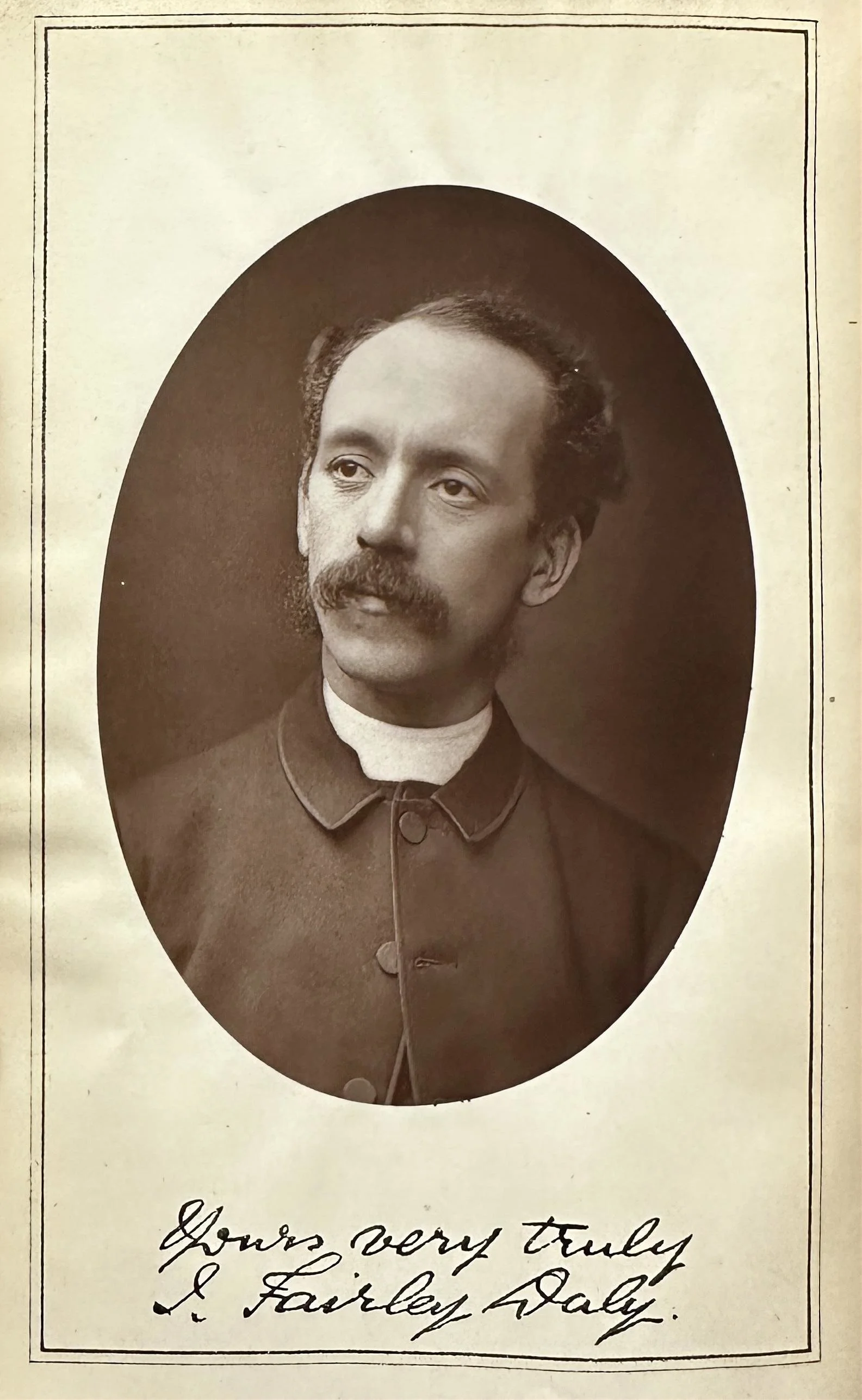
[Photograph of Rev. J. Fairley Daly.]
[Handwritten inscription:] Yours very truly, J. Fairley Daly.
47
gestions and arrangements were made with the view of lightening his labours. He was most unwilling, however, to contemplate anything like retirement from active service—his desire was to die in harness, and it was granted to him. On the 20th February, 1882, after a brief illness, he quietly breathed his last. He was buried in the Necropolis; and over his tomb his sorrowing Congregation have erected a simple monument, with an inscription which, though brief, expresses his life and character as clearly as if volumes were written for that purpose:—
“HE WAS A GOOD MAN, AND FULL OF FAITH AND THE HOLY GHOST.”
Though any reference to our present ministry does not fall within the scope of the duty devolved upon me, and which I have thus very imperfectly, I fear, performed, I cannot conclude without saying how deeply gratifying it was to those who, like myself, have been connected with the Congregation from its early days, that it should so happen, that both by lineal descent, early training, and personal conviction, his successor, our esteemed pastor, the Rev. John Fairley Daly, B.D., is one who can appreciate and sympathize with the motives which gave birth to this Congregation, and the labours of those who have sought, under such varying circumstances, to maintain and perpetuate it. We cordially wish him all success in his efforts, and trust he may long be spared to us, to see “the pleasure of the Lord prospering in his hands.”
APPENDIX.
I.
MINUTE OF A MEETING HELD WITHIN THE HOUSE OF CAPTAIN PAUL, COOK STREET, GLASGOW, ON 7TH MARCH, 1853.
Present—the following members and adherents of the Great Hamilton Street Reformed Presbyterian Congregation residing on the south side of the Clyde:—
Mr. James Paterson.
” Robert Logan.
” John Muir.
” William Grieve.
” John Munro.
” John Cunningham.
” Duncan Wright.
” James Macdonald.
” Andrew Ballantyne.
Mr. Daniel Wright.
” Robert Robertson.
” William Macfarlane.
” John Fulton.
” J. M. Robertson.
” Neil Carmichael.
” William Manson.
” David M‘Guire.
” Samuel Fulton.
Mr. M‘Guire was unanimously appointed chairman, with power to sign the minutes.
After engaging in prayer, the chairman explained that the present meeting had been convened for the purpose of considering the propriety and practicability of forming a congregation on the south side of the Clyde in connection with the Reformed Presbyterian Church in Scotland. He further explained to the meeting that Messrs. Duncan Wright, William Manson, John Fulton, and himself, at the request of several of their brethren, had waited upon Dr. Symington some short time since to inform him that such a movement was contemplated, and to ascertain his mind in regard to it; and he was happy to state that Dr. Symington had given it his cordial approbation. Since then members on the south side had been waited upon for a similar purpose, and the most of them had agreed to join in carrying the scheme into execution, and to give it their hearty support. Having made these explanations, he invited parties present to express their sentiments on the subject.
After a lengthened and friendly discussion, the meeting appeared to be unanimously of opinion that the Great Hamilton Street Congregation had now so much increased, by the blessing of God upon the labours of its pastor, as to render it desirable and necessary that some additional church accommodation should be pro-
50
vided, and that there are a sufficient number of members on the south side of the Clyde to form the nucleus of a new congregation. At the same time expression was given by all present to the regret with which they contemplated the leaving of a pastor whose ministrations they had so much enjoyed, and by which they had been so greatly edified.
It was therefore moved by Mr. Logan that the parties present pledge themselves to use all their endeavours forthwith to obtain the formation of a congregation and the erection of a church on the south side of the Clyde, and that each individual present seek to interest the other members of Dr. Symington’s congregation residing in that locality in this movement.
This motion was seconded by Mr. Munro, and was unanimously and cordially agreed to.
It was then moved by Mr. Logan, seconded by Mr. Duncan Wright, and, after some discussion, unanimously agreed to, that the number of sittings in the church proposed to be erected shall not exceed 700.
The following gentlemen were then appointed a committee to look out a suitable site for a church:—viz., Messrs. S. Fulton, Paterson, Manson, Logan, Duncan Wright, J. M. Robertson, John Somerville, Mr. Logan convener.
Mr. John Fulton was unanimously chosen to be treasurer, and J. M. Robertson to be clerk.
It was agreed that the next meeting should be held in Buchanan’s Temperance Hotel, corner of Bridge Street, on Friday next, at eight o’clock in the evening; and the treasurer and clerk, along with Mr. Manson, were instructed to prepare and lay before that meeting a preamble for a subscription list.
The meeting was closed with prayer.
II.
SUBSCRIPTIONS FOR ERECTION OF A CHURCH IN GLASGOW, ON THE SOUTH SIDE OF THE CLYDE, IN CONNECTION WITH THE REFORMED PRESBYTERIAN CHURCH IN SCOTLAND.
Several of the members of the Great Hamilton Street Reformed Presbyterian Congregation, who reside on the south side of the Clyde, having taken into consideration the overgrown state of that congregation, and that there are now a sufficient number of the members thereof on that side of the river to form the nucleus of another congregation, were of opinion that it was both necessary and desirable to have a church erected in that quarter of the city. Dr. Symington having cordially expressed his approbation of such a movement, they waited upon the rest of their brethren
51
residing in that locality, to ascertain their sentiments in regard to the proposal; and they were greatly encouraged to find that nearly all of them (and they are about 130 in number) agreed to join in carrying the scheme into execution, and to give it their hearty support.
In these circumstances, although they cannot but regret leaving their respected pastor, whose ministrations they have so much enjoyed, and by which they have been so greatly edified, they feel that this is a sacrifice which, in the providence of God, they are called upon to make for the extension of the Covenanted work of Reformation in the land; and they therefore call upon their brethren and friends to assist them in thus lengthening the cords and strengthening the stakes of the Church.
III.
MINUTE OF MEETING OF MEMBERS OF DR. SYMINGTON’S CONGREGATION FAVOURABLE TO THE ERECTION OF A CHURCH ON THE SOUTH SIDE OF THE CLYDE, HELD IN BUCHANAN’S COFFEE-HOUSE, BRIDGE STREET, ON MONDAY, 16TH MAY, 1853.
Present:
William Manson.
Robert Logan.
Samuel Fulton.
Henry Lapraik.
James Paterson, jun.
William Grieve.
William Reid.
William Somerville.
Robert Tudhope.
John Muir.
Neil Carmichael.
Daniel M‘Callum.
James Fulton.
Duncan Wright.
Robert Bell.
Daniel Wright.
Alexander Ballantine.
John Cunningham.
Alexander Rodger.
Isaac Taylor.
David M‘Guire.
James Paterson.
Mr. Manson was appointed chairman, and authorized to sign the minutes of the meeting.
The meeting having taken into consideration the whole circumstances connected with the movement for the erection of a new church, were unanimously of opinion that these are sufficient to warrant an application for a disjunction; and Messrs. Manson, Paterson, and Robertson were appointed a committee to prepare a petition to the Presbytery for that purpose, to be laid before the next meeting for signature.
The next meeting was appointed to be held within Buchanan’s Coffee-House, on Monday, the 30th curt., at eight o’clock.
The following were added to the committee for obtaining sub-
52
scriptions, &c.:—James Paterson, jun., Robert Tudhope, Alexander Rodger, John Cunningham, and Isaac Taylor.
The meeting was opened and closed with prayer.
IV.
Unto the Moderator and other Members of the Glasgow Presbytery of the Reformed Presbyterian Church in Scotland, to meet at Glasgow on the 12th day of July, 1853,
The PETITION of the undersigned Members of the First Reformed Presbyterian Congregation in Glasgow, under the pastoral charge of the Rev. William Symington, D.D.,
HUMBLY SHEWETH,
That your Petitioners being deeply impressed with the obligation resting upon them, of not only maintaining but also diffusing the principles of the Second Reformation, in the great and still increasing city in which their lot is cast, have been led to consider that, in Providence, there is now a special call to this duty, inasmuch as the Congregation of which they are members has, by the blessing of God upon the labours of its pastor, so much increased that the church is insufficient for the accommodation of the members and their families.
That the members of said Congregation at present number nearly 1000, which renders it difficult, if not impossible, for the pastor to discharge all his ministerial duties.
That your Petitioners, after much prayerful deliberation, resolved to take measures for the formation of a new congregation, and the erection of a Church in that part of the city lying on the south side of the Clyde (where nearly all of them reside, and in which there are now about 160,000 inhabitants); and for that purpose there has already been subscribed by your Petitioners and others friendly to the movement the sum of £660.
That your Petitioners consider this sum and the assurances of support they have otherwise received sufficient to warrant them to proceed with the erection of a Church fitted to contain about 700 sitters; and they are prepared to acquire ground in a suitable locality for that purpose so soon as they are placed in a position to do so, by being disjoined from the congregation of which they are at present members, and constitute into a new congregation by your Reverend Court.
That from inquiries your Petitioners have made, they find there will be no difficulty in procuring a suitable place of meeting during
53
the time which must necessarily elapse before the Church which they propose to build can be ready for occupation; and they confidently expect to be able, as they are desirous and willing, to defray all the expenses attending the celebration of ordinances amongst them.
Your Petitioners beg to assure your Reverend Court that it is no feeling of dissatisfaction either with their pastor or brethren which has induced them to take this step; of him and them they entertain feelings of the highest regard,—but the circumstances before stated seemed so urgently to call for this movement, that they would have regarded themselves as chargeable with want of zeal for the principles which they have espoused, if they neglected the opportunity thereby afforded of adding another to the watch-towers of Zion.
May it therefore please your Reverend Court to grant the Petitioners a Disjunction from the Congregation of which they are presently members; to constitute them in due form into a new Congregation, under whatever designation may be deemed most suitable; and to grant them a supply of Public Ordinances until they obtain a stated pastor; and to represent them in this behalf, and to give all necessary information, your Petitioners hereby appoint John Fulton, James Paterson, and John Macmillan Robertson, to be their Commissioners.
And your Petitioners will ever pray, &c.
David M‘Guire, 7 Norfolk Street, Agent.
Robert Logan, 32 South Portland Street, Baker.
Mrs. Elizabeth Logan, 32 South Portland Street.
Samuel Fulton, 21 Nelson Street, Grain Merchant.
John Fulton, 37 Morrison Street, Grain Merchant.
John M. Robertson, 23 Surrey Street, Writer.
Mrs. Catherine Robertson, 23 Surrey Street.
William Somerville, 9 Apsley Place, Warehouseman.
Christina Somerville, 9 Apsley Place.
Eleanor Somerville, 9 Apsley Place.
James Paterson, 88 Main Street, Smith.
Mrs. Paterson, 88 Main Street.
Duncan Wright, 40 Cumberland Street, Flesher.
Mrs. Wright, 40 Cumberland Street.
James M‘Donald, 7 Norfolk Street, Bookseller.
Mrs. Isabella M‘Donald, 7 Norfolk Street.
John Munro, 451 St. Vincent Street, Hosier.
Mrs. Isabella Munro, 451 St. Vincent Street.
John Muir, 2 M‘Neil Street, Engineer.
Mrs. Muir, 2 M‘Neil Street.
James Paterson, junr., 97 Hospital Street, Clerk.
John Cunningham, 5 Mason Street, Moulder.
54
Christian Cunningham, 5 Mason Street.
James Fulton, junior, 39 Norfolk Street, Flesher.
Mrs. Ann Fulton, 39 Norfolk Street.
Elizabeth Kent, 52 Crown Street.
John Cochrane, 30 Wellington Street.
Mrs. Pinkerton, 30 South Wellington Street.
Ann Pinkerton, 30 South Wellington Street.
Daniel M‘Callum, 67 Stewart Street, Cowcaddens, Grocer.
Alexander Brown, 48 Dale Street, Ham Curer.
Jane Thomson, 1 Houston Street.
John Murray, Scotland Street.
Mrs. Murray, Scotland Street.
Andrew Ballantyne, 3 Melville Street, Watchmaker.
Mrs. Elizabeth Ballantyne, 3 Melville Street.
Mrs. Isabella Fulton, 15 Oswald Street.
Mrs. Mary Paul, 40 Cook Street.
Mrs. Flora Ann Armour, 80 Thistle Street.
Agnes Taylor, 46 Rose Street, Bleacher.
Catherine Taylor, 46 Rose Street.
William M‘Farlane, 61 Duke Street, Assistant Warehouseman.
Robert Bell, 104 Rose Street, Baker.
Janet Paterson, 4 Adelphi Street, Warehouse Worker.
Mrs. A. Brown, 48 Dale Street.
Helen Burns.
William Reid, 148 U[n]ies Row, Miner.
Mrs. Ann Reid, 148 U[n]ies Row.
James Brownlie, 167 Main Street, Gorbals.
Mrs. Wright, 36 Cumberland Street.
Alexander Reid, Hosie’s Land, Miner.
James Watson, Garden Square, Miner.
Matthew Campbell, 3 Bolton Street, Carpet Weaver.
Andrew Scott, Nelson Street, Boot and Shoe Maker.
Martha Scott, Nelson Street.
Mary Gibb, 12 Nicholson Street.
Jean Taylor, 54 Abbotsford Place.
Henry Lapraik, Shopman.
John Auld, Crown Street, Provision Merchant.
Mrs. Auld, Crown Street.
Michael Stewart, Commercial Road.
Mrs. Thomas Rodger.
Daniel Rodger.
William Grieve, 54 Commerce Street, Hill Clerk.
James G. Aitken, 6 Clyde Terrace, Gun Maker.
Mrs. Aitken, 6 Clyde Terrace.
Thomas Watt Green Street, Shopman.
55
V.
EXTRACT FROM THE MINUTES OF THE REFORMED PRESBYTERY OF GLASGOW.
GLASGOW, 12th July, 1853.
“Met the Reformed Presbytery of Glasgow, and was constituted. Present—Rev. S. Bates, D.D., Moderator P. T., with Rev. H. Young, J. W. Macmeeken, and J. Kay, Ministers; and Messrs. Neil, Livingston, and J. Brown, R. E.
“Inter alia—A Petition from a number of the members of the First Reformed Presbyterian Congregation of Glasgow, duly transmitted by the Session of the Congregation, is laid on the table—praying this Presbytery ‘to grant to the Petitioners a disjunction from the Congregation of which they are presently members, to constitute them in due form into a new Congregation under whatever designation may be deemed most suitable, and to grant them a supply of public ordinances until they obtain a stated pastor.’ The following Commissioners are appointed to support the Petition:—Messrs. John Fulton, James Paterson, and John Macmillan Robertson.
“An extract from the Minutes of the Session of the Great Hamilton Street Congregation is laid on the table, expressing a cordial hope that the Presbytery will grant the prayer of the Petition.
“There is also presented an extract from the Minute of the Congregational Meeting of Great Hamilton Street Congregation of the 11th of this month, embodying a resolution expressing the satisfaction with which the Congregation contemplate this movement of the Petitioners,—Mr. Hunter Finlay, Preses of the Congregation, and Mr. Matthew Fairley, having been appointed to support this resolution.
“The Presbytery cordially received the Petition.
“The Commissioners are heard in support of the Petition. Mr. Hunter Finlay is also heard in support of the resolution of the Congregation. Parties are removed. After conversation it is moved, seconded, and unanimously agreed,—
“That the prayer of the Petition be granted; that a member of Court be appointed to organize the Petitioners into a separate congregation; and that this Presbytery give them as full a supply of ordinances as possible.
“The Presbytery cordially agree, in accordance with the earnest wish of the Petitioners, to appoint Dr. Symington to conduct public worship amongst them on the fourth Sabbath of this month, and to organize them into a separate Congregation on any day thereafter to be agreed on amongst themselves, the Clerk being instructed to give immediate notice of this appointment to Dr. Symington.
56
“With regard to the supply of ordinances, it is stated by the Commissioners that they have had conversation with Mr. Berry, one of our preachers, who, with the design of going to America, had given up his appointment to the Edinburgh Presbytery,—that he agreed to remain in this country for a few months, to afford this new Congregation supply of ordinances. The Presbytery agree, that as there is no documentary evidence before the Court of Mr. Berry’s resignation, the Clerk correspond with the Clerk of the Edinburgh Presbytery, and that meanwhile Mr. Berry’s services be made available for the end in view till next meeting of Presbytery; which meeting is appointed to take place in Great Hamilton Street, on Tuesday, the 11th October, at 11 o’clock, a.m.
“The Commissioners take instruments in the Clerk’s hands, craving extracts, which are granted.”
Extracted by
JNO. MACMEEKEN,
Presby. Clerk.
VI.
At Glasgow, and within the Laurieston Academy, Bedford Street, the second day of August, eighteen hundred and fifty-three years.
Met thirty-three of the parties, petitioners to the Glasgow Presbytery of the Reformed Presbyterian Church, to be disjoined from the Great Hamilton Street Reformed Presbyterian congregation, of which they are members, and to be constituted into a new congregation on the south side of the Clyde; also the Rev. William Symington, D.D.
After singing a portion of psalmody, the deliverance of the Presbytery granting the prayer of the petition, and appointing the Rev. Dr. Symington to constitute the petitioners into a congregation, was read, and he proceeded by prayer to constitute the new congregation.
The meeting then appointed John Macmillan Robertson to be clerk of the meeting.
Dr. Symington thereafter delivered an affectionate address to the members, containing many excellent advices and suggestions appropriate to their peculiar circumstances.
Dr. Symington stated to the meeting that, on his suggestion, the session of the Great Hamilton Street congregation had appointed those of their number residing on the south side of the Clyde—viz., John Brown, William Marshall, John M‘Dowall, and Dr. Parker,—to act as an interim session to the new congregation.
The services connected with the constitution of the congregation were then closed with prayer, psalmody, and the benediction.
The elders before named (with the exception of Dr. Parker, who
57
was absent from unavoidable causes) then met as a session, along with Dr. Symington, for the purpose of transacting any sessional business that might be brought before them.
The following parties then came forward, asking to be admitted as members of the new congregation, and produced their certificates, viz.:—
Andrew Donald, from the Ayr congregation.
Alexander Leckie,
Mrs. Leckie,
Robert Leckie, and
Sarah Leckie; all from the Eaglesham congregation.
James Pagan, and
Mrs. Pagan; also from the Eaglesham congregation.
Mrs. Samuel Fulton, from the West Campbell Street congregation.
The certificates produced by the parties having been examined by the session, were sustained, and they were admitted to the membership of the new congregation.
Thereafter the meeting resolved itself into a congregational meeting, for the purpose of choosing office-bearers for conducting the temporalities of the new congregation. The following staff of office-bearers was proposed, seconded, and unanimously agreed to:—
Preses.
SAMUEL FULTON, of Fulton Brothers, Grain Merchants, Union Court.
Treasurer.
JOHN FULTON, of Fulton Brothers, Grain Merchants, Union Court.
Clerk.
JOHN M. ROBERTSON, Writer, 55 Glassford Street.
Managers.
William Somerville, Warehouseman, residing in Apsley Place.
James Paterson, Smith, Main Street, Gorbals.
Duncan Wright, Flesher, 97 Cumberland Street.
David M‘Guire, Tea Dealer, 7 Norfolk Street.
Robert Logan, Baker, 32 South Portland Street.
James M‘Donald, Canvasser, 7 Norfolk Street.
Alexander Leckie, Manager of the Mile-End Spinning Mill.
John Munro, Hosier, Howard Street.
James Paterson, junior, Clerk.
The Preses, Treasurer, and Clerk to be also Managers, ex-officio.
Mr. Samuel Fulton having then, as Preses of the congregation, taken the chair, the following motions were made and unanimously agreed to:—
I. “That the managers be appointed, at their earliest convenience, to look out a suitable site for a church, and to report to next congregational meeting”—moved by Mr. Paterson, senior, seconded by Mr. Robertson.
58
II. “That the managers be appointed to let the seats to the members and others desirous to take them for the ensuing half-year”—moved by Mr. Robertson, seconded by Mr. Paterson, senr.
III. “That Mr. Cunningham be appointed to lead the praise for three months, on the understanding that the managers have the power of appointing any of the other members to do so occasionally”—moved by Mr. Logan, seconded by Mr. Wright.
IV. “That the congregation sanction and confirm what has been done by the committee in the taking of the Laurieston Academy and the Gorbals Free Church for public worship, the former for the morning, and the latter for the evening exercises”—moved by Mr. Taylor, seconded by Mr. Alexander Leckie.
V. “That the managers be instructed to make inquiries as to whether a suitable place could be got for the holding of public worship at the usual hours”—moved by Mr. Robert Leckie, seconded by Mr. Robertson.
(Signed) SAMUEL FULTON.
VII.
LIST OF ADDITIONS TO THE MEMBERSHIP OF THE CONGREGATION PRIOR TO THE CALL TO MR. M‘DERMID, ON 11TH SEPTEMBER, 1855.
Andrew Donald, Shopman.
Alexander Leckie, Mill Manager, Mile-End Spinning Cotton Mill.
Mrs. Leckie, Mile-End Spinning Cotton Mill.
Robert Leckie, Schoolmaster.
Sarah Leckie.
James Pagan, 2 Warwick Street.
Mrs. Pagan, 2 Warwick Street.
Mrs. Samuel Fulton, 21 Nelson Street.
Margaret Rodger, 52 Crown Street.
Mrs. John Fulton, 37 Morrison Street.
Mary M‘Quaker, Pollokshaws.
Mary Ann Cunningham, High Street.
William Cunningham, Joiner, 5 Mason Street.
Walter Paton, Warehouseman, 250 High Street.
Mrs. James Miller, 40 John Street Lane, Bridgeton.
Margaret Redloch, 104 Castlemilk Place.
Peter Collins, Mason, 212 Main Street.
Mrs. Anne Collins, 212 Main Street.
Andrew Fulton, Hatter, 22 Nicholson Street.
Daniel Wright, Grocer, 37 Cumberland Street.
John Sellars, Engineer, 104 Rose Street.
Mrs. Sellars, 104 Rose Street.
59
John Thomson, Commercial Traveller, 107 Cumberland Street.
Mrs. Thomson, 107 Cumberland Street.
Elizabeth Pagan, 2 Warwick Street.
Margaret Pagan, 2 Warwick Street.
James Miller, Clerk, 40 John Street Lane, Bridgeton.
John Brownlie, Smith, 11 West Tarbert Street.
Mrs. John Brownlie, 11 West Tarbert Street.
Robert Tudhope, Warehouseman, 15 Oxford Street.
William Manson, Merchant, 163 Crown Street.
Mrs. Allan Caldwell, 30 St. Andrew Street.
Mrs. James Adam, 75 Thistle Street.
Mrs. Anderson.
Mrs. William Cunningham, 230 Main Street, Gorbals.
Margaret Cunningham, 230 Main Street, Gorbals.
James Shaw, Pressman, 5 Russell Street.
Mrs. James Shaw, 5 Russell Street.
William Leggatt, Mill Manager, 8 Struthers Street, Calton.
James Paterson, Cooper, 4 Main Street, Calton.
James Fulton, Merchant, 19 Oswald Street.
Mrs. James Brownlie, 167 Main Street, Gorbals.
Isabella Pinkerton, 30 South Wellington Street.
Hannah Maguire, 7 Norfolk Street.
Mrs. David Binnie, 90 Abbotsford Place.
John Henderson, Labourer, Patrick.
Mrs. John Henderson, Patrick.
John Pollock, Grocer, 4 Adelphi Place.
Robert M‘Kinnell, Traveller, 33 Paterson Street, Kingston.
John Fisher, Quarrier, Pollokshaws.
Mrs. John Fisher, Pollokshaws.
Adam Pollock, Bookseller, 4 Adelphi Place.
Mrs. Adam Pollock, 4 Adelphi Place.
Elizabeth Pollock, 4 Adelphi Place.
James Semple, Warehouseman, 209 Thistle Street.
Mrs. James Semple, 209 Thistle Street.
Robert Auld, Weaver, 1 Stirling Street.
Mrs. Andrew Fulton, 48 Abbotsford Place.
Mary Auld, 16 Adelphi Street.
Jessie Auld, 16 Adelphi Street.
Richard Macreadie, Watchman, 23 Surrey Street.
Mrs. Richard Macreadie, 23 Surrey Street.
Isabella Miller, 40 Muslin Street, Bridgeton.
John Watt, Student, 1 Blair Street, Calton.
Mrs. Daniel Macmillan, 67 Stewart Street, Cowcaddens.
Janet Shaw.
William Harvie, Machine Printer, Thornliebank.
Mrs. William Harvie, Thornliebank.
Margaret Gallacher, 76 Thistle Street.
William Johnston, Tea Dealer, 148 Thistle Street.
60
Mrs. William Johnston, 148 Thistle Street.
Mrs. Paterson, 133 Hospital Street.
Susana Paterson, 133 Hospital Street.
David Binnie, Builder, 90 Abbotsford Place.
Mrs. William Espie, 3 Kinning Street.
Robert Leckie, Cotton Spinner, 80 Crown Street.
Andrew Paterson, Student, 133 Hospital Street.
Janet Fisher, Pollokshaws.
Jean Maconochie, 4 North Street, Anderston.
VIII.
FIRST REPORT BY THE MANAGERS TO THE CONGREGATION.
4th August, 1856.
CHRISTIAN BRETHREN,
The third year of our congregational existence has now been completed; and although it has not hitherto been the practice of those entrusted by you with the management of the secular affairs of the congregation to make any formal annual report of the matters of which they have the oversight, beyond what is contained in the treasurer’s account, yet the very important transition which the congregation has undergone during the last year, the gratifying results which have attended it, coupled with the present interesting circumstances of the congregation, have led your managers to think that a retrospect of the last year’s proceedings would not only be appropriate, but both pleasing and profitable.
At the time our last annual meeting was held, our fourth call was before the Church Courts, and him to whom it was addressed. Upon its issue many thought the prosperity—some even the very existence—of the congregation depended. Happily, all our fears were disappointed—our fondest hopes more than realized; and now, at the close of the year, commenced amidst so much doubt and anxiety, we are called upon to rejoice in, and thank God for, the ministration of a pastor whose eminent abilities and suitableness for the position he now occupies, the whole Church and our own experience alike unite in testifying.
The possession of the blessing so long sought for, and at last so fully granted, has brought with it additional duties and obligations, and not among the least of these must be ranked those of a pecuniary nature. And it is with feelings of the highest satisfaction that your managers acknowledge that the congregation has shewn itself to be fully alive to, and duly impressed with, the importance of this obligation.
61
From the statements to be submitted by the treasurer, it will be found that, during the last year, the congregation has raised—
For ordinary congregational purposes, by collections and seat-rents, - - - £226 13 9½
For special congregational purposes, - - - 144 15 2
For religious and benevolent purposes not immediately connected with the congregation, - - - 73 15 8½
Making a total sum raised for all purposes of - - - £445 6 7½
And when it is considered that, during the first three months of the year embraced in the above abstract, the congregation was without a pastor, and then only numbered 150 communicants, surely we have reason to thank God and take courage.
But while the result above stated is in every way gratifying and encouraging, there is one circumstance connected with it which requires specially to be brought under the notice of the congregation.
As stated, the sum raised for ordinary congregational purposes during last year amounts to - - - £226 13 9½
Which, with balance in hands of the treasurer at last annual meeting, of - - - 22 5 6¾
Makes a total of - - - £248 19 4
From the treasurer’s accounts, it will be found that he has expended, during the last year—
For ordinary congregational purposes, £263 1 8½
For extra purposes, 57 4 6
320 6 2½
Thus making a balance due to him on this branch of his accounts of - - - £71 6 10½
But there being a balance in favour of the congregation on the building fund account of - - - 22 15 4¼
The balance actually due by the congregation to the treasurer at the present time is reduced to - - - £48 11 6¼
From the above statement two things are apparent: first, that while the congregation has been giving largely for its numbers to religious and benevolent purposes not immediately connected with itself, its own ordinary income has, to a small extent, been insuffi-
62
cient for its own ordinary expenditure; second, that the extra congregational expenditure incurred during the last year has placed the congregation in the treasurer’s debt to the extent of £48 11s. 6¼d.
In regard to the first of these, it might be argued that the gradual increase of the congregation, so perceptibly going on, will soon render the income equal to its expenditure, and that a special collection or two during the course of the year would even now accomplish that. Without doubting this, your managers are, nevertheless, of opinion that something more is needed. Not only is there a deficiency in the meantime, but no paid precentor or beadle has yet been appointed; consequently, when that is done, the expenditure will be increased; and while special necessities may justify special means to provide for them, yet, for the ordinary current expenses of a congregation, the sources of supply should be stated and permanent. Impressed with this idea, and having such tangible evidence, as was lately before the congregation, of the excellency of the system recently organized of raising funds for the schemes of the church and the liquidation of the debt, your managers resolved to recommend the congregation to extend that system to the raising of funds, which would be applied, in the first instance, in supplementing the congregational income as often and so far as necessary, leaving whatever balance might remain to be devoted to such purposes as the congregation may from time to time appoint. By the adoption of such a scheme the most judicious distribution of the liberality of the congregation would be effectually secured. It would secure that, first of all, the necessary expenditure of the congregation (provision for which is a paramount duty upon the members) be duly provided for. This being accomplished, whatever remained would be available for any benevolent purposes to which the congregation might choose to apply it. Indeed, your managers hope and believe that this latter will always form the most important and, in course of time, the sole object of the scheme. It will virtually become what many congregations call the fund for religious purposes, and will enable the congregation to give its support to any scheme of usefulness which may be deemed to have claims upon its liberality, without the necessity of making a special collection or subscription for each; and this it will do with all the more grace and propriety, seeing that the fund which enables it to do so has, first of all, provided specially for its own wants.
In regard to the balance presently due to the treasurer, the managers have agreed to recommend that an effort be made to clear it off at once, by subscriptions being taken up for that purpose. Of your willingness and ability to do so the managers cannot doubt.
The support of the Gospel is a privilege as well as a duty, and the pecuniary gifts necessary for that purpose are now almost the
63
only mode by which the majority of Christians can personally aid in doing so. Formerly it was not so. Our fathers were often called upon to part with houses and lands, father and mother, brethren and sisters—yea, and their own lives also—for the Gospel. But we have fallen upon happier times. Under our own vine we are permitted, without let or hindrance, the enjoyment of every Christian privilege, and surely we will be concerned to shew that we do not value lightly what they secured for us at so great a cost. Our own pastor has set us a noble example of self-denial in the cause of Christ, in leaving a charge rendered desirable by almost all that nature could bestow or affection lavish, for the din and bustle of the city, and the care and toil of a new congregation. Let us shew our appreciation of such a noble act of self-denial by seeking, as far as practicable, to imitate it. Let us seek to promote the interests of the congregation, by bestowing freely both of our time and means to its service, and that not by constraint, but willingly, for God loveth a cheerful giver.
In conclusion, your managers have only to state that, being unanimously of opinion that the season of the year at which the annual meeting of the congregation presently falls to be held is altogether unsuitable, they have agreed to recommend that the time of holding the annual meeting of the congregation be altered to a more suitable season.
J. M. ROBERTSON, Cong. Clerk.
IX.
MINISTERS AND OFFICE-BEARERS.
Rev. John M‘Dermid, . . . . . 1855 to 1882
Rev. John Fairley Daly, B.D., . . Inducted October, 1882
ELDERS.
Ordained.
1853—David M‘Guire.
” Robert Logan.
” Alexander Leckie.
1857—John Fisher.
” Duncan Wright.
” Samuel Fulton.
1861—James Barr.
” William Strang.
” John M‘Donald.
” James Semple.
ELDERS.
Ordained.
1863—*John Fulton.
” *James Paterson.
” James Love.
” *John M. Robertson.
” Andrew Fulton.
” John Alexander.
1865—John Colquhoun.
” Thomas Scott.
” Walter Paton.
” Thomas Watt.
64
ELDERS.
Ordained.
1865—James Strang.
” Thomas Fulton.
1870—John Dow.
” William Clow.
” *William Somerville.
” William Wright.
1874—*Peter Gibson.
” James Fulton.
” *Alexander Meikle.
” John Adams.
1879—James Campbell.
” *Andrew T. Espie.
1884—*James Daly.
” *Alex. C. Wright.
” *John Ferguson.
” *John M‘Gregor.
” *Hugh Hamilton.
” *Robert Denny.
” *Joseph Maxwell.
1885—*William Yule.
Present Members of Session.
CLERKS OF SESSION.
Robert Logan, 1853–1863.
Wm. Strang, 1863–1864.
John Alexander, 1864–1869.
Walter Paton, 1869–1882.
Peter Gibson, 1882.
PRESESES OF CONGREGATION.
Samuel Fulton, 1853–1856.
Robert Logan, 1856–1858.
J. Paterson, sen., 1858–1860.
Wm. Somerville, 1860–1862.
Wm. Strang, 1862–1864.
Thomas Watt, 1864–1866.
James Paterson, 1866–1869.
Walter Paton, 1869–1872.
James Fulton, 1872–1874.
John Dow, 1874–1877.
TREASURERS OF THE CONGREGATION.
John Fulton, 1853–1859.
Jas. Paterson, 1859–1886.
CLERK OF CONGREGATION.
J. M. Robertson, 1853–1878.
CLERKS OF DEACONS’ COURT.
A. C. Wright, 1878–1885.
John Proudfoot, 1885.
PRECENTORS.
1858—Joseph Rodger.
1864—John Thom.
1868—John Stirling.
1876—Robert M‘Culloch.
BEADLES.
1857—David M‘Guire.
1858—William Macfarlane.
1878—Thomas Neilson.
X.
MISSIONARIES AND ASSISTANTS.
David M‘Guire, . . . . . 1859–1865.
William Clow (Martyrs Free Church, Kilmarnock), . . . 1866–1870.
Wm. H. Macfarlane (U. P. Church, Keith), . . . 1871–1872.
Wm. A. Smith (Queensland), . . . 1872–1876.
Henry F. Henderson, M.A. (Free Church, Beith), . . . 1877–1878.
P. A. G. Clark (East Free Church, Coatbridge), 1879–1882.
Rev. James C. Laing (Free Church, Strachan), 3 months, 1882.
Edward Hewitt, . . . . . 1886.
65
XI.
SUMMARY OF CONGREGATIONAL INCOME
SINCE ITS FORMATION IN 1853 TO 1886.
For ordinary Congregational purposes, by seat-rents and collections, . . . £10,412
For Missionary and other objects, . . . 2394
Subscriptions for buildings, . . . 2702
Rents from property, . . . 1921
Grants from Ferguson Bequest, and other sources, . . . 1523
For Sustentation Fund, . . . 1195
Compensation from City Union Railway, . . . 4957
Total, . . . £25,104
XII.
“THE CHRONICLES OF THE CONGREGATION,”
(GREAT HAMILTON STREET REFORMED PRESBYTERIAN CHURCH.)
By ROBERT WALKER, for many years its admirable Beadle.
(From Version written in 1860.—Unpublished.)
CHAPTER XXVI.
Now Jeduthun,* the chief singer in the congregation, had been of a long time set over the service of song in the sanctuary; but he was sick, and his natural force was abated, so that he could not minister as he was wont.
And the congregation considered the thing, and said one to another, He hath been very many days our servant, neither hath he transgressed our commandments at any time:
We will choose another fit person in his room; but let us not diminish aught of the wages that he hath heretofore received. So the congregation chose Bartimeus,† because he was skilful, and able also to instruct the daughters of music.
And the Doctor‡ exhorted the congregation to teach one another in psalms, and hymns, and spiritual songs: that they should sing skilfully, and with the understanding, also, make melody in their hearts.
¶ A.D., 1853, 12 day, 7 month.
And many were added to the church year after year; and the congregation grew and was multiplied exceedingly, and received abundantly of the pure milk of the Word.
_____
* John Rodger. † John Wright, who was blind. ‡ The Rev. Wm. Symington, D.D.
66
But certain brethren who dwelt on the other side of the brook,* namely, Zenas† and Matthias,‡ Tubal,§ Zabulon,|| Jabez,¶ and Nebat,** said one to another among themselves, The congregation is greatly multiplied;
The house wherein we worship waxeth too strait for us: moreover, our pastor himself alone cannot bear the burden of this great assembly, for more than a thousand men and women, besides little children, waiteth on his ministry every Sabbath day.
Go to. Let as many as are like-minded with ourselves on this side of the brook build an house of prayer for ourselves and our little ones wherein to worship, and let us call one of the sons of the prophets, that he may dwell with us and minister unto us in holy things, for the good of our seed after us.
And on a set day the congregation was called together to take counsel touching this matter. And when prayer was made, Zenas stood up and said, Men and brethren,
It is known unto all men that through the preaching of the Word many have been added to the congregation (the Lord make it a thousand times so many more), so that whensoever we assemble to worship the Lord our God the synagogue cannot contain all the brethren, with their wives and little ones.
Moreover our Pastor, whom we highly esteem in love for his work’s sake, waxeth old, and is not able to bear the cumbrance of all this great people, that he might give to every one a portion in due season.
So after they had communed a good while on this thing, it seemed good in the eyes of the Doctor and in the eyes of the multitude, that it should be even so as the brethren on the other side of the brook desired.
And the men were glad, and they took counsel one with another, and they sent unto Habakkuk in Bethel,†† and entreated him to come over and help, and minister unto them, saying that bread should be given him, and his water should be sure.
But Habakkuk would not give ear unto their words, but sent unto them saying : I cannot come down and leave my fatness in the wilderness to minister unto you.
Likewise they sent unto Sardis, and besought Silvanus,‡‡ who dwelt there, to come and be their overseer; but he consented not. And the men were greatly discouraged, and of a sad countenance; and they said, Men and brethren, what shall we do?
_____
* The Clyde. † J. M. Robertson. ‡ D. M. M‘Guire. § J. Paterson, sen.
|| J. Fulton. ¶ R. Logan. ** W. Manson.
†† The Rev. Mr. M‘Gill, Hightae. ‡‡ The Rev. Mr. Easton, Stranraer.
67
So Jabez and Zenas arose and encouraged the people, and said unto them, Let not your cogitations trouble your hearts. And a certain man stood up and said, My brethren, be not many masters. Behold Joel,* who ministers to the disciples at Dumah, peradventure he will give ear to our call.
Now the men longed exceedingly after the sincere milk of the Word, and the saying pleased them much.
And they wrote unto Joel after the tenor of the words which they had written unto Habakkuk and Silvanus, desiring him that he would come unto them without gainsaying.
And he would not for awhile; but afterward he repented, and came and ministered unto them; and he remaineth there until this day, a faithful Brother, as I suppose, ready to every good work.
_____
* The Rev. Mr. M‘Dermid, Dumfries.
JAMES C. ERSKINE, Printer, Glasgow.