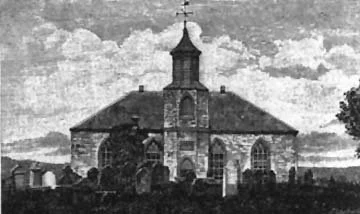
Thomson Life of McMillan
James Dodson
306 Reformed Presbyterian Magazine. [Aug. 2, 1869.
REV. JOHN M‘MILLAN, A.M., BALMAGHIE.
CHAPTER I.
HIS EARLY LIFE, TO HIS LETTER TO THE GENERAL ASSEMBLY IN 1705.
JOHN M‘MILLAN was born in 1669, at Barncachla, parish of Minnigaff, a parish lying upon the Water of Cree, in Kirkcudbrightshire. Nothing is known of his parents save that they were connected with the family of Arndarroch. His boyhood was spent in his native parish, or in its neighbourhood. It was not until he reached manhood that he went to Edinburgh and enrolled himself as a student at its University. Of the Professors under whom he studied one only is known to fame—James Gregory, successor to, and brother of, David Gregory, the friend of Sir Isaac Newton, and the earliest teacher of his philosophy in Scotland. He took the degree of Master of Arts, June 28, 1697. In his early years he was connected with the Established Church; but when he became a student he joined himself to the Society people, and continued in communion with them until he entered the Divinity Hall. In the thirty-first year of his age he was licensed by the Presbytery of Kirkcudbright—26th November 1700. It was the practice at that period for Probationers to remain if possible within the bounds of their Presbytery—a practice that still prevails, it would seem, in the Presbyterian Church in the United States,—and they were not permitted to preach in another Presbytery without extracts of license; and the minister that employed them must employ them only in his own pulpit, until he gave notice at the next meeting of his Presbytery. In accordance with this regulation, M‘Millan seems to have resided within the bounds of the Presbytery of Kirkcudbright until he was called to the parish of Balmaghie, May 29, 1701. During these six months he acted as chaplain to the Laird of Broughton. On the 18th September 1701 he was ordained. His predecessor was also a John M‘Millan, A.M., ordained in 1693, and died July 26, 1700, in the thirty-seventh year of his age, but there was no relationship between them further than the name.
Unlike many who, as they get older, desert the ecclesiastical connections in which they were brought up, M‘Millan’s early association with the Societies produced fruit. In October 1702, the Synod of Galloway appointed its ministers to explain the National Covenant to their people. To this injunction M‘Millan took exception, on the ground that no notice was taken of a later national deed, the Solemn League and Covenant. He immediately began to explain both
Aug. 2, 1869.] Reformed Presbyterian Magazine. 307
Covenants to his congregation, and, in concurrence with the members of Session, appointed a day of fasting when the Covenants were solemnly sworn, “in way of adherence.” All in the parish were admitted to enter into this oath who willingly offered themselves to the Lord, and after trial were found qualified. “Vindication of the Character of the Rev. Mr John M‘Millan,” appended to Thorburn’s “Vindiciæ Magistratus,” p. 223. In the following July—1703,—he, along with two neighbouring ministers, Tod of Buitle, and Reid of Carsphairn, presented a petition, that the Presbytery would take some suitable and effectual way to have the Church brought to assert explicitly the Divine right of Presbytery, the intrinsic power of the Church, Christ’s headship in and over His Church, to confess the sin of comprehending (receiving) so many curates, and the evils and scandals ministers and others were chargeable with in times of persecution, and the wicked laws standing in full force against the Covenants rescinded, and the Covenants themselves revived and renewed.—Clarkson’s “Plain Reasons,” p. 152.
The evils noticed in this petition were well known and deplored by every right-minded Presbyterian. Presbytery had been established in Scotland, not on account of its excellence as a form of Church government, or as Scriptural in its nature, but simply because most agreeable to the inclinations of the people. The General Assembly had been repeatedly prorogued and called by the civil power. The curates that had been allowed to remain in their charges remained, not from love to the Revolution Church, but for a piece of bread, and were a source of weakness rather than of strength; while the Acts vilifying the Covenants found no apologists or supporters except among the Jacobites. Indeed, in our time, the Act Rescissory has been set aside by the action of the Government in printing the Acts it repealed, and recognising the validity of those Acts in the Court of Session.
Well known as were these evils, the petition was yet very unpalatable to the Presbytery. Efforts were made to persuade the three petitioners to be satisfied with recording their petition upon the minutes of the Presbytery. These efforts were successful with Tod and Reid, but not with M‘Millan. He would not be silenced, but resolved still to give utterance to his convictions in the most public manner. The Presbytery now tried to make short work of him, and in a very rough-shod manner. They appointed a meeting at Balmaghie, in order to hold a Presbyterial visitation of the congregation, and ordered M‘Millan to preach the opening sermon. Without M‘Millan’s knowledge a libel was drawn up, charging him with following divisive courses, and he was summoned to appear at their bar on the same day that he was to preach before them. On the appointed day, December 30, 1703, the Presbytery met, and sent their officer to read the libel at the door of the church, but M‘Millan hearing of it, got hold of it and read it himself before the congregation, “obtesting every one of them to produce whatever they had to lay to his charge, either doctrinally or practically.” After sermon the libel was read, and an attempt made
308 Reformed Presbyterian Magazine. [Aug. 2, 1869.
to prove its charges, but not one could be substantiated. The Presbytery now offered to give up their action against him if he would cease to press his petition, but M‘Millan remained firm; “and considering that his grievances were weighty, and matter of conscience to him, and no appearance of any redress to be obtained, but matters still growing worse, he therefore protested and declined the Presbytery, and appealed to the first free and faithful General Assembly of the Church of Scotland.”—“Vindication,” p. 224. The Presbytery now broke up, and the half of the members went home. The other half went to a neighbouring church—what church is not said,—and, together with two corresponding members from the Presbytery of Wigtown, formed themselves anew. Here, without summoning M‘Millan or his congregation, they at once passed sentence of deposition, “which sentence of deposition was not so much as pretended to be founded upon error in doctrine, immorality in life, nor insufficiency for the office of the ministry, or deficiency in the exercise of it; but for what they termed irregularities and disorderly courses, which were nothing else than his bearing testimony by public preaching, and before their judicatories, against the backslidings of the Church, and all the sins of the times, so far as God discovered them to him; so that the true reason of this unjust sentence was his endeavouring to adhere to, and, in his station, faithfully to contend for the covenanted work of reformation, as it had obtained both in Church and State betwixt 1638 and 1649.”—“Vindication,” p. 225.
The names of the members who at that time formed the Presbytery of Kirkcudbright are given by Mr Scott in his “Fasti Ecc. Scott.” All of them are unknown to fame for any good work. Of two of them better things might have been expected—Andrew Cameron, the minister of Kirkcudbright, and William Boyd of Dalry. Cameron was brother of Richard Cameron, and had been sent to Holland by the Societies for his education. He took a keen interest in the Argyle expedition, and did what he could to induce Renwick to join in it, but without success.—“Renwick’s Letters, May 15, 1685, and July 9, 1685.” After the failure of Argyle’s ill-judged attempt to free his country from the tyranny of the Stuarts, Cameron fled to Holland, whence he again returned in 1687. In 1693 he became minister of Kirkcudbright. William Boyd was sent to Holland by the Societies. An interesting account of his election at a general meeting, held in Edinburgh, October 11, 1682, will be found in Michael Shield’s “Faithful Contendings,” p. 43, 44. He came over with the Prince of Orange, and was the first to proclaim him at the Cross of Glasgow. He took part in the services at the renewing of the Covenants at Borland Hill, Lesmahagow, March 3, 1689. At the General Assembly of that year he deserted the Societies, and was ordained in 1690 at Dalry. He died in 1741. Very different from M‘Millan, he retained no liking for the friends of his youth in the Societies. Where fair means failed he did not scruple to employ foul, to rid his parish of the dissenters. Howie, in his “Appendix to the Faithful Contendings,” p. 474,
Aug. 2, 1869.] Reformed Presbyterian Magazine. 309
affirms that he did what he could to get the recruiting officer to press them into the army.
These notices of the previous history of two of the leading members of the Presbytery who took a prominent part in the proceedings against him, will do much to account for M‘Millan’s conviction that he must appeal to another tribunal to obtain justice, as well as his determination to act as if no sentence of deposition had been passed upon him. He preached in his own church at Balmaghie as usual, and his people, with one or two exceptions, all sympathised with him. As, from the season of the year—mid-winter,—several members had not been present when sentence of deposition had been pronounced, he, with some of his people, appeared at next meeting of Presbytery, and asked “if their sentence was unanimous? if they continued to sustain it, or if they would cancel it?” To these questions M‘Millan got no answer; but the moderator summoned him to appear before the General Assembly in March, and gratuitously added, that he knew his appeal was to none of their Assemblies, and charged him with perverting the people of Balmaghie into schism. A summons to appear before the Assembly from a moderator of a Presbytery, and a summons made in such a manner, M‘Millan was not likely to listen to, and so he did not go to Edinburgh. His non-appearance brought a regular citation to the Commission of the Assembly in June. This citation he obeyed. Before the Commission he was led to acknowledge that he had done wrong in not submitting to the sentence of the Presbytery. For this acknowledgment he was afterwards much blamed by enemies that rose up among the Societies. Much, however, can be said in his behalf. The Presbytery was merely a minor court; and though at the time he might have refused to obey, yet his thorough conviction of the illegality and injustice of their sentence might afterwards convince him that it would be reversed by a higher court; and hence, in order to appeal it was best meanwhile to submit. His son affirms that the acknowledgment was made on the promise that “he should have justice done to him, and be reponed back to his congregation.”—P. 226. Indeed, considering the interests at stake in withdrawing from the Church which had ordained him, it was well that he paused and gave himself time for quiet thought. The statements he subscribed before the Commission, William Wilson, one of M‘Millan’s life-long enemies, in his “Testimony Deserted,” calls a “Foul Fall;” but in the estimation of most readers they speak much in his favour. They are:—
“At Edinburgh, 9th of June 1704.—The Commission having interrogate Mr John M‘Millan concerning his judgment with respect to the obedience and submission that is due to Church censures, and also with respect to his contravention of the sentence of deposition past against him by the Presbytery of Kirkcudbright: He declared that it was his judgment, That the sentence of a Church Judicatory ought to be submitted to, tho’ unjust, and redress to be craved and expected from superior Judicatories, accor-
310 Reformed Presbyterian Magazine. [Aug. 2, 1869.
ding to the comely order of this Church; and as for his own practice, he acknowledged his fault, thro’ mistake, in contravening the above-mentioned sentence, which sentence he earnestly desires may be taken off, and he reponed to the exercise of his ministry at Balmaghie. And lastly, he hereby declares his sincere resolution to maintain unity and concord in this Church, according to the Word of God, and Presbyterial principles, and particularly the obligations he came under at his ordination. Sic subscribitur,
J. MACKMILLAN.”
And,
“I, Mr John M‘Millan, humbly acknowledge my great sin in deserting the Presbytery of Kirkcudbright, as also my great sin in declining the said Presbytery, these being very contrary to my ordination engagements; and I do sincerely profess my hearty sorrow for these sins, and for any other thing in my way that hath given offence; and seeing I do hereby promise and engage (in the strength of God) to live more orderly, and in subjection to the Judicatories of this Church, and to use my utmost endeavours to maintain unity, concord, and peace therein, I earnestly desire the reverend Commission may take my case to consideration, and repone me to the exercise of my ministry at Balmaghie. In witness whereof, I have subscribed these presents with my hand at Edinburgh, the eleventh day of July 1704 years. Sic subscribitur,
J. MACKMILLAN.”
In the interval between the meetings of Commission M‘Millan refrained from preaching; and the Presbytery appointed two of their number to go to Balmaghie, and tell his family that he was to remain some time in Edinburgh, and to invite the people to hear them. But they found the parish all against them. The keys of the church were not to be had, and they got their way in only by breaking through one of the windows. This opposition of the country people to the Presbytery, when their minister was not there to encourage them, and, indeed, contrary to his own wish, says much for their persuasion of the injustice that had been done to him by deposition, and doubtless had its own effect on M‘Millan’s mind.
The Commission did not, as had been promised, reverse the sentence of deposition. After waiting in Edinburgh for a month or two M‘Millan returned home, when he wrote to the Presbytery, and craved it as a matter of right that they revoke his sentence, “and vindicate him from all the aspersions he was unjustly loaded with,” and urged them to “use some pithy essays with superior judicatories, in order to the revival of a covenanted work of reformation in all its parts.” He concluded his letter by declaring, “that on this footing only, he would give what subjection the Word of God requires of one in the station and office of the ministry.” This letter had no effect upon the Presbytery in leading them to remove the unjust sentence, and after several months silence he resumed preaching. At the same time, in justification of himself, he sent to the Commission that met in December 1704, a
Aug. 2, 1869.] Reformed Presbyterian Magazine. 311
“Protest and Appeal by John Mackmillan, unjustly deposed.” This document is written in full confidence of the justice of his cause, and with a thorough persuasion that great wrong had been done to him by the Presbytery. “He was ready to follow out all the grievances which he had formerly offered.” He sought “that the whole process,” “a capite ad calcem, be revised and judged,” “and both parties heard tanquam in prima instantia.” He retracts “his former obligations to them, protesting against the validity thereof, and declaring his resentment of what he had rashly done.” He protests against the Commission, because of its unfaithfulness to the Lord Jesus Christ, and to His Church and people, in obstinately refusing to assert His truth and interest, and to redress the grievances of the Lord’s servants and people; and renews his former appeal to the first free, faithful, and right constitute General Assembly, and concludes with protesting against all disturbance of him in the free and peaceable exercise of his ministry.”—“Vindication,” p. 228-9.
The General Assembly met in April 1705, and to it he addressed a letter, in which he declares the sentence passed upon him unscriptural, and so such as he could not submit to, and expresses his determination, on the ground taken in his first protest and appeal, “to continue the exercise of the ministry he had received of the Lord.” This determination he carried into effect, “to the conviction,” says his son, “of many, and the satisfaction of all the truly godly who were acquainted with him, and enjoyed his ministry.”
[Continued]
450 Reformed Presbyterian Magazine. [Dec. 1, 1869.
REV. JOHN M‘MILLAN, A.M., BALMAGHIE.
CHAPTER II.
HIS APPLICATION TO THE SOCIETIES, UNTIL HIS RECEPTION BY THEM AS THEIR MINISTER IN THE END OF DECEMBER 1706.
M‘MILLAN, shortly after his deposition—Dec. 30, 1703,—seems to have come to the conclusion that little was to be hoped for from the members of the Presbytery of Kirkcudbright, and to have turned his thoughts to the friends of his youth in the Societies. At the general meeting held at Crawfordjohn, April 5, 1704, a letter was read from M‘Millan desiring a conference. The conference was agreed to, and fourteen members were appointed as commissioners, but when or where it took place is not stated in the minutes. His name does not again occur on the record of the Societies until nine months afterwards—Jan. 31, 1705,—at a meeting at Crawfordjohn, where he appeared, and asked and received from them the libel of the Presbytery, and other papers in the case. He was requested to withdraw while they were read. They found “his submission” to the Commission to be “very grievous and lamentable,” and “reasoned a space thereon.” He was then called in, and they stated their judgment on the documents. He was “questioned if he had a desire to join” with them. “After a little waving of us,” says the minute, “putting back the question to us concerning joining with him, he showed his willingness to join with us.” They next discussed “wherein the difference lay between him and them,” a difference “which for a considerable time was treated upon.”
Meetings of the Societies took place in the following April, July, and August, but his name does not appear.
On October 24th a conference was again appointed, and nine
Dec. 1, 1869.] Reformed Presbyterian Magazine. 451
members commissioned to represent the Societies. At a general meeting held at Crawfordjohn, April 10, 1706, the commissioners gave in a report of a conference with M‘Millan, held at Holstane, Feb. 13th. The results of the conference were regarded as unsatisfactory, and another meeting was appointed to be held at Crawfordjohn, June 19th, at which M‘Millan was present, and gave in “Steps of defection,” which the preceding meeting had requested him to draw up. The “Steps” form a paper of thirty-six short paragraphs, each of which specifies some evil in which the Church or State had been silent, or done nothing to have removed.
The next meeting took place August 14th, when the conference was resumed. After lengthened conversation, the minutes report the following request and answer:—“I desire to know,” asked M‘Millan, “the meeting’s satisfaction with what is already past.” “The meeting, as one man, is satisfied as to what is past betwixt him and them.” The consequence of this expression of satisfaction was, that they resolved to give him a “unanimous and general call” to be their minister. At a meeting held next day, the members present were enjoined to inform their respective Societies what had been done, and to have “their minds returned to the next meeting,” that they might “go jointly on in the affair.”
Immediately after the minute of this meeting there stands upon the record two documents without any preface, note or comment, doubtless because their history was supposed to be well known to the members of the Church. They are manifestly what the Societies regarded as a satisfactory result of the conferences and meetings spread over the long period of eighteen months. The second of them, it will be noticed, closes with the words found so often on the grave-stones of the martyrs throughout Scotland.
“MR JOHN M‘MILLAN’S SUBMISSION.
“I, Mr John M‘Millan, minister in Balmagie, having displeased the godly Remnant and greatly offended them before I entered the ministry, and that in my leaving them when then joined with them; and also since in tampering with the ministers after I had declined them which I desire to lament; do oblige myself for Truth’s vindication, and the godly Remnant’s satisfaction, to stand to the determination of any faithful lawfully constitute Church Judicatory of Christ within this land when it shall happen to be, which both they and I can own, submit to, and concur with according to the comely order of this Church in her best times, in whatever hath been sinful or offensive in my walk, way or carriage ever since I left them to this very day. As Witness my hand at Crawfordjohn the 14th day of August 1706.
sic subscr. “J. M‘MILLAN.”
“MR JOHN M‘MILLAN’S APPROBATION OF OUR TESTIMONY.
“I, John M‘Millan, minister in Balmagie, heartily approve of, consent to and comply with all the Testimonies that have been carried on with respect to the Covenanted Reformation, and that both in the bypast and present times, by the honest, godly, and
452 Reformed Presbyterian Magazine. [Dec. 1, 1869.
faithful Remnant against both Church and State; as they were and are agreeable to the Word of God and covenanted work of reformation. As witness my hand at Crawfordjohn the 15th day of August 1706.
sic subscr. “J. M‘MILLAN.”
At the next general meeting of the Societies, October 9th, it was reported that the respective Correspondences were “unanimously agreed to go jointly on in the call.” “The meeting then proceeded to draw up a formal call, which was accordingly done, subscribed and delivered to Mr John M‘Millan, which he heartily received and took to consideration.” The call is differently worded from the form in use in our time, but it expresses with much propriety of language the desire of the Societies to secure M‘Millan’s services as their minister. It is:—
“We, under Subscribers of the United Societies and General Correspondences of the Suffering Remnant of the true Presbyterian Church in Scotland, England, and Ireland, having of a long time been deprived of the public administration of the gospel ordinances in purity, by reason of the manifold defections and backslidings of the ministers in these lands, And now it hath pleased the Lord, after sundry emergents of Providence, due deliberation and conferences with you, Mr John M‘Millan, minister of the Gospel at Balmagie, that you be of one judgement with us as to the present Testimony of the day for carrying on the Covenanted work of Reformation, do hereby in our own name, and in name of all our united Societies and Correspondences, give you our hearty and unanimous call to come forth and dispense the gospel ordinances faithfully and freely to us, And we promise to hear and subject ourselves unto you as our faithful leader and pastor, to whom we may safely commit the charge of our souls, and to do every other thing that precept or former practice to a minister in the like case can oblige persons in our circumstances, while you continue to go on the exercise thereof; and take this our call to your serious deliberation, and return us an answer according to our urgent necessity; and we shall desire to pray for a blessing to you and us both with it.
“As witness our hands at Crawfordjohn, October 10th, 1706.
(Signed)
“JOHN CURRIE, elder.
WILL. STEWART, elder.
DAVID JARDIN.
JAMES MUNDELL.
JOHN BELL.
JOHN GLOVER.
THOMAS BROWN.
JAS. DONALDSON.
JAS. CARGILL.
FRANCIS GRAHAM.
ROBERT BARRIE.
JO. ROBSON.
JOHN BRYCE.
WILL. HANNAH.
JOHN KNOX.
JOSEPH FRANGIS.
HUGH DICKIE.
JAMES CURRIE.
ROBT. MAXWELL.
JOHN MUIR.
JO. STANLEY.
JO. PATERSON.
CHAS. UMPHERSTON.
JAMES BRIGTON.
DUNCAN FORBES.
JO. M‘VAY.
WILL. SWANSTON.
JO. HISLOP.
JO. GRIEVE.
THOMAS MILNS.
ROBERT SMITH, preces.
ROB. HAMILTON, clerk.”
Of the thirty-two names attached to this call a few are worthy of passing notice.
Dec. 1, 1869.] Reformed Presbyterian Magazine. 453
John Currie, elder, had been a sufferer during the persecution, and had been “cast out of house and hold in Tinwald, Dumfriesshire, for not complying with prelacy.” In accordance with a practice not unusual among good people of that period, he drew up a covenant, which, although liable to the objection common to such documents of needless formality, and a formality that has sometimes become a snare to the covenanter, yet says much for his faith and fervent desire to rest upon Christ as his alone Saviour. The covenant will be found at the close of this chapter.
Charles Umpherston was one of four whom the Societies, in 1699, desired to send to Holland to be licensed and ordained, but the proposal fell to the ground. He became a surgeon in Pentland, and during his long life—he died in his eightieth year, 1758—took a deep interest in the cause to which he attached himself in youth. His name is repeatedly found on the minutes of the general meeting as one of the most prominent of its members; and, as we shall afterwards see, more than one of the documents issued by the Societies came from his pen.
James Currie was also of Pentland. His name appears on the Martyrs’ Monument in the Greyfriars Churchyard, Edinburgh. “This tomb was erected by James Currie, Mercht. in Pentland, and others.” He left behind him a short narrative of his life, which has been printed under the title, “Passages in the life of James Currie.” It shows him to have been a man of much piety, and at the same time it gives a vivid account of the hardships and sufferings endured during the twenty-eight years persecution. He was married by “Mr James Renwick” to an Helen Alexander, a woman of a kindred spirit, who has also left “Passages” in her life that have been oftener than once reprinted. One of these passages we cannot omit:—
“And when Mr Renwick was execute I went and saw him in prison; and I said to him, Ye will get the white robes; and he said, And palms in my hands. And when he was execute, I went in to the Greyfreer’s Yard, and I took him in my arms till his clothes were taken off, and I helped to wind him before he was put in the coffin.”
Robert Smith, preces, was a student educated at Glasgow. He afterwards went to Holland, under the auspices of the Societies, to complete his studies. He took his degree at Groningen. We owe to him the collection and transcription of many of the sermons of Guthrie and Cargill and others, published by John Howie of Lochgoin. In his latter years he became somewhat narrow in his views, and withdrew from M‘Millan’s ministry on the ground of what he supposed to be a sinful acknowledgment of George I. His testimony and that of James Mundell, another name at the call, are in Calderwood’s “Dying Testimonies;” but, like most of the testimonies in that volume, they are too much of a strain alien to the charity that vaunteth not itself, seeketh not her own, is not easily provoked, and thinketh no evil.
M‘Millan’s action with regard to the call, his acceptance, and the
454 Reformed Presbyterian Magazine. [Dec. 1, 1869.
delight of the Societies at receiving him as their minister, are told with artless, yet touching simplicity, in the narrative inserted in the minutes of the Societies:—
“After his receiving of our call, day and place above said, though the general meeting was very urgent and desirous that he would forthwith go and take up the Standard of the Gospel among us, through the country, as our former faithful ministers had done, yet he, upon weighty and grave considerations and reasons, declined the same until he had taken some more time to lay it out before the Lord for his counsel, countenance, and direction therein. So that until about the end of December that year, we had no preaching. At which time, according as it had been concluded at the preceding General Meeting by being left to his own determination, and accordingly as he got light therein, he imparted the same to the two next adjacent Correspondences, viz., Nithsdale and Galloway, who, according to their general allowance from the meeting foresaid, did intimate the same with all possible diligence to their brethren through the rest of the Correspondences to come to the place appointed—which was done by a great many, so that we had a numerous congregation from all airths, and a pleasant day of the Gospel—and on the Monday, preaching also with baptizing of sundry children; after which, upon the clamant call of the people both east, west, north, and south, he went through, preached and baptized, exercising also the other parts of his ministerial function where he came, as need required, many signs and tokens of his Master’s presence being with him, to the great comfort and satisfaction of the Remnant, who had been so long deprived of the sweet Gospel and ordinances of God’s house.”
The Solemn Covenant Transaction entered into with the LORD, by me, JOHN CURRIE, at Carse of the water of Ae, Sept. 15, 1681.
O Most dreadful God! For the sake of thy dear Son, I beseech thee, accept of thy poor prodigal, now prostrating himself at thy door. I have fallen from thee by mine iniquity, and am by nature a son of death; and a thousand fold more the child of hell, by my wicked practice. But, of thine infinite grace, thou hast promised mercy to me in Christ, if I will but turn unto thee with all my heart. Therefore, upon the call of thy gospel, I am now come in, and throwing down my weapons, submit to thy mercy. And because thou requirest, as the condition of my peace with thee, that I must put away all my idols, and bid a defiance to all thine enemies,—which I acknowledge I have wickedly sided with against thee,—I do here, from the bottom of my heart, renounce them all, firmly covenanting with thee, not to allow myself in any known sin, but conscientiously to use all the means that I know thou hast prescribed, to the death and utter destruction of all my corruptions. And whereas, I have formerly loved myself more than thee, and let out my affections idolatrously on the world, I do here resign up my heart to thee, that made it, humbly protesting before thy Majesty, that it is the firm resolution of my heart, and that I do unfeignedly desire grace from thee so to do, that when thou shalt call me hereunto, I may practise according to my resolutions, and through thy assistance, forsake all that is dear to me in this world, rather than run from thee in the ways of sin, and that I will watch
Dec. 1, 1869.] Reformed Presbyterian Magazine. 455
against all its temptations, whether of prosperity or adversity, least they should withdraw my heart from thee, beseeching thee also, to keep me against the temptations of Satan, to whose wicked suggestions, I resolve through thy grace never to yield myself a servant. And because my own righteousness is but as rotten rags, I renounce all confidence therein; and acknowledge that I am of myself, a hopeless, helpless, and undone creature, without righteousness or strength. And for as much as thou hast, of thy unbounded mercy, offered most graciously unto me, a wretched sinner, to be again my God in Christ Jesus, that I do accept of thee. I do call heaven and earth to record this day, that I do here solemnly avouch thee to be the Lord my God: and with all possible veneration, bowing the neck of my affections, under the feet of thy most sacred Majesty, I desire to take thee, the Lord Jehovah, Father, Son, and Holy Ghost, for my portion, and chief good: and do give up myself, body and soul, for thy service, promising and vowing to serve thee in righteousness, holiness, and humility, all the days of my life. And since thou hast appointed the Lord Jesus Christ to be the only way of entrance, or coming unto thee, I do, on the bended knees of my soul’s affections, accept of him as the only new and living way, by which I, a poor sinner, may have access to thee, and do here solemnly resign up myself unto thee, in a marriage contract, even into thy hands. O! Blessed Jesus, I come unto thee hungry, blind, naked, and hardly bestead, poor and wretched, a most miserable, loathsome, and polluted wretch, a guilty condemned malefactor, even unworthy for ever to wash the feet of the servants of my Lord, far less to be married unto thee, who art the King of Glory. But seeing such is thine unparalleled love, I do here with all my power accept thee; and do take thee for my head and husband, for better and for worse, and for every case and condition, to love, honour, and obey thee, before, and instead of all others; and that for all the days of my life, even unto death. I embrace thee in all thy three offices, as Prophet, Priest, and King. And I renounce my own righteousness, and do here avow thee to be the Lord my righteousness. I renounce my own wisdom, and do herein take thee for mine; yea, for mine only God and guide. I renounce my own will, and do take thy will for my law. And since thou hast told me that I must suffer, if I would reign, I do here covenant with thee, and by thy grace assisting me, to run all hazards with thee, verily supposing that neither life, nor death, shall part or separate betwixt thee and me. And because thou hast been pleased to give me thy holy law, as the rule of my life, and the way in which I should walk to the kingdom, therefore I do most willingly here put my neck under thy yoke, and set my shoulders to thy burden, and subscribe to all thy laws, as holy, just, and good, and so I do solemnly take them as the rule of my thoughts, words, and deeds. And though my flesh contradict and rebel, yet I will endeavour to order my whole life according to thy direction, and will not allow myself in the neglect of any thing that I know to be duty. Only because that through the frailty of my flesh I am subject to many failings, I am bold humbly to protest, that my unallowed miscarriages, contrary to the settled bensil and resolution of my heart, shall not make void this covenant, for so thou hast said and promised in thy word. And now Almighty God, the searcher of all hearts, thou knowest that I make this covenant with thee this day, without any known guile or reservation, beseeching thee, that if thou seest any flaw or falsehood herein, that thou would discover it to me, and help me to perform it aright. And now glory be to thee, O God the Father, that ever thou did find out such a way for the recovery of undone sinners. And glory be to thee, O God the Son, who hast loved me, and washed me in thine own blood, and art now become my Saviour and Redeemer. And glory be to thee, O God the Holy Ghost, who, by the
456 Reformed Presbyterian Magazine. [Dec. 1, 1869.
finger of thy almighty power, hast turned about my heart from sin unto God. O! Dreadful Jehovah, the Lord God Omnipotent, Father, Son, and Holy Ghost, thou art now become my covenanted friend; and I, through thy infinite grace, am become thy covenanted servant, Amen. So be it. And the covenant that I have made on earth with thee, let it be ratified in heaven.
Sic subscribitur,
JOHN CURRIE.
Sept. 15, 1681.
[Continued]
130 Reformed Presbyterian Magazine. [April 1, 1870.
REV. JOHN M‘MILLAN, A.M., BALMAGHIE.
CHAPTER III.
REV. JOHN HEPBURN OF URR—REV. JOHN M‘NEIL—THE PROTESTATION AND APPEAL TO THE GENERAL ASSEMBLY—THE UNION OF 1707—AUCHENSAUGH.
SHORTLY after his acceptance of the Societies’ call, M‘Millan tried to induce Rev. John Hepburn, said to have been “a man of great gifts in prayer, and of great fervour in preaching,” to join with him. Hepburn had been minister of the parish of Urr, had been suspended by the General Assembly in 1696, was afterwards imprisoned for a few months by the Privy Council, and in 1705 was deposed for holding opinions somewhat akin to those of the Societies. The attempt failed, but he succeeded with Mr John M‘Neil or Mackneely, a probationer licensed by the Presbytery of Penpont, May 10, 1669. M‘Neil was a valuable accession to M‘Millan, but not so much as he might have been, for, through somewhat erroneous ideas as to its nature, he would not, although more than once importuned by the Societies, accept ordination from one man, even were this man M‘Millan. The outlines of his discourse at the renovation of the Covenants at Auchensaugh, are the only specimen of his preaching that has been published. It is a plain, unadorned sermon, yet with a vein of piety running throughout. A volume in manuscript, written by him, is in the possession of Rev. William Symington, Glasgow. It contains two discourses on Titus ii. 14, and i. 15. The first is of great length, and occupies fully three-fourths of the volume. It bears to have been preached Nov. 10th, 1729. The second is dated January 11th, 1730. Both discourses are more elaborately wrought out than the one at Auchensaugh, and discuss with much minuteness of division the doctrines of the text. Their tone is evangelical; and each division closes with a practical application of the matter discussed. There is, however, nothing remarkable about them, either in style or in thought. They are simply the sermons of a good man of ordinary ability, which, if well spoken, might not have been unpleasant to hear. Nothing is said of M‘Neil’s
April 1, 1870.] Reformed Presbyterian Magazine. 131
accession in the minutes of the general meetings of the Societies. It is not until after he had been associated with M‘Millan for several years that his name occurs, and then along with others, as if for some time past he had been one of themselves. His name appears much earlier elsewhere. In 1708 the General Assembly “strictly enjoined” “all Presbyteries and Synods” “to take particular notice of all their members, ministers, preachers, or others, and if they find them fall into irregularities or schismatical courses, that they call them to an account.” They refer to the notice of the Commission “the disorders and schismatical courses of Mr John M‘Neil, probationer.” In consequence of this injunction, there was “sent to the Commission of the Kirk at Edinburgh, the 29th of September 1708,” “The Protestation, Declinature, and Appeal of Mr John Mackmillan, Minister of the Gospel at Balmagie, and Mr John Mackneil, Probationer and Preacher of the Gospel.” The Protestation, etc., is a document of five and a-half quarto pages, and is calmly and forcibly written. It takes no specific notice of the action of the Presbytery of Kirkcudbright. The Commission had charged M‘Millan with “swearing persons not to pay cess.” The Protestation declares the charge to be “an odious calumny,” and that cess, “or support, succour, aid, or assistance,” are only to be withheld when they are for “the upholding the man of sin, or any of the adversaries of the truth.” Then follows a statement of adherence to the teaching of the Church of Scotland in its best days, as well as a testimony against the erastianism of the Revolution Settlement. The union that had just been formed with England is declared to be “unhallowed,” “the stain,” and that which is feared “will prove the ruin of this poor nation;” “contrar not only the honour, interest, and fundamental laws and constitutions of the kingdom, and a palpable surrender of the sovereignty, rights and privileges of the nation, but also a manifest breach of the Solemn League and Covenant, which was made and sworn with uplifted hands to the Most High God, for purging and reforming the three nations from error, heresy, superstition, and prophaneness, and whatever is contrary to sound doctrine, the power of godliness and the purity of worship, discipline and government in the same.” But although it protests in strong terms “against the defections of the land, especially of ministers,” it does not take up the position of absolute separation from the Established Church. Indeed, it looks forward to re-union at some future day, for its closing words are:—
“Finally, that we may not be judged by any as persons of an infallible spirit, and our actions above the cognizance of the judicatories of Christ’s appointment, we appeal to the first free, faithful, and rightly constitute Assembly in this Church, to whose decision and sentence in the things libelled against we willingly refer ourselves, and crave liberty to extend and enlarge this our Protestation, Declinature, and Appeal, as need requires.
Balmaghie Manse,
Sept. 24, 1708.
JO. MACKMILLAN.
JO. MACKNEIL.”
132 Reformed Presbyterian Magazine. [April 1, 1870.
In the year previous to the giving in of this Joint Paper to the Commission of the General Assembly, the Societies had issued a statement condemnatory of the union that had just been formed with England. It is a quarto of sixteen pages, and is entitled,—“THE PROTESTATION and TESTIMONY of the United Societies of the witnessing Remnant of the Anti-Popish, Anti-Prelatick, Anti-Erastian, Anti-Sectarian, true Presbyterian Church of Christ in Scotland, against the Sinful Incorporating Union with England and their British Parliament, concluded and established May 1707.”
The union of the two kingdoms had long engaged the attention of statesmen in both parts of the island. So early as 1559, the Lords of the Congregation, with the full sanction of Knox, formally proposed a union of the two Crowns. They invited Elizabeth to be their sovereign, and desired that Scotland and England should be merged into a common country, to be called henceforward “by the ancient name of Great Britain.” Had it been left to the far-seeing and sagacious Cecil, the proposal would have been accepted, and, it may be, a century and a-half of misrule would have been saved to Scotland. But Cecil stood well-nigh alone at the English Court in his desire to see the two countries one. Times had changed in 1707. The union that, under Knox and Cecil, would have gone heartily into by the best men in the country, was, in 1707, brought about in direct opposition to the wishes of the great mass of Scotsmen. Indeed, so powerful and so widespread was this opposition, that at one time the government was about to dissolve Parliament, and give up the idea of union as altogether hopeless. There was nothing, therefore, remarkable in the Protestation of the Societies. It simply gave expression, in their own way, to thoughts that were common to them with multitudes of their countrymen.
The reasons for the opposition of the Societies to the union were much the same as those given by M‘Millan and M‘Neil in their Protestation and Declinature. Happily time has either removed these reasons, or shown that they were imaginary rather than real, for, as a whole, the union, save in one or two acts of legislation shortly after it was consummated, such as the much to be deplored Act of 1712, that restored patronage—an Act that was hurried through Parliament by English politicians, because it was thought that Scotland had gained more than her due share of advantage by the enactment of 1707,—has been a signal blessing to our country. It allied Scotland to a far more wealthy nation, and threw open almost every office under the Crown, from the woolsack downwards, to her sons; and the respect everywhere paid south of the Tweed to Scotsmen, is proof how well these offices have been filled. Episcopacy has made no progress among Scotch people. They are still Presbyterian to the core. It has been otherwise, to a large extent, with the owners of the soil. This difference, however, has arisen not from the union, but from a want of sympathy with the living religion of Presbyterianism; just as many members of the same class in England, from dislike to evangelical Episcopacy, have rushed to the opposite extreme, the ritualism of Rome. Episcopacy has continued
April 1, 1870.] Reformed Presbyterian Magazine. 133
to exist in England, but not in virtue of the Act of Union putting any barrier in the way of Scotsmen propagating Presbyterianism, for there has been no such barrier. The one reason has been—the will of the English people that it should be so. When this will changes Episcopacy will give way to a better system, but not a day sooner.
For some years after M‘Millan accepted the call of the Societies his name seldom appears on the record of the general meetings, until 1711, when a proposal for renewing the Covenants began to be entertained. There was some opposition from a minority, who seem to have held that the Societies, as only a small part of the nation, could not renew a national deed. M‘Millan was consulted, and expressed himself highly in favour of the proposal, but counselled due preparation. After his approval of the proposal the Societies went heartily into the matter, and resolved that the renewal should be followed by the dispensation of the Lord’s Supper. It took place at Auchensaugh, a moor near Douglas, a spot that in the present day would seem far out of the way, but in that age the district was more thickly populated than now,—it was the age of small farms in Scotland,—and it was intersected by the main roads from Glasgow to England, and from Edinburgh to Ayr. The services commenced on Wednesday, July 23rd, 1712. M‘Millan “began the day’s work with prayer for special assistance to attain due preparation for, and a suitable frame throughout, the whole solemnity.” “Thereafter he had a preparatory discourse on the nature and expediency of the work in general.” M‘Neil followed with a discourse on covenant breaking, and the duty of covenant breakers to renew their covenant with God. At the close of the discourse the Covenants and a very lengthy acknowledgment of sins, extending in the printed copy to 40 closely printed 8vo pages, were read. Next day M‘Millan preached on the happy results of covenanting with God. After the sermon the acknowledgment of sins was again read. At its close M‘Millan “admonished all such as were guilty of such public steps of defection as had been confessed in the acknowledgment to make full and free confession thereof before the congregation.” Many did so—M‘Millan himself among the number. “One particularly said he had been at the renewing of the Covenant at Lesmahagow, and would have confessed it, but was stopped. Another confessed his hearing the ministers as his sin. Mr M‘Millan asked him if he was convinced in his conscience that this was a sin, and desired none might confess anything but what they were convinced in their conscience was a sin. Another confessed, with much contrition, a profane oath.” “Some confessed that they had been troubled with strange thoughts. Mr M‘Millan checked them confessing things that needed not to be confessed. This took a very long time.”—Wodrow’s “Analecta,” vol. ii., pp. 76–78. After this confession, prayer, embracing the sins confessed, was offered. The engagement to duties—a document of
134 Reformed Presbyterian Magazine. [April 1, 1870.
eight 8vo pages—was then read, and M‘Millan gave a short exhortation, and prayed “for the gracious presence and assistance of the Divine Spirit.” The National Covenant and the Solemn League and Covenant were now read article by article, and at the close of each article the people were required to raise their right hands in token of their assent. The Covenants renewed, M‘Millan again addressed the people. Prayer and praise followed, and at the close M‘Millan gave a short exhortation to prepare for the approaching communion.
The Societies published an account shortly afterwards of the whole proceedings, in which the documents read are given in full, and the discourses and addresses in outline. This account says nothing of the attendance. This, however, as with the individual confession of sins, has been supplied by Wodrow, in the “Analecta,” in his usual gossiping manner. “July 24th, 1712.—Upon Thursday the 24th there was a very great multitude, some say one thousand, some say seventeen hundred. My informer says, It was larger considerably than the largest of our communion meetings. I am told there were several ministers there that day as hearers.”
The renovation of the Covenants, and the other papers read at Auchensaugh, occupied a prominent place for more than a century in the terms of communion required in the Reformed Presbyterian Church. In 1820, after some discussion, and the publication of one or two pamphlets, it was resolved by Synod that all acknowledgment of this renovation should cease to be demanded from her people. This change in the terms of communion was made not a day too soon. There doubtless was reason, in 1712, for the strong statements in the acknowledgment of sins in regard to the condition of society in Scotland, but they did not apply to 1820, far less are they true of 1870. Indeed the documents are now of the nature of fossils, interesting as the relics of a bygone age, but of no practical use to the times in which we are privileged to live. The chief difficulty in reading them in our day is to realise the greatness of the alteration for the better that has come over the manners, the morals, the intelligence of our countrymen, in the hundred and sixty years that have elapsed since they were given to the world. Some may marvel that their acknowledgment continued to occupy a place in the terms down to so recent a date as 1820; but Churches are conservative in their nature—not given to change; and the fathers no doubt delayed change, not on their own account, but in deference to the few good people that could not bear the idea of burying their dead out of their sight.
August 1, 1871.] Reformed Presbyterian Magazine. 279
LAST WORDS OF THE REV. JOHN M‘MILLAN OF BALMAGHIE.
[THIS account of the last words of Mr M‘Millan of Balmaghie is appended to a pamphlet, now very rare, entitled “Observations on a Wolf in a Sheep-skin,” called forth by a Paper issued by the followers of Hall and Innes. The pamphlet is signed, “C. U. Novem. 15, N. S. 1753.” C. U., there can be little doubt, was Charles Umpherston, surgeon in Pentland, and the father-in-law of Mr M‘Millan of Sandhills. “The new printed Paper” referred to in its opening sentences was a pamphlet published in the autumn of 1753 by Hall and Innes, under the title of “The True State of the Difference between the Reformed Presbytery and some Brethren who lately Deserted them.”
The account is of much interest, and by what it tells of Mr M‘Millan’s faith and hope, goes far to explain how it was that for nearly fifty years he was so looked up to and respected as a Christian minister by the Fathers of the Reformed Presbyterian Church in the first half of last century.]
AN ACCOUNT OF SOME OF THE LAST WORDS OF THE REVEREND MR JOHN MACMILLAN, ON HIS DEATHBED, NOVEMBER 1753.
CANDID READER,—Since the above Paper was given out for public view, the reverend and pious old Mr J. MacMillan, by death, had his pass from this valley of misery to a perfect state and place of happiness, on the 1st day of December, N. S. 1753.
280 Reformed Presbyterian Magazine. [Aug. 1, 1871.
The last words of dying persons, when in a sedate frame, are ordinarily reckoned of great weight.
I am not to give a history of his life and descent, only to show his being unite to the Societies he had been pastor to for a long time. In August 1706, severals from these Societies and he conversed together, and came to a good understanding with other. About the latter end of October that year, they harmoniously agreed in the matter of testimony, and then signed a call to him, which he received; and, on the second day of December 1706, made his first public appearance at Crawford-John, before a numerous audience, to the satisfaction of all, and to the comfort and joy of many.
Several days before his exit he was very sensible and full of comfort, longing (with submission) for his happy change. He was attended and visited by friends near to him, and some at a further distance were expressly sent for. His now crazy body and failing tabernacle could not supply him with organs suitable to such a vigorous soul, but was obliged, after speaking some time, to rest a while.
Being asked his opinion anent a new printed Paper, he told that, as to the narrative part of it, especially what related to himself, he was not only misrepresented, but notorious falsehoods charged upon him, and had attempted to blacken his character and name, and sully his reputation, now when he was going off the stage; but his witness was in heaven how unjustly he was reproached, and he believed God in His own time would bring forth his righteousness as light, etc. But he heartily and freely forgave Messrs John Hall, Hugh Innes, and Alexander Wright, what they had done against him, by word, writ, or print; but what injury they had done to truth, he referred to the God of truth; and leaves his testimony against universal satisfaction.
Being further asked, when now dying, what he thought of the way he had professed, and the cause he had espoused, for the greatest part of his life, in opposition to defection, either in Church, State, or general practice, he answered, he was fully persuaded of the equity of the covenanted cause, and the work of Reformation carried on from 1638 to 1649, and solemnly sworn to by these nations, to which he endeavoured, though through many imperfections and failings, to testify his adherence, and to witness against all defections from, or opposition to, that covenanted cause, or burying it in the rubbish of oblivion, defection, or apostasy; and anything else against Christ’s cause and interest, by encroachments made upon the crown and royal prerogatives of the glorious Head of the Church. He was fully convinced it was the Lord’s work and cause, which He had many times signally manifested, by remarkable appearance for the same: and died in the firm faith of it, that the Lord would yet own that cause, and raise it again from all the rubbish laid upon it by apostasy and defection; though, he said, he thought the Lord would first come in a way of judgment against the nations; that even the Lord’s own people need not expect to escape a very sharp trial for their indifferency and lukewarmness in the matters of His glory and interest, and sinful compliance with enemies.
He further added, that were he to begin his life again, he durst not counteract what he had done, in bearing testimony for these precious truths that had been sealed by the blood of a noble cloud of witnesses, but would judge it his duty to act the same part again, abstracting from his weaknesses and infirmities; and exhorted all about him to stand fast to that cause; for that, although by defection and death they were but few now to appear for it, yet, as he was assured it was the way of the Lord, so He would yet appear for, and raise up instruments for, maintaining truth.
Much he spoke to this purpose two days before his departure, though his strength was much exhausted, and oft faintish through weakness of body,
Aug. 1, 1871.] Reformed Presbyterian Magazine. 281
On the Friday immediately before his death, being asked what views he had of his own salvation, and if death was terrible to him, he replied, that death was so far from being terrible to him, that it was his longing desire to be absent from the body, and present with the Lord.
And here he broke out into a rapture, in commendation of the riches of free grace, and spoke much of the sweetness of communion with the Lord, which, he said, his soul had many times remarkably experienced, as in other duties, so particularly in meditation and prayer, to which he had been much accustomed, and that from his infancy, the Lord having begun a work of grace very early on his soul; and said that when he was but very young, he had essayed giving himself away, by solemn covenant, unto the Lord; which duty, as he had oft practised it, so the Lord always blessed it to him for his increase in grace, and strengthening in holiness. And thus he went through much of the tract of his life, recounting the way of the Lord’s dealing with his soul. But pity, much has escaped the memory of those who were present.
He continued to notice many of the promises which the Lord had many times made most refreshing and comfortable to him, through his wandering life, in the midst of dejection and downcasting; such as, Isaiah xli. 10—“Fear thou not; for I am with thee: be not dismayed; for I am thy God.” Isaiah xliii. 25—“I, even I, am he that blotteth out thy transgressions for mine own sake,” etc. Psalm lxxiii. 24—“Thou shalt guide me with thy counsel,” etc. 2 Cor. xii. 9—“My grace is sufficient for thee.”
These, with many other precious promises, he repeated with an assured confidence of their full accomplishment to himself; and this was on the Friday night. And after he had spoke long and most comfortably, with a rejoicing spirit, of the Lord’s loving-kindness to him, he was obliged to halt some time, through weakness; and, having informed where they should sing and read, desired one to go about religious worship, which, when done, he said, with a smiling countenance, “Now again the Lord has been sealing to my soul, by His Spirit, all those promises that I spoke of to you, has confirmed them to me, and assured me that in a little I shall obtain the full possession of them, and receive a crown of righteousness from the righteous Lord.”
Some friends being present, he desired again they might go about duty, and come close to the bedside, that he might hear, and so join with them; for, said he, I think I am fast going, and this will be the last night that I will join with you upon earth in serving the Lord; and so desired to sing the first five verses of the ciii. Psalm; for, said he, my soul rejoiceth in the Lord God of my salvation; then he ordered the tenth chapter of John’s Gospel to be read, and repeating the 27th and 28th verses of this chapter, with application to himself, “My sheep hear my voice, and I know them, and they follow me: and I give unto them eternal life,” etc. And, when going about prayer, he desired that they might all bless the Lord for His goodness toward him, and pray that he might have a quick and speedy passage over the last Jordan into Immanuel’s Land; and further said, O pray that the devil may be confounded, and prevented in his designs, for I know I shall yet have an attack from him. In answer to which, it was said, that he must now firmly trust in the Lord, the Captain of his salvation, who would, for the glory of His own great name, give him a complete victory; and he said, “So I believe.” And then he desired to sing in the beginning of the xci. Psalm, and to read the first chapter of the First Epistle of Peter. And prayer being ended, he inquired where that word was, “Yea, mine own God is He”? and being told it was the last line of the xlii. Psalm in metre, he caused the verse to be read, and said, “Yes, I know and am assured of it, yea, mine own God is He.” He then complained he had no feeling in the little finger of the left hand.
282 Reformed Presbyterian Magazine. [Aug. 1, 1871.
Another went to perform worship, and he ordered to sing in the xci. Psalm to the tenth verse; and caused read the four last verses of the xcii. Psalm.
After prayer was over, being now past midnight, he said he thought he had no feeling in the left hand, so fully sensible was he of life departing from the extremities of his body. Upon which, it being said to him, that as he had been desirous of his departure, and to be ever with the Lord, so it seemed to be evident that the time of his change was at hand. Whereupon he cheerfully replied that he could welcome the King of Terrors, as a messenger sent from his heavenly Father, to bring him to the mansions of glory; and added, “Lord, I have waited for thy salvation.”
Thus did his soul continue to magnify the Lord to the last; and when his natural strength failed, that he could scarce speak audibly, yet his spirit rejoiced in God His Saviour. The last words which he was heard to speak, within a few minutes of his last breath, were, “My Lord, my God, my Redeemer, yea, mine own God is He;” and the few minutes remaining after he ceased speaking, he was observed to be in a praying and praising disposition. And after he had fully finished his course, with a pleasant countenance, his eyes lifted up, and his right hand a little raised up to heaven, he willingly resigned up his soul to his beloved and faithful Saviour, in that full faith and firm persuasion, that with his eyes he should see his Redeemer, and not another for him.
Thus comfortably and joyfully he resigned his soul to God, in the eighty-fourth year of his age, on Saturday, the 20th day of November, O. S. 1753, with good reason to surviving friends and relations to conclude he died in the Lord; and that, instead of his pilgrimage difficulties and heavy reproaches by those of whom other things might have been expected, he is now above their reach, enjoying what he longed for, and his faith and hope now in fruition and possession; and instead of disdain, and being vilipended as a doting old man, and crazy, he is now above, completed in full joy. To the admiration of friends and attendants, he was, even when at weakest, in the greatest serenity and perfect exercise of his intellectuals to the very end. What account will his reproachers be able to make, in their endeavours to sully the reputation of such an old exercised and experimented Christian and minister? He believed what he taught, and taught what he believed and experienced to be the truth of God, both in theory and practical Christianity. And, in respect to the present debate, again and again he told, he had opposed that universal satisfaction, and left his dying testimony against the same, and adhered to the sound, Scriptural, and received doctrine, that Christ undertook and satisfied law and justice for the elect only.
This brief account being all I have yet got from those who attended him to the last, I hope it will be acceptable to many, and no great encroachment on the patience of the reader; and so, I bid, Adieu.
December 24, N.S. 1753.