Historical Sketch of the Reformed Presbyterian Church of Scotland,
James Dodson
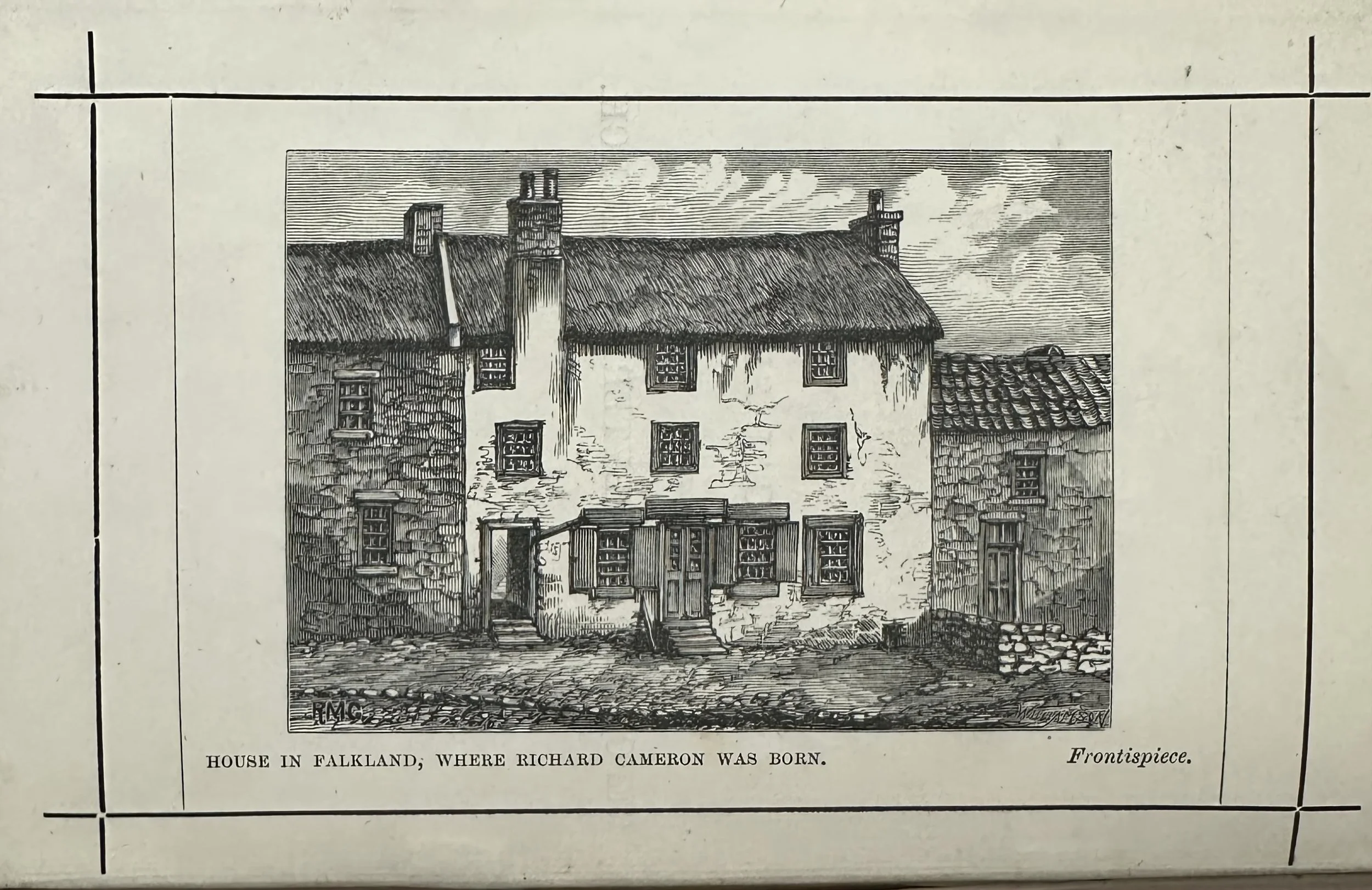
[ILLUSTRATION: House in Falkland, Where Richard Cameron was born.]
HISTORICAL SKETCH
OF THE
REFORMED PRESBYTERIAN CHURCH
OF SCOTLAND,
TO ITS UNION WITH THE FREE CHURCH IN 1876.
BY THE
REV. ROBERT NAISMITH,
CHIRNSIDE.
EDINBURGH:
JOHNSTONE, HUNTER, & CO.,
4 MELBOURNE PLACE.
1877.
PREFACE.
WHILE every human being ought to be a philanthropist, we do not blame those who love the members of their own family more than other human beings, or their own country more than other countries. We admit that such a preference is natural and reasonable. We also allow the propriety of feeling more deeply interested, in the history of our own nation or our own Church, than in the history of any other. But while a historian cannot be wholly free from the influence of such a preference, he is ever to remember that he is to write nothing but what he both BELIEVES and KNOWS to be true, though the facts recorded by him may be sometimes opposed to his personal likings. This is particularly necessary in writing a history of any particular section of the Christian Church. In this kind of writing partiality is apt to be intensified by sectarianism.
The history of a Christian Church should, to Christians at least, be interesting at any time, but there are particular times and occasions when it is more likely to attract the attention of the public. Such an occasion has recently occurred in Scotland. A Church, small in numbers, but
ii Preface.
ancient in origin, has harmoniously united with another comparatively large—modern in its distinctive name, yet ancient as any in its principles. This union has been compared to that of a mountain rill uniting with a mighty river—the rill comparatively long, in its rugged course, the river broad, deep, and rapidly widening. This rill rising among heath-clad hills, “flowered,” as James Renwick said, “with the graves of martyrs,” has long flowed among the moors and mountains of Scotland, satisfying the spiritual thirst of successive generations of “hill-fo’k.” Deepening and widening as it flowed onward, it gradually neared a noble river of water, similar in purity. The approach of the river and the rivulet being mutual, the confluence has been natural; and the result has called forth the congratulations of the nation—blessed by the united streams. The present attempt—not meriting the name of a history, but of a brief historic sketch—is humbly made by one who from infancy has drank from the rill as his father and grandfather did before him.
The sketch makes no claim to literary attraction, but the writer has endeavoured to condense historic truth. The attempt may help to inform the young, as to those Covenanters, to whom we owe so much. The rill of which we have been speaking has been generally known as the “Reformed Presbyterian Church of Scotland.” This somewhat pretentious-like name, was intended to be simply historical. The Church claimed to adhere to all the attainments of the First and Second Reformations in Scotland. But, though this was the proper and generally recognised name of the Church, it has also been known by other names. Having no ordained minister for a period of sixteen years, shortly after the Revolution of 1688, its members, consisting of several thousands,
Preface. iii
who met in associations chiefly in the south-west of Scotland, were called the “Society-men.” Having been previously driven by persecution to the mountains and moors of Scotland, they were sometimes called “Hill-fo’k.” Adhering to the principles of the strictest party of the Covenanters, the followers of Richard Cameron, the martyr, they have for nearly two centuries been called “Cameronians.” In 1706, the Rev. John MacMillan, minister of the parish of Balmaghie, in Galloway, after vainly attempting to bring the Established Church to acknowledge its defections from the attainments of the Second Reformation, left that Church and joined the followers of Cameron. From the circumstance that Mr MacMillan’s son and grandson were afterwards ministers in the same Church, its members were called MacMillanites. They were also during the last century called “Old Dissenters,” as they really were the oldest Presbyterian Dissenters in Scotland, though not seceders from the Established Church. They did not enter the Church established at the time of the Revolution, but claimed to represent an older and purer Church. They were not, as they had no reason to be, ashamed of any of these names; but their proper, distinctive, historic name by which they continued to be known till the time of the recent union was the one first mentioned. Both the Churches, now so happily united, may claim to be the Free, and at the same time the Reformed Presbyterian Church of Scotland—representing the attainments of the First and the Second Reformations—the Church of the Covenanters.
As an apology for writing this brief sketch of the history of his Church, the author may merely say, that since the time of the union he has often heard inquiries made for some such book. No such book has hitherto existed,
iv Preface.
so far as he is aware, except the historical part of the Testimony of the Reformed Presbyterian Church. That book was too bulky for the purpose of the inquirers, and was, moreover, defective, extending only to about 1840.
FREE CHURCH MANSE,
CHIRNSIDE, November 1876.
CONTENTS.
THE SECOND REFORMATION—1638-9.
vi Contents.
Contents. vii