Contact Us

Use the form on the right to contact us.

You can edit the text in this area, and change where the contact form on the right submits to, by entering edit mode using the modes on the bottom right. 

Form Block
This form needs a storage option. Double-click here to edit this form, and tell us where to save form submissions in the Storage tab. Learn more
         

123 Street Avenue, City Town, 99999

(123) 555-6789

email@address.com


You can set your address, phone number, email and site description in the settings tab.
Link to read me page with more information.

Database

Sectio Quinta.

James Dodson

This section refutes the charges of ambiguity and contradiction in the Covenant’s terms, arguing that such obscurities exist only in the imagination of prejudiced critics. The author clarifies terms like “common enemies” and “best reformed churches,” demonstrating that they are clearly defined by context, and dismisses alleged contradictions as mere misinterpretations or conflicts with the critics’ private persuasions rather than flaws in the text itself.

Read More

Sectio sexta.

James Dodson

The sixth section argues that the Covenant is a public and national obligation, not merely a private bond, meaning it binds the body politic and all posterity. The author asserts that because the Covenant was sworn by the representative Parliament and universally by the people, and ratified by the King’s oath, it engages the national faith and remains binding on successive generations so long as the nation endures, just as treaties between nations bind future citizens.

Read More

Sectio septima.

James Dodson

This section contends that the obligation of the Covenant is permanent and cannot be absolved by any human power, directly refuting the arguments of Dr. Gauden and Mr. Russel. The author insists that because an oath invokes God as witness and avenger, no superior can release the obligation to God, and the idea that the Covenant is void if not renewed by authority is a dangerous error that confuses the release of the promise's matter with the release of the oath’s bond.

Read More

CONCLUSION.

James Dodson

The Conclusion summarizes the weight of the arguments and the gravity of the subject, warning the nation of the divine judgment that awaits those who break their solemn vows. The author expresses a desire that these positions will provoke more able casuists to seriously consider the case of conscience regarding the Covenant, praying that the kingdom may be kept faithful to its obligations and preserved from the guilt of perjury.

Read More

Zanchius On the Law

James Dodson

1605-Jerome Zanchius (1516-1590).-Hieronymus Zanchius’s treatise on law provides one of the most comprehensive and careful taxonomies of law in the Reformed tradition, distinguishing with precision between natural law, human or political law, ecclesiastical traditions, and divine law in its several administrations. His chief contribution lies in demonstrating how all subordinate laws derive their authority from natural law and the public good, and therefore bind conscience only insofar as they accord with these—never merely by virtue of human enactment. This principle yields crucial consequences: that unjust laws do not bind; that the letter of a law may yield to its spirit when the public good requires it; that ecclesiastical traditions, though binding, are not of equal authority with Scripture; and that custom, however ancient, has no force against natural or divine right. Against both legalism and antinomianism, Zanchius establishes that the moral law, as the substance of all divine law, remains perpetually binding, while judicial and ceremonial laws served the particular polity and worship of Israel and are now abrogated—judicial laws as dead, ceremonial laws as deadly if reimposed as necessary. His work remains indispensable for anyone seeking to understand the proper obligations of conscience toward God and men.

Read More

Robert Turnbull on the Theatre

James Dodson

1837-Robert Turnbull (1809-1877).-In May 1837, when a petition was presented to the Connecticut House of Representatives seeking repeal of the statute prohibiting theatrical amusements, Rev. Robert Turnbull of Hartford’s South Baptist Church felt called by Providence to sound the alarm. His discourse, originally composed for a debate before Detroit’s Young Men’s Society and now enlarged and delivered before a packed audience at the Centre church, argues that the theatre—however adorned by the genius of a Sophocles or a Shakespeare—remains fundamentally hostile to literature, morals, and religion. Turnbull concedes the drama’s incidental literary merits but insists these are overborne by its corrupting tendencies: it degrades taste by habituating the mind to vivid excitement rather than sober thought, retards intellectual improvement by monopolizing the leisure hours of the young, ruins multitudes by drawing them into dissipation and vice, and clothes sin in the bewitching garb of poetry and spectacle so that what ought to repel instead fascinates. That good men in all ages—from Solon and Plato to the Reformers and the Pilgrim Fathers—have regarded the stage with deep suspicion, and that the Continental Congress itself once recommended the suppression of theatrical entertainments, confirms what the theatre's fruits make plain: however attractive the dish, it is poisoned.

Read More

A Discourse on the Sin and Danger of Opposition to Public Religious Covenanting,

James Dodson

1812-William C. Brownlee (1784-1860).-Brownlee preached this discourse in June 1811 to urge covenant renewal upon congregations that had long neglected the duty. His argument from Gamaliel’s counsel—that opposing a divine institution is fighting against God—is ably constructed, and his historical survey of covenanting's efficacy in the church, particularly the Scottish revivals, provides valuable testimony. Less commendable is the Seceder framework from which he writes: having rejected the civil component of the covenants, and having insisted on rewriting the bonds rather than renewing them in their original language accommodated to a remnant's peculiar status, the Seceders effectively preserved the form while hollowing the substance. For Covenanters, the civil terms still bound them to a distinct dissent from a constitutionally rebellious government, and no rewriting could remove that obligation without unfaithfulness. Brownlee’s criticism of the Reformed Presbytery’s infrequent covenanting thus misses the mark—he mistakes their careful providentialism for neglect, while his own tradition had already surrendered the covenant's most demanding features.

Read More

The True Principles of Human Government:

James Dodson

1844-James Brydon (18??-1883)-In this sermon, Brydon articulates a vision of human government grounded in the supremacy of divine authority over all civil and ecclesiastical affairs. Arguing that Scripture must be the sole foundation for political principles, he establishes that individuals are responsible to God first and foremost, must judge truth and duty for themselves through the light of the Bible, and owe obedience to earthly rulers only insofar as those rulers exercise their delegated authority in accordance with God’s will. Brydon contends that rulers should be both God-fearing and chosen by the people through representative delegation, that a righteous majority has legitimate authority over a minority, yet that a minority conscientiously opposed to sinful demands is duty-bound to resist—even to the point of suffering. At its core, the sermon insists that no government possesses inherent legitimacy apart from submission to the Law and Testimony of the Lord of Hosts, and that both governors and governed will answer ultimately to Him for how they have wielded or yielded to power.

Read More

Alexander Shields (c. 1660-1700)

James Dodson

Alexander Shields (c. 1660–1700) was born at Haughhead in the parish of Earlston, Berwickshire, the son of James Shields. He entered Edinburgh University at an early age and graduated M.A. in 1675. Averse to prelacy, he left his divinity studies under Lawrence Charteris and migrated to Holland, studying theology at Utrecht from 1680. After a period in London, where he is said to have acted as amanuensis to Dr. John Owen, he was licensed as a preacher by Scottish Presbyterians, declining the oath of allegiance as a Covenanter. His zealous opposition to the oath brought him under suspicion, and in January 1685 he was apprehended at a conventicle in Embroiderers' Hall, Cheapside. Remitted to Scotland, he was examined by the privy council and the lords justices, and under threat of torture signed a renunciation of engagements declaring war against the king—a compliance he soon bitterly regretted. He was confined to the Bass Rock, from which he escaped in women's clothes at the end of 1686.

Making his way at once to James Renwick, Shields publicly confessed his sin of owning the authority of James VII and became one of the most ardent champions of the Cameronian cause. His Hind Let Loose (1687), written during a trip to Holland to see it through the press, provided a vigorous historical and constitutional vindication of the Covenanters' position, defending the right of armed resistance to tyranny and arguing that the monarch is a "public servant" accountable to the people. After Renwick's execution in February 1688, Shields continued the policy of field meetings and approved the Cameronian insurrection later that year. In March 1689, with Thomas Lining and William Boyd, he took part in a solemn renewal of the covenants at Borland Hill, Lesmahagow. The following year, the three men submitted to the General Assembly and were received into fellowship, Shields having given satisfaction for his former compliance.

Shields was appointed chaplain to the Cameronian regiment in February 1691 and was called to the second charge at St. Andrews in 1696, being admitted in September 1697. In July 1699, the commission of the General Assembly authorized him to accompany the second Darien expedition as minister to the colonists. He sailed in the Rising Sun and reached Darien late in November, but the quarrels and disorders of the settlement disheartened him. After making several hazardous expeditions inland, he crossed to Jamaica with Francis Borland, only to be seized with malignant fever. He died on 14 June 1700 at Port Royal, Jamaica, in the house of Isabel Murray, aged about forty.

Read More

A Sermon in the Canongate Meeting House , Feb. 10, 1691

James Dodson

1702-Alexander Shields.-This 1691 sermon, on 2 Samuel 15:26—preached as Shields’ farewell before departing for Flanders—explores the spiritual crisis of feeling abandoned by God, using David’s flight from Absalom to distinguish between God’s unchangeable love of benevolence and the sensible manifestations of His delight, which may be withdrawn due to sin or sovereignty. While believers cannot submit to being objects of God’s hatred, Shields argues they must submit to the loss of particular blessings, callings, or comforts, acknowledging God’s justice and their own unworthiness. The work remains profoundly relevant today for its nuanced treatment of spiritual desertion and the “dark night of the soul,” offering a framework for enduring the loss of religious privilege or felt presence without abandoning faith. Furthermore, its piercing critique of a lukewarm, compromised church—more aligned with “malignants” than with holiness—resonates sharply in an era of cultural Christianity and institutional decline, challenging modern believers to examine whether indifference and worldly alliance have forfeited God’s active delight. Ultimately, the sermon calls for a radical, resigned submission to God’s sovereign will, even when it means accepting that He may employ other instruments to accomplish His purposes.

Read More

John Livingston (1603-1672).

James Dodson

John Livingston (1603–1672) was born at Kilsyth, Stirlingshire, on 21 June 1603, the son of William Livingston, minister of Monybroch and later Lanark, and Agnes Livingston of the house of Dunnipace. Educated at Stirling and the University of St Andrews, he resolved to enter the ministry after a day of spiritual meditation in a cave on the banks of Mouse-water. Licensed as a preacher in 1625, he was prevented by episcopal regulations from obtaining a parochial settlement and instead served as chaplain to the earl of Wigton at Cumbernauld from 1627. It was during this period that he preached the celebrated sermon at the Kirk of Shotts on 21 June 1630, following a night of prayer, which produced an extraordinary revival and is said to have converted some five hundred persons.

In August 1630, Livingston accepted the charge of Killinchie in the north of Ireland, where he ministered with remarkable success but faced continual episcopal persecution, being deposed in 1632 and again in 1635. Twice he attempted to emigrate to America, and twice contrary winds drove him back. After his marriage in 1635 to a daughter of Bartholomew Fleming of Edinburgh, he continued to preach privately in Ireland and Scotland until the collapse of episcopal authority in 1637 enabled him to emerge openly. He was present at the receiving of the Covenant at Lanark and served as a commissioner to London in disguise. In July 1638, he was inducted to the parish of Stranraer, where his ministry drew large numbers of Irish Presbyterians across the water to hear him, and he was a member of the historic Glasgow Assembly that abolished episcopacy in Scotland.

Translated to Ancrum in Roxburghshire in 1648, Livingston served as one of three clerical deputies sent to treat with Charles II at the Hague in 1650, though he privately doubted the king's sincerity. After the Restoration, he fell under government displeasure and was banished from Scotland in April 1663, never to return. He settled at Rotterdam among fellow exiled ministers and devoted his remaining years to biblical scholarship, preparing a polyglot Bible that earned the approbation of the learned. He died on 9 August 1672, in the seventieth year of his age.

Read More

A Letter Unto His Parishioners of Ancrum, 1671

James Dodson

1710-John Livingston.-Livingston’s Letter to his Parishioners of Ancrum merits reading because it is not merely a relic of suffering times, but a pastoral map for how the Covenanted cause was to be understood, loved, confessed, and lived. Livingston joins tenderness with testimony: he speaks as a lawful pastor to ordinary souls, warning the careless, reclaiming backsliders, strengthening the faithful remnant, and interpreting the public defection of the church in terms of Christ’s crown-rights, sworn covenant obligation, and practical holiness. It shows that Covenanter faithfulness was not a narrow political temper, but a whole way of life: family worship, Sabbath sanctification, separation from corrupt ordinances, love to enemies, care for children, reading sound books, private repentance, public witness, and steadfast adherence to the National Covenant and Solemn League. The value is that Livingston’s letter gives an older, warmer, and more pastoral form of the same principles later defended by the United Societies and the Cameronian testimony. It proves that the issues were not invented by later “extremists”: Christ’s exclusive headship over the visible church, resistance to Erastian supremacy, refusal of imposed prelacy and indulgence, and the continuing obligation of covenanted Reformation were already present in the heart of one of Scotland’s most revered ministers. It helps modern readers see that true testimony is not mere negation; it is grief, holiness, prayer, pastoral fidelity, covenant memory, and hope for recovery. In short, it teaches Covenanters how to suffer without bitterness, separate without sectarianism, and contend without losing the soul of godliness.

Read More

A Short Memorial of the Sufferings and Grievances Past and Present of the Presbyterians in Scotland:

James Dodson

1690-Alexander Shields.-This Short Memorial remains invaluable today as both a primary source of unflinching documentary evidence and a sustained legal argument against arbitrary power. Its meticulous catalog of thirty-three grievances—naming specific perpetrators, victims, fines, and extrajudicial killings—provides an irreplaceable record of the systematic dismantling of legal and ecclesiastical protections between 1660 and 1690, preserving details that official records often suppressed or sanitized. Beyond its historical testimony, the work’s enduring significance lies in its constitutional reasoning: Shields demonstrates that the Cameronians’ resistance was grounded not in sectarian anarchy but in the existing laws of Scotland, the conditions of the Coronation Oath, and the binding obligations of the National and Solemn League Covenants—arguing that allegiance is conditional upon the magistrate’s fidelity to these fundamental compacts. Crucially, by extending his indictment into the “present grievances” under William, Shields exposes the Revolution’s incomplete settlement and establishes the continuity of protest that would shape the Reformed Presbyterian tradition, making this document essential for understanding how a principled minority could maintain that they were the true defenders of the national church and covenant, not schismatics from it.

Read More

Kilbirnie West

James Dodson

1923-W.J. Couper.-This book it traces a congregation with Reformed Presbyterian/Cameronian origins through its later ecclesiastical transitions. It covers the 1824 disjunction from Kilmacolm, the building of the church, the first session, and the ministerial succession, including: Rev. James Ferguson; Rev. Peter Macindoe Martin; Rev. Alexander Davidson; Rev. Henry Tod Gillison, B.D.; and Rev. James Anderson, M.A. It preserves useful local RP memory, but also needs to be read carefully because the later United Free framing can soften or reinterpret the older Covenanter testimony. It discusses matters like the franchise/voting controversy, hymns and paraphrases, choir, harmonium, and union developments—precisely the kinds of details that show the congregation’s movement away from the stricter older position.

Read More

Kilbirnie West

James Dodson


58

VI

REV. JAMES ANDERSON, M.A.


The death of Mr Gillison allowed the question of union with the East United Free Church to be raised, and the Presbytery sent a representation of their number to bring the matter before the congregation. Several meetings of one kind and another were held, but Session and people alike were unanimous in their desire to maintain their individuality, and “sternly opposed” any change. After some negotiations further proceedings were dropped. However desirable concentrated effort may be, it would have been a pity if the distinctive historic testimony of the old Reformed Presbyterian Church in Kilbirnie had been extinguished.

The congregation were therefore free to proceed with the choice of a minister. In the end only one name was brought forward, and the Rev. James Anderson, M.A., became the unanimous selection of Session and people alike. Mr Anderson is a native of Uplawmoor, Renfrewshire, and at first chose teaching as his life’s work. He went through the whole curriculum necessary to qualify for his profession. He served as a pupil teacher at Barrhead, and thereafter became a student at the Edinburgh Church of Scotland Training College, attending some classes at the

MR ANDERSON ELECTED 59

University there at the same time. After having taught for some years, he returned to the University to complete his course in Arts, graduating M.A. at Glasgow in 1914. During his undergraduate course, and while attending the Divinity Hall, he acted as assistant at Burnbank, Hamilton, and at the Macgregor Memorial United Free Church, Glasgow. Much has been written and spoken of the struggles which many Scottish men have endured so that they might preach the Gospel under the sanction, and by the authority, of the Church. Mr Anderson’s history exemplifies the sacrifices and perseverance that have so often been welcomed in their ministers by the religious people of the land. In all his endeavour he was aided and abetted by his like-minded and devoted wife, for Mr Anderson’s Arts and Divinity courses were passed with a young family growing up around him. She made a missionary-assistant’s meagre salary resemble the widow’s cruse of oil and barrel of meal.

In 1917, the same year in which he finished his Divinity course, Mr Anderson was called to Balgedie and Portmoak United Free Church—a congregation that in former days was associated with the names of Ebenezer Erskine and Dr M‘Kelvie, the historian of the congregations of the United Presbyterian Church. While in Kinross-shire he did much fine service as one of the chaplains who had the spiritual oversight of the shell-shock soldiers in the sanatorium near his manse, besides ministering to the local Church of Scotland congregation and acting for a time as head-master in a Milnathort school.

60 KILBIRNIE WEST

His call to Kilbirnie was signed by 129 members and 60 concurrents, and the induction took place on April 29, 1920. The Rev. J. C. B. Geddes of Largs presided and gave the charges, while the Rev. W. B. Hutton of Saltcoats preached from Rom. viii. 9: “Now if any man have not the Spirit of Christ, he is none of his.” On the following Sabbath the new minister was introduced to his congregation by the Rev. William Forbes of Cairneyhill, Mr Anderson conducting the afternoon service and preaching from Luke vii. 47: “Wherefore I say unto thee, Her sins, which are many, are forgiven; for she loved much: but to whom little is forgiven, the same loveth little.”

Since coming to Kilbirnie Mr Anderson has won the good opinion of those with whom he has had public relations. The Salvation Army testify to his zeal for evangelistic work, and his willingness to co-operate in all common efforts for the spiritual advancement of the community. Those in charge of the educational affairs of the district have declared his great usefulness on the Education Authority of which he is a member. He is chairman of the Kilbirnie and Glengarnock Nursing and Ambulance Association, and Hon. Secretary of the Relief Committee of the town and district. His deep interest in the social condition and welfare of the people has thereby found an appropriate outlet.

During the century the congregation have necessarily had much faithful service bestowed upon them—service which never looked for recompense, and whose value seemed to perish with the year that


Illustration: Sabbath School Teachers, 1923.


SOME MEMBERS 61

saw it. What has thus been done, however, has been woven into the texture of the congregation and community as they now exist, and its record is written elsewhere in the permanent book of God’s remembrance. Among family names that stand out in the records are those of Knox, Muir, Martin and Fyfe—families that have belonged to the congregation from the beginning, and have assisted greatly in maintaining their continued prosperity. Within the past few months the whole-hearted service of William Mackie, J.P., has been lost. He was a manager and preses for many years, and was greatly interested in the present Centenary celebrations, but his help was suddenly removed on April 13, to the great sorrow of his fellow-members.

After a century of full activity, the prospects of the congregation are at present brighter than ever during their history. As an indication of the position they hold and the work they are doing, the following may be quoted from the last report made by the Presbytery on the congregation:

“They are greatly gratified to learn, not only of the zeal and vigour with which the new ministry has been entered upon, but of the response made by office-bearers and people, and especially of the large measure of success attending the work among the young. They congratulate minister and people alike on the continued spirit of Christian liberality, on the gratifying attendance at the weekly prayer-meeting, and on the other evidences of increased spiritual interest.”

62 KILBIRNIE WEST

All through their existence the congregation have stood for the Crown Rights of the Redeemer, the perfect freedom of the people to worship as conscience dictates, and evangelical truth. Everything indicates that their life is still being maintained in full vigour and energy, and that the spirit of their Covenanting forefathers is still alive among them, even amid all the necessary changes that have taken place since the days of Cameron and Renwick and Peden.

“Ungrateful Country, if thou e’er forget
The sons who for thy civil rights have bled! . . .
But these had fallen for profitless regret
Had not thy holy Church her champions bred,
And claims from other worlds inspirited
The star of Liberty to rise. Nor yet
(Grave this within thy heart!) if spiritual things
Be lost, through apathy, or scorn, or fear,
Shalt thou thy humbler franchises support,
However hardly won or justly dear:
What came from heaven to heaven by nature clings,
And, if dissevered thence, its course is short.”

WORDSWORTH.

Kilbirnie West

James Dodson


Illustration: Choir, 1923.
Foreign Missions Collectors, 1923.


53

V

REV. H. T. GILLISON, B.D.


The Rev. Henry Tod Gillison was born at Fossoway, Kinross-shire, where his father was Free Church minister. He belonged to a family whose heart turned to the Church. A brother was a Baptist pastor in Kirkintilloch. One cousin is a missionary in China, and another was killed on Gallipoli while acting as a chaplain with the Forces. Beginning life as an architect, Mr Gillison at last turned his attention to the ministry. Before being settled at Kilbirnie he served for a time as assistant in several congregations. It is not often that an assistant is chosen as colleague and successor to his chief, but that honour fell to him at Kilbirnie—a testimony to the impression he had made on the people by his gifts and graces.

From the beginning Mr Gillison suffered from ill-health, for which he sought every possible remedy, even wintering abroad. During these periods of absence the congregation bore with exemplary patience and much sympathy the defects in their pastor’s condition, for they all recognised his devotion to their service. Never once did they raise the question of his position among them.

Soon after his settlement the whole Church was

54 KILBIRNIE WEST

disturbed by the famous House of Lords’ decision of 1904, by which the Church was at one stroke deprived of its whole property. As already explained, the Kilbirnie people might have considered themselves secure under the judgment, but the Session, representing in this the unanimous feeling of the congregation, at once took emphatic sides, and without a dissentient voice passed this resolution on September 23: “This Session protests against the judgment of the House of Lords as inequitable, as an unwarranted interference with the Church’s prerogative in spiritual things and as calculated seriously to disorganise the spiritual work of the Church, both at home and abroad, and declares its sympathy with the Union of 1900 and its steadfast loyalty to the United Free Church.” No one has since been led to consider the resolution, thus passed in his name, either premature or ill-judged.

Mr Gillison had a very high conception of what his duty was in regard to all ministerial functions. He did his best to have all baptisms carried through in face of the congregation—a procedure to which many parents were unwilling to conform—and occasionally friction was thereby caused. He was opposed to what is called “coffining,” that is, conducting some kind of short service when a dead body is placed in its casket. The practice arose out of certain political conditions in the past history of the country, but the time for it had long since passed away, and the ceremony had degenerated into a useless survival and almost a superstitious observance. That the minister should decline to be present at

THE GREAT WAR 55

such a function, sanctioned as it was by immemorial custom, seemed to some to show him lacking in sympathy, whereas he was only careful for purity of worship and belief. Mr Gillison was also stated to be difficult to satisfy in regard to the fitness of catechumens for admission to full membership. After all, these things were merely evidence of a high standard of fidelity to his office, and the vast majority of his congregation understood his attitude.

It so happened, however, that in 1912, what is portentously called the “Quinquennial Visitation,” was carried out during one of the minister’s periods of absence. The delegates from the Presbytery met with the office-bearers only, and had some intimate conversation with them over the affairs of the congregation. Unfortunately a wholly exaggerated report of what had been spoken of was conveyed to the Presbytery, which immediately ordered a further visitation. At the meeting with the congregation matters were put in their true perspective and the whole business adjusted, minister and people agreeing cordially to meet each other’s wants.

The period of the Great War, with all its anxieties and problems, is reflected in the congregational minutes. Collections on behalf of various necessitous causes were made; the men who had joined the army were remembered with gifts; rigid economy and saving were recommended, and the appeal to all to engage in some kind of war service was endorsed. Recognising that the liquor trade was one of the greatest national hindrances to victory, the Session petitioned the Government on behalf of still greater

56 KILBIRNIE WEST

restrictions. Altogether fifty men from the congregation joined the Colours, and among these gallant lads the following gave up their lives:—

Andrew Boyd . . . Royal Engineers
Hugh A. Crawford . . A. & S. Highlanders
Colin Fyfe . . . Royal Scots Fusiliers
James Hunter . . . Royal Field Artillery
John Jamieson . . . Cameron Highlanders
William Knox . . . Cameron Highlanders and Royal Air Force
James N. Macfarlane . . Royal Highlanders
John M‘Cosh . . . Cameron Highlanders
William B. M‘Creath . . Scottish Rifles
William Reid . . . Royal Scots
William B. Walker . . London Scottish
Charles Whitelaw . . Machine Gun Corps

The organist was called up and offered to resign his eldership and his leadership of the praise, but the Session felt that there was no necessity for him to retire from either office, and made arrangements for temporarily filling his place at the instrument. In the course of his campaigning he was taken prisoner by the Germans, and suffered so severely that he died shortly after being discharged from the army. The Great War allowed no one to escape, and Kilbirnie West had its part in the common sorrow and loss.

After a long and costly search after health and an illness bravely borne, Mr Gillison passed away quietly on September 5, 1919. He was unmarried, for he was too conscientious to ask anyone to share his precarious lot, but he nevertheless left behind him

DEATH OF MR GILLISON 57

a large circle of friends to mourn his early departure. He was buried in the quiet churchyard of his birthplace, where he now lies amid kindred dust. His father had predeceased him in 1896, but a funeral service for him was conducted in the church of his youth.

Mr Gillison’s usefulness in the ministry was greatly hampered by his bodily weakness and infirmity, but all recognised in him a man of sterling character, great ability and devoted service. An intimate friend in the ministry who knew him well thus described him: “He was the most conscientious of men. Indeed, some people thought it was his conscience that killed him—he was so painfully particular in following every direction of his medical advisers, and he tried so many of them. In his religious views he was the same, painfully examining every detail before coming to a conclusion. On the whole his position on these matters was rather advanced, and he did not care to preach in his father’s church on that account. In all his ideas of Church government and discipline he would be regarded as puritan. In the doing of his duty he allowed no qualifications.

“Underneath all this he was the most lovable of men, with a fine sense of humour and a keen mind that missed nothing, though it was a constant grief to him that, through his defective eyesight, the range of his reading had to be so limited.”

NEXT

Kilbirnie West

James Dodson


41

IV

THE REV. ALEXANDER DAVIDSON


The congregation did not meet till December 23 to elect a successor to Mr Martin. The call “came out” for the Rev. James Hunter, B.D., who at the time was acting as assistant in Great Hamilton Street Church, Glasgow. The majority in his favour as against another probationer was small, and the call was signed by only 51 members and 21 adherents. Mr Hunter at once asked that no further steps be taken in it, and the Presbytery ended the matter by refusing to sustain the call.

After an informal attempt to secure the Rev. D. D. Robertson of Whithorn, which came to nothing, the congregation met again on April 20, 1870, under the moderatorship of the Rev. Thomas Ramage of Kilmarnock, when the Rev. Alexander Davidson of Stromness was unanimously chosen, the feeling against translations having long since died away in the Church. The call was signed by 123 members and 65 adherents.

Mr Davidson had spent ten fruitful and full years in the Orkneys ministering to a small and struggling cause, and had shown considerable courage in undertaking its supervision at first and in shepherding it afterwards. In the preceding autumn he had

42 KILBIRNIE WEST

declined a call from Rothesay on the ground of the loyalty of the Stromness people, and because “many belonging to other churches there had expressed opinions that had influenced him to such an extent that he could not set them aside.” Any difficulty he had had about moving southwards, however, was now removed, and on June 7 he accepted the call to Kilbirnie. The induction took place on July 7, when the Rev. John Jackson of Girvan preached from Zech. vi. 12, 13, the Rev. Thomas Ramage inducted, and the Rev. T. H. Lang of Ayr gave the charges. On the following Sabbath, July 10, Mr Davidson was introduced to his work by his friend, the Rev. John M‘Dermid of Glasgow. The people of Stromness showed their appreciation of Mr Davidson’s services by sending him away with gifts, but his removal destroyed the struggling cause in the north. Its members do not seem to have made any attempt to secure another minister, and the buildings were disposed of some time afterwards. It was surely heaping coals of fire upon the friendly heads of the Kilbirnie people when the Synod of 1874 made a grant to them of £80 from the sum obtained from the sale of the Stromness property, the money to be applied to congregational purposes.

The variation in the value of money since those days is strikingly shown by the fact that the managers in making arrangements for the induction solemnly passed the following resolution: “Taking into consideration the trouble that the Rev. Thomas Ramage as Moderator of Session has been at, and how at all times he had been ever ready and willing

REV. ALEXANDER DAVIDSON 43

to assist in furthering the welfare of the congregation, also the Rev. Thomas Lang, as Clerk of Presbytery, who had throughout our vacancy been so very active in arranging for a supply of preachers so that the pulpit had not been empty for a single Sabbath, they along with the thanks of the congregation be presented with Two Pounds Ten Shillings each”!

The disturbed state in which the congregation had been is shown by the fact that at the date of Mr Davidson’s induction the membership stood at 146, but from that time steady increase was recorded until the roll was doubled at the time of his retirement in 1902. The result was entirely due to the devotion of Mr Davidson and his acceptability with the people. He came to them with more than the usual experience of ministerial work. A native of Glasgow and brought up in Great Hamilton Street congregation—then the most important charge in the Reformed Presbyterian Church—he had during his student career, like his contemporary, Dr John G. Paton of the New Hebrides, acted as an agent of the Glasgow City Mission. The experience in preaching and visitation which he gained in that sphere and by his sojourn in the northern town, must have been of great value to him when he came to minister in a place like Kilbirnie with its factories and ironworks.

One of the first matters to which the congregation addressed themselves after the settlement of Mr Davidson was the condition of the manse. It was little more than a very small cottage, and in 1874 steps were taken for its enlargement. A wing was

44 KILBIRNIE WEST

added and a second story provided for part of the building. The total cost seems to have been £269, but the whole deficiency on the congregational accounts for that year was only £43, which shows that the people were in good heart. The jubilee of the congregation was celebrated in 1876, and at that time all debt was wiped out.

At the meeting held on his retirement Mr Davidson named as the three most outstanding events of his ministry, the Unions of 1876 and 1900, and the erection of the present church on the site of the old.

The ecclesiastical connections of the congregation have been very varied. At its institution it was under the inspection of the Reformed Presbyterian Synod, and was made a constituent member of the Western Presbytery of the Church. The growth of the Church necessitated a rearrangement of its Presbyteries in 1834, and Kilbirnie was included in the Presbytery of Kilmarnock. There it remained till 1876, when the Reformed Presbyterian Church united with the Free Church of Scotland, and Kilbirnie was added to the Presbytery of Irvine. Neither the Session nor the congregation offered objection to the Union of 1876. Any difficulty the Session may have had at first was removed by their belief that the Articles of Agreement “distinctly recognise the Mediatorial Supremacy of the Lord Jesus Christ over the nations as well as over the Church”—a truth for which the Reformed Presbytery stood. In the event, one member of Session could not see his way actively to accept the Union, but he did not carry his opposition further than to signify his disapproval,

PRESBYTERIAL CHANGES 45

and remained an office-bearer. There being already a Free Church in the town, the congregation adopted a name dictated by its geographical relation to its neighbour and called their church the West Free Church, although the letters “R.P.” continued to appear in the title for some time longer to conserve any interest the congregation might have through its former connection. In 1895 the General Assembly withdrew certain congregations from the Presbytery of Irvine, and formed them into the Presbytery of Ardrossan. Both churches in Kilbirnie were attached to the new Presbytery, although the change did not meet with the approval of the West Kirk-Session.

The Union of 1900 passed without incident so far as the congregation was concerned, the only reference in the minutes being a note of the change of name to West United Free Church. Some anxiety as to their exact standing, however, came in 1904 with the adverse decision of the House of Lords. At the Union of 1876 the Reformed Presbyterian Church had remained a separate entity so far as all questions of property were concerned, the Synod continuing to meet quoad civilia—as it does to this day. It was therefore maintained with much show of reason that the judgment of the House of Lords had no special significance for all the old congregations of the Reformed Presbytery. When, therefore, the Allocation Order reached the managers and congregation in 1907, assigning to them their property under the Churches (Scotland) Act of 1905, considerable doubt arose as to their proper course of action. How could

46 KILBIRNIE WEST

the Commissioners assign what had never fallen under their jurisdiction? Several meetings were held over the question, and much advice was sought from legal authorities. It was pointed out that no good would come of rejecting the Order. If the Commissioners had no authority, the position remained as it was, and no harm would be done. If they had legal power to deal with the property of the congregation, it would be advisable to accept what was offered. At length, in August 1907, the Allocation Order was accepted, and what was their own remained their own.

For a considerable time before 1888 the Church had caused worshippers within it some inconvenience owing to the growth of the congregation and the antiquated nature of the building. A gallery had been added, but access to it had for long been a source of trouble. In 1882, and again in 1886, a new church was suggested, but the matter was allowed to lie over. In the following autumn the question was again discussed. It was then felt that a new church must be erected on a new site, the old building to be retained for Sabbath School and other purposes. It was ultimately agreed to take a plebiscite of the members, and by a majority of 149 to 19 votes it was determined to proceed with a new building on the old site. In June 1887 it was reported that the congregation had promised £1306 towards the enterprise, and in May plans were adopted. During the building operations the congregation worshipped in the Good Templars’ Hall.

The new church was opened for public worship on

THE NEW CHURCH 47

July 7, 1889, by Dr W. H. Goold of Edinburgh, who preached from Rev. xv. 3: “And they sang the song of Moses the servant of God, and the song of the Lamb, saying, Great and marvellous are Thy works, Lord God Almighty; just and true are Thy ways, thou King of saints.” The collection amounted to the handsome sum of £201. The architect was Mr Alexander Petrie of Glasgow, and the total cost was apparently £1615. Three stained glass windows were inserted to the memory of William Knox of Moorpark, George Knox of Redheugh, and James Knox of Riverside, representatives of a family which had been associated with the congregation from its start and had taken a prominent share in all its work and activities. In 1905 another window was added to commemorate Mr R. W. Knox of Moorpark, who had died during the preceding summer. In 1899 it was suggested that a steeple with a bell should be erected, but nothing came of the proposal.

During Mr Davidson’s ministry considerable alterations were made in the mode of conducting public worship, all the changes coming spontaneously from the people themselves. Up to 1884 the only material used in the praise of the Sanctuary was the metrical psalms. In that year a petition signed by 120 members was presented to the Session asking that paraphrases and hymns should be introduced. Church regulations did not stand in the way, for the Reformed Presbyterian Synod had declared that no obstacle existed to their use in public worship, and the Free Church had legislated along similar lines. The

48 KILBIRNIE WEST

Session determined to test the mind of the congregation by voting slips, and agreed that a majority of two-thirds of the members was required before the alteration could be authorised. The result was favourable to the change, and the Session authorised the use of the paraphrases and the five hymns usually printed along with them. Their cautious actings were due to a disinclination to make too great an innovation at once. In 1888 reform was carried still further by allowing the people to sit during prayer and stand during singing. At the same time the precentor was asked to form a choir, and in due time a choir was installed, the congregation thereafter showing their appreciation of their services by meeting the expenses of an annual trip for the members.

A further advance in the musical part of the service was made in 1899, when it was resolved to introduce an instrument. The subordinate place it was expected to take in public worship was shown by the advertisement inserted in the public prints: “Wanted by West Free Church a Lady to accompany choir on harmonium.” The office of precentor was retained for some time, but the two offices were afterwards merged in one person. Since that time there have been the usual extensions of the musical part of the services in the way of anthems and voluntaries.

During their connection with the Reformed Presbyterian Church, the congregation did not require to draw from the general funds to augment the stipend of their minister, and although the demand
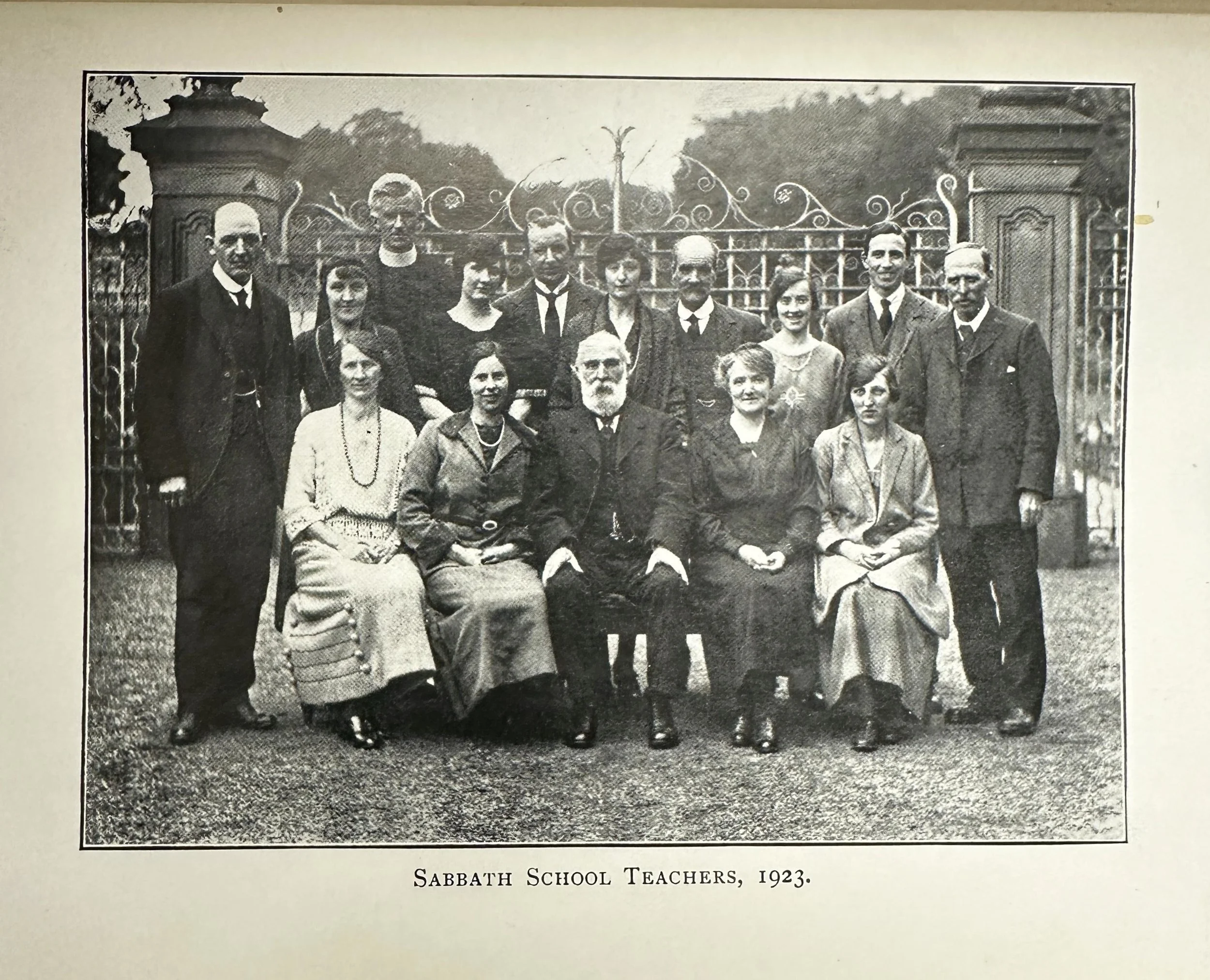
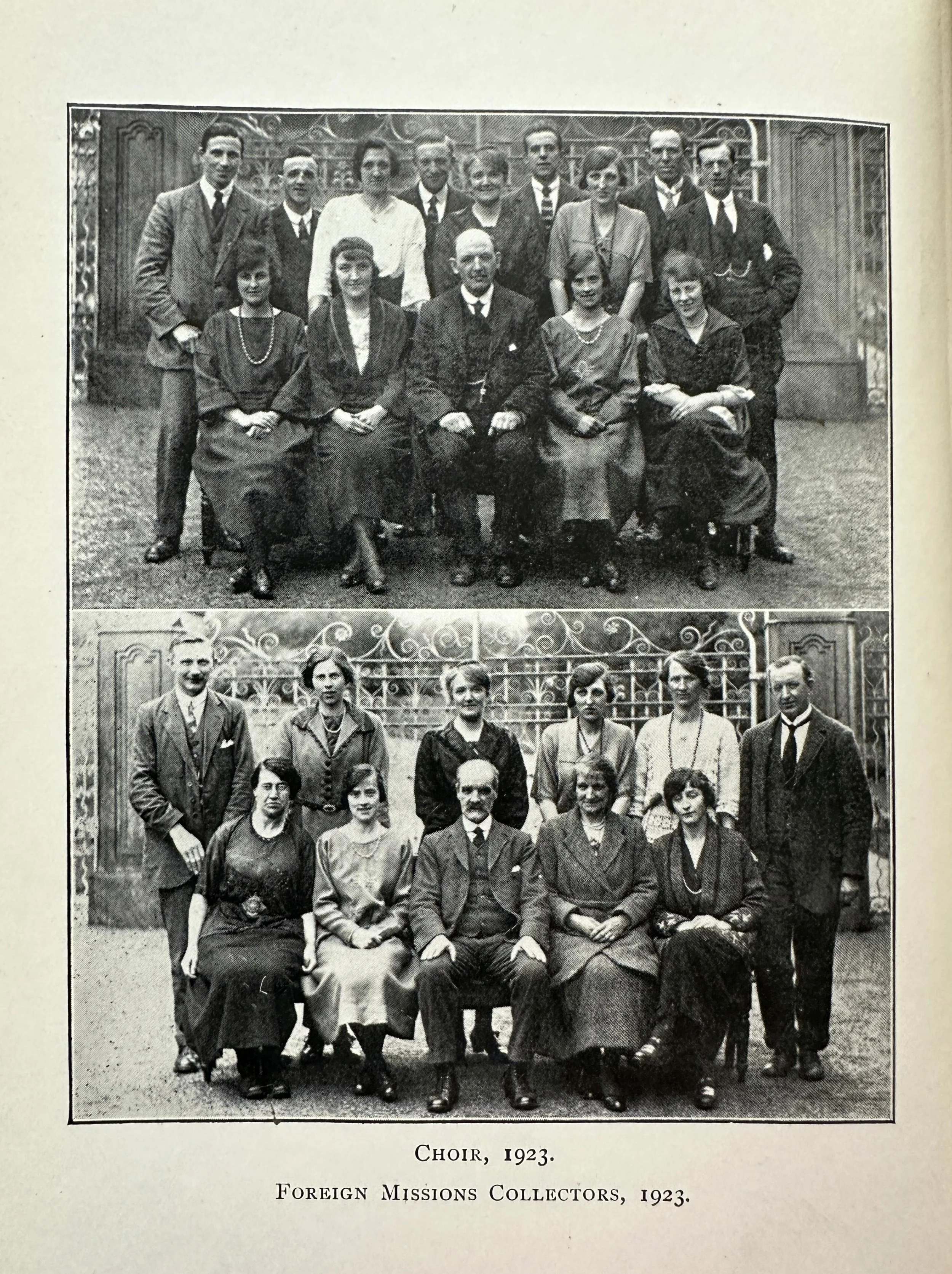
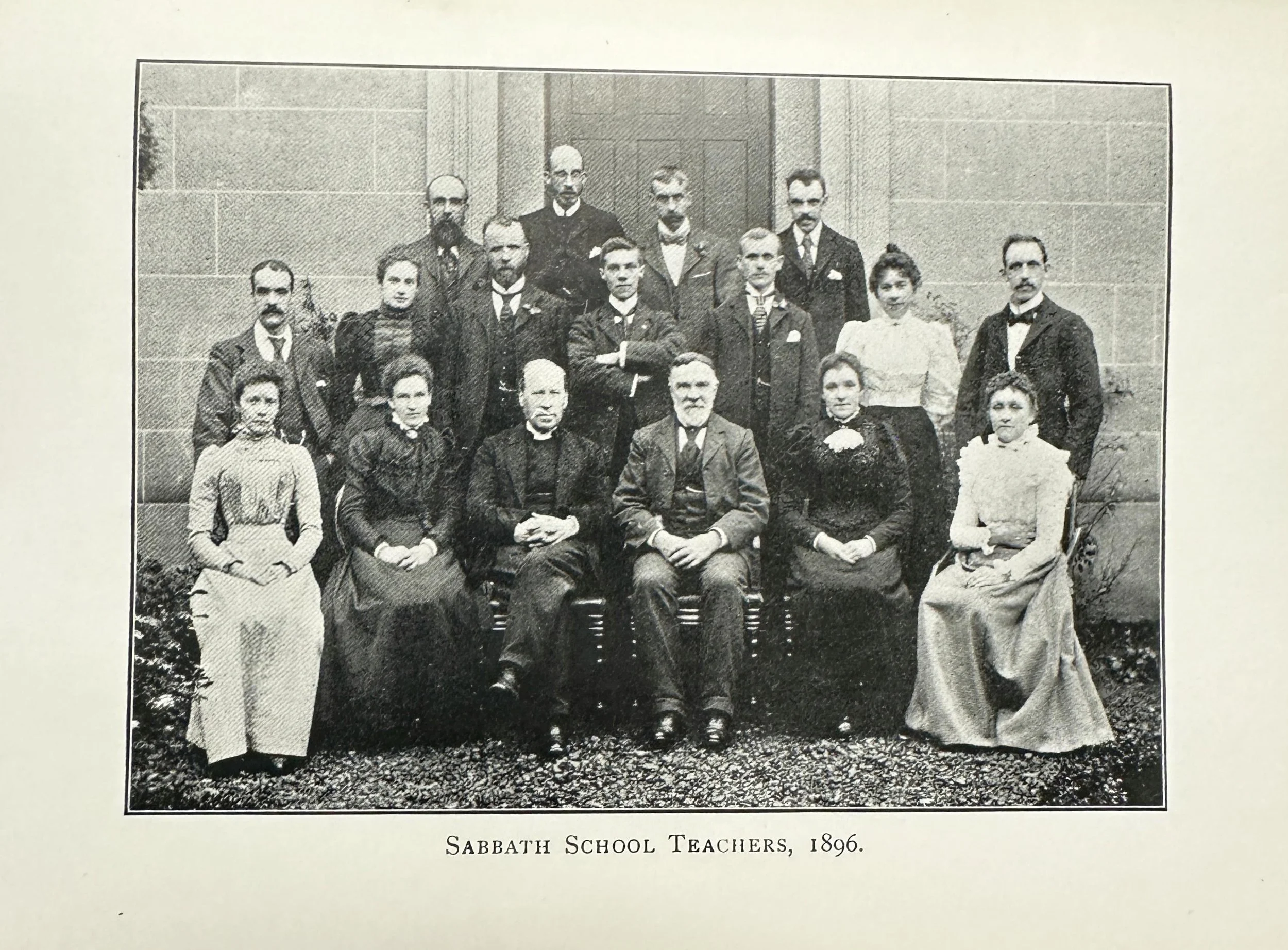
Illustration: Sabbath School Teachers, 1896.


CONGREGATIONAL FINANCE 49

for self-support after the Union with the Free Church was somewhat higher, they still contrived to raise what was needed. There was, therefore, some ground for the protest that appears more than once in the minutes as to congregations that supplemented their ministers’ stipends and at the same time drew on the funds at large. The same healthy ambition to be self-sustaining pervaded the other finances of the congregation, although they were more than once indebted to the Ferguson Bequest Fund when special expenditure had to be met. An occasional legacy came their way, but these were of small amount and infrequent in number. An interesting point was raised in 1876 in connection with a small bequest. A certain member left half of her estate to the congregation. An appeal was made by the trustees that the legacy should be surrendered for behoof of the remaining legatees. It seemed an ungracious thing to refuse, but the managers did so on the ground that it would be disrespectful to the wishes of the deceased and discourage like benefactions in the future—a decision which shows that whatever may have been the private feelings of the members, the managers took a very serious view of their position as guardians of the congregational purse.

In 1900 Mr Davidson’s health began to give way. He was near the allotted span of threescore years and ten, and had ministered in Kilbirnie for thirty years. The situation was met for some time by reducing the number of services on Sabbath to one, but it soon became apparent that some other arrange-

50 KILBIRNIE WEST

ment was required. In the spring of 1901 it was resolved to provide Mr Davidson with an unordained assistant, and the Rev. H. T. Gillison, B.D., was appointed. The arrangement continued for a time, and then Mr Davidson intimated his intention of applying for a colleague and successor. In acquiescing in the proposal the congregation minuted their appreciation of their minister’s long and faithful services. Among other things the resolution declared that “as a preacher the Rev. Mr Davidson dispensed the Saving Truth of the Gospel with earnestness, force and fulness. As a pastor his judicious wisdom was always used to promote peace and good-will. He was generous beyond measure, and was in constant attendance where and when he was needed. As a citizen he was always ready to help in good works, and at the service of any brother who stood in need of his services. As head of his own household he was much given to hospitality, and his words were seasoned with the salt of the Word.” At a farewell meeting held on April 25, 1902, he was presented with a cheque for £440.

The Assembly duly authorised the calling of a successor, and the congregation lost no time in carrying out the duty. On June 16 they met for an election. Only one name was submitted—that of Mr Gillison who had been acting as assistant for the preceding year. The call was signed by 218 members and 63 concurrents, and on September 16 Mr Gillison was ordained to the pastoral charge.

Mr Davidson did not enjoy his retirement long. He went to reside at Ardrossan, and there he died

MR DAVIDSON’S WIT 51

on May 8, 1904, having attained the ripe age of 72. What the Rev. R. M. Adamson of Ardrossan, whose ministry he attended, said of him may indicate the general esteem in which he was held. Preaching on the Sabbath succeeding his death he said he was “a divine of the old school, ever courteous, kind and genial. Mellow humour, unaffected piety and sententious remark mingled in every chance meeting with him. . . . A gracious gift of unction was sweetened by simple cheerfulness, charity and hopefulness. . . . He shone conspicuously in celebrating the Sacrament, which he invested with much dignity and impressiveness.”

He was widely known for his wit. The Rev. J. P. Struthers of Greenock, in that classic little journal, The Morning Watch, described him as “a man of a singularly rich and pleasant humour,” and gave two examples with which it may not be inappropriate to close this notice of his ministry. He had on one occasion preached from Ps. cxii. 5: “A good man sheweth favour, and lendeth.” Challenged as to what he would do if some impecunious but untrustworthy person, who had heard the discourse, asked him for a loan, he at once responded by quoting the whole verse according to the Scottish metre:

“A good man doth his favour shew,

And doth to others lend;

He with discretion his affairs

Will guide unto the end.”

On another occasion he was asked if he was ever tempted to take his humour into the pulpit. “Many

52 KILBIRNIE WEST

a time,” he said, “but I don’t do it. I say to my humour, as Abraham said to his young men, ‘Abide ye here with the ass; and I will go yonder and worship, and come again to you.’”

He also saw humour even in tragedy. He used to tell how he once remonstrated with an old woman on her deathbed about her indifference to religion, asking if she did not remember that “her days were swifter than a weaver’s shuttle.” “Oh, ay, Mr Davidson,” was her reply, “weel, I mind fine since there was naething but hand-loom weaving about a’ Kilbirnie!”

NEXT

Kilbirnie West

James Dodson


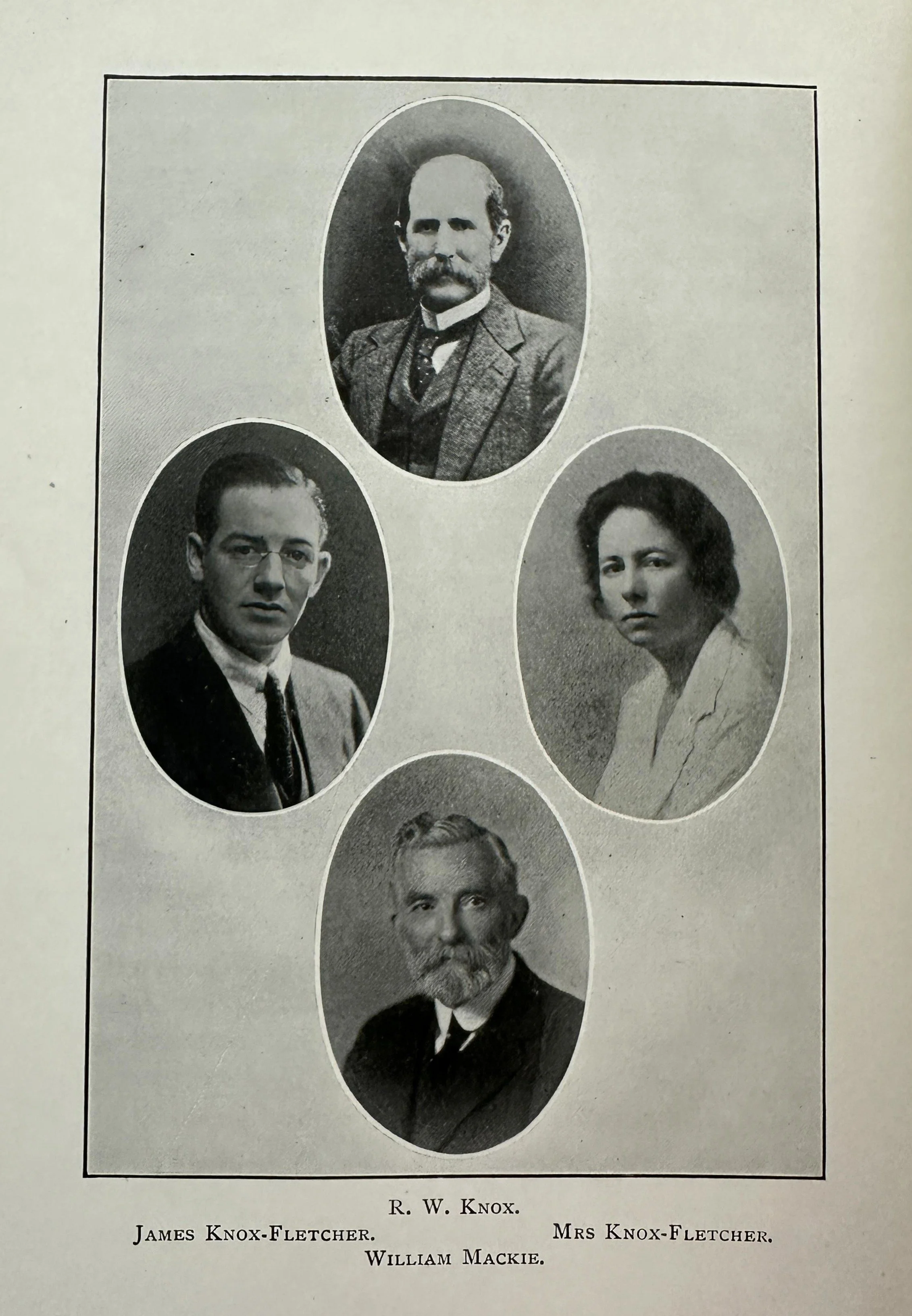
Illustration: portraits captioned R. W. Knox. James Knox-Fletcher. Mrs Knox-Fletcher. William Mackie.


33

III

REV. PETER MACINDOE MARTIN


Five months were allowed to elapse before the congregation met to elect a successor to Mr Ferguson. The meeting took place on February 17, 1863, and only one name was proposed—that of the Rev. Peter Macindoe Martin—a son of the minister of Strathmiglo and a name-child of the Rev. Dr Peter Macindoe of Kilmarnock. The call was signed by 148 members and 72 adherents, and next day was sustained by the Presbytery. Mr Martin had just finished his Divinity course and had been licensed by the Presbytery of Edinburgh as recently as October 1. His election by Kilbirnie created a somewhat complicated situation for the young probationer. He already had had a call from the vacant congregation at Girvan in the same Presbytery, and the Presbytery of Edinburgh intimated that they had sustained another from the newly formed congregation of Carnoustie. Mr Martin speedily made known his views that he could not accept the Girvan call, and it was withdrawn. To adjudicate on the competing claims of Kilbirnie and Carnoustie, a meeting of representatives from the Presbyteries of Edinburgh and Kilmarnock took

34 KILBIRNIE WEST

place on February 25, when Mr Martin indicated his preference for Kilbirnie.

The ordination took place on April 16, when the Rev. T. H. Lang of Ayr preached from Zech. iii. 7, the ordination prayer was offered by the young minister’s father, and the charges were delivered by the Rev. M. G. Easton of Darvel. It is perhaps noteworthy that the congregational meeting, which arranged the procedure to be observed on the ordination day, decreed that the meal after the service should be a “Temperance Dinner.” On the following Sabbath Mr Martin was introduced to his congregation by his father who preached from the laconic text, “Receive us,” 2 Cor. vii. 2, the new minister taking the afternoon service and discoursing from Ps. lxxi. 16. “The church, notwithstanding the heavy rains,” we read, “was at all diets filled with crowded and attentive congregations.” An old custom at ordinations was faithfully observed, for the congregational minute of May 5 reads: “It was also proposed and agreed to that the cost of the new suit of clothes presented to our Pastor by the congregation be paid from the funds of the same.” Another kindly deed was to present to Mrs Ferguson the old pulpit Bible and psalm book so long used by her husband in the public services.

As was to be expected, the advent of a new minister made some difference to the congregation. One commendable change in its customs was introduced soon after Mr Martin’s settlement. Up to that time those who had incurred the censure of the Church were accustomed to be rebuked in the presence of

CONGREGATIONAL CHANGES 35

the congregation at an ordinary diet of public worship. The practice did not always tend to edification, and on October 25, 1863, the Session agreed that when the duty required to be undertaken the minister should announce before the benediction that public censure was to be administered, but that worshippers could depart or remain as they pleased. The minute adds that “in coming to this decision the Court were guided by the uniform practice of many sessions throughout the Church.” It cannot be doubted that much unnecessary unpleasantness was thereby avoided. In a year or two all such proceedings were conducted in private before the Session.

As is well known, the controversy over the Church’s relation to the Oath of Allegiance and to the Elective Franchise caused a certain diversity of opinion. The Synod in 1863 determined that in future discipline on account of the exercise of these public duties was to cease, and the vote resulted in the loss of one or two congregations to the denomination. Kilbirnie passed safely through the crisis, the only evidence of its existence being the resignation of a prominent elder, Mr John Muir, by way of protest against the decision of the Synod. He did not, however, sever his connection with the congregation.

A curious echo of the controversy was heard as late as 1878. The then minister asked in the Session what had been the practice of the court with regard to discipline for voting for members of Parliament prior to 1863. The reply was that “several members of the congregation (now deceased) and also three members of the congregation still alive, viz. Messrs

36 KILBIRNIE WEST

Bryce Muir, James Knox, and Malcolm Allan, had voted prior to 1863, and that this was tolerated. It was further stated that about the year 1856 Mr James Knox became a Justice of the Peace, and is so at the present date. Mr Robert Whiteford, senior member of Session, who was ordained in the year 1832, states that he does not remember of any members being visited with church discipline for voting since the year 1839, and on examining the Session records it appears that there are no entries bearing on this matter.” No indication is given why the question was raised at that particular time, but it had doubtless to do with some possible action on the part of the minority who refused to enter the Union with the Free Church. It might have been added that Mr William Knox, an ardent member of the congregation who died in June 1870, had all his life been a keen politician and reformer, and had taken an active part in the franchise struggle of 1832. No one ever thought that his duty to the Church was less efficiently performed on that account.

For many years the membership of the congregation had stood at 150; in 1864 it was still reported at that figure. Next year, however, an extraordinary advance was recorded, for the membership was given as 226. An examination of the Kirk-Session records seems to show that much earnest work was being done among the lapsed and the careless. It was common for husband and wife to be admitted together, and sometimes the catechumens had to purge themselves of serious offences before they were allowed to communicate. There is no evidence

INCREASE OF MEMBERSHIP 37

that the increase was in any way due to the wave of religious revival that had spread over the country in 1859-60. In June 1863, for example, fifteen were admitted on profession of faith and twenty in the following November—unusual figures for a small congregation. Certificates were also brought from other churches in the neighbourhood. The numbers were not due to any zealous slackness on the part of the minister, for he was opposed by his Session in desiring to make the practice of family worship a condition of membership. In November 1868 the roll numbered 211, but soon after Mr Martin’s withdrawal the membership dropped to the normal of past years, thereby suggesting that the increase was due to the minister’s personal influence and activity.

An unexpected termination, however, was soon put to what thus appeared to be a successful ministry. Some indication of the coming trouble was given as early as the spring of 1865, when complaint was made of smoking chimneys at the manse. Although improvements were attempted, dissatisfaction continued, as is evident from the fact that in March 1868 the congregational meeting agreed “to take the house of Lochead in Lochwinnoch for the use of Rev. Mr Martin from this date till the term of Whitsunday, 1869,” and if possible to let the manse for that time. Mr Martin must have removed at once, for at the next meeting it was announced that the Rev. John Yuille had been secured as a tenant. It was evident, however, that the minister had become uncomfortable in his work, and at the meeting of Session on

38 KILBIRNIE WEST

December 6, 1868, he announced his intention of demitting his charge at the ensuing meeting of Presbytery. The Kirk-Session were completely taken by surprise and “separated without any of them making a remark.”

The proceedings of the next few months were somewhat painful. The congregation were perplexed as to the course to pursue, although none showed any enthusiasm for retaining the minister. The situation was a dangerous one and might have had serious consequences for the unity of the congregation, but the crisis passed without disaster. With the exception of the resignation of one of the elders no actual loss was sustained through disruption. At the Presbytery meeting on January 5, 1869, Mr Martin tabled his resignation. He pleaded three grounds of dissatisfaction with his position—the manse was unhealthy, his wife specially suffering from it; the people were not friendly to his ministry as shown by their bad attendance at church; and his efforts had not been sufficiently encouraged and supported. The state of the manse was evidently the main ground of complaint. He had made certain suggestions to meet the difficulty, but the people felt themselves unable to do what he asked. There were no recriminations, at least in public, although much might have been laid at the door of the minister’s deficiencies of temper and deportment. The congregation considered that they had been badly used and made no effort towards an amicable settlement. On January 15 the Presbytery, “without giving any decision on the matters as between Mr Martin

MR MARTIN RESIGNS 39

and the Session and congregation at Kilbirnie,” accepted the resignation.

The case might well have ended there, but unfortunately a question of financial adjustment between Mr Martin and the congregation immediately emerged, and caused considerable bitterness. The late minister retained some money as stipend to which it was maintained he had no claim. Negotiations for its return proved of no avail, and at last appeal was made to the civil courts—a course of procedure that must have caused much searching of heart among good Cameronians. It was an unhappy episode. The Presbytery afterwards formally expressed its sympathy with the congregation in “the harassment to which they had of late been subjected, and especially in being unpleasantly dragged into a civil court to obtain what they were justly entitled to.”

Mr Martin’s subsequent career is full of interest. At a meeting of the Synod of the English Presbyterian Church in 1869 he was admitted to the standing of an ordained minister, and was sent to Ipswich to supply the extension charge there. His ministrations proved so acceptable that he was almost immediately called to the pastorate, and was inducted on June 18, 1869. During the succeeding eleven years he not only built a church but gathered together a most attached congregation. He resigned on July 30, 1880, to proceed to Durban in South Africa, to the care of which congregation he was called. There he repeated his success at Ipswich, the position which Presbyterianism holds in Durban to-day being

40 KILBIRNIE WEST

in large measure due, it is said, to his share in its early history. He died in April 1888. To commemorate his work in Ipswich the congregation there have placed a memorial window in the church he built. The inscription includes his first text at Ipswich: “He led them forth by the right way that they might go to a city of habitation,” and his last at Durban: “Jesus Christ, the same yesterday, to-day and for ever.” There is just the possibility that Mr Martin’s Ipswich text had some reference to his own recent personal experiences.

In 1863 Alexander Bryce Muir of Beith, a member of the Kilbirnie congregation, entered the Divinity Hall, then meeting in Glasgow under the superintendence of Dr William Symington and Dr W. H. Goold—the only lad, so far as known, belonging to the congregation who studied for the ministry. He was duly licensed by the Reformed Presbyterian Presbytery of Kilmarnock in 1869, but was discouraged from the beginning. All the pulpits of the denomination were filled at the time and there was no prospect of a vacancy anywhere. He accordingly asked to be set free so that he might apply to the United Presbyterian Church for admission as one of their probationers. He was received, and in 1870 was called to Otterburne in Northumberland. In 1874 he was translated to Birkenhead, where he died in 1887. It may also be mentioned that Rev. James Hunter, B.D., Laurieston, spent the early years of his life in the congregation.

NEXT

Kilbirnie West

James Dodson


22

II

REV. JAMES FERGUSON


The way was now clear for calling a minister. The number of members at the erection of the congregation was certainly very small, being only seventeen, but in those days a large membership was not considered everything among the Cameronians: they were more concerned with quality than quantity. The real difficulties towards a settlement were the scarcity of ministers and the rule which then held good in the Church that translations from other congregations were inadvisable, if not inadmissible.

In January 1826, however, the prospects seemed auspicious and application was made to the Presbytery for moderation in a call. The Presbytery agreed to the request and appointed the Rev. A. M. Rogerson of Darvel to preside at the meeting of the congregation. Mr Rogerson lost no time in summoning the members, and indeed there was reason for haste because the few eligible probationers were being hurriedly picked up. On February 22 it was reported to the Presbytery that the congregation, which now numbered thirty-six members, had unanimously set their hearts on the Rev. Gavin Rowatt. Mr Rowatt was present at the meeting, but asked for “time to consider what may be his duty in the important

ELECTING A MINISTER 23

affair.” It is evident that he had other expectations. At the next meeting of Presbytery, held on April 11, the call came up for consideration, but it was now known that Mr Rowatt had been elected by another congregation, and the whole matter was referred to the Synod for settlement. When the business came before the Synod it was ascertained that Mr Rowatt had the choice of a call from every Presbytery of the Church, viz., from the congregations at Stirling, Strathmiglo, Whithorn, and Kilbirnie. He chose Whithorn, where his ministry was not of long duration, for he died in 1832.

On January 23, 1827, the congregation was again ready to go forward, and the Presbytery appointed the Rev. William M‘Lachlan, the new minister at Kilmacolm, to preside at the election—an appointment which showed that good relations had been maintained with the mother congregation. When the Presbytery next met it was reported that the Rev. James Ferguson, who had been licensed by the Southern Presbytery in the preceding year, had been unanimously chosen. Mr Ferguson was present and accepted the call, and the troubles of the people were over.

The new minister was not unknown to the congregation. Both as a student and as a probationer he had frequently conducted services among them, and the unanimity of the call, which was signed by 52 members and 108 adherents, bespoke the happiest relations for the future—a promise that was amply fulfilled.

A hundred years ago ecclesiastical movements

24 KILBIRNIE WEST

were apt to be leisurely in the matter of settlements, and the ordination was not carried out till September 5, 1827. Mr M‘Lachlan preached the ordination sermon, taking as his text 2 Tim. ii. 3: “Thou therefore endure hardness, as a good soldier of Jesus Christ.” The Rev. David Armstrong of Glasgow offered the ordination prayer, and the service was concluded with a sermon by the Rev. Robert Winning of Eaglesham, who preached from Luke iii. 18: “And many other things, in his exhortation, preached he unto the people.” On the following Sabbath Mr Winning introduced the new minister to his people, and Mr Ferguson occupied the pulpit in the afternoon, preaching from the text, 2 Cor. iv. 5: “For we preach not ourselves, but Christ Jesus the Lord; and ourselves your servants for Jesus’ sake.”

A manse was now required, and in 1830 a feu at the south corner of the park, called Muirhead Park, was obtained from Robert Walker of Bailliestone. The feu-duty was fixed at £2 per annum, a sum at which it still stands. The lease was for the apparently interminable period of 999 years. It is noteworthy that in the deeds referring to the church and manse the congregation is called “Reformed Protestant Presbyterian”—a name which occurs nowhere in the official papers of the Church at large. The manse itself was not of great extent, and in later years was considerably increased in size.

Mr Ferguson entered energetically into his work. In the days when such things were scarcely thought of seriously, he started, soon after his ordination,

REV. JAMES FERGUSON 25

week-day Bible classes for young people, and a school for children on Sabbath, “which has been in operation ever since.” Unfortunately it is impossible to give many details of Mr Ferguson’s activities for the original records of the congregation have disappeared, the earliest minute of the Session being dated January 23, 1845, and that of the Court of Managers, September 10, 1857. More than once the Clerk of Session intimates that he has not recorded many of the details of business brought before his court—to the consequent loss of the congregation in these latter days.

During Mr Ferguson’s ministry there appears to have been a commendable lack of necessity for exercising church discipline. Among the few cases noted was one in 1852 when a member was challenged for “attending and taking an interest in a dog fight at some place in the vicinity of Glasgow.” He was duly waited on by two members of Session who were commissioned to warn him of “the sin, danger and gross inconsistency of such practices”—a judgment which must meet with hearty approval even in these laxer days.

Interesting glimpses of the state of the congregation in 1841 are given in the Statistical Account of the parish prepared by the Rev. Robert Urquhart, its minister in that year. The author was evidently on the best of terms with Mr Ferguson. He says that the church was seated for 480, but “as many of the members belong to the adjoining parishes, the usual attendance does not probably exceed 240.” He placed the membership at 130 and the number of

26 KILBIRNIE WEST

Reformed Presbyterian families in the parish at 60. In his account of Kilbirnie’s educational facilities, he speaks of what was probably its only Sabbath school: “Nor in this enumeration of the sources of instruction should a Sunday school under the superintendence of the Rev. James Ferguson be unmentioned. It is well attended and has been the means of disseminating much religious instruction among the youth of both sexes.” He adds: “There is likewise a small library connected with the Reformed Presbytery composed of moral and religious works. It is supported by the heads of families and the books are lent gratis to the young attending the Sunday school.” This library is frequently mentioned in the records, and was evidently carefully attended to until quite recent times.

In similar accounts of the neighbouring parishes it is stated that about the same time there were eleven Reformed Presbyterian families resident in Dalry, comprising 55 individuals; five communicants in Stewarton; and 75 adherents in Beith—all of whom must have looked upon Kilbirnie as their spiritual home.

On October 5, 1845, the Kirk-Session did an unusual thing. For some time previous to that date Mr Ferguson had been lecturing through the first Epistle to Timothy, and in the ordinary course of his addresses had come to the text giving Paul’s advice about the taking of wine. For what he was reported to have said on that occasion, Mr Ferguson was most severely taken to task by the Temperance Advocate, a teetotal journal of the day. The Kirk-

A TEMPERANCE CONTROVERSY 27

Session was highly indignant at the attack on their minister. They solemnly recorded that there had been “the grossest misrepresentation of what was said, as well as the most brutal assault in the replies attempted to be given,” and they conveyed the sympathy of the congregation to him.

The minutes dealing with the matter are most elaborate, and the members of the court record that in framing them “they neither have been advised, influenced, nor assisted by the minister in any way whatever, and that the whole responsibility involving time, place, matter, and terms of expression rests entirely with themselves.” They also agreed that the recent judgment of the Synod “with respect to the kind of elements to be used at the Lord’s Table” should be read from the pulpit before the approaching Communion, part of the controversy evidently turning upon the nature of the elements used at the Sacrament.

The whole affair is a reflection of the agitation then proceeding on the temperance problem, and would almost be impossible to-day. The minutes show a generous appreciation of Mr Ferguson, but perhaps they do more credit to the hearts than to the heads of his aggrieved office-bearers.

The matter, however, did not end with the Session’s chivalrous vindication of their minister. In the following month certain members—three men and two women—petitioned the Session that they should be “allowed the use of ‘unleavened bread and the fruit of the vine’ in the celebration of the Eucharist”—a strange word to find in the minute book of a

28 KILBIRNIE WEST

Reformed Presbyterian court. The business thus introduced occupied no fewer than eleven sittings of the court, and evidently created considerable feeling, for the Session were at great pains to set forth the extent of the errors into which the petitioners had fallen in making their request. They were particularly severe on two of them, the delinquencies of one being arranged under no fewer than seventeen heads, and the other under five. It was the first stirrings of the unfermented wine question, and the Session were not prepared to accept an interpretation of Scripture that contradicted the sense placed upon it by long generations and would cut them off from the usages of their fathers. They declared themselves zealous for absolute obedience to what they considered the Lord’s command. It must be acknowledged that, amid much that is harsh and dogmatic, it would be hard to beat the minutes for precision of statement, debating ability and strength of conscientious conviction. The result, however, was deplorable, for the case ended in the extrusion of two of the petitioners and the withdrawal of the others from the congregation. The dust of the controversy has long since settled, but it is noteworthy that the Sacrament is celebrated to-day in unfermented wine.

In 1854 the Kirk-Session determined “to revive the office of the diaconate in the congregation.” In the absence of the earlier records, it is difficult to understand what were to be the duties of the deacons, but in due course the resolution was carried out and


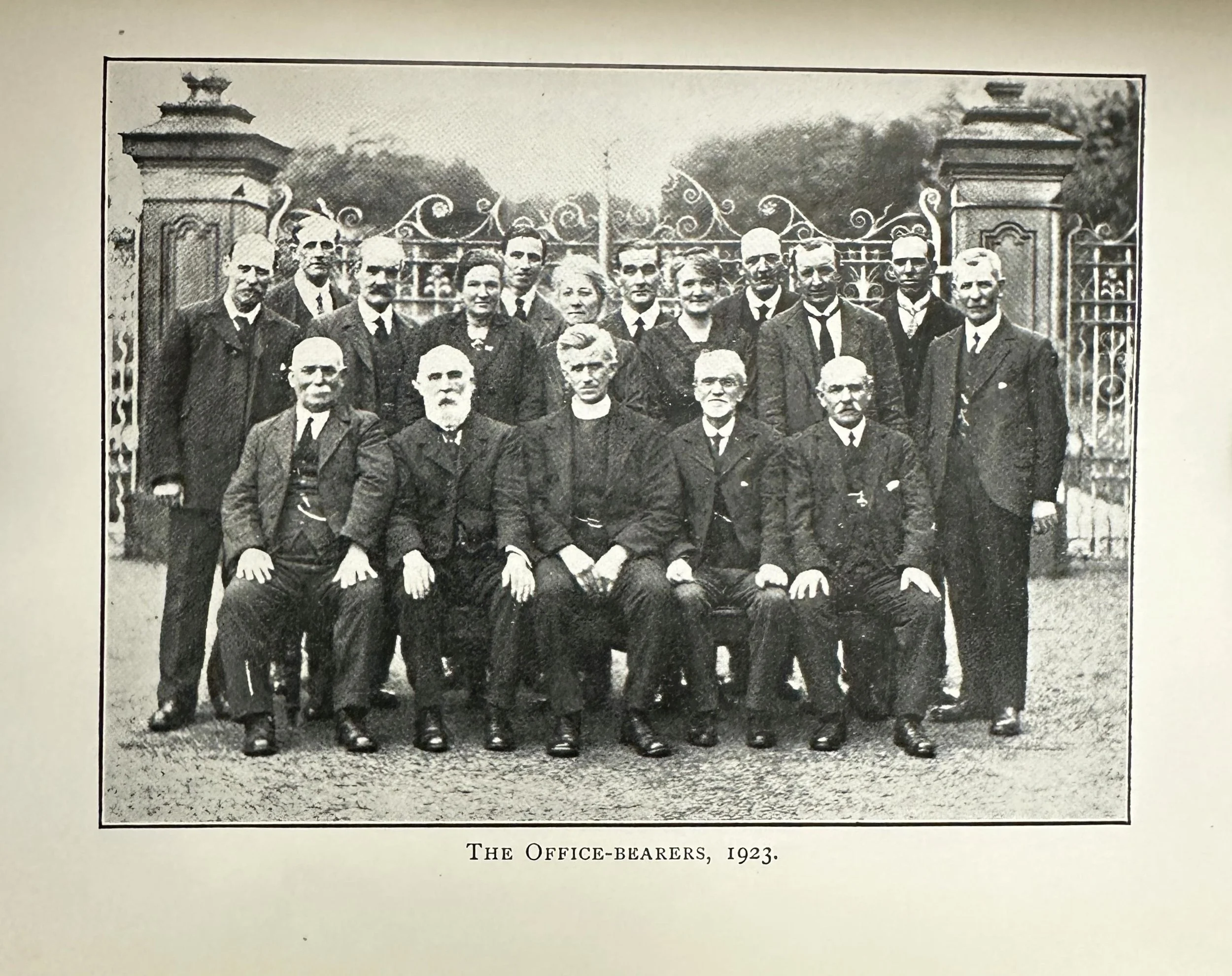
Illustration: group photograph captioned The Office-bearers, 1923.


DEACONS CHOSEN 29

John Fyfe,
John Martin,

John Gillies, and
William Paton

were duly elected and ordained. According to the Kirk-Session minutes they met for a time with the elders and assisted in such matters as the poor of the congregation and arrangements for the Sacrament. But no further additions were made to their ranks and the office seems to have been allowed to lapse. At any rate, in the first extant minutes of the congregational meetings, September 10, 1857, managers were elected in ordinary course. In 1878 another effort was made to institute the order. In March of that year the Session determined to have an election of elders and at the same time asked the congregation to consider the possibility of “having an appointment of deacons.” The congregation referred the question back to the Session, but nothing more was heard of the proposal. The ordinary affairs of the congregation are still under the control of a court of managers.

Statistics are not available during the greater part of Mr Ferguson’s ministry, but the membership of the congregation increased until in his later years it stood at 145. For some time his stipend was £80 with certain allowances for travelling and sacramental expenses, but it was ultimately raised to £100. In 1843-4 the Synod made an attempt to clear all congregational property of debt. Under the impulse, the Kilbirnie congregation met on March 6, 1844, and “after a short lecture by the pastor entered into a subscription for the extinction of the debt on their

30 KILBIRNIE WEST

place of worship, and before they separated the entire sum was fully subscribed and the debt swept off at once. . . . All parted with joyful animation, feeling that by one hearty and paternal effort they had thrown a burden off themselves and posterity.” The debt on the manse however remained. In 1860 the newly constituted Ferguson Bequest Trustees offered £1000 to the Reformed Presbyterian Church as a nucleus of a fund to be raised by its members so that all church property might be freed from debt. The Kilbirnie congregation did not see their way to join in the general movement, but undertook to clear off the £100 that still remained as a charge on the manse. A subscription was set about and the result was satisfactory, over £94 being raised. Details of the collection are interesting as perhaps showing the relative strength of the congregation in its different districts:

Kilbirnie . . . . £43 1 0
Beith . . . . 29 7 6
Dalry . . . . 12 10 0
Lochwinnoch . . . 7 0 0

The Synod gave its approval to the effort by contributing an additional £30 from the general Ferguson Bequest grant, and for the first time in its history the congregation owed no man anything.

On Sabbath, September 7, 1862, Mr Ferguson preached a sermon in celebration of the thirty-fifth anniversary of his ordination, and spoke with “unusual vigour and earnestness.” “His people,” it was said, “marked an unwonted solemnity in his

DEATH OF MR FERGUSON 31

manner as he spoke of the delight he had in preaching the glorious gospel and of the earnestness of his desire to win souls to Christ.” On the following day he went off for a short vacation to his native place near Cournance, in Dumfriesshire, where he was born in 1797. On Tuesday he was struck with apoplexy, and died on Monday, September 15. He was buried a week later at Kilbirnie, and the whole town went into mourning as the funeral procession passed through the streets.

Mr Ferguson was considered a man of considerable ability and erudition, though his discourses were probably too metaphysical and doctrinal for the average congregation. He impressed all by the integrity and loftiness of his character. The discriminating notice of him that appeared in the Reformed Presbyterian Magazine frankly stated his limitations: “It could not be said that, so far as regards manner, he was an eloquent preacher. There was some awkwardness about his enunciation. He did not excel in power and fluency of elocution. A fondness for the discussion of principles occasionally imparted a dryness to his public appearances which, however, disappeared in the later years of his life.” He was of much service on the committees of the Church, and was specially useful in the work of the Hall and the care of the students. As was the case with so many of his brethren, his few published works are sermons preached on special occasions, such as those at the ordination of the Rev. John Macleod at Stranraer in 1841, his “Lecture on the Headship of Christ” in the same year, and “The Supremacy of

32 KILBIRNIE WEST

Scripture,” a discourse from the Chair of the Synod in 1859. In addition to these he wrote an “Exposition of the National Covenant” in 1843, which appears in the volume entitled “Commemoration of the Bicentenary of the Westminster Assembly of Divines and of the Centenary of the Reformed Presbytery,” Glasgow, 1843; and at the request of the Synod prepared a “Pastoral Address” in 1855—a composition which merited, and received, high commendation. In spite of his narrow means he accumulated a library of 600 volumes, and these he bequeathed to the Divinity Hall.

NEXT

Kilbirnie West

James Dodson

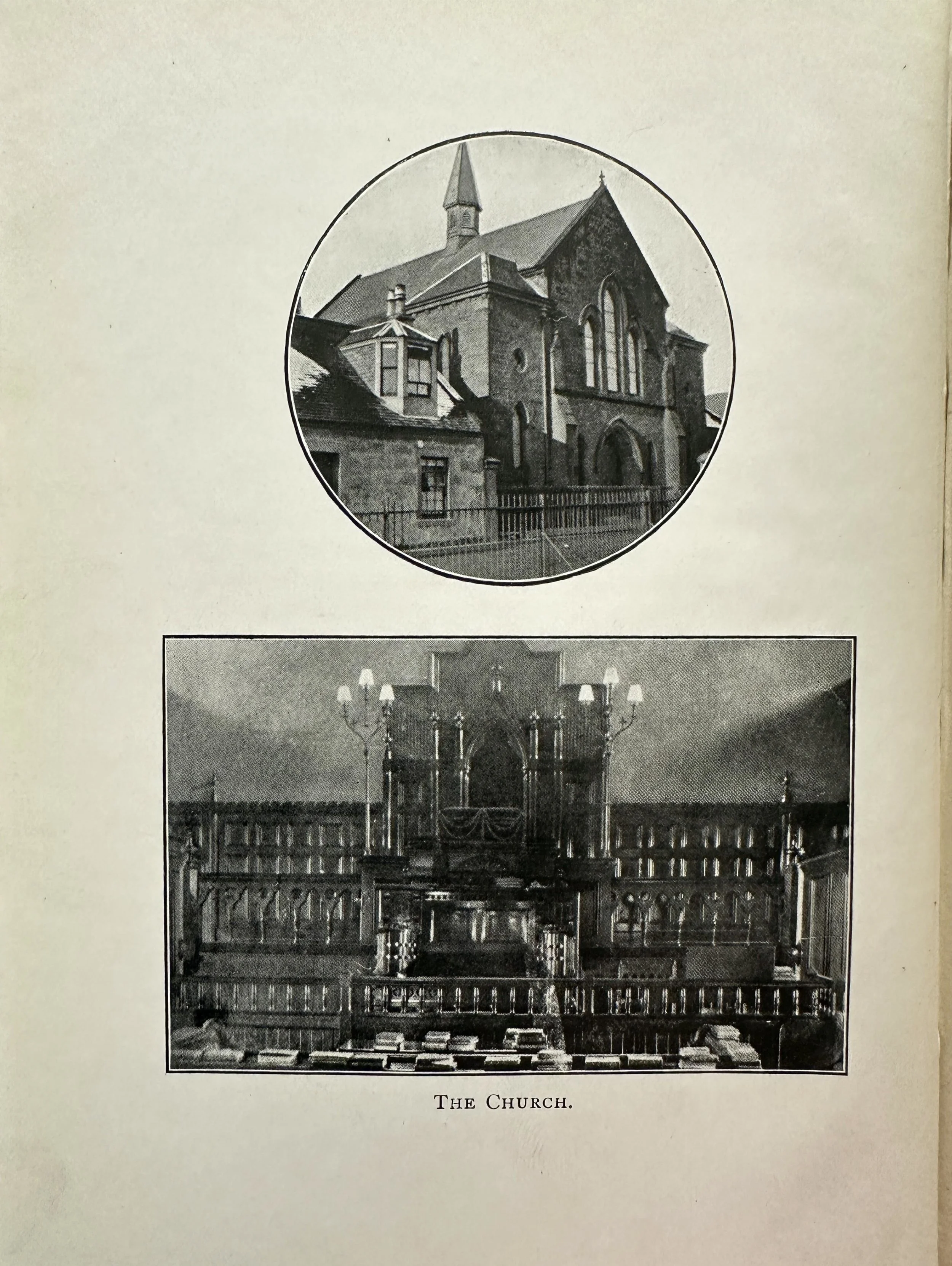
Illustration: exterior and interior photographs.

THE CHURCH.


KILBIRNIE WEST 11

I

THE ORIGINS OF THE CONGREGATION


One of the most interesting examples of the evolution of a Church occurred during the eighteenth century, when what became the Reformed Presbyterian Church of Scotland was gradually established as an ecclesiastical organisation. At the beginning of the century it consisted of a community of isolated societies which were scattered over the south of Scotland, literally as sheep without a shepherd. These societies held meetings as best they could—in kitchens, barns and caves—and in the absence of a stated ministry their members did what they could to encourage and edify the brethren by meditation, prayer, and reading of the Word. It was not till 1708 when the famous John M‘Millan of Balmaghie adhered to them that they, for the first time since the days of Cameron and Renwick, had the benefit of ministerial supervision and assistance. The accession of a second minister enabled a Presbytery to be set up in 1743, and from that date the organisation of the Church proceeded apace.

Pencilled marginal note beside “1708”: “1706”.

12 KILBIRNIE WEST

The first step in the concentration of the people into congregations took place in 1762, when all the scattered societies were divided into two sections—a northern and a southern—each under the charge of two ministers. The Northern Congregation comprised all the adherents of the Church in Fife, the Lothians, the Lower Ward of Lanarkshire, Stirling, Dumbarton, Renfrew, and Ayr, and the ministers allocated to it were John Thorburn, who resided at Pentland in Midlothian, and the second John M‘Millan, who ultimately settled down at Sandyhills, near Glasgow. From 1775 onwards the process of concentration was accelerated. Certain places began to be recognised as the centres of their respective districts, even although they could not claim any special right to the services of the ministers allocated to their whole region. The supply of students for the ministry was never adequate to the needs of the Church, but as preachers of the Gospel were licensed and as opportunity offered, suitable men were settled at the most necessitous centres. Although Kilmacolm in the west was early recognised as one of the most populous centres of a widespread district, it was at Bridge of Weir that the Rev. Thomas Henderson was ordained on April 26, 1787, over the extensive parish of which it was a part.

The region placed under Mr Henderson’s inspection comprised the northern parts of Ayrshire, the county of Renfrew, the Leven valley across the Clyde, the lochs of Argyle, and even distant Lorne—where a revival movement late in the century had brought many adherents under the jurisdiction of the Re-

REV. THOMAS HENDERSON 13

formed Presbytery. With such an extensive parish it was impossible that there could be great continuity of services at any one place, and at the beginning of the nineteenth century an arrangement was at work whereby Mr Henderson’s ministrations were secured to necessitous localities at regular intervals. The district which included the townships of Dalry, Beith, Kilbirnie, and Lochwinnoch, had sermon once every six weeks. For this and for “ministerial visitation and examinations which were punctually attended to,” they paid the fourth part of Mr Henderson’s stipend, which, beginning at £45 per annum, rose ultimately to £80. It would have been difficult to maintain spiritual efficiency under such conditions had it not been for the prayer and fellowship societies which continued their beneficent work. The dispensation of the Lord’s Supper naturally was infrequent because its due celebration was considered of such importance that several ministers were required for its proper administration, and the paucity of qualified men necessarily reduced the number of occasions for the whole Church. Kilmacolm was the spot most convenient for Mr Henderson’s scattered flock, and, when the sacrament was appointed to be observed there, communicants reached the place from all quarters. The arrangement may have had many disadvantages, but it had at least one desirable effect: it allowed the people to know one another and brought the farthest adherent into contact with the centres of interest.

The name most closely connected with the origins of the Kilbirnie congregation is that of William Orr

14 KILBIRNIE WEST

of Kilbirnie Place. He died at Causeyfoot in reduced circumstances on October 25, 1814, leaving behind a great reputation for the sanctity of his character and devotion to the cause of religion in his neighbourhood. It may have been he who, about the beginning of the century, led the people in Kilbirnie, Beith, and Dalry to think that their combined societies were strong enough to support a minister of their own. The proposal took shape so far that they planned the erection of a place of worship for themselves, “of rude construction, not seated with pews, but with a pulpit and rough planks.” The building project, however, had to be abandoned for a time through the death of Robert Knox, who is described as “the most active” among those who were promoting the scheme.

Though still nominally under the care of Mr Henderson, the societies working in co-operation with that of Kilbirnie seem to have had power of approach to the local Presbytery as an independent community with interests of their own. At least the Presbytery, acting on its noble officium, granted them special privileges. The first time that the name of Kilbirnie occurs in the official records of the Church as a separate religious community is on February 26, 1821, when supply of sermon was granted to it, the preacher being the Rev. Robert Winning, M.A., afterwards of Eaglesham. By the same authority the sacrament was dispensed, apparently for the first time in the village, on July 15, 1821, the chief officiating minister being the Rev. Hugh Young of Laurieston.


Illustration: portraits captioned Mrs Ferguson. Mrs Martin. Mrs Davidson. Mrs Anderson.

THE MISTRESSES OF THE MANSE.


DEATH OF MR HENDERSON 15

The first reference in the minutes of the Kilmacolm congregation to the desire of the Kilbirnie friends for a separate existence is made in the minute of the congregational meeting held on November 6, 1820. Commissioners appeared from Kilbirnie to plead for permission to be disjoined, but the proposal was referred to the various societies composing the congregation for their opinion. On the 5th of the following February the matter was again brought up, but again no decision was reached. The proposal then appears to have been dropped, for several meetings of the congregation were held at which no steps were taken. The cause of the delay was probably consideration for their minister, who was opposed to any separation.

Mr Henderson died on October 18, 1823, after a long and laborious ministry of thirty-six years, and, the personal element being thus removed, the movement for a disjunction was renewed. The people of Kilbirnie held a meeting on October 27, when they did what they could to organise themselves into a congregation. They appointed managers and resolved to ask the Presbytery for separate pulpit supply. At a further meeting on November 21 they determined to approach the Kilmacolm congregation for a disjunction, and, to remove any objection, resolved at the same time to raise their necessary share of the stipend required and of the funeral expenses of their late minister. The Kilmacolm congregation met on December 2, and it was evident that they did not approve of the action of their brethren, for they made some recommenda-

16 KILBIRNIE WEST

tions which it was hoped they would “fall in with.” They also resolved again to refer the application for disjunction to the various societies. But the claimants were not disposed to wait, and on December 15 they resolved to apply direct to the Presbytery. The dispute with their fellow members, however, was finally adjusted on January 1, 1824, the congregational minute of that date reading: “The meeting took into consideration the motion of a disjunction with the people of Kilbirnie and called a vote which carried for it, but still look on them as liable for their proportion of any debt that may be on the meeting-house here or deficiency of stipend.” There was reason for some anxiety on the part of the Kilmacolm members. They had recently erected a church, and the debt on it was still lying heavy on their hands. They were also going forward to elect a successor to Mr Henderson, and the collection of his stipend must have seemed somewhat precarious. Not only were the friends in Greenock pressing for a similar disjunction, but the members in Johnstone were clamouring for permission to unite themselves with Paisley, which had also recently left the mother church at Kilmacolm. The obligation resting on the Kilbirnie people was not put at a high figure. An addendum to the minute of December 2 declares that the sum of £5 would meet all the claims on them, but even that was resisted.

Long afterwards Mr John Muir, an elder in the Kilbirnie congregation, who knew the events at first hand, showed how difficult it had been for the good people of Kilbirnie to attain their end. “The societies

DISJUNCTION GRANTED 17

now forming this congregation,” he said, “appointed John Shedden and James Miller to meet with the brethren at Kilmacolm, settle pecuniary affairs, and request a disjunction. They were very averse to doing so, and stated as a reason that they were about to call Mr Halliday, then a probationer, who afterwards became minister at Airdrie, but in the event of their proving successful in getting him, they promised to grant a disjunction after his ordination. Our commissioners argued that it was very unreasonable for them to call a young man who expected to have us under his charge, while they knew to the contrary. When that argument failed, they stated that they had some debt, and required us to pay some proportion of it. To this our commissioners replied that, if we did so, we would require the same proportion of the seat rents from them, and ultimately we succeeded in getting a free disjunction”—all which shows that the fathers of the Kilbirnie church were shrewd men.

Having now obtained the consent of the brethren who were likely to suffer from their removal, the people of Kilbirnie lost no time in taking the next step. In a week they had arranged the number of congregational meetings they were to hold each year and had prepared their case for the Presbytery. Commissioners appeared at the meeting of the Western Presbytery at Crookedholm on January 13, 1824, with a formal request that the court should give effect to the decision of the Kilmacolm congregation, and should erect the petitioners into a separate congregation. No doubt the Presbytery

18 KILBIRNIE WEST

had been following the procedure of the Kilbirnie friends with sympathetic interest, for they were immediately satisfied with the justice of the claim and with the means at the disposal of the congregation for maintaining their position. The request was unanimously granted. The minute in which they embodied their decision is of some local importance and may be transcribed in full from their record:

“A petition containing a representation and narrative of the disjunction between the congregation of Kilmacolm and the societies of Beith, Dalry, and Kilbirnie is received and read. The Presbytery unanimously agree to sanction the said disjunction and did, and hereby do, declare the said societies to be disjoined accordingly.”

It is a pity that the document laid before the Presbytery is not now available; like many another valuable paper it disappeared long ago. At the same meeting the Kilmacolm congregation asked for moderation in a call, and their request was granted—a request which ultimately issued in the Rev. William M‘Lachlan being settled over them as their minister. Inspired perhaps by the success of Kilbirnie, the adherents of the church at Greenock asked for a disjunction, but the Presbytery judged the time inopportune, and set the petition aside. The parent congregation would have been weakened too much if they also had succeeded.

The newly formed congregation at once set about

BUILDING A CHURCH 19

putting its house in order. They met on February 11 and elected suitable managers. Those chosen were:

John Muir,
Andrew Lusk,
Joseph Barr,
Gavin Riddet,

William Knox,
John Shedden,
John Allan, and
William Craig.

At the same meeting it was also determined to use all diligence to obtain a suitable place of worship. As has already been indicated the people had laboured under some disadvantage regarding a meeting-house. “The preaching,” we read, “was upon Mr Knox’s green when the weather was good, sometimes in a cotton mill belonging to the late Gavin Riddet [now Stoneyholm Mill], and at other times in a flat of a cotton mill where J. W. Campbell’s now stands.” Heartened, however, by their success with the Presbytery, the people set themselves diligently to obtain a building in which they could meet with comfort. They secured the site on which the present church stands from Robert Harvie, who is described as a “labourer in Montgomerystone of Kilbirnie” and its “heritable proprietor,” with the concurrence of William Cochran of Ladylands, the superior. The Instrument of Sasine is dated January 20, 1827, but the church had by that time been built, for they had the satisfaction of entering it for the first time on Sabbath, April 20, 1825, when the Rev. John Milwain of Douglas Water preached and consecrated the building. The trustees named for the property are still of interest:

20 KILBIRNIE WEST

Alexander Orr, surgeon, Lochwinnoch.
Joseph Barr, Gateside, Kilbirnie.
John Shedden, contractor, Kilbirnie.
Gavin Riddet, cotton spinner, Kilbirnie.
William Craig, weaver, Kilbirnie.
William Knox, thread manufacturer, Kilbirnie.
John Muir, currier, Beith.

If Dr Orr was ever a member of the congregation he did not remain attached to it. For many years he was an elder at Kilmacolm, and became known throughout the Church for his piety and usefulness. He died on March 28, 1849.

The amount paid for the site and for the building of the church has not been ascertained, but the feu-duty was arranged at the satisfactory price of 5s. 3d. per annum. It is stated that it was due to the good offices of Dr Orr that the superior agreed not to exact the year’s rent as entry money at each single successor. The duty paid by the congregation still remains as at first fixed and is in perpetuity. Some difficulty was experienced in determining the form of the building. “The old people still retained the idea of a church in the barn form, and of rude construction, but the younger members insisted on having something respectable.” As originally built, the church contained no gallery. It was described as “a neat and commodious chapel.”

Nothing was now needed to complete the organisation of the congregation except a kirk-session. On April 26, 1824, it was resolved to petition the Presbytery to aid them in setting up the necessary


Illustration: photograph of the manse and group photograph.

THE MANSE.

THE LADIES’ WORK PARTY, 1923.


THE FIRST SESSION 21

court. The Presbytery appointed the Rev. John Fairley of Glasgow, along with two elders as assessors, to carry out the wishes of the people, and on Sabbath, July 18, Robert Miller was ordained as elder and William Shedden, who had been ordained elsewhere, was inducted into office. At their first meeting the same evening,

John Muir,
James Miller,

Bryce Muir, and
Agnes Craig

were admitted as the first members of the new congregation, joining on the profession of their faith.

NEXT