Robert Turnbull on the Theatre
James Dodson
HARTFORD, May 23d, 1837.
Rev. ROBERT TURNBULL:
Dear Sir,—The undersigned are appointed a committee from the society under your pastoral charge, to solicit for publication a copy of your discourse delivered at the Centre church last Lord’s-day evening, on the subject of “Theatrical Amusements.” We are happy in being the organs of your Society in making this request, fully believing that its publication and circulation will promote the cause of good morals and religion.
Very sincerely yours,
ALBERT DAY,
E. L. BROWN, } Committee.
L. B. CHILDS, }
——
GENTLEMEN,
Your communication is before me, and in consideration of the circumstances of the case, and in the hope that the discourse may be useful to the community, I beg to say that I comply with your request.
I have the honour to be,
Gentlemen,
Yours, with sincere regard,
ROBERT TURNBULL.
Hartford, 23d May,
1837.
THE THEATRE,
IN
ITS INFLUENCE
UPON
LITERATURE, MORALS, AND RELIGION.
——
BY ROBERT TURNBULL,
PASTOR OF THE SOUTH BAPTIST CHURCH, HARTFORD, CONN.
——
PUBLISHED BY REQUEST.
HARTFORD:
CANFIELD AND ROBINS.
——
1837.
Entered according to Act of Congress, in the year 1837,
By ROBERT TURNBULL,
in the Clerk’s Office of the District Court of Connecticut.
PREFACE.
——
It may not be improper in this place to give a brief narration of the circumstances in which the following essay makes its appearance. The substance of it was originally written by appointment as a Report upon the influence of the Drama, preparatory to a debate upon the subject before “the Young Men’s Society” in the city of Detroit, Michigan, in which it was discussed with great interest, and with a most gratifying result. It was subsequently enlarged into its present form, with some distant view to its publication, if circumstances should ever make it desirable. Soon after the author’s arrival in Hartford, a petition was presented to the House of Representatives, now in session in this city, for a repeal of the statute law prohibiting theatrical and other amusements, signed by a considerable number of persons. The
vi. PREFACE.
petition was referred to a select committee on the subject, consisting of one member from each county, and it was feared by some that the existing law might be repealed, and a theatre eventually established in this city, to the manifest injury of its intellectual and moral interests. This occasioned great alarm to many persons of piety and virtue, and a remonstrance was speedily got up and presented to the Legislature.
It was suggested also that some of the clergymen of the city should preach upon the subject. The author therefore felt that he was called upon in Providence to throw his essay into the form of a lecture, and deliver it to his congregation. When this intention was announced, a very general desire was expressed on the part of the citizens that it should be delivered in the largest church in the city. Accordingly the Rev. Dr. Hawes, of the Centre church, made a kind and polite offer of his church for this purpose.
A large number of persons who could not get into the church for want of accommodation, and others, some of whom were mem-
PREFACE. vii.
bers of the Legislature, expressed a desire to have the discourse delivered a second time, more especially as the petition for a repeal of the statute respecting theatres was not yet disposed of by the Legislature. In the mean time, however, the society of the South Baptist Church, had unanimously passed a vote, to request a copy of the discourse for publication; and other persons in the city, whose opinions are entitled to great consideration, had expressed an earnest desire to have it in a permanent form. In these circumstances the author felt himself bound in duty to commit it to the press without delay, and he can only hope that it may, by the blessing of God, be productive of good to the moral and religious interests of the community.
[Page 9]
THE THEATRE, &c.
——
THERE are few things of an evil nature and pernicious tendency that cannot be made to assume the guise of virtue, and put on an aspect of beauty and splendor. Indeed, evil seldom exists, unmingled, or unassociated, with some kind of good; and even at the very time when vice is sapping the foundations of religion and happiness, she not unfrequently produces some present and transitory benefits. In fact, the deadliest forms of evil are sometimes clothed in the most attractive dress; and it is this very circumstance which gives them such tremendous power over the inexperienced and unsuspecting heart. Satan, we are told in the sacred Scriptures, is transformed into an angel of light; and in accordance with this, the most
10 INFLUENCE OF THE THEATRE
pernicious institutions, the most dangerous maxims, and the most abominable habits, are often disguised in the costume of a false and bewildering ornament. It is in this manner, the refined policy of the “father of lies,” to avail himself of the powers and sympathies of nature;—to enlist the gorgeous imagery of romance, the creations of painting and sculpture, and the charms of poetry and music, in the service of infidelity and sin. And the more perfectly the latter can be concealed, and the beautiful and bewildering images of nature and art be made to cover a dark and insidious corruption, as flowers are made to bloom over the loathsome dead, the more successful is he, in his attack upon piety, virtue, and happiness.
We think this is eminently true of the Theatre, which to the worldly eye, is invested with all that can delight the senses and the soul; which professes, not only to gratify the passions, but to promote the virtue of men; and which embodies in its means for accomplishing
ON LITERATURE. 11
this result all the combined energies of painting, poetry, music, and mimic representation; and which numbers in its list of votaries and patrons a few of the brightest names upon the roll of fame.
We do not know that there is any thing absolutely improper in that form of composition called the Drama, neither are we sure, that there is any thing in mere scenic arrangements, and histrionic performances, as such, to vitiate the principles, and corrupt the morals of the community; but these are but the outer garment, appropriate and beautiful perhaps to the eye of taste, with which a dark and insidious power of corruption has been invested. They are only, as it were, the temple in which the votaries of pleasure have enshrined the god of sensual enjoyment, before which the gay and giddy circles of our larger cities bow down and worship.
The writer is not insensible to the fact, that the Drama has been the means of eliciting some
12 INFLUENCE OF THE THEATRE
of the most brilliant efforts of human genius, and that it has been illustrated and embellished by the learning and talent of some highly distinguished men; but it may well admit of question, whether the mental power thus employed, might not have been used to much better purpose, in other departments of literature, and whether those men might not have conferred far greater benefit upon their fellow creatures, by an application of their mental resources to higher and holier objects. And is it not to be regarded, as a first principle in religion and in morals, that talent and learning ought, like every other gift of the Deity, to be employed exclusively in promoting the greatest good of man? We do not mean to say, that all men of genius and acquirements ought to devote themselves to theology, and write upon no other theme than that of the Christian religion:—what we mean is, that in all they write, whatever be the topic or the style, and these may be as varied as they
ON LITERATURE. 13
please, they should have a regard to the glory of their God, and the interests of man’s immortal spirit, and bring all their productions as trophies to the cross of Christ. Some persons might be disposed to doubt the truth of the affirmation, that as great an amount of intellectual good would have been produced by such an application of their mental treasures, but that the same genius and learning which have been expended in this one department of literature, by our most popular Dramatic writers, would, if applied to other and more elevated purposes, have been productive of a larger amount of religious and moral good, is a statement which we think none would be inclined to dispute. We deem it necessary, thus briefly, to advert to the principle embodied in these remarks, for the purpose of obviating all prejudice in favor of the theatre, from its having enrolled in its annals, some of the brightest names in literary history, and from its having been distinguished
14 INFLUENCE OF THE THEATRE
and adorned by the loftiest powers of the human intellect.
In maintaining the pernicious tendency of theatrical amusements, we do not mean to affirm that the Drama, as such, has been productive of unmingled evil, a fact indeed implied in our introductory remarks. Some dramatic writers have purified and elevated the language of their times,—furnished some of the finest models of poetry and eloquence, thrown a lustre over the literature of their age, and struck out some beautiful maxims of moral and political wisdom.
What we have thus in candor admitted with respect to a few distinguished dramatists, who, by the way, bear but a small proportion to the whole number of the writers of this class, is eminently true of Sophocles, Eschylus and Euripides, the ornaments of the Grecian drama. It is also true in a very high sense of our own immortal Shakspeare,
“In whose capacious, giant, numbers rolled
The passions of old time”—
ON LITERATURE. 15
and it is probably true of Racine, the prince of the Tragic muse in a sister country.—But these are only incidental benefits derivable from this source, which, we think, are overborne and almost annihilated, by the pernicious effects of the very productions of the authors referred to, when viewed as “part and parcel” of that species of amusement, which in all ages, and in all countries, has ministered to the cause of immorality.*
Nay more, we think it may well be doubted, whether theatrical amusements have not upon
* The author feels bound in duty to say, that the productions of all the authors referred to, though deserving the eulogy he has pronounced upon them, are still liable to serious objections on account of some false principles which they inculcate, and the large admixture of an irreligious and licentious spirit with which the most of them are imbued. The Greek Tragedies are somewhat heathenish in their morals;—they inculcate the principle of fate, and justify the practice of war, suicide, and so forth. Racine partakes of the same spirit; whilst some of the plays of Shakspeare, as for example, The Merry Wives of Windsor, are exceedingly immodest and licentious.
16 INFLUENCE OF THE THEATRE
the whole been unfavorable even to literature and taste. If a few illustrious names are excepted, we shall find the dramatic productions, the comedies, tragedies, farces, and so forth, which are generally enacted on the stage, the merest trash imaginable, full of rant and fustian, and with few traits of natural beauty, wit and humor, to redeem their hideous, though perhaps exciting, and strangely attractive, deformity. The corruption of the drama, as they have chosen to call it, has been a theme of common complaint among the warmest admirers of the Thespian art, and innumerable plans have been suggested for the purpose of elevating its character, though all as yet have been utter failures. Amongst the immense mass of plays, which are either living, or defunct, amongst the thousands that have been poured from the press, “thick as the leaves in Vallambrosa,” and which have obtained a momentary notoriety, how few are there, how very few indeed, that are actually worth the reading! And even of those which
ON LITERATURE. 17
are good, nay very good, in a literary point of view, do not a large proportion of them embody a greater amount of false thinking and bad morals, than perhaps any other species of composition, unless indeed it be that of romances and novels, twin sisters of the drama? We are disposed to believe, that the stage, in modern times at least, has done much to corrupt the national taste,—has defiled the streams of pure and elevated poetry, and introduced into a great portion of what is called, our lighter literature, a strained and affected style of thought, and a frivolous and magniloquent, and would be striking, but weak, and inelegant mode of expression. Those who love theatres, and steep their souls in plays, will not often possess a calm judgment, and a pure taste, and will have little relish for the simpler and more elevated forms of composition. They will ever prefer the strained, the passionate, the startling, to the chaste, the natural, the dignified,—will relish Maturin more than Milton, Byron than Cow-
18 INFLUENCE OF THE THEATRE
per, Bulwer than Wordsworth. Excitement, vivid, passionate excitement, is the chief element of dramatic attraction; and those, therefore, who are accustomed to this, can never be satisfied without it; and hence the loftier, but didactic, forms of composition, are either laid aside, or perused with distaste, a false standard of literary merit is erected, and much of what is truly good, and truly beautiful, is proscribed, just because, to such persons it is unexciting, and consequently uninteresting and dull. It is owing to this, in some measure, that authors who would willingly employ their faculties in nobler offices, devote themselves to the drama, novel writing, and so forth. Such productions are better paid than those of more sterling value;—the latter are often a mere drug in the market, whilst the most vapid and miserable stuff commands a rapid sale. This also operates to the discouragement of really disinterested men of talent, who will not waste their powers on the stage, but for the want of suita-
ON LITERATURE. 19
ble encouragement, dare not venture to undertake works of nobler aim. Thus, a species of literature is created, which, even in regard to taste, is utterly pernicious: it usurps the throne, gives law to genius, and models the public mind. It is this which opposes such an effectual barrier to all attempts, the object of which is to elevate the taste of the community, and give them a relish for solid reading, serious thought, and innocent amusement.
In addition to this, theatrical amusements by monopolizing so much of the unoccupied time, especially of young persons, such as merchant’s clerks, mechanics, and others, materially retard the progress of improvement amongst this class, and by consequence reduce the maximum of general intelligence and taste. In a republican government such as ours, it is of unspeakable importance to educate all classes thoroughly, and especially that referred to, and by all the means in our power, to supply them with a respectable amount of general and sci-
20 INFLUENCE OF THE THEATRE
entific knowledge. This, however, cannot be done, without imparting to them habits of useful reading, reflection, and mental discipline. To this a large portion of their spare time ought certainly to be devoted. But theatrical amusements, more especially in our larger cities, come directly into competition with the accomplishment of such a result, and not only consume that portion of time, which ought to be devoted to intellectual improvement, but unfit the mind, by their exciting, and consequently dissipating tendencies, for such reading, such thinking, and such mental and moral discipline as are absolutely necessary to respectable attainments in knowledge. It will be found upon examination, that the progress of intelligence and virtue, in a large portion of the community, is by this means materially retarded.
We believe the same thing may, to a certain extent, be said of all public amusements of an exciting tendency. Balls, assemblies, masquerades, fairs, horse-racing, and gambling, (gam-
ON LITERATURE. 21
bling we mean in the more innocent sense of the term, as a thing of mere amusement, and not of gain,) are all hostile to intellectual and moral culture, to the acquisition of science, and the formation of manly habits of thought, feeling, and action. We are not enemies to innocent amusements in themselves considered; but no amusements are innocuous, and consequently innocent, which waste the time, exhaust the vigor of the intellect, dissipate the feelings, and deteriorate the habits. Amusements, to be at once truly pleasant, and truly profitable, must be pure, natural, and simple. Such are the amusements of home, in which fathers, mothers, brothers, sisters and friends, can join with an innocent hilarity. Such are the pleasures to be found amid the green fields, beneath the blue sky, beside the sparkling waters, amid the free and refreshing winds, on the mountain’s brow, in “the wide old woods,” by the shore of the sea, on the bosom of the lake, in the valley’s breast, and among the flowers of the field.
22 INFLUENCE OF THE THEATRE
They are to be found in the frank and joyous interchange of friendship and affection, of wit and humor,—in the smiles and gambols of childhood, in the quiet good nature, and ample kindness of “green old age.” They are to be found even in the pursuits of science and art, in the study of plants and flowers, of shells and insects, in the collection and classification of minerals, in the study and enjoyment of painting and poetry, sculpture and music, in the cultivation of a garden, or the formation of a cabinet. In fact, they are to be found in almost every thing, regarded with the eye of religion, pure taste, and genuine good nature. These are the amusements which at once unbend the mind, and strengthen all its powers, which diffuse over the heart a calm and unobtrusive happiness, and elicit its purest and noblest aspirations.
“Innocent amusements,” says Dr. Channing, “are such as excite moderately; and such as produce a cheerful frame of mind, not boisterous
ON LITERATURE. 23
mirth; such as refresh, instead of exhausting the system; such as recur frequently, rather than continue long; such as send us back to our daily duties invigorated in body and in spirit; such as we can partake of in the presence and society of respectable friends; such as consist with and are favorable to a grateful piety; such as are chastened by self-respect, and are accompanied with the consciousness, that life has a higher end than to be amused.”
Suppose for a single moment, that such amusements were substituted by the community in general, for those of the theatre, and others of a kindred character, what a glorious transformation it would accomplish in the public mind! How it would elevate their taste, their intellect, and their morals;—how it would promote their improvement and happiness! Science and literature would then be fully appreciated; the trash which is pouring, in such immense abundance, from the press, in the
24 INFLUENCE OF THE THEATRE
shape of novels, plays, and so forth, would give place to works of sterling value;—a taste for reading would be universally diffused;—authors would be encouraged to furnish an adequate supply of intellectual food for general consumption; the periodical press would put on a new and nobler aspect; and the march of mind and morals, now slow and heavy, would become rapid and majestic. By this means a community would be formed, at once thoughtful and happy, and in which science and learning would attain their highest elevation.
The theatre is one of the most expensive amusements, and is, in this respect, a most grievous injury to personal and general interests. How many, for the purpose of indulging in this one amusement, expend not only all their extra money, but much of what is required to pay their honest debts. How many, by this means, not only deprive themselves of the privilege of purchasing books, and providing other sources of innocent enjoyment, but subject themselves
ON LITERATURE. 25
to painful inconvenience, nay more, to temptation and crime! Were the thousands of dollars, which are annually expended in the support of theatrical entertainments, laid out in the cause of education, literature, and religion, America and the world would speedily feel the effect. It is absolutely painful to think of the immense sums annually squandered upon a mere amusement, and one, too, so equivocal in its general tendencies. One female dancer, Madame Celeste, is said to have cleared $100,000, in one year. All know the thousands that were made in this country by the former Miss Kemble, by Mr. and Mrs. Phillips and others, the first of whom, when she had satisfied her rapacity, turned round upon her supporters with the most vulgar expressions of disdain and contempt. Mrs. Elliott, a distinguished opera dancer, recently wrote a letter to the editor of “the Boston Morning Post,” who had made some incorrect statement, in reference to her age, in which after asserting her youth, (a matter of grave
26 INFLUENCE OF THE THEATRE
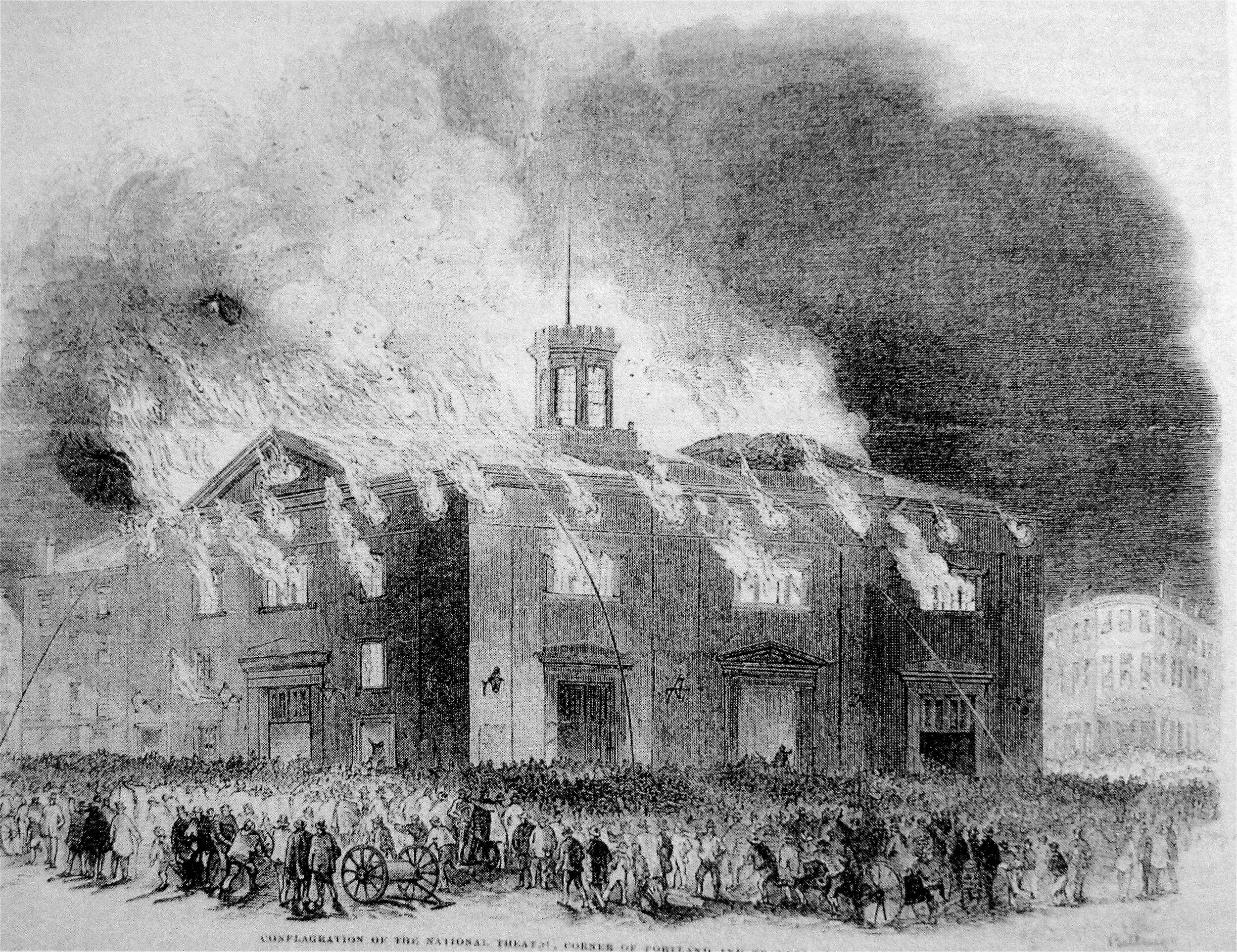
importance assuredly ! ) she states, notwithstanding the excessive pressure in the commercial world, that “her late engagements in the cities of New York, Philadelphia, Mobile and New Orleans, yielded her in ninety days acting, the sum of twenty-six thousand dollars.” Mr. Hamblin, the proprietor of the Bowery theatre New York, which was lately burnt, but which has been rebuilt in a style of greater magnificence, stated in the New York Express of Sept. 26, 1836, as an inducement to the investment of money in the new theatre, that during the last seven years, he had received at the Bowery theatre, the sum of nearly eight hundred thousand dollars! Add to this the revenues of all the other theatres in New York, and in Boston, Philadelphia, Cincinnati, New Orleans, and other places, and you have a sum of enormous magnitude, a large proportion of which is undoubtedly furnished by the youth of our land. How they procure it, is a question difficult to answer. And who are the recipients of this
ON LITERATURE. 27
money? The honorable, the industrious, the useful? No! but a set of idle, and improvident spendthrifts, many of them licentious foreigners, who have nothing to recommend them, but the elasticity of their limbs, the melody of their voices, the grace of their appearance, or at the very most, the truth of their mimic and pantomimic representations.
What! some one may be disposed to exclaim, would you be guilty of entertaining the barbarous and fanatical desire of demolishing all our theatres, so beautiful in architectural ornament, and so rich in interior decoration?—Would you destroy all our noble dramatic productions, “at one fell swoop,” and leave us without the means of gratifying our passion for the splendid exhibitions of the histrionic art? To this we would reply, in the eloquent language of Coleridge, “It is the very madness of mock prudence to oppose the removal of a poisoned dish, on account of the pleasant sauces or nutritious viands which would be lost with it!
28 INFLUENCE OF THE THEATRE
The dish contains destruction to that for which alone we ought to wish the palate to be gratified, or the body to be nourished.” We might not wish to see theatres utterly demolished, but it would rejoice our hearts to hear them resound with the glorious gospel of the blessed God, and re-echo the sweet songs of Zion; and whilst we might preserve the writings of Shakspeare, and a few others, well would it please us, to see all the comedies, tragedies, and farces in the world, heaped and blazing together in one grand funeral pile!
There are some facts and arguments upon this subject, in addition to those already mentioned, which we will now proceed to adduce. These have reference more especially to the moral and religious bearings of theatrical amusements.
First.—It is a consideration of great importance in estimating the moral effect of theatrical amusements, that good men, in all ages of the world, have regarded them with suspicion and
ON MORALS AND RELIGION. 29
distrust, and some of the most enlightened moralists have spoken of them in terms of decided reprobation. This has been the case with the majority of the most virtuous heathen. Solon, Socrates, and Plato, with a large proportion of the most considerate and patriotic Athenians, bore their testimony against their demoralizing tendencies. It was a long time before the theatre could obtain any permanent establishment in Rome, owing to the opposition of its most upright citizens, but it finally succeeded, and became a fashionable and popular amusement, just about the time when Rome began to decline and fall. It came in with the prevailing luxury of the times, and increased in splendor and magnificence, with the progress of corruption and ruin. Cicero, Tacitus, Livy, Quintilian, and others, speak of its immoral influence, in terms of great severity. The theatre has ever been an enemy to “pure and undefiled religion,” and along with the idolatrous festivals, gladiatorial shows, and other
30 INFLUENCE OF THE THEATRE
public amusements of the Roman Empire, assisted to retard the onward progress of the gospel of Christ; and so thoroughly were the early christians convinced of this, that it was finally abolished by an edict of Constantine the Great. Even the Church of Rome regarded it with the utmost jealousy at its revival in modern Italy, and excluded the actors from all offices of honor and emolument in the state. The holiest and the best men of modern Europe, the leaders of the reformation, the puritans of England, the protestants of France, the covenanters of Scotland, and the “pilgrim fathers” of the American Continent, denounced it as a most powerful engine of the “wicked one” for the ruin of immortal souls. The ministers of the gospel in the present day, the churches of the saints, and the most pious among those who believe in Christ as the Saviour of the world, unite in its condemnation. In fact, the Church of God, in all ages, has been most uniform and decided in its opposition to the theatre. Some,
ON MORALS AND RELIGION. 31
whose prejudices certainly will not be thought to have biased their judgment, as for example Johnson and Addison, have dwelt largely upon its corruptions, and although not disposed to abolish the institution altogether, have earnestly advocated a thorough reformation of its abuses. Many great and good men in modern times have not hesitated to speak out as to its unhallowed and ruinous tendencies, and even legislative bodies have sometimes been sufficiently upright and fearless as to enact laws for its suppression. The fathers of the American constitution, the early and noble assertors of their country’s rights, a short time after the declaration of independence, united in the following vote—
“Whereas true religion and good morals, are the only solid foundation of public liberty and happiness, Resolved, that it be and hereby is earnestly recommended to the several states to take the most effectual measures for the encouragement thereof, (i.e. of religion and morality,) and for the suppression of theatrical entertain-
32 INFLUENCE OF THE THEATRE
ments, horse-racing, gaming, and such other diversions as are productive of idleness and dissipation, and general depravity of principles and manners.”
We are happy to have it in our power, in this connexion, to state that the Legislature of Vermont, has lately passed some decided resolutions, to prohibit theatrical amusements, and others of a kindred character, as injurious to the morals and general interests of the community.
“William Pryne, a satirical and pungent writer, who suffered many cruelties for his admirable productions in the time of Charles I., has made a catalogue of authorities against the stage, which contains every name of eminence in the heathen and christian worlds; it comprehends the united testimony of the Jewish and christian churches; the deliberate acts of fifty-four ancient and modern, general, national, and provincial councils and synods, both of the Western and Eastern churches; the condemna-
ON MORALS AND RELIGION. 33
tory sentence of seventy-one ancient fathers, and one hundred and fifty modern Popish and Protestant authors; the hostile endeavors of poets, with the legislative enactments of a great number of Pagan and Christian states, nations, magistrates, emperors, and princes.”
All this, to say the least of it, proves that the theatre possesses a very equivocal character, that the good it produces is not, by any means, obvious, and that high and christian morality, is rather an unfavorable test of its value and tendency. We find the advocates of the stage themselves laboring under this difficulty, and defending it, rather on the ground of what it might be, than of what it is. We find them frequently expressing their regret at what they choose to regard as the incidental, but which we know to be, the uniform and permanent corruption of the stage, and sometimes insisting upon the necessity of elevating, not only its literary, but its moral character, without however producing such a re-
34 INFLUENCE OF THE THEATRE
sult. There must, therefore, be something radically bad in theatrical amusements, which produces a conviction so deep and universal.
In this connexion it may possibly be intimated by some who are loth to give up a sinking cause, and “catch at every straw” to save themselves, that our Saviour and his apostles do not, in the books of the New Testament, express their disapprobation of theatrical amusements. Neither do they, of gladiatorial shows, and many other fearful evils, which were prevalent in the Roman Empire. But they condemn them, by establishing a code of pure and elevated morality, by denouncing “the lust of the flesh, the lust of the eye, and the pride of life,”—by exhorting believers in christianity “to pass the time of their sojourning here in fear,” to place their affections upon heaven,—to prepare for the consummation of all things, and the glorious coming of the great God their Saviour. Christ and his apostles seem to have acted upon the principle, so clearly, though perhaps quaintly
ON MORALS AND RELIGION. 35
expressed in the ancient proverb, “a blow at the root is worth two at the branches,” and their grand object consequently was, to establish a pure and perfect system of truth and duty, to renovate human hearts, and bring them into a condition of unmurmuring submission to the laws of the Eternal God;—and having done this, they well knew that Satan’s empire would speedily fall, as a matter of course, and all evils and vices be banished from the world. And no living man can possibly become a genuine christian—can feel that he is bought with the precious blood of the Son of God, that he is renovated by the Divine Spirit, and that he is destined to glory, honor, and immortality, without knowing, that between his principles and prospects, and the amusements of the theatre, there is an entire and eternal incongruity!
Second.—The theatre, so far from having reformed or benefitted a single individual, has been the means of ruining untold multitudes, especially of the young. Account for it as we
36 INFLUENCE OF THE THEATRE
may, such is the melancholy fact, and we think no sensible and candid person will have any disposition to deny it. We would ask, why have so many promising young men, by means of the theatre, been allured from the paths of piety and virtue? Why has this deprived such numbers of their character and standing in society, their property and their virtue? To how many has it imparted a disrelish for business, for intellectual improvement, for piety and devotion? To how many has it given a distaste for simple and homeborn enjoyments, as well as sober, every day duties! To how many has it rendered the sanctuary of God a dull and cheerless place, and the holy sabbath, if not a season of madness and merriment, one of heaviness and gloom! And what thousands has it introduced into bad company, and smoothed and expedited their way to dissipation and drunkenness, to gambling and death? What is the reason that guardians and parents have such a dread of theatres, and other places of
ON MORALS AND RELIGION. 37
similar character, when they send their wards or their sons to our large cities? Why does the venerable father, and the pious, kind hearted mother, when they send their darling boy from the paternal roof, to learn his trade or his profession, in such places as New York, Boston, or Philadelphia, warn him, with such affectionate earnestness, to beware of the theatre, the gaming table, and the tavern; and pray nightly to their God, that he may be kept from such places of vanity and vice? What is the reason, too, that those, who, wicked themselves, wish to render others equally so, as their very first attempt upon the innocent and unpractised youth, persuade him to go to the theatre, and exult over his downfall whenever he consents to enter the unhallowed place? We would further inquire, why do theatrical amusements extend so far into the night, and come so directly into competition with the claims of devotion and virtue? Why should they as a great centre of moral evil, draw towards them
38 INFLUENCE OF THE THEATRE
so many influences of an immoral and ruinous tendency? In one word, why should they be so intimately associated, not only in the mind of the good man, but also in fact, with all that we hate,—with all that we dread? Even on the supposition that this is somewhat exaggerated, by an overscrupulous morality, does it not whisper a tale of dark, and most fearful import!*
_____
* We make the following extracts on the moral influence of “theatricals,” from a letter written by Mr. Grant Thorburn, to one of our public papers, in answer to some remark, made by Recorder Riker, favorable to the theatre.
“A writer on London and London crimes, makes the following remarks;” “I believe that more of the youths among the lower orders in London, began their career as thieves, in order that they may have the means of gratifying their penchant for theatricals, than for any other cause that could be named;”
“I wonder if Mr. Riker thinks that the youth of New York are made of any better material than are the youth of London.”
“It is a fact of which we have ocular demonstration, and a historical fact which cannot be contradicted, that wherever you erect a play house, there immediately spring up a beer house, an oyster house, a
ON MORALS AND RELIGION. 39
Third—The theatre has ever attracted within its charmed circle, the giddy and the dissipated, the licentious and the vile. Far be it from us to maintain that all who attend thea-
_____
[Footnote continued from previous page:] gaming house, and a prostitution house in duplicates around it.
“Look at the young debased future supporters of liberty, who beset the doors, front and rear; look at the stage, pit, and gallery—the Recorder will find few exalted characters there, except he refers to the sky-scrapers above. In the boxes, to be sure, you will see some gentlemen, and many of them too, are only blacklegs, disguised with clean shirts and superfine coats. The tree is known by its fruit.”
“There is something so fascinating in dramatic representations to boys of from fourteen to twenty-four, that they will steal from parents, masters, superiors or equals, or any where, so as they may gain admittance into this school of refinement, as the Recorder would say. I have known gold and silversmiths’ apprentices, dry-goods, toy-shop, apothecary and slop-shop boys, before they arrived at eighteen years, detected in long courses of pilfering, that they might get into the play-house at eight, the beer and oyster house at ten, and the gaming house at twelve. I appeal to scores of young men, now in Broadway between the Battery and Bleecker street, if this is not the case with them this week, and two or three times every week. I appeal to the Recorder, if he has not disposed of many such cases from his judgment seat.”
40 INFLUENCE OF THE THEATRE
tres are such, and that there are not some high minded and virtuous, but as we deem them, most mistaken persons, who are occasionally found within the walls of a theatre. But we think we speak the truth, and nothing more than the truth, when we say that the theatre is the haunt, the dark and ruinous haunt, not only of the foolish, the gay, the giddy, but of those also WHOSE ONLY BUSINESS IS VICE!—of those who lie in wait for the souls of men, and whose ways lead directly to the chambers of death. We do not exaggerate, neither do we set down aught in malice, when we affirm—that this class of persons regard the drama as a favorite amusement, and the theatre as a most important auxiliary! And does it not deserve the serious consideration of all wise and virtuous men, that the theatre should thus be the common and nocturnal rendezvous of the vicious and the lost?
Fourth—Theatrical amusements exert a most pernicious influence upon those who con-
ON MORALS AND RELIGION. 41
duct them, or make them the business of their lives. Of course there are exceptions to this, as to most other general rules; and some actors have been conspicuous for their virtue, although these have been “few and far between,” and on this account the better known and the more admired. A Garrick, and a Siddons, have risen superior to their profession, and shed a lustre over virtue itself; but the mass of those who live by the stage, have ever been regarded as a lost and degraded part of the community. They are distinguished for their dissipation, their want of high and honorable principle, their imprudence, improvidence, irreligion and licentiousness. In some cities, such as New Orleans and Paris, with a few others, they are accustomed to perform on God’s holy day. The writer never heard of one of them who was a member of a christian church, or who ever attended regularly upon Divine worship. It is a well known fact that even in those places where the institutions of religion are re-
42 INFLUENCE OF THE THEATRE
garded, they are generally in the habit of rehearsing their parts, and making preparations for the amusements of the ensuing week, on the Sabbath. In fact the whole business of the theatre runs counter to religion, and tends to desecrate the institutions of heaven; and hence we are compelled to regard it as a friend and an ally of infidelity. The effect of the kind of life led by players is peculiarly pernicious to female character. It strips it of all its finer and loftier attributes, its softer and more delicate charms. Sensibility, modesty, refinement and heroic virtue are gradually extinguished by the unfeminine and indelicate business of the stage, and nothing is left but the hackneyed and haggard form of injured humanity, it may be, covered and bedecked with the false and tawdry ornaments of a meretricious beauty. And who does not know the pestilent influence which is propagated from this source over the minds of the unthinking, the passionate, and the vain, who hover around it, and what tales of
ON MORALS AND RELIGION. 43
vice are connected with the green room, and other precincts of the theatre?
In describing the pernicious influence of immoral and licentious associations, Dr. Wayland makes the following emphatic remarks:—
“Hence it is that a licentious theatre, (and the tendency of all theatres is to licentiousness) immodest dancing, and all amusements which tend to inflame the passions, are horribly pernicious to the morals of a community. It would be interesting to learn on what principle of morals a virtuous woman would justify her attendance upon an amusement, in which she beholds before her a once lovely female uttering covert obscenity in the presence of thousands, and where she is surrounded by hundreds of women once lovely, but now abandoned, whose ruin has been consummated by this very means, and who assemble in this place with the more certain assurance of thus being able most successfully to effect the ruin of others.”—Elements of Moral Science, p. 305. 3d. Ed.
44 INFLUENCE OF THE THEATRE
These are facts, fearful facts, which cannot be denied, and which it would be mock prudence, and a most miserable hypocrisy to disguise or extenuate. Prostitutes and pickpockets, are among the most regular attendants, and the most enthusiastic friends of the theatre.
“O my soul, come not thou into their secret; unto their assembly, mine honour, be not thou united!”
Fifth—The greater number of our most popular dramas embody equivocal and pernicious principles, and hold up to admiration rules of action, which come into direct competition with christian morals, confessedly the sublimest and purest of all morals. Ambition, pride, revenge, interwoven with the noble qualities of generosity, frankness and talent, are the chief attributes of their most distinguished heroes, and form the ingredients of their admired, but imaginary virtue. A high regard to personal distinction, a disposition quick of resentment, and ready to wipe out the stain of an insult in the blood of a foe, with a proud
ON MORALS AND RELIGION. 45
and haughty consciousness of superior talent or superior virtue, form some of the most striking features in the character of those whom our popular dramatists would hold up to admiration and affection. They establish a false standard of honor, and seem to regard fame as the principal business of human life, and the great end of genius and virtue, suffering and death. In the majority of these productions, the name of God is used only to give emphasis to an exclamation, or to construct an oath; the sufferings and sins of humanity are made the means of amusement, and death, introduced in almost every play, a thing of mere poetical or dramatic interest. Heaven is a term, with which to grace the vapid sentimentalism of some lovelorn, and languishing heroine—judgment and eternity, expressions with which to round a period, or give energy to a speech. If religion, high, hallowed, and holy religion, is introduced at all, it is presented in the garb of ridicule;—if a severe and scrupulous morality, it is
46 INFLUENCE OF THE THEATRE
exhibited in association with fanaticism and folly, and scoffed at, as puritanical precision, and vulgar superstition. Duelling is a common and apparently laudable practice in dramatic representations; and sentiments, appropriate only to the death-bed of a christian, are put into the mouths of those, who have no claims whatever upon the favor of heaven, and are utterly unprepared for the retributions of eternity.
It ought also to be stated in this connexion, as a fact, of which there is the most ample proof, that a large proportion of theatrical exhibitions in the present day, are to a most fearful extent imbued with a spirit of the most abandoned licentiousness, in part covert, but in many cases open and undisguised. Dr. Channing, a man of fine intellect, pure taste, and liberal views, uses language upon this subject still stronger than ours. And we quote him the more readily in this place, because few will suspect him of an unthinking and sectarian prejudice upon a subject of this nature. Speaking
ON MORALS AND RELIGION. 47
of the theatre, he says,—“How often is it disgraced by monstrous distortions of human nature, and still more disgraced by profaneness, coarseness, indelicacy, and low wit, such as no woman, worthy of the name, can hear without a blush, and no man can take pleasure in without self-degradation. Is it possible that a Christian and a refined people can resort to theatres, where exhibitions are given, fit only for brothels, and where the most licentious class in the community throng unconcealed to tempt and destroy? That the theatre should be suffered to exist in its present degradation is a reproach to the community.”
Sixth—Theatrical amusements have a direct tendency to awaken and strengthen those passions of our nature which it is at once our interest and our duty to curb and discipline. This it does by the production of a wild and subduing excitement. There is no amusement comparable to that of the stage in point of deep and all absorbing interest; and this, be it remem-
48 INFLUENCE OF THE THEATRE
bered, is interest in the most energetic, the most dangerous, and least controllable passions of our nature. It takes possession of the mind to the exclusion of every thing else, at least for the time being, and leaves on it the most profound and indelible impressions. The splendor of the place,—the company,—the brilliancy and pomp of their appearance,—the rich and varied decorations of the stage,—the music, the lights,—and the costume of the actors, all combine to deepen the effect. But it is the action of the play, rapid, vivid, varied, and passing, as it does, through the most exciting scenes, and most absorbing passions of human life, which is the principal cause of this powerful sympathy, and which, with the above accompaniments, fills the mind, especially the youthful mind, with the wildest desires, and the most bewildering images. And what are the moral elements with which all this is impregnated? They are emphatically, “the lust of the flesh, the lust of the eye, and the pride of life.” The natural and moral elements
ON MORALS AND RELIGION. 49
of the most distinguished plays are those very passions, which it is so difficult to restrain, and from which all men are in the greatest possible danger. Such are those of pride, ambition, love, jealousy, revenge. Without these, no play would have the requisite excitement, which is the soul of all theatrical pleasure. And it is this, we maintain, which sweeps away the barriers of virtue, and fills the mind with vain imaginations, delusive dreams, unholy feelings, and unhallowed desires. Human passion, and human vice, are the chief ingredients of our finest dramatic productions. They are the ground work and principal means of theatrical enjoyment;—and the profound and almost overwhelming sympathy which, when well enacted, they produce, more especially in untutored minds, is the great secret of their demoralizing tendency. What would be the effect for example, of a battle scene upon the mind of a savage Indian? Take the following as an answer.
“A deputation of northern Indians of the Puta-
50 INFLUENCE OF THE THEATRE
watomie tribe, from our extreme Canadian frontiers, who had gone to Washington on business, and had never been in a city before, were present the other evening at the National Theatre, when the drama, founded upon the well known incidents of Pocahontas and the settlement of Virginia, was enacted. They appeared deeply interested in the entire play, and occasionally gave a somewhat ludicrous expression to their feelings. But that which most intensely interested them, was the grand battle scene at the close, and the terrific fight between Matacoran and Percy. It was evident they considered the thunders of mimic artillery, the rolling of drums, and the clashing of swords, and the shouts of the combatants, as the dread enactment before them of a real battle, and the whole soul of the warrior brave was stirred within him by the sight. One stern and athletic chief, who we understood was the head of his tribe, in particular presented a spectacle absolutely terrible, in the absorbing attention
ON MORALS AND RELIGION. 51
with which he regarded the combat; bending forward with distended eyeballs and clenched teeth, and a compression of muscular energy, which seemed as if his fingers would bite through the moulding of the box by which he supported himself—breathing all the time with a suppression of effort, that plainly showed how ardently he longed to mingle in the deadly conflict—till finally, giving full swing to the terrific passion which every one saw had been roused within him, he appalled the audience, by pealing out with his companions, the dread war-whoop of his nation, and using such demonstrations as plainly showed how ardently he longed to possess himself of the scalp of poor Percy.”* This may be an extreme case, but we maintain that it is a specimen of the natural tendency of well enacted passion; and although a battle scene might, upon the whole, produce
_____
* This account is taken from a newspaper published at Washington. The fact narrated occurred about a year ago.
52 INFLUENCE OF THE THEATRE
little effect upon most of our play goers, yet there are other scenes of vice which meet a response in the hearts of thousands. Few are unacquainted with the wide spread and deeply immoral effect produced in Germany, by THE ROBBERS of Schiller, one of the most brilliant productions of genius, but the more pernicious in its consequences on that very account. We fully believe that the passion for war, the love of fierce and sensual enjoyment, and by consequence, all the institutions dependent upon them, have been much promoted by Theatrical Entertainments.
It may possibly be replied, that the object of our best dramatic representations is, to render vice odious, and to repel the youthful and susceptible mind from the paths of impurity and crime, by the examples they furnish of the almost uniformly disastrous issue of base and vicious conduct. And it is urged, the more familiar we become with the dark and disgusting features of vice, the better are we prepared to
ON MORALS AND RELIGION. 53
resist its temptations, and escape its toils. This principle we very much doubt, for we believe it to be a well established fact, the more familiar any one becomes with vice, and vicious characters, unless he is possessed of fixed principles, and an almost immaculate virtue, the less is he disposed to dread and hate them. But even were the principle true in common life, it would not be true in regard to dramatic representations, because it ought ever to be recollected, as a distinction of the greatest importance, that vice, in order to excite interest in a play or a romance, must not be represented in a loathsome and disgusting aspect. And we do maintain that vice is often a very different thing indeed in a production of genius from what it is in the actual scenes of life. We can scarcely bear it, especially in its darker forms, when presented before our eyes as a living, palpable, reality:—here in most cases it disgusts and repels. But in a romance or a play, it is deeply interesting and even attractive, because it is
54 INFLUENCE OF THE THEATRE
presented there only in its poetical aspects. The witchery of poetry and eloquence is thrown over it, and however hideous and revolting in itself, is thus invested, to the youthful mind, with a most fascinating and romantic interest. A robber, a bravo, a pirate, a suicide, a murderer, are very different beings in the drama from what they are in real life. In the former, though perhaps regarded as bad men, yet they usually possess some redeeming features, and are never presented to us, except in a picturesque, and consequently attractive aspect. The same thing is true of human wretchedness, of poverty, disease, agony, and death. In novels and plays, these, the most painful and repelling of all objects, are rendered matters of deep and glowing interest; and the sensibility which would weep over the sorrows of Werter, and the death of Desdemona, would shrink from the common sufferings of humanity as utterly painful and disgusting. Thus, by means of theatrical amusements, a familiarity is acquired
ON MORALS AND RELIGION. 55
with vice in those forms of interest and fascination which are so dear to the corrupted heart of man. A false and bewildering glare is thrown over that, which ought to disgust and appal, and which in other circumstances would probably produce this effect. And there are hundreds who fully and fearlessly sympathise with such representations, upon whose minds the poetical justice, done to vicious characters at the conclusion of the play, produces no sort of counteracting and salutary effect; because while the former meets a response in the wayward heart of man, the latter does not; for every one knows that poetical justice is a mere trick of the dramatist, and not by any means consistent with fact and real life. They may talk of the moral of a play as they please, but the only and effectual moral of any such production is, (to use the language of John Foster respecting the Iliad of Homer) “the chief and grand impression made by the whole work on the ardent minds which are most susceptible of
56 INFLUENCE OF THE THEATRE
the influence of poetry,” and we may add, of mimic representation. To conclude a piece of successful villainy by the death of the perpetrator, is nothing, as far as moral influence is concerned. This produces no kind of effect upon the heart which sympathises with the talent, the energy, the pride, the daring, of the villain:—and hence to represent vice in its various forms, so as to render it familiar and fascinating, to elicit the sympathy of the youthful mind in its favor, and leave upon that mind deep and indelible impressions of all that is degrading and ruinous, associated only with the poetical, the picturesque, and the romantic, we must regard as one of the most dangerous, and fearfully pernicious effects of theatrical amusements.
We are quite aware that arguments like these will produce little effect upon minds whose moral sensibilities are blunted by vicious indulgence,—who act from no higher motives than the impulses of a degenerate selfishness, and consequently care not what becomes of the
ON MORALS AND RELIGION. 57
moral and immortal interests of their fellow creatures, if they only are gratified. “Wisdom is too high for a fool.” Her nature is too pure, too godlike, to be appreciated or loved by such men, and we cannot therefore expect them to feel the force of an appeal either to reason, to conscience, or to benevolent feeling. But men of correct principles and generous purposes will feel it, and act accordingly. All who love our Lord Jesus Christ,—all who love their fellow creatures, as moral and immortal beings,—all who love virtue and human happiness, will lend their aid to suppress theatrical exhibitions, as injurious to the present and eternal interests of the community, either by entering their protest against their prevalence, and warning men of their ruinous influence, or by giving their vote to subject them to legislative inhibition.
But be this as it may, we would, in conclusion, exhort all, and especially the young, to beware of the theatre, and never to be found within its unholy and dangerous precincts. Avoid it, as
58 INFLUENCE OF THE THEATRE, &C.
you would avoid the very gate of perdition. It may be beautiful and attractive; but temptation is there, death is there, yea ruin and everlasting woe!
“For now such things are acted there, as make
The devils blush; and from the neighborhood
Angels and holy men trembling retire.”