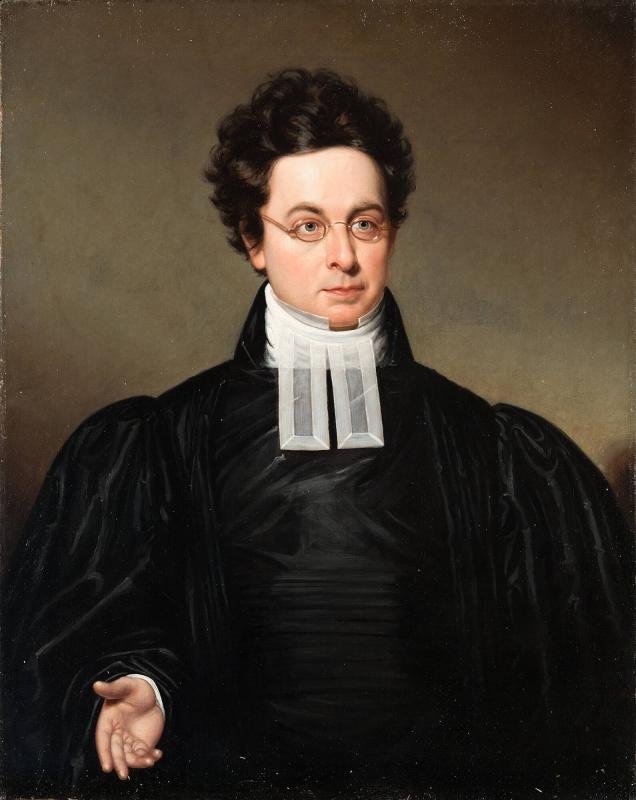
A Discourse on the Sin and Danger of Opposition to Public Religious Covenanting,
James Dodson
FROM ACTS V. 38, 39.
BY THE REV. W. C. BROWNLEE, A. M.
——“Cui fidem largitus est Deus,
“Probationes non requirit; qui fide
“Caret, nulla illi sufficit demonstration
[To whom God has granted faith,
he does not require proofs;
he who lacks faith, no demonstration is sufficient for him].” .... Huet.
PITTSBURGH:
PRINTED BY S. ENGLES & CO. WOOD-STREET.
1812.
Dedication
TO THE
ASSOCIATED CONGREGATIONS
UNDER MY CHARGE.
DEAR BRETHREN,
THIS discourse was preached at King’s creek, on the 27th of June, immediately after solemn covenanting in the congregation under the inspection of the Rev. Dr. Anderson. Our brethren who heard it, expressed a desire to have it published. It was complied with for this reason among others, that I could have the satisfaction of putting it into your hands, and prepare you for a discussion of the subject; with a view to our engaging in covenanting. I desire to lay it at the feet of our Lord, and implore his blessing upon it, as far as it is agreeable to his will, that it may be made useful in promoting his glory in the churches.
I am, Dear Brethren,
Your Servant
In our Lord Jesus.
July, 1811.
W. C. B.
P. S. If there be any profits arising from the sale of this book, they are to be appropriated to the students’ funds under the care of Associate Synod.
DISCOURSE.
ACTS V. 38, 39.
“And now I say unto you, refrain from these men, and let them alone: for if this counsel, or this work be of men, it will come to nought: but if it be of God ye cannot overthrow it; lest haply ye be found even to fight against God.”
CHRISTIAN BRETHREN,
THESE words were spoken by an eminent character, in the audience of an august assembly, and on a memorable occasion. They are the words of the famous Rabbon Gamaliel, who, if we may credit those* who have made researches into the talmudical writings of the Jews, was the son of the venerable old Simeon, who came into the temple when the infant Jesus was there presented, and taking him in his arms said, “Now lettest thou thy servant depart in peace, for mine eyes have seen thy salvation.” He was an eminent doctor of the law, held in reputation of all the people, a Pharisee in religious sentiments, and therefore disposed, more than any of the Sadducees, to lenient measures and impartial justice. They were spoken in the audience of an assembly of the children of Israel, as venerable as any assembly, composed of the aged, learned and high in office, met to deliberate about the matters of religion, can be, who are almost entirely destitute of every sen-
_____
* Grotius, Lightfoot, Guyse. It would appear that Gamaliel was superior in rank to a rabbi.—He was a rabbon.
6
timent of true religion, and every spark of sanctity: and at the same time an assembly the most august in point of members, talents and rank, that could be summoned to consult about their state affairs. For it appears from 21. ver. of this chapter, that it was not merely the Sanhedrim, or the great council of the nation, whom Gamaliel here addresses.—It was an extraordinary assembly summoned by the industry of a bigotted Sadducean high priest, to bury the name of Jesus, to cut off his faithful followers, and to crush, what he reckoned, a dangerous heresy: in the progress of which he and his partizans saw, with indignation, their unlawful commands spurned at, and their infamous conduct, in murdering the Lord of glory, exposed. It consisted of “the council” or Sanhedrim, together with all the senate of the children of Israel; which was made up of* two separate judicatories: each of which was composed of 23 judges, who had their respective seats of judgment in the inner and outer court-gates of the temple. So that the assembly in whose audience this advice was delivered, consisted of one hundred and seventeen chief priests and judges in the land of Israel and city of Jerusalem.
The occasion on which these words were spoken is memorable. The apostles having been endued with power from on high, by the grand effusion of the Spirit on pentecost, had gone forth preaching the gospel, and working miracles in confirmation thereof. They were daily receiving numerous accessions unto the christian church. Neither the contempt, nor the insolence of their enemies seemed to injure them. They were bearing down all opposition before them. This drew upon them by degrees, the envy, the malice, and at last the violence of the councils of the nation. Some of them were thrown into prison. They were maltreated, and insolently enjoined to speak no more in the name of Jesus. They boldly disclaimed the injunction. They averred that they must obey God rather than men. And their unrelenting but dastardly enemies durst not take their lives for fear of the people.
_____
* Pol.[Poole] Synop[sis]. Lightfoot.
7
Whilst the rage of their enemies was thus for a moment suppressed, but not abated, another train of events took place which made it burst into an open flame. The views and dispositions of the christian converts having been effectually changed under the influence of the gospel, an extraordinary spirit of disinterestedness, brotherly love, and mutual confidence manifested itself in them. This shewed itself in the particular instance of their disposing of their property, and depositing the sums into one common fund for the use of all without exception. Among these, a certain man and woman named Ananias and Saphira, who had professed the christian name, sold theirs, no doubt from ostentation, or an aversion from being singular in their conduct. They came and laid a part of the price at the apostles’ feet, averring that it was the whole amount. This was a singular act of hypocrisy and a distrusting of providence. It was an act of sacrilege—a withholding from God what was dedicated unto him; and above all, it was a notorious insult unto the Holy Ghost; through whom the apostles had the gift of discerning spirits. It was a lying with him. As God cut off Nadab and Abihu under the former economy to give evidence of his jealous regard to his honour, and determination to punish those who offer an insult unto him, and by an awful example to deter men from the like in future; so by the instrumentality of Peter, he struck down dead on the spot, first Ananias, and in a few hours after, his wife Saphira.
This made a deep impression on the church, and on all around who heard of it. On the church, by filling her mind with profound reverence for that holy and jealous God the Spirit, who had thus vindicated his honour by making a terrible breach upon his adversaries: and on those around, by filling them with consternation, lest he should break in upon them also, for opposing his servants, or for joining themselves unto the church in an hypocritical manner. The fame of all these things brought multitudes, not only from the city, but from the towns and villages around it, to hear the gospel, and to be healed of all their diseases. A succession of miracles
8
was wrought by the apostles on these; “for they were healed every one.” And as a consequence, multitudes were led to embrace the truths of Christ, which came attested by evidences that bespoke the singular countenance of God given unto them; and could not be rejected without offering violence unto their reason.
This success of the gospel kindled the rage of the High Priest and his party. “Then the High Priest rose up and they who were with him, and were filled with indignation, and laid their hands on the apostles, and put them into the common prison.” But mark the wonderful steps of Providence. “The angel of the Lord by night opened the prison doors, brought them forth, and said, go, stand and speak in the temple to the people, all the words of this life:” and they did so. Meantime the unprincipled and malicious High Priest had been industriously employed in collecting all the members of the council, being little aware of the interposition of the angel. On the morning, accordingly, having met in council, they sat down in judgment, and ordered their officer to hasten the criminals before them. Their officer returned and made this report. “The prison truly found we shut with all safety, and the keepers standing without before the doors, but when we had opened, we found no man within.” For a moment they were confounded and bewildered in doubts whereunto this might grow. It was only for a moment. Their consciences were steeled by prejudice and malice against every impression. They were resolved to carry their point. For upon a report being made to them that the apostles were standing in the temple and teaching the people, they despatched their officer for them. They were brought and set before the council. The High Priest insultingly demanded of them how they dared to despise their injunction, to teach in the name of Jesus, and to fill Jerusalem with this doctrine? Peter in the name of the rest offered this apology for their conduct, with a dignified firmness. And far from being ashamed to own the truths of Christ, he presented them with the outlines of the Gospel which they preached, and brought it home with such a pointed
9
application unto them, that they were filled with fury even to madness. They proceeded to take counsel to cut them off by a violent death, as an example unto others. It was in this juncture that the rabbon Gamaliel arose, and delivered this address, consisting of certain positions, from which he draws, as a conclusion, the advice in our text. “And now I say unto you,” &c.
Such was the occasion on which this advice was primarily delivered; and I apprehend, it may, without impropriety, be pressed upon the present occasion: for the present circumstances of the church, may be considered as in some respects not unlike these in which she was, when the words were first spoken. She was then meeting with opposition unto her doctrines and institutions in general, from those who professed to be her friends; and who certainly had a long standing in that once famous church. She is now keenly opposed in some of her doctrines, and particularly in regard unto the duty of covenanting; and by those who have professedly espoused the cause of truth, and appear to be true Christians. If the advice, in its general spirit, was suitably administered unto her opposers at that time, it cannot be unsuitable now.
We shall exhibit these thoughts more fully in another point of light, and I trust, you shall see that this advice is not only not foreign, but peculiarly applicable unto our present circumstances. Consider, my brethren, what is the subject matter spoken of in this advice. It is that system which all Christians acknowledge to be “The counsel and work of God.” This includes all the doctrines, ordinances and duties enjoined in the gospel, taken in its largest acceptation. Consequently, there can be no violence offered unto the spirit of the advice, in making an application of it unto any particular duty enjoined in the grand system. And accordingly, since covenanting, as shall be afterwards made to appear, belongs unto this system, we are fully authorised to view the advice as regarding opposition to it, as well as to any other duty plainly enjoined therein. It is of no consequence to object that the speaker Gamaliel, can hardly be sup-
10
posed to have had his eye on covenanting; and therefore to apply it unto such a subject, is to offer violence unto his design, and to drag into our assistance, what is not unto our point. For, not to insist upon our right to accommodate passages of scripture unto a particular subject, while it might be extended unto another; nor to enlarge upon the idea (which, however, might be followed up unto our purpose) that the intentions and views of Gamaliel’s mind, are no more to be made the rule of our application of his words, than those of Caiaphas are, when contrary unto his own intentions, he uttered that memorable prophecy respecting the necessity of the death of Christ. Suffer me simply to remark that when he here speaks of “that work and counsel,” he alluded unto what the apostles taught. In alluding unto what they taught, he had his eye either on the whole system, or on a particular part of it. If on the whole, then this duty was included; for being a Jew, and well versed in the scriptures, he was no stranger unto covenanting: If on a particular portion thereof, no reason can be assigned, why we may not apply the general maxim in the advice unto any of the other parts, as well as unto that on which he may be supposed to have had his eye fixed.
Next, take a view of the objects addressed in the advice. They were all those who were undeniably opposing “the work and counsel of God.” At this moment, after we have seen those engaging in the work of covenanting, who willingly offered themselves:—I view myself as particularly called upon to address those who have been hitherto, in one shape or another, opposing this duty; and thereby in our view, opposing the “counsel and work of God.”
In fine, reflect upon the general spirit and design of the advice in the text. It is not merely to urge the persons addressed, to decline forming a decided judgment on these matters announced by the apostles. No, it extends farther. It is to point out the danger of opposition unto these, in order to dissuade them from the evil practice in future. In addressing ourselves unto opposers of covenanting, at this time, can any advice be more
11
seasonable than this? I do not know of any more so. It is a duty which we owe unto our christian brethren, to point out their danger when we see them exposed. We are not to measure the discharge of the duty by any supposable consequences. We are to leave these in the hands of the disposer of all events. We must do our duty, “whether they shall hear, or whether they shall forbear.” This is what we owe unto the Lord; and unto ourselves as his ambassadors.
Hitherto we have considered the words of our text as having the validity of scripture. As they were uttered and laid down by a person not inspired, it is of importance to enquire into this. Though it be granted that these words were spoken by an uninspired person, yet it cannot be thence inferred that the maxim has no scriptural authority; and of course is unfit to be the foundation of a discourse. No: so far from this being the case, I assert that a position may have the validity of scripture, though uttered by a man not inspired. This will hold true respecting all points, concerning which the following things can be made to appear. First, That they have been received into the scriptures without any disapprobation of them expressed by the Spirit; either accompanying them, or found elsewhere in the sacred volume. Second, That they have received his positive approbation in one way or another; such as his countenancing them in any certain manner, by adopting and using them in carrying on his work. Here may be instanced the advice of Jethro dictated by human prudence to Moses, respecting his employing judges to assist him. Moses adopted it. God countenanced it. He afterwards gave his formal approbation of it, by appointing seventy men for that purpose, and putting his Spirit upon them. Third, That they are not contradicted by the uniform tenor of scripture. In that case they may be called their diffused sentiment compressed and expressed in other words. Fourth, That the person uttering them can be shewn to be speaking the same meaning, or sense which is expressed in different words in some other place of scripture. This is not uncommon in the quotations of the apostle Paul. Thus in quoting that
12
passage* “Mine ear thou hast bored,” he gives us the sense of it in these words “a body hast thou prepared me.”†
Now let the words of Gamaliel be measured by these rules. They are received into the sacred volume without any disapprobation affixed to them. In a certain sense the Spirit may be said to have approved of them by blessing them for the purpose of restraining the rage of the council. They are in unison with the general tenor of the word of God. In fine, I apprehend that Gamaliel is here giving us the substance of a passage of scripture recorded in the Old Testament. It is the tenth and eleventh verses of the thirty third Psalm. “The “Lord bringeth the counsel of the heathen to nought: he “maketh the devices of the people of none effect. The “counsel of the Lord standeth forever; the thoughts “of his heart unto all generations.” Hence we do not hesitate to pronounce the text to have the full authority of scripture.
These things being premised in clearing the general maxim in the words before us, we go on to make an application of it unto the particular duty of public reli-
_____
* Psal. xl. 6. Heb. x. 5.
† I cannot help noticing here a phenomenon in the religious world, which struck my mind as I transcribed these lines for the press. That is, the tendency which those, who reject creeds and confessions as tests of orthodoxy, have to the principles of the baptists. About some twelve or fourteen years ago, a society was instituted by a Capt. Haldane with the assistance of his brother, now in Edinburgh, which was styled the Tabernacles. They were independents in church government: they rejected creeds and confessions as tests of orthodoxy, &c. They have of late been almost dispersed and dissolved. Their pastors and members went off in shoals to the baptists. Their founder and some hundreds of his congregation were dipped in one day. And we might mention a recent instance in the case of the leader of “The Washington Association.”
These facts confirm this truth, that the rejecting of creeds and confessions as tests of orthodoxy, is a short and certain process of converting persons to the principles of baptists. This is easily accounted for. They reject creeds and confessions, because they allege that though they contain the meaning of scripture, yet being expressed in other words by men, they cannot be binding on the conscience, as these divine truths expressed in the words of scripture, are binding; accordingly they are under the necessity of denying, that reasoning by analogy and inference from scripture, has the authority of scripture; and as infant baptism is proved principally from reasoning by analogy and inference from scripture, they are irresistibly impelled by their received principles to deny infant baptism. Yes, and by the same process of reasoning they ought to reject females from the Lord’s table, seeing the right to that ordinance is proved only by analogy and inference.
13
gious covenanting, in the following five deductions from our text: To establish and illustrate these, and thence to make some practical improvement of the subject, is our design in the following discourse.
DEDUCTION I.—Every innovation by way of counsel or work, that is introduced into the church, by the devices of men, shall come to nought: and since the opposition that is managed against public religious covenanting, is an innovation in the church; of consequence, it shall come to nought sooner or later.
Let it be understood what is here meant by an innovation in the church. In general, it may be described to be the introduction of something that has not certainly the air of scriptural antiquity to render it plausible; nor the sanction of Zion’s King to give it importance and stability. More particularly, it is, on the one hand, either a teaching of new doctrines which are not founded on the holy scriptures; or the prescribing of things not required by God, as duties obligatory on the conscience. Or, on the other, it is a laying aside certain scriptural doctrines and duties under the pretence of their being neither expressly taught, nor countenanced by any approved example in the word of God.
In proof of the first proposition here stated, that all such innovations shall come to nought, I would suggest the following things. The scriptures are full and express on the point. Neh. iv. 15. “Our enemies heard that it was known unto us that God had brought their counsel unto nought.” In this book we find the people of God, who formed the true church of Christ, engaged in the important work of reformation: not only in repairing the temple and city, that the true worship of God might be kept up in their various ordinances; but in correcting all other abuses that fell under their notice. The persons who are here styled “their enemies,” had taken a counsel against them, and were opposing the whole of the work. This was an innovation in the fullest sense. It was opposed unto God’s will expressed from of old, even from the beginning, that the affairs of
14
his church should be zealously attended unto and should prosper. It was an attempt to oppose a duty under the pretence that it was not commanded by the true God. And the end of it, we find, was “God brought it unto nought.” We might also adduce Is. i. 11, 12, 13. “To “what purpose is the multitude of your sacrifices unto “me? saith the Lord: I am full of the burnt offerings “of rams, and the fat of fed beasts; and I delight not “in the blood of bullocks, or of lambs, or of he-goats. “When ye come to appear before me, who hath required “this at your hand, to tread my courts? Bring “no more vain oblations; incense is an abomination “unto me; the new moons and Sabbaths, the calling of “assemblies, I cannot away with; it is iniquity, “even the solemn meeting.” It cannot be supposed that God would make such denunciations against his people when endeavouring to celebrate all his ordinances, without additions; in some measure according unto his will. and the expressions “to what purpose is the multitude of your sacrifices ;” “who hath required this at your hands,” and “bring no more vain oblations,” warrant us in saying that it was more than hypocrisy for which they were reproved: and nothing less than innovations by way of adding. The severity of the reproof bespeaks God’s hatred against such, whatever was the pretence under which they were made. And what is God’s hatred but the commencement of his work in overturning them? The declaration of our Saviour* is much unto our purpose. “In vain do they worship me, teaching for doctrines the commandments of men.” And that severe remonstrance of our Apostle: “Why as though living “in the world are ye subject to ordinances after the “commandments and doctrines of men?”† And in regard unto the last species of innovation, we suggest to you the words of Jesus in Matth. xv. 5, 6. where he speaks with uncommon severity against the novel doctrines of the Jews, which countenanced undutiful children in plundering their parents of what ought to have
_____
* Math. xv. 9.
† Col. ii. 20, 22.
15
gone to their support, under the pretence of its being a gift devoted unto God: and consequently made the commandment of God to honour parents, of none effect. In fine, that none might plead ignorance as an excuse on the matter, our Lord has guarded his scriptures by repeated prohibitions of the practice of adding to, or diminishing from them:* with awful certifications of his visiting such in his righteous judgment.
Further, let us reason on this point from the nature of things, and of God. Innovations in the church are intrusions of men upon the infinitely sovereign author of all the doctrines and laws of his house. If God be of such a character as the scriptures uniformly represent him to be,—and who shall dare even to suspect that he is not so?—then how can he, according unto his very nature, tolerate this? Can he tamely give up his sovereignty, and abdicate his throne? No; this is among the things which are impossibilities with Jehovah himself. Moreover these are insults to his wisdom, his omniscience, his goodness.
To his wisdom that is displayed conspicuously in arranging and planning the order, the doctrines and laws of his house: To his omniscience that is glorified in foreseeing and ordaining every thing that could be necessary to promote his honour and secure the salvation of his people: and to his boundless goodness which has actually provided every thing necessary for that purpose. They give the lie to his veracity which has asserted the perfection of the scriptures to be such that they cannot admit of any addition from men or angels.† And they bid defiance unto the denunciation of the Almighty against those who “add or diminish.”‡
This calls for our most serious attention. Either we must acknowledge that the King of Zion shall resent these insults and injuries offered unto his perfections; and so of consequence bring all these innovations unto nought: or we must surrender the point that he is necessarily faithful, and the invincible executioner of his
_____
* Deut. xii. 32. Mal. iv. 4. Rev. xxii. 18, 19.
† Rev. xxii. 18.
‡ Rev. xxii. 19.
16
threatenings. We cannot surrender this point. Our hearts, our consciences, the declarations of scripture, unite in protesting against it: and in testifying that Christ will not, and cannot prove unfaithful nor impotent. Our conclusion is therefore unavoidable. He will give proofs of his faithfulness and power, in overturning these devices of men
But we have alledged that opposition unto public religious covenanting, is an innovation in the churches of Christ. It is proper that you keep in view the nature of the subject of which we speak. Let us give a brief description of it. Public religious covenanting is the deed of a society of Christians; in which with their hands lifted up, and swearing by the great name of the Lord their God, they declare before God, angels and men, that through his grace they desire to make a dedication of themselves unto God: that they choose him for their Father, their Redeemer, their Sanctifier; that they enter into an engagement through his strength to keep his commandments, to observe all his institutions, to listen attentively to his voice: that they pledge themselves to each other, as honest soldiers of Christ, to stand by each other in every danger; to assist and strengthen each others hands, in promoting the grand work of reformation, in their own hearts; and in the church of God at large, even to the end of their lives.
That opposition to the subject is an innovation, we evince in the following manner. The Holy Scriptures give no ground for it. My brethren, the word of God is in all cases perfectly consistent with itself. And since, as we shall have occasion afterwards more fully to declare, it plainly enjoins covenanting—Vow and pay unto the Lord your God,*—it cannot, of course, be supposed that it can countenance any opposition thereunto. Hence the opposition that is managed against this subject systematically (and every other kind, I term the random workings of an uninformed head) must result from something beyond the bounds of scriptural authority; and
_____
* Psalm lxxvi. 11.
17
is an innovation in the strictest sense. And, further, the uniform examples of covenanting in the true church of God, prove in a satisfactory manner, that the opposition in question, is a mere novelty in her. Take a general review of these. The true church of God, did, in the days of Moses,* enter into a solemn covenant to walk in his ways, and to keep his judgments; which of course, was not a ceremonial but a moral deed. This was done by the true church in the days of Joshua,† a short space before he departed this life: in the days of Asa,‡ of Joash,§ of Josiah,|| of Nehemiah,¶
We find the prophet Jeremiah charging the breach of covenants, as a sin upon that generation among whom he lived; which is a proof that the true members of the church, who along with him served the Lord God of their fathers, did not see it to be their duty to oppose it. It was opposed by the enemies of Jeremiah and of God.** The Macedonians “gave themselves unto the Lord,” in the days of the Apostle Paul; which I apprehend cannot be understood of any other duty than covenanting. It could not refer unto the making a collection for the poor saints at Jerusalem. That idea is too mean for the expression “They gave their ownselves unto the Lord;” and it is fully implied in the following clause, “and unto us by the will of God.” That is, after having dedicated themselves solemnly unto the Most High, they formally committed themselves unto the servants of Christ, to be directed by them in all their spiritual matters; and gave an evidence of their readiness to do so, by complying with the hints thrown out to them to remember the case of their poor brethren. Moreover, this expression could not refer to their being organized as a church. That had been done formerly. It could not refer unto their engagements in either of the Sacraments. The doing of this could not be something that exceeded the apostle’s hopes.††
_____
* Deut. iv. 10, 13. v. 2, 3. xxix. 1.
† Joshua xxiv. 24, 25.
‡ 2 Chron. xv. 12.
§ 2 Chron. xxiii. 16.
|| 2 Chron. xxxiv. 31.
¶ Neh. ix. 38. x. 29.
** Jer. ii. 2, 20. xi. 2, 3, 4, 7, 8.
†† 2 Cor. viii. 5.
18
In the primitive ages, during the reign of the Emperor Trajan, the christians covenanted. This appears from the well known letter of Pliny, to his master the Emperor, in which he gives this description of the Christians; “that they are an harmless inoffensive sort of people who only worship Christ as God, and bind themselves by an oath to abstain from all wickedness.”*
Hitherto we find no opposition to this subject by the true church of God. The opposition is found among those alone, who gave evidence that they were not friends to Christ. But let us trace it farther. The famous Waldenses, the followers of Huss, and Jerome of Prague, the reformed churches of France, Germany, Holland, Geneva, Berne and Louisiana; Bohemia, Sweden, Hungary, Transylvania, New England, at Salem and Boston: moreover the churches of Scotland, England, and Ireland, covenanted in their purest times. And I request you to remark, that this was done among them, not by a handful of individuals, or a few solitary congregations, while the majority stood out against it. No: they engaged in it as a church. This appears from the acts of their Synods and Assemblies; particularly those of Holland and Great Britain, Hungary, Transylvania;† and those of the synods of France, that met at Privas and Charenton.‡ It remains then to be observed, and I trust, it cannot be refused by any candid mind, that opposition unto public religious covenanting, by those whom we reckon churches of Christ, is an innovation recently introduced into the church of God. Hence we deduce our conclusion from these propositions thus proved, that all the opposition which we see carried on against covenanting, by those whom we reckon churches of Christ, shall speedily be brought to nothing.
DEDUCTION II.—Those counsels and works which God countenances in one degree or another, and at one
_____
* Pliny, jun. lib. x. litt. 97, 98. Mosheim’s church history, vol. I. p. 156, &c. Stackhouse’s history. Morrison on covenanting. &c. &c.
† See Muirhead’s dissertations on federal transactions, p. 604, 626. Acts of Assembly of the church of Scotland in 1590, 1638, &c. &c.
‡ See Quick’s Synodicon. Morrison on covenanting, p. 44.
19
time or another, in his church; must evidently be understood to be from him as their author. But public covenanting has been countenanced by him in various degrees and at different seasons; of consequence, public covenanting is of God’s appointment.
That reasoning in behalf of what we reckon a divine institution, taken from a view of its efficacy, has been by all parties reckoned just and forcible. We perceive, for instance, a remarkable effect produced by some means. The effect appears plainly to be something superior unto human skill and agency. The cause operating by the mean must be acknowledged to be equal unto the effect; and, of consequence, superior unto the skill and agency of man. It cannot, therefore, be supposed to be any thing less than the interposition of God. And, to be more particular, when the effect belongs to that class of effects which are produced by God in carrying forward his interesting work in the church, as he is pleased to produce these by his own appointed means alone; it follows that when we perceive these resulting from an institution, there must be an interposition by divine power through it; and that, of course, the divine countenance is given unto the institution: and such countenancing argues forcibly that that institution is of God. It will not weaken, but rather strengthen our argument to say, that God has frequently smiled upon the labours of those who have been guilty of gross abuses in his ordinances; and even defections from some of them; whilst, sometimes the purer part of his church, has not been so much favoured, nor highly honoured. For, on the one hand, it is to be observed that God hereby shews unto the world, and he would have his professed people, in particular, to know, that he will not have the purer part of his church to measure their duty or their fidelity by his giving greater or less degrees of countenance unto their conduct, or by any supposable consequence; but by his special injunctions; which, however, may be illustrated and freed from popular objections, by a view of God’s approbation expressed in various ways. He
20
would hereby, also have them to learn that he will be an absolute sovereign, as much in the expressions of his approbation of his more faithful servants, in that degree, time, and manner which is peculiar unto himself; as in countenancing the dispensation of his institutions, by the ministration of those who have been guilty of great abuses therein; while they have not gone the length of utterly apostatising from them, and substituting human devices in their stead. But, on the other hand, it cannot be inferred from God’s smiling upon the labours of such persons, that he gives his approbation of their abuses and defections. With equal propriety might it be affirmed that, in accepting from believers their holy obedience through Christ, he thereby approves of all that “body of death” that is in them. Hence in all this God is to be viewed as carrying on his own work in his people, by institutions dispensed by these imperfect and humble instruments; thereby testifying in a singular manner, his approbation of these institutions; and demonstrating forcibly, before the church, that they are of his own appointment. For his power appears strikingly, when the vessels which contain the treasure, are perceived clearly by the church to be earthen and weak.—And this is the spirit of our argument, to which we now request your attention.
Our first position in it, is, that these works or counsels which God countenances, must be allowed to be from him, as their author.
The truth of this may be established in the following manner.
God cannot and will not give his sovereign authority to any created being. If he did he would cease to be the only independant sovereign. New sovereignty shews itself not only in enacting laws, and appointing ordinances, but also in supporting these for all the purposes of their institution. Hence, if he cannot and will not surrender his sovereignty, and if sovereign authority manifests itself in this manner, then, it is certain that he never will countenance, in the sense stated, any thing that is not from himself directly as the instructor of ordi-
21
nances. You ask the reason. I answer, if he did so, he would be supporting the pretensions of a rival unto what his authority had founded.
Again, as all the institutions of God are most worthy of himself, and are adapted in his omniscience, and by his infinite wisdom, each to its own particular purpose, it must be allowed that he has a supreme regard unto every one of them. God’s love and regard cannot be inactive. As he has his work going on, he will manifest his love by calling forth these institutions into action, in bringing this work to its interesting termination. And as neither omniscience nor divine wisdom were exercised in regard unto the institutions of men, it is not possible that he can have any regard unto them, or give any countenance to them by calling them into accomplish the end which his wisdom is pursuing. In fine, all counsels and means, are in themselves, incapable of producing any effect. They have no intrinsic power in them for that purpose. Hence some being must act upon them, in such a manner as to render them effectual. No created being is capable of this. Such agents have not the human mind in their power. They know not the avenues into the heart. They cannot force their way thither. They cannot arrest the soul in its progress in iniquity. They cannot elevate it from that depth of misery into which it is plunged; nor give any constitution an irresistible tendency towards the effectuating of this. None but God can do it. He alone has the hearts of all men in his hand, knows all their movements, can apply the means, and produce the effect irresistibly.* Hence if these means be so countenanced, and supported amid enemies, as to be rendered effectual, either sooner or later: And if none but God can do this, it plainly follows, that it is God who countenances these means in his own sovereign way; and if so, then according unto what has been laid down, they must be allowed to bear his authority.
But we have affirmed that public religious covenant-
_____
* Philip. i. 6. ii. 13. Ephes. i. 19, &c.
22
ing has been countenanced in one way or another, in various degrees, and at different seasons.
Brethren I am aware of the difficulty that lies in the way of ascertaining this point. Prejudice throws all its weight into the opposite scale. It is hard to poise the balance fairly in such cases. But, the equal pressure of solid scriptural examples, and recent authenticated facts, if we can find out such, may come at last, not only to restore a fair equipoise, but to weigh it down decisively in our favour.
Before we can enter on the consideration of the point, it is necessary that we state the rules by which we are to be guided in ascertaining when the countenance of God may be said to be given unto an institution.
We require it, then, to be observed, that merely external splendour and prosperity is no decisive proof of its being divine. The superstition and buffoonery of the church of Rome could boast of such:
Nor the mere protraction of existence, even when constantly growing in strength, for a definite space of time. The church of Rome could boast of this in some of her most impious institutions:
Nor the production of effects however great and astonishing, if they do not obviously, or in their proper bearings tend to exalt the glory of God, in the promoting of the interests of the Redeemer’s kingdom. The time has been when some of the institutions of the Romish church, has inspired terror into individuals: and convulsed nations and kingdoms. And what ever was the display of God’s awful sovereignty in overruling these, and turning them into severe punishments, “by chusing their delusions, that they all might be damned, who believed not the truth, but had pleasure in unrighteousness?”—Yet they had no direct tendency to promote the honour and interest of Christ:
Nor is the inspiring of fear and reverence into the minds of men, and thence the effectuating the reformation of their external conduct, any decisive evidence. The
23
extravagant institutions of Rome, and modern delusions, have, in many instances, effected this.*
But an institution that has had its existence from the earliest periods of the world; that has been celebrated in the churches in the past ages, down to the present, without any testimony borne against it by the faithful, has, we may grant, the countenance of God.
And, finally, that institution must be considered as having his approbation, which is made subservient to the carrying on of any part of the great work of God in his kingdom. Such as the comforting, uniting, strengthening of his subjects: the reviving of religion, and christian morality, by overturning schemes and practices subversive of them.
We might hence argue in favour of our point from the church’s attention unto this duty from the earliest ages, without having heard of a protest entered against it by any man of God. But we select the last principle laid down as that by which we may be led more decisively to our point.
The grand design which church members have in view in their religious covenanting, is to testify their love unto God, unto all his truths, and to each other, in a manner calculated to remove all doubts and jealousies as to their sincerity in their profession; to bind themselves unto the discharge of their respective duties; to promote unity of heart, to concentrate their force; and to employ it to the best effect against the common foe, for the glory of God, the reviving of religion, and the promoting of their own comfort.
In proportion as these are effected, one branch of the great work of God in the church revives and flourishes.
Hence if we can find instances of them having been really produced by this institution, whatever may be the degree, whether they be more or less definite (for this will not alter their true nature,) we shall thereby have evidence of the intervention of the divine goodness and power: and, thence, a proof of the countenance of God given unto that as one of his own ordinances.
_____
* This may be said of the outward conduct of the Quakers, &c.
24
For this purpose I solicit your attention, my brethren, unto some facts, which we find on record.
Joash King of Judah, and his subjects, by the assistance and direction of Jehoiada the High Priest, entered into a covenant with God, the substance of which was, “that they would be the Lord’s people.”* This was made signally useful in the work of reformation in the church. Idolatry was destroyed with all the implements of the superstitious worship of Baal. The true worship of God was restored in the land, with all the hallowed ordinances; and religion experienced, as it were, a resurrection from the dead. And what is remarkable, when the king and princes “forsook the Lord,” and so brake their covenant with God “he also forsook them.” So that idolatry and irreligion, becoming general, were the prominent features of the times; and the wrath of the Lord went forth in pleading his controversy against them.
Asa, king of the same nation, succeeded his father in a turbulent season. Impiety and idolatry had overspread the kingdom.† He exerted himself in combatting the enemies of God and the church; particularly in reforming abuses which idolatry had introduced, and restoring the true worship of God. To effectuate these, he and his subjects, the true members of the church, entered into a covenant “to seek the Lord God of their fathers with all their heart and with all their soul.”—Jehovah condescended to smile upon them, to accept of that solemn act of worship, and to bless it for their rest and comfort. For “he was found of them and he gave them rest round about.”‡
You all know what a gloomy period of national calamities, and mournful defections from the truth, preceded that in which Nehemiah, the Tirshatha of Judah, was raised up and ushered into our view as an eminent reformer in the church. That darkness being greatly dissipated, he and the people of God entered into solemn engagements “under a curse and an oath, to walk in
_____
* 2 Kings xi. 17. 2 Chron. xxiii. 16.
† 2 Chron. xv. 3, &c.
‡ 2 Chron. xv. 15.
25
God’s law, to keep his commandments his judgments, and his statutes.”* Gross abuses were corrected under the fidelity of the Tirshatha, and the zeal of the people: divine ordinances were attended unto, and celebrated by the priests of God. And he gave his signal countenance unto them by accepting of their persons and sacrifices. He made his people to rejoice with great joy, “spiritual and national,” so that the joy of Jerusalem was heard even afar off.
Thus covenanting was remarkably useful in carrying forward the work of God in ancient times. And we mention these instances as an introduction, and at the same time, an illustration of what follows.
In regard of primitive times, we know only this much that the solemn engagements entered into in this duty were useful in preventing apostacy, in the diffusing of a spirit of harmony among professors, and in keeping alive that distinguished christian patience and courage, in suffering for the truth, during the persecutions under Trajan, Adrian, and the two Antonines; which though not equal unto those of Nero and Domitian, were peculiarly distressing.
There are some facts in the history of the reformed churches in France, which afford strong proof to the truth of our proposition. The members of that church, after the meeting of their synods at Alez, Privas, Charenton and Alençon, did solemnly covenant with their God. Those who are acquainted with the history of those times, will recollect what a remarkable success was given after that unto the preaching of the word of God. What a display of christian unity and love; what a striving together for the faith of the gospel; what an earnest contending for the purity of doctrine, against the various errors which had crept in; and for the correctness of discipline in its rules and application. They will recollect how the power of their enemies was at intervals signally repressed, and partially diverted into other channels, by these ecclesiastical feuds, which had existed for
_____
* Neh. ix. 38. x. 29.
26
a long time between the Roman Pontiffs, and the French monarchs:* and how they enjoyed no small degree of rest round about, under the favour of some who were in power. And, it will be remembered with mingling feelings of joy and melancholy, with what firmness, patience and perseverance, in their christian profession, that church met that terrible shock from the fiends of persecution, at the revocation of the edict of Nantz, by Louis XIV.†
And from the present state of that church, we may learn something to our point. She fell from that duty. She broke her covenant with her God. Long has she been opposing it, and long has she been experiencing the dispensations of providence, that have convulsed her almost to dissolution. And while with pleasing emotions, and the tenderest congratulations, we see her beginning to raise her head from the dust, we may exclaim, behold what a mournful wreck of her former condition! what a monument of the Lord’s displeasure in avenging the quarrel of his covenant!
We might extend our remarks to what followed the “Holy league and covenant” entered into in 1531, by the protestant princes and states of Germany, who constituted the Reformed church there. But we shall proceed to consider some facts recorded more fully respecting covenanting in the famous church of Scotland.
After the defeat of the Spanish Armada, which was impiously styled “The Invincible,” and which was designed to subjugate Britain to a foreign power, and destroy the work of Reformation that was making rapid progress therein; the church of Scotland, in a solemn manner, renewed her covenant engagements. This was done by her in 1590, as an expression of her gratitude to the Lord of Hosts for his interposition in her behalf: and in consequence of finding herself in imminent danger from the popish party within the kingdom; and
_____
* Mosh. Eccles. history, vol. v. p. 150.
† Quick’s Synod. Mosh. Eccles. hist. v. p. 353. And particularly a book often resorted to by Mosheim, entitled “Actes de tous les synodes Nationaux des Eglises Reformees de France. par Aymon.”
27
from the influence of foreign emissaries, chiefly of the class of Jesuits.
The effects of this were soon felt. The hearts of the friends of reformation were thereby cemented together in such a manner, as to bid defiance to all the schemes, which these cunning and malicious emissaries employed to separate them. Purity of doctrine was zealously and successfully maintained. Love and harmony reigned in their deliberations; and in the execution of the measures which they adopted respecting the church. A dutiful attention to the services of God, in public and private, characterised the multitude. In a particular manner, we find, that it was instrumental in impressing an awe on the minds of their enemies: and in actually bringing great numbers of them into a submission to the laws and ordinances of the church; whilst their hesitating friends, who had declined for six years to join openly and decidedly with them in the work which they were carrying on, came, and with fervent prayers, with many tears, with fasting and humiliation, joined themselves unto the Lord in a covenant of duty; and unto them in helping on the important work of reformation.*
From the year 1596, unto 1636, there intervened a period which tried the souls of the faithful. Apostacy, error, corruption of the laws, and of the true worship of God, advanced with giant strides in the tyrannical reigns of James, and his son Charles I. There were, however, not a few of the ministers of Christ, and his professing people who adhered unto their covenants, and defended the principles of the reforming church of Scotland, with unshaken firmness. This faithful little band, whose hearts were knit together by zeal for their Master’s honour, did greatly embarrass the measures of the enemies of reformation; and delivered many from their snares by exposing their impious attempts against the prerogatives of Christ: and by pointing out unto them the path of their duty, “in the cloudy and dark day.” Instances can be mentioned of the Lord smiling upon their labours, in
_____
* This was done in 1596 by those who had not covenanted before.
28
a singular manner, more than once. He did so in several congregations in different parts of the West of Scotland, in 1625—1630; particularly in that under the ministry of a great reformer, who was made instrumental in the conversion of multitudes.*
In the north east parts of Ireland in 1628, and afterwards, he wrought a great work in reclaiming many sinners and adding them unto the church: in edifying and comforting his afflicted saints, by the ministry of those covenanters, who had fled from the storm raised against them in Britain.†
But in a manner the most remarkable did this appear, in 1630 at the kirk of Shotts, near Glasgow, Scotland; where “the Spirit was poured out upon him that was thirsty, and floods upon the dry ground:” Where there was a great searching of hearts, for the divisions and afflictions of the church: where the hearts of many were melted, and tears of contrition shed for their own sins, and the sins of the land, in departing from the Lord, and breaking his covenant into which they had voluntarily entered and sworn: and of which lasting impressions were felt and seen under the very eye of their enemies:‡ and where many were added unto the Lord in a genuine conversion.
Let none be so impious as to say that this was a delusion. All was transacted strictly according unto the rule of truth. The numerous assembly came together on the Monday after the dispensation of the Lord’s supper, with an unusual spirit of prayer, and sorrow for sin, which had manifested itself on that morning, and in the preceding evening. They were addressed by an eminent servant of the Lord, a champion in the cause of the covenanted reformation; from these words in Ezek. xxxvi. 25.
Towards the conclusion, unusual emotions appeared agitating the people. Sighs, groans, tears, were the
_____
* The famous Mr. D[avid]. Dickson [of] Irvine. [Robert Fleming’s] fulfilling of the scriptures p. 416, &c. [William] Wils[on]. Def[ense of Reformation Principles]. p. 229.
† Test. of the Gen. associate Synod, p. 23.
‡ Fulfilling of the scriptures.
§ Mr. Livingston. Wils. def. p. 242, 243. 229, &c. Livingston’s Life. p. 22, &c.
29
language by which they gave vent unto their bursting hearts. No outcry, however, no shriek was heard. No fit of convulsion, no spasms made their appearance.—“Decency and order” reigned throughout the vast assembly. And by that sermon, as appeared from their lives and conversations, under the strict examination of learned, judicious, and penetrating minds—minds whom none of us dare to accuse of bigotry or weakness, about five hundred persons were converted unto the Lord.—Was not this the doing of the Most High, in supporting his work in the hands of an afflicted remnant: thereby refreshing their spirits, and inspiring them with fresh courage, to cleave unto their covenants, notwithstanding the apostacy of the majority, the threats of prelacy, and the oppressions of a tyrant?
In 1638, that church was again summoned by the voice of providence, to engage in covenanting. For the enemies of the cause of Christ were preparing to deprive them of their spiritual liberties, and to wreath the chain of slavery around their necks. They therefore entered into an oath that they would serve the Lord their God, defend his truths, and to their life’s end assist each other in promoting the cause of Christ in the church; particularly in repelling the invasions made by prelacy against his royal prerogatives.
Having thus taken the oath of allegiance unto the King of Kings, they marched forth unto the scenes of action, and proved their loyalty on the head of their enemies.—The history of the interesting period between 1638, and 1650, is a continued proof of the countenance which God gave to their covenanting. On the one side, we find them making a resolute stand against a tyrannical court sanctioning and promoting every measure of prelacy: we find mutual confidence and brotherly love presiding over their councils; harmony and decision of character, in adopting their resolutions, in the face of an opposition, managed with every art to divide and confound them. We find a persevering zeal shewn in their contending against the encroachments of kings and prelates; and in vindicating the honour of Christ’s crown,
30
as the supreme monarch of his church. We find an extensive success crowning their efforts to advance the work of reformation, in doctrine, in discipline and practice. Hence, true religion appeared among all ranks in the nation; among ministers and people; noble and ignoble, the officer and the soldier. To condescend on a particular instance, it appeared so conspicuously in that army, which the estates of Scotland had levied in 1639, and sent to the English border to meet their enraged sovereign, that when the English army saw their dispositions and behaviour, they were sensible of their having been imposed upon by the misrepresentations of the prelates and the court party, and would not fight against them; but united in petitioning the king to make a treaty with them. This spirit of religion manifested itself in a singular manner also in that army which marched in 1640 into the English borders, and overthrew king Charles’ troops at Newburn. “When they came to a quarter at night, there was nothing to be heard, almost through the whole army, but singing of psalms, prayer, and the reading of the Holy Scriptures, by the soldiers in their respective tents.”*
On the other side, the effects of this step of the church in covenanting with her God, and promoting general reformation, were sensibly felt by their adversaries. They appeared less ardent in their expectations; a visible embarrassment hung over their measures for some years. Nay, one of their bishops states, that their Archbishop, upon hearing of the church covenanting, exclaimed, “Now all that we have been doing these thirty years past, is thrown down at once!”†
We might produce the many instances of the remarkable outpouring of the Spirit upon the congregations and individuals during that persecution which lasted from 1660 to 1688.
We might instance further, the memorable revolution of 1688, which was effected by a signal intervention of the arm of the Lord; who condescended to hear
_____
* Wils. def. p. 295. Life of Livingston, &c.
† The Archbishop of St. Andrews. See Bishop Guthrie’s memoirs, p. 30.
31
the cries and groans of his people, who were struggling even to agony in discharging their duty, which they were bound to do, by the oath of their God, in their covenants, and ready to sink down under a bloody persecution, that had lasted for eight and twenty years.
And in fine, we might lead your view to the present condition of the church of Scotland; which has, by her public acts, renounced her covenant with God. And to a view of the alarming dispensations, which the Lord Jesus Christ is making to pass over her, in his giving her up to countenance error of the most dangerous tendency, as the tenets of Socinians and Armenians certainly are; and to sanction practices outrageous to the government of his house, and to the common sense of mankind, as patronage undoubtedly is, to which she has, now, by a deed of her Supreme Court, tamely submitted her neck.* But let the instances adduced suffice.
Suffer me to pause here for a moment to anticipate an objection. To weaken our reasoning from these facts, it may be alledged that these revivals of doctrine and purity, which you describe as the consequences of covenanting, manifested themselves also before it was entered into by the church. It is not denied that these evidences of the Lord’s presence appeared before she covenanted: But they were by no means so full and remark-
_____
* Decision of the General Assembly of the church of Scotland in 1784. The words are, “There does not appear to be any reason for making any innovation in the mode of settling vacant Parishes.” Patronage is not known in these United States. It will be a happy dispensation if it never shall be felt. It takes away from the Christian people the right of choosing their own pastors; and lodges it in the hand of the patron, who is either the king or some of the nobility or gentry. Under this civil and ecclesiastical tyranny, many instances have occurred of persons being ordained in congregations when not an individual consented unto it. On some occasions, Presbyteries have been so resolute in carrying their schemes in opposition unto the people, that to repel their fury, they have called in a troop of armed soldiers, to support them in ordaining ministers to the sacred-office; and though they be thus ordained, they are entitled to the salary of the Parish, by the laws of the government; although there should not be an individual adhering to their ministry. This is one of the fruits of ecclesiastical establishments by civil law. It is a matter of astonishment, how a body of christians, and presbyterians, so very numerous, so intelligent, and keenly alive to the blessings of civil liberty, could possibly be brought to submit to such an unparalleled stretch of ecclesiastical tyranny, as is exhibited in Patronage. Americans could no more brook this, than a lion to be led by a straw
32
able as after she had engaged in it. And this so far from weakening, actually strengthens our argument. For it is by these stirrings up of his Spirit, in the dawnings of such revivals, that he led on his people unto this duty; and thus combined and strengthened them for extensive reformation in the church. And, indeed, to suppose the church covenanting, without having made any progress in reformation, is to suppose a moral impossibility.
Hence, my brethren, seeing God always countenances his own institutions, for the carrying on of his own work, and seeing he has given countenance unto covenanting in his own way,—that is, sovereign as to manner, degree and season, we cannot refuse to give credit unto the truth that public religious covenanting is from God, as its author.
DEDUCTION III. These institutions which are from God, and which he employs in carrying on his work, can never be overthrown by any creature: And as public covenanting is evidently from God: of consequence it never can be overthrown by any created being.
The truth of our first assertion here will appear from the following considerations. The scriptures exhibit decided proof on the point, that no divine institution can be overturned by the power or malice of men. “I will work and who shall let,”* says Jehovah. God always works by means in his church: hence this declaration implies that he will support every one of those means by which he does work. Again, “My counsel shall stand, and I will do all my pleasure.”† “There are many devices in a man’s heart; nevertheless the counsel of the Lord, that shall stand.”‡ “Wo unto him that striveth with his Maker; let the potsherd strive with the potsherds of the earth; shall the clay say unto him that fashioneth it, what makest thou? or thy work, he hath no hands?”§ “He doeth according to his will in the army of heaven, and among the inhabitants of the earth: and none can
______
* Isa. xliii. 13.
† Isa. xlvi. 10.
‡ Prov. xix. 21.
§ Isa. xlv. 9.
33
stay his hand, or say unto him, What doest thou?”* “Upon this rock I will build my church; and the gates of hell shall not prevail against it. And I will give unto thee the keys of the kingdom of heaven: and whatsoever thou shalt bind on earth shall be bound in heaven; and whatsoever thou shalt loose on earth shall be loosed in heaven.”†
Leaving these passages without a remark, we shall reason on this point from the nature of God, and his proceedings. Can he deny himself, think you, by allowing his wisdom to be impugned, and his omnipotence slighted? this would inevitably be done, if man could so far prevail against him as to overthrow his works or institutions. Besides, Christ is in possession of “all power in heaven and in earth,” for the good of his church.
It is by these institutions that he brings into effect the grand scheme which his wisdom is pursuing: and he watches over Zion and all her ordinances every moment. He is invincible in his regal administration. No mortal man—no, not the most subtle, or fiercest spirit of hell, can overreach and defraud him; can escape his vigilance; can overcome his arm. And more—the Holy Spirit dwells in Zion. This dispensation of grace, under which we live, bears, in a very particular manner, the impression of his hand. It is altogether worthy of him as to the means, and the effects. He is honoured by carrying on the work. He is unweariedly employed in calling forth all these means in their proper place. Can he dispense with any of them? Then it must be unnecessary. Can he give up unto his foes any of them wholly? He can allow no such depredations to be committed on his church with impunity. If we say he could, we impeach his wisdom, we set bounds unto his omnipotence; we rob him of his faithfulness. Therefore none of God’s institutions can be overthrown.
Our second position was, that public covenanting is from God; or is one of his ordinances. The object of the last deduction was to explore the truth of this, by a
______
* Dan. iv. 35.
† Matth. xvi. 18, 19.
34
way suggested in the text. But this is not all the proof which can be advanced in favour of the subject before us. The following are the great outlines of it, unto which I require your attention. First.—Reason itself dictates unto us that covenanting is a duty which rational creatures owe unto God. He formed us. He gifted unto us immortal souls.—We are wholly his property. Of consequence the voice of reason proclaims that we are bound to be uniformly devoted to his service in all things; and that we ought to profess this in the most public and explicit manner.
Second.—The most high God enjoins it in his moral law which is perpetually binding on us. “Thou shalt have no other gods before me.”* This requires us not only to know, but also publicly and solemnly to acknowledge God to be the only true God, and our God. And that is the substance of covenanting. “Thou shalt fear the Lord thy God, and serve him, and shalt swear by his name.”† He urges this again upon our most serious attention. “Thou shalt fear the Lord thy God, him shalt thou serve: and to him shalt thou cleave, and swear by his name.”‡ And in fine, “Vow and pay unto the Lord your God.”§
Third.—That covenanting is appointed by God, appears from the solemn confessions and resolutions of the saints: and from the necessity laid on us to adopt them in our celebration of the praises of the Lord. “I will pay my vows before them that fear him.”|| Thy vows are upon me, O God, I will render praises unto thee.”¶ “I will go unto thy house with burnt offerings; I will pay thee my vows, which my lips have uttered, and my mouth hath spoken when I was in trouble.”** “I will pay my vows unto the Lord, now in the presence of all his people.”†† and in fine, “I have sworn and I will perform it, that I will keep thy righteous judgment.‡‡
_____
* Ex. xx. 3.
† Deut. vi. 13.
‡ Deut. x. 20.
§ Ps. lxxvi. 11.
|| Ps. xxii. 25.
¶ Ps. lvi. 12.
** Ps. lxvi. 13, 14.
†† Ps. cxvi. 14 and 18.
‡‡ Ps. cxix. 106.
35
It must be acknowledged that these saints who made such confessions unto God, and formed such resolutions, were fully persuaded that God had enjoined this duty on them. They could not have lifted up their faces, and confessed to God, “thy vows are upon me, O God;” nor resolved in this manner, “I will pay my vows,” if it had been merely their own device.
Besides, these Psalms were delivered to the church to be sung by us as christians in the private and public praises of God. If we are to sing them, we ought to make an application of them unto ourselves, according unto their various parts and our cases. That is, we ought to make them the thoughts of our minds in celebrating God’s praise. If we do not, we do nothing more than emit a sound. And surely we ought to use every mean to remove all bars out of the way of our singing them with intelligence, application and honesty. But how can that person sing in this manner such sacred passages as these, “Thy vows are on me, O God; I will pay my vows,” &c. when he neither has vowed, nor will vow unto God.—It is to no purpose to object that we vow in secret, for we sing these Psalms publicly and as a church: Neither is it of any weight to say that in the sacraments we vow. For there we vow individually: besides we do not formally swear in that vow. But in these passages quoted, the church as one body, with one united voice expressive of the union of hearts, sings “I have sworn and will perform it, that I will keep thy righteous judgments.”
Fourth.—This is obvious from the example of the church in the times of the prophets and apostles, which we are bound by the Lord’s command to imitate. We have already noticed these examples of the true church of God. And the command to imitate those who are gone before us, and who are now inheriting the promises, is too explicit and public to be called in question.* There is only one way of evading this argument; and that is by alledging that this was peculiar unto their ceremonial worship, or that it belonged unto the civil polity of the
_____
* Song i. 8. Jas. v. 10. Heb. vi. 11, 12.
36
Jews. Although the church of God in Old Testament times did bind herself to attend carefully unto the ceremonial rites of her worship, (and could she have presumed to omit divine ordinances, as these were?) yet this does not imply that covenanting was thereby made a ceremonial ordinance. To reason in this manner is as absurd, as it would be to say that as Aaron the priest of the most high God, was dutifully attentive to the offering up the sacrifices according unto the law, and to the various other ceremonies, therefore he had no religion or piety but what was merely ceremonial. The truth is, covenanting could not possibly be ceremonial, nor peculiar unto the Jewish polity. It was not enjoined by any precept peculiar to their ceremonial, or their judicial law. We invite those who think otherwise, to produce the ceremonial or judicial precept. We have already seen that it is enjoined by the moral law; and we now assert that the matter of it, or the vows engaged into, are entirely moral.*
Hence we are bound to imitate the example of the ancient church of God in this duty, as well as in any other point whatever.†
Fifth.—This appears from the prophecies of the scripture. “In that day shall five cities in the land of Egypt speak the language of Canaan, and swear unto the Lord of hosts; one shall be called the city of destruction,”‡ that is in the estimation of the wicked. And the Lord shall be known to Egypt. And the Egyptians shall know the Lord on that day; and shall do sacrifice and oblation, yea, they shall vow a vow unto the Lord and perform it.” “One shall say I am the Lord’s, and he shall call himself by the name of Jacob: and he shall subscribe with his hand unto the Lord, and sirname himself by the name of Israel.”§ And finally, “I will bring a third part through the fire, and will refine them as silver is refined, and will try them as gold is tried:
______
* Deut. xxvi. 17. Neh. x. 29.
† Song i. 8. James v. 10, 11.
‡ Isa. xix. 18 &c. See the discourse of Moncrief of Abernethy on this text.
§ Isa. xliv. 5. It is of some consequence to remark that the word here rendered “another,” signifies he.
37
they shall call on my name, and I will hear them; I will say it is my people, and they shall say the Lord is my God.”* These prophecies describe the nature of covenanting, and state that it shall take place “in that day;” that is, when the light of the gospel (of which the Old Testament church had the twilight) shall have reached its meridian; which is in New Testament times. And the Divine faithfulness and mercy will see every prophecy fulfilled in his church; and in this case, by keeping up a constant succession of faithful witnesses for all his truths.
Sixth.—We argue from the promises of God vouchsafed unto those who discharge this duty. “If ye will obey my voice indeed, and keep my covenant, then ye shall be a peculiar treasure unto me above all people, for all the earth is mine; and ye shall be unto me a kingdom of priests, and an holy nation.”† These words, it is to be observed, are not spoken to the Jews exclusively, any more than the ten precepts. The covenant alluded unto could not be the covenant of works. That was broken long before. It could not be the covenant of grace. The condition of it belonged exclusively unto our blessed Mediator.‡ Hence it is absurd to talk of persons keeping or breaking the covenant of grace.—It therefore could not be any thing else than a covenant of duty, in which the church professes to renounce the covenant of works, and to cleave unto that of grace.—And the promises here made over unto those who keep it, fully imply that it was no human device. We subjoin the following promises from the New Testament. “Whosoever shall confess me before men, him will I confess before my Father which is in heaven.”§ “Because thou hast kept the word of my patience, I also will keep thee from the hour of temptation which shall come upon the world, to try them that dwell upon the earth.”||
Seventh.—From the opposition which Satan has in-
_____
* Zech. xiii. 9.
† Exod. xix. 5, 6.
‡ Matth. iii. 15. Is. xlii. 21. Ps. xlix. 7, 8, 9.
§ Matth. x. 33.
|| Rev. iii. 10.
38
variably carried on against it, we argue that covenanting is of God’s appointment.
When we speak of his opposition, we allude unto his indirect assaults, or those made by the instrumentality of men good and bad. For Satan opposed Christ by means of Peter as well as Judas Iscariot. Now consider, on the one hand, the means by which the work of reformation was carried on in the European churches, in these periods which passed under our view. They were simply these: the preaching of the pure doctrines of the gospel, fastings, frequent and fervent supplications to the Most High—at the remembrance of which we might blush!—and particularly by covenanting. Call to mind on the other hand, the furious opposition of the adversaries of this work of reformation; their disregard of ordinances in general; and their invincible antipathy unto covenanting in particular. And say by what spirit were these men actuated? By the Spirit of God, or the spirit of darkness? Sheer prejudice may suggest a difficulty, but the answer is obvious. If then Satan opposed the work, and the great mean by which it was carried on; and if he has too much subtility to oppose the innovations of men, may we not read this much in his conduct, that he is convinced to his bitter experience that covenanting in the church, is no innovation of man, but the institution of her God, who is his terrible adversary.
Eighth.—I shall suggest only another argument on the point; the silence of the New Testament scriptures, proves that God has given his decided command to observe this duty. Brethren, when I suggest this argument, I consider myself as addressing christians, who will always receive the Old Testament scriptures as possessing equal authority with those of the New. Now the precepts which lie scattered through various parts of the Old Testament, shew that it was again and again enjoined by God upon that church as a moral duty. And in all moral precepts God speaks unto the church,—not merely unto his people in this or that generation; but unto his church as one society, whose existence has been since the commencement of time, and which will be
39
protracted unto its consummation. Accordingly he spoke these commands as much unto us as unto the ancient Jews. And, hence, there was no need why any thing more express should be said about covenanting, in the New Testament scriptures. From the silence of these scriptures therefore, we learn, that our Lord is addressing his church in this language: “I have told you, my people, plainly and fully my mind about the duty of covenanting long ago. When I came in the flesh, I found it a divine ordinance, and I left it such. And why should you act the part of wayward children, and have me to be perpetually telling you your duty?” Away, then, with our objections. Let us honour him by taking the slightest hint to do what we owe him.
“But stay,” some serious christian may say, “if our Lord designed that public covenanting should be practised under this dispensation, why did he not give some plain intimation that would have settled all disputes on the point? His omitting this, seems to imply that it was not his will that this should be attended unto.”
I ask in return, why did not Christ proclaim all the ten commandments one by one; and enforce anew all the moral precepts given under the Old Testament dispensation? “Because all this was done before he came.” You answer correctly. To complete the matter, only apply this answer unto the duty in discussion; for generals include particulars. “But, if covenanting is really to be viewed as an ordinance now, why did not Christ institute it as formally, as he did these of baptism and the holy supper?” The cases are not parallel. Baptism and the supper had no existence in the Old Testament church. It was most necessary that they should be formally ordained; and the passover and circumcision abrogated, since it was his holy will, that a change shall take place. But I ask a question which I take to be in point. What is the reason why Christ has said so very little respecting those who shall have a right to these ordinances; while he has been very express in instituting them? Particularly what is the reason why he has said so very little respecting the mem-
40
bership of infants in the visible church, and their right unto the ordinance of baptism? The answer to this will solve the difficulty which you have started respecting covenanting. He has said very little in the New Testament respecting the membership of infants and their right unto baptism, because the affair was settled of old, even from the days of Abraham. It was then that they were included in the promise of all spiritual blessings, “I will establish my covenant between me and thee—to be a God unto thee and thy seed after thee,”* which extends not merely unto his posterity, but unto the church in all generations.† Moreover this promise being connected with the divine ordinance which pointed out the nature and necessity of regeneration, I mean circumcision;‡ it was commanded that they should have the benefit of circumcision as well as adults. Now the little that is said in the New Testament respecting infant baptism is taken up, First,—In pointing out their membership in the church, as it was declared of old.§ For Christ does not in these passages say “they shall be,” but “such is the kingdom of God.” Second,—In leading us to view infants as having as good a right unto baptism, as they had unto circumcision. “Repent and be baptised,” &c.|| “Repent,” that is, ye who are adults; for God does not require impossibilities of infants. And if it be said that none but those who believe and repent ought to be baptised, this reasoning would conclude equally against the salvation¶ and baptism of infants who can neither believe nor repent. Besides he does not say, “repent all of you who are to be baptised:” but “repent, and let every one of you be baptised.”**
He goes on to shew that infants stand in the same relation unto baptism now, as they did of old unto circumcision. For the promise is there connected with the ordinance of baptism, “be baptised, for the promise is” &c.
_____
* Gen. xvii. 7.
† Gen. xxii. 18.
‡ Deut. x. 15. xxx. 6.
§ Mat. xix. 13—15. Mark x. 13—16. Luke xviii. 15—18.
|| Acts ii. 38, 39.
¶ John viii. 24. Luke xiii. 3.
** This will appear forcibly to any one who chooses to look into the original language of the place.
41
And as infants are included in the promise as well as adults, they have a right unto baptism as well as adults.* Thus you see that Christ leaves us to have our conduct respecting infants almost entirely regulated by the Old Testament scriptures: and the comparative silence of the New is pleaded by us, as importing a ratification of all the privileges granted to them of old. Even so, their comparative silence respecting covenanting is as justly viewed by us, as importing that all that has been said and done about covenanting of old, shall be binding unto the latest posterity.
All these things taken together, prove that public religious covenanting is from God. Our conclusion from these propositions thus evinced, is unavoidable: covenanting can never be overthrown by any creature. It may be opposed long and furiously. It may be at times long neglected. It may appear to be even buried, as the truths of Christ were in some manner during the dark ages. But in his own time, his own way, and by his own means, he will support it,—and that unto the latest periods.
DEDUCTION IV. Those who oppose the work, counsels or institutions of God, are chargeable with fighting against him: and public covenanting being enjoined by him, those who oppose it are, consequently, guilty of fighting against God.
By the opposers of the point in question, I understand those who speak, or write, or act obstinately against it, after having obtained a reasonable measure of knowledge respecting its nature and warrants; and being possessed of talents adequate to form a decisive judgment thereon.
* See Dr. Hemmenway’s treatise on infant baptism: and especially Mr. Peter Edwards’s book, entitled “Candid reasons for renouncing the principles of Anti-paedobaptism, with an appendix containing a short method with the Baptists,” which books I do not hesitate to pronounce unanswerable; particularly that of Edwards, because he was long an eminent baptist minister, and was well qualified, therefore, to take up the subject: and because he writes against Mr. Booth.
42
Those are included in the list, who do so before they have used the means of knowledge put into their hands; or who studiously avoid both the means and the knowledge. So that knowledge, malice, and obstinacy, are considered the principal ingredients that form the characters of which we speak.—I solicit your attention unto this explanation, christian brethren, while your patience follows me through this, and the following deduction.
Our first position here is, that those who oppose an injunction of God, are chargeable with fighting against him.
The scriptures give ample support unto the truth of this. 2 Chron. xiii. 12. where the king Abijah, remonstrating against the conduct of Jeroboam and his adherents, charges them with abandoning the worship of the true God, his priesthood, the sons of Aaron, his ordinances, his commandments. “O children of Israel, fight ye not against the Lord God of your fathers, for you shall not prosper.” Acts xxiii. 9. Where it is expressly intimated that opposition unto the doctrines of the apostle Paul, is a fighting against God; and ought to be avoided. Luke x. 16. “He that heareth you, heareth me, and he that despiseth you, despiseth me, and he that despiseth me, despiseth him that sent me.” 1 Thes. iv. 8. “He that despiseth, despiseth not man, but God.” Job xv. 25, 26. Where it is said of the wicked who oppose the truths and ways of the Most High, that “he stretcheth out his hand against God, and strengtheneth himself against the Almighty. He runneth upon him, even on his neck, upon the thick bosses of his bucklers.”
Let us subjoin also these considerations; that God’s injunctions are called his will:* which intimates that all of them are from his sovereign pleasure. As if he said unto us, “it is your sovereign’s pleasure, that such and such things be done by you.” Now, man, by opposing this will of God, sets his will and pleasure in direct opposition unto it. This is doing what he can to cross the
_____
* Matthew vii. 21. Rom. xii. 2.
43
will of Jehovah. Let it be remarked further, that God is employed in bringing his will into effect in the fullest latitude of the expression. In pursuit of this he has his extensive and complicated machinery agoing, in providence and grace. But man who opposes any of his injunctions or works, in actual deed as well as in will, places his exertions and means in opposition unto the exertions of omnipotence, and the means which his wisdom has selected as the best. And this is fighting against the Most High God, with a witness.
But as we have just now seen, we are fully authorised to rank public covenanting amongst the ordinances of God. Of consequence our conclusion cannot be refused, that those who oppose it in will, or in effect, are verily fighting against God.
And though these premises may be questioned, these reasonings impugned, and this conclusion rejected, to serve some purpose, perhaps neither disinterestedly conceived, nor candidly pursued, yet this shall be found to be so by all those persons at some future period—before or after that awful point that divides the present from the future world; when the shackles of prejudice being thrown off, and the mind freed from the toils of interest, they shall, by a clear comprehensive view, perceive the naked truth in all its beauty, or terror. Meantime, in regard unto these and similar opponents, we enter our protest against their decisions according unto their present views; and we boldly carry forward our appeal unto themselves, at that eventful and decisive moment!
Suffer me now, my brethren, to make my fifth and last deduction from the text.
DEDUCTION V. To fight against God is impious and highly dangerous; and opposition unto covenanting being a fighting against him, of consequence the opposing of public covenanting is impious and highly dangerous.
To this truth that it is impious to fight against God; the human mind cannot for a moment refuse its assent.
44
It is the denying him the honour of that homage and service due from every creature to the Creator. It is an insult unto that wisdom which adopted this plan as the best: unto that mercy that raises from the horrors of destruction: to that boundless goodness that superintended the scheme: to that power that conducts it onward to a blessed termination. It is a joining in league with the wicked; a co-operating with the devil and his emissaries. It is the doing of as much as lies in feeble creature to dethrone and disrobe the Father, the Son, and the Spirit, of their essential glory. Is not this impiety great—is it not infinite? It is. Human language can never paint the extent of the immorality of the deed. The human mind, the angelic intellect, fall far short of a conception of it!
Moreover, that this fighting against God is highly dangerous, is equally obvious. For says Job ch. ix. 4. “God is wise in heart, and mighty in strength: who hath hardened himself against him, and prospered?” The wise man adds in Prov. xxix. 1. “He that being often reproved, hardeneth his neck, shall suddenly be destroyed, and that without remedy.”
It is dangerous, because they cannot escape his omniscience. His eye searches every corner of the universe. They cannot break his prison. The walls thereof are his vindictive justice, and his omnipotence. They cannot muster up force to overcome him. They have nothing in them to move him to pity them. The most righteous claims of injured justice never can be blotted out by a few paltry tears; its ears never can be stopt by the groans of the impenitent; nor its eyes deceived by the workings of an agonized soul, “dead in trespasses and sins,” so impious and dangerous is it to fight against God.
But opposition to covenanting is as much a fighting against God, as is that which is carried on against any other of his ordinances. Of consequence, the conclusion is unavoidable, that it is impious and exceedingly dangerous, to oppose public religious covenanting.
45
We shall now make some improvement of this subject.
First.—We learn from this subject that it is a duty strongly binding on all christians whose profession embraces covenanting as an ordinance of God, to examine themselves for the purpose of ascertaining whether there be not in them a greater opposition to it, than they may be well aware of. Brethren, suffer me to address myself unto those of you who may be imposing upon themselves.—Nay, believe me, it is a case not only supposable, but real. You do this by nursing an indolent habit of mind, which binds you by its fetters, and prevents you from shaking off that ignorance which too generally prevails respecting this duty. You have heard of warm disputations, large treatises, and elaborate discourses on this subject; you thence imagine that it must require a mind capable of deep research; a length of time; a fund of patience, greater than you can command, to attain only a tolerable acquaintance with it: and rather than subject yourselves unto the pain of a resolute enquiry, you choose to remain contented with what views you may happen to possess; and run the hazard of hearing it reviled, without being able to defend it with judgment. What! is it then possible that you, christians, do particularly approve of the habits of the million around you? They reason in this manner. We hear much of the ordinances of the christian religion, much of its doctrines. But those who are strenuous for them, are little agreed in their sentiments respecting them. Much ingenuity, much patience must be exercised, much time spent in investigating and separating these from the rubbish which error and superstition have cast over them. We dare not venture on the subject. We shall for a season suspend our judgment on such doubtful matters. And accordingly they carry their resolutions into effect, as appears from their neglect of divine ordinances. Has it then been, by these enemies of the cross of Christ, that you have been tutored to adopt this mode of objecting? Have we lived to see so much infidelity working even in the bosoms of the followers of Jesus? Ah! christian
46
will nothing prevail with you to banish such imaginations from your hearts? Will you never be taught that the same objections may, as plausibly, be urged against any other of the institutions—nay, against any one of the doctrines of Christ? God forbid it. Let the love of Jesus—and he shed his blood for you—O let the love of Jesus constrain you to shake off the influence of such examples; to renounce this passive opposition unto an institution as plainly enjoined by God as any other of his ordinances. And shew to the world that you are doing so, by beginning a vigorous enquiry, with a candid and honest heart, into the nature and warrants of covenanting: and by embracing an opportunity of discharging this duty with an assertion that is due from you to your Lord.
Secondly, We infer from this subject that it is a duty incumbent on all who appear more openly to oppose covenanting, seriously and conscientiously to examine, once more, into the grounds which they have assumed in doing so.
I am well aware, that it is a delicate matter, and it may appear even invidious to point out individuals and societies who oppose the duty under discussion, while almost all would seem desirous of appearing to be its professed friends. But in doing so I claim nothing more than the common privilege of interpreting the language, and especially the practice of persons and churches. Besides, I require it to be remembered that in bearing testimony against what is erroneous in principle and practice, christian charity shews itself in one of its most amiable movements.* Those, therefore, whom I invite to this serious and conscientious examination, are these following.
1st.—Those who profess to be the friends of covenanting, but allege that at present it is not seasonable.
I trust, my brethren, that you are sensible of the necessity of being cautious in making such allegations. It is possible that they may proceed from a spirit of oppo-
_____
* Psalm cxli. 5.
47
sition merely; which, to cover itself, may assume at least plausible pretexts. But I invite you to review the aspect of the times passing over the churches of Christ; to compare them with those of former periods in which you will reckon it seasonable: then condescend on any one circumstance which does not make it a duty as seasonable now, as ever it was in any age past. We need not stay to prove that covenanting was performed by the people of God in times of distress. This was the case in a high degree in the days of Nehemiah.—“And we are in great distress”* is the conclusion of their pathetic address unto Jehovah. If ever the church has experienced seasons of affliction since, the present is one of them. To prove this, it is not necessary that it should be shewn that she is suffering precisely in the same way and by the same means. There are a thousand ways in which she may be distressed. Now, look around you with the feelings of citizens of Zion. Mark the pressure of error, heresy, schisms, divisions, under which she groans: and answer, is it not cruel to sport with her feelings, by alleging that she is not distressed, when her afflictions are verily tenfold greater than they were in the days of Nehemiah.
Covenanting was performed in times of imminent danger, arising from various temptations to sin, and especially from sufferings.†
Review the field on which, Christians, we are fighting against the common foe. Observe the number and hostility of our enemies, assaulting us under the banners of Antichrist, Deism, Socinianism, and all the gradations of error, down unto the petty sectary who storms and rages against the truths of Christ, under the awkwardly assumed garb of zeal for the truths of God against superstition and bigotry. Behold them teeming forth their legions, led on by Immorality; and urging their rage into fierceness, by their numbers and their harmony: Then say, brethren, can you point out a period of more imminent danger unto the church?
_____
* Neh. ix. 37.
† 2 Chron. xv. 2 Chron. xxxiv.
48
It is a puerile objection to say that we are not suffering actual persecution, which is the signal unto covenanting. It is worse than puerile, it is not the correct truth. For there are more kinds of persecution, than that by the sword of the magistrate. And would to the King of Zion that there were none more destructive than it!—Persecution arising from the fury of these enemies which I have just now specified, has done, I apprehend, tenfold more mischief unto the church, than the sword of all the Neros, the Domitians, the Louises and the Charleses that ever lived. And such a persecution is the church of God just now experiencing.
This duty was performed in times of apostacy from the truth, in greater or less degrees. I shall instance, as examples of this, the times in which Asa, Joash, and Nehemiah led the church of God unto this duty. Such, too, were the seasons in which the churches of France and Scotland, especially in 1638, engaged in it. It needs not to be proved that this is the characteristic of our times. I appeal unto the language of your own practice. You remain in a state of separation from the other bodies of christians. You emit occasional testimonies against error in principle and practice. You hereby declare your persuasion that this is a period of backsliding from the living God. And indeed, the slightest survey of matters in the church, will confirm the painful fact. If these circumstances, therefore, which made it seasonable at that time, actually exist at this day, whence can it be proved to be unseasonable now?
Indulge me in one instance more. This duty was performed after having experienced signal deliverances. I allude unto the examples of the church entering into a covenant with God soon after she had been delivered at the Red sea; and at her emancipation from the tyranny and idolatry of Athaliah. We too, have our reasons for looking back, and gratefully acknowledging our deliverances. Episcopacy had forged its chains for this land, and they were ready to be wreathed around our necks by a tyrannical court. Providence tore them asunder at the memorable revolution which set these
49
states free from its destructive measures. We have received, I may say, a succession of deliverances from the secret schemes and open assaults of infidelity, heresy, and delusion. Are our minds alive unto the feelings of gratitude? Or is there a soul of us who can say that we ought not to express it unto God for all these? Or can we be in doubts about the manner of expressing it, when we have the example of these pious Israelites before our eyes? No: Let us then seize the present moment, and make a dedication of ourselves to God, whose grace showers down such blessings; and whose glory is dearer unto our hearts than life itself. If then there be any regard unto unity in the broken churches of Christ; “if there be any consolation in Christ, if any comforts of love, if any fellowship of the Spirit, if any bowels and mercies,” I beseech you to proceed as a church unto this duty: set the example unto our brethren in Christ, in other societies: Let us go hand in hand in the interesting work of our common Lord. And as soon as all bars are removed out of the way of public covenanting; as soon as this becomes the general practice of the church of Christ, then—and I shall affirm it without running any hazard of prophesying falsely—then you, we and all genuine christians, shall soon behold with peculiar pleasure a union take place that shall be most satisfactory and substantial!*
A second class whom we invite are those who are in the habit of testifying against the making use of a bond adapted unto the present circumstances of the church: and who teach that covenants for reformation ought to contain things of a civil nature, particularly an oath of allegiance unto a lawful earthly sovereign.
We invite and urge you, brethren, unto another serious examination of the following points: Whether you
_____
* The words of a famous Scotch martyr, the Rev. James Guthrie, a man of singular talents, extensive learning, a professor of Philosophy and afterwards Regent of the College of St. Andrews; and the first who fell a sacrifice to the rage and bigotry of Charles II. after his restoration; deserve to be remembered by us. When he was on the scaffold, and a few seconds before he was turned over by the executioner, he lifted the napkin off his face and cried, “the covenants, the covenants, will be Scotland’s reviving!”
50
do not plead for something extremely unreasonable; insisting that we ought to adopt the form and words of the bond formerly used; while, if we covenant dutifully, our views and meaning must respect present duty, and presently existing errors? Whether on this matter you are not pleading for something, against which our eminent reformers in 1638 bare a decided testimony in their famous Protestation, which persons of all ranks, formally and publicly entered, in opposition unto king Charles I. when he called upon them to renew the covenants, in a bond used formerly by their ancestors?* Whether there be not an absurdity and no small degree of impiety in your practice, or at least in the practice of your predecessors, not condemned by you hitherto, in solemnly swearing allegiance unto a magistrate, who by your own acknowledgment had no being in the world, but who might exist in some future period: and taking the great God to witness your sincerity, and loyalty unto him, while as yet his existence was only imagined, and wished for!† And finally, whether you do not, by your views of civil government, and of covenanting, throw a bar in the way of your engaging in it; and thus are guilty of opposing it as really as any other society who do so formally. What is the language of your practice? It confirms the allegation. For these sixty and six years the practice of covenanting has been laid aside by you. Only two instances of your engaging in this duty, can be mentioned, since you first appeared as a separate body about the year 1706. These two instances were in 1712 and 1745. My assertion wrongs you if you can produce another instance recognized by you as lawful. This proclaims your views of covenanting, more forcibly than a multitude of words. Candour and honesty have a claim upon you to be consistent. They demand
_____
* Wilson’s Defence p. 246, 247. Morrison on Cov. p. 82.
† This was actually done in 1712 at Auchinsaugh, near Douglas in Scotland, by that remnant over whom Mr. M‘Millan presided; after he had been deposed from the office of the ministry by the presbytery of Kirkudbright, had acknowledged its legality, and had for some time submitted to it. This was done again by them in 1745, after they had received the accession of another minister [Thomas Nairn] who had been deposed by the secession church, and formed themselves into “The Reformed Presbytery.” [At this point, Brownlee mistakes the civil position of the Reformed Presbytery for her belief that covenanting is an occasional duty. The times he notes, prior to his writing in 1812, were precisely connected to two events which called for a specific re-affirmation of the covenants: first, in 1707, there was a union of the English and Scottish parliaments which marked a change in national constitution with the dissolution of the Scottish parliament and its absorption by the English parliament. So, in 1712, at Auchensaugh, the United Societies, led by Mr. McMillan, renewed those covenants after the manner they were renewed, in 1689, by Alexander Shields, at Borland hill, subsequent to the “Glorious Revolution”. Second, in 1743, Thomas Nairn acceded to the United Socieites and presbyteriated with John McMillan, who had ministered to them since 1706. In 1743, the Reformed Presbytery was erected and several ordinations followed through the following year. Thus, 1745, at Crawfordjohn, was an opportune time, providentially, for the newly formed presbytery to re-affirm its adhesion to the covenants, especially in light of the recent Jacobite rebellion. ED.]
51
of you, either formally to lay aside all future claims on your part, unto the name of covenanters and of reformers, who profess to walk in the steps of that venerable body of men who sealed the truth with their blood on the gibbets, on the high places, and fields of Britain and Ireland: or to put a period unto this practical opposition unto the duty under discussion, by throwing aside these impediments which you have reared in your own way. This demand is reasonable. We solicit your serious attention unto the voice of candour and honesty which are loudly proffering it in your ears.
Thirdly, we urge on to this examination, those who throw an obstacle in their own way, and in that of others, by alleging that in covenanting they shall certainly perjure themselves, because they cannot refrain from breach of vows. Let such be put in mind, that to choose false grounds, and conjure up delusive phantoms of objections, may puzzle; but it never can gain their point by ruining the cause of their opponents. For the truth is, that in covenanting no christian engages upon an oath that he shall never commit sin. He swears by the great name of the Lord his God, that, through the divine grace, he will strive to avoid it; and discharge his various duties in public and private. Let them also be reminded that God has made over unto his people certain precious promises of the forgiveness of that sin which is contracted in the discharge of duties; and of all manner of assistance in essaying to be faithful unto him:—Whilst, with these promises, those who live knowingly in the neglect of duty, dare not intermeddle. So that when it is said by God “better is it that thou shouldst not vow, than that thou shouldst vow and not pay,” it is only in regard unto those who come under engagements without ever resolving or endeavouring to act agreeably thereunto. In fine, let the patrons of this objection weigh well its extent. It may be offered with as much propriety and force against our participating in the ordinances of baptism and the holy supper. You shall certainly commit heinous sins in presenting yourselves before God in these ordinances; therefore it is better to
52
absent yourselves utterly from them. But, christian brethren, whether or not this savours much of the suggestions of Satan; and whether or not it be safer, and more dutiful to go on in obedience unto the divine command, in the ordinances of covenanting, baptism, and the supper of the Lord, taking with us the divine promises of assistance, direction and forgiveness; or to persist designedly in the neglect of duty, and thence to contract a hundred fold more heinous guilt, without being able to produce any promise of the divine countenance and approbation of that conduct, judge ye, for I speak as unto wise men.—
Fourthly: Those who oppose this duty on the supposition, that in partaking of the sacraments, we do all that is done in it; and therefore it is unnecessary. Let such be invited to consider whether this may not be equally pressed against our partaking of the Lord’s supper. Why? Because in baptism we are solemnly devoted unto the Lord; and when we come unto the years of understanding, if we improve it, we recognize the dedication by making a fresh surrender of ourselves to him. Therefore, we might argue, according to the nature of this objection, that we ought not to eat of the supper; or at least we ought not to vow at it. It is further suggested unto such, that the great use of the sacraments is to strengthen our faith by giving us a lively representation of Christ; and by sealing his benefits unto us: The grand use of covenanting is to ratify our engagements unto the Lord; and to stimulate us on unto every duty. In the former we devote ourselves personally and more secretly unto God. In the latter we come forward as a church, dedicating ourselves unto him; and pledging our fidelity unto each other mutually by oath, that we shall stand by and assist each other in promoting the common cause, a general reformation. In a word, I shall propose a difficulty to be solved by those who are strenuous for this objection against this duty. It is fact that the Old Testament church had their sacred feast, the passover; unto which, as no christian will deny, our ordinance of the supper, corresponds: that is, the same
53
thing was signified in both; the same exercise of the graces of the spirit was shewn in both; and the same engagements come under in them: It is also fact that they did covenant. Now, how came it, I beseech you, that their partaking of their sacred feast did not supersede the necessity of covenanting. If you answer this question honestly, you cut up your objection by the roots.
Fifthly: I invite and urge to this examination, those who impose upon weak christians, by attempting to frighten them from this duty, through persuasion that they do actually swear to gross falsehoods in their covenanting.
They are these who, either from an incapacity or from an unwillingness to reason on this subject cautiously, avoid an investigation of it, and satisfy themselves that they do ample justice to it by declamation. They industriously collect a variety of what they reckon falsehoods in “the acknowledgment of sins;” and then without wasting time in seeking after proof, they take it for granted that their good natured readers, will believe it upon their word, that covenanters do undoubtedly swear to falsehoods; and they exclaim, “Tremendous oath, and horrible term of communion this!! The very recital of this is sufficient to make the blood run cold in one’s veins.”*
But all this warmth of expression is to no purpose. The terrific object which had nearly “made the blood run cold in their veins,” was called up entirely by the powers of a creative imagination. There has not been a single article in the acknowledgment of sins hitherto disproved. It has been frequently attempted. But every attempt is not a victory. The reasoning advanced by opponents has been triumphantly refuted as soon as it appeared.† Besides, I request this to be attended to;
______
* This is found in the 27th page of a book entitled “Letters addressed to the Rev. Messrs. Cree, &c. &c. by a presbyterian.”
† See Gibb’s display of the Secession testimony, vol. i. p. 44, 99, 112. 118. Wilson’s Defence, p. 324,—385, 386, 94, 95, 319, 320,—169, 411.—485. Moncrief of Abernethy on national covenanting, p. 93, 94, 95. Faith no fancy, by Erskine, &c. In these places referred to, the reader will find a satisfactory consideration of these various articles in the acknowledgment of sins, which Mr. Wilson and his followers have alleged to be falsehoods.
54
that this declamation proceeds upon a pitiful misapprehension of the nature and manner of covenanting. It confounds the bond with the acknowledgment of sins, which are two distinct things. Although it could be proved that there were falsehoods (or mistakes, as a generous opponent would call them) in the acknowledgment of sins, it would not make the swearing in covenanting a “tremendous oath; or a horrible term of communion.” For, on the one hand, the bond to which alone we swear, contains no historical facts, but the substance of the vows under which we come; and which is expressed with much plainness, and scriptural simplicity. The acknowledgment of sins, on the other hand, consists, according unto its very nature, of a brief review of the various defections and backslidings in former and present times; the truth of all which is substantiated by full and explicit testimony calculated to secure a moral certainty.
And it has been so frequently asserted and proved that covenanters neither do swear, nor are called upon to swear to the truth of these as facts, that I insist that he who can cooly bring this charge against them, is guilty of deliberately slandering his neighbour. How often shall we be called upon to proclaim to the world, that it is to the bond that we swear, and it contains no historical facts? That in regard to the parts in the acknowledgment of sins, we assert them to be truths on the ground of human testimony; and swear that through the grace of our Lord Jesus Christ we shall strive to oppose and shun all such in our conduct. Oh! my friends, how impious, how inexcusable is the conduct of those who, notwithstanding their knowledge of these things from their youth, and their professions of regard to covenanting, will neither perform this solemn and plainly commanded duty, nor let others engage in it without molestation; who decline solid reasoning on the subject; address themselves unto the passions and prejudices of men whose natural aversion from duty in general, and especially from this one, secures them an attentive ear, and an easy belief.
55
Hence, in the third place, we infer from this subject, that it is the duty of all these classes of professors to receive and constantly to practice according to the spirit of the advice in our text. To such it is particularly addressed. “And now I say unto you, refrain from these men, and let them alone” who are essaying in the name of the Lord Jesus, to do what is their duty, and that of every christian—“to avouch the Lord to be their God.”
We beseech, we earnestly obtest them to consider the reason here adduced to enforce the duty of refraining from these men. It is peculiarly important—“lest haply you be found even to fight against God.”
We do not affirm that all those who oppose this duty are Christ’s determined enemies. We abhor the insinuation. It is a painful fact that many of God’s people league for a while with his foes. There are many Peters, who in trying seasons deny their Lord and his cause. But, beloved hearers, what think you, will he not chastise such persons and such churches who act this highly unbecoming part? Yes, truly: though he will never disinherit his children, he will scourge them; for he cannot prove faithless to his own declarations, and cruel to his well beloved. He would do both if he did not chastise them. And especially so when they cannot plead any excuse from ignorance. He has revealed and enjoined the duty of covenanting as plainly in every point, as christian baptism, or any other duty. “If then they be wise, they shall be wise for themselves; but if they scorn, they alone shall bear it.”
In fine, before we part, bear with me in offering a few thoughts to those of you who have this day willingly offered themselves to the Lord their God.
My brethren: you have this day made a dedication of yourselves to God in a covenant of duty. You have declared it with your hands lifted up, and swearing by the great name of the Lord your God. Men, angels, and Jehovah have been your witnesses. I beseech you to take heed to yourselves, “to walk in God’s ways, to keep his statutes, his commandments, his judgments, and to hearken unto his voice, with all your hearts and
56
with all your souls.” These are the outlines of your duty. In performing these you pay your vows. Be exhorted to do this in the habitual exercise of faith. By this you receive all the promises; by this you borrow all your strength from Jesus. “Whatever is not of faith is sin.” Consequently without this grace exercised, your resolutions, your endeavours, your deeds are no better than those of the moralist whose heart never felt the influence of divine truths. Be resolute in discharging your duties as conscientiously in secret, when no created eye surveys your conduct; as in private, when you are witnessed by a family whom you are bound to edify. And in the public performance of covenant engagements, shew yourselves christians, sincere, steady, uniform; christians actuated by an ardent zeal for the glory of your Master; not vainly elevated by the applause of men; not disposed to flinch from present duty by any artifice: not ashamed of your character under any reproach; not yielding to be carried away from your profession by indignation or wrath against your brethren—no, nor even by a sense of injuries which you may sustain.
Be entreated to watch anxiously over every movement of your hearts. You know nothing of the christian condition, if you have not felt the truth of that divine sentence, “the heart is deceitful above all things and desperately wicked.” You know nothing of his exercise, if you have not struggled against its corrupt motions; and panted after a perfect conformity unto Jesus your head. Oh! strive to have a practice which will never belie your profession,—never give an occasion unto the enemies of God to blaspheme.
For this purpose, let that scriptural bond, which you have sworn, be frequently the subject of your meditations. Ponder it most seriously. Weigh in the balance of the sanctuary, your ways, your motives, your progress in paying your vows unto the Most High. And oh! be entreated again and again, to be diligent and fervent in prayer, secret, private, social and public: to spend much of your time in earnest reviews of your past
57
conduct; to bring sins unto remembrance; to humble yourselves frequently before the Lord in secret fastings; to mourn and weep over your iniquities; and the iniquities of your families, the church, and the nation. Entreating the return of the Lord our God; giving him no rest until he come and heal our backslidings and love us freely.
And, christians, you are laid under many and strong obligations to these duties. The injunction of your Sovereign binds you; the love of Christ constrains you; gratitude unto the Spirit urges you on in them. Moreover, your situation in the world, the best examples set before you; the promises of assistance and success; the certainty of your dissolution:—and perhaps in a few days—the awful—the glorious things of the other world—all—all are calculated to urge you on to the paying of your vows.
And, brethren and fellow covenanters, if you do neglect your engagements, and thus prove faithless to your Lord “if you regard sin in your hearts;” if you turn aside unto the ways of the wicked; Oh! what will you answer your own consciences in that day when they shall speak terrible things? Wherewithal shall you answer the bitter taunts of the common foe; or repel their blasphemies against the Lord’s truths? How will you ease the pain of the bleeding hearts of your friends weeping over your infatuated conduct? Oh! what will you answer your beloved Lord, or plead before the tribunal of your Judge?—Forbid it, O our God, that any of these little ones should be so far left unto themselves, as to give way unto such practices, and desert thy cause under the eye of thine enemies!
“But, beloved, we are persuaded better things of you, and things that accompany salvation.” We have witnessed your profession. We have heard your resolutions. We trust that you are honest in both. Go forth unto the scenes of a bustling world, and act the part which you have learned, and now solemnly pledged yourselves to perform to your God, and those around you. And, oh! remember—especially those of you,
58
who are, I see, in the flower of youth, and exposed to temptations—remember what a world is before you, and with what characters you are to meet. It is a world whose vanities and tribulations will wring your hearts with agony. The characters with whom you shall meet are not all such, alas! as will encourage and keep on a young and unexperienced christian. No, my young friends, there are some whose haunts you must avoid as carefully as you would avoid the spot where the pestilence shoots its burning arrows of death; and whose company you must shun as you would a den of basilisks. But as it is impossible to live in the world without being sometimes cast in their way, be watchful: have your spiritual armour in readiness: never solicit the disagreeable combat. But if challenged to it, seek not to shun it: be prepared to give an answer to every man that asketh you a reason of the hope that is in you; and to defend vigorously the cause of God.
Brethren, you will meet with some characters who are in a state of spiritual delirium. You will see them with the utmost self-sufficiency setting aside the cure of diseased souls, prescribed by the infallible physician; and substituting in its place another, the master piece of quackery. Mark their mode of reasoning. Divine revelation must be set aside. It has not extended to all men. The Supreme Being has designed to lead all men to happiness. Reason is the only universal rule which God has given to all men: it ought to be considered as perfect. Therefore it is the only perfect rule. If perfect, it can need no addition: and hence there is no need for a revelation from heaven. Tell such, that you suspect that either a deficiency of intellect, or a debauched heart has betrayed them into such sentiments: that you hold it for an absolute impossibility that the human mind can dive into the mind of Jehovah, to discover and publish unto the world the reason why he permitted sin to enter into it: to discover and publish his purposes concerning man: whether he can pardon sin: whether his justice does not stand as a bar in the way: whether he will choose to exercise mercy or not: whether there be
59
a condition and what that condition is, on which he will receive the sinner into his favour. And tell them that you cannot offer violence unto your reason by thinking that any other being besides God could tell you this; or in doubting that he has actually done it in his holy scriptures.
You will meet with delusion literally personified by multitudes of our race, and decked with the tinsel ornaments of a narrow minded morality. These will whisper in your ear, that you should listen unto the words of the divine voice within you, follow the spark of light that lurks in every heart; beware of crucifying the Christ that is in you; lay aside all these things called ordinances, which are the inventions of Satan and the Pope, and reject the written word, “for it is the devil that contends for the scriptures to be the word of God.”* Tell such that you will never consent to renounce propriety and common sense: never consent to surrender your reason; never offer outrage unto religion; never blaspheme against God.
You will meet with some who will assure you that your Redeemer is no more than a created being. Nay, they will have the temerity to offer to prove it from the sacred scriptures. Tell them that the work of redemption is a more arduous work than that of the creation of the world: that if the latter be not the work of a creature, far less can the former: that you have no less than Jehovah’s word certifying you, that Jesus is the true God: and that you give more credit unto his bare word, than to all the reasonings of designing men.
You will meet with some who would persuade you that it is highly improper to suppose that God has elected a definite number, or that he has determined the salvation of those only from eternity. You will hear them attempting to prove, that God did by his foreknowledge perceive who would believe, and who would not, and accordingly did choose them who, he foresaw, would
_____
* See Brown of Wamphray’s book entitled, Quakerism, the path way to Paganism, p. 547. Faldo against the Quakers, part 1. chap. 3. 12.
60
believe: that Christ purchased a possibility of salvation for all men, and left it unto the choice of their free will: that faith, repentance, and pious deeds are the conditions of our being interested in Christ: that perseverance in these is the condition of their salvation; that true believers may fall finally away from grace; that perfection in holiness is attainable in this life.
“Such points are not tenable—no not for an hour,” the young christian may exclaim “I shall drive them out of them.” It is true, my young friends, they are untenable. But if you think that you can drive their abettors so speedily out of them, you miscalculate your strength. First, try your powers on the winds which veer from point to point, and defy your exertions to tie them down. Try them on the blind in urging them to come unto a decision whether this or the other be the most beautiful painting. And, finally, try them on the “wild ass’s colt,” and if you can reason him into wisdom and subjection, then go forth and enter the lists in the most sanguine expectations of victory! But though it be needless to dispute in any hopes of convincing, yet you must enter your solemn protestation against their tenets.
Protest unto such men, that you are persuaded from the scriptures that “many are called, but few are chosen:” that you have a higher opinion of the sovereignty of God, than to indulge the supposition for one moment, that God leaves the choice of “his inheritance”—“his little flock” unto the random choice of man, in whose heart “folly is bound up:” that, you cannot approve of that doctrine, which, by denying that God purposed from everlasting, to save only that small number whom he actually saves, represents him as acting without a plan, without a scheme, and therefore without wisdom; and hence not like a rational and intelligent being—which is Atheism:* that you dare not embrace their notions
_____
* That Arminianism and Methodism tend natively unto Atheism, is a point that has been proved long ago. Their views of predestination destroy, among other doctrines, that of a Divine Providence; which is nothing else than the divine hand bringing to pass his own purposes by his own means: in
61
about God’s foreknowledge, because, as explained by their other tenets, it represents God creating men for the purpose of damning them: that you consider their doctrine respecting the purchase of the possibility of salvation, and the leaving the issue unto man’s free choice, as representing it to be a matter of the utmost uncertainty whether Christ’s blood and intercession shall have the smallest effect:—a matter of the utmost uncertainty whether there shall be a single soul saved—a matter of uncertainty, did I say? Nay tell them that their doctrine represents the salvation of man, as a moral impossibility. For the scriptures say “that we are dead in sins and trespasses,” and that without Christ “we can do nothing.” Hence man can no more will to choose Christ as offered unto him, without the Spirit’s influences, than to save himself without Christ’s help. That therefore their doctrine is unparalleled in point of cruelty and impiety!
It does not mend the matter to teach that a certain portion of grace is necessary to assist the soul. This is to give up the point usually contended for, to represent the work of God on the soul as a medley of grace and merit; and to suppose that though a dead person cannot actually raise himself, yet he may do much toward it.* Tell them, moreover, that it was not a whit more impious in Simon Magus to offer money for the gifts of the Holy Ghost, than it is for them to make faith, repentance, and good deeds the condition of their salvation. For if a price is offered for the gifts of the
___________
[footnote continued from the previous page] destroying this doctrine they deny that of the truth of a God. See Edward’s Inquiry into the freedom of the will, part iv. sect. xii. Toplady on Predestination. Chamber’s Dictionary of Arts and Sciences, under the word chance. See Bibliotheca Sacra, article election: vol. I.—I cannot help quoting in this place an anecdote of Bishop Burnet and King William who ascended the British throne after the revolution of 1688.
The Arminian prelate affected to wonder “how a person of his majesty’s piety and good sense, could so rootedly believe the doctrine of absolute predestination.” His majesty replied, “Did I not believe absolute predestination, I could not believe in a divine providence. For it would be most absurd to suppose that a being of infinite wisdom would act without a plan; for which plan, predestination is only another name.” He might have added, if I deny a divine providence, I deny a God.
* See two masterly sermons on particular election by the Rev. J. Sladen in the Lime-street Lecture. p. 143, 144. 3d edit. Glasgow.
62
Spirit in salvation, what matters it whether it be money or our own deeds?
That a true believer’s perseverance in grace can no more be said to be left to himself; or to depend on his own exertions, than it can be said that God’s success in creating the world, or in carrying on his stupendous works in providence, depended on the will and exertion of those things which he created, or which he brings to pass. And, finally, that it has not been the first time, that a proud Pharisee has lifted up his eyes, and impiously professed to thank God that he is not like other men who are sinners; but that he is capable of living without sin. Nor will it be the last time that we shall hear the self righteous exclaim, “stand by, for I am holier than thou.”*
But, my brethren, it is not with the erroneous and heretical alone, that you shall meet in the bustling scenes on the stage of human life. You will be exposed unto various temptations, from the practices of flagitious characters. The lascivious, the impure, the profane swearer, the brutish drunkard,† with all the herd of impiety and debauchery, will assail you on every hand.
Soldiers of Jesus, such is the world in which you live, such the characters whom you are to encounter. You have now taken the oath of fealty unto your Captain. Go forth under his banner; and prepare for the eventful combat. “Take unto you the whole armour of God, that ye may be able to stand in the evil day. Let your loins be girt about with the girdle of truth: let the breast plate of righteousness cover your vitals: let your feet be shod with the preparation of the gospel of peace; and your head with christian hope, the helmet of salvation. Above all, take the shield of faith, whereby ye may quench the fiery darts of the wicked; and the sword of the Spirit, which is the word of God.” And having done all this,
_____
* 1 John i. 8. Isaiah lxv. 5.
† I would earnestly recommend unto every drunkard, who has any remaining spark of regard, I do not say unto God merely, but unto his own body and soul, his family, his connexions, to peruse attentively, “An enquiry into the effects of ardent spirits, &c. &c. by the venerable Dr. Rush, in the 1st vol. of his works.
63
make a resolute stand against every foe. Be not dismayed. Your Captain leads you on. It is his cause in which you are engaged. The field of battle lies within his territory. The blast of war shall soon blow over.—The crown of victory shall soon encircle your brows.—You shall ere long sit down around the throne of your sovereign. There you shall forever see his face: there you shall mingle with angels; there hold converse with those veterans who have come through many a well fought field; there you shall enjoy with them eternally what “eye hath not seen, nor ear heard, nor the heart of man conceived.” Go then, and may Jehovah in the meantime go before you, and be your reward in the hour of danger; and to his name be glory, honour, and praise, for ever and ever, Amen.
THE END.