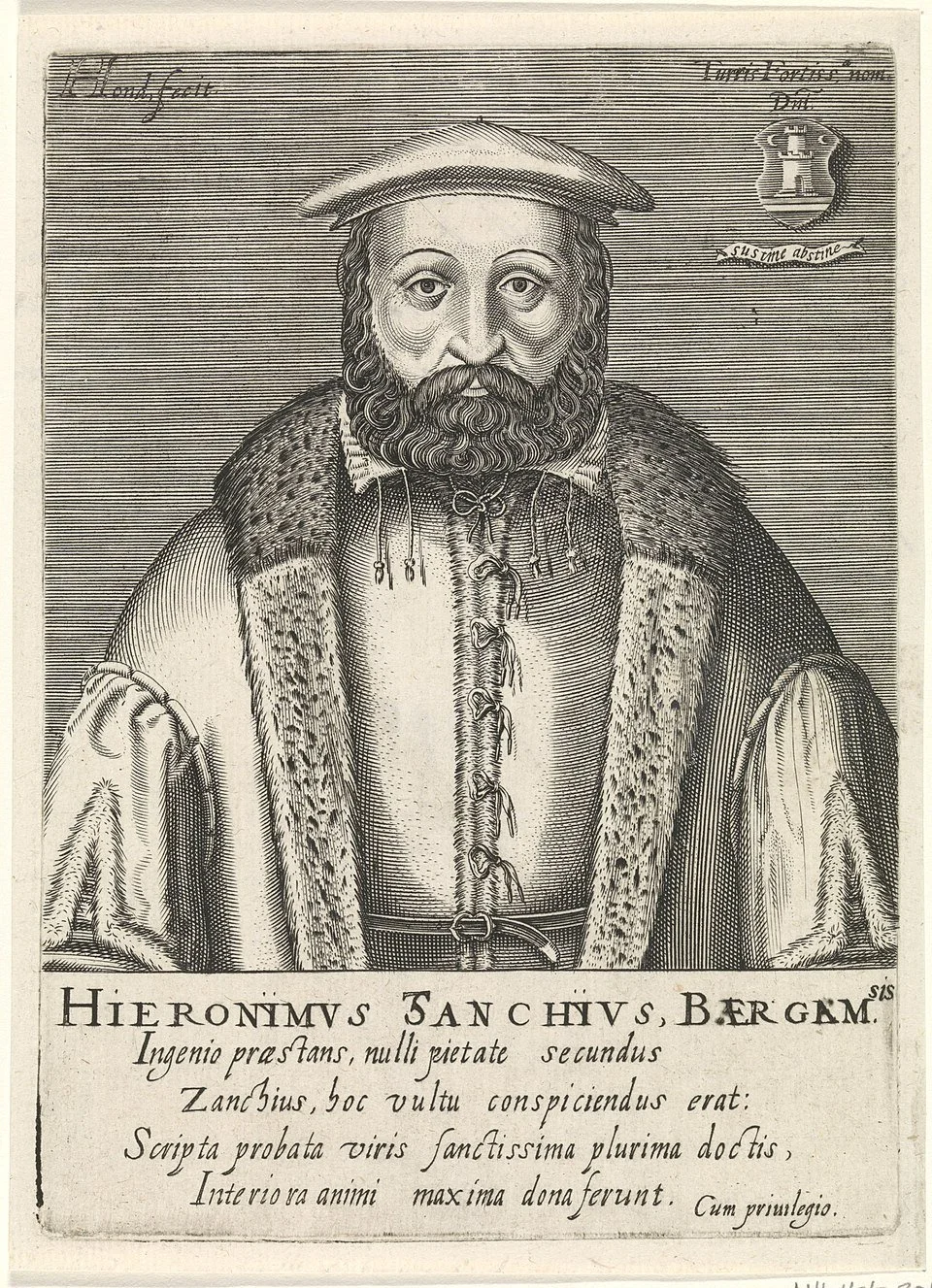
Zanchius On the Law
James Dodson
[taken from Tome IV: De primi hominis lapsu (published as Tractationum theologicorum volumen)]
CHAPTER X
Concerning the Law, through which comes the knowledge of sin.
Since it is beyond controversy that, in order to obtain a true, perfect, and particular knowledge of the several kinds of sins, an accurate explanation of the divine law is necessary—“for by the law,” says the Apostle, Rom. 7, “is the knowledge of sin”—therefore, when the law of God, which is summarily contained in the Decalogue, is to be explained by us, certain things must first be briefly set forth concerning laws, and concerning the kinds and uses of laws, and this in certain theses.
THESIS I.
Of all good laws, the office is chiefly twofold: to teach what is to be done and what is to be avoided, and to prescribe or forbid that what ought to be done or avoided should be done or avoided, and to bind men to the performance of these things.
I said, “chiefly twofold,” because there are also other offices of laws, but accidentally and secondarily, such as promising and punishing.
[Page 186]
By this name the law of God is especially worthy to be called law, since it teaches what is truly good, equitable, and honorable, and therefore to be done; and what is truly evil, and therefore to be avoided.
The Latins, however, according to the judgment of some, called law lex from ligare, “to bind,” because by laws men are bound to do other things, and abstain from others. Thus subjects are bound to and obliged by laws, as are princes and every society that is brought together and bound by certain laws. Hence some have wished the law to be understood under the name of bonds, as in the saying of Psalm 2: “Let us break their bonds, and cast away their yoke from us”; which they interpret of divine laws, to which the wicked and ungodly are unwilling to submit. Others say that lex is so called from legere, “to read.” This etymology pertains to its first office: for by laws there are selected those things which are honorable, which are useful, and which are base and harmful; and the former are taught to be observed, the latter to be avoided.
Thus there are these two chief and essential offices of every good law: to teach what is to be done and what is to be avoided; and, as far as in it lies, to command and oblige men to both. And this is, as it were, the formal element in laws. For every doctrine teaches, but does not command or oblige.
THESIS II.
The sum of those things which laws teach and command is that to each one should be given what is his own, what belongs to him, and what is due to him, both to God and to men.
For law teaches what is good, honorable, just, and what all equity demands. Hence the Pandects, title De Justitia et Jure, define justice, which is the matter of every legitimate law, thus: “Justice is the constant and perpetual will of rendering to each his right.” What else is contained in the law of the Lord, both in the first and second table, except that what is due to God, and what is due to neighbor, should be rendered? Christ also taught this when, being asked whether it was lawful or not to give tribute to Caesar, he answered: “Render unto Caesar the things that are Caesar’s, and unto God the things that are God’s”—that is, to each what is his own. This is the sum of the laws. For this reason the Greeks call law nomos, from nemein, because it distributes to each what is his own—that is, those parts and offices which belong to him. For some things belong to the prince toward his subjects, and other things to subjects toward their prince; some things to parents toward children, others to children toward parents. And this is the whole matter of all good laws: the good, the honorable, and the equitable, which must be rendered to each. Whatever departs from this, or is contrary to this, is sin. Hence follows the third thesis, concerning the end.
THESIS III.
The end of all good laws is, first, the glory of God; then the good of one’s neighbor, both private good and especially public good.
This also is beyond controversy among all the godly, who think rightly, and it is confirmed from the very matter of laws. For if the sum of the matter of laws is equity—that each should have rendered to him what is due to him—what is owed to God? To God above all is owed all honor and glory. To the neighbor, however, that which makes for his salvation and for the good both of soul and body necessarily follows. Thus the end of every good and honorable law must be both the glory of God and the good of man, especially public good, and then also private good. Therefore the Apostle says of the first end: “Whatever you do”—and he says that all things ought to be done according to the law of nature and according to the law of God—“do all to the glory of God.” This particular exhortation depends upon the universal proposition: all things that ought to be done by us, and can be done by us, must be done to the glory of God. And Christ says of every good work: “Let your light so shine before men, that they may see your good works and glorify your Father who is in heaven.”
The law itself speaks of the other end when it adds promises of present and future life to those who keep it. This good pertains to the observer of the law. And when it commands summarily that we love our neighbor as ourselves, it teaches that whatever good we desire for ourselves, we ought, for this end, to do for him also, that we may profit him and promote his good. But if that cannot be done, at least the common good of the whole Church and of mankind ought to be considered. Magistrates are appointed for this latter end also, to see that laws are kept. But to what end? 1 Tim. 2: that, says the Apostle, “we may lead a quiet and peaceable life in all godliness and honesty”; and Rom. 13, “for he is the minister of God to thee for good.” We now hold the formal, material,
[Page 187]
and final cause of all good laws.
THESIS IV.
Moreover, all good laws have flowed from God, the best and greatest, as from their primary author and fountain.
That all laws have flowed from that eternal God, Augustine concludes in De Libero Arbitrio, book 1, and also elsewhere; Cicero also concludes the same in De Legibus.
1. For what else is a good law, except the revealed will of God, which teaches and commands that this be done and that avoided?
2. We cannot establish or impose any laws unless through princes and magistrates. But whence are magistrates? From God, Rom. 13. Therefore he who resists the power resists the ordinance of God. If anyone says that God does not give those laws: if he creates laws and communicates the authority to make them, he also communicates knowledge and wisdom.
3. In every kind, that which is first is the rule of all things under that kind. Human laws are nothing else than the wills of men established by reason and consent, and their decrees. Therefore the will of God is the fountain of all laws.
4. And if wisdom and all good things are from above, from the Father of lights, then all good laws also are from him.
5. Therefore James rightly says, chapter 4, “There is one Lawgiver, who is able to save and to destroy.” Hence all other laws depend upon this, just as every stream depends upon its spring.
6. Since it belongs to him to order all things to the common good, and since from him are all good things, and he governs all things, he is also rightly called the end of laws and the glory of God; and with him is joined the good of man, and especially the public and common good of mankind and of the Church.
7. Finally, if we confess that the world is ruled by divine providence, it must necessarily be confessed that those laws by which any kingdom, province, household, or society is governed are from God. Hence Augustine, after Cicero, first posits an eternal law in God, which is nothing else than the reason or will of God, by which he governs the world; and he teaches that the reason of all things to be done is derived from it and communicated to men, which may direct their actions. From it laws proceed.
From these four causes law in general can be defined thus:
THESIS V.
Law is the manifestation of the eternal and divine will, by which it both teaches what men should do or avoid, and prescribes that it be done and avoided, being instituted for God’s glory and for the good of men, both private and especially public.
For the eternal reason and rule in God concerning things to be done and avoided, for his glory and for the good both of each man in particular and of the whole human race in common, was ordained for men, whom God endowed with reason, that they might be taught what must be done and avoided by themselves, and be obliged and moved to perform both.
THESIS VI.
Moreover, God has not manifested this will of his in one and the same way, nor to all men: but some things he has manifested by himself, others through others; and some things to some without the word, others and to others through the word, at one time only spoken, and at another time also written.
For God saw fit to reveal his will in one way to the first men, in another to later men; in one way to his Church, in another to other men. And indeed he inscribed it all in men’s minds, but he was not accustomed always and to all men to promulgate it by word. For to his Church he first set it forth by word, partly by himself, as to Adam and many of the Fathers; partly through others, whether angels, extraordinary men, or ordinary men, as through Adam to his children, through prophets and apostles preaching to other men; and then also in written tables and in written letters, as was afterwards done through Moses, the prophets, and the apostles. But to the Gentiles he was not accustomed to promulgate it by himself, but only through others, whether among the Gentiles themselves, raised up divinely and furnished with distinguished skill for this duty, and instructed by God, such as Solon, Lycurgus, Romulus, Numa, or by men sent to them from the Church itself, such as Jonah to the Ninevites, Peter to other Gentiles, and the apostles into the whole world.
These differences of peoples to whom the will of God was manifested, and the ways in which God saw fit to employ in manifesting it, must be carefully observed. For from this follows
[Page 188]
the primary division of laws: namely, into the law of nature, the law of nations, and the law of God; or into natural, human, and divine law. Therefore let this be:
THESIS VII.
All honest laws are from God, proceeding from the eternal reason of his will, and in this respect all are divine; yet with respect both to the diverse peoples, and to the diverse ways in which they have been revealed and promulgated, they are reduced to three genera: natural law, human laws, and the law of God.
In the Decretals, Distinction 1, canon 1, all laws are divided into divine and human laws. But our division is better and fuller, because it derives from the source all the ways by which laws have been handed down. For the law of nature pertains to all men. It is inscribed in all minds by God, and from it they know the law of nature. The law of God properly so called looks to the Church, with which God has deposited his word. Human laws belong to other peoples, who deduce them by their own reasoning from the law of nature, but in such a way as the Church deduces the law of God. Therefore it retains the law of nature as agreeing with the law of God and also with human laws, insofar as God wills them to be retained by us; but we do not in all points admit the laws and customs of our magistrates.
Now we must consider the several kinds of laws—what in general we should think concerning each, so that we may know whether we sin if we do not obey them. And first:
CONCERNING THE LAW OF NATURE.
As the name “nature” is taken in various ways, so also the law of nature is variously defined. The jurists understand nature as common to all living creatures, and not proper to all men.
Accordingly, in both the Pandects and the Institutes they define the law of nature in this way: “Natural right is what nature has taught all animals” (Pandects, title 1; Institutes, book 1, title 2, §1). Hence they intend the conjunction of male and female, the procreation and education of children—things which we naturally see all animals held to by this law, so that they may beget children.
Canonists and theologians restrict it to human nature. Thus in the Decretals, canon Ius naturale, Distinction 1, it is said: “Natural right is the common right of all nations, and is everywhere held by the instinct of nature, not by any constitution.” But the jurists call this the law of nations. They give examples: that God should be worshiped, parents and country obeyed, or that what pertains to religion; that parents and country are to be obeyed; that violence and injury are to be repelled, and the like, which pertain to self-preservation and the defense of one’s country.
Therefore what the jurists call the law of nations, the theologians and canonists often call the law of nature—namely, human nature. And indeed the Apostle, Rom. 2, when he speaks of the law of nature, understands only human nature: “The Gentiles,” he says, “who do not have the law”—that is, the written law—“do by nature the things contained in the law.” For certainly the work of the divine and written law is not written in the hearts of other living creatures. Hence Isidore also defines it thus: “Natural right is that which is common to all men.” The Apostle in 1 Cor. 11 also restricts it more narrowly, not indeed to a certain nation alone. For he speaks of a custom received among the Greeks, among whom it was disgraceful if a man nourished long hair, but honorable if a woman did so. “Does not nature itself teach you,” etc.? Yet this was not received among all nations, but among the Greeks.
Thomas Aquinas and other scholastics also restrict nature, in this disputation concerning the law of nature. But there are many things under the law of nature, for everything belonging to religion, humanity, and lacking a particular sense, is common to all. Whatever in men we signify to be commonly known, that is placed under natural right and the law of nature. Of these things there are three grades, placed in order among themselves:
1. The first is that man should protect himself against every force and injury. This is natural to all things, even trees and herbs, insofar as they can, to protect themselves against every injury. Hence in the laws of nations it is related that it is permitted to repel force by force.
2. The second grade is that man should not only defend himself,
[Page 189]
but also propagate his own kind by procreation and the education of offspring. This is common to him with all living creatures.
Therefore the jurists place marriage, the procreation of children, and education under natural right.
3. The third grade is proper to human nature, namely that man should be inclined to know God and to worship him; likewise to do good to those with whom he lives, and what is equitable and honorable, and to that he is naturally inclined. Aquinas has this, question 49, article 2.
Hence he proceeds in article 3, concerning the acts of virtue. For whatever is virtue is either virtue as it belongs to man, or all the acts of the virtues. To this he also cites Damascene from book 3. Likewise the scholastics, who write that whatever is contained in the law and in the Gospel, as, for example, “What you do not wish to be done to yourself, do not do to another,” and, “Conduct yourself toward your neighbor as you would wish yourself to be treated,” is of natural right. Therefore all evils and sins are against nature.
Hence those axioms which fight against the law of nature are evil in themselves and cannot be dispensed with. Likewise: he who follows the law follows nature; he who follows nature lives equitably and well with all men.
Certainly, when you read anything of this kind among Durandus and other ungodly men, it should be observed that these doctors do not speak of the law of nature as preached to men in the state of corruption, apart from the Spirit of God—for in this sense vices are according to nature, and, conversely, virtues are contrary to nature—but they speak of what it was before sin, and what it is also in part in the regenerate.
For before sin, that law of nature was perfect in man. That divine reason, the rule of things to be done and avoided, had been implanted in Adam when the image of God was impressed upon him. Thus before sin, the natural dictate of this reason was perfect in man. After sin, this law of nature was partly extinguished, with respect to God and the worship of him, and with respect to neighbor, honesty, and equity. For with the whole man turned away from God and impious toward God, and made unjust toward his neighbor, that whole image of God, which consisted in righteousness and holiness, was plainly annihilated from his mind, and his heart was made completely corrupt and prone to evil. Yet the things that men have in common with animals, plants, and other substances remain, such as that natural and instinctive dictate whereby each thing seeks to be, seeks its own good, seeks what is equitable, and so protects itself and preserves itself from every injury and violence.
Nor indeed can man now do this without sin or another injury; nor can he eat or drink without some intemperance and vice. And therefore we see this law of nature to be purer in other things than in man. For even those laws in things that we have in common with animals—we naturally know that they are good and just, and according to nature, so that we may preserve and propagate the human race, take wives, beget and educate children. For man without vice and sin has not even this after the fall, though animals perform it without fault. Thus the first and second grades of this natural law are preserved, though partly corrupted in man; but the third was entirely extinguished after the fall, so far as we see anything further. In this part of natural law, what is in man is altogether inscribed anew by God in the souls of men, as the Apostle teaches in Rom. 2. For in place of natural law, which stirred men to know and worship God and to maintain an honorable and friendly life with their neighbor, there came in another law by the devil, the law of sin and of the members, as the Apostle teaches the Romans.
This explanation was necessary in order rightly to understand those things which are often read in Damascene and Aquinas concerning the law of nature, and which are also found here and there in Augustine and the other fathers. For the illumination of what must be said, the following definitions are useful:
1. Some therefore define the law of nature thus: “The law of nature,” they say, “is the dictate of conscience, and so a certain direction implanted by God himself in the minds and hearts of men, admonishing what they should do or omit.”
But they explain what conscience is in this way: “Conscience is the recognition and, as it were, judgment and sense of man, by which, within himself, in his own soul, each man, being conscious of his own deed, either condemns or absolves himself.” This sense proceeds from God, dictating, inspiring, and urging on the soul of men. These things are very wisely spoken, and they teach the matter itself clearly.
Some, however, define it more briefly thus:
2. “The law of nature is that light and dictate of reason by which
[Page 190]
we distinguish good from evil.”
3. Finally, others define it thus: “The law of nature is a common judgment to which all men equally assent, and therefore is, as it were, especially accommodated to the manners formed by God, which, when implanted, remain.”
But we, in a recent manner of definition, and with an added difference by which the law of nature may be distinguished from others, define the law of nature thus:
THESIS VIII.
The law of nature is the will of God, and therefore a divine reason and rule for right conduct and avoidance, immediately inscribed by God himself upon the minds of all men, even after sin. By it we are all universally taught, in general, what is good and evil, equitable and inequitable, honorable and base, and therefore what is to be pursued and avoided; and we feel and are impelled that we are bound both to do the one and avoid the other, both for the glory of God and for our own good and the good of our neighbor, private and public. And if we admit what is to be avoided, or neglect what is to be admitted, we are accused; but if the contrary, defended and absolved.
The definition is lengthy, but full and perfect, containing all the causes and the single and several conditions which have been explained above concerning law in general. It will therefore be enough to run briefly through it.
1. I call it “the will of God,” because it is the rule of all justice and of everything that must be done rightly.
Therefore, for the sake of explanation, I have added another phrase taken from the definition of the second law in general, saying: “and therefore a divine reason and rule for right conduct and avoidance.” For the divine will is not separated from his wisdom, and therefore is rightly called the reason and rule of all things to be done rightly. And this whole genus agrees with all good laws.
2. Then I added two differences by which the law of nature is distinguished from others. One is that it is inscribed in the minds of all men; the second, that this is done immediately by God. These points have been explained above.
I added also, “even after sin it is inscribed upon the minds of men,” in order to signify two things. First, that it was more perfectly inscribed before sin, being concreated with the soul of Adam, as was declared a little earlier. Secondly, that through sin it was partly almost extinguished, partly darkened. What still remains in the minds of men has not now sprung from that blind and depraved nature of natural power, but has been inscribed and impressed anew by God, of his goodness, into our souls, in order that we might still recognize the remaining principles of natural law. For that which is propagated into us from Adam is blind and depraved by nature regarding true good; but God so imprints that law in the souls of men, and in general in all religions, by writing certain principles of goodness, equity, and honesty in our nature, that it may appear as if born with us and natural to us.
That this is so is manifest from this: When the Apostle had said in Rom. 2, “The Gentiles, who do not have the law”—that is, the written law in books—“are a law to themselves,” lest anyone think that God had not prepared anything in them, he explains how they are a law to themselves: namely, “they have the work of the law written in their hearts.” Therefore it is not innate or concreated, but written in hearts already created. By whom? By God. For God alone can write in our hearts, just as he also promised through Jeremiah, chapter 31, concerning the New Testament, that he would newly inscribe it upon the minds of the elect. Therefore this law has its origin not from the corrupt nature of men, nor from God himself in the manner in which, of his goodness, he again inscribes it in the souls and hearts of men after sin, so far as is sufficient, partly for the public good to be preserved, partly in order that they may be convicted of sin.
Add to this argument that it belongs to the law of nature that someone should know God and that he is to be worshiped. From where do the Gentiles have this? From God. For he manifested this to them, Rom. 1.
2. Scripture everywhere proclaims that after sin the whole heart of man is evil, perverse, and carnal. Gen. 6:8: “The imagination of man’s heart is only evil.” Jer. 17: “The heart of man is wicked.” John 3: “That which is born of the flesh is flesh.” Likewise the Apostle, 1 Cor. 2: “The natural man does not receive the things that are of the Spirit of God.” And elsewhere to the Romans: “I know that in me, that is, in my flesh, dwelleth no good thing.” Now this law of nature, or dictate of reason, is a good, divine, and spiritual thing. Therefore it is in us from somewhere else than from nature, namely from God, as we have shown above.
[Page 191]
3. Finally, if it were from nature, it would be equal in all, since it is natural to all those to whom it is common. But we see among other ethnic peoples some wiser, more equitable, more just, and more zealous for God than others; indeed, we find some who deny that there is a God, who care nothing for what is equitable or inequitable, who pursue evil. Therefore the Spirit must be so called the gift of God, by which anyone is endowed with the light of reason and judgment, so that he knows that God exists, that he is to be worshiped, and that he may distinguish good from evil, the equitable from the inequitable, the honorable from the base, and may be inclined toward the good and shrink back from evil. This also the philosophers acknowledged, and Augustine demonstrates it both against Julian the Pelagian and in his books De Civitate Dei, when he speaks of the justice and virtues of the Romans.
4. Add that Thomas and other more sincere scholastics confess that free will, of itself, has no value except for sinning.
By this law of nature men are moved and urged toward many good things, both toward God and toward their neighbor, as also among the heathen, and as the Apostle teaches and confirms from experience in Rom. 2. Therefore they themselves did not wish this law of nature to be from the principles of nature, but recognized it to be the gift of God. But, as has been said, for this reason it is called the law of nature: because, when the Apostle speaks, he opposes it to the law written in books; because God has infused it into our minds, and because that light, as Cicero says, seems to be born with us, and to be natural.
But if you read somewhere that this law is called the remains of the former image of God, understand it as the remains restored not by Adam’s propagation, but restored by God of his goodness and newly infused into our minds. For if these remains were propagated by Adam’s posterity, they would either be evil, or would belong to the substance and nature of man.
For from Adam we receive nothing except what pertains to the constitution of man necessarily, and what pertains to corruption and sin: for as far as we are from him, we are born children of wrath.
And indeed the law of nature itself is not evil, but an excellent thing. For it proves what things are good, and disapproves what things are evil, and is in agreement with the law of God written in Scripture. Nor does it even belong to the substance and nature of man. For even without this law of nature, insofar as it concerns those things that pertain to God and those that concern maintaining equity and honesty among men, we would still nevertheless be men.
III. We have assigned three offices of this law.
One is that it teaches us what is good, what is evil, what is equitable, what is inequitable, what is honorable, what is base, what should be pursued, and what avoided. General principles of good and equity only are contained in this law in our souls.
The second is that it not only teaches this, but also obliges and inclines us to do good and restrains us from evil.
The third follows from this: namely, that if we neglect our duty, it accuses and condemns us; but if it defends us, it also absolves us.
The Apostle teaches these offices clearly and plainly in Rom. 2. Therefore, as often as our heart condemns us, as John says, and the thoughts of our heart accuse us or even defend us, then, as Paul says, God is the one who does this; and this he does because he has inscribed his law upon our hearts. Nor have the ancients without reason said, “Conscience is a thousand witnesses.” For nothing is more certain than that the Lord speaks there. And the Apostle says in 1 Tim. 1, that the end of the commandment is conscience. Therefore whenever we rely upon this judgment, we act as if we believed in God. For to sin against conscience is to sin against God, who teaches and admonishes us inwardly. But God is accustomed to hand over such men to reprobate senses, as is plain in the Gentiles, Rom. 1, for “when they knew God, they did not glorify him”; therefore God also gave them up to the lusts of their hearts, etc.
IV. Hence, in the fourth place, it is manifest that not all things to which the instinct of nature impels us are of the law of nature. For this law teaches nothing but good things, and impels us to them. But our nature is inclined to evils. Therefore the propensity to injustice and sins is not of the law of nature, but springs from that which, adhering in us, fights against the law of nature. What is this? Evil affections, corruption of nature, hatred of good, concupiscence. All these things are most plainly signified by the Apostle under the name of another law—that is, of the members—in Rom. 7: “I see another law in my members, warring against the law of my mind, and bringing me into captivity to the law of sin and death.” Thus he teaches that neither sin nor death is from the law, nor from the mind of God, either written in the heart or in the tablets, but from the corruption which is in us. Therefore although
[Page 192]
it is from nature that we defend ourselves against all violence, seek to propagate our kind, and do other such things, yet whatever sin is in them comes from us. That is not from the law of nature, but from the corruption of it, and therefore must be removed.
V. Finally, from this we also attain the common end of this law with other laws in two respects: the glory of God, and the good of man, both private and especially public. I add only this concerning our own good: the proper work of every law is that it should make men good, as Aristotle says in Ethics 2, proving this, teaching, obliging, and constraining. For whatever can fall more under evil than under good—that is, that sin should be increased by it, as Rom. 7 teaches—is accidental to it. Thus the Apostle also says of the law of Scripture: “The law was given for sin, made to me death,” and other things which he there teaches. Therefore what Aristotle said—that laws are given so that they may make men good—the Apostle writes of law that it was given for death and wrath; but they intend different things, and both are just and good.
In sum, there are three goods to which the law of nature calls us, as we said earlier.
One is common to us with all things: that each should defend and preserve himself, and for this end should eat, drink, sleep, rest, walk, use medicine, clothing, and the like. Hence the laws of life were given against harmful things coming from without, and to repel violence by force.
Another good is common both to all living creatures and to man: that he should seek to propagate his own kind. To this pertain the procreation and education of children, and whatever else belongs to that matter, and to domestic care.
The third is proper to men, and is the good not only of all men, but truly of men: that you should know and worship God, and cultivate society and friendship among men.
Therefore this third part of the law of nature is usually reduced to two heads, just as the law of the Decalogue has two tables: the first concerning knowing and worshiping God; the second concerning loving one’s neighbor.
The first head is this: to know and worship God. All Gentiles retain some knowledge of God. But how can God be known from God manifesting himself in them? How do they worship him? Not from themselves and by the force of nature, but from God, powerfully manifesting himself anew. Therefore it is said, “God manifested it in them.” Consider the book of nature: the invisible things of God are clearly seen, being understood from the things that are made. From this, therefore, many things about knowing and worshiping God are transmitted to the Gentiles, so that they see in their own minds, as in books. The Apostle cites Acts 17: “For in him we live, and move, and have our being,” which pertains to the same point: “If God is the soul of us, and we are his offspring, he must be worshiped with a pure mind.” Therefore they are deservedly accused and condemned by the Apostle because, when they knew God, they did not glorify him as God. Hence it happened that they had the whole of religion among the Gentiles as though guilty and mutilated.
The second head, or principle, of this third good to which natural law stirs us is this: society and friendship among men should be preserved, and what you do not wish to be done to you, do not do to another. For every nation was accustomed to consider it unjust not to cultivate friendship with those who are like us—that is, with men. Therefore nothing is to be done to another that you do not wish to be done to yourself, and on the other hand, whatever you wish another to provide to you, the same also you should provide to him. For no social relations are more dissolved and thrown down than by injuries; on the other hand, by nothing are minds more reconciled than by duties and benefits. Therefore according to the dictate of nature we must not only befriend all, but we ought also to be humane, helpful, and beneficent toward all; and these are virtues worthy of man. The contrary are base things against nature: whatever is inhuman, difficult, unkind, antisocial, injurious. This head of the law of nature Christ confirmed especially when he drew all the commands of the second table to the love of neighbor. Then when he said, “Whatever you would that men should do to you, do ye even so to them.” Thus we see from Christ what he had impressed upon the hearts of the Gentiles. For this was the doctrine of the Gentiles also. And Severus the Emperor’s saying was received and inscribed everywhere in public places: “What you do not wish to be done to you, do not do to another.” From this second principle of natural law other laws are derived, which are inscribed in almost all men’s hearts: do injury to no one; give each what is his; keep faith; and other similar things that are found everywhere among profane writers.
Now let us hold the explanation of our definition—what the law of nature is. I now add other theses.
[Page 193]
THESIS IX.
This same law of nature is inscribed in the hearts of all; yet not equally, but in some more abundantly and effectively, in others less abundantly and less effectively, according to his will, God is accustomed to inscribe it.
Indeed, it is inscribed more abundantly in some, because although those two first principles, of which I have spoken, are inscribed in all souls, yet the conclusions and laws deduced from them are not equally held by all. Some gather more from them, others fewer. Let me explain by examples.
There is no nation so barbarous, no nation so savage, to whom it is not manifest that God exists and that he must be worshiped. This is common to all. Yet how he is to be worshiped was not known in the same way to all. Some worshiped the Spirit of the world and mind, others judged that God was a spirit; others worshiped him through idols, external ceremonies, and things that could affect the body. Certainly Cicero came nearer the truth than many inscribed among the Romans, who thought that God was to be worshiped not with a false and empty religion, but from the nature of the gods: “The worship of the gods is the best and also the holiest and purest and fullest of piety, that we always venerate them with a pure, entire, and uncorrupted mind and voice.”
The earlier Romans also were so instructed by the law of nature that, since God is Spirit, they thought he should not be represented by idols or worshiped by them. This continued at Rome for 170 years from the founding of the city. Afterwards this law of nature vanished away gradually and little by little, since they judged that God could not be worshiped without images; concerning which Plutarch in the life of Numa Pompilius, Varro, and Augustine recount, in book 4, chapter 31 of The City of God.
Among the Romans also the name of God was most sacred by oath. Among many barbarians it was likewise sacred, since they held it wicked to mock God by it.
Likewise, concerning the second principle, by which human society is commended: it was known to all by the law of nature that friendship with men must be preserved. But all did not equally understand what things necessarily follow from this principle. For what Gentiles were there who did not judge frauds, thefts, and robberies to be evils? Yet some esteemed excellent thieves worthy of praise among the Lacedaemonians. And the Romans judged theft worthy of punishment. How many also praise a lie? Yet others condemned it as a thing unworthy of man. Certainly the Romans were taught by nature that honesty must be observed especially in marriages; and yet many things were permitted by them that ought to be condemned by the law of nature. And how many peoples have been found who thought marriage between brothers and sisters, between parents and nieces, between uncles and nieces, and among blood relations and kindred contracted by affinity, not to be unlawful and dishonorable? Certainly the Canaanites were in this number, as can be seen from Lev. 18. But the data of this honesty was more abundantly known among the Romans, just as it has always been more abundantly known among Christians, also concerning these incestuous marriages; for what among the Romans was incestuous, ought also to be incestuous. And, what is less, if the same is not condemned everywhere, it is nevertheless incest.
Thus we see more clearly that the law of nature was not inscribed equally in all souls, but more abundantly in some, more sparingly in others. Certainly all know that honesty and decency must be observed. But for a man to nourish long hair, and a woman to shave her head, was disgraceful among the Persians and many other peoples, but especially among the Greeks. Therefore the Apostle refers this to the law of nature in 1 Cor. 11.
It was also more efficacious in some, and less efficacious in others. This implanted and innate law was manifest because many things were more known to some than to others. Some were more stimulated to observe the same things, so that they diligently devoted themselves to them and still devote themselves. The matter is clear in itself, and the examples already introduced sufficiently confirm it.
Therefore this ninth thesis is evident: that the law of nature was not, and is not, written equally in all souls. Certainly in the souls of the elect it has always been more abundant and more efficacious, just as the Lord also promised through Jeremiah 31.
From this also it is manifest that one and the same law of nature exists in all nations with respect to the principles, but not the same with respect to the conclusions deduced from those principles, nor also with respect to efficacy.
THESIS X.
But this law has been so firmly implanted in the souls of men
[Page 194]
by God that it cannot altogether be changed, nor can it be utterly blotted out from the hearts.
The reason is that God wills the same law to be in all men, and that law always, even to death, if anyone does evil, to be agent, accuser, and, if he should be absolved, executor. Hence the Apostle, when he had said in Rom. 2 that among the Gentiles the work of the law was written, by virtue of which they accuse or defend themselves, at once subjoins: “in the day when the Lord shall judge the secrets of men.” And Augustine says likewise in Confessions, book 2: “Thy law is written in the hearts of men, which no iniquity blots out.” Likewise elsewhere: “In that nation”—and elsewhere: “For because the law was blotted out from the hearts of the first men before the law was given, it was set forth; but not now.” Men must always at least retain the first principles of this law, as dictates of human conscience. In the same sense I understand what is written elsewhere: that natural law does not vary by time, but remains immutable; for the first principles remain those things about which all men are convinced of sin. For as to the conclusions deduced from them, it is plain from histories that, with respect to some, they are often wiped out from the souls of men—as among men devoted to a reprobate sense, as is clear from Rom. 1. But the first principles ought to remain unchangeable. Hence follows:
THESIS XI.
Men are so subject to the natural law that whoever acts against it is convicted of sin.
And thus the Apostle convicts the Gentiles in Rom. 1, because when they knew God through the law, that is, the law of nature, they did not glorify him as God. And Rom. 2: “The Gentiles, who do not have the law, are a law unto themselves.” From this the Apostle passes to other crimes, of which he accuses and convicts the Gentiles: namely, that they were disobedient to parents, covenant-breakers, without natural affection, full of unrighteousness, fornication, uncleanness, covetousness, malice, envy, etc.
Moreover, since what is called the law of nature was also explained and repeated in the Decalogue, and therefore the law of nature is usually called the Decalogue, I will not explain here the sins that are committed against the natural law, because the same is done diligently in the explanation of the Decalogue.
One further thing must be specially noted: just as Christ is the end of the whole Mosaic law, so also he is the end of the natural law, namely so that through it men, convicted of sin, may flee to Christ for remission. But concerning these things, enough.
From natural law we must pass to human laws. For these are drawn out from it by human reasonings, and that by the special light of God.
CONCERNING HUMAN LAWS.
When speaking of human laws, we must first say what we understand by the name “human laws”; then, what their kinds are.
We call human laws those which are conceived and promulgated, not only by men but also to men, in a human understanding, whether they are conceived from natural right, or even from divine right, or from their own head.
They are divided into honest and just laws, and into tyrannical laws.
Just laws are those which are honestly conceived by those who have authority, either by natural right or by divine right, and are ordered to the good of the republic or of the Church. And with these we join good and honest customs also, because they too have the force of human laws.
Tyrannical laws are those which either are conceived by those who do not have authority to make laws, or are corruptly conceived from their own lust and ordered to their own advantage. On certain grounds these are unworthy of the name of law, as Aristotle says. With these we also join evil human traditions and evil customs.
We shall speak briefly of each. First, concerning political laws.
THESIS I.
Besides the natural law inscribed by God upon the hearts of men, it was useful, and therefore also necessary, for the human race that various and manifold laws, which are called political, should be handed down through wise and prudent men, by which men might be restrained from evil and directed to good, and which might serve the usefulness and preservation of the commonwealth.
[Page 195]
There is a twofold reason for this matter. First, because the law of nature, inscribed upon men’s minds, contains only certain general principles, as was said above; and not all men are so strong in judgment that they can gather particular conclusions and laws from those general principles. Therefore it was necessary that wise and prudent men should be raised up by God, even among the Gentiles themselves, who might more distinctly unfold laws from that right of nature, for the usefulness and preservation of the commonwealth.
The second reason is that, for the avoiding of evil and doing of good, men must be moved either by the love of virtue and hatred of vice, or by fear of penalties. Now the law of nature alone is not so effectual in all hearts, though inscribed in them, that it is sufficiently efficacious to restrain men from evil and impel them to good, as the law of election has in believers, and that only in part. Rather, it only teaches, inclines, and accuses, but has no external punishments.
It was therefore necessary that external laws should be delivered, and that external punishments should also be appointed for transgressors, so that men, if not by love of virtue, might at least by fear of punishments be restrained from evil and kept within duty.
The Apostle gives this reason both in Romans 13, when he says that the sword was given to magistrates for restraining evil men, and in Timothy, when he says that “the law is not made for a righteous man, but for the lawless, disobedient,” and so forth.
Isidore gives the same reason, and it is cited in the Decretals, Distinction 4, canon 1: “Laws were made so that human audacity might be restrained by fear of them; that innocence might be safe among men; and that among the wicked themselves, by the fear of punishment, both audacity and the ability to harm might be restrained.”
Thus the discipline of political laws was necessary to restrain men from evil, since human societies cannot otherwise be preserved.
To this pertains what Aristotle teaches in Politics, book 1: “As man, if perfected by virtue, is the best of animals; so, if he be separated from law and justice, he is the worst of all.” Therefore all political laws ordered to this end have very full approval in the Holy Scriptures from the prophets, from Christ, and from the apostles: Romans 13; 1 Peter 2.
THESIS II.
All political laws, as to their substance, have their origin from natural right.
I said, “as to their substance,” because in laws two things are chiefly to be considered: the command, and the nature of the penalty added to transgressors of the law.
The substance of the command is gathered, as a conclusion, from some principle of natural law. For example: the principle of natural law is, “No injury is to be done to anyone, because what you do not wish to be done to you, you should not do to another.” From this, wise lawgivers have deduced, as conclusions, the law concerning not killing, not stealing, not knowing another man’s wife, and other laws of that kind.
Thus we see that all political laws, as to their substance, have arisen from the law of nature.
But as to the nature of the penalties, the matter does not stand in quite the same way. For the natural law teaches only in general that he who sins is to be punished. Wise men, according to their own judgment and prudence, have applied and determined this principle in general, from nature itself, to various forms of punishments, according to the quality of crimes. Therefore, although it is from the law of nature, as to kind, that sins should be punished, yet that a murderer should be punished with the sword and a thief with hanging was left to the discretion of lawgivers. Yet even in these penalties there is some difference, because among all nations it has been common that homicide should be punished capitally; therefore this penalty, because it belongs to the law of nations, seems nearer to the law of nature.
But most penalties derive their force rather from human laws and from the wills of lawgivers than from the law of nature. Hence we see various kinds of penalties among various peoples.
THESIS III.
Therefore, insofar as any human law conflicts with natural right, or does not agree with it, so far it is unjust and unworthy of the name of law.
The reason is clear. For if natural right is the rule both of human laws and of actions, then, just as every action is unjust which does not agree with the law of nature,
[Page 196]
so also every human law is unjust which does not agree with it. Many such laws are found among tyrants, and especially in the papacy: such as the law of celibacy, and innumerable others of that kind, which are properly called human traditions, concerning which more later.
Therefore Augustine rightly denies, in On Free Will, book 1, that that should be called a law which is not just. But that is not just which does not agree with the law of nature and of God.
Since, therefore, the right of nature and of God is ordered to the glory of God and the salvation of men, whatever human laws are contrary either to the honor of God or to the salvation of men are unjust and tyrannical, and unworthy of the name of laws.
To this pertain the things handed down in the Decretals concerning the qualities of good laws. The sum is this: that they agree with religion, suit discipline, and profit salvation; that is, that they do not fight either against the worship of God or against good morals, nor oppose the salvation of men and the public good.
Hence also follows:
THESIS IV.
Therefore we are no less subject to honest political laws than to the law of nature, even as to conscience.
The reason is obvious, because political laws are drawn from the law of nature and are most just; nor do they contain the will of God any less than that law does. Therefore the Apostle says in Romans 13, “Let every soul be subject to the higher powers.” We are therefore bound and constrained by the magistrate’s laws, insofar as we are subject to him. To the same purpose also is Christ’s saying in Matthew 22: “Render to Caesar the things that are Caesar’s”; and Peter’s, 1 Pet. 2: “Submit yourselves to every human creature,” or ordinance, “for the Lord’s sake, whether to the king,” etc.; and “not only for fear, but also for conscience.” Therefore Peter, in commanding this, says, “This is the will of God, that by well-doing ye may put to silence the ignorance of foolish men.”
If, then, it is the will of the Lord that we be subject to human powers, then in honorable matters, and those which do not fight with the will of God, we cannot be reluctant toward them in conscience. Thus also the Apostle Paul says in Eph. 6, “Servants, obey your masters as the Lord.” And in Romans 13, he first says that the magistrate is of God, and has received the sword from him. Then he subjoins this conclusion: “Wherefore ye must needs be subject, not only for wrath, but also for conscience’ sake.” But in what way “for conscience”? Surely not because magistrates have right in our consciences in themselves. “There is one lawgiver,” James 4. But because whoever obeys the magistrate obeys God, and he who is the author and avenger has right in our consciences.
This is also what Peter said: that we ought to be subject for the Lord’s sake.
Therefore it must be noted that political laws are either just or unjust. If they are just, they bind the conscience, not insofar as they are from men, but partly insofar as they are from the law of nature, to which our consciences are bound; and partly because God, by express command, has subjected us to them.
1. If they are truly unjust, this can happen in two ways. First, either because he who commands lacks authority to command, or, if he has authority, commands that which does not look to the public good, but only to his own advantage or pleasure; or, finally, commands something which indeed pertains to the common good, yet is unjustly commanded to you because it exceeds your strength. These, I say, are unjust in the first way. Although it is not without sin to make such laws, yet in the meantime they command nothing which is contrary to the glory of God or to the divine law. This is the first way in which human laws can be unjust.
2. The other way is if such laws prescribe that which fights with the glory of God or with his promulgated law.
In the latter case, unjust laws do not bind the conscience, because God does not bind the conscience to unjust things.
But if they are unjust in the first way, though they do not bind the conscience, nevertheless liberty remains to you either to keep or not keep them, unless perhaps charity toward your neighbor, which bears all things, compels you to keep them.
This is what Christ commands, Matthew 5: “If any man shall compel thee to go one mile, go with him twain.”
But if they are unjust in the other way, because they compel you to admit something contrary to the glory of God and fighting with his law, not only are you not bound to obey them, but you are bound to resist them.
Therefore obedience is first due to God, and then to men for God’s sake. To this belongs the saying of the apostles, Acts 4: “We ought to obey God rather than men.” So also Thomas Aquinas, II–II, question 96, article 4: “If laws,” he says,
[Page 197]
“are unjust by contrariety to the divine good, as the laws of tyrants inducing to idolatry, or to anything else which is contrary to the divine law, such laws are not lawful to observe, because, as it is said in Acts 4, we ought to obey God rather than men.”
1. But you will say, the Apostle simply commands every soul to be subject to the higher power.
I answer: power is to be obeyed insofar as it is from God. But God has nowhere commanded us to be more subject to men than to his own law. Therefore, if power prescribes anything against God, not only are you not commanded to obey human power, but rather you are forbidden.
Thus we see here that we can sin in two ways: first, if we do not obey the just laws of magistrates; secondly, if we accept their laws when they are unjust and fight against the law of God.
2. But in what way ought every soul to be, or can be, subject to human laws, when the righteous are freed from the law, and the law is not made for the just?
I answer: law has two offices. It teaches what is to be done and what is to be avoided, and so is the rule of actions; and it obliges and compels subjects to obedience.
Therefore a man may be subject to the law in two ways: either as one constrained, compelled, and obliged; or as one willingly and by the teaching and rule of his actions. The wicked are subject to the law in both ways, and the law is made for them in the former way; the just, however, in the second way. For he loves the law and runs willingly. But he who does willingly cannot be compelled. “The law is not made for a righteous man, but for the unjust,” etc. The just do those things which are of the law, because they have the law inscribed in their heart.
3. But in what way also ought or can every soul be subject to the higher powers and their laws, when kings are not subject to their own laws?
I answer: not even they themselves are subject to their own laws, insofar as they proceed from them, nor do they have any superior power, besides God, by which they are judged. Indeed, they are said to be above their laws, insofar as they can either change or dispense their laws according to their own judgment, as they see expedient for the commonwealth.
And in this sense it is written in the Pandects, title 3: “The prince is released from the laws.” When the law says “released,” it means from laws made either by others, under whose authority he is not, or by himself.
Nevertheless, insofar as law is the rule of good actions, princes are not released from those laws which pertain to the public good. Good princes willingly submit themselves to them, and ought to submit.
This is what is written in the Code, book 1, title 17, concerning laws and constitutions, book 4: “It is a saying worthy of the majesty of one who reigns that the prince should profess himself bound by the laws.” Likewise: “Our authority depends upon the authority of the laws.” And in the Decretals, book 1, title 2, concerning constitutions, chapter 6: “What each one has established as right for another, he ought to use himself.” And wise authority says: “Submit to the law which you yourself have made.” And in the Decretals, distinction 9, canon 2: “It is just that the prince obey the laws. For then he judges that his own rights must be preserved by all, when he himself shows reverence to them.”
And indeed princes, with respect to the judgment of God, are not released from just laws, which are deduced from the law of nature and ordered to the public good, nor from a superior power—that is, from the princes themselves—because for their own part they ought to promote the public good.
Therefore, considering God as the first author of all good laws, we are bound in conscience to all just political laws. Hence:
THESIS V.
From the same source it follows that sometimes it is necessary to depart from the words of a human law, when that natural right from which it was deduced, and the mind of the author by whom it was made, can be preserved.
I said, “from the same source,” that is, from the fact that human laws are deduced from natural right and ordained to the public good. For if, when you wish to adhere to the words of the law, that law falls into the ruin of those men for whose sake the law was made—namely, citizens—then those words are not to be urged, but the scope of the law and the mind of the lawgiver are to be considered, and we must act according to that. Example:
There is a law that, when a city is besieged, no one may open the gates of the city.
The end of this law is the good of the citizens, namely that an entrance into the city should not be given to enemies. And for this reason we say that this law is from the law of nature, which teaches that each one, as far as he can, should defend himself and his neighbor and care for his safety. Therefore, if it happens
[Page 198]
that, unless the gates of the city are opened, you receive within the citizens and soldiers who have been fighting outside against the enemies, but who have been overcome and turned to flight, all of them will be slaughtered, and thus the city cannot be held, who does not see that in such a case the gates of the city are altogether to be opened, contrary to the words of the law, until our men enter? For this is done according to the end of that law and of natural right.
The civil laws confirm this: Code, book 1, title 17, De legibus et constitutionibus, law 5: “There is no doubt that he sins against the law who, embracing the words of the law, strives against the will of the law. Nor can anyone, by the words of the law, fraudulently excuse an attempt made against the meaning of the law.”
The fathers also teach that the same is to be observed in ecclesiastical laws.
Hence Hilary, in book 14 On the Trinity, says: “In understanding sayings, one must ascend from the causes. For things are not subject to words, but words ought to be subject to things.” The same should especially be observed in divine laws; otherwise one will sin against the will of God the lawgiver. Example: The law was, “Thou shalt do no work on the Sabbath.” The Pharisees understood every kind of work so strictly that, even now, in regard to the Lord’s Day, it ought rather to be understood this way: that provision be made for man’s salvation, lest servants be compelled to labor daily without any rest. Therefore, if it happened that a man fell into a pit, or a snake appeared, or a sick man sought medicine, and a physician cured him, would he act against the law if, keeping the words of the law with sharpness, he neglected the man’s salvation? Christ in this way, in defending himself, convicted the slanderous Pharisees because he healed a man on the Sabbath day. For he sinned not in the least against the law, but did what the law truly intended, which thus says: “The Sabbath was made for man, and not man for the Sabbath.” Mark 2. The Apostle defends himself in the same way when he pulled ears of grain on the Sabbath because he was hungry. Christ also says: “Go and learn what this means, I will have mercy, and not sacrifice.” Should the letter be followed here, or should the mind of the legislator rather be regarded? It is permitted also to eat flesh and drink blood. If, by these words, you look upon the inheritors and interpreters of the mind and will of Christ, would that not be a just thing? Therefore Augustine rightly taught, in On Christian Doctrine, book 3, chapter 16, that the words of Christ, “Unless ye eat the flesh of the Son of Man,” are to be interpreted figuratively, because if they are received literally and properly, they seem to command a crime. What wonder, then, if in human laws it sometimes happens in the same way, so that you depart from the words of the law while yet acting according to the law, if you wish to observe the words of the law with sharpness rather than the will of the lawgiver?
The reason of this our thesis is clear: because laws are ordained from natural right to the common good and the salvation of men. Therefore they have binding force only so far as they tend to that. Therefore if, holding the words of the law, you do not serve the safety of men, you will act contrary to the law rather than from the law.
Yet caution must be added here: it is not the part of any man whatever always to interpret and gloss laws. Ordinarily, we must have recourse to the princes themselves and seek the interpretation of the law from them, since nothing is more ignorant and dangerous. But where that cannot be easily done, and especially if delay is dangerous, and the final cause of the law is also manifest, then the man whose interest it concerns, and to whom the duty belongs—for example, the man to whom care of the city has been committed—may follow the mind and intention of the legislator more than the very strict wording of the law, as was said above in the example of the law not to open the gates of the city.
THESIS VI.
Although human and political laws flow from the law of nature, yet there is no small difference between them.
The reason for this difference is that the law of nature has natural, general heads which pertain to individuals. Political law, however, so regards the public good that it is not always suited to the circumstances of times, places, and persons.
The first difference, therefore, is that the natural law is never changed, nor can it be changed. For it is nothing else than the communication of certain general rules of that eternal reason in God, concerning things to be done and avoided, made in the minds of all men.
But human laws, because they are framed for the circumstances of places, times, and persons, cannot therefore be eternal and immutable, since those circumstances can vary.
Therefore Augustine says, On Free Will, book 1: “A temporal law, although just, can nevertheless be justly changed through time.”
[Page 199]
There is a twofold reason why they can and ought to be changed. First, because human reason is not natural to itself, but advances gradually from imperfection to perfection. Therefore, as in the cognitive sciences the first philosophers handed down certain imperfect things, which afterwards became corrected and more perfect by others who followed them, so too the same often happens in laws.
Second, because the same things are not always suited to the same men, when cities, republics, and commonwealths change. Hence one set of laws is given to children, another to the same persons when they are adults.
Augustine, On Free Will, book 1, where he treats laws, gives this example: If a people is well-regulated, serious, and a most diligent guardian of the common good, a law is rightly made whereby such a people may be allowed to create magistrates for themselves, through whom the commonwealth is administered. But if, having gradually become depraved, the same people should sell their vote and commit the rule of the commonwealth to wicked men, then that earlier law is rightly changed, and another is established, by which the choice of the commonwealth is granted to the few.
For since the end of laws is the public and common good, laws are to be accommodated to that end, and therefore they may vary according to the public benefit.
And what is done in political laws should also be done in ecclesiastical laws. For this reason, where it is more expedient for the Church that ministers be chosen by the whole Church, they should be chosen by it—as also formerly the whole Church chose two, whom they set before the Lord, that from them he might declare which one was elected in heaven; and thus also the whole Church chose seven deacons, Acts 1 and 6. But where this is not expedient, and it is better that they be chosen by fewer but more perfect men, as by a consistory and senate, there also the form of choosing must be changed, just as also in those very acts of the apostles they were chosen at some time by the apostles to be appointed over the ministry, but were confirmed by the whole Church.
Those who are scandalized at these things neither understand nor truly consult the Church, since they want one and the same method to be observed everywhere. These are the reasons why human laws, both political and ecclesiastical, are often to be changed.
But you will say: since human laws are deduced from the law of nature, and the law of nature is immutable, how can they be changed without changing it?
The answer is easy: insofar as they retain anything of the law of nature, so far they cannot be changed; but insofar as they depart from it because of particular circumstances which hinder the public good, as often as those circumstances are changed, they must be changed. Human laws by their nature have such private circumstances which, because they change, bring it about that the laws also must necessarily be changed. But the law of nature has general principles without particular circumstances; therefore it is immutable.
This is the first difference between the law of nature and human laws.
The second is that the law of nature generally forbids all vices and crimes, both internal and external. It generally commands, “Thou shalt love the Lord thy God,” which enjoins internal worship no less than external: that is, that you cherish God in your soul, love him, and fear him. So also concerning neighbor: “Do injury to no man,” and, “What you do not wish to be done to yourself, do not do to another.” By this, not only external injuries are forbidden, but also internal hatreds, envies, and injustices, because you do not wish to be hated by anyone; and, on the other hand, love is commanded, because you also wish to be loved.
But political laws forbid only external crimes and command external duties, and they do not punish the will to sin unless the sin itself is outwardly committed. The reason is that these laws properly look to the common good, and that through external actions.
Indeed, human laws do not even forbid all external evils, but only those which can be avoided. For if they tried to forbid whatever evils cannot be avoided by reason of the corrupt nature of men, and to amend a contrary custom which the people is in no way willing to change or endure, wise men are not accustomed to make laws concerning these things, because this would be done in vain and without fruit, indeed with great disturbance of the commonwealth.
Here may be cited that saying from Proverbs 30: “He that violently, or too much, wringeth out, bringeth forth blood.” And the saying of Christ is not alien from this purpose: “New wine is not put into old bottles.” That is, stronger and more severe precepts are not to be placed upon old men—that is, upon men who are weaker and cannot bear them—otherwise, “the bottles are broken and the wine is spilled.” That is, through contempt of the precepts, everything is shattered and men themselves, out of contempt, slide into worse things and become more corrupt.
Therefore, among other qualities required in framing political laws, that one is not the least which all say laws ought to have: namely, that they be possible—possible, I say,
[Page 200]
according to nature and according to the custom of the country. And concerning political laws, and how far we are subject to them, enough has been said.
CONCERNING ECCLESIASTICAL TRADITIONS.
These are followed by ecclesiastical laws or constitutions, which are commonly called ecclesiastical traditions; indeed, simply “traditions” by the Apostle in 1 Cor. 11 and elsewhere.
Among the Hebrews they were called by the same name by which the law of God was called, namely Torah. For they also had their own traditions, as appears from the Evangelists, Matt. 15: “Ye transgress the commandment of God because of your traditions.”
But for the sake of distinction they called the law of the Lord the written law, and their own traditions the unwritten law, preserved afterwards in the mouth. It is also very familiar in the Church that some things which we have from the apostles are called traditions, and others dogmata. Indeed, many things which at first were traditions are now dogmata. For the apostles at first delivered to the churches by word of mouth almost all those things which afterwards they committed to writing, as is evident concerning many things in Paul’s epistles.
Hence the word tradition is taken in two ways. First, for those prescriptions or constitutions which the apostles indeed handed down from the beginning of the Church, concerning doctrine, ecclesiastical rites, and morals, but which they afterward also included in writings, so that they might always exist in the Church. Of this kind are all those things that we have in the apostolic writings and which before them had no place in the Church of Christ, such as those things in 1 Cor. 11 and 14, likewise 2 Thess. 2 and 1 Tim. 2, concerning prayers to be made publicly even for ungodly kings, and innumerable other things which we now have in the New Testament. But because these traditions are now written and are included among the canonical books, they are no longer called by the name of traditions, but ought to be called and named by the name of the Word of God.
Therefore, in the second place, by the name of traditions or ecclesiastical traditions, from the death of the apostles down to the present time, are properly understood those ecclesiastical constitutions which either were indeed handed down and ordained in the Church by the apostles but are not contained among the canonical books, or were afterward, at various times, sanctioned by synods, both general and provincial, or even by bishops chiefly with the consent of their churches, and approved as not differing from the Holy Scriptures, and as pertaining to the decency, order, and edification of the Church.
Concerning these, therefore, we shall establish some theses, so that it may more clearly appear how far we are bound to them. For in the transgression, neglect, or contempt of these things also, no small sin may be committed. First, therefore, we shall see what must be determined concerning the definition, and then other theses will be drawn from the definition.
THESIS I.
Ecclesiastical traditions are canons concerning doctrine, morals, rites, and pious actions, either conceived by the apostles from the Spirit of God and left in the Church without Scripture, or drawn from the Word of God by synods, both general and provincial, and also by leading bishops with the consent of their churches, and established, concerning the government of churches, the observation of the sacred ministry, and the administration of discipline, as well as concerning their actions pertaining to religion, ordained so that all things in the Church may be done decently, in order, and unto edification, and thus to the glory of God and the salvation of believers.
This definition consists of all the causes.
The chief efficient cause is the Holy Spirit, either breathing upon the apostles or the fountain from which they are drawn in his Word; and the bishops and the Church are the indicating cause, and their wisdom is the directing, subordinate cause. The secondary efficient causes were first the apostles themselves in those things which they left; then holy bishops defining in synods; third, the Church approving and receiving.
The matter in which they are concerned is doctrine, morals, and ecclesiastical rites. Doctrine, I say—not because they hand down new doctrine, but because they confirm the old doctrine contained in the Holy Scriptures.
The form: such are canons, indeed outside the Scriptures, but not without the foundation of the Scriptures, prudently and wisely conceived.
[Page 201]
The end is that all things in the Church may be done decently, in order, and unto edification, as the Apostle teaches concerning this matter.
Therefore those traditions which are neither immediately from the Holy Spirit nor drawn from his Word, and do not make for honor, decency, order, or edification, although they have been constituted in universal synods and by all bishops, are nevertheless unworthy to be called by the name of ecclesiastical traditions. Much less are those worthy of this name which are imposed upon innocent churches by one tyrant.
Now I run through the definition.
First, I would rather call them canons than laws, because it also pleased the ancient fathers to distinguish by this word ecclesiastical laws from political laws. You have the cause of this in the Decretals, distinction 3. But this name also pleases me for another reason, and I believe the fathers also looked to this: namely, to signify that they do not bind consciences as the law of God does, but only hand down canons and rules whereby anyone is taught in the Church how he must live and how he must conduct himself in the worship of God. For canon signifies a rule.
The matter concerning which these canons are concerned is either doctrine about religion, morals in life, or rites, that is, ceremonies in divine worship.
Canons of doctrine are those by which doctrine was not so much defined as declared by the apostles and apostolic men. Such canons are the books of the Apocrypha, then the Apostles’ Creed; then the other doctrines received everywhere in the churches and always by one consent of all, and confirmed by ecclesiastical canons.
There are also canons concerning doctrine whereby it is taught how the Scriptures are to be explained: namely, so that the sense does not fight with the rule of faith, which is the Apostles’ Creed. This is the tradition to which the fathers were continually recalling heretics, when they were corrupting the Holy Scriptures by adulterated senses.
Finally, canons concerning doctrine were, and are, those by which the doctrine of the Word of God was asserted against heretics, Arians, Pelagians, and other seducers, as very many extant in councils.
Many are concerning morals, as those concerning marriages, whether they are legitimate or illegitimate and incestuous; how they ought first to be published in the Church; then how marriages are to be celebrated. There are also many others concerning morals by which it is taught how discipline is to be administered against drunkards, perjurers, and other criminals, so that they may not be admitted to the Lord’s Supper. Likewise concerning the life and honesty of clerics—that is, ministers—insofar as they are consonant with the Word of God.
Very many were also constituted concerning rites, differing in nothing from the Holy Scriptures; for example, concerning the time of prayer, the Lord’s Supper, and other ceremonies of that kind. Thus it appears that the matter of all canons is either doctrine, or morals or discipline, or ecclesiastical ceremonies.
We have said that these are truly ecclesiastical canons which are either conceived by the apostles from the Holy Spirit, or drawn from the Word of God and retained by synods in the Church.
First, I did not say from the apostles and synods, but through the apostles and synods, so that I might signify that they were constituted not from their own head, but from the Spirit and Word of God.
Yet I do not doubt that some traditions were instituted by the apostles in the Church and left there unwritten, although not all of them have come down to us. Some also were neglected by the churches and ceased in the course of time, as Augustine also writes in Epistle 86 to Casulanus, because many churches do not observe the traditions of the apostles.
But I, with other learned men, fully hold that the canon of the books, the Apostles’ Creed, the sanctification of the Lord’s Day, and certain other canons which excellently agree with the written Word of God, are apostolic traditions, because nothing false is found in the histories, nor is the author of those traditions found to be injurious.
And since they cannot be ascribed, without great impiety, to any others than the apostles, Augustine wrote in book 4 against the Donatists, chapter 42: “That which the whole Church holds, and was not instituted by councils, but has always been retained, is most rightly believed not to have been delivered except by apostolic authority.”
Concerning those traditions which were constituted in universal or provincial synods, or also by various bishops, and which are called decrees of pontiffs, it is evident to those who read councils and fathers
[Page 202]
that all those are truly called ecclesiastical traditions which are drawn from the Word of God, that is, from the general principles of the Word of God, and which pertain to the edification of the Church.
Finally, the end is evident from the Apostle in 1 Cor. 14, where he teaches that many things of this kind were handed down. “Let all things be done unto edification,” and at the end of the chapter he says, “Let all things be done decently and in order.” Thus the clarity and truth of our definition appears.
From this, therefore, we briefly draw other theses, not unlike those which we explained above concerning political laws. For there is no small similarity between political laws and ecclesiastical traditions.
THESIS II.
Besides the written Word of God, useful and almost necessary ecclesiastical traditions are also needed, which are not expressly contained in the Holy Scriptures.
How great the usefulness of these is is clear in itself, since without proof they cannot have a foundation when they are drawn from the Word of God. Therefore they cannot be anything but most useful. Yet we do not simply call them necessary, but almost necessary, so that we may distinguish between these and the express Word of God. For the express Word of God is simply necessary, both for the constitution of churches and for the knowledge of those things that pertain to salvation.
Moreover, if it is necessary that the symbol of faith be explained in the churches, and likewise that the canon of books be distinguished from the apocryphal books, and other things of that kind, it cannot be denied that many traditions can be called necessary, since the Church cannot be without them.
But the reason of this thesis is not last in importance, because although, in the Holy Scriptures, those things are generally delivered which are necessary not only for obtaining salvation, but also for rightly instituting, moderating, and preserving churches, yet they are not everywhere and always expressed specifically and in kind, nor do they always make for edification. Therefore, because of the diversity of places, times, and peoples, various constitutions are made concerning these matters. It is not, and ought not be, everywhere as Augustine teaches concerning the Lord’s Supper in his epistle to Januarius.
Therefore those cannot but be condemned who wish all ceremonies and rites to be observed everywhere and in all churches, apart from Baptism and the Supper, in exactly the same way—as Victor, bishop of Rome, did, who wanted Easter to be celebrated at the same time even in Asia, in which matter he and other bishops sinned very gravely, as also in other similar ceremonies.
THESIS III.
As political laws have their origin from the law of nature, so also ecclesiastical traditions have their origin both from the Holy Spirit, as in the apostles, and from the written Word of God, whether through holy bishops and synods or otherwise.
For nothing is drawn from the Word of God, and consonant with it, which is unworthy of the name of ecclesiastical traditions, as we said above.
There are general rules in the Holy Scriptures from which pious and useful traditions can be sought and constituted, and those truly ecclesiastical, just as there are examples of apostolic traditions in their own books. There is also that general rule of the Apostle, 1 Cor. 14: “Let all things be done unto edification”; and also, “Let all things be done decently and in order.”
Therefore if any things do not edify but destroy piety; if they do not make for decency but are rather theatrical and ridiculous; if, finally, they do not make for order but for confusion—these are rather diabolical than either ecclesiastical or human.
Therefore the fathers also, when questions arose concerning ecclesiastical rites, were accustomed to have recourse to the Holy Scriptures, in order that from them they might prove those rites, as is chiefly evident in Cyprian. See the epistle to Pompeius against the epistle of Stephen, the Roman pontiff, concerning the rebaptizing of heretics. Although he erred in doctrine, yet his reasons are sound in kind.
THESIS IV.
Therefore, insofar as these traditions are consonant with the Holy Scriptures, or at least not dissonant from them, so far they are truly ecclesiastical and to be admitted; and we owe them obedience and reverence.
[Page 203]
The reason for this is clear. For if they are consonant with the Word of God, whoever rejects them rejects the Word of God. If they are not repugnant to it, whoever contemns the Church which established them contemns the Church. But the contempt of the Church, by which one is ungrateful to God, is evident from other places of Holy Scripture where he magnifies it, and especially from Matthew 18, where he commands that the man be held as a heathen and publican who does not hear the Church when it teaches sound and good things and corrects evil ones.
THESIS V.
But if ecclesiastical traditions are drawn from the Word of God, they are nevertheless not of equal authority with the Word revealed in the Holy Scriptures.
The first reason is that, although they are drawn from the Word of God, they are not, however, simply the very Word of God. For the Word of God is that which was immediately dictated to men by the Holy Spirit, both as to substance and matter, and as to words and form, and which, for this reason, was received by the Church as divine. But ecclesiastical traditions do not all have these conditions; because although, as to matter, they are from the Word of God, yet not as to form.
From this follows the second reason: namely, because the Word of God has authority in itself, while traditions have authority on account of the Word of God. Therefore human traditions are to be examined by the Word of God, and not, conversely, the Word of God by ecclesiastical traditions.
Hence it came to pass that the fathers, when about to dispute with heretics, dealt with them first by testimonies of Scripture, and then, secondarily, also by traditions, if they could, ecclesiastical ones, whose authority was of some force among them. Indeed, the apostles themselves, when they use traditions, prove them either from the Word of God or from the honesty, decency, and usefulness of the things themselves. Thus it does not happen when the Word of God is proposed, because that brings its own light and authority with it.
THESIS VI.
Moreover, not all traditions are of the same kind or authority; some hold more nearly to the place of the Word of God, others more remotely.
The proof of this thesis depends upon the divisions of ecclesiastical traditions which I have already partly given, and is clear in itself.
For some ecclesiastical traditions are apostolic, others merely ecclesiastical. Certainly those which are known to have proceeded from the apostles have more authority than the rest.
Some apostolic traditions were also left in the Church for all perpetuity and as necessary; others were not so. Necessary ones are the Apostles’ Creed, the tradition concerning canonical and apocryphal books, concerning the interpretation of Holy Scripture according to the analogy of faith, and the sanctification of the Lord’s Day. These hold the first place after the Word of God, and therefore cannot be neglected without grievous sin.
Of the other kind there are certain others, such as that which was for a time and because of charity necessary, Acts 15, concerning abstaining from blood, from what was strangled, and from things offered to idols; and others concerning which 1 Cor. 14 and elsewhere speak. Likewise, there are ecclesiastical traditions which are truly catholic—that is, always and everywhere received and observed—and these are of greater authority than those which are only at some time and in some place.
Therefore even in these traditions one can sin more grievously or more lightly.
THESIS VII.
True ecclesiastical traditions are distinguished from human and superstitious ones by four principal marks.
The first is that they have their foundation in the Word of God and flow from it, and therefore they cannot in any way be repugnant to it, but must be most consonant with it.
The second is that they are useful for preserving and promoting piety and worship, both internal and external.
For some things at one time were useful; but if now they are not, they ought rather to be judged harmful, and Christ and his true Church do not wish them to be observed. An example is manifest in the tradition
[Page 204]
concerning things strangled, Acts 15, etc.
Because, when it was once useful, it was therefore good and to be observed; but now, since it does not profit, it is only harmful.
The third is that all things are done either for maintaining order or decency in the Church, or for edification, according to the rule earlier cited from Paul.
The fourth is that they are not grievous and intolerable burdens, such as those which the chief priests and Pharisees once laid upon men, concerning which Christ says, Matt. 23, “They bind heavy burdens and grievous to be borne, and lay them on men’s shoulders.”
CONCERNING CUSTOM AND PRESCRIPTION.
Since with both political and ecclesiastical laws there is joined custom and the prescription of time, because custom obtains the force of law, namely if it has the conditions that are required, something must be said briefly concerning these. For not every custom or every prescription has the force of law, but only those that are just and agree with reason or with the Word of God, and are approved by the consent of the people.
Therefore something must be said briefly concerning these, so that it may be understood how far one can or cannot sin in customs and prescriptions, both in political and in ecclesiastical matters. For political matters have their customs and prescriptions; and the Church likewise has hers, against which it is not lawful to act. But we shall distinguish concerning each.
And first concerning the right of prescription; for this is more general, and is completed not so much by a brief as by a long time; and it rests not on anything but long time.
THESIS I.
The prescription of a fixed time has the force of law both in sacred and in political matters, and one can sin against it.
As to the name, prescription is called by the Greeks paragraphe, and paragraphein is to prescribe or except. It is so called because it is a plea put against him who begins, after a long time, to claim back a thing possessed by another and possessed in good faith, as though he were the owner. Prescription, therefore, here, if it is just, has the force of law and is called long-time prescription, as if one should say a prescription or exception and objection from possession of a long time, etc.
The jurists seem to have usurped the Greek word for prescription, though afterwards the Latins made use of the name “usucaption” for movable things, but joined prescription to immovable things.
It is defined thus in the Pandects, tome 3, book 41, title 3, De usucapionibus, law 3: “Usucaption is the addition of ownership through the continuation of possession for the time defined by law.”
This is the definition. But it must be illustrated by example, and that from sacred letters.
In Judges 11, the Israelites had by the best right occupied the land of the Ammonites, because God had given it to them. When Israel had now possessed that land for about three hundred years, the king of the Ammonites demanded that land from the Israelites as his own. Jephthah sends ambassadors to him, through whom he answered, in the name of the Lord God of Israel, that this land was theirs, along with other reasons, because they had already possessed it peacefully for three hundred years. This was a kind of prescription or usucaption.
This right of prescription was instituted because of public peace, and so that dominions might be confirmed. For no definite time could be established after which we might claim back what we once possessed in good faith and by good title, but before which it would not be lawful to claim it back from those who possess it; all ownership of things would be uncertain, and wars would be perpetual.
Moreover, prescription is called just when you possess a thing by a good title, in good faith, and for that space of time which the laws prescribe.
First, a good title is when you have obtained and possess something by a good method and good reason: for example, by inheritance, bequest, or just war, or by other just and good methods by which a thing truly becomes yours. For if you have acquired something by an unjust method, such as by robbery or theft, even if it is possessed for a long time, prescription avails nothing here, because it lacks a good and honest title; therefore that thing is not yours.
Then you must possess in good faith, so that you certainly know that you possess the thing without injury to another, and that there is nothing which can justly be objected to you. For if you are a possessor in bad faith,
[Page 205]
no prescription, though of the longest time, helps you; which is very well defined in canon law, in the Sixth Book De regulis iuris, rule 2: “A possessor in bad faith prescribes by no length of time.”
Finally, for there to be prescription, there must be added a just time, as the laws prescribe. In possession of movable goods, a short time is enough; but a different time is prescribed in possession of immovable things, and yet another for an immovable matter. If anyone has possessed another’s movable property by a good title and in good faith for three years, according to the civil law that property cannot be reclaimed from him, even if the other owner was absent, provided that he himself at that time never sought it back. For those princes wished by this law to punish the negligence of the former owner. But if he did not know that the thing was with you and that you possessed it, then the time of prescription must be prolonged, namely to thirty or forty years. In possession of immovable things, more time is given: ten years, namely, or even twenty years; but on the same condition as was laid down above concerning possession of movable things: “If the owner did not know that his property was possessed by you, and did not reclaim it.”
This is the doctrine of the jurists concerning prescription or usucaption.
But, as we said above, from the Word of the Lord and also by the definition of canon law, however long you have possessed another’s property, if you know that it is not yours, and that you are a possessor in bad faith, that property can be reclaimed from you, and you are bound to restore it unless the owner does not wish it, or does not seek his property occupied by you. For possession in bad faith does not prescribe by any length of time. And that rule is perpetual: “Render to everyone his own.” Therefore, if a subject can claim from a prince his own property which the prince possesses, but never dares to seek it back because he fears that prince’s indignation, the prince, because he possesses it in bad faith, is not regarded as having prescribed, nor is the subject reckoned to have relinquished it.
Enough concerning prescription. Now concerning custom.
THESIS II.
A received, confirmed, and good custom, whether ecclesiastical or political, has the force of law; and therefore one can sin also against such customs.
Two things must be explained here: first, what custom is in general, and what things are necessary to establish custom; secondly, what is called a good custom, and therefore what customs have the force of laws and what do not. For there are good and evil customs.
As to the first: what the name custom signifies, and from where it is so called, I do not think it necessary to explain. In the Decretals, distinction 1, canon 5, we read that custom is so called because it is in common use. Therefore, something is called custom if it is received into use by someone, not once or rarely, but frequently; or if it comes into use, not only by some people, but by all, or by the greater part of the people, and is received by common consent. And this at least must be present in common use. Besides these two, a third is also required: namely, that not only the common use but also the institution be approved, and that it be held as law. For we do many necessary things by common consent which nevertheless we do not consider to fall under custom and to have the force of law, if it were possible to do otherwise. Example:
In the primitive Church, Christians were accustomed to gather by night in various houses and hiding places, and to perform sacred exercises. Why? Because, on account of tyrants, they could not do it safely and openly. Therefore that was in common use among them, but not in perpetual custom; nor did they intend it to be an institution and law which others also should follow. Therefore, if we, after being granted liberty, should meet in cellars by night, we would act wickedly.
Even in Ambrose’s time, Ambrose himself was dignified with the episcopal office, although certain men said that Cæcilius and perhaps other examples of that kind existed. Was that therefore to be held as custom and law? No; because it neither lasted long, nor was it done because of necessity, without the consent of those whose learning and authority had weight, and who could answer the Arians.
Therefore custom is rightly defined in the Decretals, distinction 1, canon 5, thus: “Custom is a certain right established by manners, which is received as law when law is lacking.” “That which is established by manners,” he says, “is custom.”
[Page 206]
For in this law differs from custom: law is prescribed by words, but custom is instituted by manners; and the laws of both human and divine things depend upon the approval of the people, but customary right depends upon the tacit consent of the people.
In the fourth place, to establish and confirm custom, there is required time prescribed by law. For custom is not introduced in a few days, or in a moderate space of time, but is prescribed for in a defined time. Therefore even in the Decretals, book 1, title 4, De consuetudinibus, chapter last, these words are found: “In order that custom may have the force of law, it is necessary that it be reasonable and lawfully prescribed.” Therefore what custom is, and what things are required for it, is confirmed by a time prescribed by the laws. But what that time is, is confirmed by the civil laws.
Customs are confirmed by the civil laws for the space of ten or twenty years; but by ecclesiastical canons, not unless thirty or forty years have passed.
But the firmest custom is that of which no one knows the beginning, and of which there is no memory among men. I say the firmest; so far as the time is concerned. But it has no force if it is not consistent with right reason, or if it fights either with nature and common right, or with the Word of God. For such customs can prescribe nothing, although they be very ancient, as Christ teaches when he says to the Pharisees, “Why do ye also transgress the commandment of God because of your tradition?”
But that tradition and custom of the Pharisees was very ancient, as Christ does not deny; nevertheless, it could prescribe nothing because it fought with the Word of God. But if things reduced into use do not oppose the Word of God, common right, or nature, then they are to be retained. For in that case they do not have the same force of custom, and yet they are firm and to be observed. Thus far we have explained only in general what things are necessary for the definition of custom.
Nor is this a serious obstacle, that in the Decretals, distinction 1, canon 5, there is added a twofold reason by which customs are confirmed. For sometimes they are introduced only by common use, and sometimes by writings. These are the words of the canon: “Custom is either brought into writings, or preserved only by the manners of those who use it. What is reduced into writings is called constitution or right. What, however, is not reduced into writings, is called by the general name custom.”
Now to the second: what good customs are, and therefore are to be observed as laws.
Those customs are good which are neither instituted against the Word of God nor opposed to nature or common right.
These, therefore, are good customs, have the force of good laws, and must be observed; much more if they are also consonant with these.
Since all laws and these three first principles are referred to the sources of all laws, it plainly appears that whatever customs are consonant with these cannot, without crime, be neglected under the name of good laws. To this belongs that saying of Augustine from the Epistle to Casulanus, which is 86, where he says that one must not fast on the Lord’s Day, because this is not merely the custom of some churches. “For in these things,” he says, “concerning which divine Scripture has established nothing certain, the custom of the people of God, or the institutions of the elders, are to be held as law.” Irenaeus, tome 1, book 3, chapter 6: “Nor must one easily depart from that custom which has been handed down from the elders.” Likewise, at the end of Epistle 86 to Casulanus, from Ambrose’s answer to the question concerning fasting, Augustine gathers and concludes that those ecclesiastical customs which are neither against faith nor good morals are to be observed. For Ambrose, when he came to Rome, fasted on the Sabbath; when he was at Milan, he did not fast. Hence that saying became proverbial:
“When you are at Rome, live according to the Roman custom.”
That is, in indifferent matters.
He teaches the same thing in Epistle 118 to Januarius, column 556: that a Christian man ought so to act as he sees the Church act, wherever he happens to come. “For whatever,” he says, “is neither against faith nor against good morals, is to be held as indifferent and observed for the fellowship of those among whom one lives.”
There he repeats the example which Ambrose had given above to Casulanus, in the council, column 559 A.
Likewise in Epistle 119 to Januarius, column 576 A, he says this rule is to be observed, and that it is most wholesome: “That whatever things are not against faith, nor against good morals, and have something of exhortation toward a better life, wherever we see them established or know them to be established, we not only do not disapprove, but also, by praising and imitating, follow them, if the infirmity of some is not so hindered that greater harm results.”
[Page 207]
But what, when customs are consonant with the Word of God? Then surely nothing is more sacrilegious than to do anything against such customs.
Therefore Augustine, tome 7, Against the Donatists, book 4, chapter 5: “This is plainly true, that reason and truth are to be preferred to custom. But if custom is supported by truth, nothing ought to be retained more firmly.” Thus he speaks.
Tertullian also made much of a custom which reason and truth did not oppose. From this he very strongly confirms his argument that virgins ought to be veiled: because this custom was established also in those ancient churches which either the apostles or apostolic men had instituted. He will have it that the book should be read concerning veiling virgins, page 491. Therefore he says: “We cannot reject a custom which we cannot condemn, since it is not foreign; and we ought to interpret it, not upon that account that it is foreign, but that it has been received.” In his book On the Crown of the Soldier, he uses the same argument against those who said, “Where, according to the sacred writings, are we forbidden to be crowned?” “No one,” he says, “discerns that it is not lawful for believers to have a crown on the head, except by the reasons of such admonitions. Everyone observes it from the catechumens to the confessors and martyrs, or they deny that they have seen it; whence the authority of custom is being sought.”
Moreover, when it is asked why anything is observed, they say that a custom must be observed. “Therefore I ask in return,” he says, “whether we ought not to inquire from what source it has been committed to observation, so that it may be defended by the patronage of reason and sufficient authority.” Thus far he.
The passage is clear and evident against a custom which does not fight with the Word of God, that one ought not act against it, nor can one despise it without certain sin and scandal.
But if you say: Those Christians against whom Tertullian wrote were forbidden to wear a crown; I answer with Tertullian: “Where is it forbidden to be crowned?” But if you say it is lawful to be crowned because Scripture does not forbid it, it is equally retorted: Therefore it is not lawful to be crowned because Scripture does not command it. But because that which is not forbidden is in many cases allowed, Tertullian makes an exception and concludes thus: that this observance, namely that held constantly in the Church, that no one should wear a crown, Scripture has determined, and without doubt custom has strengthened, which doubtless remained from tradition. And he confirms the same thing by the example of civil custom: “Custom,” he says, “in civil matters is accepted as law when law is lacking. Nor does it matter whether it consists in writing or in reason, since reason commends law also. Moreover, if law consists in reason, everything that consists in reason will be law.” Thus far he.
The argument is firm.
If law, therefore, is law because it consists in reason, then custom also, which consists in reason, will be law.
Therefore one sins no less against a custom consonant with reason than against the whole law. And if this is valid in political matters, it ought also to be valid in ecclesiastical matters. But that in political matters such custom is held as law is abundantly evident in civil law, Pandects, book 1, title 3, De legibus et longa consuetudine, law 32: “Custom, in those things which do not depend upon writing, is usually observed for right and law.” Likewise book 34: “But also laws themselves bind us by no other cause than that they were received by the judgment of the people; rightly, therefore, even those things which the people have approved without any writing shall bind all. For what difference does it make whether the people declare their will by vote or by the things themselves and deeds?” And law 39: Modestinus says, “Therefore every right or consent should either consist in the necessities or in written law, or be held by custom.”
All these things are both laws and the sayings cited above from the fathers, concerning only those customs which are opposed neither to nature, nor to common right and reason, nor to the Word of God. All good customs are of this kind, and therefore to be observed, much more if they are also consonant with the Word of God.
But it is otherwise concerning others. Those customs which are not of this kind, but rather fight with the Word of God, or with natural or common right—as many are in the Roman Church—we say are in no way good, nor are they to be observed as laws; indeed, those who observe them sin no less than those who neglect the former kind. Thus the Holy Scriptures teach; thus the fathers; thus the jurists, with one and the same consent. I shall point out a few examples.
In Leviticus 18, there had prevailed among the Gentiles in the land of Canaan a custom of contracting many filthy marriages, contrary to natural right, with relatives. Although this custom was catholic among those nations, very ancient, and everywhere received, the Lord nevertheless condemns it as law, by which all those unlawful marriages are forbidden.
Hence, therefore, we say: whatever fights with natural or divine right, or even with good human laws, must be taken away;
[Page 208]
it is so far from being required to be observed.
Concerning many customs of this kind—indeed, those that prevailed among the Jews even until the time of Christ—it is evident to all how sharply Christ reproved them. But let us hear the fathers.
Justin, in his second Apology for the Christians: “Let us not suppose,” he says, “that custom should be preferred to truth, and that custom is more powerful than truth. Therefore those are senseless who prefer custom to truth.”
Cyprian, to Pompeius against the epistle of Pope Stephen: his words are most worthy to be recited here, taken from Gratian, in the Decretals, distinction 8, chapter 9: “It is not by custom that what had crept in among some ought to be hindered from prevailing over truth. For custom without truth is an old error.” Likewise Cyprian, epistle 2, book 3, to Cæcilius, page 96: “If Christ alone is to be heard, we ought not attend to what anyone before us thought should be done, but what Christ, who is before all, first did. Nor ought we to follow the custom of man, but the truth of God.”
Tertullian handed down and confirmed the same doctrine as Cyprian. In the book On the Veiling of Virgins, he first proposes something concerning virgin-veiling; then he proves it from the Holy Scriptures, which he calls “truth.” “This,” he says, “will demand truth, to which no one can prescribe, neither space of times, nor patronage of persons, nor privilege of regions. For from these things custom, having taken its beginning either from ignorance or from simplicity, is strengthened by succession into use, and so is defended against truth. But our Lord Christ called himself truth, not custom. Therefore, if Christ was always and prior to all, then truth also is as ancient and eternal as he. Let those therefore see for whom that is new which is true. Heresy is not so much novelty as old truth. Whatever savors against truth, this will be heresy, even an ancient custom.” These are all Tertullian’s words.
Clement of Alexandria, in his Oration to the Gentiles, page 42, first teaches that the knowledge of the true God must be sought from the Word of God, and that without the Word all things are darkness. Then, on page 42, he bids the nations farewell as teachers of depraved custom and as evil instructors. The Gentiles once used this against Christians, just as the papists now use it, that they were born and educated in this religion. “Should we,” he says, “abandon custom which was not sung as a fable, not merely a flattering myth or fabulous Sirens, and stop our ears to truth, and even flee from life, and cast ourselves headlong into the deep, if evil custom persuades?” Thus he there.
Augustine, tome 7, against the Donatists, book 4, chapter 5: “Reason and truth must be preferred to the custom set against it.” This is cited in the Decretals, distinction 8, canon 8. Likewise in the Decretals, distinction 8, canon 5, from book 2 On Baptism, these words of Augustine are read: “Truth having been made manifest, custom should yield to truth.” “Let no one,” he says, “prefer custom to reason and truth.” The same is confirmed in canon 7 from the same Augustine On Baptism against Donatus: “A custom thought useful by some must not obstruct truth; for the Lord did not say, I am custom, but I am truth.” Indeed, in the same Decretal, Pope Nicholas in his answer to the Bulgarians declared, “A bad custom is no less to be avoided than a pernicious corruption; since, unless it is uprooted more quickly, it is accepted by the ungodly as privilege, and, by presumption, is made more weighty by the long usage of time.”
Now, many things of this kind occur in the papal Church. Forced celibacy of priests fights with the Word of God; and that their custom cannot excuse it is because it fights with natural right and the right of nations. The custom of distributing the Eucharist without the cup is adverse to the Word of God and to antiquity and to the fathers’ usage.
Add also that other point, that customs become evil and are not to be observed if they are burdensome to believers themselves and useless to the Church. In the Decretals, book 1, title 4, De consuetudine, chapter 8, the first question is asked: “Customs which were introduced to bring dignity to churches ought to be retained with the greatest solemnity.” There the Gloss adds the reason why such customs are to be retained: because it says, “for solemnity, and not against the usefulness of the Church.” But how innumerable are the customs in the papacy that are irrational and against the usefulness of the Church! The custom of retaining images in temples—by what reason is it supported? What usefulness to the Church is there in the custom of speaking Latin, playing on organs, carrying bread in procession, shutting up girls in monasteries, and innumerable other things? Surely they corrupt the Church rather than profit it.
[Page 209]
Augustine also complains in his epistle to Januarius that so many ceremonies had crept into the Church that by them the Christian condition was more heavily burdened, and nothing more tolerable, than the Jewish condition had once been. What would he say now, good fathers, if he should rise from the dead and see what we ourselves see?
In the Pandects also, book 1, title 3, De legibus et longa consuetudine, law 28: “What has not been introduced by reason, but first by error, and then held by custom, does not bind in similar cases.”
Thomas Aquinas himself confirms all this, II–II, question 97, article 3, to the first: “The natural and divine law,” he says, “proceeded from the divine will. Therefore it cannot be changed by a custom proceeding from the will of man, but only by divine authority. And hence it is that no custom has the force of law against divine law or natural law.” Likewise, to the second: “Only that human right which fails from reason can be taken away by custom or otherwise.” Thus Thomas.
It seems to me that we have confirmed abundantly enough that good and received customs have the force of laws and are to be observed, but that bad ones have no force of law, and are to be removed; and we have clearly explained which are good and which are bad.
To these I add another brief thesis.
THESIS III.
A good custom not only has the force of law, but may also abolish a former law; and it can and ought to be the interpreter of law.
There is no doubt concerning the first. For if a custom is introduced against an established law, and it has the force of a contrary law, then it can remove that law. Thus many laws are removed by contrary customs, and are no longer observed in various commonwealths and churches. Why? Because those laws were no longer useful; therefore they are removed by a contrary custom. Example:
There was also a law given by the apostles to the Gentiles, that they should abstain from things strangled and from blood. What then? That law later, with the succession of time, ceased by disuse, and a contrary custom received the force of the contrary law. Why? Because that law ceased to be necessary and useful.
Yet even the contrary custom did not enact anything against the apostles, because they themselves established that canon only for the necessity of that time.
In the same way God seems to have suspended his first law concerning marriage, between two persons only, if he did not abolish it; for it is eternal law. He seems at least to have suspended and dispensed with it for a time to the Jews themselves, both because they did not think it then useful, and because a contrary custom already prevailed in the Church. Thus he does not approve that law, nor does he condemn it. And by many arguments he persuaded all the prophets concerning it. Therefore, although the people could not by their contrary custom abrogate the law of God, yet God himself, because of that custom which he saw to be useful to his Church, by his silence and connivance seems in a certain way to have suspended his own law concerning monogamy for a time. Certainly the laws of our ancestors concerning ecclesiastical fastings have been taken away by contrary custom even in the Roman Church itself; I speak of those which were instituted by men and the Church.
Concerning the second, that custom can and ought to be the interpreter of laws, the passage in the Pandects, book 1, title 3, concerning law and custom, law 36, is clearer: “If inquiry is made concerning the interpretation of laws, first one must inspect by what law the state formerly used in such cases. For custom is the best interpreter of laws.” And he confirms this from Lex Barbarius Philippus concerning the office of the prætor.
From all these things, such a definition of custom can be conceived:
Custom is a use agreeable to reason, and not disagreeing with the Word of God, consistently retained for many years by the consent of the people, the beginning of which there is no memory, or at least which has been prescribed and confirmed for its own time; which both has the force of law, abrogates a contrary law, and can and ought to be the interpreter of law.
CONCERNING DIVINE LAWS.
THESIS I.
There have been three times of the Church: before Moses, under Moses, and under Christ. So also there are three kinds of divine laws delivered to the Church at various times.
This difference of divine laws is not so much taken from the varied substance of the laws, or the diversity of times, as from the various ways in which they were promulgated by God and exhibited to the Church. For these we properly call divine laws.
[Page 210]
Of the first kind, therefore, are those which, both before sin and after sin down to Moses, were immediately exhibited by God to his Church by word alone.
Of the second kind are those which were partly written on tables of stone and exhibited to Moses through angels, and partly revealed to Moses and promulgated by Moses to the Israelite people, and which lasted until Christ.
To the third kind belongs the law of the Spirit of life, proper to the Christian Church: that is, that law which is effectually inscribed immediately in the hearts of the elect by the Holy Spirit, by which, being made alive, we perform the works of life.
What we say here concerning these three different ways in which divine laws were exhibited must be rightly understood: namely, that they were so called from that which was proper and principal to each time. For we do not deny that the law of God was inscribed in the minds of many both before Moses and under Moses. But this mode was proper to the Christian Church of the New Testament, as is clear from Jeremiah 31 and from the Apostle. So also Christ first explained by word what he afterwards engraved in the minds of his elect by his Spirit; indeed, the same things were afterwards committed to paper by the apostles. Yet, in the meantime, those things before Moses are properly said to have been delivered by word; those through Moses, by writing; those through Christ, by the Spirit.
The first mode was good, because it was from the mouth of God. But the second was better and more firm, because those things which before had only been uttered by word were then written. The third is best, because not only are those things most firm which are written in hearts by the Holy Spirit, but they are also most efficacious. We shall treat the first and second kind briefly, so that afterwards we may spend more freely on the explanation of the written law.
The first kind of divine laws.
Besides the law and certain particular commands made to certain persons, there were also certain laws pertaining to all men, and promulgated by the Word of God, from the creation of the world down to Moses.
The first law was concerning the multiplying of the human race, and of preserving its dignity and power over all things beneath it, Gen. 1:28: “Be fruitful, multiply, replenish the earth; subdue it, and have dominion over the fishes of the sea, the birds of the air, and the beasts of the earth.”
For although in these words there is contained a certain blessing of the Lord granted to the human race, yet no one can doubt that it also prescribes to all men that they ought to devote themselves to preserving and increasing the human race, except those whom the Lord excepts.
For the Lord excepted two kinds of men: the impotent and barren, that is, those to whom he did not communicate this blessing of begetting; and then those whom he gave the gift of continence, concerning whom 1 Cor. 7 speaks. But the rest are not exempted from this general law. Therefore they sin against this law who are consecrated neither with the gift of continence nor are eunuchs by nature or by men, as Christ speaks, and yet do not apply themselves to lawful procreation. In this part especially the priests and that whole papal crowd sin.
They also sin who, though they ought to rule the living creatures, subject themselves to them, and transfer to beasts the honor handed over to themselves by God, as the Gentiles did and still do among some. Likewise those who give more honor to certain beasts than to men.
The second law concerned foods, Gen. 1:29: “Behold, I have given you every herb,” etc. This law was afterward guarded, after the flood, so that men should not feed on animals while they were still living.
The third law, Gen. 2, was concerning not eating the fruit of the tree of knowledge of good and evil. The whole human race was bound by this law in Adam. Therefore, when he sinned against that law, the whole human race sinned in him.
The fourth law concerned marriage: namely, that it should be contracted not with parents, but with other lawful persons, and with them chastely and indissolubly. Christ interprets it, Matt. 19, and by preserving it teaches that polygamy must be avoided: “For this cause shall a man leave father and mother,” etc., “and shall cleave to his wife, and they two shall be one flesh,” as Christ explains. They sin against this: first, those who discharge the work of multiplying the human race apart from marriage, that is, without a lawful wife; adulterers, whoremongers, and those who follow wandering lusts. Secondly, those who contract marriage with parents, or with those who stand in place of parents. Thirdly, those who dissolve marriages. Fourthly, those who grow cold in love and peace with their spouse. Finally, those who take many at once, as Lamech first of all did, Gen. 5.
[Page 211]
The fifth law concerns the duty of the wife toward her own husband, and also of the husband in exercising authority chastely, moderately, lovingly, and wisely. Gen. 3: “Thy desire shall be to thy husband,” that is, thou shalt be under the power of thy husband, “and he shall rule over thee.” Women sin against this who will not be subject to their husbands, nor obey them, but wish to rule over them. Then husbands also sin who so neglect their authority over the wife that they permit them to be over their heads, or who do not rule them wisely, but tyrannically; and who do not love them, but hate and despise them.
The sixth law concerns avoiding idleness and obtaining food for ourselves, our children, and our whole household by our own labors. Gen. 3: “In the sweat of thy face thou shalt eat thy bread.” The idle sin against this: belly-slaves, sluggards, tyrants, oppressors, and frauds.
The seventh law concerns the dignity and authority of firstborn sons over their remaining brothers, Gen. 4. For concerning Cain, the firstborn, when Abel was speaking, he says: “Unto thee shall be his desire, and thou shalt rule over him.” In this law many also sin through proud hatreds, both firstborn sons against their brothers, if they do not truly rule, and younger brothers against the firstborn, if they do not obey in a lawful manner. By this law, moreover, was signified what our duty toward Christ is, the firstborn among many brethren: that our appetite ought to be toward him, and that he ought to have authority over us.
The eighth law concerned not eating flesh with blood, Gen. 9. After the flood God granted the use of flesh. But he also gave this caution, that they should not feed on flesh with blood: “Flesh with the blood ye shall not eat.” This was a temporal law as to its literal observance, but as to its end it is eternal. The end follows:
The ninth law concerns not killing man: “Whoso sheddeth man’s blood, by man shall his blood be shed,” Gen. 9:5–6. Under this law they sin who wrongfully do any kind of injury to their neighbor, even if they do not kill him.
These were divine laws, partly before sin and partly after sin down to Moses, and they were promulgated at that time without Holy Scripture and preserved in the Church of God. Enough concerning the first kind.
Concerning the law of the Spirit.
The third kind contains the law of the Spirit and of life, which is proper to the Christian Church, which the Apostle opposed to the law of sin and death, Rom. 7: “The law of the Spirit of life hath made me free from the law of sin and death.”
Although even the law of nature inscribed on the members of men is law, as we declared above, nevertheless it is not called the law of the Spirit as this is: because it is not inscribed in them by the Holy Spirit sanctifying, nor does it vivify, as this does. That law teaches what is to be done, accuses, and admonishes; but it does not bestow strength to perform and fulfill it. Hence it comes to pass that we are rather approved by natural freedom than declared free. But the law of the Spirit does not so much teach as vivify, and effectually stirs us up to obedience to God.
As to its substance, this law of the Spirit is nothing other than the will of God impressed by the Holy Spirit in hearts made alive, by which we not only truly know God, but also by living and effective faith believe in him and trust Christ; love, worship, and adore him; love our neighbor; finally, for God’s sake, mortify all evils and bear them patiently, and so diligently pursue the life handed down to us in Christ that we strive after manhood.
God himself teaches this through Jeremiah 31: “I will put my law in the midst of them,” that is, in their heart, as the Lord explains, “and I will write it in their heart.” What law? Surely that law which he had given before on tables of stone, which is nothing other than the eternal will of God.
Therefore, as to substance, this does not differ from that one, and is reduced to the one love of God and neighbor. But because it is delivered in another way, namely through the Spirit, and it was not such before, therefore this has efficacy, which that did not have, and so this differs from that.
This efficacy God made subject by the Prophet when he said: “And I will be,” that is, truly and effectually, “a God to them, and they shall be to me a people. And they shall teach no more every man his neighbor, saying, Know the Lord. All shall know me,” with a true and effective knowledge, “from the least of them unto the greatest.”
Because, therefore, this law is inscribed in the hearts of the elect in a new, sanctifying, and vivifying way by the Holy Spirit, whereas that old law was merely written on tables and outwardly set forth, therefore that law was called the law of the letter, but this is called the law of the Spirit. That law was the law of death and killing, lacking the power of the Spirit of life; this is the law of life and vivifying, because of the power of the Holy Spirit.
Hence also James calls this “the perfect law of liberty,” because
[Page 212]
it frees us from sin and renders us truly free, James 1.
In 1 John 2, he called the commandment of love, in which the whole law is contained, a new commandment in Christ and in us, because this commandment is delivered to Christ in a new way, so that manhood may be perfectly inscribed in his soul; and it is also delivered to us through Christ in a new way, for it is inscribed by his Spirit in our hearts. Therefore this is the proper and new law of the New Testament and of the Christian Church.
But in this law one can seem to sin as to substance when it is considered as that law which, as Paul says, frees from the law of sin and death.
Meanwhile this also is true: that by us, that is, from our flesh, resistance is made against the Holy Spirit dwelling in us, as Paul says; and we serve, contrary to the law of the Spirit, the law of sin.
Therefore, insofar as the elect and regenerate, by their flesh, resist the law of God inscribed in their minds; insofar as they do not perform with the zeal of their flesh the actions and motions of the Holy Spirit stirred up in themselves; insofar as by the flame of this law kindled in themselves they do not restrain and suffocate their own lusts; and finally, insofar as we infect all the works of the Holy Spirit in us with the poison of our flesh—in all these ways we sin against this law.
Hence it clearly appears how great is the corruption of our nature, since we sin under this law, and indeed the law of the Spirit and of life inscribed by the Spirit of sanctification in our hearts. From this we understand how necessary is that purgatory by which Christ, not once only, but at every hour, burns us until he perfectly frees us from ourselves in his heavenly kingdom.
It also pertains to our present purpose to consider this law of the Spirit, insofar as we have said that by it sin itself can be known.
Yet this law is not that concerning which the Apostle speaks when he says, “By the law is the knowledge of sin.” For although sin can be known through the law of nature, human laws, the law of God delivered by word, and also through the law of the Spirit, and is daily known, nevertheless the Apostle specifically means the knowledge of sin which is by the law promulgated through Moses and set forth in writing; and for this reason it is also commonly called the written law.
Therefore this must now be discussed by us.
CONCERNING THE LAW OF MOSES.
It is not difficult to define this law, since from the general description of law which we set forth above, its definition can easily be gathered. Since it is commonly called law in the Holy Scriptures, there is no need for us to labor much. The Hebrew תורה, Torah, comprehends the doctrine which teaches concerning our duties toward God and neighbor. Hence it is noted by all. Moreover פקוד, Pikkud, that is, a precept, is properly spoken of those precepts which are handed down. Likewise עדות, Eduth, that is, testimony, is the word by which that written law, declaring the will of God, is signified. In the same way also, the covenant of God was customarily signified by the name of commandments, judgments, statutes, and justifications, both in Moses and the Prophets, and especially in the Psalms; and we do not think these things should be explained one by one without weighty causes.
Moreover, as to by whom, to whom, when, in what way, and where this whole law was promulgated, it is shown abundantly by Moses in Exodus 19 and 20, and is repeated elsewhere. The sum is this:
Third, as to the mind: after the people of Israel had been brought out of Egypt, about the 2,454th year after the creation of the world, when the whole people had already been prepared for three days to hear, and stood at the foot of Mount Sinai, and there heard thunder and lightning and a trumpet sounding very loud—as was customary when laws were to be promulgated—then an angel, namely Jehovah, accompanied by other angels, descended upon Mount Sinai and assumed bodily form, so that he might be heard speaking; and, with the greatest majesty and glory, with a voice heard by more than six hundred thousand men, he promulgated his law, that is, the Decalogue, as is abundantly declared in Exodus 19 and 20.
Then, for the explanation of the ten words, he added first certain things belonging to judicial law, which Moses received from the mouth of the Lord and at first also wrote down, as we have from chapter 21 of Exodus to chapter 23. Afterwards he also received certain ceremonial laws and wrote them, from chapter 25 to chapter 32. Moses remained with the Lord forty days and nights, neither eating nor drinking. Finally, not content with this promulgation of his own and even with Moses’s writing,
[Page 213]
he wrote the sum of his law, namely the ten words, as they call them, by his own finger on two tables, and gave them to Moses to be kept in those tables. He did not do this only once; for when the first tables were broken, he did the same again, as we read in chapter 34. Moses faithfully related it to the people, chapter 35, and again repeated this history in Moses, Deut. 9 and 10. After Moses had received it, God wrote the law on those tables; and that writing was the writing of God. But when Stephen in Acts 7, and the Apostle in Galatians 3, say that the law was ordained by the hand of a mediator, this is Moses, understood as one through whom messages were conveyed, and as a coadjutor or minister of the Son of God. For Stephen names one principal Angel from whom Moses received the law. This Angel is the Son of God.
This is the sum from which it is clear: who delivered this written law, namely God himself in the person of the Son; to whom it was delivered, namely to the Israelite people; by whom, or through whom: by angels as ministers of the Son of God to Moses, and by Moses to the people; when: after the deliverance from Egypt; where: on Mount Sinai; how: as is explained in Exodus 19, 32, and 34.
Moses afterwards explained this law in his other books, especially in Deuteronomy. David explained it in the Psalms, and Solomon in Proverbs, and all the prophets were interpreters of it. Finally, Christ and the apostles did the same.
Therefore Carpocrates is refuted, who denied that God was the author of the law delivered to the Israelites through Moses, as Augustine teaches against the adversary of the law and the prophets, book 2, chapter last. Likewise the error of the Manichees and Marcionites is refuted, who condemned this law as evil. For how could a law be given by the best God and yet not be good? The Apostle openly says in Romans 7 that the law is holy and good.
But if they object from Ezekiel 36:25, “I gave them precepts that were not good,” this does not apply to the matter; indeed, it rather confirms that the law given by God was good, concerning which we have spoken in preceding sections. For he is speaking there of the laws of idolatrous Gentiles, into whose hands he delivered his people so that they might serve their laws, which were not good, because they had rejected the good laws of God. Thus also he speaks to the Romans, chapter 1: “God gave them up to the lusts of their own hearts,” etc.
But it is certain that this law was given only to the Jews, not to the Gentiles. For as to the fact that even many Gentiles observed things which are handed down in the law of Moses, this comes from natural law, because many things were common either to nature or to every law, and therefore they are in the law of Moses, as Justin Martyr and Eusebius of Cæsarea affirm concerning Plato.
But that God deemed the Jews, not the Gentiles, worthy of this law—this did not happen from the merits of the Jews, but from the grace of God, by which he preferred the Jews to the Gentiles. Moses expressly says this in Deuteronomy 4: “Thou heardest his words out of the midst of the fire, because he loved thy fathers.” And he expresses this clearly in chapter 9. David also proclaims this, saying: “He hath not dealt so with any nation, and as for his judgments, they have not known them,” Psalm 147.
From this it is also gathered that the Gentiles were never bound by those laws, but only the Jews, because they were delivered not to Gentiles but to Jews. Romans 2: “The Gentiles, which have not the law”—namely, the written and Mosaic law—“are a law unto themselves.” And: “Whosoever have sinned without law shall also perish without law.” Therefore the Apostle to the Romans does not convict the Gentiles of sin from this law of Moses, as he does the Jews, but only from the law of nature. Why? Because, he says, “the law speaks to those who are under the law.”
Therefore there was a twofold reason for the error of those Jews in the apostles’ time who wished to subject the Gentiles converted to Christ to the law of Moses: both because the Gentiles had never been bound to that law, and because none of it pertained to those whom Christ had freed from those laws, as it did to the Jews themselves. How great, therefore, is the iniquity of wishing to subject Christians, who are from the Gentiles, peoples and magistrates, to Jewish laws! Therefore, insofar as those laws were delivered to the Israelites, they do not pertain to the Gentiles; but they do pertain only so far as they agree with the law of nature and were confirmed by Christ.
But a question arises from this history concerning the time: why God did not give this law sooner to his Church.
The answer is brief: because he so willed. Yet this will has its reasons.
First, therefore, God and nature usually proceed from the imperfect to the perfect. We observe this especially after sin, and not without cause. For first man is prepared by imperfect things for more perfect things. This is the reason why first he promised a Saviour and Redeemer, and first represented Christ veiled under shadows before he manifested him in the flesh. He first makes us see through
[Page 214]
a glass and in a riddle before we can see face to face, and first by species and imperfect things before we attain perfect regeneration in heaven. Thus also he first gave the law of nature, which was far more imperfect than the written law; and the written law before the law of the Spirit.
Secondly, God first wished the world and his people to lack law, and to permit the darknesses of all kinds of sins to occupy all men, so that afterwards the people might understand that the fact that this perfect law was handed down to them did not arise from their own merits, but from God’s grace alone, as we showed above from Moses and David.
Add that this perfect law was destined for the people of God from the seed of Abraham, and therefore for Christ. But the people is not constituted from a few, but from many. Therefore, although Abraham the father and many of his children preceded it, they had not yet grown to such a number that they might be called a distinct people by themselves. Rather, for that time they had only a domestic commonwealth and only a few precepts. In Egypt, they were captive and could not be ruled by their own laws. But when, according to promise, Abraham’s seed had increased into a great multitude in Egypt, and the Israelites were delivered from Egyptian bondage, so that they were a people by themselves, under one prince, God, then the law was finally given to them by which that people might be ruled by itself and separated from the nations. In sum: a new people needs a new law. But then at last the children of Abraham became a people, when they were greatly increased in number and were made free by the freedom of Israel.
Thus much concerning the time when the law was given.
As to the final cause, it was manifold, as will be seen afterwards. Now I will touch on a few.
One was so that that people might have the form of a commonwealth and Church by which it would be distinguished from the Gentiles, and, gathered under one head, God, might be governed by itself in true religion, justice, and honesty. For nations are gathered by laws, and by laws commonwealths are constituted and ruled, and are distinguished from others.
Moses indicates this in the Song, when he compares the law to cords by which Israel was distinguished as the inheritance of God from the other peoples. And the Apostle, Eph. 2, compares it to a wall by which the Jews were separated from the Gentiles.
Another reason was that, by this law, they might better know God, the will of God, his worship, what was to be avoided, and what was to be done; since, before, these things had been greatly obscured by the law of nature. For this reason it is called doctrine, the Lord’s testimony, and wisdom excelling. David also teaches this, saying: “He hath not dealt so with any nation, and as for his judgments, they have not known them.”
A third reason followed this second: namely, that when the will of God had been known, which nevertheless they could not keep, they might better and more fully know sin, their infirmity for good, and so be humbled before God and seek help and pardon. Rom. 3: “By the law,” he says, “is the knowledge of sin.”
Fourthly, that it might be to that people a kind of pedagogy to seek Christ and to receive faith, who would free them from sins and heal them by his grace. The Apostle assigns this in Galatians 4: “Thus the law was our schoolmaster to Christ.”
And this is enough concerning this kind, and concerning the second kind of divine law, that is, concerning the written law, and concerning the general end and use of the whole fourfold law. Afterwards we shall set forth, for each particular part, the special ends of each part of the law.
I come, therefore, to the parts of the law and the particular divisions of the several parts. Let this, then, be:
THESIS II.
There are three general parts of the written law: commandments, promises, and threatenings.
By commandments it is taught what must be avoided, what must be done, and both obligations.
By promises, the good are stirred up to do what is good and pleasing to God.
By threatenings, the wicked are frightened away from admitting those things which God forbids.
The commandments are afterwards subdivided; but in the present it is expedient to deal first with the other two parts, so that we may afterwards deal more freely with the commands in the former place.
THESIS III.
Some promises of the law were openly concerning heavenly and eternal things; others concerning earthly and temporal things, but under these spiritual things were comprehended and signified.
Certainly that promise is spiritual in Exodus 20: “I am a jealous God, showing mercy unto thousands of them that love me and keep
[Page 215]
my commandments.” Likewise, Lev. 26: “I will walk among you, and will be your God, and ye shall be my people.”
The Apostle also, in 2 Cor. 6, plainly interprets this of the inhabitation of God in our hearts by his Holy Spirit.
Christ, moreover, from the fact that God is said to be the God of someone, proves that he whose God he is shall rise again to eternal life. Likewise this: “The man who doeth these things shall live in them.” For Christ plainly interprets this of eternal life, when he said to the young man, “If thou wilt enter into life, keep the commandments.” What life? Certainly heavenly life, as is clear from the context.
Therefore the law contained promises of spiritual goods and of eternal life.
Temporal promises, however, are innumerable, as may be seen in Deut. 28 concerning blessings in the field, at home, everywhere, and in all affairs. There is also certainly the promise of Canaan, and of long life upon it.
But that, under these temporal things and blessings, eternal things were promised, the Apostle teaches plainly to the Hebrews by the example of the land of Canaan, in which he says Abraham and the other fathers dwelt as in a strange land, as pilgrims, looking for another land, namely a heavenly one. “By faith,” he says, “Abraham sojourned in the land of promise, as in a strange country,” etc. “For he looked for a city which hath foundations, whose builder and maker is God.” Likewise concerning him and all the other godly fathers, he adds: “These all died according to faith, not having received the promises, but having seen them afar off, and having believed them, and embraced them, and confessed that they were strangers and pilgrims on the earth. For they who say such things declare plainly that they seek a country,” and what follows in chapter 11. Therefore it is manifest that God, in promising earthly things, also indicated and promised heavenly things. The threatenings also stand in the same way. Therefore:
THESIS IV.
Of the punishments or curses which the Lord threatened against the transgressors of his law, some were manifestly spiritual and eternal, others bodily and belonging to the present age; yet by these also eternal punishments were indicated.
That curse in Deut. 27, the last verse, certainly concerned a spiritual and eternal curse: “Cursed is he who continueth not in all things which are written in this book, to do them.” For the Apostle expressly interprets it of an eternal curse, Gal. 3:10. Likewise, when repeatedly in Lev. 20 and elsewhere he threatens that he will cast the transgressors of his law out of the holy land into the lands of the Gentiles, and there make them die miserably, what else did he signify than that he would excommunicate them from the Church, and bring it to pass that, without remission of sins, they should perish among idolaters and be eternally damned?
The sacred Scriptures are full of examples of temporal punishments by which, nevertheless, eternal punishments were also signified: Lev. 20, Deut. 28, and elsewhere. Therefore those who judge that the things given to them under the Old Testament had nothing spiritual, but that all were carnal to them and were only types and figures of heavenly things, are most foully mistaken. For then it would follow that those who died stricken in their sins did not suffer eternal death, and that those who fell asleep in true godliness did not obtain heavenly life; which directly conflicts with all the sacred Scriptures and with the very justice of God.
Now, therefore, we understand what the law promises and what punishments it threatens.
We must now speak of the commandments themselves. For the law is one thing, and the commandments of the law another. These are a part of the law, not the whole law itself.
THESIS V.
Of the commandments of the divine law, some concerned morals, that is, matters common to all, whence they were called moral; others concerned political matters and judgments, whence they were called judicial; and still others concerned ceremonies, whence they have been accustomed to be called ceremonial.
Moral precepts concern the general duties which we owe both to God and to our neighbor: namely, first, that we abstain from those things which are either against the glory of God or against the welfare of our neighbor; then, that we do those things which pertain to the promotion of both. For this reason it has been called the moral law by all. And this is the basis and substance of all divine laws.
The judicial laws are immediately joined to the moral laws in Moses, Exod. 21. These consist largely of the judgments which had to be made in the government of the people, and were an appendix especially to the second table.
[Page 216]
The ceremonial laws prescribed the rites and ceremonies by which ecclesiastical matters were to be administered; and they were an appendix pertaining to the first table. Moses treats these at length in Exod. 25, although sometimes certain ceremonies are also added to the precepts of the second table, as we shall see in their proper place. This is the first division of the commandments.
The moral precepts are further divided into two parts, according to the two tables, of which more later. The judicial and ceremonial precepts also have their own orders into which they are distributed. I will first briefly touch on the sum of the judicial laws, then of the ceremonial laws, and only then come to the explanation of the Decalogue.
THESIS VI.
As there are four principal orders in every people, so also the precepts which pertain to the government of a people are divided into four classes.
The first order, and the first relation, in every people is between judges or magistrates and citizens.
From this follows the order of citizens among themselves.
The third is domestic, between the parts of each family: husband and wife, parents and children, masters and servants.
The fourth is between citizens and strangers or foreigners.
Every people and every city is distinguished by these four degrees of order, so that the whole is comprehended in them. Therefore, if it is to be well governed, there must be fixed laws concerning each of these orders. Thus all the judicial precepts by which the Lord willed the polity of his people to be constituted and governed are reduced to four classes.
First, therefore, and before all things, we have precepts concerning the election and office of magistrates and judges toward the citizens, and concerning the obedience and honor due from the citizens in return toward the magistrates.
It would be superfluous to rehearse each of the laws concerning these matters and belonging to this first class, and it does not pertain to the matter we are now treating. Therefore I shall only indicate some of them.
THE LAWS OF THE JEWISH POLITY.
I do not cite these laws except so that, at least in some measure, it may appear how well, prudently, and perfectly that polity was instituted.
First, it had the form of monarchy, aristocracy, and democracy; and therefore it was most perfect. It was monarchical, and a kingdom, not only because God presided over it and governed it, but also because he always wished one man, in his own place, to be set over the whole people: first Moses, then Joshua and the other judges, then also kings, and finally rulers and princes after the captivity.
The Lord reserved to himself the election of these men, so that he might show himself to be the Monarch who had care over the whole people. Therefore, in Num. 27, when Moses was dealing with his successor, he said, “Let the Lord, the God of the spirits of all flesh, provide a man who may be over this multitude,” and thus Joshua was appointed. Concerning the individual judges also, we read thus in Judges 2 and elsewhere: “And God raised up judges, who delivered them,” etc. Likewise, “And the Spirit of the Lord was upon them.” For the same reason he reserves to himself the election of the king, when the law concerning that matter appears in Deut. 17: “Thou shalt set him king whom the Lord thy God shall choose.” Thus it was a monarchy and kingdom.
It also had an aristocratic form, because seventy-two elders, the wisest of all the people, were chosen to assist the supreme prince in governing the people. Concerning this Moses says in Deut. 1: “I took from your tribes wise and noble men, and made them princes.” Behold the aristocracy.
There was also democracy, insofar as all these nobles were chosen from the several tribes and by the several tribes and the whole people, as Moses also recounts in Deut. 1: “And I said unto you, Choose wise men.” Therefore that form of polity was excellent.
As to the laws, there are most excellent ones concerning the election, life, and office of judges and kings, and other things belonging to them.
The law is Deut. 16: “Thou shalt appoint judges and officers for thyself within all thy gates which Jehovah thy God shall give thee throughout thy tribes, who shall judge the people with the judgment of justice and right.”
What sort of men they ought to be, we have in Exod. 18:20. Concerning their office in making judgments, the law is Exod. 23:2–3; likewise Lev. 19:15; Deut. 1:16–17. Concerning the appointment of the king, the law is in Deut. 17, through many verses. The sum is this: First, in the election of the king, God willed that they should await the judgment of the Lord: “Thou shalt set him,” he says,
[Page 217]
“as king whom the Lord thy God shall choose.”
Secondly, that they should choose him from the people themselves, not from a foreign nation.
Thirdly, concerning his life, that he should not multiply chariots and horses, nor wives, nor immense riches. The reason for this law was that kings, through desire and abundance of these things, easily incline toward tyranny.
Fourthly, as to religion, he was to be godly, and always read in the law of the Lord, meditate upon it, always fear God, and keep his statutes.
Fifthly, as to the people subject to him, he was to acknowledge all as brethren, not proudly despise them, nor oppress them, nor decline from justice.
And lest he should err in judgments, God prescribed forms of judgments. Here belong all the laws in Exod. 21 and in large part in Exod. 22 and elsewhere, by which judges are taught how they ought to conduct themselves in particular cases.
Add that penalties were prescribed for individual crimes also, lest they should be able to err in any matter from the aim and form of justice. According to the quality of the offense, he also willed that there should be a measure in the blows, Deut. 25. All the punishments were most just and equitable, conceived with the highest prudence and joined with great clemency.
They had a penalty of loss, as in the case of thieves, who were compelled to pay fivefold, or at least fourfold, Exod. 22; a penalty of prison or bonds, Num. 15; beatings and rods, Deut. 25; disgrace, as in the case of the man who refused to take the wife of his deceased brother, for one spat in his face, Deut. 25:9. They had capital punishment, and many kinds of it: stoning, the sword, stones, fire, and the cross, as later custom used it. They also retained the penalty of retaliation, Exod. 21. They also had the penalty of servitude, as in the case of a thief who had nothing with which he could make restitution, Exod. 22. Likewise servitude was imposed on him who, though he could become free in the seventh year by just law, nevertheless refused to become free; then he was added to perpetual servitude. God did not wish his people to be punished with exile, lest they should migrate to foreigners and be infected with idolatry and the morals of the Gentiles. And because he wished the magistrate to be the guardian not only of the second table, but also of the first, that is, of religion also, he therefore appointed the gravest punishments by which blasphemers and apostates, seducers and false prophets, soothsayers, magicians, astrologers, and men of that sort should be punished, Exod. 22: “Thou shalt not suffer a witch to live.” Likewise there is a law against magicians and soothsayers. Against heretics, schismatics, and apostates the law is in Deut. 13 and 18. Against blasphemers there is also a capital law, Lev. 24. Likewise against Sabbath-contemners, Num. 15. He did not wish children who despised, cursed, or struck their parents to be spared, Exod. 21: “He that smiteth father or mother, or curseth them, shall surely die”; likewise Lev. 20. Finally, there is no transgression of the law which does not have a special penalty attached, as we shall see in their places.
Thus much concerning the kind of that polity, the election of princes and magistrates, and their office toward the people. The sum is this: nothing can be desired in any magistrate which God has not abundantly prescribed in his law.
Again, there are no lack of laws concerning the duty of subjects toward their magistrates, and concerning the honor and obedience to be rendered to them, Exod. 21: “Thou shalt not curse the ruler of thy people.” In Deut. 13 there is even a capital law against those who are contumacious toward their magistrate.
We have said more concerning the laws of the first class than perhaps our cause required. But we did this so that everyone may gather from these what is to be thought concerning the others also: namely, that they are perfect, that nothing can be lacking in them, and that provision was most wisely made by the Lord God for the several orders of men. The chief part of those laws concerns the things pertaining to magistrates and judges, whence they are also called judicial laws. In the remaining matters we shall be briefer.
II. The second class of judicial precepts contains those things which concern the order that exists among the citizens themselves, insofar as friendship, equity, justice, peace, and honesty are to be cultivated among them, and whatever disputes may arise among them are to be most lawfully removed. Therefore here there were laws concerning the division of property, concerning the dividing of fields, and lest anyone should alienate the possessions received from his fathers, as you have in Num. 32, 33, and 34. There were also laws concerning buying and selling, lending, restoring deposits, Lev. 25 and Exod. 22; concerning lending without usury, Deut. 15 and 23; concerning giving help to brothers placed in poverty, so that there should be no beggar in one’s city, Deut. 15. Laws were also given to merchants concerning just weights and measures, Lev. 19, Deut. 25; also a law concerning the payment of wages to the laborer,
[Page 218]
not to be deferred until the next day, Lev. 19. There were laws concerning how they should act in buying servants, Exod. 21; and in the same place concerning a daughter sold into servitude. There were laws concerning harm given and received, how it was to be restored and repaired, Exod. 21–22, Lev. 24, Deut. 22. Against every form of fraud there is a law in Lev. 19 and Deut. 19. Concerning pledges and mortgages, which are given and held for a loan received, God provided by law how they could be made, what ought to be admitted and retained, and what not, Exod. 22 and Deut. 24. But if disputes should arise among citizens, God taught by written law how they ought to be composed and judged, in Deut. 12; and also that no accusation against anyone should have weight unless confirmed by the testimony of one or two witnesses, Deut. 19. He also provided for those who had killed someone inadvertently, Deut. 17.
Here belong laws concerning contracting marriages: that they should not contract them with idolatrous Gentiles, Deut. 7; likewise not within those degrees of blood-relation and affinity which are described in Lev. 18. There are also laws concerning avoiding fornications and every kind of lust: Exod. 22; Lev. 19 and 20; Deut. 22 and 23. Finally, they were to love one another, and not one hate another; and if one had committed some offense against another, they were mutually to admonish and correct one another, Lev. 19. For the same cause, he strictly determined against the seditious and slanderers, Lev. 19; Deut. 22.
In sum: whatever things can be devised for cultivating charity between brethren and neighbors, whatever for peace, whatever for honesty, and finally whatever for preserving the public good—indeed, whatever was necessary for retaining pure religion in the Church—all these the Lord provided by judicial laws. We cannot briefly comprehend all the laws that belong to this second class.
Content with these, therefore, let us pass to the third.
III. The third class contains those things which pertain to the domestic members of each family among themselves: such as precepts concerning the duty of parents toward children, and of children toward parents; concerning the duty of the husband toward the wife, and in return of the wife toward the husband; of the master and mistress toward servants and maidservants, and of these in return toward them; and also concerning the duty of brothers and sisters among themselves. Concerning the duty of parents, the Lord commands them in Exod. 12 to explain to their children the mystery of redemption from Egypt and of salvation; that they inculcate the words of the law upon them, whether they are at home, on the road, or risen from bed; in short, that they instruct them in true religion and good morals; and if they sin, that they chastise them and see that they are chastised, even to the point that there is an express law in Deut. 21: if anyone had a rebellious son who would not hear the correction of his parent, the parent was commanded to bring him to the elders of the people, and there the Lord commands that he be stoned by the people. Concerning the father’s power over his children, how great it was, is clear from the law in Exod. 21, where a father oppressed by poverty is permitted to sell his daughter. Yet God provided by his law that parents should not afterward disinherit children without cause; and there is an open law concerning the retention of inheritances among relatives, and that they should not be rashly transferred outside families, so that, when males died, females were permitted to succeed to the inheritance, Num. 27.
Concerning the duties of children toward parents, there are many laws in Moses, which will be brought forward in their own time in the explanation of the commandment concerning honoring parents. In sum, God wills children to be so subject to parents that he did not wish any wrong to be inflicted by them upon parents with impunity, even against unjust parents, Num. 30; and if anyone curses father or mother, he wills him to be punished with death, Exod. 21.
Concerning the duty of a husband toward a wife—both in taking her, loving and cherishing her, and also, if necessary, dismissing her—and in return concerning the duty of a wife toward her husband, most useful and honorable laws were given. The Lord provided that no one should take a wife from another tribe, but only from his own, so that the lots of the tribes would not be confounded, and inheritances would not be transferred from tribe to tribe, Num. last. Indeed, for the conservation of families and the retention of the memory of the dead, he also willed that the brother, or nearest kinsman, should take in marriage the wife of a brother who died without children, and raise up children for the deceased brother, Deut. 25. And why did he forbid taking foreign women? Because of the danger of seduction and diverse religions, Deut. 7. Why did he forbid near relatives? Because of the natural reverence owed to them, Lev. 18. But he did not wish wives once taken to be treated badly; therefore there is a law in Deut. 21 that he who falsely charged his wife with the crime of unchastity should be punished. Indeed, so that greater love might be fostered between husband and wife, God did not wish one who had recently taken a wife to be compelled to go to war or to any public office by which he would be hindered and unable to rejoice with his wife and beget children; rather, in the first year he was to be free from all public duties, Deut. 24.
The law also concerning giving a bill of divorce, which is in Deut. 24, tended to the same end, so that both the wife and domestic peace might be cared for.
[Page 219]
Therefore God preferred to concede something to the hardness of the husband’s heart rather than permit greater evils.
Nor was there any lack of law concerning masters and servants; but he gave most equitable laws both concerning the duties of masters toward servants and of servants toward masters. These are found partly in Exod. 21, partly in Deut. 15, and elsewhere.
In sum, by domestic laws the Lord made the best provision for the individual families of the Israelites, so that they might long and happily be preserved.
IV. The fourth class remains, containing laws concerning the fourth order of men: namely, how the Israelites ought to conduct themselves toward strangers and foreigners. Citizens can have dealings with foreigners in two ways: either amicably or hostilely. In Moses there are political and excellent laws concerning both ways. Concerning the first, Exod. 22: “Thou shalt not afflict a stranger,” and Exod. 23: “Thou shalt not be troublesome to a stranger.” These laws concern those foreigners who were either going to pass through the lands of the Jews and bring in merchandise, or who had come to dwell there. But if they wished to be received as citizens, he did not wish all to be dealt with in one and the same way. The Egyptians, among whom the Israelites had been born and nourished, and the Edomites, who were of the stock of Esau, Jacob’s brother, he willed to be received into the fellowship of the people, if they sought this, unto the third generation. But the Ammonites and Moabites, because they had behaved hostilely toward the Israelites, he would never allow to be received into friendship and fellowship, and this in detestation of past injuries. Yet, outside the ordinary rule, because of certain virtues, Achior the leader of the children of Ammon was received, Judith 14, and Ruth the Moabitess. But the Amalekites, who had always been the chief adversaries of the Israelites, he not only would not have received into friendship, but also commanded that they be held perpetually as enemies, and that there be perpetual war with them, Exod. 17.
And concerning those with whom they were to act hostilely, he appointed military laws in Deut. 20. First, he would never have war waged unjustly, but that they should seek peace before they made war. He also wished them always to have priests with them who would admonish them of the divine will. Then he wished war once begun to be continued bravely, and for that reason he ordered the timid and unfit to be kept away. Finally, he wished them to use victory moderately, sparing peoples, women, animals, and fruit-bearing trees.
But that he commanded every right to slay, when the citizens of the neighbors had been killed, was a special law, as appears in the context, Deut. 20. Yet this must be observed: that men of no nation were excluded from the worship of the true God and from those things which pertain to salvation, Exod. 12. For, as to this part, God is also the God of the Gentiles.
These things concern the political laws of the Israelites, from which it appears in some measure how well, how holily, how prudently, and how wisely that polity was constituted.
But what the end and use of these laws was is gathered abundantly from the laws themselves.
1. First, therefore, it was that among the Israelites there might be some form of commonwealth in which vices would be restrained and chastised, virtues promoted, and they would live as a people lawfully gathered, not as beasts.
2. From this followed another end: that they might understand that God approves public peace, honesty, justice, order, and right distinction, and that he disapproves disorder, tyranny, barbarism, etc.
3. From this followed a third: that in a well-constituted polity the Church also and the worship of God might have place. For where there is no form of polity, there religion cannot easily or well be established.
4. Finally, that they might know God to be the avenger of sins and wicked deeds.
This, however, must not be passed over: these laws were delivered not to the Gentiles, but to the Israelites; and they were so delivered to the Israelites alone that neither were the Gentiles to follow them, nor, conversely, were the Israelites permitted to walk in the institutions of the Gentiles, as we read in Lev. 18 and elsewhere.
From this it also appears how long they ought to have endured: namely, until the new form of the Church, which after Christ was to be gathered from Jews and Gentiles, where it would be lawful for Gentiles to use the laws of the Jews and for Jews, in turn, the laws of the Gentiles, as well as their own laws. To this belongs that saying of the Apostle in Heb. 8: “Therefore, the priesthood being changed, it is necessary that the laws also be changed.” Thus much concerning the judicial laws.
CONCERNING CEREMONIAL LAWS.
THESIS VII.
The ceremonial laws also, which were almost innumerable, are commonly referred to the same four classes: to sacraments,
[Page 220]
to sacrifices, to sacred things, and to legal observations.
What sacraments are, and likewise what sacrifices are, is known. By the name of sacred things, however, we include all those things that were required for the external sacred worship of God: sacred places, times, vessels, and finally all instruments of divine worship. By the general name legal observations, since they lack a special name, are called those precepts by which a certain external sanctity and cleanness was commanded in foods, garments, and other things of that kind, by which persons worshiping God were distinguished from those who did not worship him.
In these four classes are contained all ceremonies, that is, sacred rites, both those that were exercised in the temple and in the Church and those that were exercised outside. I will briefly touch upon each.
Sacraments held the first place, by which the Israelites were either received into the covenant and bound to God, or confirmed in it.
There were two chief sacraments of the ancient Church, as there are also for us: circumcision, to which baptism succeeded; and Pesach, which we call Passover. By the former, all who were in the covenant, as the seed of Abraham, were bound; and those who had not been in it before were also received into the covenant, as Gentiles were received into the faith of the people of God. For this reason it was rightly called the covenant, since it was the sign of the covenant by which all who were confederated with God were bound and distinguished from those who were not confederated. And although circumcision, as Christ said in John 7, is not from Moses, but from the fathers who were before Moses, as we have in Gen. 17, nevertheless afterward, through Moses, it was confirmed and established by a published law among the people of God.
But by the Passover, as they recalled the memory of the benefit received in Egypt—because on account of the lamb’s blood the angel passed over the houses of the Israelites and spared them—they were confirmed in the covenant and increasingly coalesced into the fellowship of one body; and by this type they proclaimed Christ as future for the salvation of the world and as one who would gather all the elect into one body.
Therefore the first place among ceremonial laws was held by the laws concerning circumcision and the celebration of Passover.
Sacrifices held the second place, by which the people offered something to God; and concerning these especially the book of Leviticus was written by the command of God. There were many kinds of sacrifices instituted by God through Moses, although all were offered in one and the same place, and by one and the same fire, that is, sacred fire, not another or profane fire.
1. The first kind of sacrifice was the whole burnt offering, Hebrew olah. For the whole was consumed by fire. The law concerning this is Lev. 1. Under this there are many species, such as the continual sacrifice, so called because it was continually, that is, daily, repeated morning and evening, one lamb being offered in the morning and another in the evening; concerning this, see Exod. 29 and Lev. 6. Moreover, to this first kind belonged the sacrifices which were called sacrifices of initiation and consecration: namely, when either a person, such as priests; or places, such as the tabernacle and temple; or vessels destined for divine worship, were consecrated to God. For at the same time a sacrifice was offered, concerning which the law is Exod. 29 and Lev. 8.
2. The second kind of sacrifices contained the food offering, which they call minhah. It was offered from foods and fruits, and this in various ways, as Moses describes in Leviticus. The precept concerning this species is in chapter 2. Under this kind many species were contained: the sacrifice called the drink offering, concerning which see Exod. 29, Lev. 6, and Num. 28; the sacrifice of firstfruits and tithes, concerning which see Exod. 13 and 23, Num. 18, Deut. 18.
3. The third kind was the sacrifice which they call the sin offering, or expiatory and piacular sacrifice; for it was offered for the expiation of sin.
And as the crimes committed were varied, so the species of expiatory sacrifice were varied. Read Lev. 4, 5, 6, and 7. Among the other species there was also the annual and general sacrifice for sin, when at the holy time the blood offered by the priest was a sacrifice for the sins of the whole people. Concerning this the law is Lev. 16. Under this kind was also contained the sacrifice called the sacrifice of the red heifer, by which the water of purification was prepared by the high priest, concerning which the law is Num. 19. For from the ashes of this burned heifer the water of sprinkling for sin was prepared. Here also are referred various sacrifices by which various bodily contaminations and pollutions contracted by contact with various things were purified, Lev. 2 through 16.
4. The fourth kind was the eucharistic sacrifice, which was also called the sacrifice of peace offerings. For it was offered because an evil had been driven away or a good had been received, for the sake of gratitude, thanks being given to God.
[Page 221]
Concerning this, see Lev. 3 and 7 at length. Under this kind were contained these two species also: voluntary and votive sacrifices, concerning which see Lev. 7. This is the sum of the laws concerning sacrifices. All these were referred to two primary kinds: the sacrifice for sin or expiatory sacrifice, and the peace offering, that is, the eucharistic sacrifice.
III. The third class of ceremonial laws follows, containing laws concerning sacred things: namely, places, times, vessels, and instruments dedicated and consecrated to sacred worship.
Here the sacred place, in which sacrifices had to be offered, holds the first place; and this also is subdivided into various species. I shall mention the chief ones.
At first they had the tabernacle; afterward they had the temple. Outside these two places, the law of the Lord provided that no one should offer sacrifices, Lev. 17; Deut. 12. Therefore all who offered in the high places are condemned in the sacred Scriptures.
2. In the second place, sacred time had to be observed, which was divided into various species. First was the Jubilee year, Lev. 25. Secondly, there were the three annual solemnities: Passover, Pentecost, and Scenopegia, that is, the Feast of Tabernacles. Concerning these three feasts the law is Lev. 23 and Deut. 16. Then there were the new moons, concerning which see Num. 10 and 28, in memory of the light created by God. Then there were times of fastings: the fifth month, the seventh month, and the tenth month, concerning which Zechariah also speaks in chapters 7 and 8. Finally, there were the Sabbaths, concerning which so often in Moses and the Prophets.
3. In the third place, with these are numbered the sacred vessels and instruments which were required for worship: first, the ark, in which were the tables of the testimony, the urn of manna, and Aaron’s rod. Added to this was the golden table, Exod. 25, with the bread of proposition, or shewbread, Lev. 24. The golden candlestick was added, Exod. 25; likewise the altar of incense, Lev. 16; also the altar of burnt offerings, Exod. 27; finally the bronze laver, in which water was contained, with which the priests who were to minister to the Lord washed themselves, Exod. 30. In sum, whatever pertained to external worship after the sacraments and sacrifices was generally called sacred, and belonged to this third class.
IV. The last class is that of the observations which pertained to the purification and sanctification of those who served God, so that they could be discerned and distinguished from idolaters.
1. There was a law which provided that they should abstain from certain foods, Lev. 10; also from certain animals, which were called unclean; and from blood. Likewise, that they should not boil a kid in its mother’s milk, Exod. 23. Likewise, that they should not eat the firstfruits and firstborn of animals, but offer them to God, Lev. 19.
2. Concerning garments: that they should not wear a garment woven of two kinds of material, such as wool and linen; likewise, that a woman should not wear the garments of a man, nor the reverse, Deut. 22; that they should bind the precepts of God upon the hand, upon the forehead, and upon the borders of their garments. Why should I mention more of these, since these laws are almost infinite, as we said before?
These and other things by which God wished his people to be holier even in outward matters than the Gentiles were, must be reduced to this fourth kind and class of ceremonies.
This is the sum of the ceremonial laws. But to what end were so many laws given to the Jews? Certainly not so that they would be justified through these observations; but first, so that, being occupied with these things, the Jews would abstain from those forms of worship which were proper to the Gentiles, Deut. 14, 16, and 18. Likewise, so that they would not devise a worship of their own, Deut. 12. Thirdly, so that in these, as in mirrors, they might contemplate Christ to come; hence the Apostle truly said concerning the whole law that it was a pedagogy unto Christ. Finally, he wished to signify that he wills to be worshiped with outward worship also.
Concerning the abrogation of this law, the received judgment in all the churches is: first, that it was never delivered to the Gentiles; second, that it has been abrogated even for those Jews who come to Christ, so that not only does he not sin who does not wish to observe it, but, on the contrary, he sins most grievously who contends that it ought to be observed as necessary.
Hence Thomas [Aquinas], in [Summa] III, q. 103, articles 3 and 4, wrote piously: “The judicial precepts are indeed dead; but the ceremonial precepts are deadly, if anyone should wish to recall them as necessary, because this would be nothing other than to deny that Christ has come.”