Reid A Cameronian Apostle XI.
James Dodson
CHAPTER XI.
1707-1743.
THE CAMERONIAN APOSTLE.
Macmillan’s first public duty as pastor—Dispute over his marriage with Jean Gemble—Also, over baptism and relations with Balmaghie elders—The “Auchensaugh Renovation.”—He “debars” the Queen and Parliament—The “Auchensaugh Work” made the terms of communion—Disputes over the “Representation” to George I.—Military preparations in 1715—Day of Humiliation at Auchensaugh—Dispute over Macmillan’s marriage with Mistress Mary Gordon—He offers to resign—Movement to secure colleagues—Macmillan goes to Carnwath—And to Braehead, Dalsefr—His children born of third marriage—Negotiations with Ebenezer Erskine—Accession of Nairn—Reformed Presbytery set up—First licentiates—Macmillan’s work as sole pastor during 36 years.
OUR last chapter brought the story up to the year 1727, so far as the parish was involved. We must now trace Macmillan’s career as it was involved on the other hand with the organisation of which he was, to some extent, the head and agent.
One of his first duties of a public nature was to prepare the protestation against the union of the two kingdoms, which had been consummated on May 1, 1707. This document was drawn up by a committee, including the ablest men of the General Meeting; but from internal marks of style and thought I am inclined to think that the draught of it, at least, was the work of Macmillan. The reader will find it reprinted in Dr.
174 A Cameronian Apostle.
Kerr’s Covenants and Covenanters.* In the minute recording the appointment of the committee, there occurs for the first time the name of John Macneil, who, according to Mr. J. H. Thomson, was a “probationer licensed by the Presbytery of Penpont, May 10, 1669.”† Although a far older man than Macmillan, he now became something like his assistant in all offices competent for an unordained minister.
In 1708 Macmillan’s first marriage gave serious distress to the “Remnant,” not because they favoured clerical celibacy, but because he had been married by a minister of the State Church, John Reid of Carsphairn. Several members were actually “suspended” for “Accession jointly in the late emergent with Mr. John Macmillan (in his marriage),” but they were shortly after restored to membership on making an apology. The question of their minister’s relations with the elders of Balmaghie, and with the people of that parish generally, caused prolonged debate. Was it right for him to hold communion with Established Church elders, or to marry and baptize Established Church people? In strictness, all this was a grave “defection,” but the General Meeting valued their “reverend pastor” too highly to make any decisive pronouncement. The conclusion arrived at, after nearly two years, was that the meeting generally were satisfied with his “freedom in doctrine anent the sins of the land;” that his relations with the elders of Balmaghie were not carried further than as concerned the collection and care of the poor’s money, and therefore might be condoned; and that, as regarded baptism, they accepted his promise not to grant it in future, unless after due engagements from the parents to avoid “what has been this meeting’s grievance.” The point thus darkly hinted at was the “payment of public taxations.”‡
_____
* p. 419.
‡ See Conclusions, April 7, 1712, comp. with May 8, 1710.
The Cameronian Apostle. 175
An undertaking which had been projected ever since the Societies obtained an ordained minister, was at last carried into execution in 1712. This was the famous “Renovation” or renewal of the Covenants at Auchensaugh.* As it not only formed the culminating point in Macmillan’s career, but also became the foundation of the Reformed Presbyterian movement for upwards of a century, a detailed account of this remarkable event must now be given.
The project of solemnly renewing the Covenant vows arose naturally out of the longing to have a celebration of the Lord’s Supper, which grew more intense as soon as an ordained pastor was available. Since 1690, when all their ministers left them, there had been no such celebration. From the end of 1706 Macmillan had regularly administered the sacrament of baptism; but the “sealing ordinance” was earnestly desired. It was impossible to think of a sacramental occasion of such solemnity and importance, without also conceiving the project of a fresh Covenant pledge, to be taken prior to the sacred rite. Such had always been the custom of earnest followers of the “good old way.” Monteith of Borgue, as we saw, made a regular practice of renewing his own personal covenant with God before every Communion. In the purest covenanting days these “renovations” were frequent. The last great function of this kind had taken place in 1689 at Borland Hill, near Lesmahagow, with the three “Society” ministers—Lining, Shields, and Boyd—officiating. Now, after 23 years, the hearts of the faithful beat high in anticipation of another such demonstration.
The official narrative of the “Auchensaugh Renovation” was prepared by Macmillan and his coadjutors, and bears strong marks of his homely vigorous style. It is a pamphlet of 108
_____
* Hutchison (History of R. P. Church) spells it Auchinsaugh, but in the Conclusions it is Auchensaugh, and so also J. H. Thomson, R.P. Mag., 1870, p. 133.
176 A Cameronian Apostle.
closely printed pages, and contains several characteristic documents. We have, first, a “Preface” giving a detailed report of the services and sermons; then, a reprint with needful marginal amendments of the National Covenant and of the Solemn League and Covenant; and lastly, a stupendous “Acknowledgment of Sins,” covering 42 pages, along with a “Solemn Engagement to the Duties” contained in the Covenants, which fills the remaining 9 pages.*
The previous preparations had been very careful and deliberate. The final resolution to proceed with the “work” was reached only on May 26, 1712, and a committee met on July 3 to arrange for providing the Communion elements, tokens, and utensils, and to estimate the probable number of the communicants. The place fixed upon was “the common betwixt Douglas and Crawfordjohn,” a convenient centre for the scattered “correspondences.” The time of meeting was to be Thursday, 24th July, but there was to be a “humiliation day” on the previous Wednesday.† The Committee, on meeting at Crawfordjohn, found that there would not be enough elders to serve the communicants, and recommended seven members of the General Meeting to Macmillan, “with all humility,” for ordination to that office. A warlike note was struck by a direction of the committee, that “all have their arms in readiness,” and if there be “any just grounds of fear,” expresses were to be sent to all the Societies, requiring them to bring their weapons with them. Failing such special order, however, none were to come armed. A final effort to induce the Hepburnians to agree to terms of communion, and to join in the demonstration, had completely failed.‡
_____
* See Conclusions, May 26, 1712.
† The paging is peculiar, the Preface being numbered 1-40; then the Covenants, Acknowledgment, etc., 1-64; but by a printer’s error, pp. 61-64 are repeated. See the pamphlet in New College Library, Edinburgh.
‡ Conclusions, July 3, 1712.
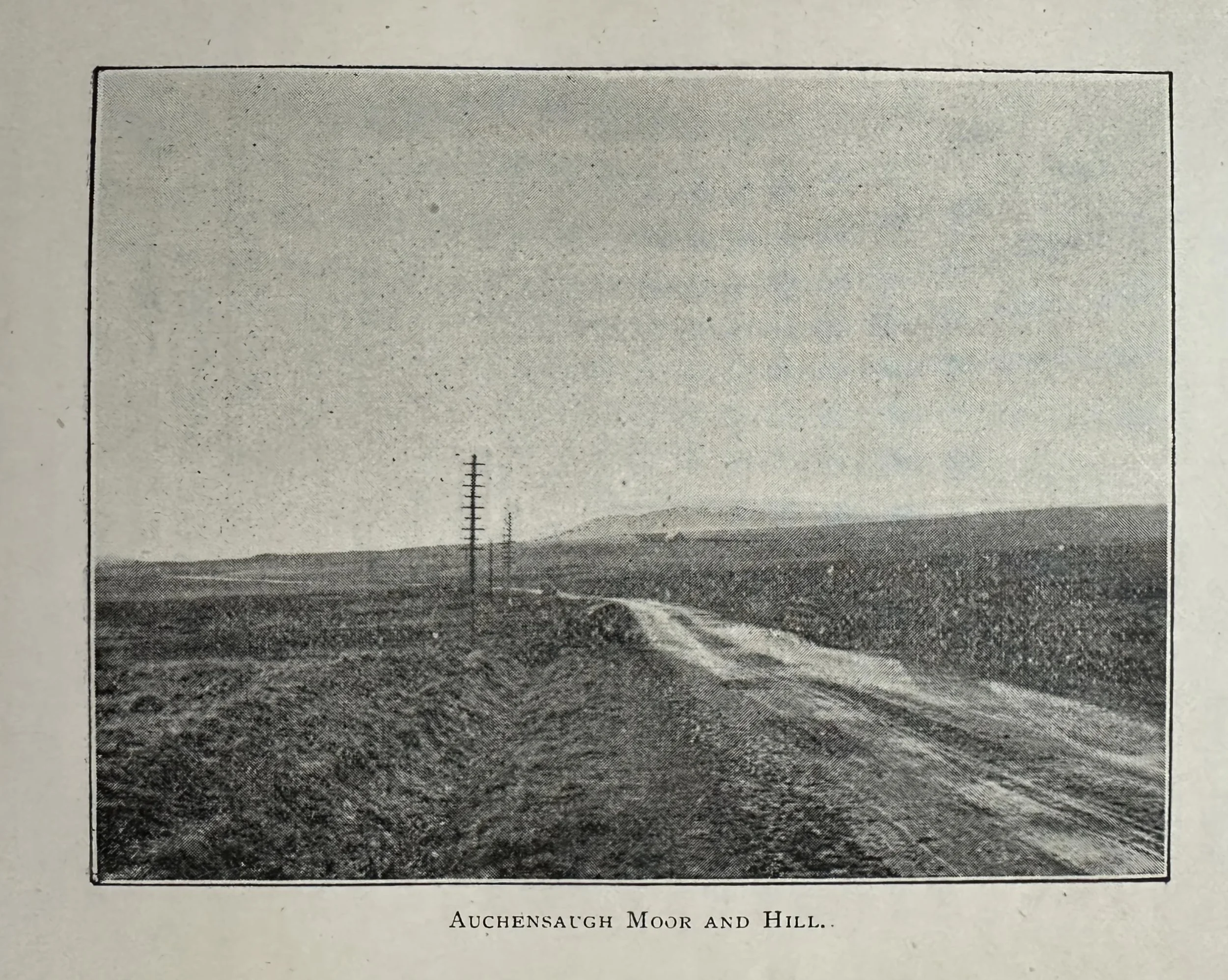
[Plate: AUCHENSAUGH MOOR AND HILL.]
The Cameronian Apostle. 177
Such were the private arrangements made by those responsible for the anxious duty of carrying through a great public demonstration, which it was at one time feared the Government or private opponents might attempt to prevent. Wodrow reflects the vulgar misapprehension of their objects when he writes, at the very date, “I doe not know how far unknown unto many of them, and it may be to Mr. Macmillan, the Jacobites may have a hand in this.”* He adds, that it is feared the Government may “make a handle of this, to bring on matters yet more grievous to the Church.” We have already pointed out, that the Cameronians were, by many, suspected of holding communications with St. Germains, and Ker of Kersland afterwards roundly asserted that he had done so himself, while keeping in touch at the same time with the cabinet of Queen Anne and George I. The position of men who refused to take the Oath of Allegiance, to pay taxes, to seek or take the decisions of the law-courts, to serve in the militia, or in any way to own the existing Government in Church and State, was certainly open to dangerous misunderstanding. It would have been pardonable if the Government had taken steps to prohibit a large assembly of men in arms, who held such principles. They did not, however, share the fears of ecclesiastical politicians, and probably Macmillan received some private assurances of protection and immunity, since, as we saw, no weapons were taken to the field after all.
It was a perfectly peaceable and unarmed multitude, therefore, which, on Wednesday, July 23, 1712, listened in solemn silence while first Macmillan gave a short address vindicating and explaining their objects in the meeting, and then Macneil preached an elaborate sermon on Jeremiah L. 4, 5, shewing the duty and necessity of renewing the National Covenants. These
_____
* Analecta, ii. 75.
178 A Cameronian Apostle.
discourses were interspersed with psalms and prayers, and finally the Covenants and “Acknowledgment of Sins” were read, with a solemn prayer of confession following. Macmillan then dismissed the people for the day, not without a “reprehension” of their “unconcerned carriage and behaviour” during the reading of the “Acknowledgment of Sins.” As this document must have taken at least two hours to read at a rapid rate, and as the previous exercises of prayer, praise, and preaching, cannot be estimated at less than other two, the reader of a modern age will hardly be able to refrain from sympathising with the restlessness of the audience. It was the height of summer, and a little impatience was unavoidable, especially as many present were mere onlookers and sightseers.
On Thursday, July 24, a multitude, variously estimated at from 1000 to 1700 persons,* gathered on the desolate moor, and Macmillan plunged into an exhaustive discourse on “Right Covenanting,” from Isaiah xliv. 5. This, his only extant sermon, shews all the qualities of the True Narrative and his other printed remains: plainness and vigour of style, fondness for everyday illustrations and references, a tendency to minute divisions and thorough searching of every topic, and a great command of Scripture. The peroration, even in a bald abstract, bears every appearance of effectiveness and a certain manly eloquence. “The keeping of this Covenant had been to our nation a Sampson’s lock, whereby we should have been able to oppose all our enemies; whereas the breach of it hath opened a door for all sorts of enemies, to creep in amongst us. And hence is verified that which the Lord has threatened his people with, for their breach of covenant: Deut. xxviii. 44,—that the enemy shall be the head, and his people the tail.”
At the close of his sermon, the “Acknowledgment” was once
_____
* Wod. Anal., ii. 75.
The Cameronian Apostle. 179
more read, “as preparative to the engaging part.” Then, he offered a solemn prayer, confessing sins and begging assistance. Turning toward the people, he commanded those who wished to renew the Covenants to “stand upright and hold up their right hands.” He recited the Oath article by article, pausing at each and holding up his hand, until the Covenanters raised their right hands. As is well known, this is the immemorial Scottish mode in taking oaths. When all was done, he delivered a closing exhortation to faithfulness, and dismissed the people in the usual form.
Wodrow’s account of the Thursday’s incidents has its usual gossipy character. He speaks of “Mr. Macmillan’s clerk” as reading the “Acknowledgment,” and adds that Macmillan stopped the reading “when the paper came to Test and Oaths,” and said, “Are there none here that are guilty of any of these things? Let them acknowledge and confess them.” Several persons rose and made confessions: one, that he had been at the Lesmahagow Renovation, and “would have confessed it there, but was stopped.” Another spoke of his sin in “hearing the ministers.” Macmillan gently asked him, if he was “convinced in his conscience that that was a sin; and desired none might confess anything but what they were convinced in their conscience was a sin.” Confessions then multiplied; one man deploring a “rash oath,” many acknowledging that they had never been married, though living as man and wife, and some confessing that “they were troubled with strange thoughts.” These last Macmillan “checked, as confessing things that need not be confessed.” It “took a long time,” and must have been a very curious scene for the elegant ladies and gentlemen, who were said to be among the crowd. This public confession is mentioned in the official report, but purely as covering “public steps of defection,” not private sins, a description fully borne out by Macmillan’s “checking” those enthusiasts, who sought
180 A Cameronian Apostle.
to wash their spiritual dirty linen in public. Wodrow’s chatty page gives a pleasant notion of Macmillan’s kindly commonsense, and of the tolerant spirit which he cherished towards the State Church. It is much to be regretted, that he did not carry to the Communion Table the same reasonable and kindly spirit. But this is to anticipate.
The Friday was, as usual in the old sacramental feasts, a dies non; but Saturday, July 26, found Macneil in the pulpit once more (if pulpit there was),* but the official account gives no details of the sermon or service. Wodrow supplies the omission, stating that the reverend gentleman “began with an apology for being a preacher,” i.e., a probationer and unordained. The employment of a probationer to preach on the Saturday, which was the special day of preparation for the Holy Communion, was then very unusual. The story is told of Warner of Balmaclellan, that when a “preacher,” he was suddenly called to assist at a “Communion Occasion,” and delivered a discourse shorter than the usual custom was. The old minister of the parish, in his prayer, “acknowledged the Lord’s goodness in carrying through the work, when his helpers failed him, and he had none but a young lad, and he geyan short-breathed (brief)!”† Macneil explained, that it was the lack of helpers which obliged him to appear again, and on that solemn day. There is something pathetic in such humility, when we remember that Macneil had been a “preacher” for 43 years. At the close, Macmillan distributed the tokens, and Wodrow adds—“I hear some were refused them, unless they would promise not to hear the Established ministers; but I know Macmillan did give tokens to some who, he knew, were not ordinary hearers, and that without any such engagement.” Here is another unsolicited testimony
_____
* Most probably, a preaching-tent was used.
† See Fasti, under Balmaclellan.
The Cameronian Apostle. 181
to Macmillan’s tolerance. The tokens were probably made for the occasion, and resembled those used at the next “Renovation,” in 1745. Of these 1745 tokens, Mr. Hutchison says that “many are still in existence. They bear on the one side the date ‘1745,’ and on the other the letters ‘G.M.,’ which to many people are enigmatical, but doubtless stand for ‘General Meeting.’”* The usual custom was to stamp on one side the initials of the parish, and on the other the date beneath the initials of the incumbent.† If this was followed at Auchensaugh, the initials would be J.M. But I have heard of no existing specimen.
The “great day of the feast” was Sunday, July 27, when, of course, the entire “work” was done by Macmillan himself. He has modestly refrained from giving us his sermon, which, according to Wodrow, was on I. Cor. v. 7—“Christ, our passover, is sacrificed for us.” The same chronicler tells us that “there were eight tables, about sixty at a table, and they were double tables. They reckon about a thousand communicants.” Macmillan “communicated himself at the first table.” He served the whole eight tables, giving all the addresses himself, and “preached at night.” Wodrow notes also that “it was a very extraordinary rain the whole time of the action.”
The most remarkable incident of the whole series of services took place this day, when, in “fencing the tables,” Macmillan said, according to his own account, “I debar and excommunicate from this Holy Table of the Lord, all devisers, commanders, users, or approvers, of any religious worship not instituted by God in His Word, and all tolerators and countenancers thereof. And by consequence, I debar and excommunicate, from this Holy Table of the Lord, Queen and Parliament, and all under them who spread and propagate a
_____
* Hist., p. 190.
† Burns’s Scottish Communion Plate, p. 464.
182 A Cameronian Apostle.
false and superstitious worship, ay, and while they repent. . . . I excommunicate and debar all who are opposers of our Covenants and Covenanted Reformation, and all that have taken oaths contrary to our Covenants, and such particularly as are takers of the Oath of Abjuration, whether ministers or others, until they repent.”*
This extraordinary utterance spread like wildfire through the country, and Wodrow records the fact that Macmillan “debarred the Queen and Parliament,” as his first piece of news regarding the Auchensaugh Sunday. Macmillan attempts to justify his action by explaining that the above tremendous formula is simply a transcript and application of the Second Commandment, as explained in the Larger Catechism of Westminster divines. There, all toleration of superstitious worship is said to be forbidden by the commandment against idolatry. Yet that very year, a Toleration Act had been passed, allowing Episcopal services in Scotland, provided the clergymen took the Abjuration Oath. That Oath itself had been imposed on the Established Church clergy in 1711, and involved a sworn promise to maintain on the throne a sovereign, who must be a member of the Church of England, and in Macmillan’s view, an idolator. His own former co-presbyters in Kirkcudbrightshire had mostly taken this Oath, but there was much division of opinion regarding it.
Even with these explanations, the reader may naturally be disposed to condemn Macmillan’s high language about dignities. It must, however, be remembered, that he spoke in the excitement of a long series of meetings, and on an occasion when covenanting precedents would be followed, even where a cooler judgment might consider them out of date. Had not Cargill excommunicated the second Charles? And was not Macmillan, in a sense, Cargill’s apostolic successor?
_____
* Official Report, pp. 38, 39.
The Cameronian Apostle. 183
After all is said, the best apology for an unwise and rash utterance like this, lies in the fact that it was a brutum fulmen, a sentence which could not be carried out, an excommunication which excluded its subjects from nothing that they were ever likely to desire. There is, after all, something in Hill Burton’s suggestion that Macmillan that day was carried out of himself, what in French is called exalté. Mr. Hutchison comments severely on the reference made by the historian to the “days of glory at Auchensaugh.”* But I suspect that Hill Burton is not far from the truth. Auchensaugh was Macmillan’s brightest and happiest day in a long life. He saw himself surrounded by a gathering of the old covenanting type, such as he had known in boyhood. He felt that he filled no mean office in ministering the Holy Supper, alone, to so great a number of devoted adherents of the “good old way.” A certain exaggeration, and uplifting of soul, were natural and pardonable results. We can but pass over the regrettable touch of intolerance, and fix our gaze rather on those traits of strong sense and manliness and kindness of heart, which even the prejudiced author of the Analecta could not feel justified in suppressing.
It only remains to add, that the whole “occasion” concluded on Monday, July 28, with a sermon from Macmillan. Thus in five days he had delivered three discourses, and “served” eight tables, besides giving frequent prayers and addresses, an amount of toil that proved his bodily and mental vigour. On July 29 a business meeting was held at Crawfordjohn, the accounts were settled, the Covenants were ordered to be circulated in a “fair copy upon parchment,” for signature by “all the men who had sworn them at Auchensaugh,” and an official print of the whole proceedings was directed to be forthwith published. August 17 was appointed as a Thanksgiving Day for the Communion.
_____
* Hill Burton, History, V., 239-242; Hutchison, History R.P. Church, p. 167.
184 A Cameronian Apostle.
On November 3 the Covenants, as renewed at Auchensaugh, were made the terms of communion, and continued to be so up to the year 1820. Women, however, were not required to sign the Covenants, a verbal consent being deemed to be sufficient.*
The high-water mark of Auchensaugh was soon left behind. Divisions crept in among the Remnant, first in connection with a preacher named Adamson,† and then more bitterly over the unfortunate “Representation of Grievances” to the new King.‡ A startling proposal was now first mooted, that Macmillan should be asked to ordain “some to the office of the ministry.” There were several “students,” as we know, in the membership, such as Umpherston and Smith. And Macneil had been a preacher for well-nigh half a century. It was a natural, although daring thought. Why not lay hands on men so highly qualified, and so secure the “succession of a gospel ministry?”
When this extraordinary scheme was debated, it was found that much difference of opinion existed. The events of 1715, also, served to hinder further procedure at this time. The Societies were arming and “rendezvousing,” and learning “manual exercise.”§ At this time there was much bustle in all the Nonconformist camps. The Episcopalians were on the alert in the interests of the Pretender. Hepburn was preparing to march to Dumfries, and meantime he armed and drilled his men near the manse of Urr. All over Clydesdale and Nithsdale, and in the Lothians, Fife, and Stirling, small bodies of the Cameronians met secretly for drill and accoutrement. It was a time of uneasiness, and no one knew how soon there might be a change of King and a change of constitution.
The Pretender disappointed all the vague hopes cherished
_____
* Conclusions, Nov. 3, 1712; March 2, 1713.
† Conclusions, Oct. 26, 1713.
‡ Conclusions, Sept. 8, 1714, and following minutes.
§ Conclusions, May 1, 1714; Aug. 15, Oct. 5, 1715.
The Cameronian Apostle. 185
regarding his career. Matters returned to their normal state, and the wrangling over the ill-starred missive, addressed to George I., broke out afresh. At length recourse was had to the ultimate expedient of a Solemn Humiliation. The brethren’s hearts turned to that Cameronian Sinai, Auchensaugh Hill, and there they spent the 24th July, 1718, in bewailing their own and the land’s sins.* In this effort to restore harmony, Macmillan took the leading part, and ultimately the threatened schism seems to have been averted.†
Once more Macmillan greatly distressed his scrupulous friends by a matrimonial alliance. His first wife, Jean Gemble, had died in 1711, and in 1719 he married Mary or May Gordon, widow of Edward Goldie of Craigmuie, and a daughter of Sir Alexander Gordon, Bart., of Earlston in Dalry. He had been brought into intimate relations with “Earlston” some years before, when the latter came into conflict with the Kirk Session of Dalry and the Presbytery. Earlston had been accused of a grave moral offence, and had made a public vindication of his character in Balmaghie Church one Sunday in February, 1711.‡ Probably he and Macmillan were old acquaintances, since the latter is said to have been descended from the family of Arndarroch on Earlston estate. Earlston, also, had married a sister of Sir Robert Hamilton of Preston, the active agent and friend of the United Societies, who is credited with first using the name of Reformed Presbyterian.§ The intimacy between the deposed minister of Balmaghie and Earlston brought the former into acquaintance with his second daughter, who in 1711 had just been left a widow with four young children. Their
_____
* Conclusions, May 6, July 25, 1718.
† At the “full-dress” debate on the “Representation of Grievances” to George I., 26 voted against it, and 22 for approving it. See Conclusions, May 9, 1715, with Howie’s note.
‡ Presb. Rec., Feb. 20, 1711.
§ Hutchison’s Hist., p. 138.
186 A Cameronian Apostle.
friendship ripened into a devoted attachment, and in 1719 they were married by Gilchrist of Dunscore, a nonconforming minister recently deposed by the Presbytery of Dumfries.*
The new alliance was well fitted to strengthen Macmillan’s position in many ways. His wife was one of a pure covenanting stock. Her father, who became baronet in 1718, was the so-called “Bull of Earlstoun,” whose romantic adventures Mr. S. R. Crockett has transferred to the pages of the Men of the Moss-hags. Her mother was, as already stated, a sister of Sir Robert Hamilton. Better still, she proved a woman of singular piety, and thoroughly in sympathy with her husband’s work and position. The reader is desired to refer, for proof of this, to the “Elegy,” reprinted in our appendix. Socially and financially, the match was extremely advantageous to Macmillan. His wife’s father had just succeeded to the title and estates. Craigmuie was the property of a minor, and probably life-rented by the widow. The marriage, however, was one of affection and perfect religious sympathy.†
In spite of these considerations, or perhaps because of some of them, the General Meeting deemed it necessary to send a deputation to “converse with” Macmillan on the “emergent of his late marriage.” They were to meet with him at “Hartbush in Tinwald,” and at same time to confer with Gilchrist on the points of difference. This was on May 4, 1719. On August 3 Macmillan attended the meeting, and offered to submit his marriage and all other “controverted things since the late work at Auchensaugh” to a “lawful competent Judicatory.” As the meeting hesitated, he at once offered, further, to surrender his call, and then, in much agitation, the assembled delegates declared that “they neither could not nor would not receive that
_____
* Conclusions, Feb. 5, 1718.
† See M‘Kerlie’s Lands and their Owners in Galloway, III. 86; 419-422.
The Cameronian Apostle. 187
call at his hand, but did humbly desire him to retain it as formerly.” This practically ended the affair, although William Wilson two years later assigned this marriage as a “step of defection,” aggravated by the fact, as he put it, that Macmillan “threw down the call, offering to leave them, as he had done oftentime before.”*
The relations between Macmillan and his friends of the Societies resembled those between a fond but exacting couple in wedlock. The strict and unbending Covenanters had grown to love and revere their chosen pastor, and yet they incessantly found fault with him for his relations with the Established Church, slender and fading as these had become. They were proud of him, and fond of him, but they could not resist the temptation to criticise him. His intimate personal association with the elders and many of the people of Balmaghie, his constant practice of baptizing the children there, and his twice-repeated offence of seeking the marriage-rite from Established Church ministers, were things “very grievous and lamentable” to men who preferred to starve in spiritual matters rather than to give or take help from the State clergy, or from ministers, such as Hepburn and Gilchrist, who just fell short by a hair’s breadth of the full covenanting “testimony.”
The records of the General Meeting now shew an active resumption of the movement to induce Macmillan to ordain a colleague or colleagues. This movement was quickened by Macmillan’s own action in declining to celebrate the Lord’s Supper because of “his own frailty” and the want of help. They were at length unanimous in judging that the “extraordinary case” justified an extraordinary step. Ordination, according to Presbyterian form, is the act of a Presbytery, and one minister cannot, therefore, confer it alone. Yet, so urgent
_____
* See MS. in New College Library, Edinburgh, already referred to.
188 A Cameronian Apostle.
did the crisis appear, that a formal call was put into Macmillan’s hands, in favour of Macneil and two students of divinity, Alexander Marshall and Hugh Clark.* In spite of this clear deliverance, the proposal remained in abeyance, although revived at intervals. Macmillan wisely shrank from a step so unusual, and fitted to give rise to hostile comment. And a different plan, offering at least a partial solution of the difficulties, soon began to be agitated.
Macmillan, as we know, still lived in Balmaghie Manse, but there is reason to believe that his field of labour was now largely situated beyond Galloway. There are complaints of friends in Galloway not attending meetings or sending contributions.† It was frequently impossible for Macmillan, now an elderly man with declining health, to attend meetings, or to discharge his pastoral duties among the scattered “correspondences,” lying chiefly in Lanarkshire and its neighbouring districts. The question at length came to be, whether he should remain in Balmaghie, where his work was decreasing, or come forth definitely and live among his friends of the Societies. This latter course would make his services more readily available, and it was accordingly, on May 8th, 1727, “overtured before the General Meeting, that Mr. John Macmillan should leave Balmaghie.”
Wodrow probably reflects, correctly enough, the state of affairs in Balmaghie at this time. He says, writing in 1725, “I hear the Macmillanites are very much broken and crumbled among themselves.” He notes also that Hepburn’s death had dissolved his party, most of whom had rejoined the Church. The followers of Taylor were “very much sinking.” The high covenanting position was evidently losing popularity in Galloway,
_____
* Conclusions, Feb. 15, May 8, July 10, Oct. 16, 1721.
† Ibid., Oct. 9, 1723.
The Cameronian Apostle. 189
and it had against it all the most powerful forces, both clerical and territorial.
In the same passage, Wodrow hints at some unpopularity caused by Macmillan’s third marriage. Mrs. Mary Gordon had died in 1723, and in 1725 Macmillan, returning from one of his frequent expeditions, brought with him a third wife, whose name, even, remains in doubt. According to one family tradition, it was Grace Russell; according to a second, it was Janet Jackson. A deputation waited on him to inquire as to the facts of the ceremony, but no information was vouchsafed them. Rumour had it, that he had been married by Fork of Killallan, with whom the Societies at one time negotiated without result. The whole affair, says the garrulous author of the Analecta, “caused a great gumm among his followers.” The Church “was very throng for some Sabbaths after his marriage, but is since turning much thinner.”* With this parting piece of gossip, Wodrow dismisses Macmillan from his pages.
Taking everything into account, we may assume that Macmillan had good reasons for leaving a post, which he had held so long against every attack. The reader is referred to the previous chapter for a more extended account of these.
Before, however, he finally turned his back on the humble kirk and manse, he experienced for the first time the joy of fatherhood. From the flyleaf of his Family Bible, we find that “Josias was born the 12th of June, 1726, upon a Sabbath morning about Six a’Cloack . . . in ye manse of Balmaghie.” He was “baptized on ye Lord’s Day afternoon, in ye presence of ye Congregation, (his) mother presenting.” Kathren or Katharine, the next child, was born in Eastshields, parish of Carnwath, on December, 19, 1727, “upon a Tuesday about one a’Clock in ye afternoon.” He must therefore have left Balmaghie at some
_____
* Analecta, III., 243-4. Gumm means umbrage or displeasure.
190 A Cameronian Apostle.
date between June, 1726, and December, 1727. But the record already quoted shews that at May 8, 1727, he was still there, and the date of his departure is thus confined between May and December 1727. Probably* he finally took leave of the parish at Whitsunday.
Although he thus threw himself unreservedly upon the support of the Societies, it was not till February, 17, 1729, that they resolved to collect funds for the “wadsett or feu of a piece of ground, to build a house upon, and provide conveniences for their reverend minister.”† Meantime he occupied successively three different houses in the parish of Carnwath—Eastshields, where “Kathren” was born, Eastforth, the birthplace of John, afterwards an eminent Reformed Presbyterian minister, and Henshelwood, which witnessed the birth of Grizel. At Henshelwood he continued until the house was built. This was not accomplished without delay and difficulty. A sum of 1000 merks, or about £50 sterling was aimed at, and the contributions came in slowly.‡ At length the humble residence was completed, and at Whitsunday or earlier in 1734, Macmillan took possession. His last child, Alexander Jonita, a girl, was born at Braehead of Dalserf, as the house was named, on 28th May, 1734.
“When man builds a house, then Death steps in.” So says the Eastern proverb, and on October 29, five months after, the little maid died, and was laid to rest in Dalserf Churchyard, “beside Mr. Francis Aird.”§
The Meeting now frequently assembled at Braehead. They were launched upon a fresh attempt to secure ministers, and were holding conferences with Ebenezer Erskine and his friends of
_____
* M‘Kie was in possession in July, 1727.
† Conclusions, Feb. 17, 1729.
‡ Ibid., Aug. 11, Oct., 1729.
§ See Kirk Above Dee Water, p. 65. Macneil also died in 1734.
The Cameronian Apostle. 191
the Associate Presbytery. In 1737, however, these well-meant negotiations also failed, the “Testimony” of Erskine not “answering our case.” Immediately, Macmillan was urged to “call forth to the office of the Holy Ministry Mr. Charles Umpherston and Mr. Alexander Marshall.”* No further action is recorded, but it was not long before these protracted efforts to secure a colleague were crowned with success.
Thomas Nairn had been ordained minister of Abbotshall in 1710, but in 1737 he followed Erskine and became a member of the Associate Presbytery. He was called to labour at Linktown, and continued there until differences arose between him and the Associate Presbytery in December, 1742. Failing to obtain satisfaction, he “declined” their authority, and at once entered into communication with the United Societies. No time was lost in giving him a call to be Macmillan’s coadjutor. The question of forming a regular Presbytery was delayed till next meeting; on the last Monday of May. This was on April 4, 1743, and from that date, according to Mr. Hutchison, the minutes are few and far between.† The Presbytery was ultimately “erected” at Braehead, on August 1, 1743, according to Nairn’s own testimony, in a sermon preached at the ordination of Alexander Marshall on November 15, 1744.
The succession of the ministry was thus secured, since regular license and ordination could now be given. Macmillan’s long pastorate of more than 36 years, as the sole ordained minister, came to an end. During this period he had led a truly apostolic life, traversing wide rural districts in Lanarkshire, the Lothians, Fife, Stirling, Nithsdale, and Galloway, on his pastoral rounds. He had preached in barns, in kitchens, in the open air—everywhere but in a church. For church, as yet, they had none. He had married and baptized, as occasion arose. He had tended
_____
* Conclusions, May 30, 1737.
† History, p. 190.
192 A Cameronian Apostle.
the sick and relieved the poor. The one thing he had not been able to do was to celebrate the Lord’s Supper among these scattered congregations. At home in Balmaghie he still held that sacred feast, probably once in two years, the usual custom at the time. His celebrations were so solemn, searching, and impressive, that the very Communion Cup used by him became an object of superstitious awe. In the infrequency of his Communions he did not stand alone, since Hepburn, too, is said to have never once administered this Sacrament, or even received it, from 1688 to his death.* But in every other part of an itinerant ministry, Macmillan had spent his strength ungrudgingly, and for no earthly reward. The Society’s minutes indeed contain no definite record, that he received any regular stipend at all from his numerous flocks, although Wodrow states that a salary of 1000 merks a year was agreed on at Auchensaugh.† If this was so it was never minuted, and probably it was irregularly paid. As we have seen, no residence was provided until he had been travelling between Balmaghie and Crawfordjohn for 27 years. On the whole, we must regard these toilsome years as affording no mean testimony to his mental and bodily vigour, his spirit of self-denial, and his devotion to the covenanting cause. To minister among Cameronians has always been reckoned a laborious if honourable office. Long sermons, long miles to walk, and limited stipends, are the traditional associations of the pure times of the Reformed Presbytery. Macmillan lived and laboured in the very making of that body. He knew, therefore, what it was to traverse great distances by mere bridle paths, to sit by the shepherd’s fire on a lonely hillside, to raise the simple psalm amid echoing hills. He knew the rough fare of farm-houses, and the perils of moss and fell. That he fulfilled his sacred office alone for 36 years,
_____
* Wodrow, Anal., II., 378.
† Ibid., II., 88.
The Cameronian Apostle. 193
without rebuke or default, and in such wise as to earn not only reverence but love from his hard-headed and undemonstrative people, surely entitles him to receive, without challenge, the name of the “Cameronian Apostle.”