Reid A Cameronian Apostle X.
James Dodson
CHAPTER X.
1704–1727.
A PARISH SCHISM.
Monteith deforced—Preaches at Balmaghie Place—Macmillan’s silence—Resumes preaching—Scene on river bank—War of pamphlets—The “True Narrative”—Cameron’s “Examination” of it—Macmillan’s reply—Judicial proceedings—A meeting of parties at Clachanpluck—Attempt to buy him out—His indignant letter—A year’s stipend from “Balmaghie’s curators” to the late minister’s children—Macmillan’s stipend—Conference of heritors and Presbytery at Clachanpluck—Interrupted by Macmillanites—The Sheriff baffled—Another riverside scene—The Sheriff’s guard repulsed by women—Complicity of the Societies in the riots—Macmillan marries Jean Gemble—Sends in his “Declinature” to the Commission—Is excommunicated along with Macneil—M‘Kie, chaplain at Balmaghie, is called—Scene at his ordination—Charges brought against him—The Sheriff twice again repulsed by women—Collision between Macmillan and M‘Kie—M‘Kie takes possession—The Glebe Riot—The “Porteous Roll”—“House of Rimmon” built—Macmillan leaves the parish—His relations with M‘Kie—Meaning of “alter minister”—The Schism is healed—Number of “Cameronians” in 1794.
LET us now return to the parish of Balmaghie, which had been thrown into violent excitement by the Presbytery’s summary deposition of its beloved and popular minister. We have seen how a large body of Macmillan’s parishioners attended him to the meeting of Presbytery at Kirkcudbright on February 22, 1704. But previous to this, the people had begun a series of demonstrations showing their absolute resolve to resist the authority of that court.
150 A Cameronian Apostle.
When the 9th of January 1704 came round, Monteith and Hay failed to carry out their appointment, Hay having fallen sick, and Monteith probably shrinking from the perilous duty of “preaching the church vacant.” Monteith was now ordered to proceed alone, but at the meeting above mentioned, he brought back a melancholy report. On Sunday, 30th January, “he went towards the Kirk of Balmaghie according to appointment, and James Gordon, Town-Clerk of Kirkcudbright, notary public, together with some witnesses.” As “he was riding towards the kirk, there came from the kirkyard about 20 or 30 men, who refused to let him go further, and actually stopped them by laying hold on the foremost horse’s bridle, whereupon Mr. Monteith, finding he was violently withstood in going to the kirk, did take out his commission from the Presbytery, and did read it to them, and did intimate the Presbytery’s sentence of deposition, and declared the kirk vacant. Whereupon, he asked and took instruments in the hands of the notary public.”
Monteith then retired to Balmaghie Place, where he “preached to such as were present,” and again intimated the sentence. Macmillan himself officiated as usual in the parish church.
Warner and Gordon reported that they also had been denied access, and had preached at Balmaghie Place. Spalding, on arriving in the parish to “supply” the pulpit, learned that Macmillan had exchanged with Hepburn, and was at Urr. He made no attempt to enter Balmaghie Church, but conducted service at the mansion house, like his predecessors. He reported, that Hepburn had “used much railing against the Church and the Presbytery in particular,” and had exhorted the people to adhere to the deposed minister.
From this point, the Presbytery’s “supplies” contented themselves with preaching at Balmaghie House, except for a brief interval of a few months, during which Macmillan remained silent, in some hopes, as it would seem, of being reponed under
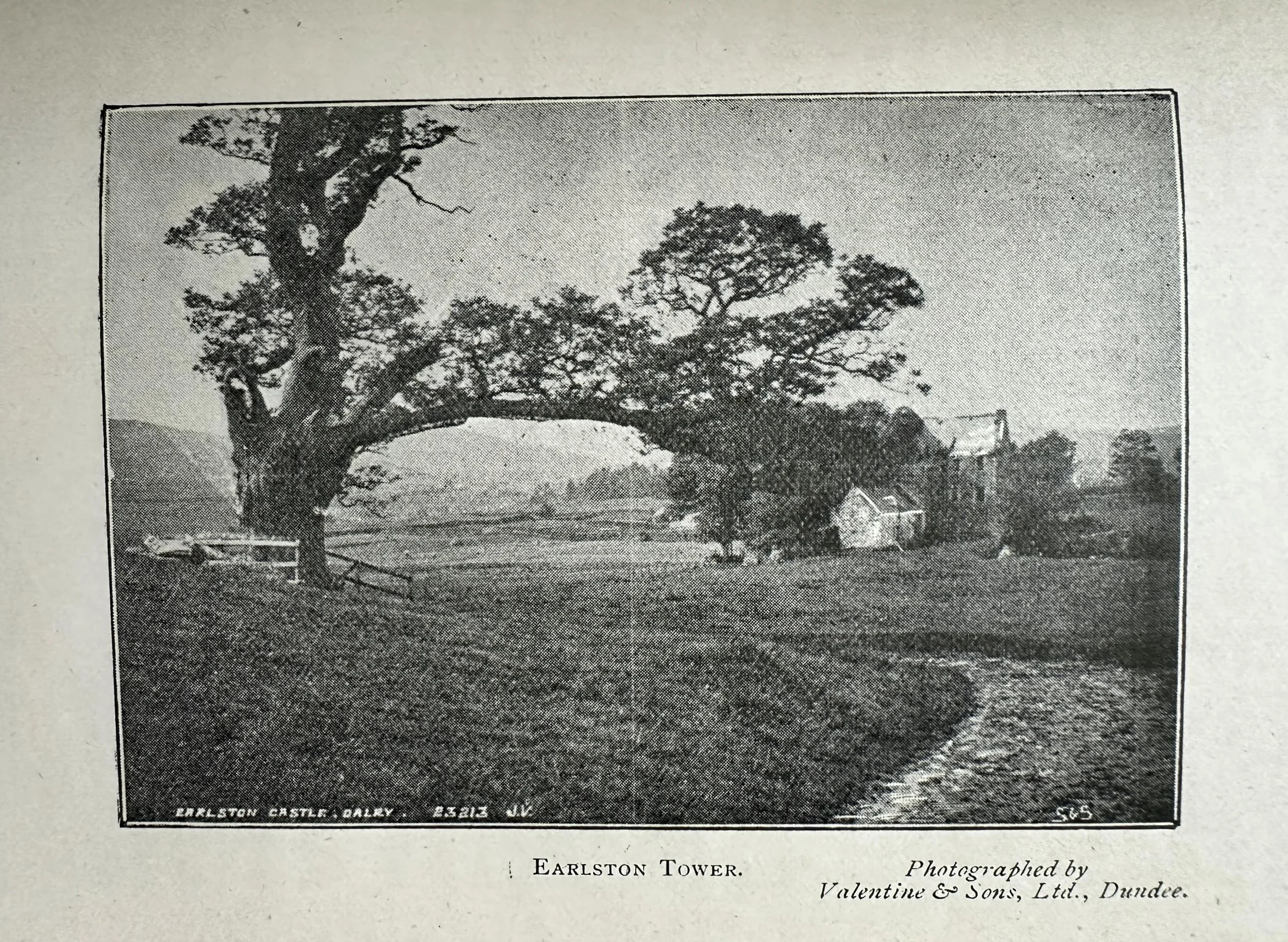
[Plate: EARLSTON TOWER. Photographed by Valentine & Sons, Ltd., Dundee.]
A Parish Schism. 151
his engagement of July, 1704. While he was waiting in Edinburgh for some decisive answer, the Presbytery sent two ministers to announce to the people that during his absence they were to attend on the Presbytery’s ministrations. But the keys of the church could not be had, and they had to enter by breaking in a window.* Macmillan returned from Edinburgh, and for a few Sundays sat in his place in church as one of the congregation. But at last, losing all hope of being restored, he rose up one Sunday after the officiating minister had intimated the preacher for the Sunday following, and had urged the people to attend better. Macmillan now announced that he would himself preach next Sunday.
“What,” said his colleague from the pulpit, “will you, a deposed man, go and preach? Go home,” he added to the people, “and mourn for it, that a deposed man is going to preach next Sunday. I wish he may get few hearers, and I hope so he will!”
Next Sunday the church was crowded. A boat was seen coming across the river carrying the Presbytery “supply.” Immediately a rush was made to the bank, and a dozen strong hands violently shoved the boat back from the landing-place. The “supply” retired to the Crossmichael bank while the “deposed” man now resumed his office.†
From this day Macmillan continued to be in all respects minister of the parish. The Presbytery several times attempted to persuade him to submit, and even threatened the terrible penalty of “greater excommunication.”‡ But that threat had no terrors for a minister whose parishioners adhered to him nearly as one man. Practically, he was left in possession, the
_____
* So J. H. Thomson, in R. P. Mag., 1869; MS. Narrative.
† Hutchison’s History, p. 147; MS. Narrative.
‡ Pres. Rec., June 27, 1705.
152 A Cameronian Apostle.
Presbytery ceasing to go through the empty form of sending “supplies” for a pulpit which was so entirely shut against them.
The publication of Macmillan’s Narrative had not tended to smooth matters on either side. Although the Presbytery employed its best pens to answer this vigorous assault, the reply was probably of little avail where it was most needed. Cameron, who prepared this document,* as convener of a committee, had previously issued a “Letter to the Parishioners of Balmaghie,” briefly and contemptuously noticed in a few lines† at the close of the Narrative. The Presbytery also employed the printing-press to circulate copies of the “Answers to the Grievances,” and of Libel and grounds of Sentence. But Macmillan proved an active literary combatant. He returned to the charge in 1706, in a pamphlet of 28 octavo pages, entitled, The Examination of the True Narrative Tryed and found False. In this, he denies the personal insinuations, with which Cameron had seasoned his work. He declares that he “was educat in the Presbyterian Perswasion,” and that his “Parents suffered much for their adherence to these Principles in the time of Prelacy, which Principles he still retains.” This fact about his parents, he declares, “is well-known,” although Cameron had asserted that it was known to the brethren that Macmillan had been “from a boy a Separatist.”
The frequent reflections in Cameron’s pamphlet upon Macmillan’s want of scholarship are passed over, but the deadlier charge that he had entered the State Church for a livelihood is vehemently denied.‡ A full explanation is given of the immediate reasons which led him to “decline” the Presbytery. “Let the LORD GOD of Gods be witness, let Angels be witness, his own Conscience, and the Ministers of the
_____
* viz., the Pamphlet intituled, A True Narrative Examined and Found False. 1705.
† See Appendix.
‡ Examination Tried and Found False, p. 26.
A Parish Schism. 153
Presbytery of Kirkcudbright, at the Bar of God’s Tribunal, let them be witnesses, if it was not purely out of Love to the Interest of our LORD JESUS CHRIST, and Conscience of duty, that upon the sight and consideration of the two Acts of the Synod of Wigton . . . he was moved to express himself so openly against joining with the Presbytery.” The “two Acts” are described, one being given in full, at page 5 of his tract. The first was that which directed active measures to be taken with the three protesting brethren. It will be found in our account of the “Grievances.” The second directed the ministers to renew the National Covenant, but pointedly ignored the Solemn League.* These pronouncements, he says, led him to judge “them to be going to a top-height of defection.”
Light is also thrown, by this spirited defence, on the exasperating conduct of Cameron and his party after they had succeeded in deposing Macmillan. It appears that, in October 1705, they tried to persuade him to “deliver up the keys of the Church to the Presbytery, and let them have free access there to preach, and himself to lie by for a time.”† If he did so, they assured him that he might expect “reposition.” But he had long since lost confidence in such promises. “Once bit, twice shy.” His damaging submission or apology in July 1704, had been wrung from him on the same understanding, yet he was still under the sentence of deposition. He had “lain by” for several months in that year, without seeing any progress made in his affair. Nothing more deeply wounds an earnest man, than the experience of what he deems to be perfidy or trickery at the hands of his neighbours. The events which must now be related can be better explained, though not perhaps fully justified, if we remember that Macmillan and his people held themselves
_____
* Macmillan had induced his people to renew both the National Covenant, and the Solemn League.
† Examin. Tried, etc., p. 12.
154 A Cameronian Apostle.
to be the victims of injustice and treachery on the part of the Presbytery. In resisting that authority, they believed that they were defending their rights against an unscrupulous and tyrannical power.
The war of pamphlets was followed by a more formidable series of judicial proceedings. In April, 1706, the Assembly’s Agent procured a summons against Macmillan and his immediate adherents to appear before the Privy Council, but this having been disobeyed, they were declared fugitives, and rendered liable to fine and imprisonment. Before putting the law in force, however, the Assembly directed their Moderator to endeavour to effect an accommodation. At his instance, a conference of heritors, elders, and people was convened at “a public-house in the centre of the parish,” probably at Clachanpluck. The heritors urged the people to yield, or “else there would certainly be put a party of dragoons in amongst them.” Macmillan was not present, but as soon as he heard of this attempt to terrify his people, he sent notice that he refused to give up the keys of the church. Upon this, it is said that one of the heritors suggested the payment to him of “so much of the by-gone stipends, as would be a subsistence to him and his family, if he would go away for good and all.” This provoked a curt and stern reply from Macmillan:—“Sir, Let your money perish with you! I am not going to make merchandise of my ministry. I do not say, perish yourself; but your money.”*
Thus, the attempt to settle the dispute had failed at both points. The people would not be frightened into deserting their minister; and he, in his turn, indignantly refused to accept a bribe and desert them.
The year 1707 saw several further developments. It is re-
_____
* This and some subsequent incidents, are from the MS. narrative already referred to. The above letter seems genuine enough.
A Parish Schism. 155
corded in a minute of the Presbytery about January of that year, that “Balmaghie and his curators have given the gift of a year’s vacant stipend to Mr. M‘Millan’s children.” These were the children of the first Macmillan, who died in 1700. The entry is noteworthy as shewing that the principal estate was now in the hands of a minor, whose guardians or “curators” did all in their power to make the deposed minister’s position untenable. As we have seen, Balmaghie House was granted as the centre for public worship. The Holy Communion was celebrated there, according to Monteith’s curious statement quoted on a previous page. The stipend was withheld from Macmillan, and only one year is tardily yielded up by the “curators” to relieve the destitute children of Macmillan’s predecessor and namesake. The other heritors probably acted in the like fashion, and retained the annual dues. The MS. narrative says that some of the non-resident heritors forbade their tenants to give Macmillan any help in working the glebe, or to lead his peats: and that they “also took up the teinds in the fore-end of their rents, when paid, and what was behind was to be so much rent resting. This they did, lest the ground should sink with the weight of teinds lying upon it, and they took this method to prevent it.” The passage is obscure, but it is clear that many of the heritors pocketed the stipend at this time, without giving even a year’s teind as a dole for widows and orphans of the Church. It may safely be assumed that, from the date of his deposition, Macmillan’s income fell by at least one half, and continued to sink gradually as one heritor after another ceased to pay the stipend, to which, of course, he had now no legal claim.
As late as 1713 Macmillan is alleged by Wodrow* to have taken the “very odd step” of sending agents round to “poind for the teind which he alleges is owing to him.” We may therefore conclude that after that date he received little or nothing by
_____
* Analecta, II. 239.
156 A Cameronian Apostle.
way of stipend, and that his sole emoluments, apart from the “Societies,” consisted of manse and glebe. It is the more important to note this, that it has sometimes been supposed that Macmillan continued to receive the full stipend for years after he was legally entitled to it. So far as his pecuniary interests were concerned, however, he had small inducement to remain in his present position.
In 1707 the heritors unfavourable to Macmillan had a conference with representatives of the Presbytery “in an inn near the centre of the parish,” in order to concert methods for expelling him by legal means. The people again flocked together, “armed,” says the MS. Narrative, “with swords and pistols,” and took possession of the inn. The heritors and ministers, thus themselves driven out, met in the open air, but they were at once joined by the people, who had, however, left their arms in the inn. A dangerous collision, and perhaps much bloodshed, were thus avoided. The Presbytery deputies remonstrated, and hinted that their next visit would be better protected from such interruptions. “An elder spoke out—‘Indeed, you may bring in the dragoons, no doubt, and raise a new persecution, which still proceeds from the corrupt clergy.’” Warner, the “father” of the Presbytery, addressed the crowd, severely rebuking them for their departure from the Confession of Faith. He was promptly attacked in turn by “an old elder,” who cried—“But you are going contrair to the Confession! We know you long ago, and any honest man that will appear for the honest cause, be sure you will employ your powers to the utmost to knock that one upon the head. Do you mind how you sat a member in that Presbytery which sat at Sondaywall and Dundrigh* upon
_____
* In the Scots Worthies, edit. 1781, p. 403, it is Dunigh and Sundewal. Dunigh was “in Galloway,” and Sundewal “in Dunscore in Nithsdale.” Howie describes these as meetings of the “indulged,” of whom Warner was one.
A Parish Schism. 157
Mr. Richard Cameron, in order to depose him? And now you are going on against Mr. Macmillan in your persecuting breath!”
This reply led to a rejoinder, and a long and heated discussion ensued, with the usual result that “some said that we wan, and some said that they wan.” According to the contemporary narrative, “some of the lairds said for to it, that the Whigs had carried the day.” At all events, the so-called “Whigs,” as the Macmillanites were now dubbed, were left in possession of the field of verbal battle.
The next incident took place on the river bank near the church, at the beginning of the year 1708. The Steward or Sheriff Depute arrived by boat accompanied by a notary public, to “put Mr. Macmillan out of his hot nest.” A body of the people met him and prevented him from landing, at the same time giving in to the notary a protest, largely signed, against the Sheriff’s further proceeding. That official accordingly retired as he came, but immediately issued peremptory summons to the heritors of “twelve parishes,” requiring them to assemble at Carlingwark, now Castle Douglas, on a certain day in August, under a penalty of £50 Scots. Accordingly, about 100 persons attended him on horseback, “going three abreast,” one of the officers or constables carrying new locks for the church “in a bag.” The cavalcade rode on unmolested until they approached the church. There they found two large bodies assembled to oppose their further progress. One of these consisted of men, and was posted around the church. The other was composed entirely of women, with the exception of “three men to accompany the women and hand the Depute a fresh protest.” The Sheriff now gave the word of command—“Forward!” But “a gentlewoman, taller in person than many ordinary men, laid hold on the Depute, seizing the horse’s bridle, and another woman by the other side checked his progress.” The “gentle-
158 A Cameronian Apostle.
woman” said, “Sir, you need not insist in that affair, for by no means we will allow you in such an action as you are about.” The perplexed Sheriff-Depute could not ride down a mob of women. Once more he confessed himself beaten, saying:—“Let them employ their sojers: I am not obliged to fight for it.” He then gave a fresh order, “Right-about,” and ignominiously retreated, with his horsemen and “new locks in a bag.”
From the description of the “gentlewoman” in this remarkable scene, it may be shrewdly suspected that that person was a man disguised in female apparel. In William Wilson’s “Steps of Defection,” given in at Glengreith on August 2, 1721, the fourth “step” is “the trying to keep Mr. Macmillan in possession of Balmaghie and concurring with that parish from several shires,” in order to oppose the Presbytery and “Justices of the Peace.” If we accept this charge, the inference is that the “Societies” had lent their aid in resisting the law, by sending members of their body to swell the threatening mob at the church. It seems likely enough, that the prolonged and successful resistance at Balmaghie was not made by the people of the parish unaided. That which overawed and discomfited the authorities, ecclesiastical and civil, was the fact that, all over Galloway and in Dumfriesshire and Ayrshire, there were bodies of men prepared to act on the old Cameronian lines, by making, if necessary, armed demonstrations against Macmillan’s ejection.
This is no mere conjecture, startling as the statement may seem. In the Societies’ minute at Crawfordjohn, May 3, 1708, there is an entry which has a significant air in this connection:—“Concluded, that each man capable in our Societies provide arms sufficient, and have them always in good case, with ammunition conformable; and that each correspondence supply those that are not able to furnish themselves. Likewise, that some be appointed in each correspondence to sight the arms and ammunition, and the foresaids to be kept private till further
A Parish Schism. 159
allowance and necessity.” The italics are mine. In the same minute, a conference was adjusted between Hepburn’s party and a committee of the “General Meeting,” and Macmillan was one of the latter. It seems hardly credible, that these military preparations, and this attempt to form an alliance with the warlike Hepburn, had no reference to the struggle going on at that very hour in Balmaghie. We need not make too much of the extraordinary fact thus disclosed, that the United Societies were in reality secret military organisations, not indeed in any high degree of equipment or discipline, but quite a match for the officers of the law. There was nothing new in this aspect of the Society movement, except what arose from the more settled government, and the dawning improvement in the conditions of social order and religious freedom. Ever since Richard Cameron and his horsemen rode into Sanquhar and declared war against a king, it had become a tradition in the scattered covenanting bodies to hold themselves ready for the defence of life and liberty. Cameron, it is true, fought openly and fell with his brother Michael at Airdsmoss; but the Revolution had made such overt action not only impossible, but unnecessary. Persecution was at an end, at least in the old dragooning style. Such arming and training, as were still kept up, must be secret, since otherwise public opinion would have condemned it. Public opinion, in point of fact, brought about very shortly the entire abandonment of the military elements in these Societies and Correspondences. William Wilson, whom we have just quoted, makes it a “step of defection,” that arms were not taken to the Auchensaugh gathering in 1712. In 1708, however, it is important to remember, that Macmillan had at his back not only the great majority of the people of Balmaghie, but an armed force which Gordon of Earlston, in 1683, estimated at 7000 men.*
_____
* Hutchison’s Hist., p. 63.
160 A Cameronian Apostle.
This year 1708 was in many ways eventful for Macmillan and his cause. We have seen how the Sheriff and his yeomanry made a vain assault on his position, some time in August. Between that date and November following, we must record three interesting events—his marriage to Jean Gemble, a lady about ten years his junior; his solemn act of protest and “declinature,” handed in to the Commission of Assembly on 29th September, and that reverend body’s response in its “Act” against Macmillan and Macneil on 1st October. The marriage ceremony was performed by Reid of Carsphairn, who was now like Tod, more or less reconciled to the ecclesiastical status quo, but did not refuse to help his old brother in controversy at this interesting moment. Jean Gemble may possibly also have been a Carsphairn woman. The “Declinature” was Macmillan’s final withdrawal from the State Church, and although signed also by John Macneil, a “preacher of the gospel,” now acting as his coadjutor, it was most probably the composition of Macmillan himself. It will be found in the appendix, and is an important document in the history of Reformed Presbyterianism. The most striking feature for us, in our present narrative, is its renewed and emphatic declaration, that they were not “schismatics, separatists, despisers of the Gospel,” and the appeal once more to what Cameron styled an “imaginary tribunal,” the first “free, faithful, and rightly constitute Assembly in the Church.”
The Commission’s response might have been anticipated, when so bold a defiance was dated from “Balmaghie Manse,” which the writer held by force against its authority. The “Act against Mr. John Macmillan and Mr. John Macneil” does not mince matters. The two offenders are declared to be “none of the Communion of this Church.” They are threatened with the “highest censure,” i.e., excommunication. The Act is ordered to be read from the pulpits of all the parishes “where the fore-
A Parish Schism. 161
saids Schismatics doe mostly frequent.” Accordingly, we find it minuted by the Presbytery of Kirkcudbright, on December 14, that the “brethren” had duly read it.
For some time, William M‘Kie, a student and licentiate of the Presbytery, had been “chaplain” at Balmaghie House. He was frequently employed to “supply” the vacant pulpit, conducting services chiefly at the mansion, but occasionally in “different corners.”* At length, on November 8, 1709, three of the elders of Balmaghie, George M‘Guffog, Alexander Charters, and Alexander Macmillan, petitioned the Presbytery to consider his claims to become the parish minister. The Presbytery had, for several months before, been in negotiation with Gabriel Wilson, an Edinburgh licentiate, but for some reason, he had not responded to their invitation to “come into the country.”† This petition betrayed a falling off in Macmillan’s faithful band of elders. Of the three who laid it before the Presbytery, two, M‘Guffog and Charters, had signed the “people’s paper” in December, 1703.‡ But they now declared openly for the Established Church, and their request that M‘Kie might be appointed was granted,§ and the usual formalities were begun.
At length the day of ordination came, but that solemn ceremony could not safely be held at Balmaghie, and it was therefore transferred to Kirkcudbright. The date was October 12, 1710, and the ordination was not completed without two unusual interruptions. The people had already demonstrated their strong opposition to M‘Kie’s settlement by another tumultuous
_____
*MS. Narrative.
† See Pres. Rec., Jan. 1708, and following meetings.
‡ Gabriel Wilson was a protégé of the “Laird of Duchra,” whose factor was a Robert Macmillan.
§ Two of them were probably tenants on the Balmaghie estate. M‘Guffog, as we have seen, was in Drumlane; Charters in Dornal; and Macmillan perhaps in Barend. There was a John Macmillan there in 1772. See Kirk Above Dee Water, p. 66.
162 A Cameronian Apostle.
gathering. It was known one day that Cameron was on his way from Kirkcudbright to “moderate” in M‘Kie’s call. At Barnboard farm, on the parish border, a crowd of Macmillan’s adherents met him and “turned him back.” This was followed by a formal protest against M‘Kie being settled as minister, signed by “Hugh Mitchell, John Cunzie, William Cairns, and others,” to the number of “84 heads of families, besides young men.”* M‘Kie’s own call had been signed by only nine persons, chiefly heritors and elders. These facts promised ill for a quiet settlement, and accordingly, the proceedings at Kirkcudbright were twice interrupted. The first difficulty arose when the usual church-door intimation was made, calling for objections against M‘Kie’s “life, conversation, and doctrine.” Immediately the tenant of Barnboard farm, John Cunie or Cunzie (the John M‘Kine who “aught this ston” in 1731) appeared and made two distinct charges of intoxication, saying that M‘Kie, “in June was a year, came from the Water of Dee riding on ane horse, and rode back and forward through the Croft of Thrieve-mains, and could not keep the highway nor sit well upon his Horse, and after he came out of Bearcroft, he wheeled off the rod upon the height of the leys, and held up his hand and cryed Ha! Ha! as if he had had Dogs, but had none; and rod as fast as the horse could carry him to Balmaghie.” This ludicrous charge was corroborated by four witnesses. The second count was equally absurd, being that, “in winter last, Mr. M‘Kie was preaching in Clachanpluck upon a Lord’s Day, and he and some of his hearers, after preaching, stayed in Clachanpluck-house and drank Ale and Brandy, but could not give an account of the Quantity thereof, and came home to Balmaghie within Night, and did neither take supper or goe about Family Worship that night. Witnesses: Balmaghie’s servants.”
_____
* MS. Narrative.
A Parish Schism. 163
M‘Kie had an easy task in rebutting such wretchedly feeble attacks, as well as a further charge made by “Robert Cochran in Collain” (now Cullenoch), that he had called his wife and certain other women a very vile name. M‘Kie denied the Threave Mains incident “simpliciter.” He admitted, however, that “after sermon he took a Drink with Balmaghie, Garvarie, and some other gentlemen, but came timously to Balmaghie and went about Family Worship without the least disorder, as he used to doe.” As to the charge of calling names, he explains that “he rod to Grennoch (Woodhall) before the Lady Balmaghie,” and while strolling on “the green” there, was hailed with cries of “Rascal! Villain! and the like,” by “Four Women making a Hideous Noise.” He admitted calling them “furious fools,” but nothing worse.
The Presbytery took needless trouble in hearing such ridiculous accusations. At length they found that there was no cause for delay.* They were, however, a second time interrupted. Macmillan himself appeared, with a paper which he desired might be read at once. They decided against this, and remitted it to a committee; whereupon he “took instruments in the Clerk’s hands, and so went off.” All impediments having thus been brushed aside, Telfair ascended the pulpit and preached a sermon about the “house not made with hands, eternal in the heavens,” 2 Cor. v. 1. Concerning which, one can imagine a caustic critic, in the light of after events, remarking, that M‘Kie perhaps needed to be assured of a heavenly tabernacle, since he speedily found much difficulty in securing an earthly one.
The ordination was followed by repeated efforts to dislodge Macmillan. A new Sheriff had been appointed, and one day he arrived at the “change-house” in Crossmichael, bent on
_____
* Wodrow (Anal. I., 315) says the accusers were “seized and sent to prison.”
164 A Cameronian Apostle.
assailing the position in the rear. The women of the little clachan, however, were on the alert. They seized his officers as soon as they landed, and stripped them of their warrants. Then they rowed them back to Crossmichael, and dismissed them with a warning not to return. A second time the gallant Sheriff made an attempt, but once more the women drove him back.*
In the Fasti, a discreditable story is recorded that, in 1711, Macmillan and M‘Kie encountered each other at a funeral, and that the former “struck at him (M‘Kie),” being joined in this assault by “his wife and many other women, who cried ‘Kill the dog!’” Jean Gemble, however (Macmillan’s first wife), died on June 12th, 1711, and the story is one which has an air of unreality. Still, the passions of even women were at fever heat over the vexed question, and a similar, but worse, charge of violent assault was brought against M‘Kie himself, as will be seen shortly.
In 1712 Macmillan was frequently absent on the Society work, and the Auchensaugh meeting kept him from home for a considerable time. M‘Kie took the opportunity to gain an entrance to the church and manse. In the latter he is said to have gone through the form of solemnly putting out the fire and kindling it again in his own name, while Macmillan’s domestics looked sullenly on. Proceeding to the glebe, M‘Kie’s companions “dug up earth and stones, delivering the same to Mr. M‘Kie, and warned the servants not to labour any more upon the ground, and to flit and remove from the manse and glebe.”
Macmillan’s absence was misunderstood by Wodrow,† who regarded it as a final retreat, and accounted for this movement by the fact that the heritors were no longer paying him stipend. But we know that long ere this Macmillan had ceased to receive stipend from the laird of Balmaghie and other leading heritors. And that he had not, by any means, given up the struggle,
_____
* MS. Narrative.
† Analecta, II., 88.
A Parish Schism. 165
appeared very soon after, when M‘Kie and his supporters attempted to plough the glebe. This was on Dec. 9th, 1713, and I have already referred to the incident as the “Glebe Riot.” It was the most violent scene yet witnessed in this series of disorders. The appearance of “five ploughs,” guarded by “two men with guns,” was the signal for a rush by the Macmillan party. They were met undauntedly by M‘Kie’s men, and “sticks and stones were freely used.” The “cords of the ploughs were cut, and dogs hounded on the intruders.” M‘Kie, who was himself on the ground, is said to have knocked a woman down, “stamping his foot upon her breast and face to the effusion of blood.” The woman’s husband “chased the reverend gentleman with a drawn sword, with which he succeeded in inflicting a slight wound in the back.” Another episode of the combat was furnished by a woman armed with a “heuk” or sickle, who aimed a blow at the minister’s throat, which he warded off with his gloved hand. His fingers were “cut to the bone.” The glove was long preserved as a reminder of his escape, and the woman who aimed the blow afterwards committed suicide. By this time the ploughshares had been seized and thrown into the Dee, where they have long since rotted away. The M‘Kie party now fled, the minister himself retiring ingloriously “with all his clothes cut by the buttocks,” and, if the veracious chroniclers be credited, showing wounds both in front and rear.*
Although some of the foregoing particulars must be discounted, the Presbytery Records leave no doubt that this discreditable riot actually occurred on the date given. As early as December 15th, or on the Tuesday following the outrage, a “delation” or formal report was made to the Presbytery at
_____
* The above account of the Glebe Riot is derived from the MS. Narrative, and Nicholson’s History of Galloway, and bears manifest marks of exaggeration and vulgar legend.
166 A Cameronian Apostle.
Kirkcudbright, that M‘Kie “had been most inhumanly and barbarously treated, abused, wounded, and beaten, and had his Cloaths torn by a Rable of the irregular people in the parish upon Wednesday last, being the ninth of the current.”* This official report coincides generally with the MS. Narrative. The Presbytery directed a formal complaint to be lodged with the Lord Justice-Clerk and the “Queen’s solicitor.”
The Lord Justice-Clerk advised that the Judge Ordinary or Justices of the Peace should be furnished with “ane Information of the abuses committed” against M‘Kie, and should then be required to put the rioters on the “Porteous Roll,” so that they might be prosecuted at the next circuit court. The “Porteous” (otherwise portuos, portour’s, or portuis) Roll is “ane catalogue containing the names of the persons indyted.”† The name is perhaps derived from the French porter, to carry, the roll being carried up to the aires or circuit court. It lay with the local justices to furnish informations or charges to the Lord Justice-Clerk, who in turn drew up this list of persons accused and suitable indictments against them. The procedure, now aimed at, had just been settled by Act of Parliament, Queen Anne, cap. 16, sect. 3, 4.‡ This Act worked with the proverbial inefficiency of new enactments. Although the offences were committed in December 1713, it was reported by M‘Kie to the Presbytery in April 1715, that the “Stewart Depute” had taken no steps to get the names inscribed on the Porteous Roll, and the Presbytery at once directed a strong remonstrance to be sent to that official, threatening to report him to the “Justiciary” for neglect of duty. Johnston of Anwoth was delegated to
_____
* See Presb. Rec., Dec. 15, 1713, sessio secunda, 7 p.m.
† Form of Process, lib. ix. c. 7.
‡ See Erskine’s Principles, 1870, p. 629: Bell’s Dictionary of the Law of Scotland, p. 749; Hume on Crimes,
I., 128; Jamieson’s Dictionary, voce Porteous. And compare portuis, the technical term for a priest’s breviary.
A Parish Schism. 167
attend the approaching May Circuit in Dumfries and lay a statement of the “disorders” before the Lords of Justiciary; but illness prevented him from fulfilling this duty. The Lord Advocate’s advice was next sought, and in accordance with his suggestion, the statement referred to was forwarded to the Agent for the Church. Cameron was at a later stage directed to lay it before the Commission of Assembly. The chapter of accidents was completed by the Presbytery Clerk failing to supply Cameron with this paper, when he repaired to Edinburgh. It was sent after him, but reached him too late. The Commission had risen abruptly, owing to the “Confusions of the time.” The Pretender’s expedition had filled the Church with alarm, and the Presbytery, “considering the Extraordinar Confusion that the Nation is now in,” were obliged meanwhile to let the matter drop.
A long interval succeeded, during which Macmillan laboured unmolested among his people. But on May 29, 1717, Monteith reported that the statement and complaint had at last been laid before the circuit judges.
M‘Kie now made a complaint to the Presbytery, on October 1, 1717, that ever since his ordination, he had been kept out of church, manse, and glebe. He had been obliged to conduct service in the open air, but this exposed his hearers in winter to “wind and rain.” He craved the Presbytery’s intervention, so that the heritors might either get peaceable possession, or else build a “meeting-house for the worship of God.” The Presbytery issued a letter, in consequence, requiring the heritors to take action as described, under pain of legal proceedings.* The heritors ignored this peremptory command, although it was learned privately that “Balmaghie, Keltoun, Cassencary, and Duchray”
_____
* Presb. Rec., Oct. 1, 1717. At this meeting, James M‘Millan, a son of the late minister of Balmaghie, and the Presbytery’s “Bursar,” was examined as a divinity student.
168 A Cameronian Apostle.
would concur in the execution of the Presbytery’s will. That reverend body now resolved to take legal advice, but there is no record of the result, and in all likelihood, the friendly heritors took steps to shelter the small congregation to which M‘Kie ministered. The MS. Narrative says, that “one heritor, with Mr. M‘Kie and his party, concluded and builded a meeting-house, which some called the ‘House of Rimmon,’ and there they worshipped, and troubled the kirk no more.” It is added, that M‘Kie was lodged with his family (for he was now married) in a “certain gentleman’s house which was enclosed into a park, being hard by the ‘House of Rimmon;’ and there he rested, never expecting the kirk or manse.”
The site of the “House of Rimmon” cannot now be settled, but I have been told that it lay on the river-bank near the ferryman’s cottage. In that case, M‘Kie’s temporary residence may have been at Livingstone, a house which answers to the vague description quoted above. As M‘Kie had married (in a romantic fashion, after something like an elopement)* a daughter of Nathaniel Gordon of Carleton, he was probably in easy circumstances. He was also a man of prudent and peaceable nature, shrinking from the violent scenes which had attended every attempt to gain his legal rights. From the year 1713, he does not seem to have repeated his endeavour to get possession of the glebe. The manse was still held by Macmillan, who married again some time before 1721, his choice falling upon a daughter of Sir Alexander Gordon of Earlston, the widow of Edward Goldie of Craigmuie. As this lady had a number of children by her first marriage, Balmaghie manse was for a short time the home of a family. As to the church, it is said that a working agreement was made in 1714, that M‘Kie should have it whenever Macmillan was away from home, as he now was very
_____
* See, for this curious episode, Presb. Rec., Nov. 16, 1714. Carleton is in Borgue.
A Parish Schism. 169
frequently.* Such was the state of matters from that date up to the middle of 1727, when Macmillan finally took his departure.
The immediate cause, which led to this event, was a decree of the Court of Session at length obtained by M‘Kie against him for the rent of the glebe for 17 years, reckoned at 100 merks yearly. The news of this decision spread consternation among his adherents, a number of whom had already, however, begun to frequent M‘Kie’s ministry. Seventeen hundred merks or about £94 sterling, was a large sum in those days, yet the devoted band who had never deserted Macmillan hastened to offer to become responsible for the payment, if only he would remain among them. But his mind was made up, and he had more than this heavy liability to influence his decision. Both church and manse were now in a deplorable state of disrepair. The Presbyterial Visitation held immediately after he departed, disclosed the fact that there was only a single pane of glass left in the church, and that the manse and offices were nearly ruinous.†
He was probably receiving no stipend now from any of the heritors. His first popularity was yielding to the wasting forces of time, and the gradual and growing reconciliation between the two parties in the parish. A new generation, too, was grown up since the stirring days of the “Grievances.” Above all, a wide sphere of usefulness offered itself in Lanarkshire, where the Societies were chiefly located. His increasing labours among the “Remnant” made it desirable, also, that he should live in a less remote and inaccessible spot than Balmaghie.
All these reasons combined were enough to produce his removal, and accordingly M‘Kie at last, in July, 1727, obtained possession of the glebe and ecclesiastical buildings, and found himself the sole minister in the parish. The conflict had lasted for nearly 24 weary years.
_____
* MS. Narrative.
† See Presb. Rec., Sept. 13, 1727.
170 A Cameronian Apostle.
While we must, of course, hold Macmillan guilty of resistance to the law in retaining church, manse, and glebe, we must take into account the state of things in the Church generally, and the unsettled political situation. It is an undoubted fact, that scores of Episcopalian ministers were left in possession of benefices, especially in the north of Scotland, simply because their parishioners would permit no other pastors to be settled among them. Why make fish of one and flesh of another? This was, in fact, Macmillan’s own apology for his course of action. He acted not as a law-defying individual minister, but as one of the people of a whole parish, who even at the last begged him not to leave them. The people’s call was emphatically his, and not M‘Kie’s; and in the Church of John Knox, it was easy to quote that Reformer’s own conduct, in the Castle of St. Andrews, as a precedent for obeying such overwhelming summons to minister to a flock, who would receive no other shepherd. Macmillan, to the close of the Parish Schism, styled himself “Minister of the Gospel in Balmaghie,” and exercised all the functions of parish minister. It is true that on Jean Gemble’s tombstone he designates himself as “alter” minister in Balmaghie, and this has led some to imagine that, after 1710, he recognised M‘Kie’s claim to be regarded as minister de jure. That, however, is a mistake. A glance at the upper part of the stone shows that it bears also the names of the first John Macmillan and his wife, and hence the epithet alter, to prevent confusion between two successive ministers having the same name. The epitaph to his second wife contains no such distinctive term, because it is carved upon a separate stone. Here, we read simply “Minister of the Gospel in Balm’Ghie.” Macmillan’s whole contention was, as we have repeatedly noticed, that he and such as he, were the true parish ministers of Scotland, and we cannot believe that he ever owned M‘Kie’s title to that honoured name. He went
A Parish Schism. 171
in and out ignoring his presence, as M‘Kie in turn ignored Macmillan’s ministrations, even re-baptizing a child christened by the “deposed man,” if the well-known story of the “Twice-Christened Bairn” be true.*
Again, the unsettled state of the country tended to weaken men’s sense of legal obligation, especially in rude country districts like Galloway. The alarm of a French invasion in 1708, and the Pretender’s adventure in 1715, kept the people in a state of uneasiness. We have seen how all attempts failed to bring to book William Murdoch and others implicated in the Glebe Riot, and how this was directly due to the political events of 1715. The Macmillanites, like Hepburn’s party, were regarded as Jacobites by many, and in Hepburn’s case, the suspicion of what was roughly classed as Whiggery, seems to have had some just basis of fact. The Government of the day, however, could not afford to go to extremities against large associations of men, having arms and some degree of military training. And thus it became possible for a determined and fearless minister, like our subject, to hold his own against every power of Church and State. In doing so, he must not be hastily condemned as simply disloyal or lawless, since he was, in a passive sense, connived at by the civil authorities, who were wise enough to see that, at such a crisis, it was best to leave him alone.
Macmillan left Balmaghie, doubtless, with a sore heart. For to its little manse he had brought three times† a happy bride, and one darling boy had been born there. Twice the angel of death had entered it, and taken away his beloved partner. And in the kirkyard on the hill, lay many whom he had tended, as a faithful pastor, in life and death. It must have been a cruel
_____
* For epitaphs referred to, also a reprint of the amusing tale of the “Twice-Christened Bairn,” see Kirk above Dee Water, pp. 32, 77-80.
† He married a third time in 1725, his second wife having died in 1723.
172 A Cameronian Apostle.
wrench to go at last from a spot where he had laid “dear dust,” and had perhaps fondly hoped to lie himself when all was done.
There is no record of any parting demonstration. Sullen disappointment was in his people’s hearts. They had fought and suffered for him, and now, when “Kirk and State had quite given over,”* he left them. Whether owing to some such natural displeasure, or to the ordinary healing work of time, the Parish Schism quickly melted away after Macmillan’s definitive exit from the scene. In 1794, after sixty-seven years, the then parish minister reported that there were 862 souls in Balmaghie. Of these, 838 were attached to the Established Church. And of “Cameronians,” there were only 8!
_____
* MS. Narrative.