The Kirk Above Dee Water V.
James Dodson
“The End of that Man.” 55
V.
“THE END OF THAT MAN.”
IN a plain house at Bothwell, called Broomhill, a venerable old man lay dying one winter’s day in 1753. It was the last day of November, a month which begins with All Saints, and ends with S. Andrew. Although dying so far off from his first and most beloved home, this aged saint was John Macmillan, alter or second of the name in succession in the Galloway parish of Balmaghie. It is a fact worthy of passing note, that the first preacher of Christianity in this parish was named Andrew, and came from the neighbouring church in Ireland. Thus, on S. Andrew’s day, his distant successor was slowly “crossing the bar.” Friends were around his bed, silently witnessing the death of a faithful Christian pastor. It was a worn-out frame, exhausted by eighty-four busy years, which reposed on the bed. The eye was dim, and the natural force abated. Time had been when John Macmillan’s voice had rung out, clear and firm, over the heads of devout multitudes gathered in the open air. All over Galloway, and in Ayrshire, the Lothians, and Fife, he had tramped about in every kind of weather to visit and comfort the scattered flock of Covenanters. And now he was going on a last journey, ending in eternal peace. The aged limbs were already straightened out, the wrinkled
56 The Kirk above Dee Water.
hands folded on his breast. For some time his eyes had been closed. Suddenly he opened them, and looked out from his dying body upon the faces around. A friendly ear was placed at his lips, and heard his last words—“My Lord, my God, my Redeemer—yea, mine own God is He!”
It was a solemnly beautiful deathbed, and it had been preceded by a life of equally austere and solemn beauty.
It is common among unthinking readers to look upon our Scottish Covenanters as being generally men of a harsh and unlovely mould, strangers to family affections and brotherly friendships. Macmillan’s public life bore out only too well such an unfavourable impression. From the first year of his ministry in Balmaghie, the year 1701, he held himself conscientiously bound to set a face of granite, hard as his native rock in Galloway, against the defections of the Church of the Revolution. For him, brought up from boyhood in the strictest Covenanting circles, the true and only Covenant was that of 1643, known as the Solemn League, which not only pledged its adherents to defend and maintain the Presbyterian Church, but also asserted the duty of imposing Presbyterian views, by force if need be, on all the British realms. To Macmillan, Popery and Prelacy were things with which no communion, whether sacred or secular, ought to be permitted. Presbytery was a divine institution, and as such must be vindicated as the exclusive form of national religion. All other forms were not merely mixed with error; they were absolutely wrong, and must be firmly suppressed, or at least discountenanced. We must try to get into the soul of an earnest if, perhaps, narrow man, who could, as a child, remember the “killing year,” 1685, and had perhaps
“The End of that Man.” 57
himself seen Lagg’s dragoons scouring the fields around Minnigaff. We must imagine the growth of his intense feeling of hatred for a religious form which had sought to drive people to church by such means. And we must finally conceive this ardent and obstinate nature, nurtured amid scenes of oppression and suffering for conscience sake, realising the compromise which his Church accepted in 1690—the “Revolution Settlement” of the Church of Scotland. No doubt a Protestant sat on the throne, and Presbyterianism was fully secured in Scotland; but in England, Prelacy received an equal support, and in Ireland, Romanism was granted a large toleration. Even in Scotland, the General Assembly could not meet or dissolve without royal mandate. To the older Covenanters, this seemed a heavy fall from the hopes which they had cherished. In their disappointment some of them, like Hepburn at Urr, even proposed to unfurl the blue flag of the Covenant, and bid armed defiance to an Erastian and time-serving Government. Others, like our own Macmillan, contented themselves at first with emphatic protests against sinful compliance in any form with the reigning power, and with sedulous pastoral training of the people in their parishes in the tenets of the Covenanting theology. We cannot wonder, if such stress of conscience, and daily friction with the established order in Church and State, moulded the man’s outward shape into something of sternness and bigotry.
But it would be a great mistake to think of Macmillan as a mere angry and obstinate bigot. Fortunately we possess proofs that, while faithful to his Covenanting views to the last, he showed throughout a spirit of sympathy and
58 The Kirk above Dee Water.
tolerance by no means frequent among his colleagues, and, indeed, condemned by them more than once. Taking first his public life in Balmaghie and elsewhere, we find that after the first fiery rupture with his Presbytery in 1703, issuing in a sentence of deposition pronounced at Crossmichael Church, Macmillan next year made submission to the Commission of General Assembly, and afterwards to his Presbytery. He expressed “hearty sorrow” for not attending their meetings, and for “declining” their jurisdiction; and he humbly begged that he might be reponed. Meantime he would refrain from preaching. Accordingly, he did remain silent for about a year, but, despairing at last of redress, he one day rose up in church at the close of a service conducted by the Presbytery’s delegate, and intimated that he would himself preach next Sunday. From that day he continued his public ministry, which was entirely agreeable to the parishioners. And it was 26 years after his deposition before he finally retired, amid universal expressions of regret, from the quaint little manse and church on the banks of our Dee. We do not for a moment defend Macmillan’s retention of the ecclesiastical buildings and glebe. The stipend, of course, he could not hold in the same way. But we may surely find a palliation of his offence in the fact, that he seems to have done nothing positively to hinder his successor’s work, beyond keeping him out of the manse and church. And when he left Balmaghie, in 1729, he did so not from compulsion, since the authorities had ceased to disturb him, but solely in order the better to tend a much larger and wider flock—to become, in fact, the Bishop of a great diocese stretching from Galloway to Fife.
“The End of that Man.” 59
More positive tokens of Macmillan’s superior tolerance are seen in the fact, that he kept up brotherly communion with the elders of Balmaghie long after he had become fully associated with the “United Societies” of Covenanters, to whom such fellowship was a thing entirely sinful. Further, he permitted himself to be married (for the third time) by a parish minister; which also was a grievous “defection” in Covenanting eyes. And perhaps the most striking fact for us, in these days of changing discipline as regards baptism, is that he was severely censured for baptizing the children of persons who were not themselves members of the Covenanting Societies. In reference to these points, the historian of the Reformed Presbyterian Church says that they “arose from his desire to give a more liberal interpretation to, and application of, the principles of the Testimony, and to infuse a more charitable feeling towards others around.”* Such a view throws pleasing light on a character which, to his own Presbytery and to later students of his life, has sometimes seemed best described by the old Scottish word “dour.” “Dour,” in some measure, Macmillan must have been. What Scotsman who has dared any good thing for Scotland but has been more or less “dour?” But Macmillan’s whole effect on the stern religionists, over whom at last he became the revered head, was a softening and broadening one. Especially he fostered works of kindly helpfulness, and, as early as 1719, we read of one of the meetings at which he took part. . . . “Upon a petition given in by a poor, infirm man in Galloway, the meeting thought fit to make a
_____
* Hutchison’s History of the Reformed Presbyterian Church, 1893, p. 170.
60 The Kirk above Dee Water.
collection for him, and to recommend his necessitous case to others in fellowship.”
Turning now to the less public life of this great man, we might linger for hours over its records of quiet, pastoral usefulness. Is it not a crowning proof of Macmillan’s lovable nature that the whole people (with but a few exceptions) of Balmaghie stood by him for 26 years after he had been solemnly deposed? True, at times a section in a Scottish parish will cling to a deposed minister for a time, even if they deem him guilty of gross misconduct. But that is only the result of Scottish loyalty and chivalrous backing of a losing cause. Here there was no question of moral misconduct at all, and the entire congregation may be said to have continued to Macmillan their perfect confidence and obedience. When his successor was ordained in 1710, only 9 parishioners signed his call, while 87 heads of houses, besides young men, protested against it. In 1843 it would have been said that they had “vetoed” it. It was a pastoral life of singular faithfulness, and a family life of peculiar piety, which riveted these loving bonds for ever between Macmillan and the people of Balmaghie, and excited such a fervent devotion that more than once they risked fines and imprisonment to protect their beloved minister. The parish of Balmaghie was covenanting to the core at this time. It preserved, with sacred care, the remains of George Short, and of the “two Davids Hallidays,” both shot down on the wild moorlands on its borders. The visitor to the lonely churchyard may still read how
“One name, one cause, one grave, one heaven do ty
Their souls to that one God eternally.”
“The End of that Man.” 61
Little wonder that, with a minister such as Macmillan, and only a generation distant from such bloody scenes, these people were not afraid to resort to force in resisting, as they believed, the old prelatic foe. But we pass from these rude outbursts of a sore and embittered zeal. Macmillan himself, both in Balmaghie and throughout his larger parish (or diocese, as we should perhaps call it), was such a minister as men to-day still sigh for, and would still at fit season be ready to die for. He was an incessant visitor, not for gossip or social pleasure, but for prayer and catechising. Like his covenanting forbears, he often, and for a time always, preached in the fields, or in houses and barns. For thirty-seven years he did his heavy work quite unassisted, save in those parts which an unordained minister (a layman, in fact) could perform. The Holy Sacraments, indeed, became specially dear when dispensed by John Macmillan. Mothers eagerly sought to have his kindly hands laid on their babes, even when the father chose rather a regular minister to give baptism. Is it not a proof of Macmillan’s real lovableness, that they “brought little children unto him,” as the mothers of Salem long before to his gentle Master? And the Lord’s Supper in his hands became a rite most searching, solemn, and strengthening to the soul. The very cup used by him at last gained an almost superstitious value as a test of the worthy communicant. We have seen and handled that cup often; but the virtue is departed with the prophet-soul of Macmillan. In his own home, we can catch but faint glimpses of the good minister; but we know now that he was three times married, and brought up a numerous offspring, of whom one at least was held
62 The Kirk above Dee Water.
worthy to be joined in his ministry. To this very hour, his descendants speak of him lovingly as “old Balmaghie.” They cherish his Family Bible and his antique seal-ring. One of them has commemorated him in Balmaghie Church. Another is diligently collecting the family memorials. The Reformed Presbytery, which he founded in 1743, has enshrined his name in more than one temple for the worship of God.* That body for long was known as the Macmillanite Church. Stern and unyielding he may have been where he thought conscience bade him be so, but in himself he was a fine and noble character, hewn out of the Galloway rock, and with the kindly perfume of the heather and the peat clinging to his very soul.
_____
* e.g., the Macmillan Free Church, Castle-Douglas.
“The End of that Man.” 63
NOTES TO CHAPTER V.
Note 1.—LAST WORDS OF THE REVEREND MR JOHN MACMILLAN, ON HIS DEATH-BED, NOVEMBER, 1753.—“. . . Prayer being ended, he inquired where that word was, ‘Yea, mine own God is He?’ and being told it was the last line of the xlii. Psalm in metre, he caused the verse to be read, and said, ‘Yes, I know and am assured of it—yea, mine own God is He.’ He then complained he had no feeling in the little finger of the left hand. Another went to perform worship, and he ordered to sing in the xci. Psalm to the tenth verse; and caused read the four last verses of the xcii. Psalm.
“After prayer was over, being now past midnight, he said he thought he had no feeling in the left hand, so sensible was he of life departing from the extremities of his body. Upon which, it being said to him, that as he had been desirous of his departure and to be ever with the Lord, so it seemed to be evident that the time of his change was at hand, he cheerfully replied that he could welcome the King of Terrors, as a messenger sent from his Heavenly Father, to bring him to the mansions of glory, and added, ‘Lord, I have waited for Thy Salvation.’ . . .
“The last words which he was heard to speak, within a few minutes of his last breath, were, ‘My Lord, my God, my Redeemer, yea, mine own God is He;’ and the few minutes remaining after he ceased speaking, he was observed to be in a praying and praising disposition. And after he had fully finished his course, with a pleasant countenance, his eyes lifted up, and his right hand a little raised up to heaven, he willingly resigned up his soul to his beloved and faithful Saviour. . . .
“Thus comfortably and joyfully he resigned his soul to God, in the eighty-fourth year of his age, on Saturday, the 20th day of November (O.S. [Old Style]), 1753. . . .”
From a very rare pamphlet—“Observations on a Wolf in a Sheepskin,” published 1753, and written by C. U., i.e. Charles Umpherston, surgeon in Pentland. See Reformed Presbyterian Magazine, vol. for 1871, page 279.
64 The Kirk above Dee Water.
Note 2.—MACMILLAN’S EPITAPH IN DALSERF.—The monument, which is about to be repaired, is four-square, and has the following inscriptions:—
East Side.—A public tribute to the memory of the Rev. John Macmillan, minister of Balmaghie in Galloway, and afterwards first minister to the United Societies in Scotland, adhering at the Revolution to the whole Covenanted Reformation in Britain and Ireland, attained between 1638 and 1649. An exemplary Christian: a devoted minister; and a faithful witness to the Cause of Christ: died December First, 1753, aged eighty-four.
Look unto Abraham your father; for I called him alone, and blessed him and increased him.—Isa. li. 2.
North Side.—Mr Macmillan acceded to the Societies in 1707. The Reformed Presbytery was constituted in 1743; and the Synod of the Reformed Presbyterian Church in Scotland in 1811.
Hitherto hath the Lord helped us.—1 Sam. vii. 12.
South Side.—Erected at the grave of Mr Macmillan by the Inhabitants of the surrounding Country of all denominations, who testified their respect to his much venerated memory, by attending and liberally contributing, at a Sermon Preached on the spot, September eighth, 1839, by the Rev. A. Symington, D.D., Paisley.
Why should not my countenance be sad, when the city, the place of my fathers’ sepulchres, lieth waste.—Nehemiah ii. 3.
West Side.—Mr Macmillan was succeeded in the ministry by his son, the Rev. John Macmillan of Sandhills, near Glasgow, who died February Sixth, 1808, aged seventy-nine; and by his grand-son, the Rev. John Macmillan, of Stirling, who died October Twentieth, 1818, aged sixty-eight. These preached the same Gospel, and ably advocated the same public cause, adorning it with their lives, and bequeathing to it their Testimony and the Memory of the Just.
Instead of thy fathers should be thy children.—Psalm xlv. 16.
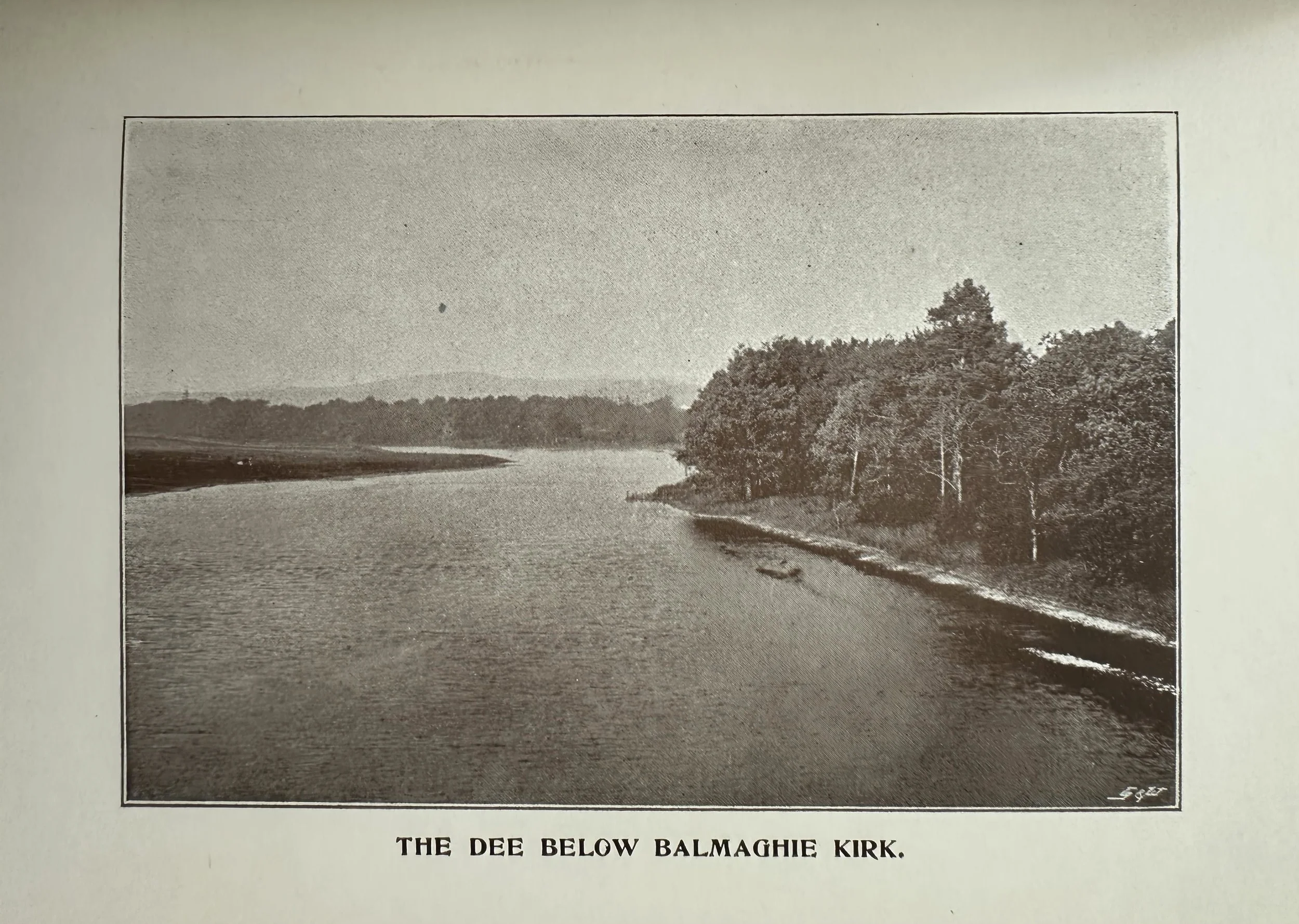
[Illustration: THE DEE BELOW BALMAGHIE KIRK.]
“The End of that Man.” 65
Note 3.—MACMILLAN’S FAMILY AND DESCENDANTS.—Macmillan married first Jean Gemble, died 1711, aged 31, by whom he had no issue.
Macmillan next married the widow of Edward Goldie of Craigmuie, who was a daughter of Sir Alexander Gordon of Earlston. She died 1723, aged 43.
Macmillan married, thirdly, Grace Russell, in 1725 or thereabout, by whom he had five children, viz.:—
(1) Josias, born 1726, “upon a Sabbath morning about six o’clock,” at Balmaghie Manse; died Feb. 7, 1740, aged 13.
(2) Kathren, born 1727; died Feb. 17, 1736, aged 8.
(3) John, born 1729.
(4) Grizel, born 1731.
(5) Alexander Jonita, born 1734; died same year, aged 6 months.
Josias, Kathren, and Jonita (Janet), are buried in Dalserf, and their gravestone, partially mutilated, is built into the platform of their father’s monument as before described. The inscription is as follows:—
HERE LYES THE CORPS
OF KATHR
JANNET M‘MILLAN,
DAUGHTERS OF THE
REVERINT MR JOH . .
M‘MILLAN, MINISTER
OF THE GOSPEL.
. . . JO. . . .
GRIZEL MACMILLAN married John Galloway of Sandyhills, near Glasgow, and had issue two sons and one daughter, Elizabeth, who married John Grieve, surgeon in Inverkeithing.
John Galloway dying in 1764, his widow, GRIZEL MACMILLAN or Galloway, married the Rev. John Thorburn, Reformed Presbyterian minister in Pentland. She died in 1767, leaving an infant girl.
Andrew and William Galloway, great-grandsons, restored the Macmillan stone in Balmaghie churchyard in 1843.
JOHN MACMILLAN II. married twice, and had by his first marriage six children, and by his second no less than twelve. One of his daughters married Rev. Thomas Rowatt, Scaurbridge Cameronian Church, Penpont. The youngest son of this marriage became an
66 The Kirk above Dee Water.
ironmonger and farmer at Newton-Stewart, which he left for Edinburgh. He died in 1880. A son of his, Thomas Rouet, Esq., still survives, and is in possession of his great-great-grandfather’s seal-ring, with crest and motto.
From John Grieve, the first husband of Grizel Macmillan, descends another surviving great-great-grandson, John Grieve, M.D., Glasgow.
Note 4.—MACMILLANS IN CHURCHYARD.—There is a remarkable number of Macmillans interred in Balmaghie churchyard. It may be interesting to subjoin a list, as complete as I can make it, after careful search:—
MACMILLANS BURIED AT BALMAGHIE.
Rev. John M‘Millan, died 1700, and his wife Catherine Williamson, died 1700.
Jane M‘Millan, spouse of John M‘Meiken, died 1850, aged 93.
Grisel M‘Millan, spouse to James M‘Cartney, died 1746, aged 66.
Agnes M‘Millan, “the disconsolate widow of a Christian and affectionate husband,” died 1805, aged 93. Her husband was Alexander M‘Cartney, died at Campdouglas, 1774, aged 64. Their daughter, Jane M‘Cartney, died 1829, aged 79.
Agnes M‘Millan, wife of Wm. M‘Gowan, died 1793, aged 78.
Wm. M‘Millan, merchant in Castle-Douglas, died 1824, aged 76.
Samuel M‘Millan, his son, died 1807, aged 18.
Alexander Macmillan, in Castle-Douglas, died 1838, aged 78.
Samuel Macmillan, his son, died 1843, aged 48. He married Margaret Hannah, and three daughters, Margaret, Mary, and Annie, are here interred along with her.
I have failed to trace the relationship—if any—to the great Macmillan, or to each other. I conjecture that Grisel M‘Millan, born 1680, may have been a daughter of John M‘Millan, the first minister of that name. I have not succeeded in determining any relationship between the two ministers. Perhaps they were cousins. There was a John M‘Millan in Barend in 1772, apparently a very old, and certainly a very poor, man, as he was reckoned not “good” for one pound sterling. He might have been a brother of Grisel, but no gravestone contains his name.