Reid A Cameronian Apostle XII.
James Dodson
CHAPTER XII.
1743-1753.
THE LAST STORM.
First regular charge under the Reformed Presbytery—Dispute over Fraser of Brea—Fraser’s doctrine of justification—Macmillan’s position—A vote taken—Disruption of Presbytery—Macmillan’s last days—His dying testimony—His favourite “promises”—And texts—“Yea, mine own God is He!”—Last moments—Appearance after death—His children—And descendants—Monument in Dalserf Churchyard—Mural brass in Balmaghie Church—Graves of Jean Gemble and Mistress Mary Gordon—Poetic tributes to the latter.
THE history of the “Reformed Presbytery,” as its founders called it, is so far connected with our subject, that we must follow it for its first few years of infancy. Mr. Hutchison’s valuable work may be consulted by those who desire further particulars.
Macmillan had now attained his “imaginary tribunal” in the shape of a “free, faithful, lawfully constituted judicatory.” Henceforward a veritable Presbytery met at Braehead, although, for a few years, the force of habit and the need of winding up old affairs convened the General Meeting as formerly. The latest minute is in August, 1759, when a desire was expressed for a “renovation” of the Covenants. The minutes of the new Presbytery, between 1743 and 1758, are unfortunately lost; but it is known that there was a “renovation” in 1745 under its auspices. By this time a third minister had been added, the Presbytery having laid its hands in ordination on Alexander
The Last Storm. 195
Marshall, who had long been favourably regarded by the Societies. Marshall was the first licentiate of the Reformed Presbytery. The venerable hand of Macmillan was laid on his head. It had performed no such Presbyterial function since the year 1702, when Gordon of Crossmichael was ordained. He took part in four subsequent ordinations. John Cuthbertson was ordained in 1747; James Hall in 1750; John Macmillan, his own surviving son, in 1750; and Hugh Innes in 1751.*
Macmillan did not live to see the formation of regular charges, the first of which, having a meeting-house, was at Sandhills, near Shettleston, a suburb of Glasgow. This, the oldest Reformed Presbyterian Church, had most appropriately his own son for its minister.† But this was not till 1781, when the venerable pastor had been many years in the grave.
As Macmillan’s ministry began in strong controversies, so it ended amid a violent dissension regarding doctrinal points. The dogma in dispute was one which has always afforded scope for division, the atonement made by our Lord. The discordant voice came from the grave. The Rev. James Fraser of Brea, while a prisoner on the Bass Rock, had written a “Treatise on Justifying Faith.” He died in 1698, and it was not till 1749 that the work was published. Its editor, a minister of the Associate Presbytery, was at once deposed. Macmillan’s attention was drawn to the book, and the Reformed Presbytery, shortly after its publication, formulated four propositions in opposition to its teaching. Briefly stated, Fraser’s teaching affected chiefly the extent of the atonement. He divided justification by faith into four different stages or classes:—(1) legal or fundamental justification, by the death of Jesus, in which all mankind have a share; (2) personal, obtained by conscious
_____
* Hutchison’s Hist., p. 190: Binnie’s Sketch, pp. 15, 16.
† Binnie’s Sketch, p. 80-83.
196 A Cameronian Apostle.
union with Christ; (3) declarative, or the justification granted to saints who have sinned, and (4) final, after the last judgment.*
The crucial point arose in reference to the first of these classes, the so-called legal or fundamental justification. Fraser found in the New Testament the frequent statement, that “Christ died for all.” He read Christ’s own invitation, “Come unto me, all ye that labour.” He knew that, over broad Scotland, the gospel-offer was made to all. Yet the ordinary view of the Confessional teaching regarding Election and Predestination was, that only a limited number were destined and chosen to benefit by Christ’s atoning work. He himself honestly believed this, but he desired to find some logical reconciliation between the free gospel-offer and this limited salvation. He imagined that he had found it in the distinction between legal and personal justification. Christ died for all, and all therefore have a legal right to the benefits of his death. But all will not be saved, because God has, in his mysterious wisdom, appointed that many shall never claim their legal rights. Many are, as he phrases it, “reprobates,” and die without further interest in Christ. They are not personally justified, but only forensically and technically.
Fraser’s illustrations make his meaning clearer. Two may be given, to throw light on his reasoning. The world of mankind is compared to a casket of jewels. Christ bought the world as one might buy such a casket; but He bought it only for the sake of the chosen few, as one might buy a whole casket for the sake of some special jewels inclosed within it, retaining these, and casting the rest away. Again, “reprobates” are compared to men in prison, with the door unlocked. Christ’s death unlocked the door, but “reprobates” die in their dungeon, because they will not walk out at the door.†
_____
* See Fraser’s Meditations on Justification by faith.
† Walker’s Theology and Theologians in Scotland, ed. 1888, p. 82.
The Last Storm. 197
Dr. Walker, in the work quoted below, has pointed out the fatal weakness of Fraser’s theory. It makes “the Father satisfied, and the Saviour the wrath-inflicter.” It may be added, that it is Universalism without Salvation, a shadow without a substance. The system is indeed full of such contradictions. Taking only the illustrations quoted, how absurd to cast away anything so precious as a jewel! How wasteful to buy a whole casket, for the sake of a small portion of its contents! And how unreasonable to condemn the prisoner for not going out at the unlocked door, when you tie him hand and foot with the bonds of a doctrine of reprobation!
The Reformed Presbytery, in opposition to this theory, formally declared that “Christ represented and died upon the cross only in the room and stead of a select number of mankind.” But James Hall, who had been licensed in 1750, espoused Fraser’s views, and soon a serious agitation arose in the little Church Court. Macmillan, owing to age and frailty, could not attend all the consequent discussions, but he wrote to his brethren in terms of anxiety and distress, pleading for the old teaching.
At last, in April 7, 1753, the storm reached its height. A formal discussion took place at Brounhill, lasting all day, and till late on the following evening. An issue for a regular vote was adjusted as follows:—“Whether Mr. Fraser’s maintaining that the Lord Jesus Christ satisfied for the sins of all mankind, so that His satisfaction may be competent to be proposed to them in the Gospel, and pleaded by them for their justification; and that this satisfaction is the ground and formal reason upon which this faith is founded—be a dangerous doctrine?”
Of the seven clerical members, only four were present at this meeting. Nairn had unhappily left the Church under scandal. Cuthbertson was in America. Marshall, the proto-licentiate, was ill. The remaining members were the two Macmillans, father and son, who voted together in condemnation of Fraser’s
198 A Cameronian Apostle.
teaching; and Hall and Innes, who voted for it. Out of five elders, who also took part, three voted with the Macmillans, and two with the minority. Next day, April 9, the minority tried to have the decision rescinded, but failing in this, they declared it null and void, since two members had been absent and a fundamental Christian doctrine had been denied. They further claimed to be the “essential parts of the Presbytery,” and talked of suspending and censuring the others. Finally, Innes, who was Moderator, abruptly closed the meeting, and along with his small following, left the place. They carried with them the Presbytery records, which were thus lost.*
It may well be supposed that such exciting scenes did not tend to prolong the life of the aged Macmillan. He was no longer equal to these Presbyterial conflicts, as he had been when he first laid his “Grievances” on the table at Kirkcudbright, and faced his wrathful co-presbyters. Some dim thoughts we may conceive passing through his mind, as the end swiftly drew near, regarding the emptiness of all these refinements and theological wranglings, the beauty of peace and love among brethren. Perturbatus egredior, said the ancient heathen sage; and Macmillan might have been pardoned if he had echoed the sad phrase. But the last days, now to be described, were not vexed beyond measure by painful reminiscences. And eternal peace settled at length on the worn brow.
The deathbed of Macmillan is associated with the Fraser of Brea controversy in a somewhat peculiar way, inasmuch as the contemporary account is an appendix to the Observations on a Wolf in a Sheepskin of Charles Umpherston. This curious little tract is now rare, but two perfect copies are in the New College
_____
* I have followed Hutchison’s account, History, p. 198, 199. He fixes this discussion and division at Edinburgh; but the Wolf in a Sheepskin locates it at Brounhill, pp. 10, 21.
The Last Storm. 199
Library, Edinburgh. The Observations, dated “November 15, N.S., 1753,” or November 4, O.S., were completed just sixteen days before Macmillan died, and possibly Umpherston embodied in them the aged minister’s own arguments. This paper is a critique of Messrs. Hall and Innes, who had recently circulated a statement of their case among the Societies. Incidentally, light is thrown on the strained relations between these two young clergymen and their spiritual father, Macmillan. The first discussion on Fraser of Brea’s doctrines took place, it seems, at Brounhill, not at Braehead. Macmillan had apparently made a change of residence. Here, the aged pastor “tabled” Fraser’s doctrines as unsound. At this conference, Umpherston accuses Hall and Innes of most disrespectful conduct. “ . . . frequently, when that pious (I say not sinless) old Man did speak,” they were observed “to turn their Faces, and make himself, and what he said, rather a matter of Buffoonry, than anything else; and, to my own Hearing, to express themselves in a most diminutive way, which I will not here mention.”* The young men, in point of fact, as the fashion of youthful presbyters too often is, considered Macmillan a fossil, and laughed irreverently at his antiquated views and phrases. They ridiculed his remarks on “Arminian texts,” on a supposed “threefold Covenant,” and on assurance of salvation. Such has been the mode of assertive youth in Presbyteries, up to our own day.
The controversy ended on April 9, as we have seen, in an act of petty larceny. Macmillan was fast drifting far beyond all such disputes. The criticisms of Umpherston were hardly ready for press, when it was seen that the end was very near. The particulars recorded cover the last week, beginning at a date “several days before his Exit,” when his friends, from near and far, gathered round his bed. No names are given, but in
_____
* Wolf in a Sheepskin, p. 7.
200 A Cameronian Apostle.
addition to his surviving son John, now aged 24, and his surviving daughter Grizel, aged 22, he had beside him his faithful friend and apologist Umpherston, whose medical skill lent special value to his presence. Umpherston’s trained eye noted the increasing weakness, with many other details which an ordinary observer would hardly have recorded so exactly. “His now crazy Body and failing Tabernacle could not supply him with Organs suitable to such a vigorous Soul, but was obliged after speaking some Time to rest a while.” He was asked his opinion about a recent manifesto of the two seceders, and was able to express it in round terms. “ . . . he was not only misrepresented, but notorious Falsehoods charged upon him, and had attempted to blacken his Character and Name, and sully his Reputation, now when he was going off the Stage.” Plainly, the “Buffoonry” of the younger men had wounded him deeply; yet he added that “he heartily and freely forgave Mess. J. H-l, H. In-s, and A. W-t (J. Hall, H. Innes, and A. Wright) what they had done against him . . . and leaves his Testimony against Universal Satisfaction”—i.e., against Fraser’s doctrine of legal or forensic justification: as described above.
He was “now dying,” says Umpherston, who professionally saw the signs which even a lay eye learns to notice. He was asked about his past life, and his attitude on Church questions. The brave old Covenanter never faltered. “ . . . he was fully persuaded of the Equity of the Covenanted Cause, and the Work of Reformation carried on from 1638 to 1649. . . . He was fully convinced it was the Lord’s Work and Cause, which he had many times signally manifested, by remarkable appearance for the same. And died in the firm Faith of it, that the Lord would yet own that Cause.” Yet he “thought the Lord would first come in a Way of Judgment against the Nations, that even the Lord’s own People need not expect to
The Last Storm. 201
escape a very sharp Trial for their Indifferency, and Lukewarmness, and sinful Compliance with Enemies. He further added, that were he to begin his Life again, he durst not counteract what he had done, in bearing testimony for these Truths that had been sealed by the Blood of a noble cloud of Witnesses; but would judge it his Duty to act the same Part again, abstracting from his Weakness and Infirmities. . . .” We can see, here, how the old man’s mind wandered back to the early days at Balmaghie, when he passed through so many stormy experiences. “Much he spoke to this Purpose, two days before his Departure, though his Strength was much exhausted, and oft faintish through weakness of Body.”
On the last day of his life, Friday, November 30, N.S., he still continued to recall the past. In answer to a question, as to whether “death was terrible to him,” he declared his “longing desire” to be with the Lord, and “broke out into a Rapture . . . and spoke much of the Sweetness of Communion with the Lord, which, he said, his Soul had many times remarkably experienced, as in other Duties, so particularly in Meditation, and Prayer, to which he had been much accustomed, and that from his Infancy, the Lord having begun the Work of Grace very early in his Soul. And said, that when he was but very young he had essayed giving himself away by solemn Covenant unto the Lord. . . . And then went through much of the Tract of his Life, recounting the Way of the Lord’s Dealing with his Soul.” We share the regret which follows, since these last reminiscences are very full of value: “But pity, much has escaped the memory of those who were present.”
The dying man now repeated many of the “Promises which the Lord had many times made most refreshing and comfortable to him, through his wandering Life, in the midst of Dejection and Down-casting.” The devout reader will find it a pleasure to read some of these, as noted below.
202 A Cameronian Apostle.
Fear thou not, for I am with thee; be not dismayed, for I am thy God.
I, even I, am He that blotteth out thy transgressions for mine own sake.†
Thou shalt guide me with thy counsel, and afterward receive me to glory.‡
My grace is sufficient for thee; for My strength is made perfect in weakness.§
In the midst of these pious ejaculations, great weakness seized him, and the thought of Family Worship entered his mind. It was night, and the ruling habit was strong in death. He named the psalm to be sung, and the Scripture lesson; then begged “one to go about religious Worship.” The “one,” left unnamed, was doubtless his faithful friend and doctor, Umpherston. When the prayer ended, Macmillan, with a “smiling countenance,” said:—
“Now again the Lord has been sealing to my soul, by His Spirit, all those promises that I spoke of to you, has confirmed them to me, and assured me, that in a little I shall obtain the full possession of them, and receive a crown of righteousness from the righteous Lord.”
Some friends came in at these last moments. He “desired again they might go about Duty, and come close to the Bed-side, that he might hear, and so join with them; for, said he, ‘I think I am fast going, and this will be the last time that I will join with you upon Earth, in serving the Lord.’ And so desired sing the first five verses of the 103rd Psalm; for, said he, ‘my soul rejoiceth in the Lord God of my Salvation.’” The Scottish reader hardly needs to be reminded, that it is this Psalm, sung to the plaintive tune of Coleshill, which forms the Nunc dimittis [Now let depart] of the communicants leaving the Holy Table.
_____
* Isaiah, xli. 10.
† Isaiah, xliii. 25.
‡ Psalm, lxxiii. 24.
§ 2 Cor., xii. 9.
The Last Storm. 203
Macmillan felt himself to be in extremis [at the point of death], and though none dreamed of giving him the Communion, he wished to depart rejoicing as one who had feasted, and was content.
Next, he ordered the tenth chapter of St. John to be read, and repeated the verses: “My sheep hear my voice, and I know them, and they follow me. And I give unto them eternal life, and they shall never perish, neither shall any man pluck them out of my hand.”* Then, as the prayer began, he begged “that they might all bless the Lord for his goodness, and pray that he might have a quick and speedy passage over the last Jordan into Immanuel’s land: further said, ‘O pray that the devil may be confounded, and prevented in his designs, for I know I shall yet have an attack from him!’”
Still, the aged Christian craved for Scripture song and word. At his request, a part of the 91st Psalm was sung, Qui habitat [He who dwells]; and the first chapter of St. Peter’s first epistle was read. It is that which concludes with the sad tale of the withering grass and falling flower, a theme fitting for those dark days of November; and then triumphantly contrasts this with the abiding Word of God.
At last the prayer was said, and then a fond memory came to him. Where was it written, Yea, mine own God is He? Some one said, it was in the metrical Psalm xlii., the very last line of it, and at his request the whole verse was read—
“For yet I know I shall Him praise,
Who graciously to me
The health is of my countenance,
Yea, mine own God is He.”
“Yes, I know,” murmured the departing pilgrim—“and am assured of it—Yea, mine own God is He!” “Then,” says the good surgeon, “complained he had no feeling in the little finger of the left hand.” Another friend engaged in prayer, and then
_____
* S. John, x. 27, 28.
204 A Cameronian Apostle.
“he said he thought he had no feeling in the left hand, so sensible was he of life departing from the Extremities of his Body.”
It was now “past midnight.” The clock had struck, and the first day of December was begun. It was almost the anniversary of his first sermon as the minister of the United Societies, preached December 2, 1706, forty-seven years before. The coincidence seems to have struck the narrator, since he refers to the date at the beginning of his narrative.*
“Upon which, it being said to him that, as he had ever been desirous of his Departure, and to be ever with the Lord, so it seemed to be evident, that the Time of his Departure was at Hand. Whereupon, he cheerfully replied, that he could welcome the King of Terrors, as a Messenger sent from his heavenly Father, to bring him to the Mansions of Glory; and added, ‘Lord, I have waited for thy Salvation.’
“Thus did his Soul continue to magnify the Lord to the last; and when his natural Strength failed, that he could scarce speak audibly, yet his Spirit rejoiced in God his Saviour.
“The last Words which he was heard to speak, within a few minutes of his last Breath, were, ‘My Lord, my God, my Redeemer, yea mine own God is He.’ And the few minutes remaining after he ceased speaking, he was observed to be in a praying and praising Disposition. And after he had fully finished his Course, with a pleasant Countenance, his Eyes lifted up, and his right Hand a little raised up to Heaven, he willingly resigned up his Soul to his beloved and faithful Saviour, in that full Faith and firm Persuasion, that with his Eyes he should see his Redeemer, and not another for him.”
“Thus comfortably,” adds the devout chronicler, “and joyfully, he resigned his Soul to God, in the eighty-fourth year of his age, on Saturday the 20th Day of November, O.S., 1753.”
_____
* Wolf in a Sheepskin, p. 39.
[Plate: FLY-LEAF OF MACMILLAN’S FAMILY BIBLE.]
The Last Storm. 205
Such a death needs no comment. It speaks for itself. The man who could die thus was no mere “bigot separatist,” or narrow sectarian. There was much in him of the patriarch, or even what Cunningham styles the high-priest. These incessant praises and readings and prayers bespoke one who had lived in the atmosphere of family prayers, and had been used to direct and appoint these daily devotions. And the right hand “a little raised up to heaven” (since the poor left hand was now dead), may seem to us a significant benediction on the sorrowing little Church. It must take us back, too, to the “high day” at Auchensaugh, where, as his right hand rose, a thousand others were lifted up to swear the solemn Covenant Oaths. What were the associations that made the words, Yea, mine own God is He, so dear, and drew them from his dying lips? We can but guess, and perhaps wrongly. But plainly enough there was an ancient sweetness in them for his soul. And perhaps they took him back to some summer day on the Minnigaff hills, when the field-preachers uttered their rough homely message, and men’s hearts burned within them with a sacred, passionate fire.
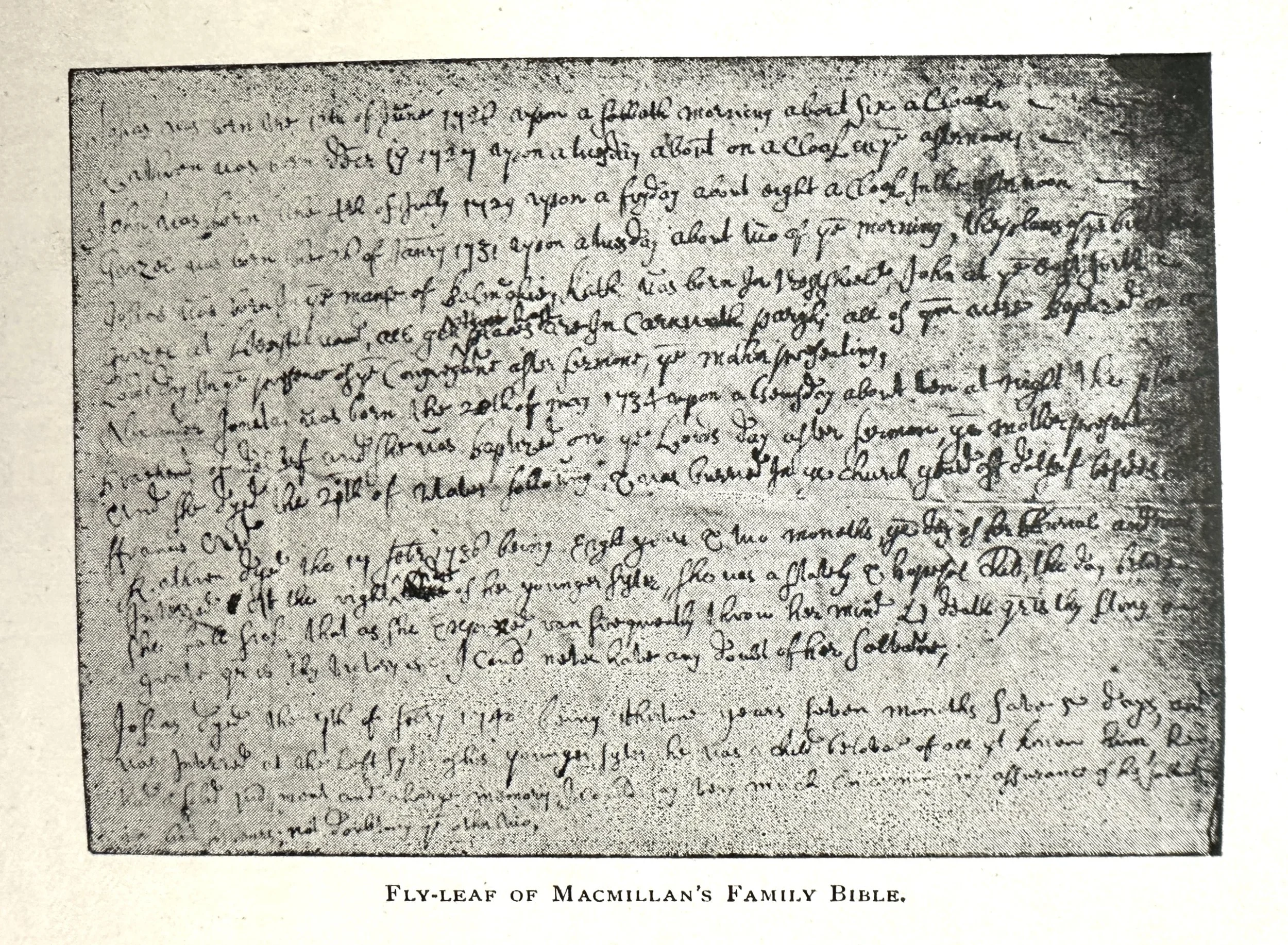
The story ends here, or to continue the figure of our chapter headings, the voyage is finished in port. But some few particulars must still be given as to Macmillan’s family and descendants. As we have seen, he was thrice married, but the two first unions were childless. The flyleaf of his Bible records the offspring of his third marriage, and touchingly sets down the death of three out of his five children. First, the infant daughter, quaintly named Alexander Jonita, died in 1734, aged 4 months. Then in 1738, died “Kathren,” a “stately and hopeful child; the day before she fell sick, that (as she expressed) ran frequently through her mind—‘O death, where is thy sting? O grave, where is thy victory, etc.?’ I could never have any doubt of her salvation.” The child was only eleven. Two years passed, and in 1740 Josias, the eldest of all, was called away, “being thirteen
206 A Cameronian Apostle.
years, seven months save 5 days. . . . He was a child beloved by all that knew him: he had a solid judgment and sharp memory. I could say much concerning my assurance of his salvation, but forbear; not doubting the other two.” The infant, Jonita, lies in Dalserf Churchyard, with “Kathren” on her right and Josias on her left. Near them their aged father, too, reposes, his great monument contrasting with the tiny fragment built into the base, with its mutilated inscription—
HERE LYES THE CORPS
OF KATHR . . .
JANNET M‘MILLAN
DAUGHTERS OF THE
REVERINT MR. JOH . .
M‘MILLAN, MINISTER
OF THE GOSPEL
. . . JO . . .
The “other two,” of whose salvation the kind old father doubted not, were John and Grizel. John, as we have recorded, was licensed and ordained by the new Presbytery in 1750, at the age of 21; and he lived till 1808. At his death, aged 79, he was minister of the Reformed Presbyterian Church in Calton, Glasgow, with John Fairley as his colleague during the last years. He was twice married, and one daughter became the wife of Thomas Rowatt, minister of the Scaurbridge Cameronian Church, Penpont. The youngest son of this marriage became an ironmonger and farmer at Newton-Stewart, which he left for Edinburgh. He died in 1880. A son of his, Thomas Rowatt or Rouet, Esq., is in possession of his great-great-grandfather’s seal, referred to in a former chapter.
The daughter Grizel married Andrew Galloway of Sandyhills near Glasgow, and had issue two sons, and one daughter Elizabeth, who married John Grieve, surgeon in Inverkeithing, whence he removed to Glasgow in 1794, and died there in
The Last Storm. 207
1820, aged 58. From him descended another great-great-grandson, John Grieve, Esq., M.D., Glasgow.
Grizel Macmillan became a widow in 1764, and married, again, John Thorburn, Reformed Presbyterian minister in Pentland. She died in 1767, aged 36, leaving an infant girl.
John Macmillan II. had a son, also named John, who was the first Professor of Divinity to the Reformed Presbyterian Church. He died in 1818, aged 68. The period covered by the ministry of the three John Macmillans extended from 1707 to 1818, or no less than about 112 years. The epitaphs on the Dalserf Monument, which was not erected till 1839, give these dates; and conclude by saying—“These preached the same Gospel, and ably advocated the same public cause, adorning it with their lives, and bequeathing to it their Testimony, and the memory of the Just.”
It is a “far cry” from Dalserf to Balmaghie; yet in the little parish church of the latter, a fine memorial brass was erected in 1895, bearing the following inscription:—
“TO THE GLORY OF GOD
AND IN MEMORY OF
JOHN MACMILLAN, A.M.,
Born at Barncauchlaw, Minnigaff, 1669:
Ordained minister of the Parish of Balmaghie 1701:
Accepted the Pastorate of the United Societies 1706:
Which office he laboriously discharged for 47 years:
Died at Broomhill, Bothwell, 1753. Buried in
Dalserf Churchyard.
A Covenanter of the Covenanters:
A Father of the Reformed Presbyterian Church:
A Faithful Minister of Jesus Christ.”
“This Tablet is placed here by his Great-great-grandson,
John Grieve, M.D., Glasgow, 1895.”
208 A Cameronian Apostle.
The tablet is placed above the manse pew, and at the north end of the church. The preacher to-day, as he lifts up his eyes from prayer, sees from the pulpit the burnished surface. He can, with ordinary eyesight, read the name in large letters. So, through the coming years, this mute reparation is made to one whom the parish loved, but the Church rejected. Outside, in the churchyard, the spot can be shown where Macmillan’s pulpit stood, for the east gable of the old church was partially preserved, for the sake of the fine monument to M‘Kie, Macmillan’s successor, which had been built against it. And near at hand lie Jean Gemble and Mistress May Gordon. To the latter, her husband wove a chaplet of verses:—
“Here lies, beneath this humble monument,
The precious dust of an exalted Saint:
A Mary rightly nam’d, whose gracious heart
Ev’n from her youth still chose the better part;
High Birth, Health, Honour, could not make her proud,
But Grace and Vertue made her great and good;
For piety and prudence liv’d renown’d,
And now is with immortal glory crown’d.”
A larger poetic tribute has been reprinted in our appendix. Both, like all Macmillan’s printed work, are anonymous, but unquestionably from his hand.
Macmillan’s own dust is in the churchyard of Dalserf, where the imposing monument has lately been renewed by loving hands. There, also, rest three children, but their mother’s grave is unknown.