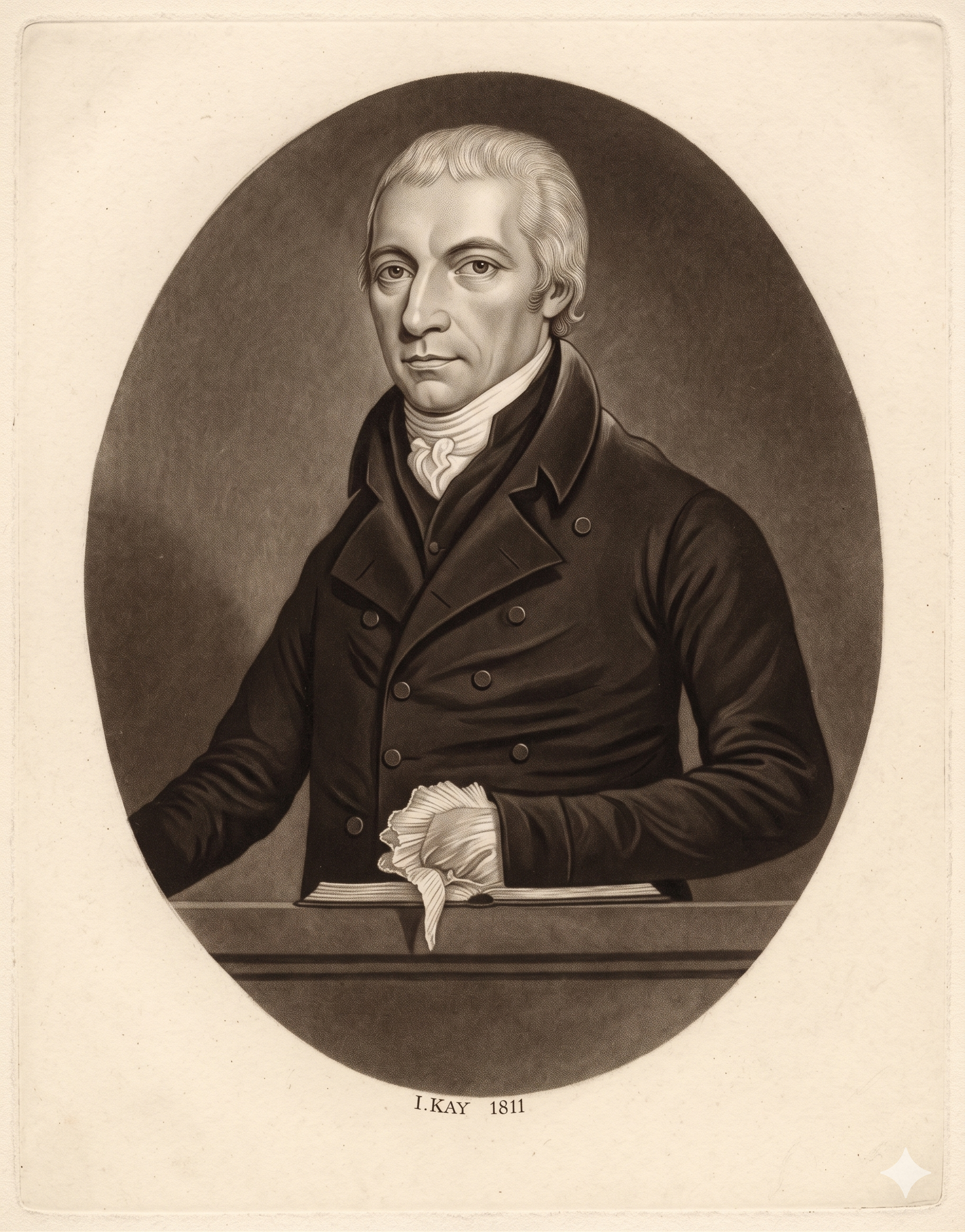
The Essence of Old Light Principles Extracted:
James Dodson
IN
A SERIES OF LETTERS,
ADDRESSED TO THE REV. MR CHALMERS, ON OCCASION OF HIS REVIEW OF A PAMPHLET, ENTITLED, CONSOLATION TO THE CHURCH, &c.
TO WHICH IS SUBJOINED,
A TWO-FOLD APPENDIX,
CONTAINING,
I. OBSERVATIONS UPON THE POSTSCRIPT OF AN ADDRESS TO THE ASSOCIATE CONGREGATION OF KELSO.
II. EXTRACTS FROM THE NARRATIVE, DECLARATION, AND TESTIMONY OF THE ASSOCIATE PRESBYTERY OF PENNSYLVANIA; WITH OBSERVATIONS.
By ROBERT CULBERTSON, LEITH.
But he turned, and rebuked them, and said, Ye know not what manner of spirit ye are of. LUKE, ix. 55.
Edinburgh:
PRINTED BY J. PILLANS & SONS, LAWNMARKET,
FOR OGLE & AIKMAN, PARLIAMENT SQUARE; M. OGLE, GLASGOW;
AND R. OGLE, LONDON.
1808.
[Page 1]
THE ESSENCE, &c.
LETTER I.
Sir,
YOUR late pamphlet, entitled, Address to the Associate Congregation of Haddington, comprehends a review of one lately published by me, entitled, Consolation to the Church, &c. For some time I was undetermined whether it would be most proper to allow your publication to sink unnoticed into the gulph of oblivion, or, by replying to its illiberal aspersions and strange misrepresentations, endeavour to bring it into more general notice. Convinced, however, that the more extensively it is circulated, the more obnoxious will the principles you have espoused become to every true Seceder, I have taken up the pen, and proceed to offer you my remarks.
It is not proposed to follow you through all the mazes of your controversy with the Synod; nor does this appear to be necessary. So far as your publication interferes with questions which have lately been discussed before that Court, it presents to the public only the meagre figure of what was originally dubbed a Remonstrance, but now wears the more conciliating name of an Address. While this Proteus was in the remonstratical form, he was attacked with great ability and success by the Synod’s committee. The victory which these champions gained over him was so complete, that, like a poor felon escaped from justice, he has been compelled to change both his dress and his name. As the labours of that committee are now published to the world,
[Page 2]
and contain an able answer to every reason of separation which you have advanced, it would be spending time to little purpose to attempt any additional reply.—It is only in so far as your publication bears upon my own character, and the conduct of the Presbytery with which I have the honour to be connected, and likewise upon the work which I have lately published, that it is proposed to offer any remarks.
Although you may not be disposed to admit, that the gall and wormwood of an irritated mind discolour the pages of your performance, very few, except those of your own party, will hesitate in agreeing with me, that this is the case. My object in this first letter, is to point out a few specimens of this, collected from the language you have made use of; and I hope to execute this disagreeable task with that coolness and moderation which become persons in every situation, the want of which is more inexcusable when composing in the quiet retirements of the study, than when engaged in the heat of debate. The task, however, which I have undertaken, is not of that kind which precludes the introduction of any thing facetious; and if now and then a laugh should be raised, I hope nothing that is rude or unmannerly will be uttered to excite it.
You have hardly introduced my name, till you seem inclined to strip me of almost every thing that is human. You will scarcely admit that I am possessed of the common feelings of a man, or that I have either the head or the heart of one of the human species. My Address to the people of Haddington commences with an expression of sympathy, which you would have your readers believe was totally feigned, otherwise I would not have been there.—Do you imagine, that sympathy to a distressed friend is more effectually expressed by keeping at a distance from him, than by paying him a visit in the time of his affliction? Job’s friends were of a different mind, and all men but yourself are of their opinion. Considering the work I was appointed to perform, my absence might have been an expression of mistaken sympathy to you, but would have been cruelty to those with whom I am connected by the tie of church-fellowship in your place. At any rate, you might have been so charitable as to have given me the credit of good intentions. Your
[Page 3]
words are, “If he (Mr Culbertson) had had any decent portions of that tender sympathy, it is probable that he would not have been there that day,” p. 78.
But this is nothing compared with what follows in the same page, where you say, “When this is considered, surely his application of Psal. xix. 20. to the objects of his address can scarce fail to fill one with horror.” Here, Sir, I cannot laugh; you compel me to be serious. The charge of blasphemy is so heavy, that no mind, except one that is absolutely void of all sense of religion, and regard to character, but must feel sensibly indeed under it. Before you had brought forth a charge of this nature, it might have been expected, that you would have examined the grounds well upon which you proposed to establish it. But passion and prejudice must have blinded you exceedingly, when you imagined, that in my Address there was any application of that precious text to the objects of my compassion at Haddington, or to any creature whatever. He to whom I have applied it, is the Infinite One. Read that part of my Address over again, and you will see that it is the naked truth which I am declaring. My words are these, “One infinitely greater than any of you had to say, Reproach hath broken my heart, and I am full of heaviness,” &c. Psal. lxix. 20. Under that load of reproach which was cast upon the people whom I addressed, I endeavoured to call their attention to the Prince of sufferers, and who was reproached as never man was; and in so doing, I think I had a good pattern to follow; when I had that of Paul in his address to the Hebrews, chap. xii. 3., where he says, “Consider him that endured such contradiction of sinners against himself, lest ye be wearied and faint in your minds.” I have made no application of that text but what you yourself must have frequently done when it came in your way. It was therefore natural for one in your condition to feel uneasy, when you were giving to the world such an unjust and shameful representation of my sentiments. I have a better opinion of you than to imagine that you could traduce your old friend as a blasphemer, while you must have been persuaded, that you had no just ground for it, without feeling some degree of horror even at the attempt.
One might have thought, that your resentment would have
[Page 4]
spent itself when you had proceeded so far as to represent me in the manner you have done in the passage last quoted. But a revengeful spirit, like the grave and the barren womb, never says, It is enough. Accordingly, you speak of me, in p. 81. as going on, “in spite of truth and a good conscience, to tell the people, that the Synod are contending for no other principles than those which were avowed by the Associate Presbytery,” &c. If this expression, in spite of truth and a good conscience, has any meaning at all, it is certainly this, that I told the people of Haddington a most deliberate lie. What else can be the design of classing my opposition to truth and a good conscience together, if it is not to insinuate, that my conscience was not so faithless as not to tell me roundly, that what I was going to utter was a falsehood, but, in spite of all the remonstrances of this good conscience, I persisted in uttering lies?—But why should I wonder that you have given me the abominable character of a liar, when I find the majority of my fellow-presbyters characterized in a manner that is no better. For you speak, in p. 95. of only some among us having any remaining sense of duty and propriety. And that this stigma upon our moral and ministerial characters might be the more attended to by your readers, you have been so shameless as to print it in a different character. If there are, then, only a few among us who have any remaining sense of duty and propriety, the great majority of that Presbytery, of which you were so lately a member, must be nothing but a set of hardened villains. Pray, Sir, to which of these two parties did you belong? You will very likely say, that you were in the minority. And is it by bringing forth such hideous charges against others, that you demonstrate your own sense of duty and propriety? Whether you consider my conscience to be good or bad, I do not think it would have permitted me to bring forth a charge of this nature against any set of men whatever. I am not inclined to say of Popish priests, nor even of the priests of Baal, that they have no remaining sense of duty or propriety.
But the odious imputation you have put upon me, reflects upon the whole Associate Synod; for in declaring that we are contending for no other principles than those which were avowed by the Associate Presbytery in their answers to Mr Nairn, I
[Page 5]
have said nothing but what the Synod themselves have declared. Of course the whole of that venerable body must oppose truth and a good conscience. If we are such rascals, how could you continue so long with us as you have done? How could you with a good conscience sit in last meeting of Synod, and not open your mouth against a single lie that was uttered, or decision that was passed? All the lies at last meeting have received the sanction of your approbation; for though you attended both weeks of the meeting, you neither protested, nor remonstrated, nor dissented, nor even opened your lips against one thing that was done.—Will such a mode of writing add any thing to the respectability of your own character, or that of the Associate Constitutional Presbytery, of which you are now a member? By these hard sayings, you have injured yourself far more than you have done me, or any of those with whom I am connected in ministerial fellowship. Few persons will believe us to be such men as you have endeavoured to represent us; the recoil, therefore, of this piece of heavy ordnance must be terrible against yourself.
Having thus attempted to place me on some kind of footing with him who was a liar from the beginning, and who was never supposed to have any regard to truth or conscience, you are at length so indulgent as to bring me back again to my old connections in the human family. But, alas! the condition in which you set me down, is a most degraded one. It is not in the asylum of the blind, for there I would not have been precluded the enjoyment of rational pleasure; nor is it in the hospital of the afflicted, for there the mind might have had strong consolation; but it is in the cell of the lunatic, or the house of the bedlamite: For one while I am represented by you as raving, p. 117.; and at another, you express a wish, that my understanding may not be departed from me, p. 93.—When you reflect a moment upon these expressions, do you not think that your own publication is a flat contradiction to what you insinuate about my idiotism or derangement? Would any man in his sober senses spend upwards of fifty pages in reviewing the reveries of a fool?—Without making farther observations upon this head, I shall leave you to reconcile your own conduct to-
[Page 6]
wards the man that raves, by your superior measure of intellect.
In another passage you seem inclined to give me a portion with the beasts that bellow. Speaking in allusion to the calfish mode of worship which prevailed in ancient Israel, you say, p. 45. “After the example of these at Dan and Bethel, we may see calves set up at London, at Edinburgh, or at Leith.” Had you contented yourself by making mention only of the two first, every person would have thought that you meant nothing rude; and that these two cities were mentioned rather than others, because they were of greatest note in the United Kingdom. It is manifestly with this harmless design that you introduce Dover and John-o’-groat’s House. But when you class the town of Leith with London and Edinburgh, every person will see what is your aim. It was well that your sense of propriety kept out Haddington; for otherwise some wag might have said, These calves will be four brethren.*
Though you have sent me for a season to graze with the beasts of the field, you are nevertheless obliged to admit that I am possessed of such a measure of understanding, that the Presbytery of Edinburgh judged me qualified to be the Jack Ketch in the tragedy, p. 76.† This name is introduced with such familiarity, that your readers must be inclined to suppose he is a very intimate acquaintance of your own. You have likewise alluded to his duty with such plainness and perspicuity, that one would imagine you are up to all the secrets of his profession. If he has got any thing in his line to perform at the west end of the Luckenbooths, or in the Grassmarket, I shall leave you to give him your best advice how he may do his duty quietly†.
_____
* This expression is not intended as an insult to Mr Chalmers, or to any of his brethren, or any other man; but simply to shew with what facility low scurrilous language may be retorted upon those who use it.
† Unless it had been published to the world, we could hardly have expected that any minister of the gospel, not to mention a Seceding minister, who has espoused a Testimony for the discipline and order,
[Page 7]
Your scurrilities, Sir, are endless. There is scarcely a page of your pamphlet, in which the language of Billingsgate is not to be found. To retail any more of it, would be insulting to my readers, as it would imply a suspicion of their being capable of finding entertainment in stuff of this kind. I cannot, however, close this epistle, without adverting to your ungenerous treatment of a fellow-presbyter, who, to use your own language, never did you any harm. In p. 95. you tell your readers, that “a young member, who will perhaps become wiser as he gets older, insisted, it is said, to have the sentence of deposition passed, and to apply to the Synod at their next meeting for an explanation of it.” You tell this idle story as a matter of report, with an it is said. If any has said so, it is most likely to have been some of your own party. While the Presbytery were deliberating upon your elopement, I observed one or two of that faction looking on. If they have brought you this information, I can assure you it is false: they have strangely cabbaged or spunged this piece of stuff. Is your opinion of your former friends so completely altered, that you can imagine any of them capable of making such a foolish proposal? I hardly think there can yet be such a revolution in your mind. What, then, can be the design of this silly story, but to blacken the reputation of another,
† as well as for the doctrine and worship of the house of God, would have set the ordinance of deposition in the degraded light which Mr Chalmers (I hope inadvertently) has done. If the minister who intimates that sentence is an executioner, it is easy to see what sort of a matter deposition itself must be. Persuade others that ecclesiastical office-bearers, acting the part of disciplinarians, are so many hangmen, and they will not entertain a very favourable opinion of church-discipline. If Mr Chalmers should say that he only alluded to Jack, because he was convinced that the grounds of his own sentence were irrelevant, this never can be admitted as an apology; for whether the application of that censure to him was right or wrong, this does not affect the nature of the ordinance. Deposition is still a divine institution; and those who are employed about it, discharge a more honourable service than common executioners have got to perform.—Religion apart, I ask you, Sir, was it like a gentleman to compare your late brother to a hangman?
[Page 8]
another, by reporting to his prejudice what you do not believe to be true*. We do not exculpate ourselves from the charge of lying, if we only say that we did not invent the story. If we report for truth what another has invented, that he may be credited, while at the same time we are under strong impressions that it must be false, we are to all intents and purposes chargeable with the low vice of lying. The resetter and the thief, you know, are always considered to be brethren; and no person but supposes that the liar and his co-adjutor are near of kin. “For I heard the defaming of many; fear on every side: Report, say they, and we will report it. All my familiars watched for my halting, saying, Peradventure he will be enticed, and we shall prevail against him, and we shall take our revenge on him,” Jer. xx. 10.—I am, &c.
_____
* When the Presbytery were deliberating upon the grounds of Mr Chalmers’s sentence, the abstract question about the extent of deposition happened to be introduced, and a desultory conversation followed, till the Moderator, who happened to be the young brother alluded to, interfered, by reminding the Presbytery, that the question before them did not properly respect the nature or extent of the censure, but the grounds upon which it was proposed to establish it; and that, as it did not belong to individuals or to inferior courts to introduce special views of church-censures, the regular course was to bring in an overture to the Synod, to settle matters of discipline and order. This was certainly a very different matter from what Mr Chalmers hath represented. Nothing but extravagance could have supposed what he hath imagined, and nothing but the most singular disposition to make his brethren appear as contemptible as possible, could have induced him to publish it!
[Page 9]
LETTER II.
Sir,
MY last contained a few specimens of your scurrilous mode of writing. If this sort of mean personal abuse is gloried in by the members of the Constitutional Presbytery, it gives me pleasure to think, that I do not know of an individual belonging to the General Synod, who would not blush to be the author of such scurrilities. In this I propose to lay before you a few specimens of your misrepresentations. I do not call them falsehoods, because I wish to entertain a much more favourable opinion of you, than to suppose that you would either speak or write beside the truth. But as some of them are so glaring, you have certainly laid yourself extremely open to suspicion. I have seldom met with a performance where the statement of facts was more loose and incorrect, or where the writer manifested greater keenness to draw inferences and conclusions, which, upon a very little reflection, he might have been satisfied would not bear the test of examination. You sometimes deal in tragedy, it is natural to suppose that you sometimes deal in fiction likewise. Had not these two been nearly allied, it is most likely that Shakespeare had not written so much for the stage, nor would our theatres have been so well attended. Whether you have used a little of the poetic licence, or not, will best appear from what follows.
Near the beginning of your Review, at the bottom of the foot-note, p. 78. you represent me as having joined in voting your deposition, for no other reason but because you could not renounce several important parts of principle which you had become bound to hold. This, Sir, I call a misrepresentation. I never voted for your deposition, nor for that of any of your brethren, upon such grounds. If I were to repeat what I have elsewhere asserted, that the Synod never denied you the liberty of retaining all your peculiar principles about the magistrate’s power, provided you would not disturb the peace of the church, you might very probably give the same answer as you have formerly done, and, in your own grovelling dialect, might say, that
[Page 10]
that it stinketh, p. 101. But, Sir, the truth will never corrupt; and if any ill savour is emitted, it must proceed from those who pervert it. You have favoured the public with a reading of your sentence of deposition. Let us then turn over to that official paper, and see what the grounds of your deposition are: “Mr Chalmers for some time past has been following divisive and schismatical courses, calculated to break the peace and harmony of the body, and particularly of the congregation of Haddington; he has declined the authority of this Presbytery, and given up with all ministerial and church-communion with the General Associate Synod; and his conduct is now aggravated by his obstinately refusing to return to his duty, and take back his paper of Protestation and Declinature.” These, Sir, are the grounds of the sentence passed on you; and you admit, in p. 100, that these are the only grounds upon which it rests. With what face, then, could you represent me, or any of my brethren, as having voted for your deposition, because you would not renounce certain principles? I am sure that, in the above paper, there is not one syllable about principle to be found. How could you write such a declaration, and likewise insert the Presbytery’s sentence at full length? A moment’s reflection might have suggested to you, that every one might not be disposed to take your mere assertion for proof, and that some might be at the trouble to compare what was said with the legal evidence which you had brought forward, to see whether the charge was established or not. Had you not endeavoured to disturb the peace of the church, and presented a formal declinature to the Presbytery, to this day you might have been one of the ministers of the General Associate Synod, and, for any thing I ever saw of a disposition to the contrary in any of my brethren, you might have carried your Old-light principles to the grave with you, without ever meeting with any molestation from us upon that head.
With regard to what is said in the same note, about Mr Bruce and yourself assisting in my ordination, the one preaching in the forenoon, and the other in the afternoon, on that occasion, I shall only reply, that in matters of religion I am taught to call no man father. “Levi said unto his father, and to his
[Page 11]
mother, I have not seen him; neither did he acknowledge his brethren, nor knew his own children,” Deut. xxxiii. 9. If you have followed Mr Bruce because you were his colleague on the day of my ordination, I am not inclined to follow either one or other of you upon such a pretext.
In p. 79. you misrepresent the controversy betwixt the Synod and yourself, by asserting that the Synod have “stated a controversy with the Standards of the Church of Scotland, and with the Testimony of the Associate Presbytery.” I know of no quarrel that the Synod have ever stated with these standards. They have quarrelled with your interpretations of them, but with the standards themselves they never found fault. The Westminster Confession of Faith is still the confession of our faith, and the Testimony of the General Associate Synod is only a new display of the Testimony of the Associate Presbytery. If you say, as you have already done, That it is not; I have an equal right to say, That it is. Affirmation is just as good proof on my part, as negation on yours. But I can likewise add, as an evidence of my own conviction, that, were there any occasion for it, I am in readiness to comply with the advice which you frequently tender, of taking the old Formula again. You frequently put me in mind that I have sworn that Formula; at these intimations I take no offence. Whoever puts me in mind of my duty, or of my engagements, does me a service. But if, by these intimations, you would have your readers believe that I have renounced these bonds, be so kind as correct this mis-statement in your next edition, for I consider it to be both my glory and my interest, as well as duty, to adhere to them all.
Your reflections in the paragraph alluded to are concluded with another misrepresentation, which is given in the following words: “It is a deceitful view that he (Mr Culbertson) gives of the difference between the Synod and the brethren whom they have deposed, as if it lay in a diversity of opinion about the power of civil rulers in matters of religion. There are various other very important things about which they differ, as I have endeavoured to shew you.”—Where is it that you have shewn them? Not, I am sure, in your Address, nor in your Review,
[Page 12]
nor in any of your Notes. You quarrel with the Synod’s doctrine upon the subject of covenanting, and you find no less fault with their doctrine upon liberty of conscience. But what is the ground of your quarrel with the Synod upon both these? Is it not the magistrate’s power? It turns wholly upon this hinge. Will Mr Chalmers refuse this? The magistrate’s power is the only banner I can see displayed in this field of controversy with the Synod. It stands upon the front and rear, and upon both flanks of your army. It is, in short, the motto upon every thing for which you contend with the Synod; and I have sometimes thought, that if you had taken an appropriate designation to yourselves as a court, you would not have called yourselves the Constitutional, but the Magistratical Presbytery. If you could persuade the people that there are various important matters, besides the power of the civil magistrate, about which you differ in opinion with the Synod, many of them, I have no doubt, would be alarmed. Classing us so frequently with Socinians and Sectarians, in a general way, and representing our principles as more nearly allied to those held by these sects, as is often done in the Brief Statement, is doubtless intended to excite alarm; but this mode of writing is only calculated to impose on the unwary and inattentive reader. It is well known, that the power of the civil magistrate is the trunk, and all the various important articles are the branches of the tree. Cut down the first, and the rest will fall to the ground. Throw this out of the question in debate, and we have in fact no controversy remaining.
In your Address, I find indeed one article, wherein you pretend to state a difference with me, though not with the Synod, and with which the question of the magistrate’s power has no connection. It is near the middle of the Note, p. 8. wherein you tell us, “that in the late revival of the Latitudinarian scheme of communion, by the erection of new societies, composed of different denominations, for foreign missions, the condemnation of which was warmly opposed by Mr Culbertson, among others.”—When you were reviving this old controversy, you should have mentioned those others who acted with me, so that, if you meant to bestow any eulogium upon me, they
[Page 13]
might have come in for their share of the praise. Though you may not recollect the names of all those who were upon the same side with me in the missionary question, yet I think you can hardly have forgotten some of them. Was not our late brother Mr Hog one of the number? And what a pity, that in aiming this thrust at me, you should not have spared the reputation of one who is no longer in this militant scene to repel the calumny! But here, as in many other things, you blunder egregiously. My opposition was not in the way of maintaining that the constitution of any of these societies was right, but that I did not think it was yet proper for the Supreme Court of the Secession to interpose, by a solemn sentence respecting them. The societies were then only forming; the object of their association was the grandest that could be conceived, but how they were to act remained yet in a great measure to be disclosed. I therefore thought that it was sufficient, in the mean time, to publish a warning to the people to do nothing in the missionary business, or in any other matter, that was contrary to their profession. And I still think that that plan was the best. It had less tendency to irritate, than the rigid measures said to have been pursued by some, after they got new light upon that matter.—You no doubt, by this representation, try to hold me up as a kind of Latitudinarian; but I have the satisfaction to think that few persons suppose my principles to be of that cast. Lest too many things should be crowded upon your attention at once, I shall conclude this epistle, and embrace a future opportunity of addressing you upon some other misrepresentations in your pamphlet.—I am, &c.
[Page 14]
LETTER III.
Sir,
IN the course of your Address, you labour hard to convince your readers that the Synod have changed their ground, and stand no longer, as a public body, where they originally were. As a corroborative proof of the truth of these allegations, you represent me as speaking the sentiments of my brethren, as well as my own, upon the subject of covenanting, and the original Secession Testimony, and endeavour to construe these sentiments into a condemnation of both. You have a piece of very singular misrepresentation upon the first, in p. 87. where you say, “It is astonishing with what effrontery he (Mr Culbertson) censures the mode of covenanting which was agreed upon by the Associate Presbytery, and has hitherto been practised in the Secession, as falling short of at least one leading design, and with what satisfaction he triumphs at the thought of its having come to its end.”
When I entered upon the drudgery of reviewing your harsh sayings and singular misrepresentations, I endeavoured to arm myself against irritation, and resolved not to render railing for railing, though I should meet with many a coarse expression, and many a falsehood too. Yet, Sir, when things of the most serious nature are laid to my charge, while you must be sensible that you have no proper ground to proceed upon in these charges, it is far from being easy to pocket such insults. As you must know that the charge you have brought against me in the passage quoted from your work is a vile calumny, were it not for the sake of others, I would make no other reply than simply to deny it. My readers, however, will expect that I should say something further, especially as you have brought it forth accompanied with such strong asseverations respecting its truth.
I ask you then, Sir, in what part of my pamphlet have I censured the mode of covenanting which was agreed upon by the Associate Presbytery? When or where did I ever triumph at the thought of its having come to an end? Any triumph of this
[Page 15]
kind must have been in a thing of nought, as the same mode of covenanting is practised in the Secession to-day that was in use at the beginning; and as I am a hearty friend to this mode of covenanting, it is not likely that I would concur in any vote of censure upon it. The passage you have quoted from the foot-note of p. 12. of my sermons, affords you no proof of what you alledge; and it is so plain, that it will not even apologize for your misrepresentation. There I have said, that “I am not without apprehensions, that before the Synod had completed the review of their public standards, covenanting, as practised among them, was beginning to fall short of this leading design,” viz. to be a bond of union and confidence among the covenanters, that they will strengthen one another’s hands, and encourage one another’s hearts, in the way and work of the Lord. And who that knows any thing about the state of matters among us at the time referred to, can entertain a doubt of this? Do you yourself entertain any? Is not the controversy that is presently managed betwixt us a mournful proof of this fact? All public religious covenanting must bear upon the public profession of the body; and what confidence can it beget in the minds of covenanters about that profession, while they are not agreed in their views about its articles? Could you, in the way of retaining all your peculiar principles about the civil magistrate’s power, join in public covenanting with me, while avowing principles directly the reverse of your own? Covenanting in such circumstances would not only defeat its design, but would be a prostitution of the ordinance. It is this juggling mode of covenanting which I have condemned; and I think even the church of Rome herself would be ashamed of it. But do the censures I have passed upon this mode of covenanting imply any censure upon that which was agreed upon by the Associate Presbytery? No; I can honestly condemn all covenanting of the one kind, and with equal honesty I can approve of the other.
As practised by the General Synod, it is the same species of covenanting, and it is managed in the same way as practised by the Associate Presbytery. You are the men that have passed the severe sentence upon the Presbytery’s mode of covenanting, when you insist upon persons joining in this ordinance in a two-
[Page 16]
fold capacity, as members of the state, and members of the church, in a religious, and also in a civil character. It is admitted even by yourself, that our fathers set about covenanting as a witnessing body, p. 89. Is it in any other capacity that the Synod set about it? Where then is the difference betwixt the Synod’s mode of covenanting, and that of the Associate Presbytery’s? And as you plead so strenuously for covenanters joining in a civil as well as in a witnessing character, you must plead for a different species of covenanting, and for a different mode of procedure in that work, from what hath been in use in the Secession; and if these are your principles, you must be the party that have left their old ground; and the General Synod will be disposed to triumph, not that you have left them, but that they themselves continue where they originally were.*
_____
* In the foot-note to my Address, there is an opinion expressed respecting the difficulties which lie in the way of the Protesting brethren’s procedure in covenanting, as hitherto practised in the Secession. That note seems to have been like a volley of grape-shot amongst them; it has excited a scream from all their writers, and they are astonished how I should have conceived an opinion of that kind. My reasons are the two following: 1st, The Associate Presbytery set about that duty as a witnessing body. Mr Chalmers himself hath admitted this. I then propose this simple question, Whether do men sustain the character of witnesses for Christ as members of the church, or as members of the state? If it is only in the first of these that we can be said to be witnesses in matters of religion, how then can the Presbytery’s mode of covenanting be practised by the Protesters, while they contend for persons joining in that duty in a civil as well as in a religious character? This is not only a different mode, but a different species of covenanting.—2dly, Covenanting, as practised in the Secession, was not the making of a new covenant, but the renovation of a former deed, viz. of the national covenant of Scotland, and of the solemn league and covenant of the three nations. Our fathers did not consider these deeds to be national because they were sworn “by the national representatives, and by the people in obedience to national authority,” but because persons of all ranks, and
[Page 17]
You next proceed to represent me as making an attack upon the Judicial Act and Testimony, p. 91. To this misrepresentation I can only reply as to the former, that I have neither done this; nor was it in my heart to do what you have so unjustly laid to my charge. I have said indeed, that if that testimony contains both old and new light principles, it must be inconsistent and self-contradictory. And who would not concur with me in that opinion? But while I hold, that the Synod can shew from the standard-books, which have been in use in the Secession from the beginning, that their present principles are those of the Associate Presbytery, I have no where said that you are able to do this with regard to your principles: I have therefore brought forth no charge of contradiction against these standards. The attack was made upon your peculiar principles, and not upon any public papers, either of the Presbytery or of the Synod. The glare of Old-Light appears to have exceedingly injured your organs of vision; yet I cannot believe you are so blind as not to perceive this. But if you can hold me up as an enemy to covenanting, and to the former Testimony of the Secession church, and make your readers believe that it is all truth which you say against me, I have no doubt but you will reckon that an important end is gained. For though I am only an insignificant individual in that respectable body of which the General Synod is composed, yet if your readers entertain such an unfavourable opinion of my sentiments, they will very probably entertain the same unfavourable opinion of those of my brethren. The whole Synod will then be considered as an apostate church, and all that have any regard to the original Testimony of the Secession, will most likely come over to your camp. If by this means you think of gaining proselytes, the goodness of your intention will never
_____
[continued from page 16] the great body of the nation, at least in Scotland, joined in them. They therefore thought they were perfectly consistent in setting about their renovation, though they had none of the national representatives to concur with them; but as our brethren make their nationality to rest upon the act of the representatives, and the authority of the nation, with what consistency can they renew their deeds without a parliamentary concurrence?
[Page 18]
justify your measures.—I have already told you, that I am as friendly to the Associate Presbytery’s mode of covenanting as you are; and instead of triumphing at the thought of its being buried, few things would bury me sooner to my own grave, than to be assured of the burial of that work. I can likewise assure you, that instead of being hostile to the former Testimony, I have taken in accessions to it since the new one was enacted. And if any person, who is found otherwise qualified for admission, shall signify his inclination to express adherence to the old, while at the same time he means nothing disrespectful to the new, I am in perfect readiness to receive him into the arms of full fellowship; and I know not of a single elder in the session of Leith, but would be ready to receive him upon the same terms. Why then stigmatize me as an enemy to that Testimony? Do not cast fire-brands, arrows, and death, and then say, Am not I in jest?
The contradictions you try to palm upon me in p. 110.—113. are the fruit of as singular misrepresentation as is to be found in the whole of your performance. You introduce the subject of your sarcastical observations in these pages, in the following terms: “We find him (Mr Culbertson) saying, p. 29. The Lord brought again Zion, by stirring up the spirit of rulers to employ their station and influence to promote the work of God. In illustrating this, he refers to various instances; and concludes the paragraph with this sentence: At the return from Babylon, the godly princes in a very eminent manner employed their powers of office for the good of the church; and if kings are to be nursing fathers, and their queens nursing mothers to the church in the latter days, must not those persons employ their office-powers in the same way? Amen, Mr Consolations and Address. I know not whether you distinctly understand what you were saying. But I understand it well; and it has my cordial assent.”
Though you have told us, that you understand my meaning well, yet as I have already shewn your ipse dixit must not always be received as good evidence, one cannot read over the first part of your remarks upon the passage you have quoted,
[Page 19]
without entertaining a suspicion as to whether you really understood its meaning or not. Before you are entitled to full credit here, we must have it ascertained whether you are really capable of distinguishing betwixt a negative and an affirmative proposition, or betwixt an objection and an argument. One would think it were an easy matter for any person of an ordinary capacity to do this, though he should not have all that extensive acquaintance with foreign authors which you pretend to. Yet, simple as this branch of knowledge is, you have betrayed a singular want of it here. What is meant as an objection, and is accordingly stated in that form by way of interrogation, you have commented upon, as if it were an argument, or an affirmation. What writer would reckon his productions safe in the hands of those reviewers, who had either so little sense, or so little candour, as to state his objections for arguments, and his arguments for objections? In this manner you have attempted to do with mine, and I appeal to every candid mind if this is fair dealing.
If you really mistook the meaning of the interrogation with which the paragraph is closed, to prevent a mistake of the same kind for the future, I shall throw away that crooked thing called interrogation, and state it with such simplicity, that I think a child may take up what I intend. It is this: “At the return from Babylon, the godly princes, in a very eminent manner, employed their powers of office for the good of the church; it has therefore been pleaded, that the rulers of the kingdoms of this world should employ their office-powers in the same way.” The paragraph that immediately follows is an answer to that objection, and runs thus: “We have been often told what Nehemiah, Zerubbabel, and the godly reforming princes among the Jews did; and we have been as often reproached as if we were robbing Christian princes of their legitimate powers, because we refuse their right to do the same. Because the Jewish rulers did so and so in the matters of religion, it has been inferred that Christian princes may do the same. But this is bare assertion, instead of argument. It ought first to be established, that the princes of the kingdoms of this world have the same office-powers with the Jewish rulers. Unless this point is established,
[Page 20]
there can be no argument taken from the powers of office which belonged to the one, and applied unto the other, &c.
When I read the first part of your remarks upon the passage alluded to, I thought you had afforded me an excellent opportunity of apologizing for many of the severe things you have said, from an apprehension that you had mistaken my meaning. But you have been so ungenerous as to deprive me even of the satisfaction of appearing in the character of an apologist; for the latter part of your remarks carry sufficient evidence along with them, that you understood my meaning well. Hence, towards the bottom of p. 111. you say, “Do you imagine that you are at liberty to use the word of God, even out of the pulpit, as jugglers dexterously turn their hands to impose on the simple people; first seeming to grant power to Christian magistrates, and then by turning a point of interrogation to retract it all?” Here, Sir, you completely outwit yourself; for you admit that the point of interrogation was intended to intimate that I did not grant those powers which you plead for. With what assurance, then, could you say in your preceding remarks, that I had granted them? Will the same proposition both deny and affirm? You may as well say that the same assertion can be both true and false, or that Old and New Light are all one. Yet, strange to tell, you assure us that you understand its meaning well, viz. that it amounts to all that you plead for, and is one of the best sayings in my publication; and ere you get to the bottom of the next page, you assure us, that my words are to be understood in an opposite sense, and that I have granted no such thing as office-powers to civil rulers in matters purely religious. If you think I have acted the part of a juggler well, I am sorry I cannot return the compliment. I do not think you will acquire much fame by the tricks you have here attempted to play upon Mr Consolation. It will require both juggling and jesuitism to reconcile your contradictions.
After you have given vent to a singular vein of low irony and ridicule upon the paragraph quoted, you tell us, p. 113. that you “should have left this part of Mr Culbertson’s sermon to sink beneath the mass of its own absurdity, were it not necessary to detect some very gross sentiments which he has vented respecting
[Page 21]
the civil policy of the Jews.”—It is natural for one in my circumstances to ask, What may some of these gross sentiments be? The first that you have branded with this red-hot iron is this: “He (Mr Culbertson) teaches, for example, that the Jews had properly no civil government.”—And is this, Sir, a gross sentiment? In what does its grossness consist? The heresy lies here: It is at open war with the doctrine of Old Light; for if the Jews had properly no civil government, they could not be said to have any civil rulers properly so called, and therefore no argument could be deduced from the powers of their rulers, and applied to those of Christian magistrates. And however sterling any truth may be, if it has but an unfavourable aspect to the doctrine of your party, it must be condemned as a gross sentiment, and the author no doubt branded with the designation of a gross heretic.
But, Sir, when your sentiments upon this subject come to be a little more narrowly examined, I am afraid they will be found to be somewhat grosser than my own. When we speak of civil government, we mean not only a government that is exercised about civil matters, but a mode of managing these matters which is wholly of human invention. Had the Jewish people any government of that kind? They had laws which respected civil matters, and they had rulers whose office it was to see these laws put in execution; but who framed these laws, and who gave them their constitution? I find their Magna Charta, their Bill of Rights, their Habeas Corpus Act, and all the securities of their liberty, and the different features of their constitution, in the five books of Moses: and the whole is prefaced, not with a Georgie Rex, or The people willeth, but with a far higher sanction, The Lord spake unto Moses, saying.—You will hardly refuse, that Jehovah was their Lawgiver in civil matters, as well as in religious; that he was the King of their state as well as of their church? Must not, then, all office-power under such a monarchy be accounted sacred? And might not those who filled these sacred offices do a thousand things which mere civil rulers in other countries durst not perform? If you degrade the Jewish constitution to a level with the political fabrics of other kingdoms, you must deny the divine authority of their judicial statutes,
[Page 22]
and run either into gross sentiments, or into gross nonsense.
In the catalogue which you have given of my heresies upon Jewish politics, I find the following are classed together as peculiarly dangerous tenets. 1. “They (the Jewish rulers) did not derive their official powers from the people, but from God.”—If their government was a theocracy, a government in which Jehovah himself was King, from whom could the inferior rulers in that state derive their powers of office, but from him who was the head of it? And accordingly, mutinous as the people were in the days of Samuel, yet they durst not set up one to be king over them, as the result merely of their own choice. They knew that none of that description could reign according to law, and therefore they referred the matter to Samuel, who laid it before the Lord. Their first king was given by God, and the second was by an interposition which was no less divine; for David was pointed out as with the finger unto Samuel, and at the same instant he was called to anoint him. Paul speaks in the same manner upon this subject, when he tells us, Acts, xiii. 21, 22. “And afterward they desired a king, and God gave unto them Saul the son of Cis; and when he had removed him, he raised up David to be their king.”
2. “The people had no vote in framing their laws, or modelling their constitution; all was done by God.”—And who ever imagined this to be a gross sentiment but yourself? Were the judicial precepts presented to the people only in the form of a bill or overture, to be deliberated upon, whether it should pass into a law? or were they enjoined as the statute and common law of the kingdom, ratified and appointed by the supreme Lawgiver, totally independent of any judgment or rule of theirs? One would almost suppose your Bible to be in the same state that you represent my Turretine, covered with dust and cobwebs; for if you had but slightly glanced over the 21st chapter of Exodus, you would have been at no loss to determine whether their laws were given by the authority of God, or were merely proposed by him to be deliberated upon and sanctioned by the people. 3. “Their rulers held their crowns, not by the will of the people, but directly and immediately from
[Page 23]
God himself; their kings had a divine right to rule over them.”—I have often heard the divine right of mere secular princes called in question; but, till men of Old Light principles arose, I never heard the divine right of David, of Solomon, or of any of the Jewish princes, disputed.
But, say you, “there cannot be a more direct and flagrant contradiction of the doctrine of the Associate Presbytery, than what Mr Culbertson hath advanced with so much assurance!”—If the doctrine of the Associate Presbytery is contradicted by any of the inspired writers, it is as much your business to reconcile them as it is mine. For my part, I can see no contradiction betwixt them; nor is there any betwixt the sentiments of the Presbytery, as stated in the passage you have quoted from their answers to Mr Nairn, and those which I have published. But, as you can sometimes perceive both truth and falsehood, good Bible doctrine and gross heresy in the same sentence, I must admit that you are capable of perceiving contradictions where I can find none. Their argument is taken from Prov. xxiv. 21. “My son, fear thou the Lord and the king, and meddle not with them that are given to change.” According to the Hebrew form of government, no man could be set up as king over them, either by the primores regni, or the body of the people, according to the strict letter of the law, but in the way of referring the decision to God, the supreme Ruler in their state, as well as in their church, Deut. xvii. 15. But if the majority of the nation, in the election of their rulers, overlooked this important article, the minority were not at liberty to rebel against him that their brethren had set up. Whatever might be the mode of his introduction to office, in all his lawful commands he was to be obeyed; and those who refused obedience could be considered in no other light than as rebellious subjects, persons given to change. This, I think, is the scope of the Presbytery’s argument against Mr Nairn, founded chiefly upon the latter part of the verse, “Meddle not with them that are given to change.” And where is the direct and flagrant contradiction of any of my tenets upon Jewish politics, with this opinion of the Associate Presbytery?
This letter has far exceeded my intended limits, and yet they are
[Page 24]
only a few of your misrepresentations which are pointed out. Those that remain would afford ample matter for many more, even of a larger size. But, as I have no doubt that, ere this time, you have impatiently recurred to my proposed design of giving only a few specimens, so far as I am personally concerned, I shall therefore spare you any farther uneasiness, and shall likewise release myself from the unpleasant task of dwelling upon matters that are so personal. In my next, I propose to take some notice of your account of the manner in which you have left your former connections, and your unhandsome treatment of your late elders.—I am, &c.
LETTER IV.
Sir,
AMONG the great variety of matter which is comprehended in your Address, there is an historical account of what may be called your elopement, which is intermingled with many bitter reflections upon your late elders and the Presbytery of Edinburgh. I cannot propose to take notice of every hard saying you have uttered in the course of your narrative, nor of all the blunders into which you have fallen, either as an historian or a biographer. Only the following are selected as specimens of your manner of writing upon these topics.
You would fondly claim to yourself the merit of having departed voluntarily from among us, because you could not, with a safe conscience, continue any longer in the communion of the body; yet such is your eagerness to get a stroke at the elders, that you represent them as having brought matters to an issue, by taking their sides, p. 58. Your account is introduced with a history of two sessional meetings, wherein you do not represent your old friends in a very favourable light. The less you had said upon their speeches, it would have been the more to your own honour, as every reflection of the kind you have made must bear hard upon yourself. If they are little better than
[Page 25]
blockheads, or men that can speak without any meaning in what they say, how did you once find them qualified for the office of rule and government in the congregation, and solemnly invite them to take part with you in that employment? Of all men, the moderator of a session should be the least forward to utter any thing prejudicial to the moral or intellectual qualifications of his own elders. There is nothing he can say prejudicial to them, but it must hurt himself. The elders of Haddington need no attestation from me; but, were I called upon to express a judgment respecting them, I could say, that, so far as I have had access to know them, they appear to be a very intelligent and respectable body of men, and some of them well qualified to argue the matter in debate, even with you, Sir, any time you please.
The meeting of session at which the rupture took place, you say, “was called at the desire of all the members, for the express purpose of taking their sides, and declaring adherence either to the old or new profession.” From that day, it would appear, you never met with them in a sessional capacity any more. If you, then, have acquired any honour by leaving the Synod, it seems these despised elders come in for the best share, as their taking their side was the immediate occasion of your going away!! Misrepresentation has been very busy about the cause of your departure, and has often pointed you out as a persecuted man. But there is no one that can read your own account of the matter, but must see that at the meeting of session May 18th, you only wanted some plausible excuse to get away. If you had really a quarrel with your elders, you had a better pretext at the meeting held on the 25th January 1807, when you say they attacked your doctrine, and it would appear some strong language was used. But at the meeting on May 18th, “not the least irritation of temper appeared, nor was one loud or hasty word to be heard.” It is surprising that you did not go away at the first of these meetings rather than the second, when, if the elders were to blame, it was in the former instance, and not in the latter.
My wonder, however, ceases, when the following things are considered.—The congregation does not appear to have been ripe
[Page 26]
for a revolt in the month of January; but in the month of May, matters were so far changed, that there appeared to be many concurring circumstances to favour you in the scheme of carrying the congregation with you, or, to use your own words, “to keep them where they were,” in connection with you as their minister. It was then suspected, that the party who were favourable to your views was considerably increased. The meeting of the General Synod was then over, and that Court was not to assemble till another year had expired. The Presbytery of Edinburgh had many vacancies to supply, and were never left with a smaller proportion of preachers. No provision whatever was made for Haddington, in case any part of that congregation should continue in adherence to the Synod. The meeting of Presbytery too was over, and, contrary to their usual practice in the summer, they were not to meet again till after an interval of eight weeks. If ever you meant to strike a decisive blow, it required no great degree of generalship to see, that this was the nick of time for it. If this season should be suffered to pass, another might never occur so favourable for your designs. The meeting of session was accordingly no sooner over, than you embraced the first opportunity of making your declaration to the congregation; and this made the people take their sides also.
Permit me here to remind you of a few things.—You did not sign the material declinature given in by your brethren to the Synod 1806; you could not therefore make your declaration to the people under that banner. You were still in full communion with the Synod. You sat in that Court both weeks of their meeting, only about fourteen days before your meeting of session on the 18th of May. Your name was called over to have your judgment upon the several causes which came before them. I observed you were particularly attentive in making inquiry at the clerks, if the Haddington elder’s name was likewise upon the roll. While you, and your session and congregation, were thus in full fellowship with the Synod, it was a singular declaration for one in your circumstances to make to the congregation. It would have been manly, had you given in your declinature to the Synod, and then gone home and made your declaration
[Page 27]
to the people; but to sit in that Court under the mask of a friend till it rose, and then attempt to stab their reputation as an ecclesiastical body by the vilest charges, cannot be condemned in terms that are too strong. In all this, you may say, there was “no human art nor carnal policy;” but if human art and carnal policy are not to be seen in it, I am afraid there must be something worse. By sitting in the Synod in the manner you did, you were with that Court as two hostile armies are when a flag of truce is thrown out on both sides, and no definite period is mentioned for the re-commencement of hostilities. No general would reckon his honour safe, did he order his troops to fire upon the enemy, till he had given previous notice that the armistice was closed. And unless you will say that honour is not to be regarded by ecclesiastics, I do not see upon what principle you shall be able to defend this part of your conduct.
I cannot conclude my remarks upon your historical account of the conduct of the elders, without adverting to some little inconsistencies in your narrative. In one place you represent the session of Haddington as “one of the most peaceable and harmonious sessions that perhaps ever was under the inspection of the Synod,” p. 58. and I give you full credit in what you say upon that head: but in another place, p. 66. you represent the same men as spreading “themselves through the various departments of the congregation, not with the manly openness of recruiting serjeants, but with the dark secrecy of conspirators, going from house to house, imposing upon a number of people, and endeavouring to form a party for having you expelled from among them.”—Is it possible that the very men whom, only a few pages before, you had represented as so distinguished for an amiable and peaceable disposition, could all at once be transformed into as many dark secret conspirators? Will any person give you credit for what you have said here? If these men are such as you would represent them in this passage, I am afraid your condition must be worse than ever, for by this harsh saying you have certainly exposed yourself to a civil prosecution. Will the laws of any well-regulated realm suffer one subject to traduce another as a dark secret conspirator, and yet hold him guiltless? I hope they will still prove themselves to be men of
[Page 28]
the same disposition that you first represented them, and that they will give you no molestation upon this head, but suffer the bloody charge to sink down into perpetual oblivion, under the mass of its own severity. Could they take any satisfaction in seeing you injure yourself, they must have the enjoyment of it here. For so far as you attempt to depreciate any man’s character below what is known to be its just level, your own reputation must always sink.
You say, their object was to have you expelled from among them. But did you not tell the congregation, on the preceding Sabbath, that you would have no more connection with the Synod? There was then no need to form any party to get you expelled, for, according to your own confession, you were already away. But it was, that “you and your family might be sent to shift for yourselves elsewhere.” I do not believe there was a single man or woman in the congregation that wished to injure your temporal interests in the smallest degree. If you would not continue to minister among them in connection with the Synod, you could have no claim upon them for support; yet such was the regard that many of them had for you, that I know they were fully minded to continue their usual contributions till you were provided for. Whether this ungenerous attack will serve to confirm them in this resolution, I leave it to yourself to judge. But who would have thought that the man who had left the Synod upon the avowed pretext that he could not in conscience continue any longer in connection with that body, would have uttered one syllable about his temporal support! Of all men, evangelical ministers have least reason to be afraid of want. If they are godly men, they will be provided for in a manner no less liberal than other saints are; if they are ungodly, but continue to hold up the torch of gospel-light to others, that they may be saved, they will not want their official wages. Generally this class have a more liberal temporal provision than the other. For the sake of the ministerial character, you should have suppressed the sentiment about shifting for yourself and your family, as you cannot but know that infidels may make a bad use of it, and say of this case, as they have done of the ministry in general, that these men, like the Levite, have thrust themselves
[Page 29]
into the priest’s office only for a bit of bread. What I have remarked upon the manner in which you have left the Synod, together with the observations upon the account which you have given of the elders, will, I am persuaded, be reckoned a sufficiency for one letter; I shall therefore reserve my observations upon the way in which you treat the Presbytery to the next.—I am, &c.
LETTER V.
Sir,
HAVING vented so much of your gall upon your old friends the elders, it was hardly to be expected that the Presbytery of Edinburgh would escape without tasting a little of its bitterness. They are accordingly no sooner introduced, than you represent them as proceeding “in a summary and unjust manner against you,” p. 68. The foundation of the charge is laid in this, that the elders had given in to the Presbytery, at their meeting at Howgate, a petition and complaint, bearing, “That Mr Chalmers had refused the dispensation of the Lord’s supper in the congregation, unless the elders would consent to it in the way of stating an opposition to the new display of the Testimony; and that he had read to the congregation a paper, containing very injurious reflections on the procedure of the Synod; particularly charging them with renouncing their former principles with all the solemnity of an oath,” p. 67.—In consequence of this petition and complaint, the Presbytery, you say, “proceeded in a very summary and unjust manner against you.” Before offering any remarks upon the Presbytery’s procedure, or your commentary upon it, it will be proper first to relate what the Presbytery really did. Their minute runs thus: “The Presbytery, after deliberating on this matter, agreed, nem. con. in prohibiting Mr Chalmers from preaching, or performing any part of the ministerial office, till he have an opportunity of being heard and dealt with by the Presbytery.
[Page 30]
“At the same time it was agreed, that Mr Chalmers be cited to attend the next meeting of Presbytery,” &c.
We have now the matter of your complaint, and the grounds of it, fully before us; and may I not ask you, whether the Presbytery has done any thing in your case, as represented here, different from what is common in all cases of that nature? Was it the custom in Haddington with you and your peaceable elders, to allow every scandalous person the full and undisturbed enjoyment of his privileges, till, after a tedious process was ended, he was found clearly convicted of the truth of what had been laid to his charge? Supposing one of your present elders was charged with any gross crime, say it is theft, and no fewer than ten of the most respectable members of the congregation should come to the bar of the session complaining against him on that head, at the same time taking the whole burden of the proof upon themselves, and assuring the session, that it was a matter of such notoriety, that it was noised both in town and country; supposing also, that that elder were absent from the meeting, and his turn to collect, or perform some part of official duty, should occur before another meeting could be held, how would you act in such a case as this? Would you suffer him to stand alone at the church-door, though the people should be disposed to whisper to one another, and say, He will finger every halfpenny of the money into his own pocket? I presume you would lay him under some restraint, both as to his office and his Christian privileges, till the matter was fully canvassed. The Presbytery, then, have done nothing in your case, by the restraint which they laid upon you, but what you would also perform upon others, were they in similar circumstances. The complaint brought against you was of such a nature as to infer high censure, if it could be proven; that complaint was not taken up upon vague report; a number of respectable men appeared at the bar of the Presbytery, ready to substantiate every thing they said; the Presbytery would pass no judgment upon the truth or falsehood of the things charged, till you had an opportunity of being heard, and saw your accusers face to face; but, in the mean time, they did what common sense must dictate in such a case, if the business to be done, to lay you under a restraint from performing
[Page 31]
any part of your ministerial work, till the matter should be fully canvassed. If you say this was condemning you before you were heard, with equal propriety you may say, that every thief is condemned because he is kept in jail till the day of his trial. The public prosecutor is warranted by the law of the land, to apprehend any man upon suspicion, and even to give him a few weeks in jail before he serves him with an indictment. May suspicious characters be apprehended by the state, and laid under restraint till they clear themselves of the imputation? And have the office-bearers of the church no powers to lay suspicious characters in this society under any restraint, till a tedious process shall be ended? Restraints of this nature no doubt imply, that something scandalous is laid to the person’s charge, and that there is some presumption of the truth of the charge; but whether it is really true or false, they say nothing. This becomes matter of after discussion.
You have now published that paper to the world which was the foundation of the elders’ complaint before the Presbytery; and from the paper itself it appears, that their complaint was well founded. The only article upon which you even so much as quibble, is that part wherein they represent you as having charged the Synod with renouncing their former principles with all the solemnity of an oath. This you say, “as laid, is a falsehood.” By examining the paper itself, we may soon have the point ascertained, whether you or the elders deserve credit in this matter. The latter part of the paper, I find, contains the conclusion of a protest which was given in to the Synod, and which runs thus: “The grounds of protestation are farther increased by the procedure at this meeting of Synod, ratifying their acts, now and formerly protested against, by a solemn oath and vow,” p. 61. This, being inserted in your congregational paper, certainly formed a part of your Address to the congregation at the time when the whole paper was read. Now, in the very first sentence of that Address, you tell the people, that “a very important change has been made in the state of the public profession, by certain new deeds which have been agreed upon and enacted by the General Synod;” and in the next, you tell them, that “you found yourself under the necessity of stating
[Page 32]
a decided opposition to these new deeds, and maintaining your adherence to the Reformation-standards of the Church of Scotland, and to our original Testimony in behalf of these standards.” In the beginning of the next paragraph, you tell them, that “there are principles and doctrines laid down in it (the new Testimony) which are directly contrary to those of the Reformation.” If the Synod have not only changed the state of their profession, but in the new Testimony have embodied principles which are in direct opposition to what is contained in the old; and if they have done all this with the solemnity of an oath or vow to God, is it not evident that you have charged the Synod with renouncing their profession with the solemnity of an oath? For if the new is opposite to the old, with the same solemnity that they have confirmed the one, they must have rejected the other. If you had meant to make the elders liars as well as conspirators, you should not have furnished them with a printed copy of this Address, which enables them to prove, that in this matter, at least, they were honest men, and that the charge, as laid, is no falsehood.
Having finished your remarks upon the affair of your prohibition, you next advert to the conduct of the Presbytery in the matter of your deposition. And that you might set us in the most odious light that you could, you have published your own shame, by inserting the sentence of deposition verbatim in your pamphlet. In your raillery against the author of Consolation, you say, that “neither in his Title-page, nor in his Advertisement, nor in his Sermons, nor in his Notes, can any man distinctly learn what that sentence of the Presbytery of Edinburgh was which he was sent to intimate,” p. 94. You have now abundantly supplied that defect, by not only telling the world that you were deposed, but likewise by publishing the grounds of that sentence. I thought it was enough for me to tell in the title-page of my pamphlet, that I was sent to Haddington to intimate a sentence of Presbytery, without saying to the world whether it was a sentence of deposition or restoration, of condemnation or acquittal. I had no inclination to tell those that are without, nor even those that were within farther than the circumstances required, that a brother was
[Page 33]
deposed; much less was I inclined to publish the grounds of his deposition. It seems you are otherwise minded, and have therefore published both. You are thus disposed to glory in what others will account to be your shame.
The grounds of your deposition are so valid, you never once insinuate that they would have been irrelevant in any case but your own. In p. 100. you attempt to shew that the Synod, and not you, were the schismatics; but you do not refuse, that schism persisted in is sufficient to infer deposition. Your declinature was such a strong measure, you do not give the least hint that this step of itself would not have exposed any other office-bearer to the highest censures of the church. But though you were guilty of schismatical practices, and afterwards by your declinature proved yourself to be an ecclesiastical deserter, yet it seems the Presbytery ought not to have followed you with a sentence of deposition, because this was carrying the matter as high as could have been done, supposing you had been guilty of theft, adultery, or murder, p. 98.
This sentiment is no doubt intended to excite the rage of the simple people against the Presbytery of Edinburgh, because they have passed as high a censure upon Mr Chalmers as is done upon those who are guilty of the most flagrant immoralities. I may be permitted, however, to ask these simple ones, if the Constitutional Presbytery has one kind of deposition for schismatics, another for thieves, a third for adulterers, and a fourth for murderers? Are the censures of their church so manifold, that they have a separate censure for every separate offence? Is there such a gradation in their scale, that they can apply the exact proportions to the several individuals that come before them? In criminal cases it is otherwise. One man may be found guilty of murdering his neighbour, and another of murdering his own father: the criminal law of the land condemns both to the punishment of death. Nor does the law of the church point out any higher censure for an office-bearer than that of deposition, let his scandal be ever so atrocious. The question here is not, What does a thief or a murderer deserve? but what does an obstinate schismatic deserve? As for murderers, and persons of that description, ecclesiastical office-bearers need not trouble their
[Page 34]
heads about what degree of ecclesiastical punishment should be inflicted upon them. They have only to refer all cases of that nature to your trusty friend Jack.
The most inconsistent part of your remarks upon the Presbytery’s sentence respects the terms in which that deed is expressed. It is, say you, “a very solemn and awful sentence, considering the terms in which it is expressed,” p. 95. Here you seem inclined to poison the minds of the simple people with an opinion, that the Presbytery have made use of terms or modes of expression in their sentence which are unusual, or which are seldom employed, except where the scandal is of the grossest and most flagrant kind. Many of your readers, it may be presumed, are not deeply learned in the order of ecclesiastical procedure, nor in the usual phraseology of ecclesiastical deeds. But to those of them who know better I may say, Is there any term or mode of expression introduced into your sentence, which does not belong to the common form of deposition? Why, then, do you repeat again and again these solemn words, In the name and by the authority, &c.? If you have any quarrel with these expressions, you have given this controversy a wrong place in your pamphlet. It should have been stated among the reasons of your separation from the Synod, as this is a matter with which the Synod are as much concerned as the Presbytery of Edinburgh. And if you have a quarrel with the Synod upon this head, you may with equal propriety quarrel with your Constitutional brethren; for if they should also find it necessary to depose you, it is more than probable that they will make use of the same kind of phraseology. If you have any suspicion of this, you had better take the first word of flitting, and lose no time in giving in your next declinature to them.
In the same page you tell us, that “the Presbytery, in their reasoning upon this motion, (for deposition), were, you believe, considerably difficulted. There was no small demur with some, who had any remaining sense of duty and propriety, whether there was a just ground for such a sentence or not.”—Have you not told us, in the preceding page, that the sentence was unanimous? You have there inserted the Presbytery’s sentence at full length; and among other things it bears, “That the roll being
[Page 35]
called, and votes marked, it carried unanimously, Depose and Suspend.” How, then, could you say there was no small demur with some, whether there was a just ground for the sentence? You must either maintain that the clerk of the Presbytery has not furnished you with a fair extract, or admit that you have here, as in many other instances, contradicted yourself. But whatever severe things you have said against me as a man, a minister, and an author, you have no where said any thing against me as a clerk. You have admitted all my official papers to be correct. I wonder how you could believe my extract to be genuine, and at the same time believe that there was a demur amongst us respecting the just grounds of the sentence. Can you believe contradictions? Perhaps Old Light is some way connected with the magic of the second sight, so that you can not only believe contradictions, but likewise assert them.
In page 97. you try to represent my sentiments upon the abstract question of deposition, as if they had a tendency to make this ordinance of Jesus Christ a mere party observance. Neither your observations nor my own upon that subject enter at all into the merits of the controversy betwixt us; it would therefore be foreign to my present purpose to enter upon the discussion of that question here. I have admitted the questions about ordination and deposition to be knotty or difficult, and therefore have stated my opinion upon them with diffidence. But, with the help of your two lanthorns, you see matters so clearly, that you do not seem to find any difficulties upon the subject. The general principle which you appear to have assumed, is this, That deposition puts the person into the same condition in which he was before he was ordained. Accordingly, the deposed minister must be reduced to the state of a layman. If this doctrine of yours is right, will you be so kind as answer the two following questions: First, Whence is it that deposed ministers, when restored to office, are not re-ordained? If you say there is no need for this, because they have been ordained already, this is coming into my views at once. I hold deposition to be a censure, and nothing farther to be necessary to the person’s restoration, beside the relaxation of that censure. But if he was reduced to the condition of a layman, something farther
[Page 36]
than this must be necessary, otherwise all the lay brethren must be regular clergy, because there is no censure of deposition lying upon them. Secondly, If deposition reduces ministers to the condition of laymen, how can you sustain baptism, or any other ministerial acts performed by deposed ministers, to be valid? Supposing all the lay-brethren about Haddington should begin to baptize and dispense the sacrament of the Supper, would you suppose these acts to be ministerial? You would perhaps say, that “the sacraments ministered by them would be no right sacraments of Jesus Christ.” While I hold it as a principle, that Jesus Christ has no wrong sacraments, I must also hold it as a principle, that sacraments dispensed in the manner alluded to are not Christ’s ordinances at all, but a profane mockery of his.
Thus, Sir, I have pointed out some of your misrepresentations. They were only specimens I proposed to lay before you; and though I have furnished you with more than you were inclined to see published to the world, I have not gone over the one half of what is contained in your pamphlet. If you have written so loosely as in the instances referred to, your readers will perceive, that your work must be read with a considerable degree of caution, and that every thing they meet with is not to be taken “as laid.” My next shall contain a few strictures upon the spirit and tendency of your publication; and with these I shall conclude this correspondence.—I am, &c.
LETTER VI.
Sir,
WHAT valuable purpose you intended to serve by writing in the manner you have done, is best known to yourself. If you meant to establish your own reputation upon the ruins of mine, it must be crazy indeed that required such a method of
[Page 37]
support. If you meant only an act of hostility against my pamphlet, it was a singular method of carrying on the war, to direct such a multitude of envenomed shafts against the writer. The author and his work are two very different species of being, and any mind would easily distinguish betwixt them. If my pamphlet did not give a just representation of facts, or if it contained principles inimical to sound doctrine, you were at perfect liberty, as a reviewer, to say all this, and much more, to your readers against it, provided you could support your assertions by solid criticism; but you had no right to say one word prejudicial to my private character. How, then, could you transgress all the laws of good breeding, yea, even of common decency, by representing me as a man of no feeling, a blasphemer, a liar, and an idiot? How could you compare me to an executioner? Nor do I think you were even at liberty to represent me as a man of confined reading. It is very probable my library is worth double the sum of your’s; and that the circle of my acquaintance with writers upon theological subjects is as great as your own. But though I should not be able to cope with you in any of these respects, whether my reading be confined or enlarged, is a matter with which you had nothing to do. The question before you was not, What hath Mr Culbertson read, but, What hath he written?—Nor were you at liberty to say, that I had “contented myself with a few scraps from other writers,” (p. 116.), unless you could at the same time shew, that I was guilty of that species of literary theft called plagiarism. I can set you and the whole Constitutional court at defiance, to shew that there is a single line of that description from beginning to end in my pamphlet. On this head you ought to have been very quiet. No person acquainted with your taste for reading, and ability for authorship, but suspects that you have got some manuscript assistance. When did you scrape up your acquaintance with Heidegger, Spanheim, Stapfer, Bernard Moor, Voetius, Apollonius, and many others? It is easy for a pedant, by the help of a friend, to bespatter a page with a great multitude of foreign names, and thereby make a shew of erudition, while he would require more than half a day to read half a page of their works.
[Page 38]
Were it possible, Sir, for your method of warfare to secure the victory, no person would imagine the honours of it were greatly to be coveted. The honours of victory are generally estimated from the prowess of the enemy; and the more warlike and experienced the enemy is, the conquest is always accounted the more honourable. Accordingly, military gentlemen seldom under-rate the talents of their adversaries; they know the conquest of a feeble enemy secures no praise; they wish it to be understood that the enemy behaved with such valour, that nothing but the superior courage of British soldiers or British seamen could overcome him. But, contrary to the usual tenor of military dispatches, you represent your antagonist as a contemptible foe, (Notes, p. 130.) Supposing, then, you had laid this antagonist prostrate at your feet, no person would imagine you had any chance for a peerage by your victory over him, as the conquest was so easily obtained.
Instead of acquiring any honours, I am afraid you have lost considerably by this manner of fighting. To scold like the lowest of the people may pass in Billingsgate, but will be current no where else. We form our opinion of characters from the strain of their conversation; and our opinion of the spirit and temper of an author from the strain of his performance. Should your character be estimated from the strain of your publication, this standard will rather depress than exalt you in the public mind. The cause which you have attempted to support has gained nothing by this effusion of your spirit. I have not heard of an individual that is so much as staggered in his opinion about what you call New Light, by any thing you have said against it; but there are not a few whom it hath greatly confirmed. Can the cause be good, say they, that requires a spirit of this kind to support it? If misrepresentation and scolding are the fruit of Old-Light principles, we wish to have none of these principles classed among the articles of our creed.
Mankind at large do not dip deep into abstract and nice speculations. They rather form their opinion upon these points from the degree of esteem in which those are held who have embraced them. In so far, therefore, as any advocate for these opinions injures his own reputation, he injures the cause which
[Page 39]
he pleads. The Presbytery of Edinburgh occupy the same place in the scale of public estimation, that they held before your pamphlet was heard of. No person believes them to be what you have represented them, men that have no remaining sense of duty or propriety. Your old elders, too, stand upon the same ground where you left them, and no person imagines them to be like dark designing conspirators. What, then, must the public think of the author’s sense of duty or propriety, who would bring forward these charges? And what must they think of that cause, for the sake of which these charges were brought forth? The officious letter-writer in a certain periodical work to which you have referred, and the author of Consolation, do not appear to have done the cause of Old Light any good; but their attempts have been extremely feeble, compared with the masterly strokes in your publication against it. I know not of a more direct and immediate way to bring that cause into contempt, than to plead for it in the manner you have done. One sentence of raillery will do more to its injury, than twenty sophistical reasons will do to support it.
Your method of writing is very pernicious to the general interests of religion. If ministers of the gospel, under a profession of zeal for religion, breathe nothing but the spirit of party and of passion, what must those who are cold to religion think of it? It is no difficult matter to determine, whether the opposition that has been made to truth by open enemies, or the unhallowed strife of professed friends, have done greatest injury to the cause of God. If the first have slain their thousands, the slain of the last have been very numerous. Satan triumphs to see these mother’s children angry with each other; but more especially when their strife is managed with an unchristian spirit.
I need hardly mention, that your method of managing controversy is calculated to do much injury to the reputation of the whole body of Seceders. You cannot be ignorant of the charge that has often been thrown out against them, that they are a turbulent quarrelsome people, and perpetually engaged in wrangling and strife. I hope Seceders are not more quarrelsome
[Page 40]
than their neighbours; but if you have done nothing to support that calumny, no person will say that your manner of writing is calculated to wipe it off.
I have only to add, and, considering with what sort of an antagonist I have had to contend, I think the public will not be surprised when I say, that, till you learn to write like a man who is contending for truth rather than for victory, and who can discriminate betwixt the moral character of a writer and the merit of a performance, you are never to hear from me in this manner any more.—I am, &c.
A. P.
[Page 41]
APPENDIX I.
MR CHALMERS is not the only writer that hath attempted a review of Consolation, &c. Several weeks before his work appeared, it was attacked in a Postscript to an Address to the Associate Congregation of Kelso. Had there been nothing in that publication which reflected upon the public profession of the General Synod, beside what was contained in the Postscript, it would never have occurred to the writer of this Appendix, that any reply was necessary. But as the Address was said to contain a statement of the articles of difference betwixt the present and former Testimony of the Associate Synod, and as that statement was so full of misrepresentation, and calculated to fill the mind of the reader with the bitterest and most groundless prejudices against the Synod, it was thought that a few strictures upon it might not be unreasonable.
It cannot be said that that work contains any thing upon the controverted articles which may be called new, except what is laid down in a foot-note, p. 24. where we are told, “miracles formerly used are not now employed, and the aid of civil power is now introduced.” So that magistrates have succeeded to miracles, that they may confirm the faith of their subjects by the sword, in the doctrines and institutions of a religion, which disclaims the use of carnal weapons altogether, and says, “The weapons of our warfare are not carnal.” Most of Protestants will think this sentiment is entitled to the merit of being judged new.
Though the grounds of difference in this statement are substantially the same with those specified in a remonstrance given in to the Synod, and though the Synod’s answers to the reasons of remonstrance have been since published, this work is ushered into the world as if it were entirely new, and as if no answer had ever been made to any part of the argument. Considering with what industry it has been circulated, it appeared to be but fair dealing with the public to tell them, that the answers by the Synod’s Committee contained a reply to all the arguments of this statement, while it appeared in the form of a remonstrance; and if the reader would do justice to the controversy, he ought not only to consider the articles in the Statement, but the Answers
[Page 42]
by the Committee, and see which of the two parties have the right side of the question.
It was apprehended, that the substance both of the arguments and answers might be given in few words, placing them in separate columns, the one over against the other, with references to the pages of both performances, that those who wished fuller information might consult the works themselves as they saw cause. The following is a specimen of the manner in which it was intended to reply.
STATEMENT OF THE DIFFERENCE, &c.
The Old and New Testimony differ, 1. In the causes which gave rise to them. The former Testimony was produced by an honest zeal for reformation; the present Testimony arose from a growing dissatisfaction with some parts of the covenanted Reformation.—The only proof given of this charge is, that students and preachers had been accustomed to state objections to some parts of the standards, and were at length licensed and ordained without having joined in the bond.—P. 3, 4.
ANSWERS.
The first motion for a new display of the Secession-Testimony was introduced by one of the present members of the Constitutional Presbytery. When the measure was at length agreed to by the Synod, it is well known that another of them was one of the most zealous advocates for it; that he was one of the Committee appointed to bring in the draft of an overture for that purpose; and that he took a laborious part in the framing of that overture, till it was finished. And if any thing was yet necessary to goad on the Synod to do what they have done, there was a third, who took the most effectual method, by refusing to be ordained till the Synod should give an explicit declaration of their principles upon the subject of the civil magistrate’s power, p. 12, 13, and 148.—The Constitutional Presbytery consisted originally of four members, and, if three of the four did as is above represented, they come with a bad grace, and state this as a ground of difference. The proof that is taken from the temporary suspension of covenanting is equally bad in their mouths, when it is notorious, that that Presbytery at this moment are employing one in preaching and baptising, who has never yet joined in the bond. Quere, Do these brethren sit at home, when this gentleman occupies any of their pulpits?
[Page 43]
In this manner I had gone over the different articles of the statement, and had only to transcribe for the press, when I received the mournful tidings of the death of the author. I cannot now think of appearing before the public by any reply to that Address, as the author is no longer here to defend it. But respect to the memory of the deceased does not forbid any man to vindicate his own reputation. As the Postscript of that work contains a review of Consolation, and breathes a good deal of the spirit and temper of Mr Chalmers’s review, there cannot be any indelicacy in offering the following remarks.
The first paragraph contains nothing but general charges, and runs in these terms: “I had hardly finished the above Address, when there was put into my hand a pamphlet, entitled, Consolation, &c. On perusing it, I was sorry to find that it did not correspond to its alluring title; on the contrary, so far as the Protesters, and the points in controversy between them and the Synod, are concerned, it should have been entitled, Falsification and Defamation. Of the author’s zeal no one can doubt, this being the second time that he has appeared in print in this controversy within these few months. Yet, from the work itself, particularly the Notes and Address, one cannot help suspecting either the author’s talents, or his good intentions. To say the most charitable thing that can be said, he seems to have wrote at random, and upon a subject which he does not understand.”
From this it would appear that my pamphlet has been wrong entitled, and that, instead of Consolation and Address, it should have been Falsification and Defamation. There yet remains one part of it which hath received no designation whatever; it is that part which is thrown into the bottom of the page, below the black lines, and which good judges have said is the best part of the work. It consists chiefly of a collection of facts, so stubborn, that all the Constitutional heroes have not been able to overthrow one of them. If we should call them stubborn facts, the title of my pamphlet will then run thus, Falsification and Defamation, supported by Stubborn Facts!
No person has any right to find fault with my zeal, unless they can shew it has been misapplied with respect to its object,
[Page 44]
or expressed in an improper manner. It is good to be zealously affected in a good cause.
Nor have persons any right to quarrel with the measure of my intellectual endowments, or to judge of my intentions. I may be exceedingly culpable in not having improved my one talent, but that I have only one can be no fault. The power of judging men’s intentions is also the province of Him who “searcheth the hearts, and trieth the reins of the children of men.”
With respect to what is said in the close of the paragraph about my writing at random, I have no other defence than what follows:—I thought the sermonising part of my pamphlet had been pretty methodical. Mr Chalmers himself can find no fault with the Address upon the head of method. It has pinched him to such a degree, that he felt as if I had kept very close to my subject. The only thing, therefore, against which this charge is levelled, must be the foot-notes. But these in polemical writings have always been considered as a kind of literary Cossacks, whose manner of fighting is irregular. Some have thought they might be called the flying artillery of the camp, and others the rifle corps of the battalion. Whether they have acted the part of good marksmen or not, is pretty well determined from the general outcry that has been raised by the party.
What is contained in the other parts of the Postscript mostly coincides with the matter of the Address; and the reason formerly given prevents me from making any reply. There are, however, two apparent contradictions attempted to be palmed upon me, and which no person will say it is improper in me to reconcile. One of them is thus laid: “In the advertisement prefixed to the work, he (Mr Culbertson) says, Except in a single point about the magistrates’ power, they (the Protesters) were of one mind with him about the different articles of our public profession. Yet they are told, p. 12. (foot-note), that these brethren and the Synod were not united in their views with regard to some articles of the public profession. What a glaring contradiction is here!—What credit is due to one who says and unsays in the compass of a few pages!” Though a person had once been guilty of a petty theft, this single
[Page 45]
single act of dishonesty would not be sufficient to stamp his character with the odious mark of being habit and repute a thief. And though a writer in one or two instances should commit himself, there would not be sufficient grounds for any to say that the rest of his publication was a collection of falsehoods. Though, therefore, this alleged contradiction had been real, it gave no warrant to any reviewer to deduce the general inference of “What credit is due to one who says and unsays in the compass of a few pages?” But it is refused, that, except in sound, there is any contradiction betwixt the two passages. In sentiment there is none. It is a certain fact, that there are different articles of our profession about which we were not agreed; and it is equally certain, that the whole controversy respecting these articles terminated in this one point, viz. the magistrates’ power. The articles are different, but the bone of contention about them is still one and the same. Throw the magistrate’s power out of the controversy, and I know not of one article of our profession wherein we are not agreed. Where, then, is the contradiction? How sandy is the foundation upon which the general charge hath been built, that no credit is due to one who says and unsays within the compass of a few pages!
To loose the knot of the other contradiction, nothing farther is requisite than to quote the two sentences complete from that part of my pamphlet upon which it is attempted to form it. They run thus: “In conformity with that CHARACTER which they bear as members of a kingdom which is not of this world, they will throw in all their influence, and their authority too, to promote the interests of this kingdom. They will abolish all those laws which are in favour of any false religion; they will enact laws for the protection and encouragement of the friends of the true; and, whatever their influence can command, in a CONSISTENCY with the genius of a religion which is pure and peaceable, they will endeavour to be nursing fathers and nursing mothers to the church.”—The reader will be surprised to learn, that, in order to make out the alleged contradiction here, all that is printed in Italics is omitted in the Postscript quotation.
[Page 46]
The first sentence has been cut through the middle, and the first half, having an unfavourable aspect towards Old Light, was thrown away, and the reader left to suppose that it never had an existence. The second sentence is treated in the same manner, only the first half is retained, and the second half is kept out of view, because it was equally unfavourable with its dissected brother to the cause of the party. What an easy matter is it to make any writer contradict himself, by quoting only half sentences from his work! Can it be said of this method of quotation, It is fair dealing?
A. P.
[Page 47]
APPENDIX II.
EXTRACTS FROM THE NARRATIVE, DECLARATION, AND TESTIMONY OF THE ASSOCIATE PRESBYTERY OF PENNSYLVANIA; WITH OBSERVATIONS.
“WE judge it necessary, however, in professing our adherence to the Westminster Confession, to declare, as our brethren in Scotland have done, our mind concerning the power of the civil magistrate in matters of religion, more particularly than that Confession does.
“We do, therefore, assert, that as the kingdom of Christ is spiritual, acknowledging no other laws and no other rulers than he has appointed in it, (a truth plainly and fully declared in the Westminster Confession), so the civil magistrate has nothing to do with it as a magistrate. As a member of the Christian church, he is bound to improve every opportunity which his high station and extensive influence may give him for promoting the faith of Christ, for opposing the enemies of this faith, for supporting and encouraging true godliness; and for discouraging whatever in principle or practice is contrary to it. But to accomplish these ends, it is not warrantable for him to use any kind of violence towards either the life, the property, or the conscience of men. He ought not to punish any as heretics or schismatics; nor ought he to grant any privileges to those he judges professors of the true religion, which may hurt others in their natural rights. His whole duty as a magistrate respects men, not as Christians, but as members of civil society. The appointed means for promoting the kingdom of Christ are all of a spiritual nature; the weapons of our warfare are not carnal, but spiritual and mighty; not, through the force of human laws, compelling men to that which they dislike, but through God, by his almighty power and grace, making the obstinate and rebellious yield a cheerful submission to him.
“If any article in our Confession of Faith seems to give any
[Page 48]
other power to the civil magistrate in matters of religion than what we have now declared to be competent to him, we are to be considered as receiving it only in so far as it agrees with other articles of the same Confession, in which the spiritual nature of the church is asserted, and the keys of the kingdom of heaven denied to belong to the civil magistrate; and in so far as it agrees with this declaration of our principles.
“To worship God after that way and manner they judge agreeable to his will, is a right common to all men. They may, and often do, err and offend the Most High, by substituting a false worship in place of that which he requires; but no power on earth may take that right from them,” p. 68, 69. Edinburgh edition.
The following observations are suggested to the reader:
The Associate Presbytery of Pennsylvania, now the Associate Synod in the States of America, is in full fellowship with the General Associate Synod in Scotland. The greatest number of those ministers of which the Synod in America is composed, were missioned thither by the Synod in Scotland, and are still considered as adhering to their former religious profession.
Upwards of twenty years ago, the brethren in America found it necessary to give a new display of the Secession Testimony, suited to the state and circumstances of that part of the Secession Church. The General Synod never gave a judicial approbation of that Testimony, as they were not competent judges of what might be most suited to the circumstances of the church in that distant part of the world; but they as little found fault with its form, or with any part of its matter. As truth is immutable, and cannot be affected by local circumstances, had there been any principle in the American Testimony contrary to what were the received principles of Seceders, the Synod in Scotland could not have been blameless if they had not
[Page 49]
pointed it out to their brethren in America, and insisted for a retraction, or such explanations as would have been satisfactory. Nothing of this kind was ever judged necessary. And as they continue in the same bonds of fellowship since that Testimony was enacted as before, they thereby declare, that in matters of principle, and in their public profession, they are still one body and one bread.
In that Display which the brethren in America have given of the Secession-Testimony, they have separated the narrative from the doctrinal part. The first, as well as the second, belongs to their judicial Testimony, but adherence to it constitutes no part of the profession which is required of church-members upon their admission to communion. The words of their act, prefixed to the narrative, are, “The Presbytery did, and hereby do, judicially approve this narrative as what they judge necessary, both as a Testimony by them to the cause and work of God in former times, and as an account they are in duty bound to give the present and following generations, that they may not forget the works of God. The Presbytery do, however, declare, that an adherence to this narrative, as is evident from the nature of the work, can make no part of that profession which will be required of church-members upon their admission to communion with us.”
In the same Display they have made an explicit declaration of their principles upon the head of the civil magistrate’s power in matters of religion. Let the candid reader examine their principles, as expressed in the extract with which these observations are preceded, and compare them with the principles of the General Synod upon the same subject, as stated in what is called the New Testimony, and say, if the Synod in Scotland and the Synod in America are not of the same mind upon the civil magistrates power?
In the preceding extract there is a declaration of principles equally plain upon the head of liberty of conscience; and it accords so exactly with the declaration of the General Synod upon the same subject, that these last have manifestly borrowed the language of the first. The American brethren have said, “To worship God after that way and manner they judge most agreeable
[Page 50]
to his will, is a right common to all men.” The General Synod have declared, that “a liberty of worshipping God in the way which they judge agreeable to his will, is a right common to all men.” The sentiment contained in both is the same.
In no part of the American Testimony, so far as I have been able to observe, is public religious covenanting represented in any other light than as a church-deed. They no where speak of persons joining in this duty in a civil as well as in a religious character.
The brethren who have lately separated from the Synod were equally knit with the other members of the General Synod, by the bonds of ministerial and Christian fellowship, to the ministers and private Christians belonging to the Secession Church in America. They concurred in missions to that quarter; they contributed in the usual way for defraying expences incurred by missions; and, so far as is known to the writer of these observations, went hand in hand with the Synod in all their public proceedings respecting American Seceders.
From the preceding extracts and observations, the following conclusions are unavoidable:
The separation of the narrative from the doctrinal part of Testimony, is no new thing in the history of the Secession Church. That branch of it which is now extended over most of the States in America, hath done this long before the attempt was made in Scotland.
The General Synod hath expressed no new doctrine upon the civil magistrates’ power upon public covenanting, or upon liberty of conscience. The same doctrine upon these heads laid down in the New Testimony, is contained in the American Testimony, and is expressed in both nearly in the same words.
The conduct of the separating brethren is most inconsistent. They have lived in full fellowship with the Secession Church in
[Page 51]
America, while they condemn the Secession Church in Scotland, upon matters of principle which have long been avowed by both. Can that be heresy on this side of the Atlantic, which is sound doctrine upon the other side of it? Or is it such a small evil in America that it may be tolerated there, while no sufficient Testimony can be lifted up against it in Scotland, unless the strong measure of separation be employed?
The declarations of these brethren are no less absurd. They contend, that the Synod have changed their old ground, but have not been so honest as to avow it. And if any presume to plead in behalf of the Synod, that that body continues where they originally stood, they are branded with opposing both truth and a good conscience. The preceding extracts contain official documents, which prove, that the principles referred to have been avowed in the Secession long before some of those brethren had any vote in the judicatories of this church. They cannot, therefore, be called new doctrines. The American Testimony was enacted in 1784, and these doctrines have of course been avowed for the space of twenty-four years at least. It is also worthy of remark here, that in the American Testimony these principles are not published as new discoveries, but as principles received in the Secession from the beginning. They are declared to be as old as the Presbytery’s Answers to Mr Nairn’s Reasons of Dissent. In that Testimony, p. 35. there is a summary of the Answers to Mr Nairn, which is concluded in the following words: They (viz. the Associate Presbytery, in their Answers to Mr Nairn) declared, that the essential duties of the magistrate were prescribed by the light of nature; and that his whole office respected the good and evil works of men, only as these affect the peace and order of civil society.
When appeals can be made to so many public deeds in defence of the Synod, the separating brethren should speak with greater caution than accuse the Synod of a change of principle. When appeals are made to the writings of individuals, these writings can express only what were the convictions of those individuals; but when appeals can be made to public judicial deeds, we see from them what was the mind of that Church at large. If, however, the testimony of any individual were to be admitted
[Page 52]
into this controversy, I know of none that could have such a claim to be heard as the drawer of the Presbytery’s Answers to Mr Nairn. If there is any cloud upon the language of these Answers, he must be best able to dispel it, as he must have been best acquainted with the import and meaning of his own words. It is well known, that the late Mr Gib of Edinburgh had this task imposed upon him, and executed it with such ability, that the Presbytery found few alterations in that long paper necessary. Mr Gib did not imagine that the American brethren had mistaken the meaning of the Answers, otherwise he would not have given his unlimited approbation of their Testimony, as appears from his advertisement to the Scots edition. And unless his sentiments had been the same with those which are expressed in the New Testimony, he would never have written as he has done in his Strictures upon Persecution and Toleration. In that pamphlet he expresses himself thus: “It is competent for, and incumbent upon, the Church, to take cognizance of the religious principles and practices of her members, and to proceed against them as erroneous or undutiful in these matters, by the exercise of discipline. But no religious duties can be warrantably enforced by civil penalties; no man can be justly subjected to any penalties of that sort, for any error of principle, or iniquity of practice, in religious matters as such. It is competent for, and incumbent upon, the Christian magistrate, to countenance true religion, and discountenance false religion; to encourage the professors of the one, and discourage the professors of the other; to do so by all means which may consist with men’s natural rights, so as not to touch any one’s person or property, life or liberty, on a religious account. But it is grossly inconsistent with the sovereignty of the Lord Christ, the spirituality of religion, and the unalienable rights of conscience, for the civil magistrate to make himself an authoritative judge of true and false religion, of religious principles and professions, for dealing compulsively with his people in such matters; or that they should be any way accountable to him in the matters of their faith and worship as such. A maintaining and promoting the public good of outward and common order, all
[Page 53]
all reasonable society through his dominions, is the proper work of his office. If men are truly chargeable with principles or practices, under the name of religion, which manifestly strike against the welfare of civil society, or are, according to the common principles of reason, subversive of the public peace; the pretence of religion ought not to be any safeguard unto them in such a case. But it is the magistrate’s business to restrain or punish them as troublers of the civil state, or under the character of bad subjects; yet still without assuming any cognizance of them as bad Christians, or using them with any compulsions in that respect, as it is by quite other sort of means that men are to be reclaimed from religious errors or enormities.”
The protesting brethren have changed their ground. The Secession Church hath all along declared, that the whole of the magistrate’s duty respects men, not as Christians, but as members of civil society; that he has nothing to do with the kingdom of Christ as a magistrate; and that “earthly kings and princes ought not to interfere with Christ’s kingdom, farther than by demeaning themselves as good subjects of it, by a profession and conversation agreeable to the laws of Zion.”—As these brethren now contend for the opposite opinion, have we not reason to express some degree of astonishment, that they do not avow the change?
J. PILLANS & SONS, PRINTERS, EDI[N]BURGH.
[Unnumbered advertisement page]
In the Press, and in a few days will be published,
BY THE AUTHOR OF THIS PAMPHLET,
THE COVENANTER’S MANUAL;
OR,
A SHORT ILLUSTRATION OF THE SCRIPTURE DOCTRINE OF
PUBLIC VOWS.
CONTENTS.
CHAP. I. The Nature of Public Vows.
II. The Foundation there is in Scripture and Reason for Public Vows.
III. The Nature and Extent of Covenant Obligations.
IV. Special End and Design of Public Vows.
V. Matter of a Religious Covenant.
VI. Manner of entering into Religious Covenants.
VII. Seasonableness of Public Covenanting.
VIII. The Payment of Vows.