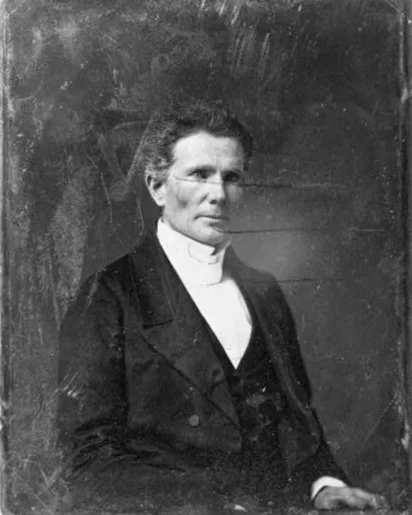
The Worship of the LORD in His Sanctuary.
James Dodson
A DISCOURSE
DELIVERED ON SABBATH EVENING, APRIL 30TH, 1854,
AT THE
OPENING OF THE FIRST REFORMED PRESBYTERIAN CHURCH,
BROAD STREET, PHILADELPHIA.
BY THE
REV. ALEXANDER DUFF, D.D.,
MISSIONARY OF THE FREE CHURCH OF SCOTLAND IN CALCUTTA.
REVISED FROM A PHONOGRAPHIC REPORT BY J. E. SAMPLE, M.D.
PHILADELPHIA:
PUBLISHED BY THE SESSION OF THE FIRST
REFORMED PRESBYTERIAN CHURCH.
1854.
Page 3
CORRESPONDENCE.
Philadelphia, May 10, 1854.
REVEREND AND DEAR FRIEND:—
At a recent meeting of the Session of the First Reformed Presbyterian Church of this city, the pleasing duty was assigned to me of tendering to you on behalf of themselves, as well as the people of their charge, their united and heartfelt thanks for the very able and peculiarly seasonable sermon, delivered on the occasion of the dedication of their new house of worship, on Sabbath evening the 30th ultimo. It was still further made my duty to request your permission for its publication.
I most sincerely hope that you may be induced to lend us your aid in the publication of this discourse, believing as I do, that the great truths which were so prominently brought out, are not only highly important in themselves, but particularly suitable to the present condition of the Church and the world, and that their wide circulation may by the blessing of God, do much to promote the purity of His worship, and at the same time arouse the Church to increased exertion for the conversion of the world, from the worship of dumb idols to the worship of the only living and true God.
That the great Head of the church may continue still more and more to bless your labors in the cause of our common Lord and Master, and spare your valuable life long for still greater achievements, on behalf of our adored and risen Emmanuel, and that at last you may receive the plaudit “well done good and faithful servant” is the prayer of
Your affectionate Friend,
GEORGE H. STUART.
Stated Clerk of Session.
To Rev. ALEX. DUFF, D.D.
Free Church Missionary, from Calcutta.
New York, May 12th, 1854.
MY VERY DEAR FRIEND.
I have only time simply to acknowledge the receipt of your note, requesting permission, on the part of your session, to publish the discourse which
Page 4
I preached at the opening of your New Church, and soliciting my assistance in the publication of the same. To this request I shall cheerfully respond, so far as I can—praying God that his richest blessing may descend on the faithful ministration of the gospel, in the House so recently dedicated to his blessed service.
Yours, very affectionately,
ALEXANDER DUFF.
To Mr. GEO. H. STUART,
Clerk of Session.
Page [5]
DISCOURSE.
CHRISTIAN FRIENDS AND BRETHREN:—
We have this day assembled, for the first time, in this edifice, for the public worship of the great Jehovah. The occasion is altogether a peculiar one; it is naturally expected, therefore, that the services should be somewhat peculiar also. In the previous part of the day, we have had the privilege of enjoying two very seasonable and impressive services; and it is now my desire to follow up these by contributing another of a somewhat supplementary character.
The object to which the church is dedicated is the public worship of Jehovah; and I will seek to direct your attention to some of the leading characteristics of public worship, in order, if possible, to disentangle it from certain practical misapprehensions, and exhibit it in the clear, pure light of scripture. To this end, let me direct your thoughts to that psalm, (the 95th,) a portion of which you have been singing.
“O come, let us sing unto the Lord, let us make a joyful noise to the Rock of our salvation. Let us come before his presence with thanksgiving, and make a joyful noise unto him with psalms.” Here, dear friends and brethren, we have a grand and solemn invitation to the public worship of the great Jehovah, and at the same time a divinely authoritative statement of its great constituent elements. This worship of Jehovah is the highest and most ennobling exercise in which the soul of man can possibly be engaged. In what does it consist? It consists in concentrating all the powers, feelings, emotions, faculties of the soul upon the greatest and worthiest object in the universe,—an object of whose resplendent glory this whole universe is but a dim and subordinate reflection. According to almost immemorial usage, this sublimest acting
Page 6
and engagement of the spirit of man has been divided into the two great generic departments of prayer and praise. In order, therefore, that such services should be at once intelligent and acceptable; worthy alike of the great Creator to receive, and of his rational creatures to bestow, it is plainly implied that there should be the possession of appropriate knowledge; and knowledge plainly implies the impartation of appropriate instruction. For, how could we hopefully and intelligently pray to the supreme God, or how could we earnestly ask him for things felt to be needed and desirable, such as pardon of sins, and other similar and undeserved mercies, were it not for the assured knowledge, not merely of his ability to hear, but of his willingness to answer the entreaties of the humble suppliant? how would we unite in glorifying and magnifying his character, attributes, and works, and extolling his unrivalled perfections, were it not for a due knowledge of his surpassing greatness, and a due appreciation of his transcendent excellencies?
Hence, the beauty, the divine beauty, and significancy of the order and arrangement of the topics in this grand and solemn invitation to the worship of the great Jehovah—“Come, let us sing unto the Lord;” but why come and sing the praise of the Lord? Because, says the Psalmist, “he is the rock of our salvation;” he is the rock upon which is the fortress and strong tower to which poor dying sinners are invited to resort as a covert from the storm and a refuge from the tempest; and upon which is securely planted the foot of that ladder along which sinners are privileged to climb to the realms of the redeemed in glory.
“Let us come into his presence with thanksgiving, and make a joyful noise with Psalms;” but, why thus joyfully come to his presence with a loud voice and psalms?—Because of his greatness and supremacy above all rulers and potentates, visible or invisible, natural or supernatural; for “the Lord is a great God, above all gods;”—because, too, of that omniscience with which he can penetrate into the remotest recesses of creation, far beyond the knowledge or ken of man; and the omnipotence with which he communicates and upholds whatever of strength or magnitude belongs to the mightiest of his visible works; “for in his hands are the deep places of the earth; the strength of the hills is his also;” and, lastly, because he alone is the great Creator, the absolute sovereign of universal
Page 7
nature, ruling and governing all things according to his good pleasure. “For the sea is his, and he made it; and his hands formed the dry land.”
Next, we are earnestly invited by the Psalmist to “come into his presence, and worship and bow down and kneel before the Lord our Maker.” Why are we thus invited to prostrate ourselves in prayer and supplication before him? Not merely because he is the Lord our Maker, and, as such, has an original and indefeasible right to the entire services and homage of our lives; but because, in addition to this, he has graciously condescended to enter into covenant with us, effectually to feed us, and effectually to guide, govern, and defend us by his Almighty hand and power, when we were aliens and wanderers in the mountains of vanity, delusion, and perdition; “for he is our God, and we are the people of his pasture, and the sheep of his hand.”
Here, then, dear friends and brethren, we have instruction of the sublimest kind, beautifully interblended with the invitation to unite in the public worship of Jehovah. Here, accordingly, we have the Divine model and pattern, which has been imitated by the Reformed Protestant Churches in general, in peremptorily ordaining that public worship should be indissolubly associated with ample instruction in the varied forms of reading and expounding the Sacred Scriptures—those vast and exhaustless repositories of a wisdom and knowledge emphatically divine. Let, then, we would say, the temples dedicated to the monster idols of heathenism, to the rationalistic unity of Mahommedanism, to the virtually deified saints of anti-Christian Popery, exclude, if they will, all the means and appliances of wholesome instruction from their desecrating precincts; and let them continue to exhibit the spectacle of a sheer blindfold superstitious devotion, of which ignorance is truly reputed to be the natural and prolific mother. Such exclusion and such exhibition, on their part, are alike consistent with systems of error which have sprung from the stagnant marshes of human corruption, and subsequently fomented by the delirious pretensions of human pride. But the God whom we serve is a God of knowledge and not of ignorance, a God of light and not of darkness, a God of truth and not of hollow unsubstantial mimicries. Right well is it, therefore, and befitting, that the distinguishing glory of the temples dedicated to his worship
Page 8
—the temples of a resuscitated and living Christianity, which is designed spiritually to illumine and indefinitely to expand the intellect of man, as well as to cleanse and ultimately transform his heart into the burning purity of seraphic natures;—oh! right well and befitting is it, that such temples should ever minister the means of soul-awakening instruction, and ever exhibit the spectacle of an enlightened devotion, based upon knowledge, drawn fresh and pure from the pellucid source of Jehovah’s holy oracles, and in inseparable alliance with the quickened actings of sanctified reason and high intelligence. The subject-matter of all such knowledge being the revealed word of the living God, it is, in its range and variety, illimitable as its author;—knowledge, embracing the decrees and purposes of the eternal counsel, the awful holiness of the great Jehovah, and the desperate sinfulness and helplessness of man; the absolute necessity of an atoning sacrifice for sin to satisfy the claims of offended justice; the divinity and marvellous incarnation of the eternal Son of God to work out a spotless righteousness for us; the divinity and personality of the Holy Spirit, and the necessity of the regenerating influences of his grace; our absolute dependence on the Lamb slain, the sacrificed victim, as the source of life and nutriment to the soul; together with the consummation of the processes of the redemptive economy, in the resurrection of the body, and the enjoyment of those pleasures which are at God’s right hand evermore;—knowledge thus reaching back into the remotest recesses of the infinite duration that is past, and reaching forward into the remotest unfoldings of the infinite duration that is to come—seizing, as it were, in its mighty grasp, the two eternities, and holding them up to the contemplative gaze of the renovated spirit, irradiated with all the splendors of heaven’s own light, and replenished with all the manifested wonders of creation, providence, and grace.
But, dear friends and brethren, while from the authority of Jehovah’s word, we would insist upon a thorough exhibition of gospel truth in the pulpit, as well as a heart-searching application of it, we have a caution to give, a warning to utter, in connection with this important subject. There is a risk and danger to which, in our day, souls thus replenished to the full with heavenly knowledge are exposed. There is in this, our day—pre-eminently the day of boastful intellect and boasted intelligence—a raging craving
Page 9
for knowledge; and hence the source of a frequent and fatal delusion; hence the tendency, on the part of multitudes, to rest entirely satisfied in divine things with a mere abstract head knowledge, which comes immeasurably short of a saving impression on the heart, or the real conversion of the soul to God—a tendency to remain satisfied with a mere abstract intellectual acquaintance with the theory of redemption, instead of vividly apprehending the downright necessity of actually subjecting themselves to the renovating, transforming processes of redemption. Oh, pestiferous error!—oh, vile and mischievous delusion! For, what the abstract knowledge of food would be to the hungry man who has nothing to eat; what the abstract knowledge of water would be to the thirsty man who has nothing to drink; what the abstract knowledge of fitting raiment would be to the naked man who has not a rag to cover him; what the abstract knowledge of architecture would be to the shelterless man who has no dwelling to screen him from the inclemencies of storm or tempest; what the abstract knowledge of gold and silver and other mineral treasures would be to the absolutely poor man, who is pining away in utter wretchedness and want; what the abstract knowledge of combustion would be to the shivering man who has no fuel or fire to warm him;—such, and none other, is the abstract speculative knowledge of the divine truths of the Gospel to the unregenerate soul, or the soul of that man who has never appropriated them, seized upon them as his own, so as inwardly to digest them, and cause them to pervade, purify, and expand the entire powers and faculties of the soul; and invest, as with an atmosphere of holiness, the whole tenor of his outward life and conduct. Oh, woful, disastrous misuse of the knowledge of that which was meant to save! Behold humanity, universal humanity, wrecked and ruined amid the tempest-tossed billows of the ocean-stream of time!—behold the life-boat of saving knowledge sent out from heaven to the rescue!—behold crowds of the shipwrecked and ruined leaping into its bosom! But, instead of rowing it vigorously up the stream against the billows and the breeze, towards the celestial haven of safety and blessedness, behold them carelessly and merrily gliding along,—down, down into the rapids—the resistless cataract that shall soon precipitate them into the yawning depths of a bottomless perdition. Oh, frightful, soul-harrowing catastrophe! to see
Page 10
the life-boat of knowledge, which was meant to save, converted, by man’s wilful negligence and perverseness, into a vehicle for more gently yet swiftly conveying myriads of the lost into the clinching embrace of the fire that is never quenched! To what use are ye turning it, ye who are assembled here this night? Let conscience reply, as in the sight of a holy and heart-searching God. To what use are ye turning this life-boat? whither, dear friends, are ye plying your oars?—up the stream, towards the gardens and palaces of the celestial city, or down the stream, towards the nethermost abyss surging with tempestuous fire? All heaven, all hell, now pause for a reply;—ready, here, to burst into hosannahs of praise—or, yonder, into shouts of fiendish triumph? Come, then, dear friends and brethren, come now, and disappoint hell of its expected triumph, and lighten up with new songs of joy the realms of everlasting day.
But, while thus insisting upon the necessity of ample knowledge savingly applied, let us not be running into extremes. The tendency of blind, superstitious formalism is to exclude the preaching of the gospel of God altogether; the tendency, in many of the Protestant reformed churches, has been to make preaching almost the all in all. With the former, the tendency is to devotionalize everything; with the latter, to sermonize everything. With the former, the tendency is to let a blind devotion, in the shape of mechanical ceremony and utterance, monopolize all; with the latter, to let a cold intellectualism, or pseudo-intellectualism, in the name of preaching, monopolize all. The former would throw preaching, if tolerated at all, into a corner, to occupy a very secondary and subordinate place; the latter would throw devotion in prayer and praise into a corner, to occupy a very humble and unworthy place. In order to correct or get rid of such injurious extremes, on either side, we must give special heed to the lesson divinely inculcated in such a passage as that which constitutes our text;—a passage in which we find prayer and praise proclaimed to be organic, or integral essential parts of public worship. Let us, then, briefly consider the nature and extent of prayer, viewed as a constituent element of the public service of the sanctuary.
It is the more needful to give heed to this subject, inasmuch as here are endless practical misapprehensions abroad concerning it. The house, for example, which is set apart for public worship is
Page 11
called the house of prayer; the Sabbath, on which the public worship of God is celebrated, is called the day of prayer; the officiating minister is denominated the man of prayer; the form of sound words employed by him is called the form of prayer. Now, dear friends, it must be known to you that there is an extreme tendency in formalistic or superstitious minds to take advantage of such language, and use it as the ground of a false and ruinous conclusion. The idea is ever apt to seize on such minds that there must be some exclusively authorized persons, times, places, and forms, in connection with the offering of prayer. And do we not find such a tendency sometimes carried out to its natural consummation in the midst of us? Let us, then, strive to get this delusion dissipated. Every minister of the Christian sanctuary is, or ought to be, in a high and peculiar sense, a man of prayer; but let us never forget that acceptable prayer is not limited to him. For, what is prayer? Prayer is, after all, but the breath of faith, the pulse of the regenerate heart, the direct and necessary outgoing and emanation of the quickened spirit. Let the soul be effectually touched by Divine grace, and immediately it lives, however feebly; and, living spiritually, it must and will breathe out its heavenward desires and wistful longings; and this soul-breathing is the very essence of prayer. One friend may pray for another, in the sense of intercession, as a friend, but not for another vicariously, as a hired or appointed priestly substitute. Dear friends and brethren, to pray in this manner is to pray by proxy; and to pray to God by proxy, as tens of thousands of mere formal, superstitious worshippers are now doing, is in itself as absolutely preposterous and useless as for a man to eat or drink by proxy, or to breathe by proxy, or sleep, or walk, by proxy. No, friends and brethren, if there be a particle of physical life in a man, he must eat, drink, breathe, sleep, walk, and perform all other corporeal functions, for himself; otherwise, it is a sign either that there is no life in him, or that it will soon expire. So it is with the soul of man. If it be awakened by the Spirit of God, it must pray and perform all other spiritual functions for itself; and if it do not, it is a sure and infallible sign either that there is no spiritual life in it, or that it is fast lapsing into inanition or total extinction.
As there are no exclusively authorized persons, so neither are there any exclusively authorized forms, for prayer. Is it not true
Page 12
that the very babe, not yet able to speak in accurate grammatical style, or even to lisp a single intelligible sentence, can make its wants thoroughly known to the loving mother by signs and cries, if in no other way? And so with the babe in Christ. In the absence of distinct verbal utterances, there may be heartfelt sighs, and groanings which cannot be uttered, but which reach and pierce the ears of God, and, clearly apprehended by him, are answered, and soon return with richest blessings. In like manner, there are no exclusively authorized times for prayer. The God whom we worship is not like the feeble, dependent god of the blinded pagan, who needs sleep and rest, and who therefore must have special times for his service. Our God, the Good Shepherd of Israel, neither slumbereth nor sleepeth. The Psalmist could rise at midnight to praise him. Neither are there exclusively authorized places for prayer. The Gods of the heathen, who have material forms or images, can only be addressed in prayer where the image is. Jehovah, our God, is omnipresent, and all places are alike unto him. The housetop, the verdant field, the mountain solitude, the ocean shore, the wooded wilderness, the naked desert, the noisy street, the densely thronged market-place,—all, all are alike unto him, and no man can be where he cannot give vent to the aspirations of a quickened soul, at least in secret sighs, or broken, ejaculatory utterances.
But though we thus would insist upon it, that the Scriptures do not, with reference to prayer, sanction the idea of exclusively authorized persons, times, places, and forms; and though we would thus raise our solemn protest against the dogma of blind superstitious heathenism, or equally blind superstitious Popery, with the strangely freckled offspring of her decrepit old age, dotard Tractarianism,—the detestable dogma, that acceptable prayer can only be offered through certain antiquated patristic forms, by manually consecrated priests, in ceremoniously consecrated houses, and at traditionally canonical hours;—yet have we no hesitation in affirming that some forms may be decidedly preferable to others, some persons peculiarly qualified, and some times and places pre-eminently suitable. Such forms would include the Lord’s prayer, the briefest and most comprehensive which the world has ever known, many of the psalms, and other portions of Scripture, together with sundry current forms of prayer, from the use of which myriads of God’s believing people find edification and refreshment to their souls. Such per-
Page 13
sons are, or ought to be, the under shepherds of the flock, gathered out of the wilderness of this world,—Jesus Christ, the Lord of glory, being himself the chief shepherd and overseer. Such places may, or ought to be, those houses which, like the present, a pious liberality has reared and segregated from all ordinary or profane uses whatsoever, so as to leave the minds of the worshippers wholly undistracted by any disturbing associations at variance with the feelings of sacredness. And such times are, or ought to be, the Sabbath days, holy unto the Lord, and honorable,—those precious seasons, on which, at regular periodic intervals along the processional march of time, the cloud of divine glory has, by the immutability of the divine promise, been found specially to rest.
Accordingly, dear friends and brethren, on those days of high solemnity, you, as professing disciples of the Lord Jesus Christ, are privileged and invited to come up to the public sanctuary dedicated to the worship of the Great Jehovah,—to come up, and in connection with the offering of prayer and supplication to the Most High, not merely to be passive recipients in the way of deriving benefits from him who there prays, but actually to engage yourselves, in prayer,—prayer for yourselves and others. How is this to be done? Not trusting in yourselves or in any worthiness in your services, but emboldened solely by the express invitation and gracious promise of a covenant-keeping and unchangeably faithful God, you come up to the sanctuary, there to consider your earthly shepherd, not as a priestly substitute to pray in your stead, as if the form of words when used by him, could act mechanically as a spell upon your own unexercised spirits, but simply as your chosen and appointed ministerial organ to lead your devotions, by giving utterance to supplication in audible sounds which you can intelligently apprehend, powerfully feel, and deliberately adopt, as embodying the fervent aspirations of your own exercised hearts. In this way, this purely scriptural way, the public prayer of the sanctuary becomes, not the prayer of the pastor alone, as if he were shrouded in some undefined and undefinable veil of mysterious sacredness, but the prayer of the tens, or fifties, or hundreds, or thousands, who may be assembled; and who, being of one heart and of one mind, unite with him, seizing upon, and appropriating his successive utterances as their own, and thus causing his prayer to become, not one, but by combination and spiritual affinity, many in one, or a mighty plurality in unity.
Page 14
Embraved, on the other hand, by the promises of his heavenly Father, and enheartened by the marvellous answers to prayer, recorded in the volume of inspiration, the pastor or public minister of the sanctuary, stands up in the presence of the great congregation,—stands up as in the audience-chamber of the King of kings, awed, but not appalled by the presence of the majesty of Heaven, and there pours out his soul,—not after the manner and fashion of the learned and polite in elaborately prepared and merely technical forms, or nicely balanced rhetorical sentences, or in dry, cold, theological dissertations, or in ornate speeches set forth with pompous phrase and florid imagery,—and he pours forth his soul, not in such muddy and turbid currents as these, but in a pure, clear stream of simple heartfelt devotion. Issuing full and fresh from his own surcharged spirit, the devotional stream of adoration and supplication distributes itself, as it were, abroad over the assembled believing worshippers, in many rills—multiplying and swelling as they go along, so that each separate rill enters the prepared vessel of each waiting individual soul, with a volume that equals the original as it emanated from the fountain head. Each thirsty soul being thus replenished to a continuous overflow, the rill of prayer thence returns; each returning rill soon unites to each, and all, combining in one mighty confluence constitute a rushing torrent, which, swifter than the rays of light, those bright outspreading wings of morn, and endowed with more than the royal privilege of exemption from the gravitating force of materialism, mounts on high, and, passing the empyrean heavens, pours itself in rolling clouds of incense into the golden censer in the hands of the great Intercessor before the throne, already filled with odors which are the prayers of saints;—and perfumed with the fragrance of his infinite merits, is graciously accepted there, as a sweet-smelling savor; and thence returns, amid the cycles of a revolving Providence, to enrich and gladden the parched and weary spirits on earth, like the refreshing dews on Mount Hermon, or rain upon the new-mown grass, or showers that water the earth.
The third great department of public worship is praise. Now, praise, in a general way, may be characterized briefly as the fresh blossoming and beauteous effervescence of a grateful heart. Though no means which man can devise may adequately or commensurately set forth the praises of the great Jehovah, yet, throughout all ages,
Page 15
to sing unto the Lord in psalms and hymns, and spiritual songs has been held to be one of the most impressive methods of attempting to do so, a method recommended by the example of our Lord and his Apostles, by such inspired exhortations as this of my text, and by the glimpses afforded in the sacred oracles of the nature of the employments of saints and angels in the heaven of heavens.
But, apart from such authoritative sanction and recommendation we may know, from the constitution of the human mind, and the lessons of ordinary experience, that there is a potency in sacred song which admirably fits it to be a vehicle of the celebration of Jehovah’s praise; since the solemn strains of music, whether of voice or instrument, tend above all things, speedily to dissipate the grossest associations connected with the ordinary turmoil and business of life—to abstract the thoughts and elevate them above the more grovelling concerns of time—to seize on and pervade, while they exalt and purify the feelings and emotions of the heart, thus preparing the soul as a fitter soil for the reception of religious impressions. Hence, as we may infer, hence the probable reason why, guided by the Spirit of Inspiration, the Psalmist placed the singing of Jehovah’s praise first and foremost in the order of divine worship; “O come and let us sing unto the Lord.” Hence, too, as we may fairly conclude, hence the chief reason why some of our Reformed Communities, such as that to which this church belongs, and the Presbyterian churches of Scotland, directed by the model which inspiration has supplied, not less than the instinct of a divine philosophy, have ordained the public worship of the sanctuary to commence with the singing of psalms, or hymns or songs, or sacred melodies;—the human voice being, in the forementioned, as well as other cases, the only instrument. Not that we regard the employment of other instruments, such as harp, organ, or lyre, as in itself sinful or injurious:—but because, however suitable, such or similar instruments might have been under the shadows of the Mosaic economy, where all was typical and ceremonial, and where, as has been often noted, the plurality and variety of them were admirably fitted to represent the diversified conditions and affections of the spiritual man; we yet judge, on the whole, the absence of them fully more in accordance with the pure spirituality and soul-elevating sublimity of the evangelical dispensation.
While music, and especially vocal music, is thus legitimated by
Page 16
every authority, human and divine, it becomes us to be vigilant and jealous against prevailing misconceptions. We must be equally on our guard against its undue neglect on the one hand, or its unwarrantable abuse on the other. With some of our Protestant churches the tendency has been to make too much of it, and with others too little: and we must endeavor to discover the true medium between these extremes. When the heart is cold and uninterested how can anything come forth worthy of the name of sacred song? the languor with which the praises of Jehovah are too often sung is an infallible sign that the heart is spiritually torpid or dead. You may remember what a great countryman of your own—the greatest perhaps of all metaphysical theologians in the school of old orthodoxy—said with reference to the great religious revival of his times, “that there was nothing in which the intensity of the revival showed itself more conspicuously than in the outbursting tones in which the praises of Jehovah were celebrated in song.” Now, when in any congregation there is a faintness in singing Jehovah’s praise, indicative of a want of fire from above in the soul, how often, instead of waiting on God for the stirring up of languid affections is there a tendency to try and make up for the deficiency by mere mechanical utterances through the aid of organs or trained bands of singers? I know no theoretical objection against the judicious employment of these as auxiliaries in devotion; but there is a fatal tendency in lukewarm or fashionable churches to regard these not as auxiliaries but as substitutes for the personal devotions of the worshippers. Now to sing the praises of Jehovah by proxy is just as preposterous and useless as to pray to Jehovah by proxy. But the delusion connected with it is so very insidious, that there are myriads who can delightedly listen to sacred music, whether the instrument be an organ or the human voice, and because they enjoy it, are ready to conclude that they are in a devotional frame, and celebrating the praises of the Most High.
In order, if possible, to expose the source of this fatal delusion let me simply remind you, that, from the very constitution of our nature a melodious succession of single sounds or a harmonious combination of simultaneous sounds is fitted to excite pleasurable sensations in the mind apart altogether from any meaning, significancy, or sentiment associated with them. Further, let me remind
Page 17
you that all real music, whether in the form of melody or harmony, or both combined, is neither in the human voice nor in the instrument—but in the soul;—whence it wells out, linking itself with conceptions that are solemn or sublime, and pouring itself forth through the medium of the articulate sounds of the human voice, or in conjunction with the inarticulate sounds of instruments. Now if these musical sounds happen to be associated with words of piety and sacredness, which have no real meaning except to regenerate spirits, they who can find a sensitive regalement in the mere excitation of melodious sounds,—without any susceptibility of being suitably affected or impressed by the words which symbolize heavenward thoughts and emotions,—are ever apt to indulge the fond imagination that they are of the number of the religious and the devout: they do delight it is true in the sacred melody; but alas! alas! it is not in the sacredness but in the musical harmonies which accompany it,—not in the godly sense but in the outward carnal sounds. And so, their piety, after all, is but the piety of the external ear, which is much akin to the piety of an organ, or lyre, or trumpet, or murmuring brook, or roaring waterfall;—and their devotion, the mere excitement of sensitive affections stirred up by the play of vibrated matter on an organ of external sense, and so, in its essential principle, differing in no respect from the devotion of the serpents and cockatrices referred to by the Psalmist and the Prophet, whose envenomed rage could be allayed, and themselves riveted into apparent ecstasy, by the sweet notes of the charmer skilled in the art of charming wisely.
If any further evidence were wanting of the power of this fell and fatal delusion, we have only to point to those grand carnivals which, in different countries, are occasionally celebrated in honor of the God of the Senses, and popularly known under the name of “Oratorios,” or “musical festivals.” For weeks the preparations are often conducted on a scale of royal magnificence, and daily bulletins are issued to report the advancing stages of the onward progress. The hall is gorgeously fitted up to fill and satiate the lust of the eye, the air is laden with fragrance and perfume; and couches there are of curious and cunning workmanship, which soothe and satisfy the sense of touch far beyond fabrics of softest down; and delicacies there are within reach to regale the taste, wafted from the fields and gardens of tropical climes. At length
Page 18
the day of high festival arrives, and companies of men singers and women singers, with their instruments of sound, and the leaders of the choral bands assemble there, and the mighty throng of this world’s gay votaries come crowding there. Among these, for aught we can tell, there may be some poor stray wandering sheep from the gospel fold, but assuredly among them are trooping herds of the notoriously ungodly and profane, the reckless, the profligate, and the reprobate. Then think how easily and delightedly even these moral outlaws can turn away from the ordinary products of the great masters of music and of song, which portray the incidents and excitements, the joys and the pleasures that are associated with carnal mirth and earthly felicities; and as they listen with the ear of sense to the strains of sweetest melody, embodying the grandest conceptions connected with the sublime mysteries of the Christian faith, they can respond to anthems which vividly describe the passing away of the visible heavens as a scroll, and the melting of the elements with fervent heat,—anthems, too, that seem to peal forth the very trumpet-sounds of the resurrection and final judgment—with feelings of ecstasy as irrepressible as they are unutterable. And yet, all the while, their own hearts remain spiritually as unchanged as the granite rocks over which the evening breezes have been passing with gentlest murmurs; without a single spiritual thought or spiritual desire corresponding with the awful solemnities of a scene in which one day their own everlasting destiny shall assuredly be fixed.
Would that by these and similar considerations one and all here this day were made to feel with reference to sacred music, whether in the home or in the sanctuary, that the mere outward sound and jingle, whether of voice or of instruments, is not that spiritual harmony which is the delight of saints on earth, or the spirits of the redeemed in heaven; that the thrills of concord on the natural organ are not the divine joys of a regenerated soul! Would that one and all were made to feel the force of the Apostle’s admonition, “I will sing with the spirit, I will sing with the understanding also.” Then would they never be found virtually singing, as many alas! do, with heedless indifference, or singing to the regalement of their own carnal sense, while they professed to be singing to the praise and glory of God. Thus, with a sweet and gracious sense of Jehovah’s loving kindnesses pervading the soul, and a divinely in-
Page 19
spired joy replenishing and employing all its powers and faculties, the renovated spirit would soon find itself stirred up from the depths; words expressive of the prevailing sentiment would soon flow in ready and spontaneous utterance, and that utterance would naturally manifest itself in audible cadences or sounds. Oh, how different from the vapid, insipid tones of the poor lifeless formalist, useless and worthless to himself, and horribly grating and discordant in the ear of God,—sounds which, as they roll along, cannot but whisper whence they come, even from the fount itself of heavenly melody, now communicating from its fulness to the heir of glory.
Ah, if in this manner, on the Sabbath days believers came up to the house of God with the full intent and purpose of heart to praise him,—not with the idolatrous design of regaling their carnal selves, soon would their teeming and surcharged spirits find vent for themselves in sacred songs. Each, singing with grace in the heart to the Lord, and finding scope for the breathings of the inner man in words which inspiration itself delighted to employ; and these words linking themselves with grave sweet melodies which soon assimilate the sympathies of all hearts, with the symphonies of all voices; there would soon arise such a tide and swell of harmony from the whole congregation of adoring worshippers as would prove, even in the absence of all instruments and refined and labored niceties of art, the most grateful music to the truly pious, and the most acceptable to God, the great author of all the harmonies of this immeasurable universe!
Such music was wont to be heard, in days long gone by, on thy bleak upland moorlands, and dreary mountain solitudes, oh sorely tried and tempest-tossed Scotland;—when thy poor persecuted children, hunted, for conscience sake, like partridges on the mountains, so often braced and embraved their spirits, by loudly rehearsing the songs of Zion, heroically to confront the stakes and the scaffolds of martyrdom.
Such music as we have sometimes heard even in more recent times in thy rural churches and solitary churchyards, and sequestered glens, oh, highly favored Scotland, when after the high solemnities of a communion Sabbath, the praises of the Divine Redeemer, pealed forth by assembled thousands, whose hearts gushed to overflowing under the smitings of divine love, broke upon the
Page 20
enraptured ear like the parting thrill of seraphic voices, or the far-sounding echoes of heaven’s own eternal hallelujahs.
Oh, that there were in this and every other people such a spirit to praise the Lord. Ye would not want ample food and matter for your songs. Ye could range through all creation, and catching the holy flame, ye would with the entranced Psalmist exclaim, “Praise ye the Lord, praise ye the Lord from the heavens, praise him in the heights, praise ye him, all his angels, praise ye him all his hosts, praise ye him, sun and moon, praise him, all ye stars of light, praise him, ye heaven of heavens and ye waters that be above the heavens: praise the Lord from the earth, ye dragons and all deeps, fire and hail, snow and vapor, stormy wind fulfilling his word; mountains and all hills, fruitful trees and all cedars, creeping things and flying fowl: kings of the earth and all people, princes and all judges of the earth; both young men and maidens, old men and children: let them praise the name of the Lord, for his name alone is excellent, his glory is above the earth and heaven.” Ye could then range for fresh aliment through the unfolding roll of divine Providence, with its wondrous records engraved as with a pen of iron forever, in the history of individuals, nations, and empires, records of mercies and deliverances the most amazing, of retributive judgments the most appalling. Above all ye could find matter ever new and ever exciting, in the stupendous scheme of redemption. Ye might strive to emulate the choral strains of the heavenly host over the plains of Bethlehem on the first advent of the Prince of Peace. And surely when ye rise from contemplating with the eye of faith and susceptible loving hearts, the astonishing scenes of Gethsemane and Calvary:—when conscience awakes with its stinging convictions of sin and guilt, and scorching pre-apprehensions of the divine wrath;—and repentance awakes, under a gushing sense of provocations and affronts offered to the majesty of heaven, into the overflowings of bitter but ingenuous sorrow—and memory awakes and recalls to mind the Egypt of frightful bondage in which by nature ye were enthralled, and the hell of horror on whose fiery frontiers ye were carelessly treading;—when faith awakes to apprehend the dreadfulness of the divine vengeance, whose terrible sword descended with swift and resistless fury to smite the Shepherd, surety and substitute of sinners, that out of his riven side the life-stream of salvation might freely flow;—when
Page 21
gratitude awakes at the marvellousness of that love which so broke through the mountain barrier of our transgressions, as to rear a fabric of mercy and pardon on the foundations of a magnified law, and satisfied justice. Oh, when by such heavenly contemplations and exercises of spirit the smouldering embers of languid, benumbed affections are blown into a glowing warmth, and the altar of your devotion is made to smoke with the sacrifice of loving hearts, inflamed with the holy fire of God’s ineffable love to you, surely, surely, ye cannot but respond to the jubilant hymn of the great assembly of the first-born, that surround the throne on high, and with joy unspeakable and full of glory sound forth the triumphal song, ever exhilarating and ever new, “Worthy is the Lamb that was slain. Amen.” “For thou hast redeemed us to God by thy blood. Amen.” “Salvation to our God who sitteth upon the throne, and to the Lamb. Amen.” “Blessing and glory and wisdom and thanksgiving and honor and power and might be to our God forever and ever. Amen.”
“Come then, O come, let us sing unto the Lord a new song, let us make a joyful noise to the rock of our salvation; O come, let us worship and bow down, let us kneel before the Lord our Maker;” for, in and through the cross of Calvary, he who before was to sinners a consuming fire, has now become our God, and we are the people of his pasture, and the sheep of his hand.
And, finally, let us pray that in this beautiful edifice now first opened this day for the public worship of the great Jehovah, the glorious truths of the gospel of salvation may continue to be proclaimed as now in all their purity and freshness and fulness, from age to age. That the Holy Spirit may seal home the truths thus faithfully proclaimed with quickening power on the souls of the hearers. That through the preaching of the everlasting gospel, applied and enforced by the energy of his almighty grace, tidings may ever and anon be wafted by angel messengers to the courts above, of this one and that one being born here. That this house may truly be found, from generation to generation, what it is designed to be, a birthplace of souls, a nursery for the Paradise above. That its habitual Sabbath exercises of prayer and praise may thus prove it to be a vestibule and preparation for the diviner exercises of the temple not made with hands in the New Jerusalem. That the heavens may be wide opened and the streams of divine
Page 22
grace descend upon you and your beloved pastor—your children and your friends.—That your light may so shine as to radiate into the remotest ends of the earth.—That through the vigor of your inner life, your self-denying, man-blessing, God-glorifying liberalities, may be so exuberant as to cause their vivifying, fertilizing influences to be felt around the waste howling wilderness of heathendom.—And that all who have this day truly enjoyed mutual communion and fellowship in this earthly sanctuary, may, through grace and the merits of the Redeemer’s accepted sacrifice, be privileged to renew it without alloy in the heavenly tabernacle, in that bright realm, where faith is swallowed up in vision; and where the Sun of Righteousness, once shrouded on the heights of Calvary, shines in unclouded splendor, and shall shine forever, to irradiate the myriads of the redeemed—the immortal trophies of the cross! Amen.