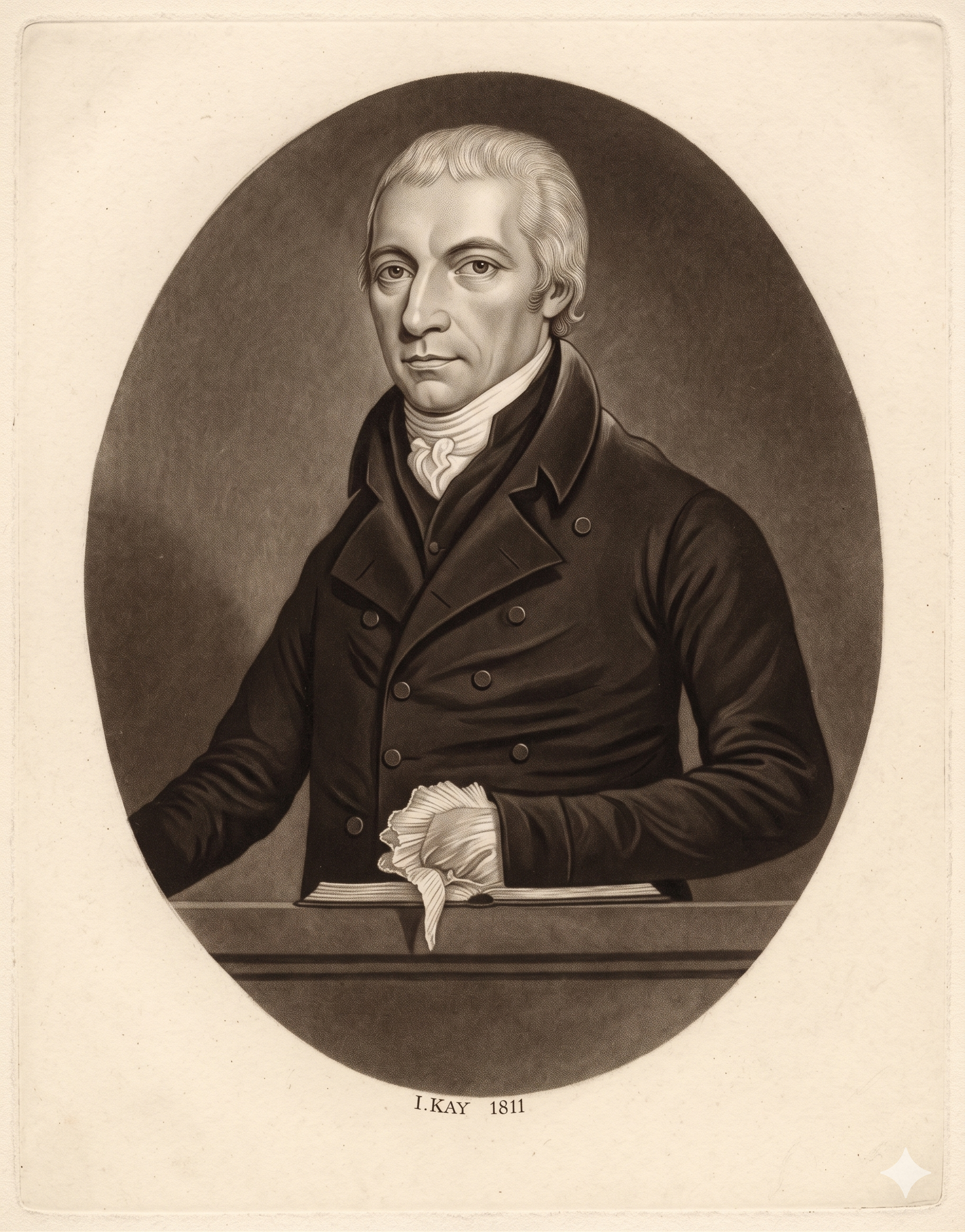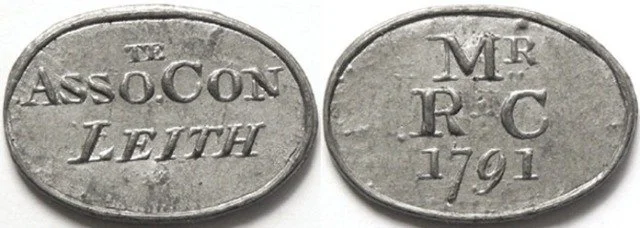
Robert Culbertson (1765-1823).
James Dodson
Biographical Sketch
The Rev. Robert Culbertson was born at Morebattle on September 21, 1765, to James Culbertson, a farmer and feu-holder in the parish who was an influential member of the Secession congregation and highly respected for his piety and worth. His early education began at the school of his native parish, followed by attendance at the grammar-school at Kelso. In 1782, he entered the University of Edinburgh, where he pursued his studies until their close, with the exception of one season spent at Glasgow College attending the Natural Philosophy Class under Professor Anderson.
Having passed through the required examinations and trials with distinction, Mr. Culbertson was licensed in 1790. The following year, he received a unanimous call to the Associate Congregation of St. Andrew’s Street, Leith. This congregation had a complex history, having originated from a split within the South Leith Kirk congregation over the appointment of minister William Aitken in 1766. The Antiburgher faction initially met in a meeting house on Cables Wynd, moved to a purpose-built church on the Kirkgate in 1775, and after a series of splits and reunifications, finally established itself in the old Glasite Meeting House off St. Andrew’s Street as the St. Andrew’s Street Antiburghers.
When Mr. Culbertson was called to this congregation in 1791, it was an Associated Congregation, i.e., a member of the General Associated Synod. Under his leadership, the congregation continued to grow, and he quickly established himself as a notable figure in the community—prominent enough to be the subject of a caricature by the renowned Edinburgh artist John Kay.
Mr. Culbertson was a New Licht Antiburgher, representing a more theologically liberal position than the Auld Lichts, who held more strictly to Calvin and the Covenanting tradition. This theological distinction became particularly significant in 1798 when the Antiburghers split into Auld Lichts and New Lichts (old and new lights), a division that would later affect the Burghers as well.
Despite these theological divisions, Mr. Culbertson was known for his conciliatory approach. When the New Lichts of the Burgher and Antiburgher churches realized that what united them was greater than what divided them, he served on the negotiation committee that brought about their union. He “greatly rejoiced” at its success, which resulted in the formation of the United Secession Church in 1820.
Mr. Culbertson was recognized as a writer of considerable merit in the religious world. He was one of the original editors of the Christian Magazine, a project conceived in 1796 at a meeting of brethren at Craigmailing. The initiative arose from conversation regarding the need for a religious periodical work of the same description as was then conducted in Scotland. He worked alongside Rev. Messrs. Black of Dunfermline, Peddie, M’Crie, and Moore of Edinburgh, Whytock of Dalkeith, and others, creating a respectable body of contributors. The magazine was carried on for seven or eight years, after which it passed into the hands of Mr. Whytock and the late Dr. M’Crie. At the close of 1806, after Dr. M’Crie's death, Mr. Culbertson claimed the magazine as one of the original editors, and in 1807, a new series was commenced by him in conjunction with Mr. Black of Dunfermline. The Rev. Mr. Simpson, formerly minister at Thurso, was subsequently admitted to the charge and assumed the editorship, constituting chief conductor of the work. Mr. Culbertson contributed largely to the magazine in both its old and new series.
Among his publications are the following appearing in order:
1800: “Hints on the Ordinance of the Gospel Ministry”—an exposure of lay-preaching and the inconsistency of latitudinarian fellowship.
1800: “A Vindication of the Principles of Seceders on the Head of Communion.”
1803: “The Covenanters’ Manual, or a short Illustration of the Scripture Doctrine of Public Vows.”
1817: Two sermons entitled “Consolation to the Church.”
1817: “The Pillar of Rachel’s Grave, or a Tribute of respect to departed Worth”—a sermon on the death of Princess Charlotte and her infant son.
1820: “The Death and Character of George III, King of Judah.”
His chief work, “Lectures, Expository and Practical, on the Book of Revelation,” was first published in two volumes a few years prior to his death. These lectures, embracing the latter two of the three heads into which Revelation is usually divided, were so favorably received that the author was induced to undertake the elucidation of the first division. He had collected ample materials for this purpose but did not live to see the additional volume published. A new edition of his Lectures on Revelation in three volumes was published in 1826, containing a memoir of the author dedicated to the Marchioness of Huntly by his son, James Culbertson.
In 1793, Mr. Culbertson married Miss Elizabeth, daughter of Mr. John Richmond, a seed-merchant in Edinburgh. By this marriage, he had a family of five sons and four daughters.
Beyond his ministerial duties, Mr. Culbertson was a popular and influential figure in the broader community. He was a patron of many causes and donated heavily to charitable and educational institutions, including the Edinburgh Bible Society and the Leith Public Library. His engagement in civic and religious matters extended beyond his immediate congregation, reflecting his public-spirited nature and ardent concern to promote peace, truth, and righteousness on earth.
While attending a meeting of the Presbytery of the newly formed United Secession Church at Edinburgh in 1823, Mr. Culbertson was seized with an illness and died nine days afterward, on December 13, 1823, at the age of fifty-eight. His death was considered untimely, coming just three years after the union he had helped negotiate and before he could see his congregation’s grand new premises completed in 1826. This new church, built on land acquired from the city next to the High School of Leith by John and James Rutherford in the classical style, was so significant that the congregation named the new street St. Andrew’s Place after their church. The building is now the B-listed Edinburgh Hindu Mandir & Cultural Centre.
The Rev. Duncan of Mid-Calder, his biographer, noted that in him were united firmness of mind with the greatest suavity of manners; unassuming modesty with becoming dignity; warmth and tenderness of feeling with decisive promptitude and vigor of action; eminent literary attainments with godly singleness of heart. He was a gentleman, a scholar, a Christian; an able, faithful, diligent minister of Christ; as a friend, constant; as a counselor, prudent; public-spirited, with an ardent concern to promote peace, truth, and righteousness on earth.
In his public ministrations, his discourses were uniformly distinguished by elegant simplicity of diction, purity of style, and perspicuity of arrangement, often marked by minute and extensive biblical research. He possessed a happy talent for reconciling apparent incongruities and providing clear elucidation of the most difficult doctrines of theology. In description, he excelled, and when pathetic, there was a touching tenderness of expression that found its way irresistibly into the diversified states of his hearers’ feelings.
He ended his ministrations on the 3rd of the month with a singularly striking, impressive, heavenly discourse on the words, “Thou wilt receive me into glory.” He passed through life amidst many trials, “keeping the noiseless tenor of his way” with faith and patience. His name and memorial will not perish; through what he has done and through other works left in readiness for the press, he will be cherished and perpetuated with cordial regard so long as learning, talent, and religion continue to be revered among men.
After his death, his vacant pulpit was filled in 1825 by the Rev. John Smart (1801-1871), who initially lived opposite on Morton Street. Smart was minister until 1845. In 1847 the United Secession Church merged with another split off of the Kirk–the Relief Church of 1761–to form the United Presbyterian Church.
WORKS: