MINISTRY OF THE FIRST DR WILLIAM SYMINGTON.
James Dodson
CHAPTER VIII.
AFTER the death of Mr Armstrong, the thoughts of the Congregation were at once turned to Dr Symington of Stranraer. He was a younger brother of Dr Andrew Symington, whose name has already been mentioned, and like him a native of Paisley, where he was born on the 2nd of June, 1795. He early devoted himself to the ministry, and when fifteen years of age, he entered as a student at the University of Glasgow. Four years later, he began his attendance at the Theological Hall of the Reformed Presbyterian Church, which then met in Stirling. The third Rev. John M‘Millan was Professor, and for four years William Symington waited on his lectures, and pursued with unusual diligence, the course of theological study marked out for him. He also found time for much general reading, and began thus early to write
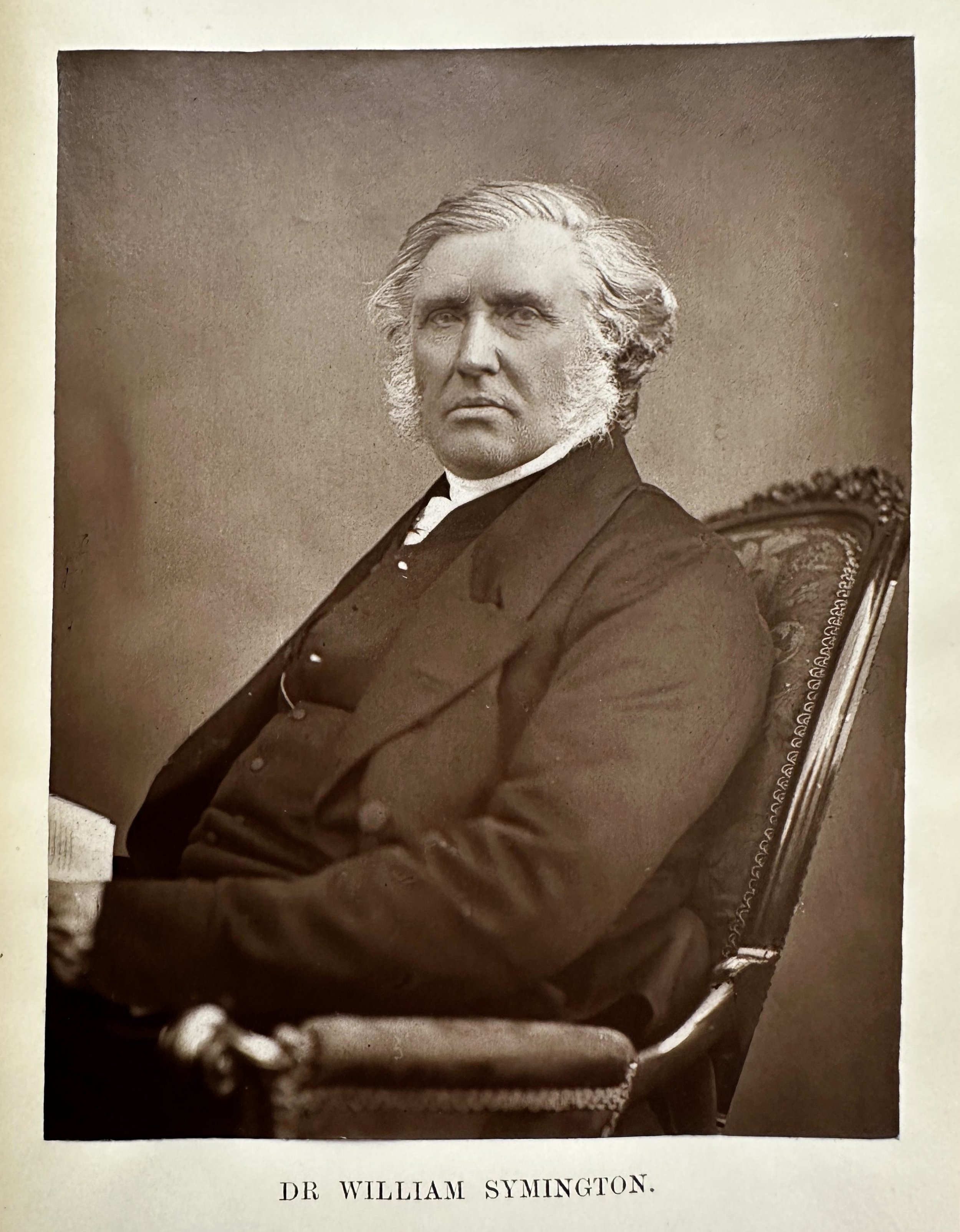
[Illustration.] DR WILLIAM SYMINGTON.
DR WILLIAM SYMINGTON. 111
for the press. He was licensed to preach the Gospel on the 30th of June, 1818, and on the following Sabbath he occupied his brother’s pulpit in Paisley, taking for his text, Rom. i. 16, “I am not ashamed of the Gospel of Christ.” From the first his success as a preacher was very marked, and he soon received calls from the congregations of Airdrie and Stranraer. He accepted the call to Stranraer, and on the 18th of August, 1819, he was ordained there. The Rev. John West of Colmonell began the services by a sermon, the Rev. Dr Andrew Symington of Paisley presided in the act of ordination, and another sermon was then preached by the Rev. Thomas Rowatt, of Penpont. So great was the interest excited by the ordination, that the crowd of worshippers attending was estimated at from four to five thousand. The little old meeting house could not have accommodated a tithe of the people, and the solemn ordination services were conducted in the adjoining Churchyard. The young preacher soon filled the Church to overflowing, and in 1824 the old meeting house was taken down, and a larger and more elegant building erected. It was not within the Congregation only that his influence was felt. Large numbers of earnest Christians belonging to all denominations were frequent worshippers
112 MINISTRY OF THE FIRST
in the Cameronian Meeting-house; he took a leading part in the promotion of every good cause in Galloway; and it is hardly going too far to say, that evangelical religion throughout the whole county received a great impetus from his earnest and most persuasive advocacy.
Dr Symington had been nineteen years in Stranraer, when, on the 5th of March, 1839, the Congregation of Great Hamilton Street called him to be their minister. It might have been expected that a call to one so pre-eminently gifted would have been unanimous. But this was not the case. Some members of the Congregation entertained a strong feeling against “translations”; they regarded these as “an infringement on the rights and privileges of our brethren in the Church altogether uncalled for.” Two probationers, Messrs Thomas Marshall and James Bryden, were accordingly proposed for the vacant charge, but the supporters of Dr Symington largely outnumbered those voting for both the other candidates, and they comprised all the men of influence in the congregation. The call was accepted by Dr Symington on the 16th of May, and on the 11th of July he was inducted to his new charge. On the following Sabbath, he was introduced by his brother, Dr Andrew Symington of Paisley, who preached from the happily chosen
DR WILLIAM SYMINGTON. 113
text, Acts xviii. 10, 11, “Be not afraid, but speak and hold not thy peace: for I am with thee, and no man shall set on thee to hurt thee: for I have much people in this city.” Dr Symington’s own text on that and the three following Sabbaths, was 2 Cor. iv. 2, 3, “By manifestation of the truth commending ourselves to every man’s conscience in the sight of God. But if our Gospel be hid, it is hid to them that are lost.”
Dr Symington’s fame as a preacher had preceded him, and soon the church in Great Hamilton Street was crowded. The Congregation, which numbered little over three hundred members when he was called, increased rapidly, sometimes as many as fifty or sixty persons being received into Church fellowship at one time, till the membership amounted to between nine hundred and a thousand. Multitudes of strangers came to hear Dr Symington, and every sitting in the church was generally occupied. This was particularly noticeable during the winter months, when many aspirants to the ministry belonging to all the Presbyterian Churches, came to hear the great pulpit orator.
Dr Symington possessed all the gifts which go to make a great preacher. He had a noble presence, a winning manner, a clear and musical voice, great command of beautiful and appro-
114 MINISTRY OF THE FIRST
priate language, and an ease and grace in delivery which are difficult to describe. To these he added unwearied industry; and best of all, he spoke with a fulness of conviction which compelled attention.
Courses of monthly lectures on Sabbath evenings became a feature of his ministry. The first was on the book of Daniel, and began in November 1839. So great was the popularity of the preacher, that after the first six lectures had been given, it became necessary to deliver the remainder in the afternoon as well as in the evening, the second audience waiting in the street long before the church doors were opened for the evening service. This course was followed by others on the life of Joseph, and the Apocalypse, which were hardly less popular.
The late Professor Binnie, who was a member of Great Hamilton Street Congregation for about ten years after Dr Symington’s induction, thus describes, in a letter to the Rev. A. M. Symington, D.D., of Birkenhead, his father’s biographer, the impression made upon an attentive hearer by Dr Symington’s ministry:—
“How much your father excelled as a preacher there is no need to tell; the crowds who constantly resorted to his ministry from first to last sufficiently attest that. Other testimonies
DR WILLIAM SYMINGTON. 115
could easily be given. A venerable friend of mine in Stirling, who was an elder of the Established Church long before the Disruption of 1843, told me that, having occasion to pay an annual visit to an estate belonging to him in Galloway, it was his unfailing custom to arrange his visit so that he might spend a Sabbath day in Stranraer; and this he did for the sole purpose of hearing Dr Symington preach.
“Some of the causes of his popularity were obvious to every hearer. He had all the natural parts of an orator—a commanding and winsome presence; a good voice; singular lucidity of thought and expression. He never lost himself in misty attempts at thinking, or failed to convey clearly what was in his mind. But other and deeper causes were at work. For one thing, he was a most diligent student, giving himself continually to reading and meditation. Besides having always in hand some course of systematic reading in divinity, he kept himself well abreast of the best literature of the day . . . What is of still greater importance, he knew and loved the Gospel of the grace of God; his preaching, therefore, whatever the topic might be, was always perfumed with a certain unction, which commended it to the hearts of Christian hearers. And this again was connected with the fact that
116 MINISTRY OF THE FIRST
he was a man of prayer. From himself, indeed, one did not hear much regarding his private feelings and habits. He was reticent about himself, perhaps to a fault. But secret emotion cannot be quite hidden. If when he entered the pulpit, his garments often smelled of myrrh, the reason, I do not doubt, was that he had just come forth from the palace of the King.”
But it was not only as a preacher that Dr Symington’s influence was felt in the city. Few excelled him as a platform speaker, and many a good cause owed much to his advocacy. Any movement to secure the better observance of the Sabbath, or to promote the circulation of the Bible, was certain to secure his support. In his own Church, too, he powerfully pled the cause of missions, and he enjoyed the great happiness of seeing missions both to the heathen and to the Jews established by the Synod of the Reformed Presbyterian Church. A Bible Association had long existed in his own Congregation, that now became a Bible and Missionary Society; and a Juvenile Jewish Missionary Society was also organized. By these, large sums were collected for the support of the Church’s missionary enterprises.
When Dr Symington was called, the stipend promised to him was £250 a year. In 1841,
DR WILLIAM SYMINGTON. 117
that was increased to £300. Four years later, the Congregation insured Dr Symington’s life for £1000, the annual premium amounting to £38 · 12 · 6, and in 1850, the stipend was further advanced to £350.
When Dr Symington came to Glasgow the Congregation was still £1760 in debt. Of this £260 was paid in 1842, £940 in 1845, and £60 in 1846, but the remaining £500 was not discharged for nearly twenty years longer.
Sabbath Schools in connection with the Congregation had been begun during Mr Armstrong’s ministry, but they were now extended. For the better accommodation of the classes, premises were rented in Risk Street, Calton. These rooms were occupied during the week by day and evening schools, for the poor children of the neighbourhood.
A most successful district mission was also begun. The missionaries were at first employed by the Glasgow City Mission, but they were largely supported by the Congregation, and many of the members of the Congregation assisted them in their work. One of the most successful of these missionaries was the Rev. John G. Paton, whose noble work in the New Hebrides, during the past twenty-five years, is known to all who take an interest in Foreign
118 MINISTRY OF THE FIRST
Missions. Mr Paton was an elder in Great Hamilton Street, and did not a little by his contagious example, to evoke the enthusiasm for Home Mission Work, which to this day is bearing so abundant fruit.
The rented schoolrooms having become too small for the proper accommodation of the educational and mission work, the Congregation, in 1852, bought the old Wesleyan Methodist Chapel and Schools, in Green Street, Calton. The purchase money was £900, of which £400 was raised by subscription at once; £500 remained a burden on the property till 1859, when a grant of £200 having been received from the Ferguson Bequest Fund, the other £300 was subscribed by members of the Congregation, and the whole debt discharged. When the property was bought, and subsequently, large sums were laid out in improving the buildings, and making them suitable for the constantly increasing educational work conducted in them. They afforded a great amount of accommodation, but even after all the improvements were made, the class rooms fell very far short of what is now thought necessary in schools. In spite of all drawbacks, however, the premises were for many years the scene of a remarkable amount of Christian activity. A school of Industry was
DR WILLIAM SYMINGTON. 119
taught in one room, and a boys’ school, which at first occupied another apartment, grew under the energetic teaching of Dr John Mathie, Mr Mathieson, Mr Forsyth, and Mr Thomson, till every available corner of the large building was crowded with scholars. For several years the School was the largest in the east end of the city; and when the Education Act came into operation, the Congregation transferred to the School Board of Glasgow an admirable staff of teachers, and about nine hundred scholars.
In 1851, the Great Hamilton Street Congregation consisted of nearly a thousand members. Many of these resided on the south side of the river, and as they met week by week at their fellowship meetings, it was proposed that they should try to establish, in that district of the city, a third Reformed Presbyterian Congregation. It was with great regret that any of them contemplated the idea of separating from a Congregation they loved so well, and from a ministry so attractive and elevating as Dr Symington’s, and a considerable time elapsed before the idea took practical shape. At length, on the 12th of July, 1853, a petition for a disjunction, signed by sixty-seven members, was presented to the Presbytery of Glasgow, and being heartily supported by Dr Symington, the
120 MINISTRY OF THE FIRST
Session, and the remaining members of the Congregation, the prayer of the petition was at once granted, and on the 2nd of August, the new Congregation was constituted. Shortly thereafter, a church was erected in Salisbury Street, Laurieston, which was opened by Dr Symington on the 18th of March, 1855. On the 8th November following, the Rev. John M‘Dermid, formerly minister in Dumfries, was inducted as first minister of the Glasgow Southern Reformed Presbyterian Church. How admirably and successfully his work was done, it does not lie with us to record.
On the 22nd September, 1853, Dr Andrew Symington of Paisley died. For thirty three years he had been Professor of Theology to the Reformed Presbyterian Church. In January following Dr William Symington was appointed Professor of Systematic Theology, and his son-in-law, Dr W. H. Goold of Edinburgh, was at the same time appointed to a new Chair of Biblical Literature and Church History. The work thus laid upon him was entirely congenial to Dr Symington’s tastes, and he entered upon his new duties with ardent enthusiasm. During the session of the hall, which lasted for eight weeks in autumn, his pulpit was supplied by Ministers of the Synod, but during the rest of
DR WILLIAM SYMINGTON. 121
the year, he still performed his full ministerial work, and he had also to prepare a course of lectures for his students. The complete course extended over four or five sessions. Such an amount of labour soon began to tell upon his strength, for in less than two years after his appointment as professor, Dr Symington reached his sixtieth year. He applied for the assistance of a colleague, and in March, 1857, his eldest son William, who had been minister in Castle Douglas, was called. “The opposition made by his attached flock, and his own deep conviction, retained to the last, that he was not suited for a charge in a large city, led him to decline this call.” Two years later the call was renewed, and “on the 3rd of March, 1859, Dr Symington was granted the desire of his heart in seeing his first-born son inducted as his colleague and successor.”*
Mr William Symington began his ministry in Great Hamilton Street on the afternoon of the following Sabbath, taking as his text, Jonah iii. 1, 2, “And the word of the Lord came unto Jonah, the second time, saying, Arise, go unto Nineveh, that great city, and preach unto it the preaching that I bid thee.”
Aided by a son whose power and culture as a preacher made him every way worthy to occupy
_____
* Memoir of Dr Symington, p. 95.
122 MINISTRY OF THE FIRST
the same pulpit, a long and tranquil evening might have been expected to close Dr Symington’s busy life. But his work was more nearly finished than any one supposed. At the close of 1861, Mr William Symington had a severe illness, which for a considerable time entirely laid him aside from work. He went to Leamington for rest and change. During his absence Dr Symington was able to occupy the pulpit with much of his old vigour, but on the 10th of January, 1862, he was attacked with influenza which rapidly undermined his strength. On Sabbath the 12th he rose from his bed to preach. His text in the forenoon was Matthew vi. 19, 21, “Lay not up for yourselves treasures upon earth, where moth and rust doth corrupt, and where thieves break through and steal; but lay up for yourselves treasures in heaven, where neither moth nor rust doth corrupt, and where thieves do not break through nor steal; for where your treasure is there will your heart be also.” In the afternoon he delivered, with much of his old fire and unction, his last sermon from the words: “It is of the Lord’s mercies that we are not consumed, because his compassions fail not.” Lam. iii. 22. During the following week Dr Symington’s illness became very serious. His youngest son, then Minister in Dumfries, occupied
DR WILLIAM SYMINGTON. 123
the pulpit on the two following Sabbaths, and remained with his father during the week which intervened. Mr William Symington was summoned home, and he and other friends did all they could to comfort and sustain Dr Symington during his last hours.
Shortly before his death, he repeated a favourite hymn:—
“And when I’m to die,
‘Receive me’ I’ll cry;
For Jesus hath loved me,
I cannot tell why;
But this I can find,
We two are so joined,
He’ll not be in glory
And leave me behind.”
His last words were—“There remaineth a rest for the people of God.” He died on Tuesday, the 28th of January, 1862. He lies buried in the Necropolis, and a handsome monument, erected by his Congregation and other friends, marks his grave.
We cannot close our notice of his ministry better than by transferring to our pages the words in which he has been lovingly depicted as a student and a friend by his son-in-law, Dr Goold:—
124 MINISTRY OF THE FIRST
“The power and value of system was notably exemplified by our departed father. He owed most of his usefulness in life to what we may designate his peculiar love and faculty of order. His very study was the image of his thoughts—a place for everything, and everything in its place. It was the same principle that gave him success in that walk which he chiefly cultivated—systematic theology. He was in his own person a living refutation of the folly of the modern prejudice against it. It was with him no dead herbarium, but a living garden—no fetter cramping the native elasticity of his thoughts, but the wing with which he soared upward, till he could take more accurate survey of the whole domain of divine truth.
“It is but right to add, that he ‘adorned’ the doctrine of his Saviour, as well as professed and believed it. In private habits he was eminently devout. His delight was communion with God. His closet could testify to his prayerfulness. But yet there was nothing of the morose about him. Genial and buoyant with the glee of childhood, he was the life and spirit of every company in which he mingled; in wit and repartee never rivalled, but never losing in the joyousness of his nature the dignity which became the Christian and the minister; the youngest of
DR WILLIAM SYMINGTON. 125
his grandchildren hailed him as a companion, while they revered him as a patriarch.”
It was not only as a preacher that Dr Symington was known. In 1834, he published a treatise on the “Atonement and Intercession of Jesus Christ,” and four years later he published a second volume on the “Mediatorial Dominion of Jesus Christ.” Both volumes were received with much favour, and are still regarded as valuable contributions to the literature of the subjects with which they deal. After coming to Glasgow, the pressure of his ordinary work was too great to admit of much time being spent in authorship; but even during these busy years he found time to edit an edition of Scott’s Commentary, to which he added many valuable notes; and in 1851, he also published a volume of “Discourses preached on Public Occasions.”
His degree of Doctor of Divinity was bestowed by the University of Edinburgh on the 20th November, 1838. The proposal to confer the degree was made by Dr Chalmers, and seconded by Dr Welsh. Edinburgh, it was afterwards found, had only by a few days anticipated his own Alma Mater, Glasgow, which had a diploma filled up and waiting the signature of some members of its Senatus.