MINISTRY OF THE SECOND DR WILLIAM SYMINGTON.
James Dodson
CHAPTER IX.
MR WILLIAM SYMINGTON, on whom now devolved the entire charge of the Congregation, was in his thirty-eighth year at the time of his father’s death. He was born in Stranraer on the 15th February, 1824, and educated there, chiefly by his father, till in his thirteenth year he left home to attend the Arts Classes in the University of Glasgow. Theology he studied in Paisley under his uncle, Dr Andrew Symington. On the 28th of April, 1845, at the early age of twenty-one, he was licensed to preach the Gospel by the Presbytery of Glasgow. On the following Sabbath he occupied his father’s pulpit, and charmed every hearer by the simple beauty of his language, and the ease and dignity of his delivery. Wherever he went as a probationer, his preaching was equally admired, and on the 23rd of April,
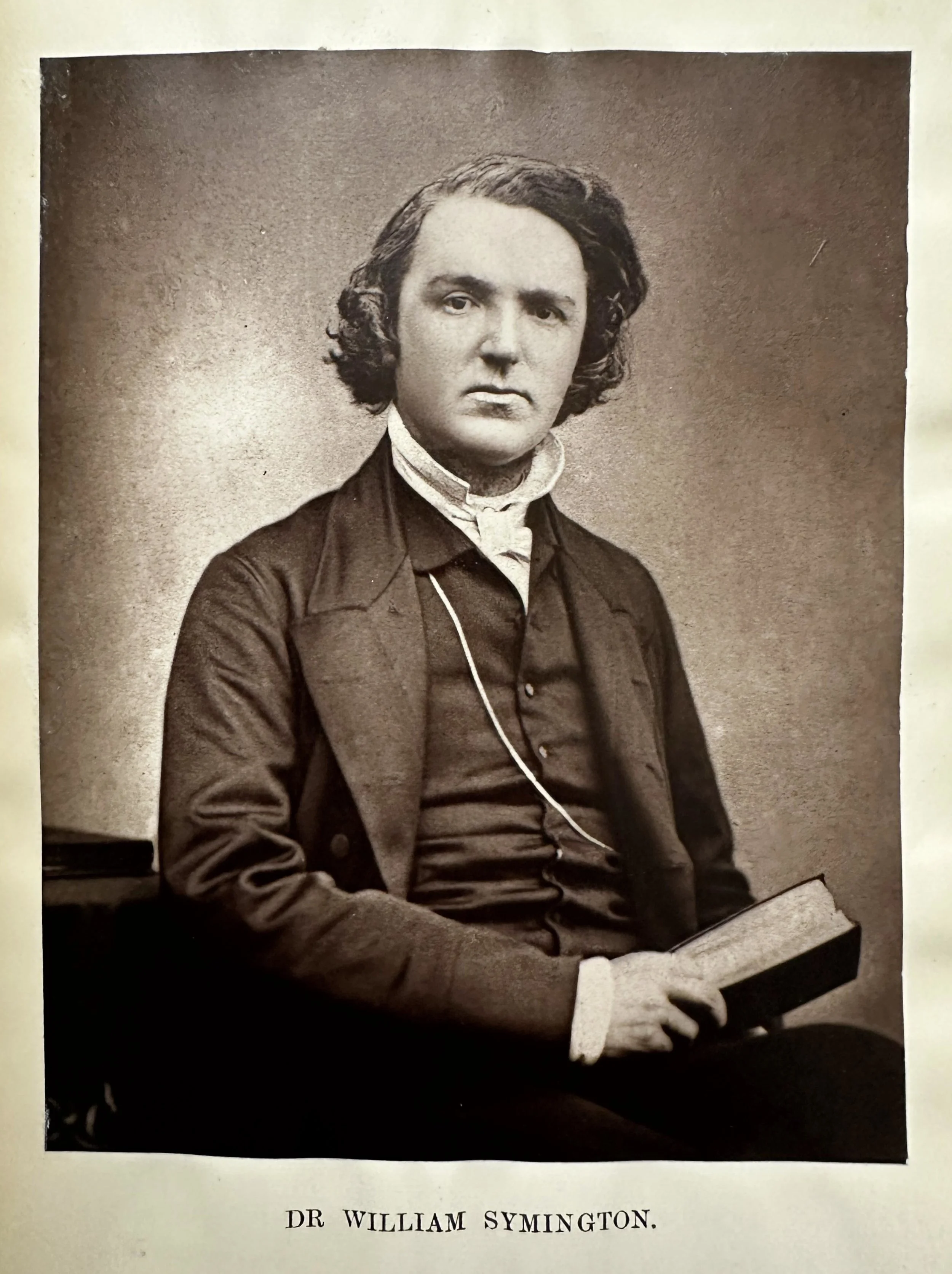
[Illustration.] DR WILLIAM SYMINGTON.
DR WILLIAM SYMINGTON. 129
1846, he was ordained minister of the Reformed Presbyterian Church in Castle-Douglas. In that charge he passed the happiest days of his life, beloved as a minister and friend, not by his congregation only, but by the whole community.
After his father’s death his health was so far restored that he was able to resume his work in Great Hamilton Street, and the Congregation continued to prosper, but it was never so large as it had been formerly. In January, 1859, a fourth Reformed Presbyterian Congregation had been constituted in Glasgow. A church was built in Grant Street, off St. George’s Road, and opened by Dr Wm. Symington on 4th August, 1860. The Rev. John Torrance, formerly of Colmonell, was called to be minister of the new Congregation, and inducted on the 30th May, 1860. Although this Congregation was at first formed of members disjoined from the West Campbell Street Congregation, it received numerous accessions from Great Hamilton Street. The City had grown so large that it was found impossible for members residing in the west, to attend a church so far east as Great Hamilton Street. In this way the old Congregation gradually suffered great loss of strength, although in numbers the membership did not for many years show any marked diminution. The missionary and educational work in Green
130 MINISTRY OF THE SECOND
Street were still carried on with great vigour and success. The Sabbath Schools were large, the teachers numerous, and other members of the Congregation assisted the missionary in conducting kitchen meetings, distributing tracts, and visitation. These spheres of labour proved as beneficial to the members engaged in them as to those for whom they were primarily intended. There was work suitable for every one, and there are comparatively few members of the Congregation who have not in some way or other taken part in the work in Green Street. None of those so engaged have ever had reason to regret it; and now there are scattered far and wide, in every quarter of the globe, earnest Christian workers, who received their early training in that mission field.
In March, 1861, Mr John Edgar, then a student of divinity, was appointed missionary. He threw himself into his work with great ardour, and the mission prospered exceedingly. In the winter of 1861-2, ten prayer meetings were established in different courts and closes of the district. These were taken charge of, and conducted by about thirty members of the Congregation. They met every Sabbath at a quarter-past one o’clock, and continued for half an hour. The average attendance at these meetings was
DR WILLIAM SYMINGTON. 131
about 125. In many cases the prayer meeting proved a stepping stone to the Mission church. The attendance at it steadily increased, and many of the hearers came under the saving influence of the Gospel. At a Meeting of the Glasgow Presbytery in January, 1863, a petition from people attending Mr Edgar’s meetings, was presented, asking to be formed into a regular Congregation. Sixty-six of the number at the same time applied to be admitted to the membership of the Church. The prayer of the petition was cordially granted, and the Session of Great Hamilton Street was instructed to meet with the applicants for Church membership.
At a meeting of Presbytery held in Green Street on the 9th of March, Mr William Symington reported that the Session had met with the applicants, and after careful examination and inquiry they had, on the 2nd of March, admitted sixty of them to the Communion of the Church. The Presbytery approved of the Session’s proceedings, and after devotional exercises conducted by the Rev. Professor Binnie, the new members were formally recognised as the Green Street Reformed Presbyterian Mission Congregation. Of the new members only nine were admitted on certificate from other congregations. Some of those joining the Church for
132 MINISTRY OF THE SECOND
the first time were far advanced in life. One of the Great Hamilton Street elders met with and cordially recommended for admission to the Church, a man, at whose trial for murder a number of years previously he had acted as a Juryman. The subsequent life of this man proved the sincerity of his repentance; he lived a quiet and consistent life, and died in the faith, continuing to the end a member of the Mission Church.
Besides continuing to provide a place of worship for them, the Great Hamilton Street Congregation agreed to contribute for four years £60, £55, £50, and £40 to assist the mission Congregation in paying their minister’s stipend; the aid thus diminishing gradually, as the new Congregation might be expected to grow in strength.
Mr Edgar was licensed to preach the Gospel by the Presbytery of Dumfries on the 7th of January, 1863; a call was immediately given him by his attached people in Green Street, and on the 3rd of June he was ordained over them. The Rev. James Naismith, of Douglas Water, preached, and the Rev. William Symington, after narrating the steps taken by the Congregation to secure Mr Edgar for their minister, put the questions of the formula, and offered up the ordination prayer. On the following Sabbath
DR WILLIAM SYMINGTON. 133
Mr Edgar was introduced by his friend, the Rev. John Torrance. Under Mr Edgar’s earnest ministry the new Congregation continued to prosper, and on the 5th September 1868, the foundation stone of a new and commodious place of worship, erected for their accommodation in Landressy Street, was laid by the Rev. William Symington. The site, which cost £650, was presented by James Burns, Esquire of Kilmahew, and his son, John William Burns, Esquire, Younger of Kilmahew. The Church and halls connected with it, cost about £3,000. The Church was opened on Wednesday, the fifth of September, 1869, by the Rev. Sir Henry Wellwood Moncrieff, Bart., Moderator of the Free Church General Assembly; and on succeeding Sabbaths special services were conducted by Rev. William Symington, Rev. Robert Howie, Dr Robert Buchanan, and other representative ministers. The whole cost of Church and halls was paid, and the Congregation freed from debt by the end of 1872.
For some years after his father’s death, Mr William Symington was able with great acceptance to discharge unaided the duties of his office. But after a time his health again began to fail, and he suffered much from a painful and depressing malady. Against this he struggled
134 MINISTRY OF THE SECOND
for several years, but in 1868 he found himself unable to discharge all the duties of his office, and the Rev. James Hunter, B.D., was engaged as assistant. Mr Hunter retained this position till the beginning of 1870, when he received, and accepted, a call to Laurieston. In October, 1869, Mr Symington was invited by James Young, Esquire of Kelly, who was for a number of years a member of his Congregation, to accompany a party of friends to Palestine. This invitation Mr Symington accepted, and the four following months were spent by him in visiting that most interesting of all lands. The party first went to Egypt, and spent some time in Cairo, visiting the Pyramids and other monuments which made the land of the Pharaohs a land of wonders even in the days of Abraham. From Egypt, the party went to Palestine, and in Jerusalem, Bethlehem, Jericho, Galilee, Damascus, and Lebanon they became acquainted with scenes which possess an undying interest for every Christian. On Sabbath, the 13th of March, 1870, Mr Symington, with re-established health, again occupied his own pulpit. Two days later his young assistant left to assume the duties of his new charge, receiving as a parting gift a gold watch and a purse containing sixty-five sovereigns.
DR WILLIAM SYMINGTON. 135
After the removal of the Mission church to Landressy Street, Mission work was begun anew in Green Street, and has ever since been successfully conducted. Among the missionaries who have occupied the field we find the names of William Clow, Adam Maxwell, and others, who have since made their mark in the Church; and we cannot soon forget Henry B. Goold, who came among us beloved for his father’s sake, but who soon won a place in every heart for himself. His rare devotion to his work was only too great, for soon he sunk under the weight of his labours, and was called away to an early reward, just as he was about to enter upon the regular work of the ministry.
In 1871 a new branch of work was begun in Green Street. In connection with the Glasgow Foundry Boys’ Society, a Children’s Church, meeting during the hours of the ordinary forenoon service, was begun. That work has prospered greatly; so much so that in 1874 the meeting had to be divided into senior and junior sections, and more recently an infant meeting has also been formed. Each of these has for some years been as large as the one meeting was at first. From those meetings some hundreds of young people have gone to join various churches in the eastern district of the city, while others
136 MINISTRY OF THE SECOND
have carried a grateful remembrance of the Green Street meetings to every quarter of the globe.
In 1870, James Reid, Esq. of Calderbank, who for more than fifty years had been a liberal and most useful member, died, leaving a legacy of £450 to the Congregation. With this, and £50 from the ordinary funds, the managers were enabled to pay a debt of £500, which had remained a burden on the Church from the time of its erection in 1819.
In 1874 the area of the Church was entirely reseated, and the whole Church cleaned and painted, at a cost of £350.
In 1877, the offices at the east end of Church were taken down and rebuilt, the session-house, vestry, and hall heightened and enlarged and a ladies’ room added.
We must anticipate a few years in order to embrace in our congregational history an account of the erection of our new mission halls. In 1882, the Juvenile Delinquency Board, who had for some years occupied, as tenants, part of the Green Street premises, bought the property for £3250. The Congregation immediately thereafter, purchased the property lying between the old premises and Green Street. On this front site, a handsome building was erected in every way better adapted than the old one, for the
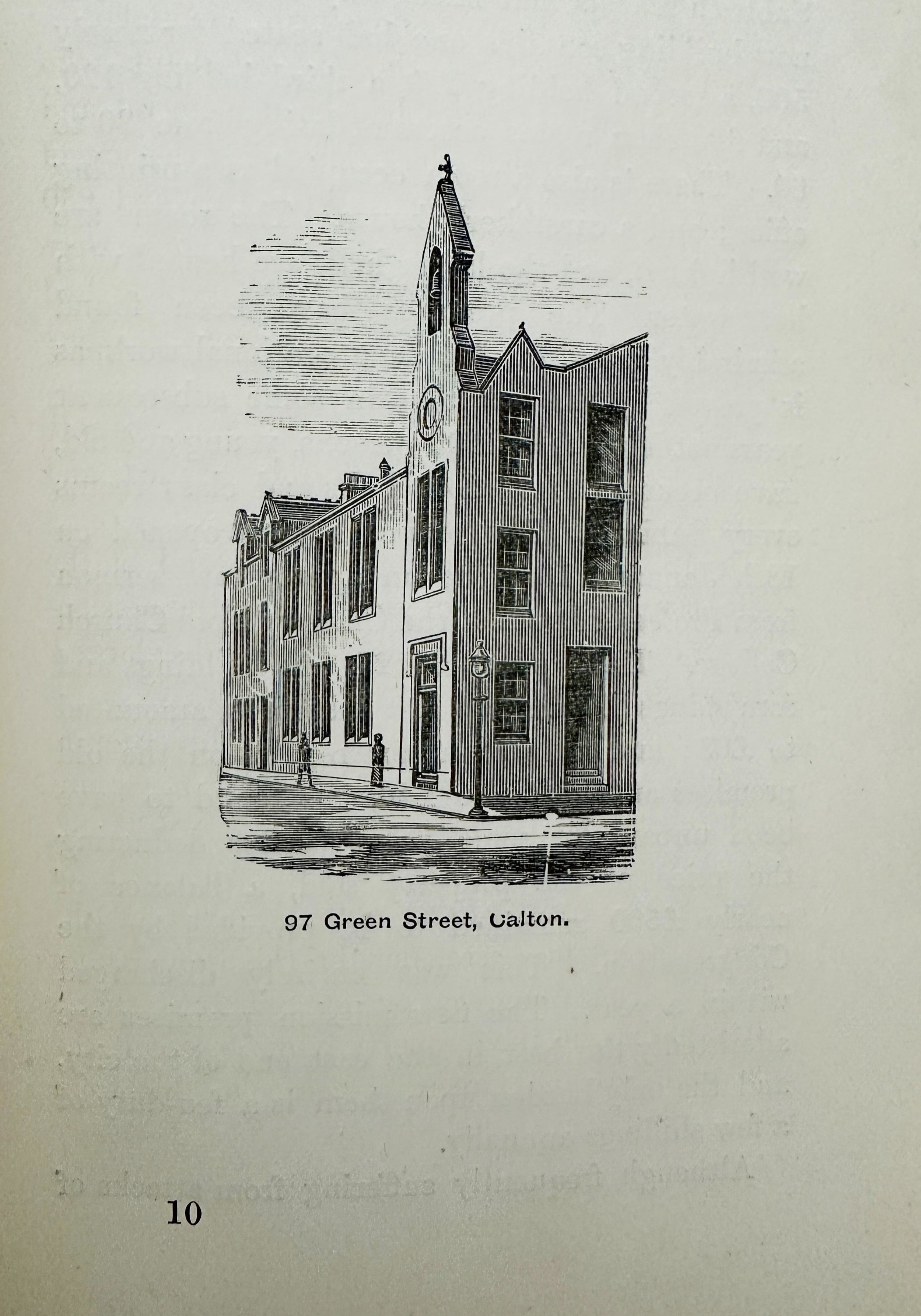
[Illustration.] 97 Green Street, Calton.
138 MINISTRY OF THE SECOND
Sabbath schools and missionary meetings. The new building contains one hall seated for nearly 500, a second holding 220, a third holding 120, and five class rooms accommodating from 30 to 60. There is also a room occupied as a printing office; and a caretaker’s house. The rooms are well lighted, and the larger halls are heated with hot water. The premises have been found admirably suited for the congregational work, as is proved by the fact that in some subsequent years not fewer than 1200 persons, young and old, have occupied the various halls and class rooms every Sabbath. The premises were opened on 18th January, 1883, by an appropriate sermon from Professor Bruce of the Glasgow Free Church College. The site cost £1125, the buildings and furnishings £2514, the law expenses amounted to £65; and an account for repairs on the old premises amounting to £40, was found to have been unpaid for some years. After deducting the price of the property sold, a balance of nearly £500 remained to be provided by the Congregation. This was entirely discharged within a year. The new mission premises are admittedly the best in the east end of the city, and the only burden upon them is a feu-duty of a few shillings annually.
Although frequently suffering from attacks of
DR WILLIAM SYMINGTON. 139
illness more or less severe, Mr Symington continued to discharge the duties of his office till near the close of 1871. He then felt constrained to retire from labours he loved so well, in order to prevent the Congregation suffering further, through his long continued ill health. His resignation was laid upon the table of the Free Church Presbytery of Glasgow in October, and accepted at the following meeting. Although retiring from all active work, Mr Symington retained the status of senior minister till his death. In December, 1877, the Rev. Simeon R. Macphail, M.A., of Elgin, was called to be his colleague and successor. This call Mr Macphail accepted, and he was inducted on 28th March, 1878. Mr Symington did not long survive this event. He died on Sabbath the 9th of February, 1879, after a short illness, and was buried beside his father in the Necropolis. He was a man greatly beloved. As a preacher he had little of his father’s fire and power; but his thoughtful sermons, expressed in language equally remarkable for its elegance and simplicity, entitled him to rank as no mean preacher.
In July, 1874, he received the degree of Doctor of Divinity from the Washington and Jefferson College, U.S.A., and thus he ended life as the second Dr William Symington. He was the
140 DR WILLIAM SYMINGTON.
sixth minister of the Congregation, and occupied the pulpit in May, 1876, when, with a united people, he joyfully took part in the happy union of the Free and Reformed Presbyterian Churches. By taking this step the members of the Reformed Presbyterian Church testified in a very practical way, that they were true Covenanters. The union then consummated was an important step toward the attainment of that uniformity in religion, for which we are all bound by the Solemn League and Covenant to labour.
Having thus in the course of our narrative reached an event which has given to our beloved Church a new name, but without any change of principles, we draw to a close our history of the First Reformed Presbyterian Congregation.