MR ARMSTRONG’S MINISTRY. 1814—1838.
James Dodson
CHAPTER VII.
ON the first of January, 1814, the Congregation of Calton at length resolved to apply to the Presbytery for a moderation, and at a meeting of that body, on the 5th of the same month, a moderation was granted. On 7th April, a call was, by a decided majority, given to the Rev. David Armstrong, Probationer. The stipend offered was £150 a year. The call was very shortly afterwards presented to Mr Armstrong, who craved longer time to consider it; and it was only accepted on the 28th September following. Mr Armstrong was ordained on 23rd February, 1815. The Rev. A. M. Rogerson, Darvel, preached and presided at the ordination; his text being 2 Timothy iv. 5, “Make full proof of thy ministry.” Mr Armstrong was introduced on the following Sabbath, by the Rev. William
92 MR ARMSTRONG’S MINISTRY.
Goold, of Edinburgh, of whose Congregation he had been a member. Mr Armstrong’s first sermon was from the text, 2 Cor. iv. 5, “We preach not ourselves;” and on the two following Sabbaths, he preached from the succeeding clauses, “But Christ Jesus the Lord,” “And ourselves your servants for Jesus’ sake.”
In February, 1818, the members of the Congregation comprising the fellowship meetings in Eaglesham and East Kilbride, applied to the Presbytery for a disjunction. This application was cordially supported by the office-bearers and members of the Congregation in Glasgow, and shortly afterwards the Eaglesham Congregation was formed, and the Rev. Robert Winning, M.A., ordained as minister.
After removing from Sandhills to Calton, the Congregation rapidly increased; and even before Mr Armstrong’s ordination, it had outgrown the accommodation which the Kirk Street Meeting House afforded. The minutes of a Congregational Meeting held on the 13th December, 1814, record that “the increasing demand for seats in the Meeting House, and the inconvenience experienced from the want of suitable accommodation, made it necessary that a more suitable house for the present circumstances of the Congregation should be
MR ARMSTRONG’S MINISTRY. 93
thought of.” The Managers were instructed not to lose sight of any piece of ground that might appear to them suitable, without informing the Congregation, and to call a meeting for the purpose of giving information to the members, when a site was found.
The Congregation seems to have been encouraged to take this step, not only by the increase in the membership, but also by the state of the congregational funds. At the meeting at which the resolution to erect a new church was adopted, the Treasurer reported that his books showed a balance in hand of £252 · 14 · 11.
On 24th December, 1815, a steading of ground at the corner of Graeme Street and Macfarlane Street, containing 800 square yards, was bought for a new church, from the Faculty of Glasgow College, at 18/9 per square yard. At the same meeting, it was reported that subscriptions for the new building amounting to about £650 had been promised. It was found shortly afterwards that the ground purchased, was not suitable; and the sellers having intimated their willingness to relieve the Congregation of their bargain, the ground was surrendered to them in January, 1817.
In 1818 the subject of a new church was again taken up. Two proposals were made. One that
94 MR ARMSTRONG’S MINISTRY.
a meeting house should be built, suitable for the present Congregation under the charge of the present minister; the other that a considerably larger house should be erected, in which there would be services thrice every Sabbath, and that to enable this to be done a Colleague to Mr Armstrong should be called. By a large majority the first motion was carried.
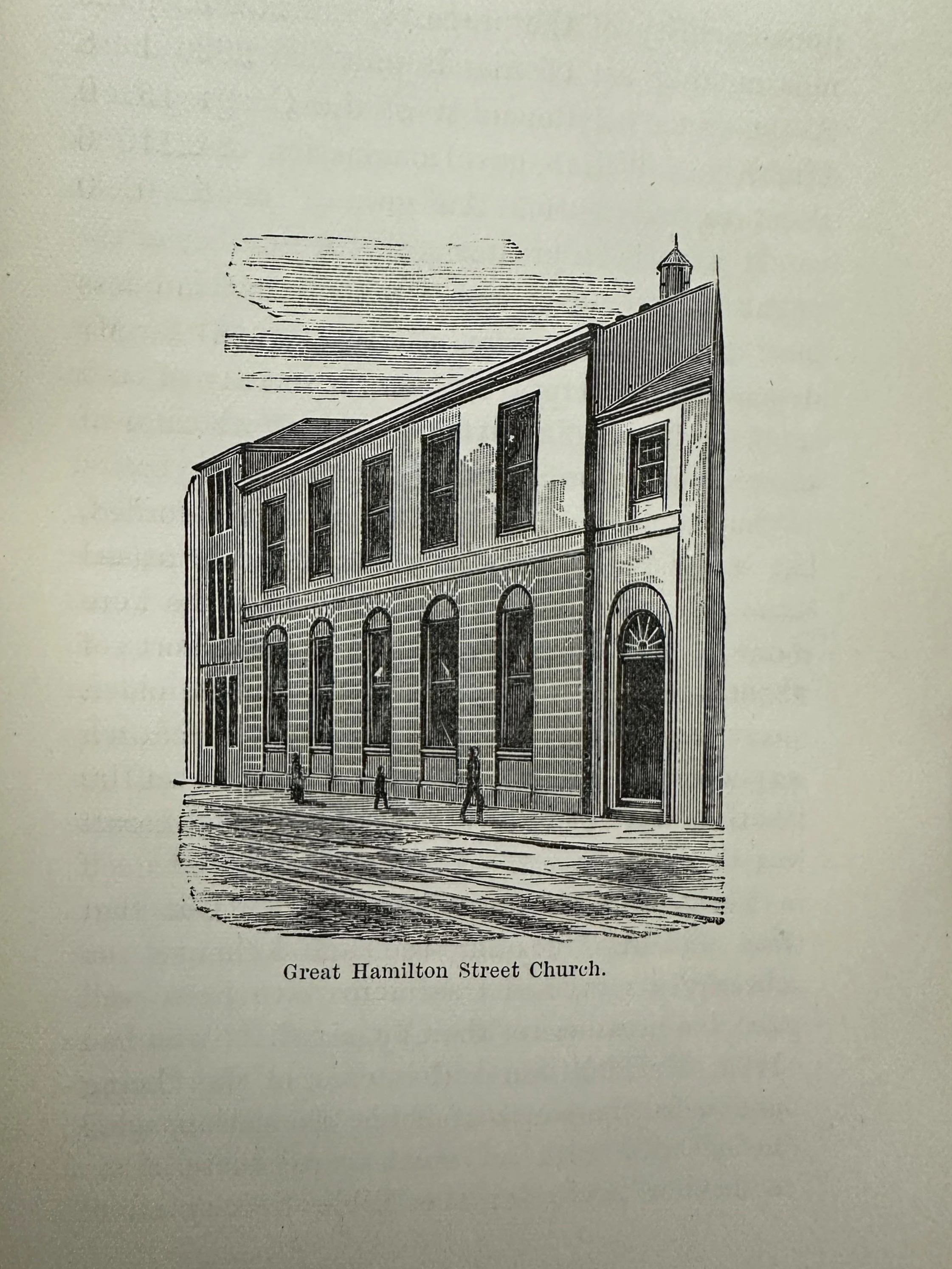
Six sites were spoken of for the new church—in Great Hamilton Street, Carlton Place, Macfarlane Street, Maxwell Street, George Street, and Sydney Street. Regarding three of these sites particular inquiry was made, and it was found that the prices at which they could be bought were, ground in Sydney Street 7/ per yard, ground in Great Hamilton Street 21/ per yard, and ground in Maxwell Street 42/ per yard. The Managers were almost unanimous in recommending the Great Hamilton Street site. That advice was followed by the Congregation, and on 27th August, 1818, the ground upon which the present church stands, was bought from the Corporation at 20/ per square yard.
Mr Joseph Brash was appointed Architect of the new church, and Mr James M‘Ewan, Measurer. The Architect shortly thereafter submitted two sketch plans. One showed a church containing 1068 sittings, with square
MR ARMSTRONG’S MINISTRY. 95
communion seats in the centre of the area; and the other a church containing 1100 sittings, all in pews. The latter plan was adopted, and the erection of the church with which we are all so familiar, was soon commenced.
The Architect’s first Estimate of the cost of the new church had been £1531; and the Managers were not a little surprised, when the tradesmen’s offers were received, to find that they amounted to £2700. Adding to this the cost of the site £700, the Congregation found themselves face to face with an expenditure of £3400; a very large sum for such a Congregation to raise in those days. But the people were hearty and united; the population of the city was increasing at an unprecedented rate; the Congregation had been growing rapidly, and the building of the new church was commenced. Subscriptions to the amount of £630 had been promised, and it was expected that this sum would be increased to £800; the old church was expected to sell for £650; the Congregation had in Bank £150; three of the members had promised to advance £800; and by borrowing a further sum of £1000 upon security of the building, it was expected that the whole expenditure would be met. The principal Contractors and the contract prices were as follows:—
96 MR ARMSTRONG’S MINISTRY.
| Trade | Contractor | £ | s. | d. |
|---|---|---|---|---|
| Joiners | A. & J. Brown | 1329 | 0 | 0 |
| Mason | Thomas Binnie | 962 | 1 | 8 |
| Slater | Robert Watt, Jun. | 94 | 15 | 0 |
| Plumber | George Douglas | 84 | 11 | 6 |
| Plasterer | John Andrew | 55 | 0 | 0 |
The new church was completed within less than a year, and opened in July, 1819. Mr Armstrong himself preached on the occasion, and chose for his text, Exodus xx. 24: “An altar of earth thou shalt make unto me.”
The actual cost of the building is not recorded, but it considerably exceeded even the increased estimate made after the tradesmen’s offers were received, and probably did not fall short of £3300, making with the price of the ground a total expenditure of £4000. The old church was sold at Martinmas 1819, for £550—£100 less than had been calculated upon. The result was that ere long the Congregation found itself in serious financial difficulties. Trade at that time was greatly depressed, and although the subscriptions promised seem to have been well paid, the members of the Congregation, who had advanced £800 while the church was being built, were unable to continue their loans, and money had to be borrowed elsewhere. The Faculty of Physicians and Surgeons lent £1500
[Illustration.] Great Hamilton Street Church.
98 MR ARMSTRONG’S MINISTRY.
upon security of the property, and now one, and now another set of friends provided £900 more. A generous lady member of the Congregation, Mrs Agnes Wilson, gave a donation of £300 to assist in paying for the ground, or the debt would have been greater still. A number of the members, instead of assisting to bear this heavy burden of debt, were at that time largely dependent for support upon the charity of their more fortunate brethren, some of whom were themselves suffering greatly, from the stagnation of trade, and losses they had made in business. As many as twenty-six members were at one time receiving regular assistance from the Poors fund of the Congregation. The allowances to them averaged 6/2 per month, and in eleven years from 1819, to 1829, the session in this way expended in all £883 · 4 · 11. This was not less than one-fifth of the whole congregational income for all these years.
For a time the office-bearers of the Congregation continued hopeful, the annual charges were cheerfully met, and even some extra congregational objects were liberally aided. So early as 1806, Mr M‘Millan had interested the Congregation in the cause of Bible circulation, which he pleaded with so much earnestness that a collection made for the Bible Society on the
MR ARMSTRONG’S MINISTRY. 99
following Sabbath amounted to £56; surely a noble collection for such a Congregation to make! A Bible Association was now organized, and year by year the Congregation contributed to the British and Foreign Bible Society, or the Glasgow Bible Society. At an earlier date we find that a collection was made to aid the persecuted Protestants in the south of France. In 1819, the Congregation petitioned Synod to institute a fund to provide a salary for the Theological professor, to support the Synod Library, to assist deserving Students, to send the Gospel to destitute corners of the country, and for such other purposes as the general interests of the Church might require; and all these objects shared to some extent in the liberality of the Congregation.
But the great trade depression continued long, the ordinary congregational income fell off, and the Congregation was for some years largely indebted to its treasurer. So disheartened had the managers become, that in May, 1830, they resolved to recommend the Congregation to sell the Church for £2800, which sum had been offered for it by the Relief Congregation under the pastoral charge of the Rev. Mr Turnbull. It was believed that a very plain church, sufficient to accommodate the members, might be built for
100 MR ARMSTRONG’S MINISTRY.
£1000, and that a new site would easily be got not far from the existing church. The Congregation, before agreeing to the proposed sale, instructed the managers to see what sum could be raised for reduction of the debt. At a subsequent meeting it was reported that, the members having been canvassed, subscriptions to the amount of £231 had been promised. That sum being deemed quite inadequate to extricate the Congregation from its financial difficulties, the members reluctantly agreed to sell the church. Some further meetings were held with the Committee of the Relief Congregation, but they ultimately withdrew from the negotiations, and bought the “Noddy” Church, now St. Alphonsus Roman Catholic Church, Great Hamilton Street. The subscriptions previously promised for the reduction of the debt, were almost all very shortly paid to the treasurer, and by the end of September it was reported that one bill for £200 had been paid, and before the close of the year a further payment of £200 was made in reduction of the floating debt, which then stood at £500.
About this time some members of the Congregation began to express dissatisfaction with the ministry of Mr Armstrong. He was a man of undoubted ability, who earnestly and faithfully discharged his pastoral duties; but he greatly
MR ARMSTRONG’S MINISTRY. 101
lacked popular gifts. To many he endeared himself by his unaffected piety, and by the solid worth of his preaching; but others lamented the absence of warmth, and life, in his public ministrations, and also complained of the undue length of the services. Expression was given to this feeling of dissatisfaction at the Annual Meeting, held on 5th January, 1832. It was proposed that the meeting should express its opinion upon the question—Is it expedient, if practicable, to have a Collegiate charge in the Congregation? Forty-four voted that such an arrangement would be desirable, and only five that the existing state of matters should continue. Fifteen members present at the meeting declined to vote. A Committee was appointed to wait upon Mr Armstrong, and represent to him the desire of the Congregation. That deputation seems, unfortunately, to have been composed chiefly, of those who were known to be dissatisfied with Mr Armstrong’s ministry. Mr Armstrong, after considering the proposal submitted to him, replied by letter, deprecating any change. That letter was submitted to a meeting on the 6th of February. After debate, two motions were made: one, that in view of the position taken by Mr Armstrong, a Collegiate charge was impracticable; and the other, that it was still
102 MR ARMSTRONG’S MINISTRY.
practicable. The latter motion was carried by a majority of one, thirty voting for it, and twenty-nine for the other, while sixteen declined to vote either way. A motion to proceed with the steps needful for securing a second minister, was next carried by a considerable majority over a motion for delay; and a Committee was appointed to prepare a plain and simple statement of the position of the Congregation, and to lay the same before the Presbytery. These proceedings evoked much sympathy for Mr Armstrong among the members, the majority of whom had not even attended the meetings held to consider this important matter, and his friends now bestirred themselves on his behalf. He invited the members to meet him in conference, on the 22nd of March, a day which had been appointed as a National Fast, and fully explained his feelings in regard to the proposed change. At a Congregational Meeting held the same evening, it was resolved by one hundred and sixty-four votes to thirty-four, “That the petition for forming this Congregation into a Collegiate Charge, now lying on the Presbytery’s table, be withdrawn.” From this resolution twenty-six members dissented.
Disappointed in their endeavours to obtain within the Congregation the arrangements which they thought needful for edification, the
MR ARMSTRONG’S MINISTRY. 103
dissentients, on the 5th of July following, asked the concurrence of the Congregation in an application, which they intended to make to the Presbytery for a disjunction. They urged that the increase of the city afforded ample room for the establishment of a second Reformed Presbyterian Congregation in it. It would have been well for all parties had this request been at once acceded to; but unfortunately other counsels prevailed, and by a considerable majority, the meeting resolved to oppose a disjunction, and appointed a deputation to appear before the Presbytery for this purpose. The opposition was at that time successful. Various attempts were made to restore harmony in the Congregation, the parties had private conference among themselves, and a Committee of Presbytery also met with them, but these efforts were unavailing.
During those unhappy years, Mr Armstrong was greatly depressed, notwithstanding many efforts made by his friends to cheer him. In addition to several more private tokens of regard, the Congregation, at the Annual Meeting in January, 1834, resolved to present an address to Mr Armstrong, expressive of their unabated attachment to him personally, of their appreciation of the faithful manner in which he uniformly
104 MR ARMSTRONG’S MINISTRY.
discharged his official duty, and of sympathy with him under much personal affliction. The address was presented along with a purse containing Twenty pounds. In December, 1834, Mr Armstrong’s health, which for a number of years had not been robust, was seriously affected, and his eyesight became so weak that he intimated to his people his inability to continue the regular discharge of his duties. In this serious state of matters the Managers made an earnest appeal to the minority, assuring them of their earnest desire to remove all grounds of difference, and to act harmoniously in making arrangements, which might be satisfactory to all. But it was too late. Those who had petitioned for a disjunction had withdrawn from the Congregation, and from the 2nd of June, 1834, had met for worship in a hall in the centre of the city; strong language had been used on both sides, which was not so easily forgotten; and the minority replied that they thought it would be best for all concerned that they should renew their application at the next Meeting of Synod, to be recognised as the West Reformed Presbyterian Congregation, Glasgow. That application was made, and was warmly supported by numerous friends throughout the entire Church, many of whom presented petitions to
MR ARMSTRONG’S MINISTRY. 105
Synod in support of the application. On the 23rd of April, 1835, the Synod at length granted the disjunction asked, and a second Congregation was thus formed in Glasgow. A church was shortly thereafter built in West Campbell Street, and the new Congregation made repeated efforts to obtain for their minister, Dr William Symington of Stranraer, but he felt it to be his duty to decline their calls. In 1838, the Rev. Stewart Bates, D.D., previously minister in Kelso, was inducted as first minister of that Congregation.
In the meantime, Mr Armstrong’s health had become worse, and it was feared that he would entirely lose his sight. He was for a time quite unfit for work, and his pulpit was supplied by ministerial friends and probationers. On 12th January, 1835, in a very touching letter addressed to his people, Mr Armstrong intimated that all the means used for removing the malady under which he suffered having proved unavailing, he had ceased to hope that he would ever be delivered from it. He therefore offered to retire, that another minister might be elected by the Congregation. Numerous meetings were held to consider the matter. It was felt that a suitable retiring allowance must be given to Mr Armstrong; but the Congregation, weakened by the recent
106 MR ARMSTRONG’S MINISTRY.
withdrawal of about fifty members, was unable to give that, and to provide at the same time a suitable stipend for a new minister. Indeed, so disheartened were the office-bearers by the withdrawal of so many members, some of whom had been both useful and liberal, that they at first spoke of selling the church property. Wiser counsels soon prevailed, Mr Armstrong’s health also improved, he resumed his ministry with increased devotion, and ere very long he was again able to overtake most of his work. The members of the Congregation worked quietly and harmoniously together, and within two years, in addition to clearing all the current expenses, the debt was reduced by £250.
At the beginning of 1838 it looked as if both minister and people had got over their difficulties, and that many years of quiet usefulness were before them. But early in March Mr Armstrong was attacked by typhus fever. It is believed that he caught the infection when visiting a member of his Congregation who died of that disease, although, when Mr Armstrong called, the real nature of the illness was not known. Mr Armstrong’s illness ran a very brief course, and he died on the 30th of March. He was buried by his Congregation in the Calton Burying-ground, on the 3rd of April, and on
MR ARMSTRONG’S MINISTRY. 107
the following Sabbath, his life-long friend the Rev. A. M. Rogerson, who twenty-three years before had preached at his ordination, was called to preach the funeral sermon. He took for his text 2 Cor. v. 1—“For we know that if our earthly house of this tabernacle were dissolved, we have a building of God, an house not made with hands, eternal in the heavens.” The elders and managers placed on record their sense of the value of Mr Armstrong’s services and their deep sorrow at his sudden death, “by which the Church has lost an enlightened and able minister, and the Congregation a faithful and diligent Pastor. The plainness, variety, boldness, solemnity, earnestness, and affection of his public labours, together with his unremitting attention to the more private duties of the ministerial office, must long continue to endear his memory to those who have had the advantage of living under his ministry.”
Shortly afterwards a considerable sum of money was raised for Mr Armstrong’s widow and family. His widow still survives, more than fifty years after the death of her husband, a widow indeed, most worthy of the loving regard of all who are privileged to know her.