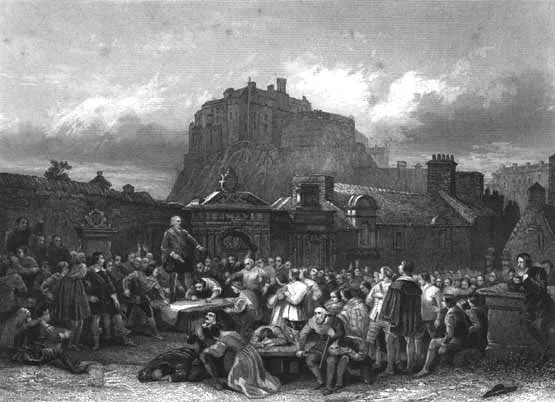
A Short Exposition of the Popish Tenets
James Dodson
Abjured in our
National Covenant,
OR
Confession of Faith,
With a plain Refutation of these Errors.
1 PET. iii. 15. Be ready always to give an Answer to every Man that asketh you a Reason of the Hope that is in you, with Meekness and Fear.
GLASGOW:
Printed by ROBERT SMITH and ALEXANDER HUTCHESON in Company, Book-sellers in the Salt-market, MDCCXLV.
[ 3 ]
A short Exposition of the Popish Errors abjured in the national Covenant, with a plain Refutation of the same,
THAT the Antichristian or popish, hath not the least Claim or Title to the true Religion is evident, particularly from the Divine Causes thereof, which may be reduced to these four following. First, The Efficient and original Cause, and this is the great and glorious JEHOVAH. He, and none but He, is the happy Author, the wise Institutor of Religion; for he is the Father of Lights, from whom cometh every good Gift and perfect Donation. Now, if God be the Author of true Religion, then Popery is cut off from any Pretensions to it, seeing it is purely the Fruit or human Invention, favours wholly of the Flesh, and not of the Spirit; and stands calculated for no other End, but to support and satisfy the Lusts of corrupt Nature: In short, ’tis nothing else but a mischievous Mystery of Iniquity; and therefore could never proceed from a Holy GOD, with whom Wickedness neither can, nor shall dwell.
2dly, There is the material Cause of Religion, or the great Things propounded and treated by it viz. The high Mysteries concerning GOD and his Church, together with the Way and Means of eternal Life and Blessedness. It lays open the wonderful Way, which
[ 4 ]
the infinite Wisdom of GOD has fallen upon for the Relief and Deliverance of Mankind Sinners, while it set forth precious CHRIST before us, in the Glory of his Person and Offices, in the Purchase of his Death and Sufferings, the Triumph of his Resurrection and Ascension, the Efficacy of his Intercession, together with the certainty of his coming at the last Day, when all the Elect shall be gathered together to that State and Place of perfect bliss, where they will be before the Throne of GOD, and serve him Day and Night in his holy Temple. O! how sweet and glorious is the Matter of true Religion, more to be desired than Gold, yea, than much fine Gold, sweeter than Honey from the Honey-comb: From which ’tis evident, that Popery is a false and Antichristian Religion. For 1st, The Matter of it is not Divine Truth, instead of this, it urgeth and teacheth the Precepts of Men; and particularly, Popery makes unwritten Traditions and Fables the Object of Faith. 2dly, ’tis a bare-fac’d Enemy to the Matter of true Religion, while it banisheth all Care of saving Knowledge, makes Ignorance the Mother of Devotion, calls for implicite Faith, binding People to believe what the Church believes. In a Word, Popery denies the Divine Authority of the whole Scriptures, but in so far as they stand attested, approven and confirm’d by the Authority of the Pope and Church. Hence that blasphemous Prelat Gregory the 7th published to the World, that no Book, nay not so much as any one Chapter in the whole Bible would be Canonical, if it were not for his Authority making it so.
3. There is the formal Cause of true Religion, and this I take to be the Agreement that is betwixt
[ 5 ]
it and the Will of God in the Holy Scriptures, which we are to look upon as the supreme Rule both of Faith and Manners, and therefore Popery is to be rejected, as expressly contrary to, and altogether inconsistent with the Will of God, as will appear from the Instances mentioned in this Essay.
4thly, There is the final Cause of true Religion, which is the Glory of God and the eternal Happiness of poor Sinners. But with the greatest Impudence, Popery robs GOD of his Glory, while it maintains, that Angels and Saints departed may be invocated, moreover it invades the Divine Glory, while it asserts, that Men and Women may be justified by a Righteousness of their own, inconsistent with the Nature of Christianity, which is to hide Pride from the Eyes of Men, Rom. iii. 27. Where is Boasting then? It is excluded. By what Law? Of Works, nay: But by the Law of Faith, again Popery sinks the Glory of the Redeemer, by setting up Pilgrimages, Purgatory, and good Works, as Competitors with him in the great Business of Sinners Salvation; notwithstanding of what is so plainly affirm’d by the Holy Ghost, that there is no Salvation in any other. In a Word, it brings a black Ecclipse upon the Divine Glory, by setting up the Pope as Head of the Church; yea, it setteth him above GOD, by giving him a Power to Dispense with lawful Oaths, and unlawful Marriages, and in a Word to make Good Evil, and Evil Good. Thus by considering all these Causes of true Religion, you may see that Popery has no just Claim to it. No wonder then that our Worthy and honoured Ancestors, having believed with their Hearts and confessed with their Mouths the true Christian Faith and Religion, abhorred
[ 6 ]
and detested all kind of Popery, and in special the particular Heads following.
1. The usurped authority of that Roman Antichrist upon the Scriptures of God, upon the Kirk, the civil Magistrate and Consciences of Men, all his tyrannous Laws made upon indifferent Things against our Christian Liberty.
(1.) Upon the Scriptures of God, by adding unto them, and making equal with them the Books of Apocrypha and their own Traditions, directly contrary to Deut. iv. 2. but especially, while he will have the Determination of all Points of Religion to be sought for, not from the Scriptures themselves, but from that Sense or Exposition which it pleaseth him or the Kirk of Rome to give. But the Spirit of God in his Word lays down the contrary Course, Acts xvii. 11. 2 Pet. i. 19. John v. 39.
(2.) Upon the Kirk contrary to the Word of God, Luke xxii. 25, 26. 1 Pet. v. 3. and yet by Peter it is that he pleads this Authority.
(3.) Upon (or over) the civil Magistrate. Thus he adds civil Usurpation and Tyranny unto his Ecclesiastical; but CHRIST says, My Kingdom is not of this World, John xviii. 36. Further, the Apostle speaking of the lawful Magistrate, will have every Soul to be subject to the higher Powers. Now, he does most slavishly subject to himself the highest civil Authority, as History bears Witness, and this proves him very clearly to be the Antichrist, and that Man of Sin spoken of, 2 Thess. ii. 4. for thus he exalteth himself above all that is called God; now these in civil Authority are called Gods. I said ye are Gods, Psal. 82. 6.
(4.) Upon the Consciences of Men. This he does by
[ 7 ]
by loosing the Conscience when he should not, by his Dispensations, Pardons, &c.
[2.] By binding it, when it should not be bound, by his Ordinances, Traditions, and Doctrines of Men, whereto he subjects Mens Consciences contrary to the Apostles Rule, Col. ii. v. 20, 21, 22, 23. This he does in Points of Practice, and as to points of Faith, he usurps Authority over the Conscience, when he will have every one to believe as the Kirk believes, contrary to that of the Apostle, not that we have Dominion over your Faith, 2 Cor. i. 24.
2. His erroneous Doctrine against the Sufficiency of the written Word, the Perfection of the Law, the Offices of Christ, and his blessed Evangel,
(1.) Against the Sufficiency of the written Word contrary to 2 Tim. iii. 15, 16, 17. verses.
(2.) Against the Perfection of the Law, directly contradicting Psal. xix. 13. The Law of the Lord is perfect.
(3.) Against the Offices of Christ. By his Doctrine he wrongs CHRIST in all his Offices
[1.] In his Prophetical Office, while he says, the Scriptures are not perfect, [2.] In his Priestly Office, by the Sacrifice of the Mass, the Satisfaction of Men by Pennance and Purgatory; and the Mediation and Intercession of Saints and Angels.
[3.] In his Kingly Office, while he says, Christs Laws are not perfect, that they have not seen sufficiently to the appointing of under Office bearers in his Church and Kingdom: But Christ has seen sufficiently to this, as appears from Eph. iv. 11, 12, 13. So that these who add any new Offices in the Church, incroach upon his Kingly Office.
(4.) Against Christ’s blessed Evangell. He wrongs the Evangel or the good and sweet Tidings
[ 8 ]
to Mankind Sinners several ways, by sending the distressed Consciences of Men for Peace and settling, for Comfort and Consolation, to their own Works and Merits, at least in a great Part, and not to CHRIST alone, contrary to Mat. xi. 28. v. Come unto me all ye that labour and are heavy laden, and I will give you rest.
[2.] By sending poor Souls for venial Sins (for which Distinction there is no Warrant from the Word) to their own Satisfaction, partly in this Life, partly in Purgatory.
[3.] By his Doctrine concerning the uncertainty of Salvation through CHRIST, and that we ought to doubt of the same.
[4.] By his denying the certainty of the Perseverance of the Saints.
3. His corrupted Doctrine concerning original Sin, our natural Inability and Rebellion to God’s Law, our Justification by Faith only, our imperfect Sanctification and Obedience to the Law.
(1.) Original Sin. The Church of Rome concerning this, besides others, have these two main Errors. 1. While, even before Baptism, they Place it only in the want and absence of that original Righteousness, which was before the Fall, but not in any certain Corruption or sinful Disposition, contrary to Scripture and Christian Experience, 1 Cor. ii. 14. 2 Cor. x. 5. 2 Eph. iii. Jer. xvii. 9. Rom. iii. from ver. 10. to ver. 20. These Scriptures make it evident, that original Sin stands not only in an Absence of original Righteousness, but also in the Corruption of our whole Nature.
[2.] After Baptism, they will have it to be no more Sin, but the Seed of Sin, to make Way for their other corrupt Opinions of fulfilling the Law, Merits, and going about to establish their own Righteousness. But we see how the Apostle thinks
[ 9 ]
of it, Rom. vii. 17. expressly calling it Sin that dwelleth in him, and ver. 24. O wretched Man that I am who shall deliver me from the Body of this Death, Gal. v. 17. For the Flesh lusteth against the Spirit, and the Spirit against the Flesh, and these are contrary the one to the other.
(2.) Our natural Inability and Rebellion to God’s Law. The Papists speaks sparingly, doubtsomely and darkly of our natural Inability unto what is spiritually good, ever ascribing and referring something unto Man himself and free will, as their Doctrine and Comparisons do testify. They compare Man in a state of Nature, to a Man not dead as the Scripture speaks, but to a Man wounded, or fettred, &c. They deny the unconverted the Act or Action of Good, but not the Power or Faculty; but the Scripture removes not only the Action of Good, but the very Power, as appears from Rom. viii. 7. 2 Cor. iii. 5. We do not say, that by the Fall the Soul of Man hath lost it’s natural Power, or Faculties, but we say according to the Word of God, that these Powers, have no Power at all for any spiritual Good, and that not only from external Impediments; (as the Popish Comparisons import) but even from an inward, inherent Inability and Insufficiency, until they be renewed by Grace; hence the Scripture speaks of a New Heart, Ezek. xxxvi. 26. calls our Renovation a Creation, a New Birth, a New Generation or Conception, all importing, that there is no Power existing, either Will or any other Thing, before the LORD come in with his Spirit. But the Papists would have something in a Man himself, were it never so little, that the right husbanding and guiding of this, might procure and bring
[ 10 ]
in all the rest; and so to give to Man wherein to Glory: But all boasting is excluded, says the Apostle, By what Law? Not by the Law of Faith, but by the Law of Works. The natural Understanding ever would be at a Mans self, why this Man gets Grace, and another not, this Man is chosen and another not; but all the Reason of giving or denying of Grace is from GOD himself, who works the Will and the Deed of his own good Pleasure, Phil. ii. 13. As for our natural Rebellion to GOD’s Law, ’tis clearly manifested by many Places of Scripture, Rom. viii. 7. Neh. ix. 29. and on-ward, we are ready to walk contrary to God, to be stiff-necked and Rebellious, to withdraw the Shoulder, to harden the Neck, to stop the Ear that we should not hear, to walk stubbornly, so desperately wicked are we. Nor is this Rebellion altogether removed from the Regenerate, but their unrenewed Part still rebels, Rom. vii. 23. Gal. v. 17.
(3.) Our Justification by Faith only. Not to speak of other Places, ’tis fully, clearly and evidently laid down, Rom. iv. throughout, with the beginning of Chap. v.
(4.) Our imperfect Sanctification and Obedience to the Law, this is evident from 1 Kings viii. 46. 1 Joh. i. 5. These erroneous Doctrines of the Papists, with respect to Justification, and Obedience to the Law.
[1.] They are most dangerous to the Souls of those that imbrace them; for that they put them out of the Way of escaping Hell and eternal Damnation, and of attaining to Heaven and everlasting Happiness in going about to establish their own Righteousness, they miss the Righteousness of GOD, which is in CHRIST
[ 11 ]
JESUS.
[2.] As these Doctrines must be dangerous to Souls, so they must be most Derogatory to the Sufferings and Obedience of our dear Lord and Saviour, to his Love in obtaining both, and to the Greatness of the Benefit we receive by both; as also to the free Love and Favour of GOD in the Merits of his Son, who so freely hath bestowed, two so main Benefits, and purchased them to us at so dear a Rate.
4. His corrupted Doctrine concerning the Nature, Number and Use of the Holy Sacraments; with all his Rites, Ceremonies, and false Doctrine, added to the Ministration of the true Sacraments, without the Word of God. His Doctrine concerning the Nature of the Sacraments; as for the Sacrament of the Supper, they turn it into a Sacrifice, to a Stage-play, far different from that Simplicity set down in the Scripture; so do they also with Baptism by their crossing, Oyl, Salt, Spittle, &c. making these Signs of their own devising. They Err also in annexing, ascribing and tying an Efficacy and inherent Virtue to the Sacraments, above any that they acknowledge to the Word; but that such Grace is not tyed, nor Virtue inherent in the Sacraments, but floweth from the Spirit, who bloweth when he listeth, is clear from Matth. iii, 21. ver. I Baptize you with Water, (and no more can the outward Ministry do) but he that cometh after me, shall Baptize you with the Holy Ghost and with Fire.
(1.) As to the Use of the Sacraments. The Supper they turn it from the Use of a Sacrament to a Sacrifice; and for Baptism, they tye Justification to it, as the Effect to the Cause; whereas the Scripture makes Circumcision (now Baptism is of the same Nature) to be but a following Sign and Seal
[ 12 ]
of the Righteousness which is by Faith, which Abraham had before his Circumcision, Rom. iv. 21. So Cornelius before the Sign or Seal received the Thing signified; He was a devote Man, and received the Holy Ghost, and consequently was justified first, and then baptized; upon this their erroneous Opinion concerning Baptism, depends their absolute Necessity of it.
(2.) The Number of the Sacraments, CHRIST gives Warrant for two, but the Papists add five Bastards of their own deviseing, viz. Orders, extreme Unction, Pennance, Marriage, and Confirmation. But that none of these are Sacraments, will be clear if we consider what a Sacrament is, viz. an outward Sign of an invisible Grace, instituted and ordained of CHRIST for that effect, so that for a Sacrament, we must have
[1.] A Word of Command.
[2.] A Word of Promise, we have both these Words anent Baptism, the Word of Command, go and Baptize; and the Word of Promise, He that Believes, and is baptized, shall be saved anent the Supper, the Word of Command is, Do this, and the Word of Promise, This is my Body broken for you, and Joh. vi. ver. 51. 55. Now if we apply these to the Papists Bastard Sacraments, we will find they halt.
{1.} For extreme Unction, it was never a Sign of Grace, but of a temporal Blessing of Bodily Health.
{2.} It was a Work of Miracles, which is now ceased.
{3.} It is perverted and misapplied by the Papists, not given for curing, but before Death for a superstitious End.
|2.| For Orders, Imposition of Hands of old indeed, was a Sign of Gifts, but not of Grace.
|3.| As for Confirmation, is not the LORDS Supper, a Sacrament for Confirmation and strengthening?
|4.| It may be said
[ 13 ]
also of Marriage, that there is no Word of Command to use it as a Sacrament, and no Word of Promise to that Effect.
|5.| For Pennance, or any sort of Mortification enjoyed by the Romish Priests, the Papists themselves, cannot agree about a Sign and Thing signified in it; yea, in it self it is a most blasphemous Thing, derogating to the Satisfaction of CHRIST. In a Word, what is requisite to be represented to us, or sealed up, is sufficiently represented and sealed, by the Sacraments of Baptism and the Supper; either what concerns our Entry or Progress in Christianity concerning either our Justification or Sanctification; and therefore other Sacraments under the New Testament are Superfluous.
5. All his Rites, Ceremonies, false Doctrines added to the Administration of the true Sacraments without the Word of God. Can they say with the Apostle, That which I received of the Lord have I delivered unto you? Or should not we say of them as the Psalmist says, I have vain Thoughts: but thy Law do I love, Psal. cxix. 113; Psal. ci. 3. I hate the Work of them that turn aside, Psal. cxix. 104. I hate every false Way. Concerning these we are to consider, that they are Will-worship, Superstition, done without a Warrant; and to such the LORD says, Who hath required these Things at your Hands? Lev. x. ver. 1. Nadab and Abihu offered strange Fire before the Lord, which he commanded them not, ver. 2. And there went out Fire from the Lord and devoured them, and they died before the Lord.
6. His cruel Judgment against Infants departing without the Sacrament, his absolute Necessity of Baptism. The first of these flows from the
[ 14 ]
last: But that the Sacrament of Baptism is not absolutely necessary to Justification, and consequently to Salvation, is clear from what has been said before: Abraham was justified before he was circumcised, and Cornelius before he was baptized; and though they had both died before they had received the Sacrament, yet they had been saved; and the Reason was, because, that though they wanted the Seal, yet were they within the Covenant, and why may it not be so with some Infants dying without Baptism, Gen. xvii. 7. And I will establish my Covenant between me and thee, and thy Seed after thee ---- to be a God unto thee, and thy Seed after thee.
7. His blasphemous Opinion of Transubstantiation, or real Presence of Christ’s Body in the Elements, and receiving of the same by the wicked, or Bodies of Men. This blasphemous Doctrine, has cost many a dear Saint and Martyr his Life, and no wonder, for it has been the Occasion of most vile Idolatry and bread Worship, a Sin most odious in GOD’s sight. In it self ’tis against Sense and Reason. 2. Against Faith, for it is a Point of our Faith according to the Scripture, Acts iii. ver. 21. Whom the Heavens must receive, until the Times of the Restitution of all Things. 3. ’tis dishonourable to our Lord’s glorious Body, that as it follows, that it should be received by the wicked, torn by the Teeth of Men, &c. Indeed, when he was upon the Earth, his Body was ill used by the wicked, expos’d to many Injuries; but now it is his glorified and glorious Body, as ’tis called by the Apostle, Phil. iii. 21.
8. His Dispensation with solemn Oaths, Perjuries, Degrees of Marriage forbidden in the Word.
[ 15 ]
Word. This is his Presumption to take upon him, to Dispense with GOD’s Law, and to give Liberty to Sin.
9. His cruelty against the innocent divorc’d. This is against our Saviour’s Doctrine, Matth. v. 31, 32. It hath been said, whosoever shall put away his Wife, let him give her a writing of Divorcement, but I say unto you, that whosoever shall put away his Wife, saving for the Cause of Fornication, causeth her to commit Adultery; And whosoever shall marry her that is divorced committeth Adultery.
10. His devilish Mass: His blasphemous Priesthood: His profane Sacrifice for the Sins of the dead and the quick. These Points go together.
(1.) His Mass is indeed Devilish by all other Points, having in it vile Idolatry and bread Worship, the Depravement of God’s holy Ordinance of the LORD’s Supper sundrie Ways; and being so derogatory to that full sufficient Sacrifice, once offered for the Sins of many, Heb. ix. 28. Heb. x. 12. 14. ver. To what purpose then are the often repeated Sacrifices of the Mass, they make a Distinction of a Bloody and unbloody sacrificing of Christ; according to the former he was, (say they) once offered; but in regard of the latter often. But where find they this Distinction in the Word of GOD? There can be no unbloody sacrificing of CHRIST, Heb. ix. Ch. 22. ver. And without shedding of Blood is no Remission. Now in the Mass they acknowledge no Blood, and consequently no Remission of Sins, and therefore they contradict themselves.
(2.) His blasphemous Priest-hood, his profane Sacrifice for the Sins of the dead and the quick. His
[ 16 ]
His Priest-hood is blasphemous, as bringing with it all these Consequences of the Sacrifice of the Mass. The Apostle, Heb. vii. 23, 24. makes a Distinction between the Priests under the Old Testament, and that of the New, standing in this, that they were many Priests, and under the New, only one, viz. CHRIST; but according to the Papists, they are also many Priests.
11. His Canonization of Men, i. e. his declaring and pronouncing them to be Saints. This is the Occasion of much Idolatry and Superstition following it, whereupon followeth Invocations of such as are cannonized, dedicating of Days and Temples to them, worshipping their Images and Reliques. When the Sons of Zebedee were seeking a Degree of Honour and Glory from CHRIST above others, takes he it upon him, no, (says he) It is not mine to give, but it shall be given to those by whom ’tis prepared.
12. Calling upon Saints or Angels departed, worshipping of Imagery, Relicks and Crosses; dedicating of Kirks, Altars, Days, Vows to Creatures. For the Saints departed, we want a Warrant to call upon them. How shall we call upon him, in whom they have not believed; but so it is, that on Saints or Angels or any Creature we should not believe; how should we then call upon them? Further, they are ignorant of our Case and Condition, and consequently know not what we pray for, Isa. lxiii. 16. 2 Kings xxii. 20. But
(2.) If they say, tho the Saints being still in Heaven, and so cannot well know our Necessities, nor hear our Prayers; yet the Angels are ministring Spirits unto us, and pitch their Tents about us; are we not then to pray to them? I answer
[ 17 ]
in the Negative. For First, They are not to be believed in, and so not to be called upon. 2dly, The Apostle expresly forbids it, Col. ii. 18.
(3dly,) Worshipping of Images, this may be understood, either of their worshipping of the Images of the Creatures, which is expressly forbidden in the second Command; or their making or worshipping of any Image of GOD, which is also expresly forbidden, Deut. iv. 15, 16. and in the second Command.
(4.) Reliques, (viz., The Remains of Bodies or Cloths of Saints, preserved by Roman Catholicks with great Veneration) if worshipped, they come under the Compass of the former Evil, viz. Idolatry. To reform them for any religious End, is without Warrant, Command, or Example in the Scripture.
(5.) Crosses. Are they not much rather to be discharged and broken down? How clearly speaks the Word against these Crosses, Lev. xxvi. 1. Ye shall not rear up unto you any standing Image, neither shall ye set up an Image of Stone into your Land, to bow down unto it: For I am the Lord your God. How many are there of this Kind in this Land, even almost in every Corner.
(6.) Dedicating of Kirks. Where is there Warrant under the Gospel, for any Holiness of Places? What says our SAVIOUR to the Woman of Samaria? The Time shall come, when they shall neither worship in this Mountain, nor at Jerusalem; but they that worship, shall worship in Spirit and in Truth; which is, as I conceive; the Time is coming, when such Ceremonies of Worship, as of Holiness of Places, shall cease, only they shall keep the Substance, they shall Worship in Spirit and Truth.
(7.) Altars. This Imports
[ 18 ]
their wicked Sacrifices, and their blasphemous Priest-hood. 8. Days. Gal. iv. 10. Ye observe Days, and Months, and Times, and Years. He adds, I am afraid of you, least I have bestowed my Labour in vain. So Col. xi. 6. Let no Man judge you in respect of an Holy Day. They will readily Answer, That these be the Jewish Days: But says he not, ver. 20, 22. Why are ye subject to Ordinances, after the Doctrines and Commandments of Men? Now the Jewish Days, were not the Commandments of Men, but of God. And, I pray you, did the LORD Discharge his own Ceremonies of Days, to the End they might give Place to these of Mens devising. 9. Vows to Creatures, or Saints departed, this is refuted by the like Reason, that calling upon Saints departed; for indeed it is calling upon them, at least it has it ever accompany’d with it. But further, vowing is a Part of GOD’s Worship, Psal. xxv. ver. 11.
13. His Purgatory, Prayers for the dead, praying or speaking in a strange Language; with his Processions, blasphemous Litanies, and Multitudes of Advocates or Mediators: His manifold Orders, auricular Confession.
(1.) His Purgatory. An imaginary Place of Purgation for the Souls of the Faithful, according to the Papists Creed, where they are to be purified by Fire, before they are admitted to the State of perfect Bless. This is a Doctrine contrary to the Truth, Comfortless to all Christians, derogatory to the Fulness of CHRIST’s Satisfaction, and to the Fulness and Freeness of our Justification, and of GOD’s Mercy in the full and free Pardon of our Sins, as if God did forgive a Part, and made us to satisfy in Purgatory for another Part, is this to
[ 19 ]
justify or forgive freely? ’Tis invented for filthy Gain. But for Refutation, the Scripture speaking of the State and Place of Men after this Life, makes no mention but either of Hell or Heaven, Luke xvi. ver. 25, 26. John iii. 36. Matth. viii. 11, 12. Rev. 20. 15. also Chap. xxi. 7, 8. 1 Joh. i. The Blood of Jesus cleanseth or purgeth us from all Sin. How then can it be said, that in Purgatory we must be purged from all our venial Sins? But most clear is that Passage against it, Rev. xiv. They that die in the Lord, rest from their Labours, and their Works follow them. Now the Papists by this Doctrine of Purgatory, will have many of these who die in the Lord, and shall be saved from Hell, when they die, to be beginning their Labours, and their greatest Labours. The Argument may be thus framed. They make all that go to Purgatory to go in end to Heaven, and be saved. Now, none can go to Heaven and be saved, but such as die in the Lord, and all such as die in the Lord, rest from their Labours; and further it is said, their Works do presently follow them at the Heels; for so does the original Word import; and so they cannot go to Purgatory. If they die not in the Lord, they shall never go to Heaven, which they say they do. They rest from their Labours, and consequently go not to Purgatory.
(2.) Prayers for the dead, This is a profaning of GOD’s Ordinance, seeing the dead is unalterable, Luke xvi. 26. Heb. ix. ’Tis appointed for all Men once to die, and after Death the Judgment, viz. Immediately after, nothing intervening, as the emphatick Particle (But) Imports; and if he mean not immediately, he might as well said,
[ 20 ]
after Birth comes the Judgment. The particle (The) is also pithie to this effect, even the Judgment, the Sentence that shall not be revok’d, therefore all Prayer for them is in vain.
(3.) Praying or speaking in a strange Language, This is so clearly confuted, 1 Cor. xiv.---20. That ’tis wonderful they don’t acknowledge their Error.
(4.) His Processions. Here is vile Idolatry advanced, they carrying some Image or Host, consecrated Bread for the greater Solemnity, and better Occasion of Idolatry and Adoration.
(5.) Blasphemous Litanies. This Litany, is their Service and Prayers, wherein they most blasphemously invocate the Saints, especially the Virgin Mary.
(6.) Multitude of Advocates and Mediators. Thus they incroach upon CHRIST’s Priestly Office and Intercession. 1 Tim. i 5. Were we sure that a Kings only Son would solicite his Father for us; were it not needless labour to employ some others, even some Subjects with him, and he undertaking to do it alone, would he not think it a Dishonour to him, when by his Conduct, either his Credit, Power or Fidelity is called in Question. If they shall say, ’tis over great Boldness to come to the Prince at first, and so should employ other inferior Courtiers. I say, this is but as the Apostle speaks, voluntary Humility. They say ’tis too great Boldness, but the Scripture says the contrary, that ’tis not so, to come to God through Christ, Heb. iv. 14. 16.
(7.) His manifold Orders. Namely, Cardinals, Archbishops, Bishops, Deans, Sub-deans, Priests, Friars of all Sorts, &c. against all these, ’tis to
[ 21 ]
be said, that they are not of CHRIST’s Ordination; and saith our Saviour, Every Plant that my heavenly Father hath not planted, shall be rooted up. Again, John x. I am the Door, he that entereth not by me, he is a Thief and a Robber. Now that these Orders are not of CHRIST’s ordaining, and have not their warrant and calling from him, appears from Eph. iv. 10, 11, 12, 13. where the Scripture speaks of CHRIST’s ascending. Now left he his Church destitute and desolate when he ascended? No, He did sufficiently provide his Church with Office-bearers; for he gave some Apostles, some Evangelists, these for a Time, as being extraordinary Officers. And some Pastors and Teachers, these to continue to the End of the World. What shall these suffice? Yes: For perfecting the Saints, for the Work of the Ministry, and for edifying the Body of CHRIST. Are not then all others Superfluous? But will ye say, O for a Time these were sufficient, but not for ever. Yes, For it follows, Till we all come to the Unity of the Faith, &c. so that ’tis clear, all other Orders are Superfluous, seeing these mentioned are sufficient, also they are not of CHRIST’s ordaining; for he did sufficiently see to his Church. We may then Argument against all these Orders, both from the final and efficient Cause. From the efficient or Author, they are not of CHRIST’s giving; for these of his giving are there mentioned. He gave some Apostles, &c. for the final Cause, they serve not, or at least are needless for the Ends whereunto all Church Officers should serve; for CHRIST saith, that these Ends were accomplished without them.
(8.) Auricular Confession, which is such as Ro-
[ 22 ]
man Catholicks whisper in the Ears of their Priests, Their Doctrine in this Point is, that they will have all Men to be bound in Conscience to confess all their mortal Sins, with all their Circumstances, as far as possibly they can Remember, once every Year at least, and that to a Priest, unless it be in the Case of extreme Necessity; a Point in Pretence for Religion, but indeed invented for politick Ends: For if once the People can be brought to confess all these Sins to a Priest, they are put wholly in his Power, with respect to their Reputation, Estate, Person, and even Life it self. This Point they press as a main Point of Religion, absolutely necessary for the Remission of their Sins; and indeed there lyes the foulness of their Error in this Point, that they press it for such a main Point of Religion, and as being so necessary to Salvation, when they have no Warrant for it from the Scripture, In vain do ye worship me, said CHRIST, teaching for Doctrines the Precepts of Men, who required these Things at your Hands? They pretend for it in sundry Places of Scripture, as that in James v. Confess your Sins one to another, and pray one for another, which place
[1.] Does not tye them to confess to a Priest.
[2.] It tyes the Priest as well to confess to them.
[3.] ’Tis nothing but a Confession of Charity of mutual wrongs, that’s here to be understood, such as these who are Sick and like to die, use to do to their Neighbours Confess one to another, and pray one for another, as if he had said, heartily forgive and be reconciled to one another, if not before Death, yet then at last; lest the Judge arrest thee, as says our Saviour CHRIST. As for that of Matth. iii. Many were baptized, confessing their Sins, ’Tis not said they confessed their Sins
[ 23 ]
to Man, nor is it said they confess’d all their particular Sins, with all their Circumstances of Agravation; but only in the general, they confessed their Sins. Is it, I pray you, any ways probable or possible, that John the Baptist, did hear the particular Sins, yea the Circumstances of Sins, of these many whom he baptized. A third Place is, Acts xix. 18. And many that believed came, and confessed their Sins, and shewed their Deeds. But how? All in particular. That is not said, Further it was voluntary, and not of Necessity. And shall that which is set down by way of History and event of some particular Persons, be set down as a general and necessary Rule for all, to be kept in Conscience, and of Necessity; yea the contrary may be evinc’d from the Words; for ’tis not said, that all that believed, which should been said, if the Example had been for general Use; but ’tis only said, that many that were baptized, confessed their Sins. This Doctrine has neither Scripture nor Antiquity for it; not being brought into the Church till about 1200 Years after CHRIST’s Nativity.
14. His general and doubtsome Faith. The Popish general Faith is this. They affirm, that for the Promises of Salvation, in the general we may believe them, or have Faith in regard of them; but for the particular Application of them to our selves, this they Teach, that it is not to be done by Faith, assuring us of our own Salvation; but only by Hopes in a conjectural likelihood. This their general Faith cannot be but a doubtsome Faith, and so indeed they maintain a Doubtsome Faith. They say, that we must always be in Doubt, and to have Assurance is Presumption, and so are against certainty of Salvation, at least, so
[ 24 ]
far they say, that there is no certainty of Salvation by ordinary Faith, but only to some few extraordinary Persons, and that by extraordinary Revelation; or at least the Certainty which ordinary Persons have, is a Certainty not of Faith, but of Hope, which (as they say) ministers but a conjectural Certainty. This Doctrine is most Comfortless, making Men (in stead of living in the Comfort and Joy of believing, and of Faith) to live in Doubting and in Fear. But what says the Scripture? Ye have not received again the Spirit of Bondage to fear, but the Spirit of Adoption, whereby we cry Abba Father. It is a most dangerous Doctrine; for it is an Error anent the very Nature of Faith, denying the Application and Assurance of Faith, and so is a fearful fundamental Error, for Faith is the Mean and Instrument both of our Justification and Sanctification. It purifyeth the Heart, worketh by Love; so that there is no Love, no working, no Fruits, where there is no Faith. How can the Popish Faith bring forth any Fruit, seeing they will ever have it, holden shattering with Fear and doubting, so that to Err anent the Nature of Faith, is to prejudge and hinder our own Salvation. Again, this Doctrine as ’tis comfortless, and dangerous, so ’tis clearly false and contrary to Scripture: The Papists hold only a general Faith, without Application to a Person in particular; but the ordinary Phrase of Scripture imports Application, such as, my LORD, my GOD, has loved me, given himself for me, has loved us, and washed us in his own Blood, thou art our GOD, thou will love us; we believe, that through the Grace of our LORD JESUS we shall be saved. If they say, the Scripture was penned
[ 25 ]
by extraordinary Persons, who might imply and include themselves. But are not Sinners of Mankind taught, thus to imply and include themselves in the Lord’s Prayer, Our Father, &c. If they say, it is an Application of Hope and not of Faith, I say we are commanded to Pray in Faith, James i. ver. 6. But let him ask in Faith, nothing wavering: For he that wavereth is like a Wave of the Sea, driven with the Wind and tossed, ver. 7. For let not that Man think that he shall receive any Thing of the Lord. Moreover, Believing is compared by our Saviour to receiving. To as many as received him, &c. which he explains thus, even to as many as believed on his Name, John i. 12. also ’tis compared to eating and drinking, which import Application. The Papists recommend doubting; but the Scripture discommends it, Matt. xiv. 13. O thou of little Faith, wherefore didst thou doubt? So does the Apostle, James i. They blind a settled Assurance, call it Presumption, and so forbid it; but the Scripture commands us to draw near in the full Assurance of Faith, Heb. x. 22. Further, what we pray for we should believe, for we are commanded to ask in Faith: But the Salvation and the Remission of our Sins, we should pray for; and therefore we should believe even the Remission of our own Sins, and our own Salvation through Christ.
15. His Satisfaction of Men for their Sins: His Justification by Works; opus operatum, Works of Supererogation; Merits, Pardons, Perigrinations, and Stations;
(1.) His Satisfaction of Men for their Sins. Their Opinion in this Point is, that Christ has satisfied for the eternal Punishment of our Sins; but for the temporal Punishment,
[ 26 ]
we ourselves must satisfy for it, partly in this Life by Pennance and good Works, partly afterwards in Purgatory. This Opinion and Doctrine is false and foolish, as wanting Ground from Scripture or the Matter it self; for who can rede the March between the Temporal and eternal Punishment of Sin; for is it not clear that alike grievous Sinners, have not in this Life alike grievous or great Punishments or Judgments, in respect that many of them close their Days in Prosperity, having no Bonds in their very Death. And among God’s own Children, he deals more exemplary with some than with others. He deals not with all Fornicators, Murtherers, Lusters, &c. as he did with these of Israel. How shall any then distinguish, and set a March between the Temporal and eternal Punishment of Sin, how far and how much we should satisfy for our selves. ’tis also a very comfortless Doctrine; for that if we should have a proportionable, temporal Suffering to the proportion of our Sins in this Life, or Purgatory, our Case were very dolesful; but so it is, that even in this Life, and in regard of temporal Punishment, he deals not with us according to our Sins, nor Rewards us according to our Iniquities; but looks upon him, even upon him, on whom he has laid the Chastisement of our Peace; he keeps not the Proportion of our Sins therein, but Proportions it according to our Weakness or Ability, lays no more on us than we are able to bear; and he hath holy Ends he aims at by his fatherly Chastisements; so that when we are humbled for bygone Sins, made to stand in Aw for Time to come, then he puts a Period to our Afflictions: Also this Doctrine derogates greatly from the Fulness of Christ’s Satisfaction, and
[ 27 ]
from the Fulness and Freeness of God’s Mercy, and in both these respects is contrary to Scripture, 1 John xvii. There ’tis said, The Blood of Jesus Christ cleanseth us from all Sin, and consequently from these Sins which, by an antiscriptural Distinction, they call venial Sins. And whereas the Papists say, they derogate nothing from Christ by this, because even their Satisfaction and Works have their Dignity and Merit from Christ’s Satisfaction, he meriting that their Works and Satisfaction, should satisfy God’s Justice; so that in some Sense say they, the Blood of Christ cleanseth us from all Sin. This is but a Subterfuge, and fully refuted by Heb. i. Ch. 3. ver. Who having by himself purged us from our Sins, &c. so has not merited that we by our Works and Satisfaction, should satisfy and purge away our Sins, for then it should been said, that he purged us from our Sins by our selves; but so it is, that ’tis said expresly by himself, Rom. iii. 24. Being justified freely by his Grace, cuts the Throat of their Distinction; for how can one be said to be justified freely, absolv’d freely, pardon’d freely by a Judge, when one Part only is pardoned, and another Part, viz. The temporal Judgment and Punishment is inflicted. Can he be said to pardon a Debt freely, who remits a Part, suppose the greatest Part, and exacts another Part.
(2.) His Justification by Works. That this is a false Doctrine, is evident from Psal. cxliii. 2. Enter not into Judgment with thy Servant: For in thy Sight shall no Man living be justified. Also from Rom. iii. 28. We conclude, that a Man is justified by Faith, without the Works of the Law. Whereas they alledge that only ceremonial Works
[ 28 ]
are excluded from Justification, or meerly moral Works going before Faith, they are easily refuted by several Places; namely that of Eph. ii. 8. By Grace are ye saved through Faith. So loath is the Apostle that our Salvation should be any ways ascribed to us, as the Papists do by their Merit, ex congruo, and Election according to forseen Works, that he asserteth, Faith, is not of our selves, i. e. is not any way merited or procured by us; but it is the Gift of God, ver. 9. nor of Works, least any Man should boast, not of Works Ceremonial, not of Works of Nature, yea, even not of Works of Grace; these also are excluded, as is clear from the Words and Reason following; for, says he, We are his Workmanship in Christ Jesus, created unto good Works, which God hath fore-ordained, that we should walk in them. Good Works would he say, these be the effects following Regeneration and Justification, and not the Cause thereof. Now what be the Works whereunto we are created or regenerated, or whereunto God hath ordained us, are not they I pray you, Works of Grace and not of Nature, Works of the moral Law? Even these are excluded from Justification. But will they say, we are not justified by Works only, but partly by Grace, through Faith, partly by Works. This is refuted by Rom. xi. 6. Where the Apostle says, that these two cannot stand together. If of Works, then no more of Grace: Otherwise Grace is no more Grace.
(3.) Opus operatum, i. e. The Work done, they think the very outward Work done pleases God, be the Heart what it will. Hence it is, they tell over so many Pater nosters and Ave Marias, and if they do this any ways ratling them over, they
[ 29 ]
think all is well, altho’ it be in an unknown Tongue, that they understand not what they say; but God is a Spirit, and will be worshipped in Spirit and in Truth; he loves not a Form of Godliness without the Power thereof.
(4.) Works of Supererogation, or Superarrogance rather. They do not only take upon them the full filling of the Law; but maintain that they may go beyond the Law, by doing Works of Supererogation; which the Law doth not require. But against this, I say, 1. Their Works of Supererogation they will reckon Things pleasing to God, and (as I think they will say) they are Things according to his Will, then say I, they are contain’d within the Compass of the Law, otherways the Law is not a compleat and perfect Rule of God’s Will: But this is absurd and false; For the Law of the Lord is perfect, Psal. xix. 7. 2. The Law of the Lord Commands us to Love the Lord with all our Heart, &c. but this cannot be attain’d in this Life, far less can any go beyond it: And therefore there is no Work of Supererogation. 3. Christ says to the Apostles, Luke xvii. When ye have done all these Things that are commanded you, say that ye are unprofitable Servants.
(5.) Merites. This is a most absurd and impious Doctrine. They have a twofold Merit. One of good Works before Regeneration, which they call Merit ex congruo, whereby they will have our good Works before our Regeneration, to Merit a further Gift from God, even the Grace of Regeneration, tho’ not for the Worthiness of the Work yet ex congruo, or Promise, or because it is not agreeable to the Lords Justice or Goodness to do otherways. This is a most dangerous Opinion, making a Man’s self
[ 30 ]
to be the first Author of his own Salvation, and greatly derogating to the Lord’s free Grace. But what says the Scripture of our Works before Regeneration? says it not, that whatsoever is done without Faith is Sin? And that without Faith, it is impossible to please God. Now, before our Regeneration we have no Faith. It says also, that all the Imaginations of the Heart are evil, and only evil, and that continually. Who can bring a clean thing out of an unclean? Now for their merit ex condigno, whereby they affirm, that our Works after Regeneration, even in regard of the Worth and Dignity of the Work, do merit eternal Life. But 1. How does this diminish the Benefit of the Righteousness and Obedience of Christ, through whom allenarly we come to the Enjoyment of so great a Benefit! ’tis by his good Works, and not by ours that we attain eternal Life. Hell we deserve but not Heaven, Rom. vi. last. The wages of Sin is Death, but the Gift of God is eternal Life, through Jesus Christ our Lord. And Rom. iv. 4. Now to him that worketh, is the reward, not reckoned of Grace, but of Debt. So that to receive eternal Life by work or working, and by Grace or Gift is opposite. Moreover, if any Works do merit eternal Life through the Dignity of the Work, it should be the Sufferings of the Martyrs; but of these the Apostle says, That they are not worthy to be compared with the Glory that is to be revealed, Rom. viii.
When we are commanded to beg of God our daily Bread, what Folly or Presumption is it in us to think, that we can merit eternal Life.
(6.) Pardons. The Jews could say, can any forgive Sins but God. But let it be, that they take upon
[ 31 ]
upon them to Pardon only Ministerially, which is the Intimation only of Pardon to a penitent Sinner, how absurd is it for them, to sell these Pardons indifferently to all, for Sums of Money. If it was Wickedness in Simon Magus, to offer to buy the Gifts of the Holy Ghost with Money, how great impiety must it be in these, who sell and buy the Remission of Sins; should they not rather keep that Rule, feed the Flock, freely ye have received, freely give.
It was the absurdity of this Opinion that first made Luther to start at Popery, and so was a Mean and Occasion of the Discovery of their whole Errors, and the casting off the Yoke of Popery. Altho’ indeed there is not a Point in all their Doctrine more alluring and plausible to both Parties, viz. Giver and Receiver than this; for to the Giver it brings Gain, and to the Receiver it breeds Ease and Security of Conscience, though a false and woeful one; so that the Sweetness of this Point detains many in Popery; and yet the Lord made it a Mean and Occasion of the contrary.
(7.) Perigrinations. This is their going a Pilgrimage for Merit or Pennance, to this Image or that Temple &c. 1. This is a Thing in it self Superfluous, in regard of the Persons whose Temple, Image, or Reliques, they go to see and worship. 2. It is Idolatry in regard of themselves or the End wherefore they go, it partakes of the Evil of Merit, or else of Satisfaction or Pennance before spoken of.
(8.) Stations. This is their set Time for their Fasts, Lent, which is a set Time for Fasting forty Days next before Easter, Ember Days, which are the Wednesdays, Fridays, and Saturdays in the
[ 32 ]
Ember-weeks, which are four Seasons in the Year set a Part for Fasting, viz. The first Week in Lent, the next after Whitsunday, the 14th of September, and 13th of December, &c. That we are not to have a set Anniversary Time yearly coming about for Fasting, this Reason doth prove, viz. Because when they have set a Time for Fasting, it may be the Lord calls to Feasting and rejoycing, and so on the contrary. In the Book of Ecclesiastes, There is a Time for every Thing, a Time to mourn, and a Time to rejoice, i. e. a fit Opportunity: Now these Times are not in our Hands, but in the Lord’s. Hence after the Captivity, the People were forbidden to mourn and weep, because the Lord had called to rejoycing, Neh. viii. 9, 10. In another Place, the Lord says, I have called to Fasting, but behold rejoycing, &c. Our spiritual rejoicing and Humiliation should be as the Lord calls unto them, and not as Man appoints. Our Saviour’s sayings, Matth. ix. 15. Can the Children of the Bride-chamber mourn, as long as the Bridegroom is with them? Imports, that all Times, or every Time is not seasonable for Fasting; and that therefore set Times for the same are not to be allowed, because they may fall in a Time of rejoicing.
16. His holy Water; baptizing of Bells; conjuring of Spirits. Hallowing of God’s good Creatures, with the superstitious Opinion join’d therewith.
(1.) His holy Water. Their Font Water, they will have it all to be Holy, not only in the use, when they are about the Action of Baptism, but even before and after: Yea, they ascribe even an inherent Holiness to it. Hence they abuse it to many super-
[ 33 ]
stitious Uses, without any Warrant was the River of Jordan, John the Baptist’s Font, any whit better thereafter, that he baptized in it? From whence can their Holy Water have all that Vertue in the several Effects, that they ascribe to it? It must either be from it’s own Nature, or by the Lord’s special Institution: Now ’tis evident their holy Water has not these uses and Effects by Nature, nor hath it this Vertue by God’s Ordination and Institution; otherways let them shew their Warrant, for God’s instituting and appointing any Holy Water for these Effects and Ends they put it to.
(2.) Baptizing of Bells. The very evining of so Holy an Institution to such an Use is high Profanity.
(3.) Conjuring of Spirits. To pray unto God, who has all Power over all Spirits, we may; but to use conjuring Words, and then to think by such Words to Command them is Superstition, and folly. To command and cast out Spirits is a Work of Miracles now ceased; and these who take it upon them, are like to the Sons of Sceva in the History of the Acts, who took more upon them than they had Warrant for.
(4.) Hallowing of God’s good Creatures, with the superstitious Opinion join’d therewith. Under the Law, it pleased the Lord, in his unsearcheable Wisdom, to put a Note of Uncleanness upon some of his Creatures; that some of them might not be tasted, and some not touched: And also, by Hallowing and Consecration, he put a Note of Holiness upon some of them, that they were not to be tasted by every Man, viz. The Shew-bread, and the Remnant of the Sacrifices. Likewise the Ves-
[ 34 ]
sels of the Sanctuary were consecrated, the Priests Garments, &c. but these Things now have no Place, 1 Tim. iv. 4. For every Creature of God is good, and nothing to be refused, if it be received with Thanksgiving, ver. 5. For it is sanctified by the Word of God, and Prayer. But where is there any Ground now, for any special ceremonial Sanctification or Hallowing; since we are to keep the Apostles Rule, not to subject to these Rudiments, Colos. ii. ver. 20, 21, 22. Wherefore if ye be dead with Christ from the Rudiments of the World: why, as though living in the World, are ye subject to Ordinances, (touch not, taste not, handle not: Which all are to perish with the using) after the Commandments and Doctrines of Men? They are very precise about their consecrated Vessels, wherein they receive their Sacrament, but our Saviour upon that Occasion, used these ordinary Vessels, wherein he and his Disciples did eat and drink at their ordinary Meals. Further, the Consecration and Hallowing of Things under the Law, were so precisely and punctually according to God’s Command, that the very Particulars are set down: But the Popish Hallowing, wants all Warrant from the Word of God, general or particular.
17. His worldly Monarchy. Of this we spoke upon the Point of his usurp’d Authority over the civil Magistrate. Says not our Saviour: My Kingdom is not of this World. And says the Apostle, Let every Soul be subject to the higher Powers. How then shall the Pope, as a pretended Ecclesiastick Person, claim so high a worldly Title and Preheminence, and strive to exeme all his Clergy
[ 35 ]
from the Jurisdiction of the civil Magistrate, directly contrary to this the Apostle’s saying.
18. And wicked Hierarchy. These are his Cardinals, whereof there are Seventy two in Number; Patriarchs who are above Arch-bishops, of which there were anciently five, viz. at Rome, Constantinople, Alexandria, Jerusalem and Antioch, Arch bishops, or Chief-bishops over a certain Number of other Bishops, who have the Charge of Dioceses, or the Bounds of Bishops Jurisdiction, &c. every one Subordinate to an other, failing in two things. 1. That they are Orders not of God’s ordaining, as was proven before from Eph. iv. Plants which the Lord has not planted. 2. In their Lording over one another, without any Warrant from the Word, Matth. xx. 25, 26. They are like to the People of Israel, who were not content with God’s sort of Government, and so would be ruled after the Manner of the Nations. What is Wisdom in the Eyes of the World, is Foolishness to God, as his Wisdom seems Foolishness to them.
19. His three solemn Vows, with all his Shavelings of sundry sorts. In the performing of these they place Works of Supererogation; but these Vows shall be proven to be sinful. One of their solemn Vows is, the Vow of a single Life, and not to Marry, which Vow they make without any Respect or Reference to the Gift of Continencie; and this is clear from their enjoining it to numbers of Persons destitute of that Gift, as doolfull Experience and lamentable Effects registrated in Histories do Testify, all following this devillish Course of vowing a single Life. Now this is quite contrary to Scripture, 1 Cor. vii. 9. But if they cannot
[ 36 ]
contain, let them Marry: For it is better to Marry than to burn, ver. 2. Nevertheless, to avoid Fornication, let every Man have his own Wife, and let every Woman have her own Husband. That they have not a regard to the Gift of Continency, appears particularly from this, that they do not enjoin it to particular Persons, but to Orders and Sorts of Men; for they enjoin a single Life to all their Clergy, as if the Gift of Continency were proper, and promised to certain Sorts and kinds of Men. ’Tis a Thing so absurd, that the Apostle 1 Tim. iv. 1. 3. calls it a Doctrine of Devils, viz. forbidding to Marry. But they say, altho’ the Gift of Continency be not at first in a Man, yet it may be obtain’d by Fasting and Prayer, and therefore he may vow it. Answer, This is denied (and how their Clergy attain to it, Experience bears Witness) for ’tis the proper Gift of God, 1 Cor. vii. 7. For I would that all Men were even as I my self: But every Man hath his proper Gift of God, one after this manner and another after that. And so none can attain unto it but these on whom it pleases the Lord to bestow it; not albeit they pray never so much for it, yet they can not be sure the Lord will bestow it upon them, and therefore should not rashly engage themselves in the Vow of a single Life.
The second Vow is, the Vow of Poverty and of a Monastical Life, as the former Vow of a single Life, is the Occasion of much Uncleanness; so this is the Occasion of much Unprofitableness; for this way shutting up themselves in a Cloister or Monastry (which is a College of Monks or Nuns) they debar themselves from manifest Duties of the moral Law, while they pretend to give themselves allen-
[ 37 ]
arly to Prayer. We should have a respect to all God’s Commandments, and to render our selves unable to perform any of them, as they do, particularly from acting the Duty of giving Alms to the Poor, wherewith the Lord is well pleased. And not only by their Vow of Poverty do they render themselves unable for this Duty of Charity; but by their Idle and Monastick inclosing themselves, they are disabled from many other Christian Duties. This sort of Life hindreth the Sons from succouring the Fathers, the Daughters from supplying the Necessity of the Mothers, the Wife from taking care of the Common-wealth, the Valiant from Defending his Country, yea, it hindreth the Divine from preaching; for if some of them preach, it is not as Monks, but by way of Licence and Dispensation.
(2.) This their Vow and Life is not only an Hinderance of good Duties, but also the Occasion of much Sinfulness, as Experience Testifies. It was not for nought, that even to Adam in Innocence a Calling was given to dress the Garden, who could better practise Devotion than any sinful Man can do.
(3.) These Mendicants, who live on Alms, they are not only unprofitable to the World, but burdensome to it. They eat not their own Bread according to the Apostles Rule, 2 Thess. iii. 12. They are chargeable to the Rich, and Prejudicial to the Poor, who are Poor indeed, living upon that which were better bestowed upon them, who cannot help themselves. Indeed they are, under the Pretense of long Prayers, devouring Widows Houses, even that which should be given to Widows and the Fatherless. They pretend for this their Idleness, that they thus live a holy and angelical Life; but will they be more holy
[ 38 ]
holy than Adam in Innocency? And as for the Angels they are not Idle, but ministring Spirits for the Heirs of Salvation. So much for the Evils following the Vow of Poverty and of a monastick Life. And for Refutation, ’tis quite contrary to the Scripture, they follow and embrace Poverty; but the Scripture gives Example and Warrant to pray against it, Prov. xxx. 8, 9. ver. Give me neither Poverty, nor Riches, feed me with food convenient for me: Lest I be full, and deny thee, and say, who is the Lord? Or least I be poor and steal, and take the Name of my God in vain. They will say, their Poverty is not of this Kind, that they need to Steal, as being without the hazard of want. Since it is so, then their Vow of Poverty, is not so Meritorious as they alledge; for whoever come to want, they are without the hazard of it. The Scriptures sayes, ’tis more blessed to give than to receive, Acts xx. 35. But they will have it to be more blessed to receive than to give, they make it a Counsel of Perfection, a Work of Supererogation. The Scripture makes Poverty a Curse, Deut. xxiv. 48. and to have few poor amongst us a Blessing: But they prefer God’s Curse to his Blessing. The Scripture says, that he who laboureth not should not eat; but every one should eat his own Bread, having a particular lawful Calling, 2 Thess. iii. But the greatest Saints among the Papists labour not, have no Calling at all. They will say, their Labour and Calling and Working, is to Pray, and this deserves the Name of a Calling, and is worth Entertainment, as well as that of preaching of the Word. Ans. We find that for the latter it is allowed for a Calling in Scripture, and a Maintainance allowed unto it: But for
[ 39 ]
for one to give himself allenarly to praying, without any particular Calling, is more than we have Warrant or Example for in the Word of God.
The third Vow is of regular and canonical Obedience, whereby they tye themselves to keep some devised Rule of living, consisting in outward Observations, in Meats, drinks and Apparel, such sort of Apparel only, and such sort of Meats only. Now this is prejudicial to Christian Liberty, and is against the Word of Truth. Stand fast in the Liberty wherewith Christ hath made you free, Gal. v. 1. Let no Man judge you in meat and drink, Col. ii. 16. Why, as though living in the World are ye subject to Ordinances, (touch not, taste not, handle not: Which all are to perish with the using) after the Commandments and Doctrines of Men. Yea, ’tis a part of that Doctrine of Devils, 1 Tim. i. 3. Forbidding to Marry, and commanding to abstain from Meats. As for this their Shavellings of sundry Sorts, ’tis the Superstitious shaving of their Friars and Monks.
20. His erroneous and bloody Decree made at Trent, with all the Subscribers and Approvers of that cruel and bloody Bond, conjur’d against the Kirk of God. This is against the Sixth Command. Thou shalt not Kill, and Acts ix. 4. Saul, Saul, why persecutest thou me?
And finally, we detest all his vain Allegories, Rites, Signs and Traditions brought into the Kirk, without or against the Word of God, and Doctrine of this true reformed Kirk. The Thing most to be observ’d here is. That in Matters of Religion, is to be rejected not only what is contrary to, or against the Word of God; but even also whatsoever is without the Warrant of it. This
[ 40 ]
Tenet being well stuck to, does cut short both their Traditions, and their signifying Rites and Ceremonies introduc’d in the Worship of God by Mens Inventions. Against their Traditions, consider Prov. xxx. 6. Deut. iv. 2. For their signifying Rites and Ceremonies introduced, we would Remember, that they are Will-worship, Superstition and without the Commandment of God. Who hath required these things at your Hands, Isa. i. 12. Rom. xiv. 23. Whatsoever is not of Faith, is Sin, Matth. xv. 9. But in vain they do Worship me teaching for Doctrines the Commandments of Men.
FINIS