Reid A Cameronian Apostle XIII.
James Dodson
CHAPTER XIII.
SUMMING UP.
Macmillan’s character conditioned by nationality and country—His shepherd-life—His chief qualities—Determination—Conscientiousness—Self-Distrust—Shrewdness—Tolerance—Affectionateness—Poetical Spirit—Piety—Conclusion.
IT may not be tedious, to any reader who has accompanied me thus far in the story, to present some brief sketch of Macmillan’s character as disclosed in the preceding pages.
Character cannot be fully understood without reference to country. Macmillan was a Scotsman of the purest strain. He was more than this, however; he was a thorough-bred “Galloway man.” Any one, who will make the pleasant pilgrimage to Barncauchlaw, and from thence to the wilder scenery of Glenhead, Craigencallie, and the martyrs’ graves at the Caldons, may easily gather something of the influences which moulded the boyhood and early life of Macmillan. Minnigaff and Kells and Carsphairn were assuredly “meet nurses” for such a man. The first-named parish, in particular, abounds in curious and even startling features. Even under our comparatively tame modern régime, with steam-rolled roads and the telegraph wires humming at the side, the drive from Newton-Stewart across the Cree to Murray’s Monument, or away up to Glen Trool, furnishes scenery of wild and sometimes savage beauty.
The friendly guide points out deep, if not bottomless, peat-holes, where no animal heavier than the mountain-sheep dares to tread. The “devil’s pasture,” they call them. At one point
210 A Cameronian Apostle.
we draw up and test the eerie echoes which roll in from the hills. At another, a shaggy group of miners stand at the door of their rough shanty. For lead-mining has long been an industry, though hardly a very profitable one. Long snow-white ribbons of foaming water stretch down the sheer hill-sides, from which also huge masses of rock seem to threaten the wayfarer.
One has to blot out of the wild mountainous landscape every road, bridge, and fence, in order to conceive even faintly the aspect of the country as Macmillan saw it. In his time there were no wheeled carriages. At the beginning of the present century the chatty and learned author of the Buchanites from First to Last was the only person in the district around Castle Douglas who used a gig for his journeys. And even he did the bulk of his Inland Revenue work on foot.
I number still among my parishioners an aged dame whose girlhood was spent in the parish of Minnigaff. She remembers vividly the long narrow footpaths leading from her home to Minnigaff Church, and including such breakneck places as are indicated by names like the “cat-loup,” the “fit-loup,” and the “horse-loup.”† Perhaps Macmillan himself knew these dangerous spots by the same descriptive names.
On the seemingly endless expanses of rolling hillsides Macmillan learned his first lessons as a pastor, by literally herding the rough sheep on his father’s farm. Whatever is distinctive in a Scottish shepherd we may expect to find appearing, more or less, as an element of his character. And no one familiar with these Galloway wilds needs to be told that there is not on earth a being more solid, watchful, shrewd, and self-reliant than the “herd.” Great responsibility is his, seeing that hundreds of pounds’ worth of stock is confided to his care. In the anxious
_____
* Joseph Train, the friend and correspondent of Sir Walter Scott.
† i.e., cat-leap, foot-leap, and horse-leap.
Summing up. 211
lambing time he hardly closes an eye in sleep, ranging at all hours of the day and night over pathless hills, in order to minister to his charge. His food is the homely “piece,” carried in his pocket. His plaid forms both a mantle and a blanket. Beside him, ever on the watch, trots the almost human “collie,” which is believed to do everything but speak. He strides along at a pace which no townbred limbs can equal, and though alone, he feels no depression or fear. In the seventeenth century his task was even harder, since there were no fences, and a careful watch must be kept up till harvest was over, lest the sheep should make a destructive “raid” on field or garden.
Such a life builds up a character very marked and impressive, even in a man who has had no special advantages from education or surroundings. If we assume that Macmillan lived this life till he was twenty-six, we can have little hesitation in tracing the main features of his character to these early associations.
The determination, for example, shewn by him in pursuing any course which he undertook, was a quality founded in the discipline of the moorland and sheepfold. Although signs of apparent vacillation occur, the reader cannot fail to note that his whole career ran on certain fixed lines. He would be a minister of the Gospel, but he was resolved to submit to no authority save Christ’s own. Christ had a “kirk” in Scotland somewhere, which he sought with unwavering stedfastness. He failed to find it in the Establishment; for that, according to his view, had early separated from Christ. He could not find it in the brief, though powerful movement of Hepburn; for Hepburn seemed in some degree to be serving two masters. At last he sought and found it among the “Suffering Remnant,” with whom indeed his boyhood and youth were entwined, and among whom, in the prelatic days, his own father and mother had endured hardness. The various tackings and wanderings of his career were not the results of “weakness” or “disingenuity,” as his
212 A Cameronian Apostle.
critic, Andrew Cameron, declared. They were nothing more than the successive efforts of a resolute voyager on the sea ecclesiastical, determined at all risks to reach firm land. When once he gave in his adhesion to the United Societies, he never faltered or turned back. And he touched ground early enough to spend forty-six toilsome years in the pastorate.
Macmillan’s conscientiousness was a characteristic Scottish quality, which accounted for occasional apparent inconsistencies. A Scotsman must have his “scrupulosities:” must “lift up his testimony.” And it was a time of hairsplitting dialectics. The great question of the day was, as it has ever been in Scotland, the relation of the Church to the State. That question has assumed several different forms, and in our time it appears in a form which would sorely puzzle Macmillan. For, he never doubted, what all Church parties laid down as an axiom, that the State ought to recognise, confirm, and nourish the Church. Nay, more; he held, as all did, that the State ought to compel its citizens to conform to Christ’s true religion. Papists and prelatists, equally with “witches” and unbelievers, should be punished by the strong arm of the law. During his own brief time as a parish minister, he had eagerly and firmly set the law in motion for such ends. But when the State sought, however remotely, to assert its authority over the true Church, to convoke and to dissolve her Assemblies, to impose civil tests and qualifications for her ministers, in short, to exact, as the price of its protection, submission to another Head than Christ; Macmillan revolted against this, and took his stand for the high Covenanting doctrine. The Church of the Covenants, as seen between 1638 and 1649, in the Golden Age of Presbytery, sat enthroned above all principalities and powers. A king, to her, was but a mortal sinner as others, whom she could set up or cast down by Christ’s authority. Donald Cargill excommunicating the second Charles, Richard Cameron declaring war
Summing up. 213
against James at Sanquhar Cross, these were Macmillan’s heroes and types. Upon these, he formed his own views and conduct. Yet, in the nice distinctions of a period like that of the Revolution Settlement, he could not but feel at times confused and shaken. When men like Carstares accepted the modified privileges accorded by William of Orange: when the Scottish people, as a body, settled down contentedly in a Church, which gave them full parochial freedom after a time of fear and bondage: when the leading ministers of Galloway, including his own pastor, hastened to seat themselves under the Erastian vine and fig-tree, although more than one of them had suffered and fought against prelacy: can we wonder, that a raw countryman was, for a time, impressed and carried away?
And must we not, at least, give to Macmillan the credit of pushing his way through a forest of distinctions, and reservations, and ingenious adaptations, to the old high ground where Cargill, Cameron, and Renwick made their stand? All around him, the most powerful influences worked for conformity. So much had been gained; why peril the whole Presbyterian system by setting up inopportune objections? Was not Presbytery established as the National Church Government? Were not the days of persecution and martyrdom for ever banished? In Galloway itself, was not every parish provided with its minister, duly and orthodoxly “called” by the people? As for further attainments, such as the Covenants aimed at, might they not be cautiously and gradually endeavoured? Such pleas satisfied the consciences of men like Lining and Boyd and Cameron. For a time, they lulled the conscience of Macmillan himself. But the Oath of Allegiance gave him a rude awakening. All his old scruples rushed back. The Church submitted to this “Erastian yoke;” and where were now the fine promises and prospects of a gradual enlargement of her liberties? Macmillan began to fear, that the progress was downwards, instead of upwards. And
214 A Cameronian Apostle.
the whole burden of Covenanting woes settled once more upon his soul. The very foundation was rotten, for Presbytery had been settled only as being “agreeable” to the people, not as being the sole divine ordinance of Christ’s Church everywhere. Episcopacy was set up in England. Popery was endured in Ireland. The Assemblies of the Church were made a shuttlecock for the King’s advisers to play with. The Church herself was allowed to remain impure, from a leaven of the old “malignancy,” and from the supineness of her “church officers.” We have seen, how these lamentations rang out in the “Grievances.” Plainly enough, Macmillan’s conscience was of a less pliable order, than that of most. And, unaided by great learning or high position, he drove his way alone, through every sophism, straight to the highest Covenanting ground.
There were not wanting seasons of self-distrust, as he struggled on to his final stand. We must frankly recognise in him that element of vacillation, which has always mingled with deep spiritual emotion. It would be a mistake to suppose, that Macmillan simply felt, that he was right and all others quite wrong. The patient reader will see in the narrative already given, more than one stage at which he was seized with doubt. Could so many and so learned men be “off the foundation?” What right had he, the youngest and least accomplished presbyter, to repel their repeated and tempting invitations to him to “rest and be thankful?” Such inward self-questionings led to Macmillan’s partial submission to Presbytery and Assembly. Even Hepburn made terms with the Church, and Hepburn was much his senior and superior in gifts. The pent-up feelings of his heart broke out in the pulpit, in the dark days of November 1703. “They want me to ‘club’ with them, to make an agreement! But none such is like to be.” For on the Friday, when “he went to his studies,” they did not “go” with him; and this he took as a token that he must not bate a jot of his prin-
Summing up. 215
ciples, if he would keep a clear conscience. There had been a hard fight in his soul, that Friday night. Interest and personal comfort pulled one way: his high Covenanting views pulled the other. He came out of the conflict victorious over self, but excited and upset. “Once there were three that stood for the Truth,” he cried from his pulpit; “but now, I know not but there is only one. Yet though all should leave me, I am resolved to stand where I am!” In such “brave words,” a sympathetic ear detects a tone that wavers. I believe the speaker was in a sea of doubts, all that bleak November. “Stand by me,” he implored his rude congregation, as they sat bonneted and plaided in the little church; “yet if you fail me, I am prepared to stand to my hazard!” We are told, that during these dark Sundays, he was “upon” his ordination text—“Pour out your heart before Him; God is a refuge for us.” It is easy to picture the feelings which moved him to harp upon this string.
Then came the dreaded day of the “Visitation.” A last temptation befell him. His brethren offered to let the whole prosecution drop, if he would engage to submit to them, in other words, to abandon his active testimony against the corruptions of the Church. For the last time, he hesitated. He craved half-an-hour to think. We may guess how the time was spent. When he returned, it was in a renewed excitement and fervour of soul. Sign the agreement? never! “The parish of Balmaghie would ha a bonnie bird of me to be their minister—a brave minister—a bonnie dearie indeed—if I subscribe this till I be excused from the Libel.” In such a homely outburst, the countryman stands revealed under the clergyman’s coat: half-abashed before the imposing gathering, yet finding vent in his native Doric. This was perhaps the supreme struggle; but even when deposed, a faint gleam of hope induced him to sign the extraordinary “submission” of July, 1704, which his Society friends found so “grievous and lamentable.” He distrusted his
216 A Cameronian Apostle.
own judgment, and yielded to the pressure and influence brought to bear upon him in Edinburgh. He felt himself inferior to the eminent men there who counselled the step, and who hinted at the prospect of his restoration. Perhaps, it needed the suspicion of betrayal, whether right or wrong, to fire his blood again. This it was which made him start from his seat in church at last and cry, “I myself will preach next Sunday!” His doubts were ended. The die was cast. He was embarked in a struggle with the Church and her ally the State.
Along with Macmillan’s self-distrust went a very considerable degree of caution and shrewdness: these also being quite native to the soil. We have noted, in the proper place, how he protested against the irregular procedure of the Presbytery from the very outset. We have seen how carefully he guarded his protestations from the suspicion of schism or divisive conduct. His excessive caution in answering questions has also been manifest. “Would he own the ‘people’s paper’?” . . . “He would neither own it, nor disown it.” That is an answer savouring, a hundred miles off, the still Galloway spirit, watchful against even the most inoffensive approaches. His demeanour throughout the long “Parish Schism” was carefully adjusted to the same measure. Never once did he appear in any of the numerous violent scenes which occurred, unless we believe Wodrow’s unlikely story of the collision with M‘Kie at a funeral. Yet his temper was quick and fervent, and Cameron even styles him a “brawler with words.” The Narrative and his subsequent rejoinder shew a rude and lively energy, both of style and argument. There is less polish than in Cameron’s work; but to compensate for this, there is harder hitting, and a quicker eye for popular repartee. Macmillan’s life and conduct evinced even more markedly his Scottish shrewdness. He averted more than one disruption in the Societies by his timely concessions or suggestions.
Summing up. 217
Perhaps it was the union of two of the qualities above-mentioned, his self-distrust and his shrewdness, which partly bred a third and a very fine one, his tolerance. This may seem a strong term to give to one, who was at the head of a body which continued to denounce witchcraft and quakerism in the same breath, and to which George Whitfield was simply a blinded prelatist. But Macmillan from the first strove to broaden the view of his co-religionists. He stood out for a certain clerical communion and fellowship. He sought the matrimonial rite from his old friend, John Reid of Carsphairn, though this was in Cameronian eyes a black defection. He kept session with his old elders at Balmaghie. He baptized the children of Church people. He would not hear of church-going being confessed as a “sin.” He gave “tokens” at Auchensaugh to some who occasionally “heard the ministers.” He took no part in the military operations of the Societies. His aim seems really to have been, to live and let live, leaving time to vindicate his testimony for the “good old ways.” Like Hepburn, he seems to have mellowed into a serene endurance and solemn expectation. He felt that, for himself, he had done right; but he could not declare that everyone else had done wrong.
I doubt if Macmillan was ever much of a partisan at heart. One fact is remarkable—he made no attempt to form a sect in Balmaghie. When he departed, the parish quarrel died quickly out. Although popularly called Macmillanites, the people to whom he ministered were, as we know, the old “men of the moss-hags.” As an old Cameronian dame once expressed it to me—“We didna join Macmillan! It was Macmillan that joined us.” And in this she was literally correct. Again and again, at the beginning of the controversy, he declared himself no schismatic or separatist. He was a Church of Scotland man, but the Church of Scotland had drifted away from him and his like, and he was left alone. His repugnance to the oft-
218 A Cameronian Apostle.
repeated suggestion, that he should ordain some others as colleagues, came as much from his staunch Churchism as from any theory of holy orders. It was in his old age that a Presbytery at length sprang up. And he died before the idea of separate charges had been mooted.
One marked feature of Macmillan’s character was closely connected with this broad and tolerant spirit. It was his affectionateness. He was a man who formed close friendships, and dearly loved home life. The language of the Societies’ “Conclusions” is touching here. They refer to “our reverend pastor,” and “our faithful pastor.” The panic which ensued, when he offered to resign, shewed what a hold he had on their hearts. The extent to which women figured in the commotions in Balmaghie is a token of the attachment of his flock to his person and ministry. The men were not behind, as we have seen. Macmillan’s married life was singularly happy. The “Elegy” is a pleasing picture of genuine love and devoted attachment. One feels how winning a personality it must have been which gained over the high-born daughter of Earlston for a poor country manse. The consistent tradition is that Macmillan was very friendly and courteous in manner.
The strain of poetry in his soul lent an additional charm to his outward air and ways. Carefully examined, the Elegy appears a somewhat remarkable achievement for a country minister, and yet no reasonable doubt can be felt that it came from Macmillan’s own pen. It reveals the qualities of kindliness and tenderness which we have ventured to attribute to him, along with a delicacy of feeling and expression which impress us with the sense of a high-bred and cultured individuality. It need not be a surprise, however, to find a marked development upon the style of the True Narrative, since nearly twenty years had passed, and Macmillan’s mind and manners had both grown in due proportion.
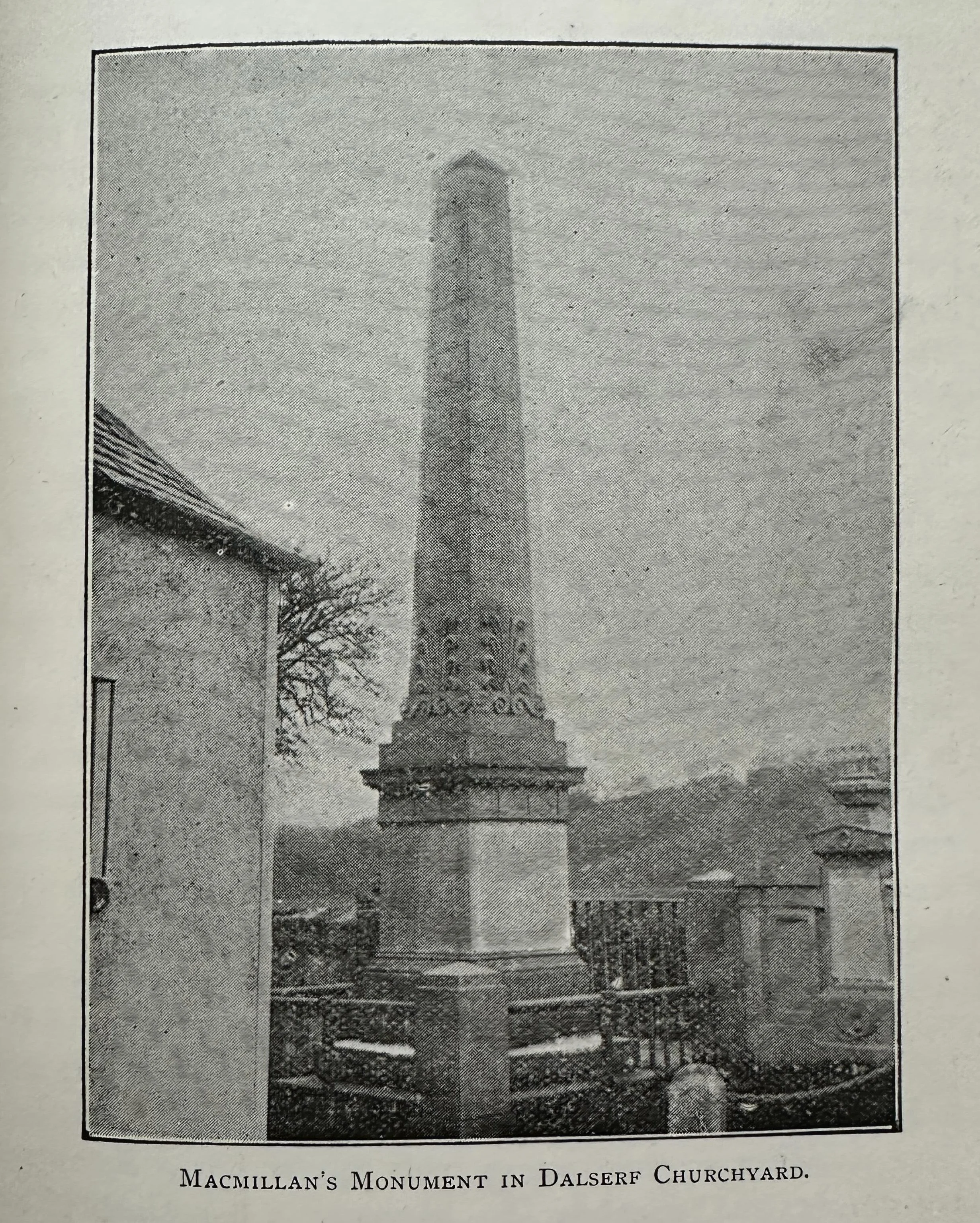
[Plate: MACMILLAN’S MONUMENT IN DALSERF CHURCHYARD.]
Summing up. 219
Altogether, one may carry away the notion of an attractive and impressive man, fit to hold his own with the best social circles, yet always keeping a homely flavour of his native soil and rocky hills. And chief of all his characteristics, even by the earliest testimony of his opponents, was his piety, a thing usually assumed in any clergyman, but likely to be specially eminent when thus singled out for mention. It was for his “name of piety in the bounds,” says Cameron, that the Presbytery made haste to license and ordain him. And the name, we know, represented a reality preserved during a long life. No breath has ever passed on Macmillan’s moral or professional character, save when party spirit dictated a groundless insinuation. His deathbed may stand beside those of distinguished Christians, for its solemn beauty and quiet pathos. Whatever faults he may have had (and every virtue has its own defect), he was indubitably a “good man.”
Whether he attained to be a “great man,” or just fell short of that coveted eminence, I shall leave others to decide. Certainly, he took part in a great epoch of the Scottish Church, and acquitted himself bravely and honestly. That Church has always had a way of casting out men whom she, at her heart, loved and honoured. Macmillan is one of these respected and beloved outcasts. The Church of our day has won much for which he contended and suffered; and she cannot cherish any grudge amid her gains. How much more she may yet acquire, which he would have wished, it is impossible to say. But in him she may claim one of her own children, bone of her bone and flesh of her flesh; whose chief crime (if such it be) was that he longed to see her made perfect in a world full of compromises, and whose chief praise must, in this respect, be that he demanded a “spiritual independence” such as now her best and most loyal sons are willing to defend.
Appendix of Documents, Edited from the
Original MSS. or Prints.
CONTENTS.