Reid A Cameronian Apostle VI.
James Dodson
CHAPTER VI.
1701–1703.
STORM.
Macmillan visits and catechises the parish—His sermons—His pastoral work—Communion seasons—“Purleycueing”—Tokens—“Macmillan’s cup”—“Fencing the tables”—Baptism—Macmillan a popular minister—His first attendance on the Presbytery—Scandalous lairds—A day of fasting—Death of King William—The oath of allegiance—Another fast—Overtures to the Assembly against Episcopacy—First dissension—Macmillan announces his separation—Tod and Reid join him—The “Grievances” given in—A committee to answer them.
THE first business of a country pastor, after his ordination, is to visit every house in his parish. This duty Macmillan performed in the autumn of 1701, and probably he combined with it the catechising of his people, a custom then in full force. Boston of Ettrick added public catechising at the evening service;* but in Balmaghie no evening service could be held, because of the distances to be traversed by the bulk of the people.
The morning and evening prayers of a clergyman’s house were in those days semi-public, and may be regarded as constituting a daily service. This part of his duty Macmillan discharged with relish and zeal. As we have seen, even before his ordination he had a “name of piety in the bounds.”† The new minister for a time pursued his calling quietly, preaching, visiting, celebrating the sacraments, and taking part in what
_____
* Boston of Ettrick, p. 65, 103.
† Examination, p. 43.
Storm. 93
were then styled “church judicatories.” Of his pulpit style and matter, there remains only one specimen, preserved in the Auchensaugh tract, to be fully dealt with in a separate chapter.* The custom then was to choose some fruitful text, and labour it for several Sundays together. Thus we read that at the Visitation in 1703, “he preached upon his ordination text, which he had been upon for some Sabbaths before, Psalm 62, 8th verse, ‘Trust in Him at all times, ye people,’ etc.” This was not the text of the sermon preached at his ordination, but that of his own first sermon as minister of the parish, September 18, 1701.† It need hardly be said that “preaching” meant speaking without book, as it does still in Galloway.
“Is he a reader?” is often asked regarding a minister. The answer is at first startling:
“No, no; he is nae reader. He preaches every word!”
The length of sermons was much in excess of modern measure, and there was generally a prelude in the shape of what was called a lecture, being the “opening and adding” in which the Presbytery so constantly exercised its clerical members. This custom persisted till a recent date. The present writer, preaching as a candidate on the very ground where Macmillan walked, was required to give both lecture and sermon, making about fifty minutes of discourse. In 1701, the total space spent in speaking must have been as great, and probably much greater. I should estimate the length of Macmillan’s sermon on ordinary Sundays at an hour at least. With the lecture added, his hearers endured perhaps an hour and a half of exhortation. And tradition has it, that two hours was no uncommon allowance. There were, however, mitigating features, such as weak human nature demands. It was not unusual for people to come and go during the sermon. And every little
_____
* See chap. xi.
† See contemporary MS.
94 A Cameronian Apostle.
parish church had, quite near to it, a place of refreshment, not uncalled for in districts where men came long distances to service. Hill Burton* describes the young lairds and peasantry as retiring to such modest hostelries, after the service was concluded, in order to discuss the sermon or the newest scandal. In the tiny “Kirk Clachan,” now called Shankfoot, there was then the unfailing “alehouse”; and we cannot doubt that, spite of the Synod’s fulminations against “untimeous drinking,” there was a brisk trade done every week.
Macmillan preached in tolerably broad Scotch, not scrupling to use such words as braw, and the vernacular thir for these. It was the common speech of his class and of the best Scottish society. We can see, from the remains of his printed work, that he had a style of his own, reflecting the rude energy and quick wit of his former companions in the farm and sheepfold. The chief feature of its substance is the wealth of Scriptural reference, especially to the Old Testament. He was fond of analogies and illustrations, whether from history or daily life. The interminable divisions and sub-divisions of his “Narrative,” and of the Auchensaugh sermon, were not peculiar to him. They were in the fashion of his day, and by no means wearisome to his regular hearers. To a country congregation, minute division is still acceptable, because it breaks up the solid mass, and enables an unaccustomed mind to take it in piecemeal. The ingenious author of Beside the Bonnie Brier Bush has cleverly shewn how a rustic memory grasps the “heads” of a discourse.†
As a pastor, Macmillan was quite at home. He was a Galloway man among Galloway folk. He spoke the same tongue, knew the same life of hardship and rough brotherhood, and was in fact a “countryman” with a college education. He was no mere clodhopper, however, but the social equal of his “heritors,”
_____
* History, vol. viii.
† See Beside the Bonnie Brier Bush.
Storm. 95
and the superior of most of them in station, morals, and information. His chief work lay in Clachanpluck, among the villagers, but many a round would be made, on foot, or riding a rough pony, through the “farm-towns” and to the distant shepherds’ cottages. At this time, his duty took him frequently to Balmaghie Place, as it was then generally called. For its owner lay under heavy censure, and the Presbytery held him in an unrelenting grip. As the minister went about, he catechised the people in groups, summoning all and sundry to attend his “diet” at some central spot. The custom still prevailed as late as 1840, but its only survival now is a common jest about the “carritches.” Throughout his visitation, there was incessant prayer. Prayer indeed was the distinguishing feature of a clergyman. The cottagers still say, “It is nae weesit without a prayer.”
In his domiciliary work, Macmillan kept a watchful guard over his people’s morals. The tone was sufficiently low, and scandals were sadly abundant. It does not seem to have struck the clergy of that time, that the housing of the poor was a frequent cause of trouble. Sanitary ideas were still in their infancy. In any outbreak of moral or physical disease, the Presbytery thought only of prayer and fasting, when it might have been better at the same time to set about sweeping and cleaning and other wholesome works. A pastoral letter was the shot fired at intemperance or immorality, when a police court would have done more to check the vice. A solemn fast, with long sermons and prayers, was the weapon with which the old world clergy fought a fever or “pest.” We should still, perhaps, at present, have the religious function. Most certainly, however, we should fight the enemy with medical skill and sanitary appliances.
Macmillan at communion seasons was transfigured, and became a veritable high-priest. It is difficult for a degenerate age to realise the “Holy Fair” of the old Scottish Church. The
96 A Cameronian Apostle.
Holy Communion, as a rule, was celebrated on some bright summer or autumn day. In Balmaghie, it was the second Sunday of July, or as near to it as possible. From all parts of the parish, and from neighbouring parishes as well, the people flocked to the church. It was something like a Scottish “Holy Week.” The “work” began on the Thursday, and was not concluded till the following Monday. The minister of the parish called to his aid several of his brethren, who preached in turn. He himself preached the “action” sermon, a discourse delivered just before the sacrament was celebrated. And he gave a concluding sermon on the Monday, summing up the various instructions of the whole “occasion.” This was known quite recently as purleycueing.*
Tokens were given out on the Saturday to such as applied for them, and were not under scandal. Macmillan’s tokens were lost when Dr. Martin became minister at the end of 1768; but Mr. Burns, the learned author of the volume on Scottish Communion Plate, has fortunately recovered one specimen, which has been added to the collection in the General Assembly’s library. The Communion cups were those given in Hew M‘Ghie’s ministry, and are still in good condition after well-nigh 300 years. At what time Macmillan’s celebrations of this sacrament became specially associated with deep solemnity and conviction of sin, it is impossible to say now. But the tradition is, that none who was unworthy could look on “Macmillan’s Cup” without plain tokens of guilty confusion. The lines in Nicholson’s “Brownie of Blednoch” are well-known:—
“But he slade ay awa’ or the sun was up,
He ne’er could look straught on Macmillan’s cup.”
[“But he always slipped away before the sun was up;
he never could look straight at Macmillan’s cup.”]
_____
* The word is a corruption of pour la queue [i.e., “by the tail”]. Dugald Williamson of Tongland was in his time reckoned the best purleycueing member of the Presbytery.
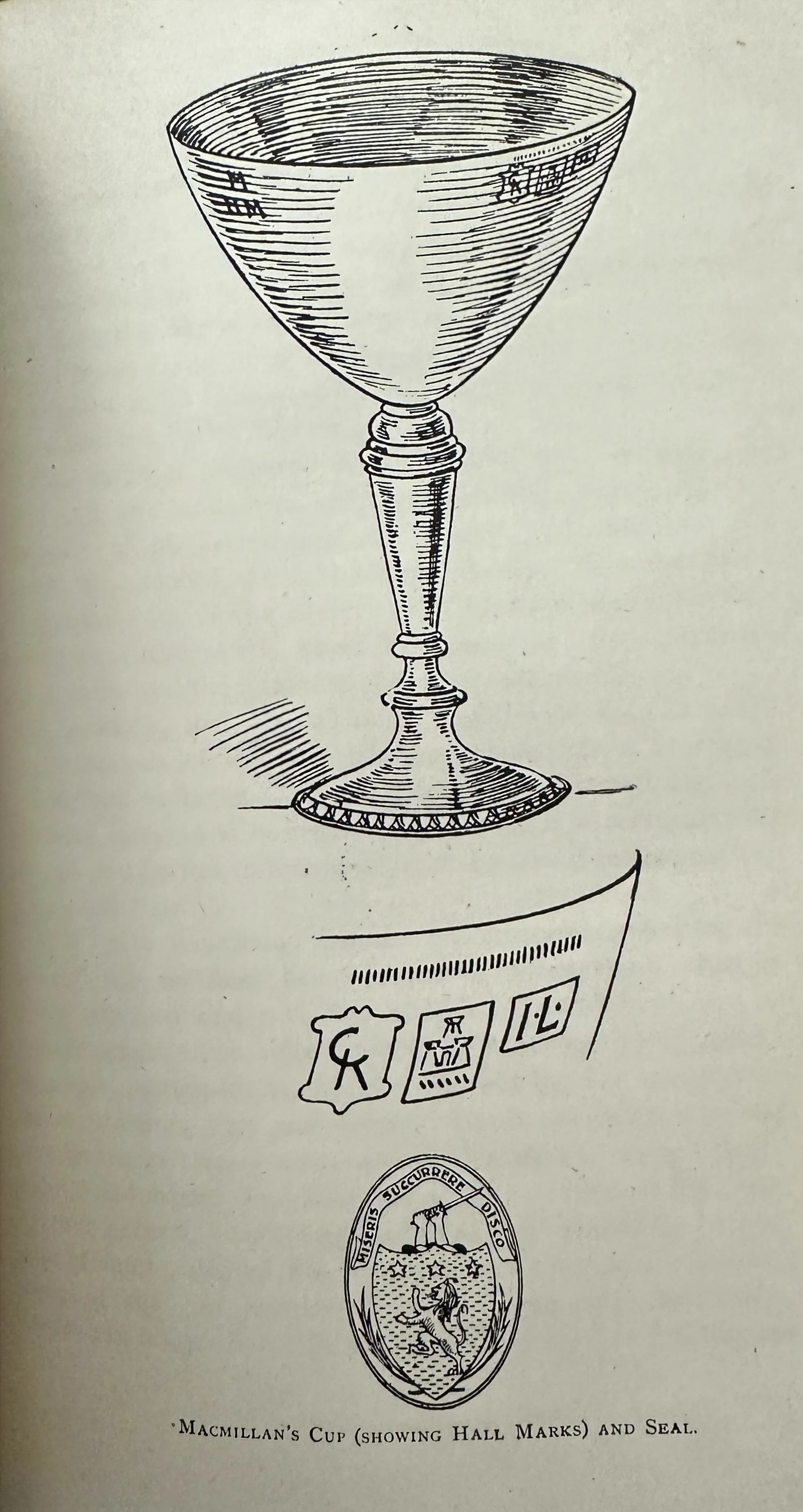
[Plate: MACMILLAN’S CUP (SHOWING HALL MARKS) AND SEAL.]
Storm. 97
This poem appeared in the Dumfries Monthly Magazine for October, 1825, with a note on these lines by the author as follows:—“This cup was treasured by a zealous disciple in the parish of Kirkcowan, and long used as a test by which to ascertain the orthodoxy of suspected persons.”
No trace exists of a Kirkcowan cup, and I assume that Macmillan, in his Communion service at Auchensaugh, used one or both of the Balmaghie cups.
The tradition preserved in Nicholson’s lines indicates the profound awe and stern gravity which were soon noted as qualities of his sacramental occasions. The strictness with which he “fenced the tables,” and boldly “debarred” from Communion such as he deemed unworthy, was afterwards illustrated at Auchensaugh, where he “debarred” the Queen, the Parliament, and the ministers of the Established Church.
It is likely, that Macmillan’s Communions soon attracted large numbers of the neighbouring people. In a later time, “Tongland Sacrament” became similarly frequented, and it is said that servants, at hiring fairs, long made it a condition that they should be free to attend either “Tongland Sacrament” or Keltonhill Fair.
It is worth remarking, that the old custom of “fencing the tables” was far from being formal or unnecessary, when so many strangers and outsiders attended the celebrations. At present, communion rolls are carefully kept, and few “guests,” as a rule, participate in the rite. It has become a congregational function, pure and simple. But in that time, men and women trudged weary miles to be present at a favourite “Sacrament,” and hence discipline had to be exercised in the mass, by such general “debarrings” as were then practised. A vast deal of inter-parochial life has been lost through the passing away of the old custom of great Communion gatherings. Doubtless, abuses crept in, as Burns’s “Holy Fair” illustrates
98 A Cameronian Apostle.
so unsparingly. But ministers and people from various parishes met in fellowship, now hardly known at all.
The other sacrament recognised by the Church, that of baptism, was usually administered in the sacred building, although nowadays such a thing is hardly ever seen. Macmillan’s own children were baptised “on the Lord’s Day, in the presence of the congregation, the mother presenting.”* No font was in existence in 1768, when it is minuted that “there is no Bason for Baptism.”† As I write, I remember that still there is “no Bason.” For baptism is universally in private houses, and the water is taken from an ordinary bowl.
Macmillan’s relations with his people, in all the foregoing pastoral duties, were from the first most cordial and harmonious. His call had been unanimous, and with this good beginning he went on happily. The first storm in his otherwise peaceful ministry came from the outside, and was brewed in those “church judicatories” which it was an essential part of his duty to attend regularly.
As we have seen, Macmillan took his seat as a member of the Presbytery on December 24th, 1700. He was the representative or “ruling” elder from the parish of Girthon. He sat again on March 18th, 1701, when Kells was re-annexed, and Mr. Ewart, his old minister, once more became a member of the Court. The same day, M‘Ghie of Balmaghie compeared and confessed his grievous sins. In addition to a darker scandal, these included “his extravagancies in swearing and drinking.” Cameron was appointed to rebuke him publicly before the congregation in six weeks’ time, in the usual manner, i.e., the culprit appearing in the “place of repentance,” and dressed in the “habit of sackcloth.” M‘Ghie was called in, and the Moderator read this sentence and “did gravely rebuke him.”
_____
* See flyleaf.
† See Sess. Minute Book, 1768.
Storm. 99
Immediately before this, another M‘Ghie, the laird of Slogarie, in Balmaghie, was dealt with in absence, and warned that, unless he submitted, he would be excommunicated. As Macmillan was then frequently “supplying” the pulpit of Balmaghie, he may have had to read the citation and warning to this gentleman. It may be imagined what condition of things prevailed when two leading gentlemen of the parish were thus outcasts from the Church.
Macmillan now ceased to appear as an elder, because he was on “trials” for his ordination, which took place on September 18th, 1701. He attended every succeeding meeting, and as early as December 9th, he was chosen to act as clerk till next meeting of Synod. The minutes after this date are frequently in his handwriting, even after he ceased to be the official secretary. The custom was, apparently, to employ the youngest ordained member, except in delicate and difficult matters. But sometimes it happened that one hand wrote the scroll minute and another engrossed it in the Presbytery’s book. It does not appear that any fee was paid for such labour.
On January 7, 1702, a day of public fasting was appointed, and a statement of the “causes of the Fast” is engrossed. These throw light on the moral and religious condition of the district. Among other causes, are mentioned “gross ignorance,” “neglect of the duties of godliness in secret, private, and public,” the “manifold witchcrafts,” and the “great neglect of evidencing faithfulness and zeal against such hellish wickedness.” Much emphasis is laid on the “idolatrous popery in the land.” The “dreadful breach” of the “Covenants, National and Solemn League,” is deplored. Reference is made to “profane cursing, swearing, and banning,” as a prevalent vice; as also to “murders, whereof some are unnatural, uncleanness of all sorts, fornication, adultery, midst tippling, drunkenness, and revelling, oppression, cheating, and defect of considerateness in dealing and bargain-
100 A Cameronian Apostle.
ing . . . lying, slandering, backbiting,” and other such sins. The “barbarous, hellish, and cruel persecution” is also roundly denounced. Sabbath-breaking by drinking assemblies and neglect of church attendance: disobedience to parents; and coldness and “barrenness” under Gospel ordinances are set forth as crying evils. Finally, a long paragraph sets forth the “fearfull incrotchments” made by Erastianism, and the supineness of “church officers” under these, which, “though not matter of separation, is yet reckoned matter of lamentation.” The picture is a dark one, but the Presbytery and Session Records of the time shew that it was also a true one. Child-murder, in particular, was dreadfully common. At the meeting immediately previous, Macmillan, along with Cameron and Monteith, had been assigned the sad duty of being present with a poor unfortunate, called Marion Daa, a former parishioner of Balmaghie, lying under sentence of death in the Kirkcudbright Tolbooth, for “murthering of her child, which was unlawfully begotten.”*
But the crowning grievance in this curious list of “causes” was evidently the “incrotchments.” In the light of the events which followed so swiftly, one might suppose that Macmillan, Reid, and Tod had a share in drafting this and some other parts of the manifesto. It was not so, however. The document was the joint production of Cameron, Telfair, Monteith, and Clark. It is significant, that they describe the “Erastianism” of the Church as being “not matter of separation.” For here, was just the point at which issue was soon to be joined in the Presbytery.
Meantime, harmony still prevailed outwardly, and all the brethren reported at next meeting that they had kept the Fast in their parishes. The growing uneasiness at “encroachments”
_____
* Presb. Rec., December 9th, 1701. They accordingly were present at the execution.
Storm. 101
is seen in the overtures sent up from the Presbytery by their commissioners, who were Warner, Spalding, and Johnston. The Presbytery overtured the Assembly to declare the jus divinum of Presbyterianism, and the “intrinsic power” of the Church to hold her Assemblies and other judicatories. They suggested that the Covenants should be renewed. They also called for the suppression of witchcraft, and of two dark sins, adultery and incest, which they describe as “abounding in the land.” Finally, they demand the energetic enforcement of the laws against Popery and Quakerism.
Macmillan took part in the ordination of Gordon to Crossmichael at the next meeting, April 8, 1702. At the same meeting, the Assembly members gave in their report. They had given in the overtures, above mentioned, to the Committee on Overtures; but “nothing was concluded anent them, in regard the Assembly rose suddenly, because the king was then reported to be at the point of death.” William died on March 28th, and this minute faithfully reflects the panic and agitation into which his death threw the Church. All thought of jus divinum or intrinsic right, or “renewing” of the Covenants were driven out by the political crisis. The hopes of men like Macmillan, who had entered the ministry in the expectation of obtaining reforms, were instantly discouraged, and finally blasted.
It was known that the new Queen was strongly biassed in favour of the Episcopalians, and the Presbyterian Establishment again hung in the balance. It must always be remembered, that large masses of the people were still Episcopalian, and in probably not less than 200 parishes, “curates” still held the benefices and ministered religion.* There was also a certain residuum of the old Roman Church, figuring incessantly as
_____
* At the Union in 1707, there were 165 “curates” in livings. See Cunningham, I., 196.
102 A Cameronian Apostle.
“Papists” in the Presbytery records. The accession of a daughter of James VII., the author of the hated “Toleration,” was well fitted to cause alarm. At such a time, no thought could be spared for constitutional reforms. Bare existence was at stake, and the Assembly dispersed in some disorder, no man being sure of the next step.
The main apprehension was speedily stilled, by the Queen’s recognition of the Establishment in all the rights secured for it by her predecessor on the throne. But the feeling of relief was followed by deep searching of heart among the brethren, when the Privy Council sent down an order for all ministers to “swear the Allegiance and subscribe the Assurance” to Queen Anne’s Government.
The Presbytery took this communication into serious consideration, and on January 17, 1703, Cameron was appointed to draw up a “declaration concerning the Oath,” which, while reciting the securities granted to the Church under the Claim of Right, yielded to the Queen all due subjection and loyalty within the laws. This was at once signed by Cameron, Monteith, Ewart, Spalding, Falconer, Clark, Johnston, and Gordon. Warner, Tod, Telfair, and Macmillan, although present, did not then sign.
On February 9, a second Presbyterial Fast was solemnly appointed, the “causes” being three in number, viz.: “(1°) the deplorable division in the bounds, which seemingly increaseth; (2°) the deplorable state of the Church of France; (3°) that prayer may be put up that the Lord may direct and countenance the ensuing General Assembly and Parliament.” The reference under the first head is obscure, but we may assume that the Oath of Allegiance and Bond of Assurance were already producing much dissension among the clergy, many of whom hesitated to accept either or both. The “Church of France” means of course the Huguenots, who at this time were suffering
Storm. 103
terrible persecutions. The Edict of Nantes had been revoked in 1685, Scotland’s own “killing time,” and since then, thousands had been driven from their homes or put to death. The Assembly was the first of Queen Anne’s time, and guidance would assuredly be needed.
The Presbytery did not fail, at the same meeting, to renew their previous overtures to the Assembly, and they added two more. One was a demand for the deposition of any minister who should “seek after, or have the offer of a bishopric, and comply therewith.” The other called for the prohibition of the “English Service” within the Church, and was aimed at the remanent “curates.”
The first symptoms of “division” appeared in the minute of April 8, 1703, when Tod of Buittle was dealt with as to statements which he was reported to have made, reflecting on the brethren who had taken the oath. It was rumoured that he held the oath to be sinful, and had said that it placed an Erastian yoke on their necks. Tod, in effect, answered to the interrogations that these rumours were “arrand lies,” and “further added, that although he looked upon the said oath as sinful, yet he looked not upon it as a ground of separation; and that he would not separate unless the Presbytery thrust him to the door, and then he knew what to do.” The moderator at this stage admonished him to “forbear all divisive courses.”
Such was the first muttering of the storm, which broke out more fully at the next meeting, May 15. Tod was not present, but divisions appeared in another quarter of the Presbytery’s bounds. “This day,” says the minute, “John Thomson in Castell in the parish of Rerrick, came in with several other men with him, designing themselves the commissioners from the societies of five parishes, and offered a paper to the Presbytery entitled, ‘The causes given them by the Church, hindering their communion therewith.’”
104 A Cameronian Apostle.
These were evidently the elected representatives from the Society people of certain parishes not specified, one of which, no doubt, was Rerrick, and possibly Balmaghie, Carsphairn, and Buittle were also represented. They were questioned by the moderator, whether they had come to “calumniate the Church, or to receive light,” and whether they would accept the Presbytery’s decision as binding. They ignored the embarrassing query first put, but as to the second point, they frankly declared that they could not own the Presbytery as a “judicatory of Christ.” Thereupon, the Presbytery very naturally declined to receive their paper. The deputies then “took instruments in the clerk’s hands,” as did also the moderator on behalf of the Presbytery. This meant that each party protested its bona fides, the Presbytery, in particular, declaring that it refused the deputation a hearing solely on the ground that they would not own its authority.
The dilemma of these good men was one on which the Society people were constantly impaled. If the judicatories were true courts of Christ’s Church on earth, then why refuse to own and submit to them? If they were not, why approach them at all with papers or protests?
This scene was at once followed by a dramatic incident, which, even in the formal minute, has a strange interest. “This day, Mr. Macmillan gave in a sort of a verbal protest against all the evils of this Church; to which the moderator said, ‘And so doe we all of us.’ As also, Mr. Macmillan declared that he would withdraw from the Presbytery for three or four Presbytery days, and perhaps longer, and refused to give the reasons of his withdrawing; moreover, declared that he had no correspondency with John Thomson and his followers, and disapproved their actings as irregular. Upon which he went out, and the Presbytery, considering the matter, thought fit to send the clerk to call him in, that the Presbytery might discourse more fully.
Storm. 105
And being come in, the moderator spoke gravely to him, and desired the grounds why he withdrew from the Presbytery. To which he answered, that he withdrew not from this Presbytery only, but from the whole National Church of Scotland as now established, and that the Oath of Allegiance, as cumulative to other defections, was the grounds of his withdrawing, and that he declared he knew not whether this Church was Presbyterian or Episcopal, in regard the General Assembly had not declared the same by their explicit act. Whereto the moderator, in name of the rest, answered to the first, that the Oath of Allegiance was not sin, but duty, and a walking conform to the principles of our covenanted work of Reformation, which the Presbytery was able to make appear against all gainsayers. And to the second, that the divine right of Presbytery did not depend on a declaration of the General Assembly, but upon the Word of God, neither was ever a Church Government exercised by Sessions, Presbyteries, Synods, national and provincial, without prelates, doubted to be a Presbyterian Church before. But Macmillan asserted he would speak no more at that time, and removing himself, the moderator, in name and authority of the Presbytery, required him to attend the Presbytery for converse, and act as a co-presbyter conform to his ordination engagements. But he refused and went forth. The Presbytery reserves the consideration of this till the next.”
From the above, it is clear that Macmillan’s hopes had sunk so low that he began to entertain doubts of the lawfulness of further association with the Church in its present course. Absence or “withdrawing” from the meetings was zealously noted, as the outward sign of dissatisfaction and divisiveness. Accordingly we find a committee appointed at next meeting, June 8, to go to the manse of Buittle and converse with Tod, who was a second time absent without excuse, and was known to have intimated from the pulpit “public exercise in his house”
106 A Cameronian Apostle.
the day of the last meeting. Macmillan’s absence was also discussed, and the Presbytery, considering his “offensive carriage” at the last meeting, appointed a second committee to converse with him at the manse of Balmaghie. In each case, if the committee found “noe satisfaction,” they were to cite the absent brother to attend next meeting.
Tod proved amenable to “converse,” and promised to attend a meeting at New Galloway on July 6. Macmillan declined to attend the next meeting, but proffered an excuse which the committee did not believe. They therefore cited him, and, as he did not appear, the Presbytery appointed another committee.
At the New Galloway meeting on July 6, a new offender appeared in the person of Reid of Carsphairn, whose absence for some time had attracted the jealous eye of his brethren. Macmillan and Tod came late. Their affair was delayed to the sessio secunda at 5 p.m., when the first demonstration was made of joint action by the trio of absentees. They produced now a paper, which they desired to be read “instantly.” A long debate ensued. At last the three malcontents were requested to retire, while the Presbytery further deliberated. Thereupon, Macmillan took the lead, and shewed his quickness in applying Church forms of process. He declared that if they withdrew at the Presbytery’s request, they were “stated” (we say nowadays sisted) as parties at the bar. The Presbytery ignored the objection, and the three brethren retired. A vote was taken, and it was unanimously agreed, late as it then was, to hear the paper read; but to stipulate that the Presbytery’s official answer to the paper should be a written one. This was meant to avoid difficulties which might arise from a verbal discussion.
The trio were then recalled, and judgment intimated. Macmillan, for himself and the other two, at once protested, and “dicted” a formal statement to the clerk urging that, having been received as co-presbyters, they should not have been
Storm. 107
treated as parties. Tod also added a complaint, that they were not to be permitted to discuss the paper, but bound down to written answers.
We pause to say, emphatically, that at this critical stage the Presbytery went wrong, whatever may be held as to their later actings. Undoubtedly these three men were members of court. They were not as yet under any libel. They were entitled to vote along with their brethren until a libel should be duly drawn up and served. To exclude them, while a secret discussion and vote were taken, was in the highest degree irregular and unjust.
The formidable paper, thus wrangled over, will be found elsewhere. It was the “Grievances.” The reading was followed by “long conference,” during which the three grew impatient, and “went out without leave asked or given, and left the Presbytery, though called to attend.” Tod, however, promised to attend next meeting. It was nearly midnight when Warner produced a letter of advice from the Commission on the affair; surely a strange suppression of so important a document. Telfair was commissioned to take up a reply to Edinburgh, along with all the documents, and to ask for a committee to come and help in settling the matter.
In order to prepare an answer to the “Grievances,” a committee was appointed, consisting of Warner, Telfair, Cameron, Boyd, Ewart, and Monteith. These men may therefore be regarded as the élite of the whole Presbytery for learning and character. A reference to the details* given in a former chapter will shew how little sympathy Macmillan’s strict and uncompromising views could expect from them.
_____
* See Chap. iv.