Reid A Cameronian Apostle V.
James Dodson
CHAPTER V.
1700.
MEETINGS AND MANNERS.
Presbytery Records—Last Bishop of Galloway—The Synod of Galloway—Presbytery Meetings monthly—Sessio secunda—Places of Meeting—Clachanpluck—Privy censures—“Opening and adding”—Attendance compulsory—References from Sessions—The Greater Excommunication—Visitations—“Slaves”—“Papists”—Schools—Bridges—Corresponding members—“Common heads”—Presbytery dinners—Social status of presbyters—Their marriages—Dress and manners—Simplicity and eccentricity—Semple of Carsphairn—Nathaniel M‘Kie.
THE minutes of the Presbytery of Kirkcudbright do not begin till April 30, 1700, and it may be assumed that the earlier records from 1690 are lost. The Synod of Galloway met at Minnigaff on May 14, 1689, to knit up the ravelled affairs of its diocese. It found many parishes without ministers, and the supply of qualified men was not at first equal to the demand. A number of ministers “from Ireland” were present, of whom some received calls to parishes within the bounds of the Synod. Thus, John M‘Bride was called to the parish of Borgue, but he did not long continue, since we have seen that Monteith entered on his office as minister there in 1692.
The last Bishop of Galloway was John Gordon; son of John Gordon of Caldwells, in Ellon. He was descended from the Haddo family, and had been a chaplain in the Royal Navy, and afterwards to the King. He secured his bishopric by the influence of the Earl of Melfort. When James VII. deserted
80 A Cameronian Apostle.
the throne, Gordon also fled from Scotland. Afterwards, he went in the King’s train to Ireland, where he was appointed Chancellor of Dublin. When the Irish bubble burst, he retired to St. Germains, where he used to read the English liturgy in his own lodging to such as came. About 1702, he went to Rome and made a solemn recantation before Cardinal Sacripante. He received the tonsure from Pope Clement XI., assuming the additional name of Clement. The four lesser orders he received from Cardinal Casoni. The Pope now granted him a pension and the honorary title of Abbot. He died at Rome in 1726, aged about 83, having survived all the other deprived bishops.
Such was the chequered story of the bishop, whose late diocese was henceforward to be ruled by a Synod of Presbyters. The parishes of the Synod were gradually supplied with Presbyterian ministers. In Kirkcudbright Presbytery there appears to have been a clean sweep of the obnoxious “curates” in 1689, and no troubles were experienced there, as in some other districts, from the presence of clergy of the prelatic type.
We have already commented on the individual members of the Presbytery, and it may now be interesting and useful to observe the Presbytery at its ordinary work.
The meetings were usually held once a month, at either the beginning or the end of the month as agreed upon. The meeting frequently covered two days, owing to the mass of business and the tedious forms observed. Sometimes there was a sessio secunda on the same day, generally at 5 P.M. The morning sitting began commonly at 9 A.M. The Presbytery did not scruple to sit very late, sometimes into the early hours of the morning, in order to complete an important case. The places of meeting varied constantly, although Kirkcudbright was the ordinary seat. As Presbyterial visitations were then frequent, meetings might be held in any parish church or at any point in
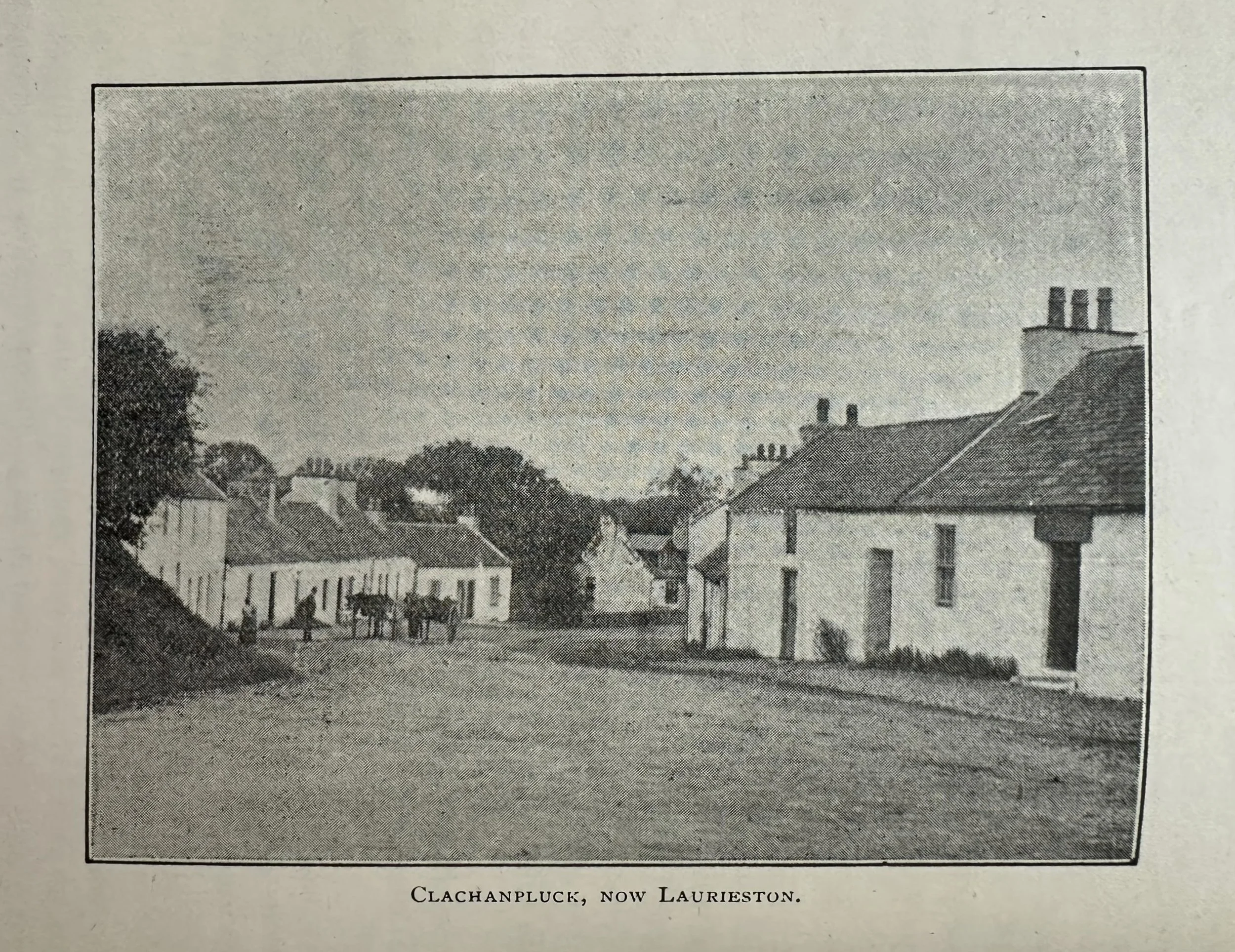
[Plate: CLACHANPLUCK, NOW LAURIESTON.]
Meetings and Manners. 81
a parish. Next to Kirkcudbright, the most frequent point of concentration was Clachanpluck, or its neighbouring localities, Polsack and Cullenoch. The tradition is, that such meetings were held in the change-house or inn of the place.
The village presented an unusual scene of bustle and animation on a “Presbytery day,” for the clergymen rode in on horseback, accompanied in many cases by their elders or by servants. In days when newspapers were hardly known, and communication was difficult, the assembling of the clergy from all parts of the county must have brought a considerable amount of excitement and talk along with it. The fact that Balmaghie was so often visited, and was in a sense a Presbytery seat, made that parish all the more liable to presbyterial supervision. And it put the brethren in a better position to hear and see what was going on, whether, to their mind, right or wrong.
Presbyterial rules were very strict. Members were required to attend every meeting, or else to give in a valid excuse. Absence from two or three meetings was made the subject of special inquiry, and sometimes of censure and warning. At intervals, the brethren met “for prayer and privy censures.” On these occasions a full attendance was insisted on, and the procedure was, that first “severals of them were nominat to pray per vices.” Then inquiry was made if the members had the Acts of Assembly, and if any special Act (e.g., against profaneness) had been duly read from the pulpit. After these preliminaries, the real and delicate work of “privy censures” began. The brethren were “removed per vices, and returning, were commended, exhorted, and admonished, as there was found cause.”* This custom, whether for good or ill, has become obsolete in the Church. And there are obvious difficulties in the way of restoring it. One can only regret that the
_____
* Presb. Rec., passim.
82 A Cameronian Apostle.
kindly custom of commending a deserving brother should have lapsed, making the pastoral life so depressing as it sometimes becomes, in the absence of authoritative approval and praise.
On ordinary occasions the meetings began with prayer, and thereafter a member, previously chosen, “opened and added in the ordinary” on a text of Scripture. This mystic phrase simply means that such member gave an exposition of the passage; and then added a theological or dogmatic application, which the Presbytery approved or challenged, as they saw proper.
The next thing done was to consider the absentees from last meeting, and their excuses; and this applied to representative elders as well as to ministers.
Then came what, unfortunately, was the staple business—discipline cases referred from Kirk Sessions, of which, at the beginning of the eighteenth century, there was an alarming list. This frequent reference to the Presbytery seems to have arisen from the parties in fault desiring to be purged by an oath from their scandal. Such oath, however, could not legally or prudently be given or taken without the Presbytery’s approval. And it was never permitted except after every other means had been used to ascertain the truth.
Disobedience to the orders of the Kirk Session also furnished a large crop of references. Parties confessing sins were frequently directed to stand in the “public place of repentance, wearing the habit of sackcloth,” for one or more Sundays, and to receive public rebuke from the pulpit. This was called “satisfying the Session,” and when it was spread over several Sundays, the parties were said to be “going on in satisfaction.” Failing obedience, the Sessions appealed to the Presbytery, who cited the contumacious, sent committees to confer with such as failed to appear, and if necessary, pronounced sentence of the greater excommunication against them. The greater excommunication was a censure which could be inflicted only by the Presbytery.
Meetings and Manners. 83
The lesser consisted in suspension from the sacraments, and was in the power of the Kirk Session.
When any one was condemned to suffer the greater excommunication, the Presbytery directed the minister first to deliver three “public admonitions,” on three several Sundays, with a Presbytery meeting intervening between them, so that this process alone might cover a space of three months. Then, if the person continued stubborn, there followed three solemn public prayers, covering another interval of three months. Last of all, if these efforts failed, the dreaded sentence was passed by the Presbytery after prayer. The minister was required to intimate it from the pulpit, and solemnly offering prayer for the offender, to declare him cast out of the Church and delivered over to Satan. Even at the last moment, however, signs of penitence in the offender entitled the minister to withhold the final doom.
To us, reading such ancient records, the question arises, What gave such weight to these spiritual decrees? The answer is grimly expressed in the Form of Process:—“The people are to be warned, that they hold the person to be cast out of the communion of the Church, and that they shun all unnecessary converse with him or her; nevertheless, excommunication dissolveth not the bonds of civil or natural relations, or exempts from the duties belonging to them.”*
The greater excommunication, therefore, made a man or woman a boycotted person, and reduced him to the society of his own home. He became a spiritual pariah, with whom no “unnecessary converse” must be held. He was “delivered over to Satan,” and in a rude and superstitious age such a doom seemed worse than death.
The Presbytery did not scruple to make free use of this terrible weapon against offenders in high places. Humbler
_____
* Form of Process, c. viii., sect. 17.
84 A Cameronian Apostle.
sinners, as a rule, broke down and submitted while the slow torture of “admonitions” and “prayers” was going on.
When all the repulsive work of discipline was finished, the Presbytery took other business. As ecclesiastical buildings gradually fell into decay, there came a frequent necessity for visitations of manses and churches. The Presbytery was the court of decision for such causes, and the usual rule was to summon respectable tradesmen to depone on oath what repairs were needed, and how much they would cost. The needful sum was then ordered to be paid by the heritors to the minister.
At an ordinary diet of Presbyterial visitation, the custom was that, after sermon, the minister, elders, and people were severally “called in,” and questioned on various points. For example, the minister was asked if his people kept family worship: the elders in turn were asked if their minister kept family worship. The people were next interrogated as to their pastor’s diligence in visiting and preaching. The answers were regularly minuted, and the Presbytery expressed approval, or administered advice and censure, according to circumstances.
Macmillan, in his “Narrative,” has shortly expressed the gist of such visitations, in the following quaint sentences:—“There was nought like a visitation observed, either with the people or yet with him. For they were never inquired at, how they pleased either his doctrine or walk, and if he was diligent in his pastoral duties; neither did they inquire at him how he pleased the people.”*
As in the present day, so then, occasional items of special business were dealt with as they came up. One, which occurs several times at this period, refers to a collection appointed by the General Assembly “for those taken captives by the Turks.”
_____
* See Appendix. “Pleased,” of course, means “pleased with.”
Meetings and Manners. 85
Another concerns “papists,” of whom lists were given in by the respective ministers, and Cameron was appointed to submit these to the quarterly meeting of the Commission in Edinburgh. The laws were strict against such, and the Presbytery more than once dealt with them, with a view to inducing them to conform to the Church.
For example, Warner and Macmillan were deputed to deal with the “papists” in the parish of Parton, in conjunction with the parish minister, “for their conversion and reclaiming.” Special attention was directed to “apostates,” i.e., such as had fallen away from the Reformed doctrine.* It is a little staggering, at first, to find the same reverend body, which appointed a committee to lay the Ringcroft ghost, dealing at some length, and with a degree of severity, with a poor “papist” who was found using a “monument of idolatry.” For so the Presbytery styled the crucifix.
Education was also under Presbyterial care. It is recorded that several parishes, of which Balmaghie was one, had no funds for a schoolmaster’s salary. They were directed to take steps to secure these with all speed. This matter became afterwards a query in the Presbyterial visitations.
It was in keeping with the old union of offices implied in the name of Pontifex, that the Presbytery should see that the Synodical collection, appointed for building “a bridge over the Water of Dee,” was duly made in all the parishes.†
In those days, Presbyteries appointed “correspondents” as Synods still do. These were directed to attend neighbouring Presbyteries, which in their turn commissioned some of their body to sit with the “corresponding” Courts. Sometimes such neighbourly help was expressly asked for. The Presbytery of Wigtown, for instance, requested that two or three members
_____
* Presb. Rec., Dec. 9, 1701.
† Presb. Rec., Dec. 15, 1702.
86 A Cameronian Apostle.
might be sent from Kirkcudbright to “correspond” with them, and Cameron, Ewart, and Monteith were accordingly sent.* We shall afterwards see that two correspondents from Wigtown sat at Macmillan’s deposition.
Before leaving the subject, it may be mentioned that two important questions long occupied the Presbytery’s attention. One was the subscription to the Confession of Faith, which was required of all ministers and elders. The other was the subscription to the “covenanted work of Reformation.”† It was indeed an age of oaths and signatures, and much time and suffering were to be expended in growing out of these swaddling-clothes.
With all its antiquated forms and narrow views (as they seem to us now), the Presbytery was a hard-working and conscientious body. And it paid a laudable attention to the theological studies becoming a learned ministry. A list of “common heads,” or theses, was early drawn up, containing points not already “handled” by the Presbytery. These were discussed in Latin by the members appointed at the beginning of the Presbytery’s diet. It is interesting to learn that such high and weighty themes as Free Will, The Holy Trinity, Faith and Works, the Person of Christ, were debated in an ancient tongue by this gathering of country ministers. It may be doubted whether many similar assemblies of Presbyters to-day could “handle” such a knotty point as this, assigned to Telfair, the ghost-layer:—De concursu Dei cum causis secundis, particulari, simultaneo, et praevio [Concerning God’s concurrence with secondary causes: particular, simultaneous, and prior]. Or this, confided to Clark of Twynholm:—De unitate et identitate foederis gratiae, quoad substantiam, in utroque Testamento [Concerning the unity and identity of the covenant of grace, as to its substance, in both Testaments]. Amid their variegated duties, these old world ministers never quite forgot that they ought still to be students of theology and philosophy. The very minute of Macmillan’s deposition closes with a reminder that, “at the
_____
* Pres. Rec., Dec. 15, 1702.
† Pres. Rec., Nov. 19, 1702.
Meetings and Manners. 87
next,” Mr. Cameron is to “have his common head, De viribus liberi arbitrii [Concerning the powers of free will]. ”*
At the close of the Presbytery meetings, the brethren doubtless dined together in a genial and brotherly way. Such Presbytery dinners attained their height after an ordination service. In the Fasti, there is preserved the following account of sums “debursed at the moderation of the call, and at his ordination.” (The ordination was that of John Reid’s son and successor in Carsphairn):—
“Imprimis to the Presbytery Clerk at the moderation as his due, ... ... ... £3 0 0
do., to John Paterson in Knockgray, for meal for the ordination dinner, ... ... 5 8 0
do., to John Hair in Holm, for a boll of malt to the said ordination dinner, ... ... 9 0 0
do., to the said John Hair, a Wether and a Lamb he furnished for the said occasion, ... 5 0 0
do., to Hugh M‘Hutcheson in Lamloch for a Wether, 3 12 0
do., to George Stevenson for a Lamb, ... ... 1 13 0
do., to Mr. M‘Myne in Damelintoun, for Flour and Bakings on said occasion, ... 1 14 0.”
The total is alarming, being £30 7s. But let the reader remember to divide by twelve, as it is Scots money! The Presbytery dined, in true Galloway fashion, on mutton and oatcakes. The proportion of meal to malt seems a Scottish counterpart to Falstaff’s bread and sack.
The social standing of the Presbyters of those days was, relatively, very much higher than at present. They were practically the only learned men, sometimes the only educated men, in their parishes. They were by far the most cultured and civilised. The country gentlemen were little better than rough farmers, who lived on their own mutton, and brewed their own
_____
* Pres. Rec., Dec. 29, 1703.
88 A Cameronian Apostle.
ale, and whose standard of morals was not high or nice. Profane language was extremely common. Wodrow preserves a reminiscence of Lining’s, that Lord Jedburgh “told Shields, in Flanders, that his first check arose from his little girl, two years old. Her mother had taught her ‘Ill, lying, and banning bairns [cursing children] would go to hell.’ Hearing her father cursing, the child said:
“‘Papa, banning bairns go to hell!’”
“‘Ay, but my bairn, I am not a bairn, but a muckle man.’”
“‘Muckle banning men will get a muckle hell!’”*
[“‘Papa, swearing children go to hell!’
‘Yes, but my child, I am not a child; I am a big man.’
‘Big swearing men will get a big hell!’”]
Among a gentry of this rough and unpolished sort, a college-bred and Christian gentleman shone without effort. The drunkenness which prevailed among the country lairds also distinguished them from the clergy, who were necessarily examples of sobriety.
The ministers met the “county people” on equal, if not often superior ground. Their incomes were as good, or even better. Their sacred authority was such, that the highest might well respect it in their persons. We may pardonably quote the matrimonial alliances as a sure index to the social rank of the clergy in 1700. For instance, Gordon of Crossmichael married a daughter of Viscount Kenmure: Ewart of Kells married “the heiress of Capenoch;” Spalding of Parton, “the heiress of Shirmers.” Macmillan’s second wife was the daughter of Sir Alexander Gordon of Earlston, and widow of Edward Goldie of Craigmuie. M‘Kie, his colleague and successor, married a daughter of Nathaniel Gordon of Carleton in Borgue. Many modern Galloway families of the county descend from these old parish ministers. The Johnstons of Carnsalloch, for example, are descended from Johnston of Girthon.
The reader might be apt to suppose, because these clergymen lived in thatched houses, ate braxy, and drank muddy ale, that
_____
* Wodrow, Analecta, Vol. II.
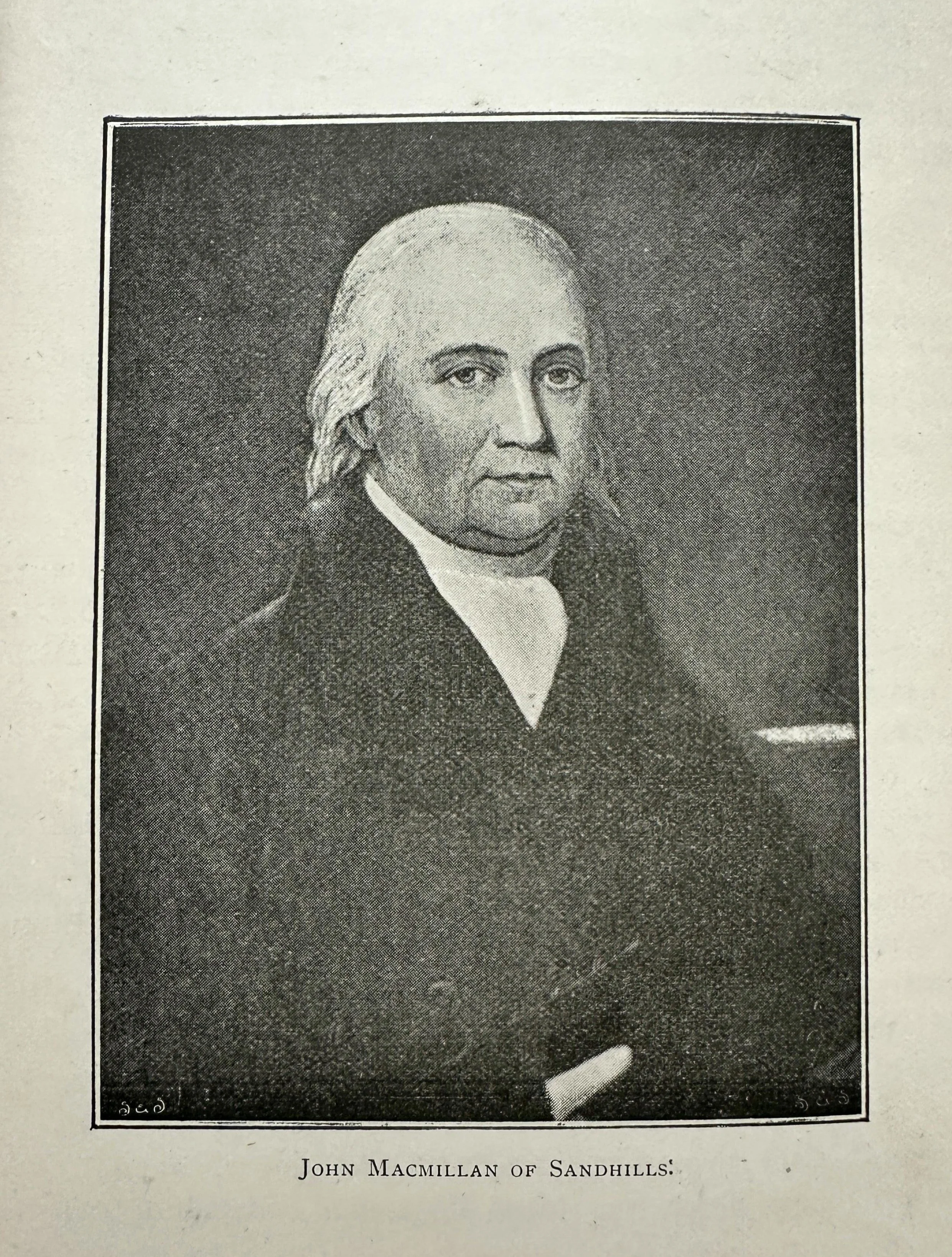
[Plate: JOHN MACMILLAN OF SANDHILLS.]
Meetings and Manners. 89
they were men of uncourtly ways and rude exterior. A glance at any clerical portrait of the period will dispel this delusion. The fine portrait of Thomas Boston of Ettrick, prefixed to Dr. Andrew Thomson’s life of that worthy, may be taken as a contemporary type, since Boston lived and laboured exactly at this time. The clean-shaven face (for beards were then unknown among the clergy), the spotless bands and ruffles, the carefully curled hair, down to the ring on the little finger of the right hand, shew us a very fine gentleman indeed, much more elaborately dressed than the rough and ready country parson of to-day. The tradition is, that Macmillan also was such a figure, very courteous and polished in manner, and of a stately form. Unfortunately, no portrait is known to exist. But his son John Macmillan of Sandhills, as figured in his portrait, is just such another as Thomas Boston, in outward appearance. The sole relic of Macmillan’s outward array, which has come down to us, is a massive and beautiful seal, which he doubtless wore at his fob. It is of the purest gold, and bears his coat of arms (lion rampant), his crest (two-handed sword), and his motto, Miseris succurrere disco. Such an article belonged to no country boor or rough vulgarian. And tradition has reached me of the costly and well-nigh imperishable silken fabrics, in which Mrs. Macmillan the third robed herself. Such details are not beneath notice, since they help to correct a wrong impression, and at the same time bring the personality of the men more vividly before us.
With all this, the clergy of the day were, beyond doubt, a strange mixture of dignity and simplicity, amounting at times to broad eccentricities of manner and conduct. This is best illustrated from the anecdotes of John Semple of Carsphairn, preserved in Patrick Walker’s life-like pages. I may be permitted to quote a few passages of special and curious interest:—
90 A Cameronian Apostle.
“When he was going to the ford in the water of Dee, on his way to the Presbytery, he would not be hindered from riding the water, though he was told by some that the water was unpassable, saying, ‘I must get through, if the Lord will; I am going about his work.’ He entered in, and the strength of the water carried him and his horse beneath the ford. He fell from his horse, and stood up in the water, and taking off his hat prayed a word to this purpose, ‘Lord, art thou in earnest to drown me thy poor servant, who would fain go thy errands?’ After which, he and his horse both got safely out, to the admiration of all onlookers.
“When a neighbouring minister was distributing tokens before the Sacrament, Mr. Semple, standing by and seeing the minister reaching a token to a woman, said—‘Hold your hand! That woman hath got too many already, for she is a witch;’ of which none suspected her then. Yet afterwards, she confessed herself to be a witch, and was burned for the same.”
The incident before the Privy Council has already been narrated. The sequel is given in Patrick Walker’s words:—
“After this he went home, and entered his pulpit. He said, ‘I parted o’er easily with thee, which has been many a sore heart to me; but I shall hing by the wicks of thee now!’ . . . He died with much assurance of heaven . . . under great impressions of dreadful judgments to come on these covenanted lands, especially on Scotland, and the west and south thereof, above all other places, by the bloody sword of Popish and others taking part with them: repeating these words three times over, ‘A Bloody Sword for Scotland!’”*
Another quotation, this time from the Fasti,† will help to deepen our impression of the simple, and even eccentric, manners of the Scottish parochial clergy in the eighteenth century. It refers to Nathaniel M‘Kie, Gordon’s successor in Crossmichael, and a son of M‘Kie of Balmaghie. He was accustomed to make interjections during his reading of Scripture, and here is one specimen, often quoted:—
_____
* See Biographia Presbyteriana.
† Vol. II., under Crossmichael.
Meetings and Manners. 91
“And the Lord said unto Moses—sneck that door; I’m thinking, if ye had to sit beside the door yersel, ye wadna be sae ready leaving it open! It was juist beside that door, that Yedam Tamson the bellman gat his deith o’ cauld, and I’m sure, honest man, he didna let it stay muckle open. And the Lord said unto Moses—I see a man aneath that laft wi’ his hat on. I’m sure ye’re clear o’ the sough o’ the door. Keep aff yer bannet, Tammas, and if yer bare pow be cauld, ye maun just get a grey worsit wig like mysel’; they’re no sae dear—plenty o’ them at Rob Gillespie’s for tenpence!”
Nathaniel M‘Kie is said to have written the song—“Nae dominies for me, laddie!” Altogether, he gives us a refreshing picture of the homely Scottish parson, perfectly unaffected yet a gentleman all the time: speaking pure “Galloway Scots,” as Macmillan himself spoke and even wrote it: a being very Scotch, and very human.