The Kirk Above Dee Water IV.
James Dodson
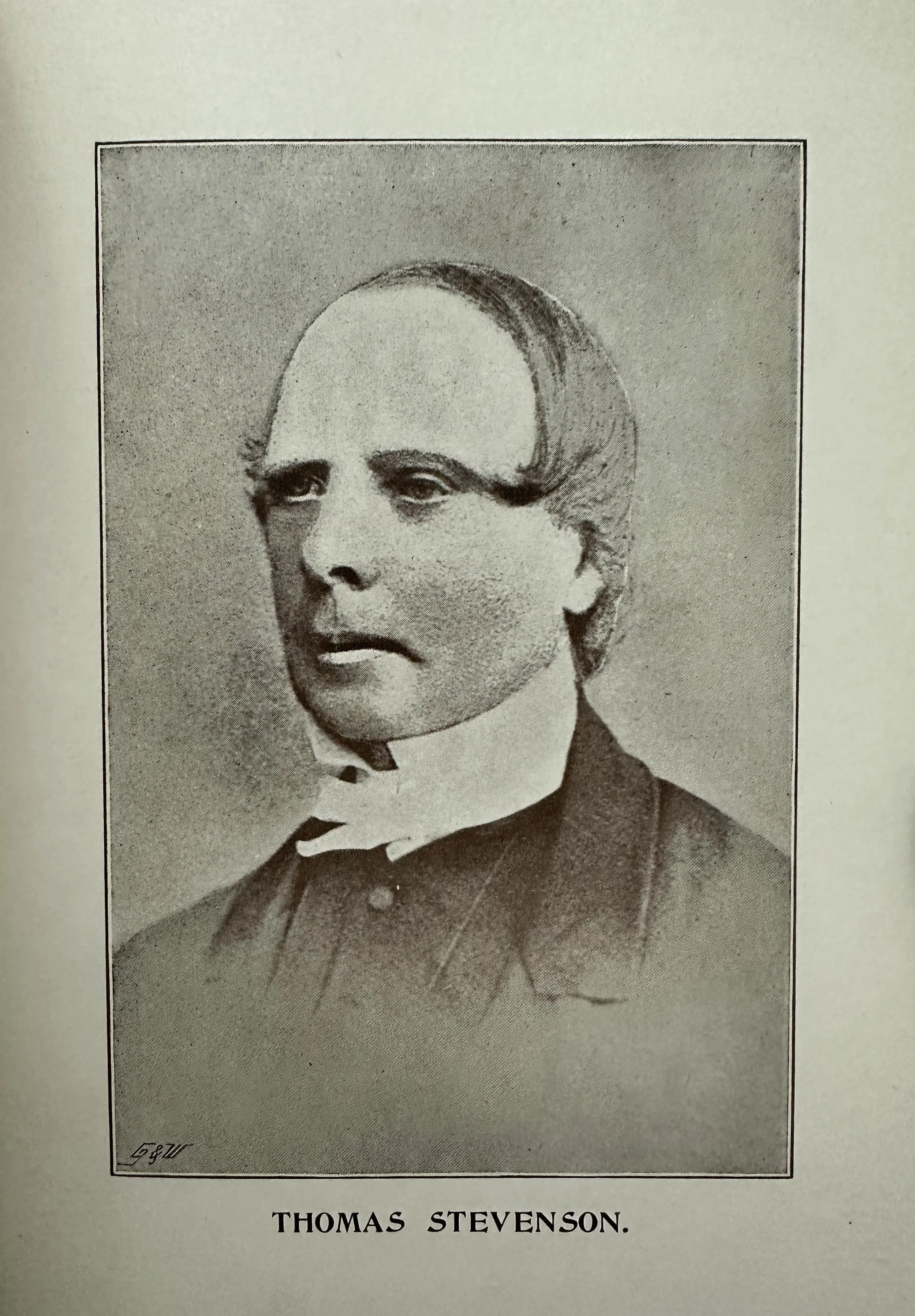
[Illustration: THOMAS STEVENSON.]
48 The Kirk above Dee Water.
IV.
AN EPISODE IN GALLOWAY.*
THE publication of a “History of the Reformed Presbyterian Church,” by the Rev. Mr Hutchison of New Cumnock, will draw attention anew to the curious drama of Spiritual Independence, played out in a remote Galloway parish in 1703-1729. Most Scotsmen have heard of the sect called Macmillanites, and better known as Cameronians or Reformed Presbyterians. But few at the present time are aware that they derived the former name from the minister of an obscure and thinly-peopled parish in the Presbytery of Kirkcudbright. The parish of Balmaghie, where Macmillan made his stern stand against the State, is situated about three miles from Castle-Douglas, and includes an area of about sixty square miles. The diminutive church can be seen, with the homely manse at its side, perched on a small eminence on the banks of the Dee, opposite Crossmichael station on the Portpatrick Railway.
The traveller who will look out of his railway carriage at that station sees a broad sheet of water, which at first seems to be a loch, but is really the swollen and sluggish river. In one corner of this, large quantities of fine eels used to be caught. Exactly opposite the station, with this mimic lake
_____
* History of the Reformed Presbyterian Church. By Rev. Matthew Hutchison, New Cumnock. Paisley: J. & R. Parlane, 1893.
An Episode in Galloway. 49
between, is Balmaghie Church, a small cruciform edifice having a picturesque belfry and pointed arches. The present church and manse are only 100 years old, but a fragment still remains of the old church in which Macmillan for some years set at defiance the whole power of Church and State. The ancient church is represented by a small portion of the eastern gable, into which had been built an imposing monument to the memory of Macmillan’s successor.
John Macmillan, born at Barncauchlaw,* in Minnigaff Parish, in 1669, took his M.A. degree at Edinburgh, where he also completed his theological studies. While a student he joined what were known as the “Societies,” being associations of churchmen who claimed a larger spiritual freedom than was then enjoyed by the Church of Scotland. Upon entering the Divinity Hall, he left them, and, after being licensed by the Presbytery of Kirkcudbright, he was for a short time chaplain in the family of Mr Murray of Broughton. In 1701 he became minister at Balmaghie, succeeding another John Macmillan, whose latter years had been darkened by chronic sickness. The parish was therefore in a neglected state, but Macmillan soon roused it effectually.
Macmillan’s connection with the “Societies” had left a deep influence on his mind. He was not long settled in his new office before his restless spirit found vent in a formal “statement of grievances,” presented by him to his Presbytery in July, 1703. In this action he was joined
_____
* On the Hassock of ground granted by Robert Bruce to Widow Amabel, whose three sons, M‘Kie, Murdoch, and M‘Lurg, became his henchmen. It includes Risk, Larg, and Machermore.
50 The Kirk above Dee Water.
by two co-presbyters, Mr Reid of Carsphairn and Mr Tod of Buittle. This paper complained that the Solemn League and Covenant was ignored, and the divine right of Presbytery allowed to fall into the background; also, that certain political oaths were imposed on the clergy, and in other ways that the Church’s freedom was invaded by the State. The Presbytery appointed a committee to answer these complaints, consisting of Messrs Warner at Balmaclellan, Telfer at Rerrick, Cameron at Kirkcudbright, Boyd at Dalry, Ewart at Kells, and Monteith at Borgue. Ultimately the Presbytery passed a resolution that, “being desirous to be as condescending as they can, for peace sake they do pass all bygone differences and misbehaviours of said John Macmillan.” But they added, that if he still continued to be “turbulent and divisive,” then “all former things now passed from shall be revived, and he censured for them, with such new offences as shall be found just.” These “former things” included Macmillan’s action in causing his people to renew the Solemn League at a congregational fast, and also in refusing to recognise the oath of allegiance to Queen Anne.
After this decided rebuke, Macmillan ceased to attend his Presbytery, who thereupon dealt with him once more, and exacted a promise to attend and be submissive. But such promises were no better than “withs” to bind this ecclesiastical Samson. He soon publicly disowned his pledge, and the Presbytery then resolved to hold a visitation at Balmaghie. Before this could take place, however, a libel was drawn up and duly served upon him. He was charged with breach of faith and with turbulent conduct, but no averment was made against his life or doctrine.
An Episode in Galloway. 51
Mr Hutchison is of opinion that the whole movement arose from the Presbytery’s dislike to the agitation for spiritual independence which Macmillan was keeping alive.
On a bleak day in December, 1703, the Presbytery met in Balmaghie Church to lead proof, when a petition from the people against their procedure was handed in, and Macmillan finally declined their authority, appealing to the “first free and lawful” General Assembly. Next day, 29th December, they met at Crossmichael Church, placing the broad waters of the Dee between them and the stubborn pastor and people of Balmaghie. Macmillan did not appear; the libel was found proven; and on a vote taken, “suspend or depose,” it was unanimously agreed to depose him, which was at once done. Mr Monteith of Borgue and Mr Hay of Anwoth were ordered to declare the Church vacant on Sunday, 6th January, 1704.
Now came the “tug of war.” Mr Monteith vainly endeavoured to carry out his orders. On 22nd February, 1704, he reported to the Presbytery that, accompanied by a notary public and some witnesses, he was riding to the church at Balmaghie when “there came from the kirkyard about 20 or 30 men, who refused to let him go further, and actually stopped them by laying hold on the foremost horse’s bridle.” He thereupon read out the sentence of deposition and declared the church vacant, taking instruments in the hands of the notary, and so rode disconsolately home to Borgue. On the way, however, he stopped at Balmaghie House, and preached there to a small gathering. Macmillan himself occupied the pulpit of the parish church.
52 The Kirk above Dee Water.
The first blow had thus been struck in the war between Macmillan and the Church Courts. Active hostilities ensued. At first, indeed, he hesitated to enter on a course of open rebellion. Twice he appealed to the Assembly, and under the prospect of being reponed he permitted for a season the pulpit of the church to be filled by the Presbytery’s “supplies,” as in a regular vacancy. But his patience was soon exhausted. One Sunday the officiating minister intimated the “supply” for next Lord’s Day and exhorted the people to attend better than they had been doing. Macmillan, who was, as usual, present, got up and intimated that he intended to preach himself next Sunday.
“What!” said the officiating minister, “will you, a deposed man, go and preach?” Turning to the congregation, he added—“Go home, and mourn for it, that a deposed man is going to preach. I wish he may get few hearers.”
Next Sunday Macmillan entered the pulpit. The church was packed. As the bell began ringing a boat had been seen coming across the Dee. It contained the Presbytery “supply.” Immediately a rush was made to the bank, and a dozen strong arms pushed the boat away from the landing-place. Such were the amenities of Church life in Balmaghie in 1705.
After this exciting scene Macmillan continued to occupy pulpit and manse as if no sentence of deposition had been pronounced. The arm of “Cæsar” was therefore invoked by the Church. The Commission of Assembly in 1706 appealed to the heritors to persuade the offending minister to give up the keys of the vacant church to the Presbytery. The attempt was made, but in vain. Macmillan continued
An Episode in Galloway. 53
to ignore the authority of the Church Courts, and his parishioners generally adhered to him, although their conduct exposed them to fines and imprisonment.
The Town Records of Kirkcudbright show that the Town Council had before them in 1707 a petition from Charles Livingstone, glover, burgess in Kirkcudbright, praying to be relieved of a fine of 500 merks, or about £28, inflicted upon him because he had been married by Mr Macmillan. Livingstone pleads the “scarcitie of money,” the frequency of such irregularities since the Revolution, and his own previous good conduct. We are glad to find the Council remitted the fine.
Another remarkable scene now took place near the church. In 1708, on an application by the Presbytery, “craving the benefit of law to put Macmillan out of his hot nest,” the Lords in Council at Dumfries sent the Sheriff with 100 yeomanry to expel the contumacious minister. The people, however, assembled in such numbers that the Sheriff was obliged to retire.
At length steps were taken to institute a new minister, and Mr William M‘Kie was duly called, and arrangements made for his ordination. The ordination took place on 12th October, 1710, seven years after the deposition of Macmillan. The formal proceedings prior to this had not been uneventful. Mr Cameron of Kirkcudbright, a brother of the famous Richard Cameron who fell at Airsmoss, had been sent to preach in Balmaghie Church, but he got no farther than the parish boundary. At Barnboard a body of Macmillanites unceremoniously turned him back. Eighty-seven heads of families, representing probably half the population, petitioned against
54 The Kirk above Dee Water.
Mr M‘Kie’s settlement, and craved that Macmillan might be reponed. The Presbytery, however, stood firm, and the new minister was ordained.
The next act in this curious drama was long remembered among the gossips of the parish. The new minister arrived at the manse, but was denied admittance. He then attempted to have the glebe ploughed, but the indignant neighbours rose, and drove off his supporters. They “cut the reins in pieces, turned the horses adrift, and threw the ploughshares into the adjoining lake.” One infuriated dame aimed a deadly blow at the minister’s throat with a reaping-hook. He put up his gloved hand to ward it off, and his fingers were cut to the bone. The conflict had thus nearly cost human life, and actual blood had been shed.
Mr M‘Kie, a pacific and prudent man, withdrew and took up his abode in a gentleman’s house about three miles off. A meeting-house, called in contempt “The House of Rimmon,” was built for him. He married, and till 1729 quietly pursued his sacred calling side by side with the redoubtable Macmillan. The latter continued to live in the manse and occupy the parish pulpit; he cultivated the glebe and generally exercised the functions of a parish minister. It was the Papal Schism on a small scale! And it caused some strange complications, such as that of the “Twice-Christened Bairn,”* familiar to all lovers of Galloway lore.
_____
* See page 77.