Kirk in the Craigs V.
James Dodson
42
CHAPTER V.
MR McMILLAN AS A PRESBYTER.
I regret to say that from 1778 on to 1827 the Records of the Craigs Session are lost; so that, for particulars as to Mr McMillan’s life and ministry, I have to depend on the Presbytery minutes, and on scattered notices and traditions.
The Presbytery Records show that he was a most faithful attender of the meetings. But this is in strict keeping with the tight hold the Presbytery kept upon its members. In illustration of this point, it may be mentioned that in 1785, at Douglas, the court put it upon its record, “that in all time coming the court do meet at ten of the clock forenoon. That no member shall withdraw from the court without leave obtained from the Moderator, and that no member shall be absent from any meeting of the Pby. without giving sufficient reasons for his absence. All which resolutions are carefully to be observed by the members upon the pain of censure.”
From his character and position Mr McMillan was chosen to execute delicate duties. For example, so early as 1779 he was appointed along with Messrs Courtass & Steven to go
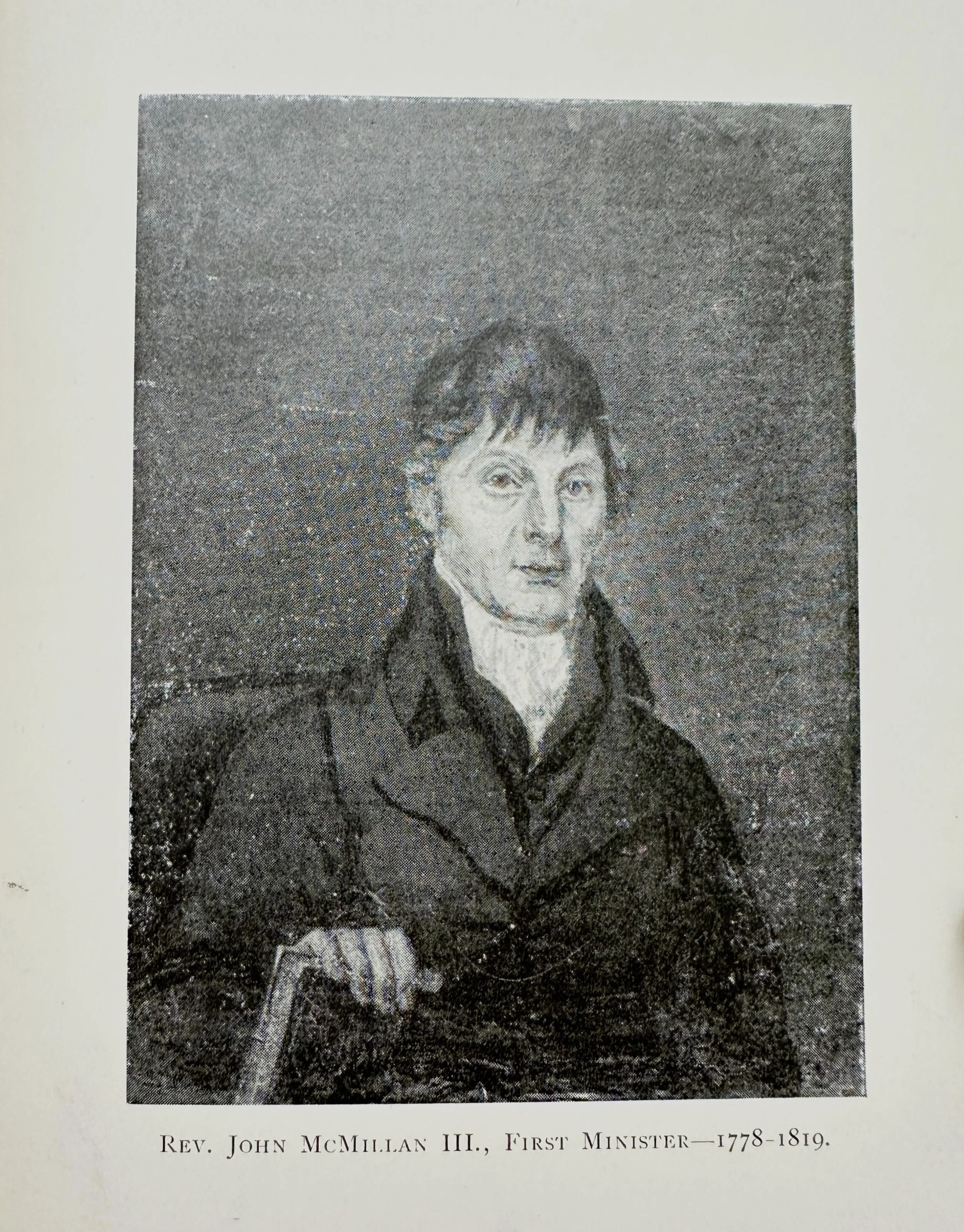
[Illustration: REV. JOHN McMILLAN III., FIRST MINISTER—1778–1819.]
43
to Ireland, “to assist in ye settlement of some affairs in ye church in yt kingdom.” Mr Courtass apparently was not able to go. When Messrs Steven and McMillan came back from their mission, “The Pby. came to enquire into ye diligence and faithfulness of their conduct during their continuance in yt kingdom, and having heard a distinct representation of ye same from their own mouths, found they had acted consistent wt their Commission and in agreeableness to the word of God, and therefore the Pby. expressed their approbation of their conduct.”
In the course of his Presbyterial labours, Mr McMillan attended a meeting at Douglas on 9th March, 1803, which deserves more than a passing notice. At that meeting the Rev. Samuel Wylie appeared as a Commissioner from the Reformed Presbytery of the United States of America. Mr Wylie brought with him an interesting letter which stated the desire of the Church in the States for a close connection with the Churches in Scotland and in Ireland. The letter authorized the Commissioner to seek information in regard to the history of the Reformed Church in Scotland since the Revolution, and to request a supply of ordained ministers, or of preachers, to aid them in their work across the sea.
Mr Wylie got a reception which must have pleased him much. From his appearance and speech he seems to have been a model commissioner. The Presbytery say that he made
44
his statement “in a very clear and affecting manner.” They granted him all he asked, with this exception, that they could send out meantime no ministers. But, having heard good news from a far country, the Court, in their thankfulness and joy, said that if any ministers or preachers should in future express a design of going forth to labour in America, “they would not discourage them, but use every mean to further their design.”
On a Sabbath day in the middle of March, 1891, there was an ordination of Deacons in the Craigs Church in the forenoon, and in the afternoon the present minister gave a sketch of the History of the congregation.
A venerable minister was present from the Reformed Presbyterian Church of the United States of America. This was the Rev. Dr Wylie of Philadelphia, the son of the Commissioner who appeared before Professor McMillan and the others at Douglas in 1803. It was one of the curious coincidences in Providence that that worthy minister should have come to the Craigs that day to hear names mentioned which had been familiar in his father’s mouth, and in his own ears, as household words. Though far from home, Dr Wylie said he felt very much at home. Dr Wylie’s wife has a local connection with Stirling. She is a daughter of the late Mr James Grant and his wife, Helen Drummond. It is rather remarkable that Dr Wylie is thus the brother-in-law of the Rev. Dr Culross, formerly of Stirling, now Principal of the Baptist
45
College, Bristol, and of the Rev. Dr Andrew, Editor of the British Messenger, Stirling.
When, in 1810, the original Presbytery divided itself into three Presbyteries—the North-Eastern, Southern, and Western—Mr McMillan was appointed to constitute the first meeting of the North-Eastern Court, to which from that date he belonged. This he did at Laurieston on 2nd May, 1810.
The first Synod was held at Glasgow in May, 1811. The Court elected Professor McMillan to the chair. He had thus the honour of being the first Moderator of “The Synod of the Reformed Presbyterian Church in Scotland.” On the occasion of constituting the Court, Mr McMillan preached the opening sermon from John xvii. 21. The brethren requested him to publish his sermon, but this does not seem to have been done.
Mr Alexander Pearson was the elder from Stirling on that important occasion.
MR McMILLAN AS A PREACHER.
Of Mr McMillan’s preaching there are few notices to be obtained.
When a young man, he had a voice of remarkable power. On the occasion of his first sermon, which was preached in the open air, his father (John McMillan II.) walked round the great audience, and could make out every word.
From all I have been able to gather, his dignified appearance and methodical manner
46
lent force to the message he delivered from his Master. His church was a humble one; his congregation was never large; yet the following story, told by a former adherent of the congregation, sheds light on the point now in question.
“An English gentleman taking a journey through Scotland, whether for pleasure or business I cannot say, came to Stirling, and was detained here over a Sabbath. Coming out of his hotel on the Sabbath morning, in order to find some place of worship, he came wandering along until the Craigs Church caught his eye, and in he went. Returning to his hotel after service, he met the landlord at the door, and said to him, ‘Well, sir, I have been in the poorest church I have ever seen, and in the poorest congregation I have ever seen, but I heard the richest sermon that I ever heard in my life.’ Mr John McMillan was the preacher of that sermon.”
MR McMILLAN AS A PASTOR.
Mr Hutchison in his able work—to which I have frequently referred—states that Mr McMillan had adherents as far separated from the centre of his work as Buchlyvie and Crieff on the one side, and Linlithgow on the other. This may have been true in the early years of his ministry, before the disjunction of the East side from the West side of the congregation, to which I have referred above. There were so many Reformed Presbyterians in Buchlyvie and neighbourhood that the Presbytery used fre-
47
quently to meet there. So early as 13th June, 1768, I find that “the Four Johns” met at “Bauchlivy” in their capacity as a Church Court. At the Jubilee celebration of Gartmore Free Church on 23rd Feb., 1894, grandchildren of Mr Andrew Wood were present. His practice was to walk from near Gartmore to the Craigs Church, and he used to say that he was as fresh on Monday morning after his Sabbath walk of 40 miles as on any other day of the week.
Latterly the district over which Mr McMillan had to journey preaching and catechizing and visiting, although contracted, was always a wide one.
Among the old papers, I have found several small accounts of collections which were taken when Mr McMillan preached at a distance from Stirling, or held a meeting with his distant members and their friends in a private house or schoolroom. Alloa, Backyett, Doune, Dunblane, and Thornhill are thus commemorated. About half of the sum raised was given to the poor. A small balance usually remained after defraying necessary charges. This would be added to the general congregational fund.
These visits may be thus explained. Each district containing a considerable number of members was called a “quarter.” Naturally, one supposes from this name that there should only have been four quarters. But in this case there were more. In 1783 I find that the quarters
48
were Stirling, Abbey, Dunblane, Milton, &c., Bannockburn, Newhouse and St Ninians, Monteath, and Alloa.
This accounts for the representative constitution of the session and the court of managers. Each quarter, as far as possible, seems to have been represented in both bodies.
The elders were really assistants to the minister in the oversight of the members where they respectively dwelt. They were godly men, much respected, and, in their own way, conducted meetings among their neighbours, some of whom, owing to their distance from Stirling, and other causes, could not often attend the services of the sanctuary.
Instances were not awanting in which the young people hurried forward their domestic and outdoor work in order to hear the minister or elder on a round of visitation saying the long grace before meat. After the usual greetings, and before the more serious work of the day, the homely hospitality of the dwelling was heartily extended to the spiritual overseer.
Even in my time, a sweet-natured saint and elder of the congregation used to say to me at his cottage door in the Moss—“This is a humble place, sir; but I welcome you as a servant of God.” The young minister used to think that the words had benediction in them, and felt inclined to add—“Without any dispute the less is blessed of the better.”
49
MR McMILLAN AS AN AUTHOR.
Only one separate publication comes down to us bearing Mr McMillan’s name. This is its title page—
GLASGOW | Printed by PETER TAIT, for the AUTHOR | M,DCC,LXXXI. pp. 74.
The letter is a closely-reasoned warmly-evangelical defence of the principles of the Reformers and Martyrs in Scotland, and of those of the Reformed Presbytery. It is a capital specimen of the controversial literature of the time. In places the letter is tart in tone. That may be explained by remembering that at the time he wrote it, Mr McMillan was suffering from an accident whereby he burned one of his feet. His stately way of referring to this is:—“A dispensation of providence confined me to my room, from the public duties of my function.”
The only other printed productions of Professor McMillan I know of are his Charge to the Minister and People at the Ordination of the Rev. A. Symington, M.A., at Paisley, in 1809; and his letter to his flock in 1819.