Kirk in the Craigs VI.
James Dodson
50
CHAPTER VI.
MR McMILLAN AS A PROFESSOR.
It is a wonder, amid such exacting labours as Presbyter, Preacher, and Pastor, Mr McMillan found time to keep up his theological studies. That he did so was evident to his brethren in the ministry.
Between 1743 and 1803, the students for the ministry had been trained by the ministers within whose bounds they resided. Although, in 1786, Mr Thorburn had been appointed “Teacher of Divinity,” he died before he had time to enter with any fulness into the duties of the office.
The question of a successor in this work was brought before the Presbytery again in 1799; but, further than approving of the proposal and keeping it under consideration, nothing practical was done.
At length, in 1802, at an extra-judicial meeting, the Court advanced so far as to nominate the Rev. John McMillan, jun., to take charge of the students belonging to them. In 1803, the Presbytery unanimously approved of the above extrajudicial proposal. After careful consideration, Mr M‘McMillan accepted the position on 17th
51
August, 1803. The salary proposed to be given to the Professor was not a large one—only “£30, or a sum as near it as possible.” At the same meeting, a Committee of the Court was appointed “to take the management of the money to be collected for the purchase of books for the students’ library, and for the Professor’s salary,” which salary, it may be noted, was to be raised by a contribution of about £2 yearly from each of the congregations.
In November, 1803, Prof. McMillan stated to his brethren that he had begun his work of teaching, but that he had arranged for a fuller meeting in the month of May, 1804. In that year, Mr McMillan had a severe illness which laid him aside both from his professorial and ministerial duties. He was so ill that he requested that the charge of the students should be transferred to some other minister. The Presbytery would not hear of this—“till they see the issue of the mean he is using at present for the restoration of his health.” The patience of the Court was rewarded, for from 1805 to 1819, the students—with the exception of the year 1818, when Mr McMillan’s health was failing—came regularly to Stirling for their theology.
Regular students attended for four summer sessions of eight weeks each or thereby. The names of some occur in the list (to be given below) five times. Irish students attended for one or two sessions. They could get ordination in the sister country, after a shorter course of
52
training than was demanded by the Scottish Church.
THE COLLEGE
was a very humble one. It consisted of only one room—the Session-house at the east end of the Craigs Church.
Details are awanting as to the course of instruction given by Professor McMillan. His method of instruction appears to have been simple, his lectures being an extemporaneous, or, at least, unread comment on the Christian doctrines in the order in which they are presented in the Confession of Faith. This was the method of theological instruction at the time in the national universities. Even the great Bishop Butler of the “Analogy” had only one teacher.
From the notes of the lectures made by some of his students, it is evident that they were not mere loose impromptu effusions, but the result of much thought and study, and that he possessed a singular accuracy of thought and statement. The best evidence of his efficiency as a professor, and his usefulness to the church of the fathers, is to be found in these fathers themselves—in the class of ministers whom for fifteen years he trained to preach the Gospel in the old Hall in “the Craigs of Stirling.” The men who proceeded from that Hall were the men who were the instruments in the hand of God of making the Church what she was, of raising her reputation, extending her usefulness, and of continuing her existence. That his
53
prelections were highly appreciated is obvious from the following testimony under date 19th Sept., 1816:—“I am again at Stirling,” writes one of the students—who was afterwards himself a Professor of theology—“attending on the instructions of the very learned and pious Professor McMillan. I would look forward to my future prospects, and see in them an important stimulus to the diligent improvement of every moment of time, and to a careful attention to the lectures I am now privileged to hear.”
During their college sessions the students boarded generally with families connected with the Craigs congregation. They would, in their spare hours, ramble in our beautiful neighbourhood, and thus refresh their bodies and their minds for their further studies. They used to go, when the fruit was ripe, over to Cambuskenneth Abbey for a “blythe cake,” as they called it. Many besides the students have enjoyed the summer treats at that famous old site and village. We cannot doubt but that the good folks who entertained the budding angels of the Kirk would, in their turn, look forward with interest to the opening of the session when the students came to “the City of the Rock.” Many a long talk on the Covenants and the killing times would these students and their hosts enjoy. Humble folks then were eloquent and pointed when they came to discuss “the principles.”
Mr (afterwards Rev. Dr. Wm.) Symington used to board with Ebenezer Dickson at Newhouse. At tea one evening the student (and he was better
54
off than students usually are), happened to say—“Isn’t it a great shame that we should have to pay so much duty on that sugar to the Government?” “Duty !” said Ebenezer sternly ; “Don’t call it duty, call it SIN.”
MR M‘MILLAN’S CLOSING DAYS.
From the facts (1) that the Treasurer’s book shows many entries for pulpit supply in 1818, and that in that year there were many “vacant” Sabbaths on which there was no sermon in the Craigs, and (2) that there was no meeting of the Theological students at Stirling, the inference is plain. Mr McMillan’s health was giving way. A letter was read from him in Synod on 10th Nov., 1818, in which he spoke of continued indisposition, and requested supply for his congregation.
His last appearance in Presbytery was at Stirling on 2nd March, 1819. He was Moderator at the meeting, and Mr George Robertson was his elder. During the following summer his condition seems gradually to have become worse. During this trying time, the brethren of the Presbytery stood nobly by their father and leader. This is gratefully acknowledged by Mr McMillan in a letter addressed by him to his congregation, and read to them by the Rev. William Anderson, M.A.—afterwards of Loanhead (whom he had appointed to take charge of the congregation in his absence), on 6th June, 1819.
This letter, which was published in the “Scottish Presbyterian” for January, 1841, is
55
a noble, dignified, and affectionate production. The Covenanter appears in it, but the Christian gentleman and minister is uppermost.
Mr McMillan had been advised to go to Bath by his medical attendants. He thought he might be “absent about two months, longer or shorter.” It has been longer.
He died in Arthur St., Edinburgh, on Wednesday, 20th Oct., 1819.
Sabbath, the 24th, was a “vacant day” in the Craigs, in more senses than one.
Mr McMillan’s funeral sermon was preached by Rev. Dr Mason on 31st October.
The North-Eastern Reformed Presbytery met at Falkirk on Nov. 2nd, 1819. They say—“It is with deep regret that the Court has to record the death of the Rev. John Macmillan, the father in the Reformed Church in Scotland, and a member of this Presbytery. He was an ornament to his profession, a judicious and able minister. His worth will be long remembered, and his death felt as a great loss to the church and her judicatories.”
The Synod, when they met in May, 1820, could not but take appropriate notice of the same event. This is the expression of their sadness. Most of the ministerial members had been students in the College in the Craigs of Stirling. No wonder they speak with deep feeling:—“In making up the roll of members of this meeting, the Synod have to notice the loss of a venerable name which had stood first
56
in seniority from the constitution of the Synod, and till of late had always a place on the roll of present members. The Rev. John McMillan of Stirling was removed by death on the 20th of October last, in the 68th year of his life, and the 42nd of his ministry, having been ordained at Stirling, March, 1778. He laboured with unusual ability and acceptance in the service of the Church. For sixteen years he held the place of Professor of Divinity, with great respectability to himself and usefulness to the Church. His presence in the Court was at all times a blessing and an ornament, and his loss will be long deeply felt and deplored. A great man in Israel is fallen ; a pillar, and a father. But his memory is blessed, and we are called by such events to lift up our voice for the remnant left, and to pray for a succession in the Church of Christ.”
In 1820 the congregation erected the handsome tombstone which may be seen under the shadow of the old Parish Church tower beneath which he began his ministry.
The Castle is not far away ; only “the Valley” is between. The Tower is the symbol of the Church, and the Castle of the State. The line between these Mr McMillan in his life-time and by his ministry had often tried to draw. He sleeps across it.
It is a fit resting-place for a Christian minister and true servant of his time. Of him our ancient town, famous for its perennial beauty and its noble history, need never be ashamed.
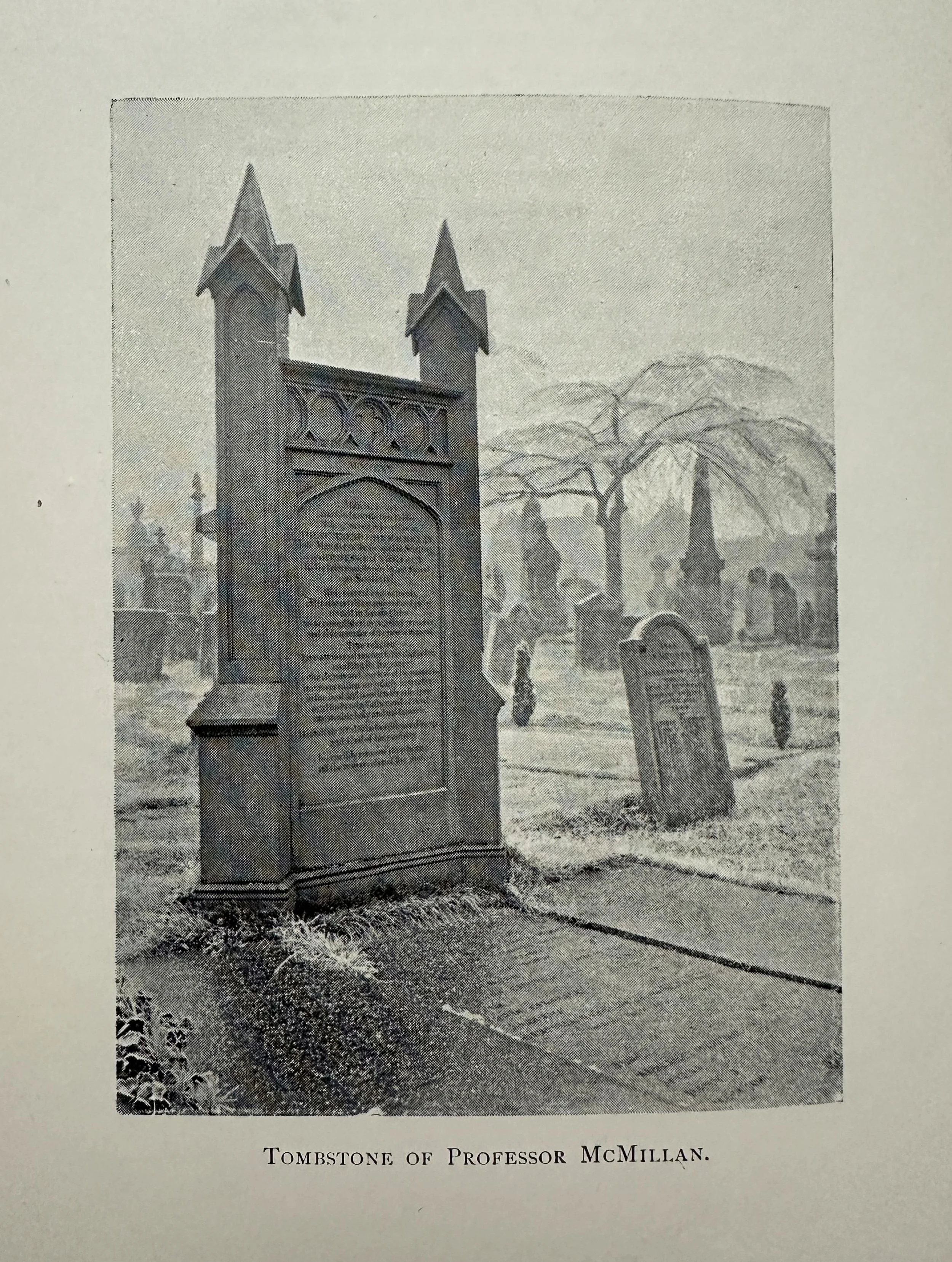
[Illustration facing page 57: TOMBSTONE OF PROFESSOR McMILLAN.]
57
The monument was built by Mr John Harrower, Stirling, according to the plan of Mr Robert Wright of Edinburgh, and cost £25.
The inscription on the tombstone of Mr McMillan was written by the Rev. Dr Andrew Symington of Paisley, who succeeded his former professor in the Theological Chair. It is a model of devout, graceful composition:—
MDCCCXX.
A bereaved flock
Erect and inscribe this Tablet
At the grave of a beloved Pastor,
THE REVEREND JOHN MACMILLAN,
Late Minister of the Gospel in Stirling,
AND PROFESSOR OF THEOLOGY,
To the Reformed Presbyterian Synod
In Scotland.
Rich natural endowments,
Extensive erudition, and eminent piety,
United in forming him
An accomplished Evangelical preacher,
And able minister of the New Testament.
True religion
Gave a universal unction to his character,
Emitting its fragrance
In the dignity and courtesy of his manners—
In conversation singularly instructive—
In the best and most tender affections
As a Husband, a Father, and a Friend—
And in a life holy and unblameable.
He died Octr. 20th, 1819, in the 68th year of his age,
And 42nd of his ministry.
His earthly remains sleep here,
Till the resurrection of the just.
Mr McMillan is also commemorated on the west side of the Macmillan monument over his grandfather’s tomb in Dalserf Churchyard. The inscription there is as follows:—
58
“Mr Macmillan was succeeded in the ministry by his son, the Rev. John Macmillan of Sandhills, near Glasgow, who died February Sixth, 1808, aged seventy-nine : and by his grand-son, the Rev. John Macmillan of Stirling, who died October Twentieth, 1819, aged sixty-eight. These preached the same gospel, and ably advocated the same public cause, adorning it with their lives, and bequeathing to it their Testimony, and the Memory of the Just.
“Instead of thy fathers shall be thy children.” Psalm xlv. 16.
John McMillan I., II., and III.—father, son, and grandson, covered by their lives (1669-1819) exactly 150 years.
Their united ages amounted to 232 years.
The three ministries in all (1701-1819) came to 118 years.
This number happens to denote, in this year of grace 1896, the present age of the Craigs congregation.
Professor McMillan was twice married. I have not been able to find out the names of his wives. The second—so far as I can learn—came from Edinburgh or its neighbourhood, and brought with her a considerable fortune. There was a large family at Viewforth, but only one son married. This was John, who was appointed Agent of the Bank of Scotland in Stirling in 1809. Mr McMillan retired on a pension in 1833. The Bank of Scotland, in his day, had its office at the foot of Broad St., in the interesting old building inscribed as having been the House of Darnley, and the nursery of James VI. of Scotland. In his later days, Mr McMillan had an infirmity in his limbs which necessitated
59
his driving from Viewforth to his office. His white horse was a familiar object then as it passed up and down Quality St., now King St., and Baker’s Wynd, which at that time was the name of Baker St.
Mr McMillan had a large family, most of whom died very young. One of his sons—Campbell—was an officer in the Indian army, and died in India at the early age of twenty-three. After Mr McMillan’s death in 1851, his widow resided at 17 Melville Terrace, in which house she died in 1873. Her maiden name was Campbell. At her funeral, her son Charles was present. He was then understood to be a farmer near Charleston, South Carolina, U.S.A. I have heard that he married a Creole lady and had a family, but whether any of his children survive I cannot say.