Kirk in the Craigs II.
James Dodson
19
CHAPTER II.
This seems the fitting place to introduce some light upon the McMillan family which by the act of ordination above described came into close and lengthened connection with the “City of the Rock.”
JOHN McMILLAN I.,
From whom the Reformed Presbyterians sometimes got the nickname “McMillanites,” was a man of mark in his day. He was the first ordained minister whose services were enjoyed by the “United Societies.” The leading facts of his life are summarized on a tablet erected to his memory in Balmaghie Church:—
TO THE GLORY OF GOD
And in memory of
John McMillan, A.M.,
Born at Barncauchlaw, Minnigaff, 1669:
Ordained Minister of the Parish of Balmaghie, 1701:
Accepted the Pastorate of the United Societies, 1706:
Which office he laboriously discharged for 47 years:
Died at Broomhill, Bothwell, 1753. Buried in
Dalserf Churchyard.
A Covenanter of the Covenanters:
A Father of the Reformed Presbyterian Church:
A Faithful Minister of JESUS CHRIST.
This tablet is placed here by his great-great-grandson
John Grieve, M.D., Glasgow. 1895.
20
The Rev. H. M. B. Reid, B.D., the present parish minister of Balmaghie, has recently written the life of McMillan with admirable fulness and great ability under the title, “A Cameronian Apostle.” John McMillan I. was married thrice. It is interesting to note that his second wife was Mary or May Gordon, widow of Edward Goldie of Craignuie, and a daughter of Sir Alexander Gordon, Bart. of Earlston in Dalry—the “Bull of Earlston”—whose exploits are detailed by Mr Crockett in “The Men of the Moss-hags.” After her death in 1723 Mr McMillan published an elegy setting forth her praises. The pamphlet was published at Edinburgh in the same year. At the close is the following acrostic:—
“Majestic mildness grac’d her countenance:
Admir’d endowments made her amiable,
Religious really, not in pretence:
Yielding to good, to ill uncounsellable.
Grace rais’d her soul ’bove mean and vulgar aims,
Order’d her steps in new obedience.
Renowned virtues were her brightest gems,
Devotion, join’d with frugal diligence.
Oblivion’s abyss shall not drown her fame;
Nor livid envy blast her balmy name.”
Mr Reid’s other volume, “The Kirk above Dee Water,” deals also, but not so elaborately, with Mr M‘Millan’s life and doings. He was no ordinary minister. His very communion cup was venerated for many a long year after his death. Only “the worthy” were thought to be capable of fixing their gaze upon it. Nicholson’s ballad, “The Brownie of Blednoch,” commemorates both it and its sanctity:—
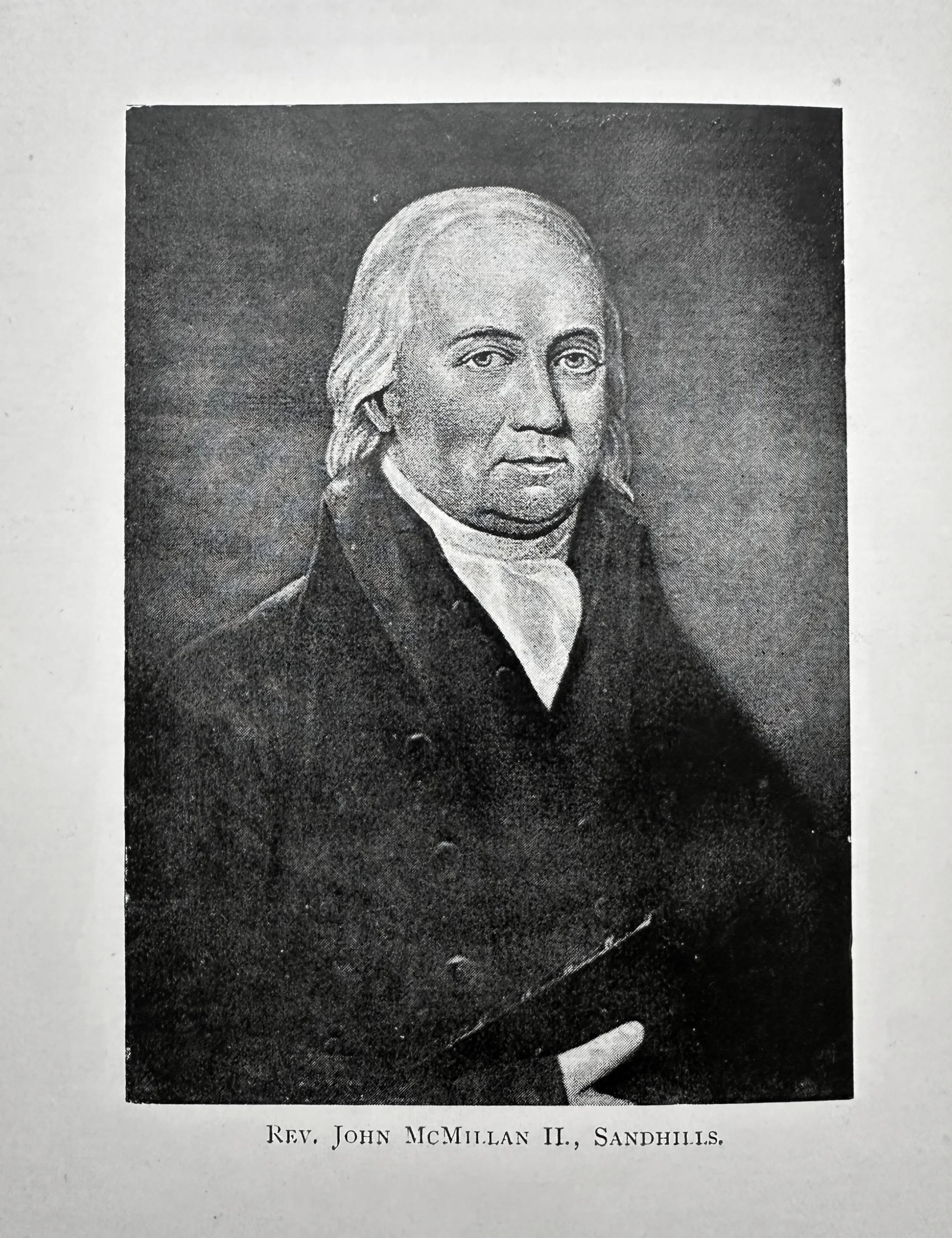
[Illustration: REV. JOHN McMILLAN II., SANDHILLS.]
21
“But he slade ay awa’ or the sun was up,
He ne’er could look straught on M‘Millan’s cup.”
Mr Reid’s words at the close of the chapter entitled “The End of that Man,” in which he gives a touching account of the going out of a godly life, seem to me just and fitting. “Stern and unyielding he may have been where he thought conscience bade him be so, but in himself he was a fine and noble character, hewn out of the Galloway rock, and with the kindly perfume of the heather and the peat clinging to his very soul.”
JOHN McMILLAN II.
Was not the son of “Mistress May Gordon,” but of his father’s third wife, about whose name there is an uncertainty. Some say it was Grace Russell, others say it was Janet Jackson. In any case, from the fly-leaf of the Family Bible it is clear that “John was born the 4th of July, 1729, on a Friday about eight o’clock in the afternoon.” The place of his birth was Eastforth, in the parish of Carnwath. He was licensed and also ordained in the year 1750, at Bothwell. He soon settled at Sandhills, near Shettleston, where he had bought a small estate. Upon his property he built a church, a small, thatch-roofed building. The Great Hamilton St. Free Church is the present representative of that humble meeting-house. Mr McMillan’s wife was a daughter of Mr Charles Umpherston of Pentland. Mr Umpherston was a descendant of Helen Alexander of Pentland, who wrote—“And when Mr Renwick was
22
execute, I went and saw him in prison: and I said to him, ‘Ye will get the white robes,’ and he said, ‘And palms in my hands.’ And when he was execute I went in to the Greyfriars Yard, and I took him in my arms till his cloathes were taken off, and I helped to wind him before he was put in the coffin.” It may be noted here, in passing, that the distinguished Indian official, Sir Charles Umpherston Aitchison, K.C.S.I., who died recently at Oxford, was a descendant on his mother’s side of Charles Umpherston of Pentland.
Mr McMillan’s ministry was a long one, extending in all from 1750 to 1808. He died at Sandhills in the 84th year of his age, and the 57th of his ministry. In his day he took an active part in the “Atonement Controversy,” and published several pamphlets dealing with the ecclesiastical situations of the time as they arose. The historian of the Reformed Presbyterian Church, the Rev. Matthew Hutchison of New Cumnock, thus sums up his estimate of Mr McMillan:—“He was a man of noble presence and dignified manner, yet withal most amiable and kind, beloved and trusted by his brethren, and esteemed by all who knew him. His appearance in the pulpit was solemn and impressive, and such was the whole service as conducted by him. He was in the habit of preaching long sermons, and when some one suggested that, for his own sake, they might be shortened, his reply was—‘Wae’s me, that I should weary myself and ither folk wi’ my
23
preaching.’ The only specimen of his preaching we have seen,” adds Mr Hutchison, “is an excellent sermon preached at the ordination of his son at Stirling, and certainly it does not err on the side of brevity.”
“He was the last,” said the Presbytery in their Record, “of the four old members” (the four Johns), “who long composed the Presbytery, and who were all found in their generation to be faithful to the cause of God and truth. Being the first in office, he had to bear the burden and heat of the day, extending his labours over the community at large, amidst a scene of trying hardships, of which we, in our time, have little acquaintance; and now he rests from his labours, and his works do follow him.”
JOHN McMILLAN III.
was born in 1752. He was licensed by “the Four Johns” in Presbytery at Pentland on 4th Jan., 1775. The first part of their minute referring to the license of Mr McMillan along with that of Messrs William Steven and Walter Grieve is worth quoting as showing the pious spirit and painstaking method of these ministers. “Ye Presb. appointed ye Rev. John Thorburn to moderate for yt. affair who accordingly proceeded, and after having interrogate ye candidates severally of their experience of ye Lord’s work upon their own spirits, he informed ym. of ye Presby.’s resolution, and after calling on ye name of ye Lord by prayer for his gracious countenance and presence, did, as ye mouth of ye Presb. in ye name of ye Lord Jesus Christ,
24
ye alone King and head of ye Church License. The said Mr William Steven, Mr Walter Grieve, and Mr John McMillan to preach ye everlasting Gospel, and having given ym. some suitable directions as to their duty in this new station, concluded ye action wt. prayer.”
During his time as a probationer or “candidate” Mr McMillan, under the orders of the Presbytery, must have made many long journeys. His appointments, and those of the other “candidates,” are regularly entered on the minutes of each meeting of Presbytery. Take the following as a specimen:—On Jany. 15th, 1777—“The Pby. appoint Mr McMillan to preach Sabbath first at Pentland, second and third at Merse and Teviotdale, fourth at Selkirk, fifth at Lithgow, sixth at Airdary, seventh, Old Monkland, eighth at Windyedge, ninth at pleasure.”