Kirk in the Craigs III.
James Dodson
25
CHAPTER III.
COMMUNION SERVICES AT STIRLING.
We have seen how acceptable Mr McMillan’s services were, as evidenced by the four calls which were presented to him. We may now trace his history after his settlement at Stirling on 11th March, 1778.
In those days Communion seasons were rare. One reason for this state of matters was the small number of ministers available for extra help; another was the multiplicity of the services which the people demanded on such occasions. Practically, for many a day, it needed all the ministers of the Presbytery to carry on the full supply of sermons and addresses. The usual way was for a kirk-session or body of adherents in a particular place to approach the Presbytery by way of petition, craving the dispensation of the Sacrament of the Lord’s Supper within their bounds. For example, at a meeting of Presbytery at Stirling on March 8th, 1780, it is stated that “The Pby. received four petitions craving the dispensation of ye Lord’s Supper in ye ensuing summer, one fm. ye session of Pentland; one fm. ye session of Quarrelwood; one fm. ye session of Stirling; and one fm. Ireland,”
26
all which they agree to grant; “but refer ye fixing of ye time till next meeting of Pby.”
At the succeeding meeting an appointment was duly made in the following terms:—“The Pby. agree yt ye dispensation of ye Sacrt. of ye Lord’s Supper be held at Stirling, 3d Sabbath of July, and appoint their next meeting to be held at ye above place on ye Monday after ye work is over.”
This Sacrament—the first during Mr McMillan’s ministry—was accordingly held on 16th July, 1780, and, on the following day, the Presbytery met and recorded in their minutes that—“The Dispensation of the Sacrt of ye Lord’s Supper was essayed in the different places appointed in the preceding minutes.” This date is an important one. I had always a difficulty about the date on the Craigs Communion Cups. The above extracts from the old Presbytery Record make the matter quite clear. They must have been procured and dated with reference to the celebration of the Communion above referred to. The inscription on the Cups runs in double lines almost all the way round. This is a copy of it:—
THE COVᵀᴰ P—BYTIAN CONGREGATION AT STIRLING. JOHN M‘MILLAN MINR MEMBER OF THE R‘PBTY 1780.
The only other occasion on which the sacrament was “essayed” at Stirling during the period 1778–1783 was on the 1st Sabbath of August, 1782, when the following appointments were observed, as far as health would permit, and was found practicable:—“Mr McMillan Jnr. preach
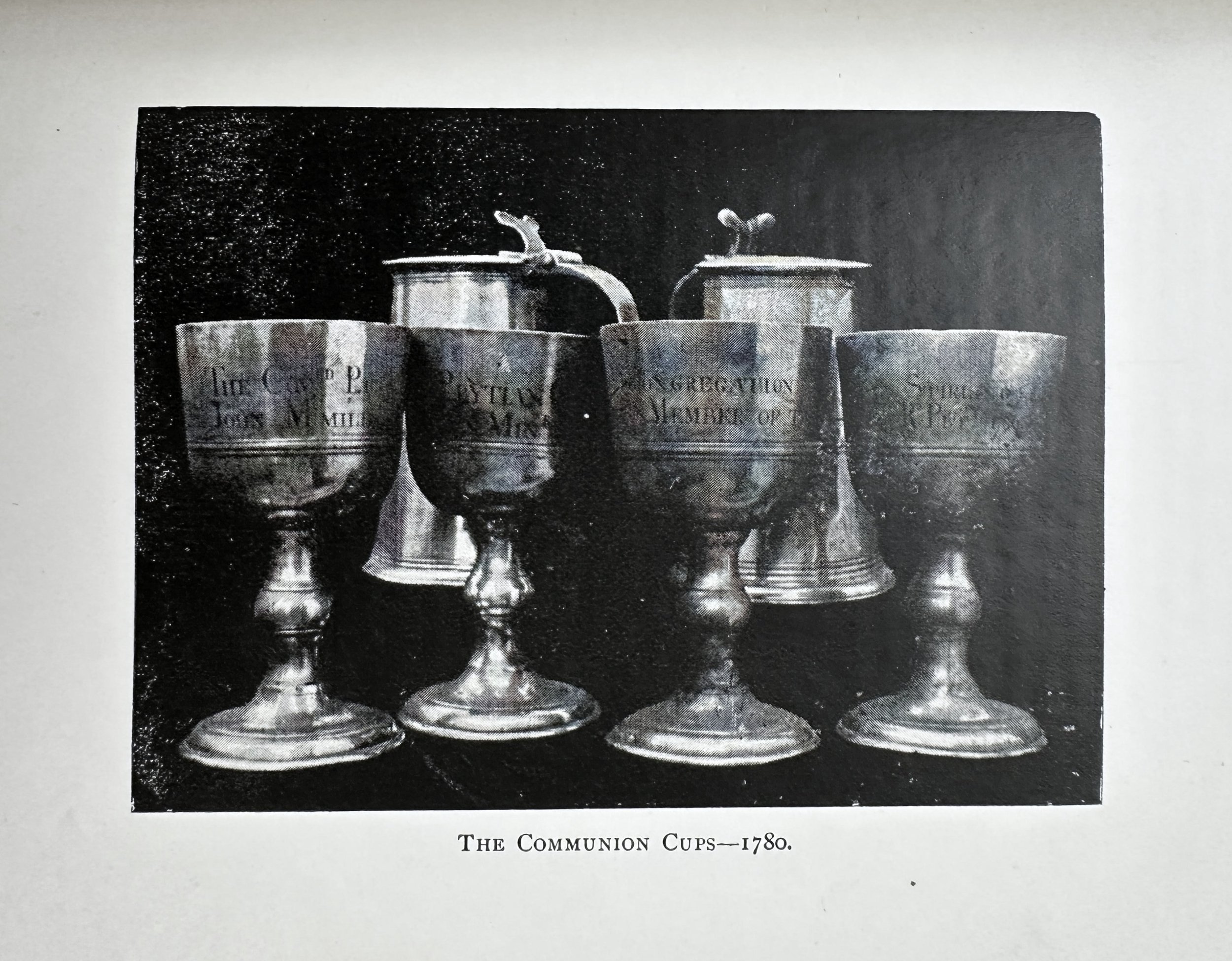
[Illustration: THE COMMUNION CUPS—1780.]
27
the action sermon, Mr Thorburn (of Pentland) Sabbath Evening; Mr James Reid (probationer, afterwards of Newton Stewart), begin on fast-day, Mr Thorburn conclude; Mr Steven (of Crookedholm, Kilmarnock), begins on Saturday, Mr McMillan Senr (of Sandhills) concludes; Mr Grieve (of Inverkeithing) begins on Monday, Mr Steven concludes; Mr Grieve, Friday evening.”
On such occasions the congregation met in the part of the King’s Park which Dr Goold’s father used to call “the back of the desert.” I take this to mean the sloping ground at the back of Park Place. Many strangers came to take part in such celebrations from all parts of the Lowlands. Some, it is said, came even from Ireland. As a remarkable instance of the numbers who attended more or less closely on such services, I may mention the statement of Mr Hutchison in his History. He says—“At the first Communion at Sandhills the numbers were computed by a military officer at from ten to fifteen thousand at different periods of the day.” To many godly people, and to the ministers, such must have been times of true spiritual and social refreshment. To the thoughtless and godless they were only “Holy Fairs,” whose abuses deserved the sharp satire of Burns.
One could imagine no place in broad Scotland where such celebrations would be more impressive than in our beautiful Park. The stillness of the country, if not the scent of the heather, would be there; and there, those who
28
so dearly loved the Psalms could literally lift up their eyes to the hills. The memories of the Esdraelon of Scotland would stir the feelings of men and women to whom, above all things, God, and Scotland, and liberty, were dear. The lays of kirk and covenant had there appropriate setting. They had there, too, the martyred memory of James Guthrie of Stirling to touch their thoughts to gratitude for their own happier times.
In the early part of this century, the Communion services were held in the St Ninians Well Green—a suitable spot for fixing the tent, and handy, as being near the church.
A DISJUNCTION.
On 7th May, 1783, a petition came before the Presbytery from the people of the east (Linlithgow) end of the congregation, craving a disjunction from the people of the west (Stirling) end. The Court, on 16th June of the same year, recommended the holding of a congregational meeting to consider the subject. The meeting was held at Plean, but no practical result flowed from it. A Presbyterial compromise in the following terms met with no better success, although its reasonableness, as well as its arithmetic, seemed promising:—“Recommend it to the congregation in both sides, as the only habile relief in the present state of matters, that the minister should give two-thirds of his labours to the west end of the congregation, and one-third to the east, and that both sides divide their support for the
29
minister in proportion to the supply of sermon.”
The result of the agitation was that fresh petitions came from both ends of the congregation. At length, on 10th Nov., 1784, the Presbytery unanimously resolved to divide the congregation, and so to set up a new charge. This is their minute:—“The Pby. therefore did and hereby do disjoin the people residing on the east and south side of the water of Carron from the Stirling congregation, and fix the Rev. Mr McMillan, jun., in the western part of his former charge, and the Pby. take the eastern part of that charge under their inspection.”
This was the origin of the Reformed Presbyterian Congregation at Laurieston, near Falkirk, now known as Laurieston Free Church. The first minister of that charge was the Rev. James Reid, jun., who was settled in 1788. The present minister is the Rev. James Hunter, B.D., a son-in-law of my distinguished predecessor, the Rev. Professor Binnie.