Kirk in the Craigs I.
James Dodson
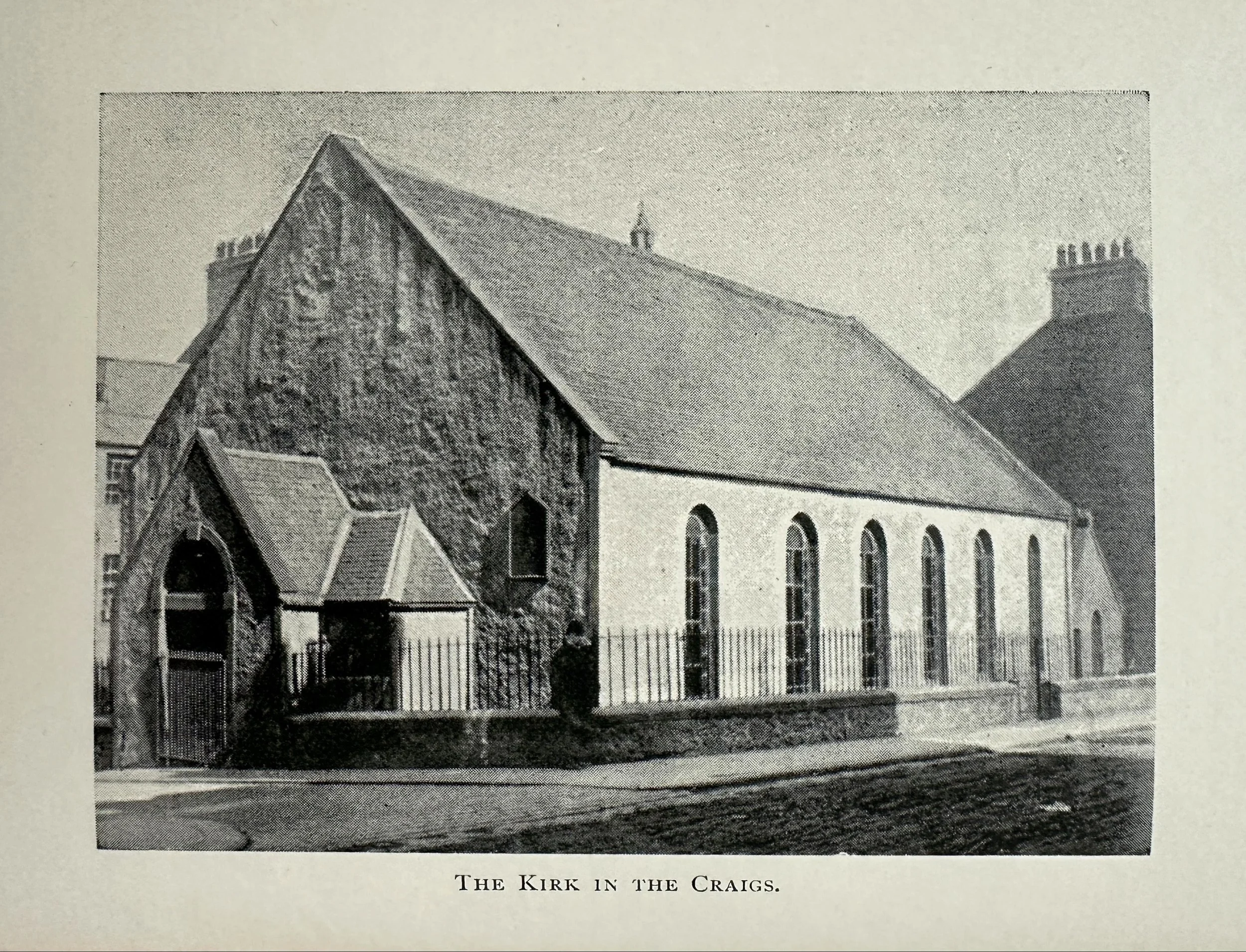
[Illustration: THE KIRK IN THE CRAIGS.]
9
A Kirk and a College
IN THE
Craigs of Stirling.
CHAPTER I.
On 11th March, 1778, the first minister of the congregation now known as the Craigs Free Church was settled. Of religious communities of that date there were several in Stirling, of which the following may be mentioned:—
Those adhering to the Establishment met in the East Church under the Rev. Thomas Randall and Rev. John Muschet. In St John St. the followers of Ebenezer Erskine assembled. Their minister was the Rev. Robert Campbell, M.A., who was settled in 1766. On the site of the present Viewfield U.P. Church there stood the old Back-i-toon Church, in which the Rev. John Heugh ministered to the adherents of the General Associate (Antiburgher) Synod.
10
Besides these and others, there had long existed in the town and neighbourhood “Societies” of the body of Christians who have been known at various periods of their history by such names and nicknames as Covenanters, Cameronians, Old Dissenters, Society People, Hill Folks, Men of the Moss-hags. They called themselves Reformed Presbyterians. The world knows that they were men of principle and piety—enthusiasts for the cause of civil and religious liberty, as they understood these things. If they were stern rather than charitable, let it be remembered that they had stern work to do, and that persecution hardens the mildest. Their ideal was an exacting one—a covenanted nation and a constitutional government under a covenanted king. Looking back as they did wistfully to the attainments of the Scottish Church at such dates as 1560, 1638, and 1649, it is little wonder that the Revolution settlement did not satisfy the Covenanting party in Scotland. Their struggle was that of men who asserted the Divine right of Presbytery against the theory which, in their view, embodied “the Divine right of kings to govern wrong.” High-Church Presbyterians in this regard, they remained, in an important sense, outside of the State and the Church—a party of history and hope.
In this town and district, the old Dissenters were in the habit of meeting from time to time for worship and conference. For long their meetings were held in private houses. Their
11
practice was really an extension of the good old Scottish practice of family worship, concerning which Professor Herkless in his recently published life of “Richard Cameron” quotes a saying of Norman Macleod when he was minister of Loudon:—“Of that (family worship) there seems not to be a vestige, except among the Cameronians, and there every family has it.”
In 1766 the “Old Dissenters” of Stirling got an accession to their strength. A number of members, dissatisfied with the manner of the settlement of the Rev. Mr Campbell, withdrew from the St John Street Secession congregation and joined with them, obtaining from the Reformed Presbytery supply of sermon. The congregation, thus composed, “met for public worship in a place called the Apple Yard.” There were many apple yards or orchards in Stirling then. I am sorry I can throw little light on the exact locality referred to in this extract from an old minute copied into one of the Records of the Craigs Church. I can only throw out the suggestion that the orchard may have been that belonging to Bailie Gib,—where Erskine and his followers met from 1740 to 1742. In this document it is said “they received a loan of the West Church, it being then unoccupied.” The Rev. Dr Goold of Edinburgh, whose father often assisted here at Communion seasons when this century was young, told on his father’s authority, and on the authority of Mr David Jeffray, Edinburgh—the son of an original member of the Craigs congregation, “that after Mr
12
Macmillan came to Stirling, he preached for seven years under the venerable Franciscan Tower which is such an ornament to the town.” Though search has been made in the Records of the Town Council and Kirk Session in and around 1776—the date referred to, I am sorry to say there is no record preserved of any grant by either body of the use of the West Church. It is quite credible,—seeing that “the coppersmiths were allowed to work in the porch of the West Church” from 1779 to 1817—that the Reformed Presbyterians were allowed to worship in the Church itself from 1776 to 1783. The minute of Presbytery, to be afterwards quoted, seems to clearly indicate that the uniform tradition is correct:—“Ye Pby. repaired to ye Church.” To what Church? They had none of their own. Only one Church was available—for the West Church was unoccupied in a regular way from the time Ebenezer Erskine left it in 1740 until the year 1817. My conclusion is, that without any express sanction, the old Dissenters were tolerated in the use of the venerable building referred to for seven years.
On 15th January, 1777, at its meeting held at Douglas, Lanarkshire, the Reformed Presbytery had their hands full. They sanctioned the erection of three new charges. One of them is that of “Stirling wt. ye parts adjacent.” At the same meeting, moderations in calls were granted to Inverkeithing, Ayr and Renfrew, Hamilton, Stirling, Merse and Teviotdale. From the reports of the ministers who
13
officiated in these localities it appeared that no fewer than four calls had come out in favour of Mr John McMillan, junr. [This is actually McMillan III.; he was called junior, and his father, McMillan II., was called senior, because the first McMillan, “the Cameronian Apostle”, died in 1753; ED.], viz., Hamilton, Stirling, Inverkeithing, and Merse & Teviotdale. Mr McMillan craved time to deliberate, and on June 9th craved “some little time longer, & ye Pby in consideration of ye difficulty of ye case grant said petition till ye next meeting.” At Ponfeich (near Douglas), on 1st September 1777, Mr McMillan decided to accept the call from Stirling. Some of the Hamilton people were evidently disappointed at this decision. They took a peculiar way of expressing their chagrin. At Sandhills on 11th November “a Representation & Petition was given in by some Commissioners from Hamilton congregation remonstrating some grounds of suspicion with respect to ye Stirling congregation, or rather as to some of those who had of late acceded to ye Pby, yt they were not, or would not be found, such as honestly adopted & professed ye principles of ye Pby, and therefore, they craved yt ye Pby. would enquire more distinctly into ye situation of yt people; upon which, after long conversation amongst ye members signifying what each knew of yt matter, & particular enquiry & examination had of ye Comissrs here present from yt Bounds, ye Pby. came to find yt there were none of those of such characters, principles or practices as were represented in ye remonstrance yt either had been or were allowed to be members of yt congregn, ye discovery of which ye Pby. appre-
14
hended in some measure satisfied ye complainers, whereupon ye Pby. next proceeded to fix ye time of ye ordination of ye candidate above sd, & which they agree shall be at Stirling ye second Wednesday of March 1778; and yt ye Rev. Mr McMillan preach ye ordination sermon, & ye Revd. Mr Steven conclude ye work with a short discourse, & ye Revd. Mr Thorburn serve ye edict in due time.”
The reference in the above minute is plain from the previous history. The followers of Ebenezer Erskine, who had joined the Old Dissenters of Stirling, were apparently not sound enough politically for some of the true blue Presbyterians of Hamilton.
The second Wednesday of March, 1778, was the 11th of that month. It was an important day for some of the good folks of Stirling, and for the Presbytery. For there was only one Presbytery in the Reformed Presbyterian Church at that time, and only five ministers in it. The Moderator, the Rev. John Courtass, came with his elder from Quarrelwood, near Dumfries; the father of the minister-elect, Rev. John McMillan of Sandhills, came from near Glasgow with his elder; the Rev John Thorburn with his elder came from Pentland; from Douglas Water in Lanarkshire came the Rev. John Fairley also with his elder; the Rev. William Steven—a recent addition to the Presbytery (1777)—brought his elder with him from Crookedholm, near Kilmarnock. It was no joke attending a Presbytery meeting in those days. Eleven weary men and
15
the same number of horses would find rest and a welcome at Stirling on the evening of 10th March, 1778.
THE FOUR JOHNS.
The four first mentioned in the above paragraph were known widely and familiarly as “the Four Johns.” For 16 years they had formed the list of the ordained ministers of their church. From 1763 onwards the Revs. John McMillan and John Thorburn were the colleague pastors of the Northern congregation which included the societies in Fife, the Lothians, the lower ward of Lanarkshire, Stirling, Dumbarton, Renfrew, and Ayr; while the Revs. John Courtass and John Fairley had as their charge the Southern congregation—embracing the Borderland and the Province of Galloway. They were true evangelists, travelling much, preaching much, visiting in all weathers their widely scattered adherents. Their old minute book is battered and weather-stained. But for care and correctness their proceedings will stand comparison with those of any church court. Theirs was a gospel which encouraged no scamping of their Master’s work. They united an Evangel of grace with one of detail.
THE SETTLEMENT AT STIRLING.
When the Presbytery met on 11th March, their first business was to require of the representatives of the congregation “a more explicit acct. as to what outward encouragement in respect of a comfortable subsistence they had to settle ye person among them for yr proper
16
pastor whom they had called. The foresaid Representatives in answer to ye demand of ye Pby. signified yt they had deliberately agreed among themselves to afford ye sd Mr McMillan as yr settled pastor ye sum of 52 lib. annually at ye least, and that they were desirous and hoped that in course of providence it would be rather more than less. This answer ye Pby. accepted as satisfying for ye present, and so sent out their officer John Weir, pro tempore, wt ye edict to ye church where the congregation was convened in order to its being read three times and returned, wh accordingly was done, and returned to ye Pby. wt out ye report of any objections. Hereupon ye Pby. repaired to ye church, where after the sermon by the Revd. Mr John McMillan from Math. 24-45, “Who then is a faithful and wise servt, &c.,” ye sd Mr McMillan, Junior, after answering by his assent to ye formula of questions put to candidates before yr ordination was solemnly ordained to ye holy office of ye ministry by prayer and ye laying on of ye hands of ye Pby., after wh ye Revd. Mr McMillan, Senr, and minrs present gave him ye right hand of fellowship. Then fm ye pulpit tendered a charge & advice both to ye minr & people, necessary on ye occasion. Mr Steven then succeeded & preached a sermon fm Phil. 1-27, “Striving together, &c.” Ye public worship being concluded wt prayer & singing, ye Pby. returned to yr seats, where ye Revd. Mr McMillan took his seat together wt Thos. Downie, chosen by ye
17
session for his elder, upon wh ye modr & oyr members again gave him ye right hand of fellowship as a co-presbyter. The Pby. then required Mr McMillan’s subscription of ye formula of questions in yr presence, wh he accordingly did, upon this ye modr by ye Pby.’s order delivered ye call fm ye people of Stirling wh till this time had been lodged wt ym into the Revd. Mr McMillan, Junior’s, hand.”
A LONG SERMON.
The sermon preached in the West Church at the ordination of his son, by the Rev. John M‘Millan, sen., was subsequently published. It is rare now. Its title page is as follows:—
FALKIRK | Printed by DANIEL REID, and sold by him and other Booksellers. | M,DCC,LXXIX.
This sermon is a most orderly, able, and elaborate piece of work, lofty in tone and full of Christian wisdom. It may be said to form a compendium of practical Theology, and a complete directory as to ministerial aims and duty. That these statements are true, may be surmised,
18
from the fact that the sermon proper occupies 90 pages 8vo printing. The subject is treated under five general heads, and under these fifty-five particulars. The charges to the minister and people occupy about 12 pages—the former being laid out under nine, and the latter under six particulars. The whole pamphlet runs to 102 octavo pages.