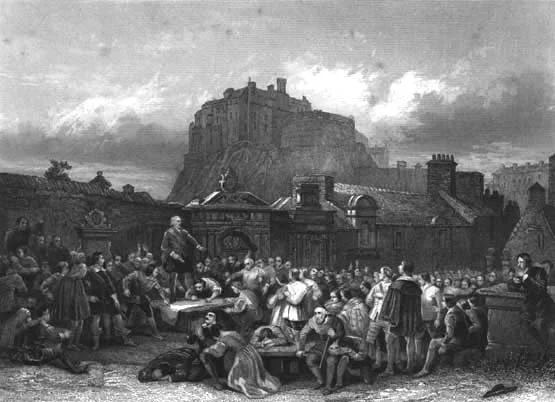
A Review of a Paper
James Dodson
Lately Written
Against the Being and Binding Obligation of our Sacred NATIONAL COVENANTS; Especially, the SOLEMN LEAGUE and COVENANT of the Three Kingdoms.
Whereunto
An Analysis of the SOLEMN LEAGUE and COVENANT of Scotland, England, and Ireland, is prefixed and some TESTIMONIES of learned and orthodox Divines for these COVENANTS are subjoined.
By a LOVER of Truth and PEACE,
With a Covenanted Reformation conducive thereunto.
II KINGS, chap. xi. 17, and Jehoiada made a Covenant between the Lord, and the king, and the people, that they should be the Lord’s people; between the king also and the people.
GALATIANS, chap. iii. 15. Though it be but a man’s Covenant; yet if it be confirmed, no man disannulleth or addeth thereunto.
EZEKIEL, chap. xvii. 15, or shall he break the Covenant and be delivered.—Ver. 19, Thus saith the LORD GOD, as I live, surely mine oath that he hath despised, and my Covenant that he hath broken, even it will I recompense upon his own head.
Aderit prævaricatorum Numerus, vel proditorum, qui nunc in Ecclesia contra Ecclesiam surgere, et fidem pariter ac veritatem subvertere cæperunt. [There will be a number of prevaricators, or traitors, who have now begun to rise up in the Church against the Church, and to overthrow both the faith and the truth.]——Cyprian. in Epist.
FALKIRK: Printed by DANIEL REID, for the Editor. 1779.
(Price only sixpence.)
[Preface, page unnumbered]
A PREFACE.
BY the EDITOR.
THE following sheets were published a number of years ago, by a worthy minister of the church of Scotland, in vindication of our solemn covenants; and particularly the solemn league, in answer to the objections thrown out against them by Mr. John Glas, and others in his day; and when the same objections are offered against them in the present age by numbers, of various denominations, it is judged proper to republish the following review of the objections against them, and vindication of them and of their binding obligation for the information of the present age, and of posterity, and to guard them against condemning these solemn engagements and their binding obligation rashly, and
[Page iii]
without attending to what may be justly offered from the word of God in their defence.
The editor, by his republishing the following sheets, in vindication of our covenants, does hereby declare, that he, as well as the worthy author, pleads only for the obligation of the covenants, in so far as he judges they are moral, and the reformation sworn to in them agreeable to, and founded on the word of God.—The editor, and the body he is connected with, viz. the Secession, in their Testimony, while they approve of all the branches of reformation solemnly reviewed and sworn unto in different periods, meanwhile have cautiously guarded against the thought, that they also approve of every step by which it was carried on, especially of those which are every where condemned in the same Testimony: Their Testimony is levelled against the several modes which many in these lands have invented of blending the church of Christ with the kingdoms of this world; and against every Erastian, as well as Popish or Prelatical encroachment on the authority of Christ,
[Page iv]
and the liberties of his free and independent kingdom.—In it they assert, in the strongest manner, the freedom of that kingdom, its distinction from the kingdoms of the world, and the unrivalled head-ship of that Divine Person over it; tho’ in their Testimony they do not dwell on the faults of the last reforming period, nor Ham-like, expose the nakedness of their worthy ancestors, for whose mistakes their trying circumstances greatly apologize.
The words of the Associate Presbytery are, “But since the Church Militant is in an imperfect state, it is not hereby (i.e.) by any thing the Presbytery had said concerning the last reforming period) intended to affirm, that under the above-mentioned period, there was nothing defective or wanting as to the beauty, and order of the house of God; or, that there was nothing culpable in the administration; all that is designed by the above particular deduction, is to declare, that the church endeavoured, and mercifully attained, a considerable pitch of reformation during the aforesaid period.”
[Page v]
—If these particulars had been duly attended to, it might have prevented a number of illiberal and unjust reflections thrown out in some pamphlets lately published against the Secession by some ministers of a society, who are neither of, nor out of the communion of the established church, who pretend to open an Asylum for the relief of the oppressed in the communion of that church; and in order to accomplish this charitable deed, attempt to level all public professions of attachment to Christ in all his truths and ordinances, openly disclaiming all distinction of religious characters and professions, in order to the highest acts of church-communion (provided, as they express themselves, they be found in the essentials, and that they can charitably suppose them to be good men);—Their pretences are seemingly plausible to those whose attachment unto the united system of divine truths, respecting doctrine, worship, discipline and government sworn to in our covenants, is but slight, and many are thereby deluded into the snare of giving up with any laudable effort either for
[Page vi]
holding what we have, or recovering what we have lost.—Such lukewarmness in the cause of Christ among these who are loud; and we would charitably hope, sincere, many of them in their profession, of love to Christ and his saints, is truly affecting and lamentable.—But, it is not intended in this preface, to engage in a dispute with the authors of the above-mentioned pamphlets, which would be a disagreeable task, as the violence of their passions displayed in them, disgrace their arguments; and, the pleasure they seem to take in attempting to humble their adversaries, induces them to use the coarsest language; yea, to abound in the lowest expressions of a Billingsgate wench; tho’ one would think a disputant may be warm, and in earnest in pleading his cause without dishonouring his reason, or provoking the pity of mankind by virulent and abusive declamations against those that oppose them, for “the wrath of man worketh not the righteousness of God.” It is related concerning Luther, that when one told him what loud accusations his adversaries laid against him, and how they reviled
[Page vii]
him in their books, I know by their roaring, said he, that I have hit them right. The application is easy and obvious.
The editor begs leave to conclude by entreating the readers of the following sheets to peruse them without prepossession against our covenants, or the principles sworn to in them, and to attend to the force of what is said in their vindication, and then let them judge if according to the law and the Testimony they deserve to be condemned, or if we are not bound by the law and Testimony to adhere to the truths sworn to in these covenants, and in agreeableness to these covenants by every lawful mean to endeavour to prosecute the ends of them. I shall only add the following opposite extract from the judicious Boston, in a sermon on Deut. xxxii. 20. No generation, saith he, can go back from purity of reformation attained by their fathers, but on their peril; and, so far as they insist in the steps of their backsliding fathers, they justify them in their backslidings, and so enter themselves heirs to their sins, and consequently to their judgments.—The covenant made with the
[Page viii]
Gibeonites in Joshua’s time, was binding in the days of Saul, and the slaughter made of them in the days of Saul contrary to that covenant, the land suffered for it many years after that in the latter end of David’s reign.—The Lord saith of the Jews in the days of Jeremiah, they are turned back to the iniquities of their forefathers which refused to hear my word, and they went after other gods to serve them: the house of Israel, and the house of Judah have broken my covenant which I made with their fathers.
Whereas it is reported, that I and others was taking out and putting in, what we pleased of the original Copy, I assure the public, that there is not one sentence put in, or kept out, but an advertisement about the Appendix, with reference to their proper pages, which is carefully observed in this edition; and, altho’ we are not favoured with the author’s name, it doth not alter the matter of the book.
I cannot but acknowledge myself and the public indebted unto the encouragers of the reprinting of this Review; and may God’s blessing attend it, is the earnest wish of Eb. W.
[To the Reader, page unnumbered]
TO THE READER.
IT is lamentable, that, since the renewing of the National covenant 1638, and entring into the solemn league and covenant 1643, there have been, and still are, so many who exhibit a specimen of their wit, and a shrewd discovery of their antifederal malignity, in striving to disannul, or loose the bands of these sacred and perpetually binding covenants. But especially, as the great and godly Mr. John Brown, shewing the vanity of their pretensions, who plead the nullity, or non-obligation of these covenants, saith; ‘It is matter both of admiration, and of grief and sorrow, that there should be any found within the church of Scotland, who had so far forgotten themselves, as now to turn, not only enemies to piety and Christianity; but also enemies to very humanity, and not only break covenant-ties themselves, but also teach others to do the same; and that without any fear of punishment, either from God, or man. But God, who is jealous, will not be mocked, let men dream of exemption as they please, and by sophistical shifts think to blind their own eyes, and the eyes of others; God, who will not hold them guiltless, that take his name in vain, will, no doubt, by sad answers from heaven, discover the impiety and folly of these patrons of profanity and inhumanity.’ Such learned Anticovenanters were the doctors
[Page x]
of Aberdeen, 1638, soundly answered by the zealous ministers, sent thither to prepare for, and press the taking of the National Covenant.
Such were the Sectaries in England; whose errors, heresies, schisms and blasphemies, being abjured in the solemn league and covenant, were gravely testified against by many Presbyterian ministers (near 800, besides the concurring testimony of hearers) in at least 14 several counties of England, in their joint, harmonious, subscribed testimonies to the truth of JESUS CHRIST, to our solemn league and covenant; and against those errors, &c. and the toleration of them, Anno 1647 and 1648. And these Sectarians afterward invading, and over-ruling Scotland, their Antiscriptural and Anticovenanted practices and Tenets were witnessed against by some eminent ministers, in their testimony to the truth of JESUS CHRIST, to the National Covenant of Scotland, and to the solemn league and covenant of Scotland, England and Ireland, &c. subscribed 1658 and 1659.
Such antagonists were the Oxford doctors, Dr. Featly, &c. fairly confuted by Mr. Zach. Crofton, in his Analepsis, and fastning of St. Peter’s fetters, and by TORGUS, printed London 1661. Mr. Crofton in his later book, doth largely, learnedly and soundly confirm and enforce the obligation of the covenant against that profane opposition made thereto; removing all obvious objections, in handling these seven propositions, viz.
‘1. The asserting of the solemn league and covenant, and its obliging force, is a duty indispensibly incumbent on every man, in his place; but especially on the ministers of the gospel.
‘2. The irregularities in first making the covenant will not discharge its obligation, now it is made and sworn.
[Page xi]
‘3. The matter sworn in the solemn league and covenant is just and lawful to be maintained and pursued.
‘4. The form and manner of making the solemn league and covenant was good and allowable.
‘5. The ambiguities and contradictions of the words, in the solemn league and covenant, are imagined and not real.
‘6. The covenant in its quality, and for its obligation, is public and national, as well as private, and personal.
‘7. The solemn league and covenant is, in the nature of it, permanently binding, and no way to be absolved or discharged.’
Such impotent opposers were the perjur’d prelates and their apostate underlings; some of them writing and printing against the covenants (because condemning their new constitution and course, their defection and deformation) after that woful catastrophe 1661. The learned Mr. Brown sufficiently answers the seasonable case of submission, &c. in his apologetical relation (printed 1665) page 327, to 416, wherein sect. 20. he demonstrates the dreadfulness of the sin of covenant-breaking; particularly of abjuring the National Covenant and the solemn league and covenant. And, sect. 21. The great hazard of perjury, or covenant-breaking. Sect. 22. He vindicates the solemn league and covenant, and answers the anonymous author of the seasonable case. And, sect. 23. Vindicates the National Covenant from the exceptions of that author.
The true nonconformist also vindicates the same covenants from the aspersions of the author of seven dialogues, in his answers to Dial. IV. page 205, to 236, printed 1671.
[Page xii]
And the late learned principal of St. Andrews, Mr. Thomas Forrester in his rectius instruendum, or a review of three dialogues between informer and doubter, 1648. Part second, is wholly on these two, the abjuration of Prelacy in both covenants, and, the obligation of these covenants.
Some hints of whose writings are subjoined to the following REVIEW, not only as testimonies for our now condemned sacred covenants; but also as proofs and reasons, which the condemners should have considered and try’d their skill to invalidate, ere they had so arrogantly pass’d sentence against them: sure all these testimonies of covenanters may, with the unbiassed, counterbalance (and will, with judicious, tender Christians, down-weigh) all that the Anticovenanters of our day have said, or can advance: and may serve as an argument, ab exemplis, from the practice of the people of GOD; which as Mr. Shield says, to condemn were impious, and to deny were most impudent.
Also in Ireland, as there was great indignation against the National Covenant of Scotland, and an oath pressed by the deputy, the Earl of Strafford, &c. condemning and abjuring that way of covenanting, 1638.—1640; against which oath, and the swearers of it, Mr. Rutherford, in his letters, pronounces, in the name of the Lord, such terrible things; Part 2. Lett. 27. To the persecuted church in Ireland 1639, and Lett. 29. To Mr. Stewart, &c. Prisoners of Christ at Dublin, 1640, which was soon and dreadfully execute, in the massacre 1641, wherein so many thousands of the Protestants were miserably murdered; so there was great opposition made to, and many objections against the solemn league and covenant of the three kingdoms, in 1643, &c. as by the then states, lords justices, and
[Page xiii]
most of the surviving inhabitants, being popish, prelatic, or malignant enemies to the covenanted reformation. Yet, even there and then our Lord had his witnesses, confessing him before men, and boldly avouching and vindicating his cause and covenant. We see a paper writ by some of the ministers in the north of Ireland, as appears in the year 1644; wherein, after the ensuing analysis of the covenant, there are above 30 objections against that covenant, solidly and succinctly answered. But those not being the objections of the Anticovenanters among us now, it seems not necessary to insert them, or the answers thereto; tho’ ’tis thought fit (in regard we have so little from that one of the three confederate kingdoms, to shew their sense of, and adherence to that sacred covenant) here to print, what introduced them in the same manuscript, viz.
An ANALYSIS; or, a brief opening and explanation of the solemn League and Covenant, for Reformation and Defence of religion, &c.
THIS covenant hath a preface, six articles, and a conclusion.
First, In the preface we have the persons ends, motives, &c.
1. The persons covenanting, viz. men of all ranks and qualities in all the three kingdoms of England, Scotland and Ireland.
2. The ends aimed at by this covenant are three, viz. 1. The glory of God. 2. The honour and
[Page xiv]
happiness of the king and his posterity. 3. The true public liberty, safety and peace of the three kingdoms.—Wherein every one’s private condition is included.
3. The motives, occasions and inducements, leading on to take this covenant, are six, 1. Our living under one king. 2. Our being of one reformed religion. 3. Our remembring the manifold bloody plots of the enemies of God against the true religion, and the professors thereof, every where, viz. in France, Germany, the Low-countries, and especially in the present insurrection of Ireland, the distress of England, and the dangers of Scotland. 4. Our not prevailing by supplications, remonstrances, protestations and sufferings. 5. The commendable practice of these kingdoms in former times, especially Anno 1587, between King James and Queen Elizabeth, against the Spanish Armado, 6. The example of God’s people in other nations, as in France the Low-countries, &c.
Upon all these the preface declares, that we resolve to enter into the league and covenant, and to subscribe and swear it with our hands lifted up to the Most High GOD, which is a most reverend sign and expression of a solemn calling on the name of God, as Abraham did, Gen. xiv. 22. And we have good reason to do so to our God who hath lifted up his hand to us, and for us, to do us good, Ezek. xx. 5, 6.
Secondly, The articles of the covenant are either for reformation in the two first; or for rights in the next two, or for peace in the last two. Every one of these are, first positively, for these things foresaid; and then precatively, or against the opposers thereof.
In all these articles we take GOD to witness, 1. Of the manner. 2. Of the matter.
[Page xv]
The manner of our undertaking is, 1. sincerely, and not in hypocrisy. 2. Really, and not verbally, or in profession only. 3. Constantly, and not for a time only. 4. Trusting in GOD’s grace, and not in our own strength. 5. To do according to, and in our several places and callings, and not beyond our power, place, or calling.
The matter of the first article, which we undertake, is,
1st, To endeavour to preserve the reformed religion in the Kirk of Scotland. 1. In doctrine, it is all orthodox. 2. In worship, it is pure and unmixed. 3. In discipline and government, against our common enemies; for it is warantable, and noways tyrannical.
2dly, To endeavour the reformation of religion in England and Ireland, in all these particulars of doctrine, worship, discipline and government, according to GOD’s word (as the only rule) and the example of the best reformed churches, as the most laudable and convenient copies according to that rule.
3dly, To endeavour in manner abovesaid to bring the churches of God in all the three kingdoms, to the nearest conjunction and uniformity, in 1. Religion. 2. Profession of faith. 3. Form of church-government. 4. Directory for worship. 5. And catechising.
The end of all which is, 1. That we, and our posterity may live in faith and love as brethren. And 2. That the Lord may delight to dwell in the midst of us: and so to avoid the devilish divisions which prelacy and ceremonies raised amongst us as a partition-wall.
Therefore consider, that we undertake this covenant for our children, as well as ourselves; seeing it is, that our posterity may live as brethren: and
[Page xvi]
so we must be careful to instruct them herein, and to cause them to make conscience thereof; which our zealous example and practice will best bear in upon them. And without such diligent instruction of our children, and good example given by us to them, GOD may justly plague us, and let them forget and fall from this covenant, and the judgments of God will fall on the posterity, as on Israel, for King Saul’s breaking of the oath to the Gibeonites, 2 Sam. xxi. 1.
II. In the second article, we declare against the opposite courses to reformation, that we shall in the like manner, that is to say, sincerely, really, constantly, thro’ God’s grace; and according to our places and callings: and further, without respect of persons, endeavour the extirpation of 1. Popery. 2. Prelacy, (that is church-government by (1.) Archbishops. (2.) Bishops. (3.) Deans. (4.) Deans and Chapters. (5.) Chancellors. (6.) Commissaries. (7.) Archdeacons, and all other ecclesiastical officers depending on that hierarchy. 3. Superstition, as crossings, holidays, &c. 4. Heresy, as Arminianism, Anabaptism, &c. 5. Schism, as separation from lawful and well-constitute churches. 6. Profanity of all sorts, as drunkenness, swearing, &c. 7. Whatsoever is found contrary to sound doctrine, and the power of godliness.
The ends which we have before us, in this article, are,
1. To beware, that we partake not in other mens sins, and plagues.
2. That the Lord may be one, and his name one, in the three kingdoms.
[Page xvii]
III. In the third article, we undertake, in manner aforesaid, and with our estates and lives, mutually to preserve and defend,
1. The rights and privilege of parliament.
2. The liberties of the kingdoms.
3. The king’s majesty’s person and authority, in the preservation and defence of the true religion, and liberties of the kingdoms.
The end aimed at herein is, that the world and our consciences may bear witness of our loyalty; and that we have no intentions to diminish his majesty’s just power and greatness.
IV. In the fourth article,
1st, We undertake against the enemies of true religion, the king, the parliament, and the people’s rights; and to endeavour to discover all of them. Namely,
(1.) Such as hinder the reformation of religion, as all Papists and Prelatists do.
(2.) Such as divide between the king and his subjects, as all flatterers, and politick incendiaries.
(3.) These who divide one of the kingdoms from another.
(4.) These who make factions or parties among the people, contrary to this league and covenant.
2dly, To endeavour, that they be brought to publick trial.
And, 3dly, That they receive condign punishment, as the degree of the offences shall require or deserve; or, as the supreme judicatories of both kingdoms (or others having power from them) shall judge convenient.
V. In the fifth article, we promise to endeavour that these kingdoms may remain conjoin’d in a firm peace and union, to all posterity; as is concluded by both parliaments. And, that justice be done upon the wilful opposers thereof, as in the former article.
[Page xviii]
These things we are to endeavour, according to our places and interests.
VI. In the sixth Article, We undertake,
1. To assist and defend (in this common cause of religion, liberties, and peace of the kingdoms) all those, that enter into this League and Covenant, in the maintaining and pursuing thereof.
2. Not to suffer ourselves to be withdrawn from this blessed union, neither directly (against the covenant) nor indirectly (upon other quarrels) to weaken them, who maintain the covenant; neither by any combination, persuasion, nor terror.
3. Not to make defection to the contrary party; nor to give ourselves to a detestable neutrality in this cause, which so much concerns, 1. The glory of God. 2. The good of the kingdoms. 3. The honour of the king.
4. That we shall zealously and constantly continue therein, against all opposites.
And, 5. Promote the same against all impediments, according to our power all the days of our lives.
6. That, what we cannot suppress, or overcome ourselves, we shall reveal, and make known, that it may be timely prevented.
All this we promise to do, as in the sight of God.
THIRDLY, in the conclusion there is,
1. A confession of many sins against God, and his Son Christ Jesus (evident in the fruits thereof, viz. our present distresses and dangers.)
2. A profession of desire to be humbled, 1. For our own sins 2. For the sins of these kingdoms. More particularly, for that, (1.) We have not valued the gospel. (2.) Nor laboured for the power and purity thereof. (3.) Nor endeavoured to receive Christ in our hearts. (4.) Nor to walk worthy of him in our lives, as we ought to have done;
[Page xix]
which are the cause of all other sins amongst us.
3. A purpose, desire and endeavour, avowed and promised, for ourselves, and all others under our power and charge, both in public and private, in all duties to God and man, To amend our lives; and each one to go before another, in the example of a real reformation.
4. The ends aimed at in all these, are, 1. That the Lord may turn away his wrath. 2. That He may establish these churches in truth and peace.
5. The solemn taking of this covenant is expressed in that, 1. We make it in the presence of ALMIGHTY GOD. 2. With express remembrance, that He is the searcher of all hearts. 3. With profession of a true intention to perform the same. 4. With an appeal to the same GOD in the great day, saying, As we shall answer to GOD in the day, when the secrets of all hearts shall be laid open.
6. All is closed with a prayer to God (without whose help we can do nothing) 1. To be strengthened by His Spirit for this end 2. That he would bless our desires and proceedings with such success, as may be, (1.) Deliverance and safety to his people. (2.) Encouragement to other Christian churches, groaning under, or in danger of the yoke of antichristian tyranny, to join in the same, or like association and covenant.
And the great ends looked to, and desired therein, are, 1. The glory of GOD. 2. The enlargement of the kingdom of JESUS CHRIST. 3. The peace and tranquillity of Christian kingdoms and commonwealths. Amen.
Here follow, in the manuscript, answers to 32 objections moved against the solemn League and covenant of the three kingdoms, in Ireland, viz. 8 state objections contained in a proclamation, dated 18
[Page xx]
December 1643, by the then lords justices; but not published in the north, till the 24th of April 1644, at Belfast, when the said lords had no commission. 14 popular objections; and 10 tacit or heart prejudices against the said covenant: among all which objections, soundly answered, only this following is relative to the purpose now in hand, viz.
“The 11th objection is, That howbeit we read of diverse covenants made in the Old Testament, yet no such covenant is to be found in the New-Testament.
“We answer, 1. This objection takes away the authority of the Old Testament, which holds now as well as then, in all things, except in the ceremonial law, which had its accomplishment in Christ. 2. The Old Testament foretold, that in the times of the New Testament, there should be an unanimous ploughing of the people of God, to his holy hill. That the inhabitants of one city, should go to the inhabitants of another, wishing them to seek the Lord, and they would go also; and that one should say, I am the Lord’s, and another subscribe with his hand to the Lord: and that, when all the ends of the earth were to look to the Lord, every tongue shall swear to God. Isa. ii. 2, 3. Mic. iv. 1, 2. Zech. viii. 20, 21. Isa. xliv. 5. and 45. xxii. 23. And whoever doubted to apply that unto the time of the New Testament, which was foretold by Jeremiah, Chap. l. 4, 5.
“And albeit the history of the New Testament, doth not report, that such a covenant was made; because no whole nation had then unanimously received the gospel; and the Christians were so mixed among the Heathen, that even the preaching of the gospel, concerning Christ crucified, was a stumbling block to the Jews, and to
[Page xxi]
to the Gentiles foolishness. Yet it was foretold by John, that the called, chosen and faithful would so cleave to the LAMB, that they shall make war for him, and with him; when the kings shall lend their power to the beast; and also they will follow the lamb, in an army, when the beast and false prophets, and the kings and captains shall come to fight against Christ and his armies, who would not be knit together, neither could they requite the whole, as required, Rev. xvii. 6. but being tied to one another in some holy obligation and covenant.
“Mr. Shields, in his Hind let loose, p. 65. says, ‘This is that covenant, comprehending the purpose of all prior, and the pattern of all posterior covenants, to which Christ’s witnesses did always adhere, for which the present witnesses do suffer and contend; that covenant, which the representative of church and state, in the three nations, did solemnly subscribe and swear, for themselves and posterity; of which the obligation, either to the duty or the punishment, continues indispensibly on the generation; which, for the moral equity of its matter, the formality of its manner, the importance of its purpose, the holiness of its solemn engagement, and the glory of its ends, no power on earth can disannul, disable, or dispense; That covenant, which the Lord did ratify from heaven, by the conversion of many thousands at their entring under the bond of it, securing and establishing unto them, and all the faithful, the blessings and privileges therein expressed, and avouching himself to be their GOD, as they had avouched themselves to be his people; that covenant which in all the controversies it hath occasioned, did never receive a greater confirmation, than from the ma-
[Page xxii]
lice and opposition of its adversaries; that covenant, which malignants do malign and deny, and sectaries scorn and lay aside, as an almanack out of date, which hath been many ways traduced and reproached by enemies, and yet, could never be reflected on by any serious in this land, without a honorable and fragrant remembrance: especially that retortion of adversaries, of the rigour of its imposition upon recusants, to justify their cruelty upon its asserters, now, is to be repelled, not with confutation of its importance, but with disdain of its impudence: for who were the recusants? but wicked enemies to God, and church and nation, who for their malignancy were then to be prosecuted; not for their scrupling at a covenant, but for their contumacious contempt of a law: this was no violence done to their conscience; for as they had none, and could not pretend to any, so they were never troubled for that, but for their opposition to and conspiracy against the common cause.’”
The following REVIEW should been published some months ago; but it wanted the imprimatur of some not very forward (not to say, indifferent) in the case; which to our worthy and zealous ancestors and martyrs was a case of confession, even to appear valiant for the truth, the cause of Christ, a covenanted reformation according to his holy word: which very few earnestly contend for, in these peaceable, yet perilous times, far more dangerous to the soul by prevailing errors, and abounding iniquities of all sorts, 2 Tim. iii. 1—6. than the troublous times of persecution to the body. Inordinate self-love gives carnal counsel, spare thy self and the fear of man bringeth a snare. As lukewarmness in religion is lothsome to Christ, Rev. iii. So detestable indifferency and neutrality
[Page xxiii]
in his cause, i.e. lukewarmness, is solemnly engaged against in the covenant.
As the rev. author of the Review did not see it fit, or needful, to answer, in order, every section, or sentence in the anticovenanters paper; so, ’tis thought expedient, however impertinant criticks may call it, to make some addition of reasons, authorities, &c. without diminishing the matter, or altering the phrase of the reviewer. While the author’s allowance and brethrens approbation, were so long expected for publishing this Review, out comes in August, or end of July, an essay to prove the perpetual obligation of the National Covenant of the church of Scotland, with remarks on three scandalous letters, &c. Upon which essay and remarks, though many other remarks might be made; yet I only notice, hic & nunc, That, whatever truths and sayings worthy of credit and acceptance be in them, they not essaying to prove the perpetual obligation of our Solemn League and Covenant, but passing it sicco pede, in deep silence, which some may take for consent, that it is not obligatory, or may be buried in oblivion, renders the essay less acceptable to some. And not making any remarks, however brief or general, upon the letter here in view, the publication of that essay can be no impediment to the printing, necessity or usefulness of this Review. Wherewith if the rev. author be not pleased, it be published without his knowledge, and not so accurate, or full, as he would had it; let him amend or enlarge it, as he wills, in the second edition.
Now these our covenants, only of late controverted by seemingly pious persons, being not only solemn engagements, promises, oaths, vows and sacred covenants, as composed at first, and extended in the acknowledgment of sins and engagement
[Page xxiv]
to duties but also a compend of our confession of faith, yea, of the whole divine law, and (as great M‘Ward saith, in his earnest contendings, p. 238.) the blessed word of the Lord explained and accommodate; whereby we engage ourselves and posterity to maintain what is attained conform to it, and reform what is not agreeable thereunto; not in our own strength but through his grace enabling us, according to our several places and stations; as is evident from the express words and subject matter of these covenants, more than once sufficiently proven by scripture. Let any detracter, who will be so hardy, as to disapprove the same, appear and bring forth their strongest arguments; ’tis here undertaken, and seems no difficult task, to prove such antiscripturists and antichristian (how much soever they pretend to be for Christ) as well as anticovenanters; yea in Britain and Ireland apostates too, who deserting the covenant of their fathers, and taking oaths contrary to and exclusive of our holy covenants, are perjured: especially such as by office should be and pretend to be keepers of both tables of the law, and the keys of the kingdom of heaven, viz. Christ’s house on earth. But it seems few such will incline to hazard their cause in a public or printed dispute, for which they shew otherwise so much zeal: as finding it safer to drive their design privately, by dispersing letters, or preaching (where none reply) reflecting on the practice of our reformers in entring into National Covenants, and condemning the said covenants. But they who condemn our covenants, must consequently condemn our reformation, and the scriptures by which they are warranted, and the blood of Christ’s saints and martyrs, who maintain’d and seal’d them with their dearest blood. Farewell.
[Page 25]
A REVIEW OF A PAPER LATELY Written against our NATIONAL, and SOLEMN LEAGUE AND COVENANT.
THERE was put into my hand a paper lately written, condemning the practice of our worthy ancestors, in entring into national covenants, especially the solemn league and covenant; and hearing the author is publickly propagating his notions with great zeal, to the seduction of some weak people, who yet are reputed pious, I thought it not amiss to review the paper. The author is said to be a present minister of the church of Scotland, which justly raiseth the indignation of sincere Presbyterians, that any bearing that character of a Presbyterian minister should attempt to trample on the laudable methods our church was directed into, for promoting the work of reformation. The church of Scotland formerly accounted covenanting with God their duty, honour and happiness; as is evident, particularly from the Acts of Assembly from 1638 to
[Page 26]
1649; and this method was highly approved by the venerable assembly at Westminster, as august, pious and learned a body of men, as has constituted a synod since the apostles days: yet this author would make the world believe all these assemblies were under a delusion, led away with a spirit of error, taking methods directly opposite to the mind of Christ, and consequently were therein antichristian. Whether it be so, or not, shall be enquired in the present REVIEW.
Let it offend none, when I say, God himself testified his approbation of this way by a plentiful effusion of the Holy Ghost, in these covenanting days; this was evident by the conversion of multitudes of all ranks, the increase of grace, knowledge and holiness in these who were converted: the body of our nobility and gentry had another air for sobriety, seriousness, and regard to God, than they have now, or have had for many years bygone: our commons were generally a set of people as remarkable for sound knowledge in divine matters, acquainted with the power of godliness, and the sealing comforts of sincere religion, as have been perhaps in any church since the apostolick age. There was such an impression of divine things in the hearts of all ranks, that the infectious influence of a lewd court and a scandalous clergy could not wear it off, till that generation had left the stage, and the next was near gone also. What remains of true piety in the land, is almost confin’d to these who affect that way. Multitudes, in standing for these covenants, and the interest of truth and holiness contained in them, did bear the brunt of a cruel persecution for twenty-eight years, fining, confining, imprisonment, banishment, spoiling of goods, being hunted up and down like partridges
[Page 27]
on the mountains, laying down their lives on scaffolds and fields under the direction of their own honest ministers according to the word of God; a set of men of whom the age was not worthy, all of them confessors, some of them martyrs. I own, matters are much changed now, we have got new teachers of another taste; some of them, as ’tis feared, are infected with pernicious heresies; others indifferent about religion, the world is their god; others sceptical in weighty points of doctrine, if not altogether deists; others, tho’ retaining a form of godliness, utter strangers to the power thereof. The author I deal with, tho’ he join in promoting the common defection, is a man by himself; his province is to attack our covenants, to unhinge all government and order in the church, pull up the hedges, let in all errors in doctrine, corruptions in worship that he can look on as consistent with grace; and all under high pretensions to spirituality. If we believe him, this way of covenanting is quite wrong, and altogether unjustifiable: our covenants ought not to have been entered into; and, after they are made, they no way oblige: our assemblies and worthy ministers were sadly deluded, every step they took was against the mind of Christ, though many of them seem’d to be as much under the conduct of heaven, as any men ever breathed these fifteen hundred years.
In his preamble, he says, “I shall endeavour to lay open to you such thoughts as I have at present upon that subject, and that with all freedom—intending nothing, if I deceive not myself, but your benefit, and my own conviction, if I be in a mistake——desiring to thing soberly in a matter, wherein a great many of the godly in the nation, are of different sentiment from
[Page 28]
what I incline to think; and to be so much sensible of my blindness, and strong biass in me to error, and my readiness to be deceived, as to ly open to conviction from the law and the testimony.”
Answ. 1. If such as follow in his paper be his present thoughts, they are vain, sinful, erroneous and dangerous thoughts, as may appear in the Review to the unbiassed reader, and to himself upon serious second thoughts. And, if he ly open to conviction, let him hear what the Holy Spirit saith, in the law and testimony, Jer. iv. 14.—How long shall thy vain thoughts lodge within thee! Acts viii. 21, 22, 23. Thy heart is not right in the sight of God; repent therefore of this thy wickedness, and pray God, if perhaps, the thoughts of thine heart may be forgiven thee. But, 2. It seems, as these were thoughts he inclined to think, so he was resolved to lay them open; and to discover them, with all freedom, [Gr. Parrhesia,] with boldness of face, and freedom of speech, so the word imports. Hence, if we can’t find his name at his paper, we may conjecture, it was he who so boldly and publickly, at several occasions, vented such heterodox thoughts at Dundee, within these twelve months last past; or some that spoke for him, with a Parrhesia, in the church-judicatories since. Whoever he be, he useth a boldness of speech in a strain different from and contrary to what becomes an ambassador for Christ, Eph. vi. 19, 20. to make known the mystery of the gospel. However, 3. We may let some things he says here, in his preamble, stand as concessions on both sides. That (1.) A great many of the godly have different sentiments from him: we yield more, viz. That all the orthodox, have not only different, but also contrary sen-
[Page 29]
timents in this matter; yea many that are neither godly nor orthodox, have sentiments contrary to his, with respect to the religion and obligation of solemn and national promises, oaths, vows, covenants. (2.) His blindness, we concede to his also, as very evident in the scope and subject of his paper. (3.) His Biass to error, we grant it, and that he has too much inclined to follow it, in so boldly uttering such errors. (4.) His readiness to be deceived; we are forced, by what we see and hear of his false positions to grant, that he is not only ready to be, but is actually deceived: and it were good for him that he did not go about to deceive and seduce others; for he lays open with all freedom, these thoughts, wherein he is, and others by his rough garment, may be deceived, Ezek. xiv. 9. O that he who commands his to take heed that they be not deceived, even by such as come in his name, would break the snare, discover the danger of such deceivers, and keep his disciples from going after them! Luke xxi. 8. Truce-breakers are ranked among the worst that profess the name of Christ; from whom, though they have a form of godliness, we are commanded to turn away, 2 Tim. iii. 5.
He says, my scruples, with respect to our covenants, especially the solemn league, and the lawfulness of entring into them, and therefore the obligation of them, take their rise chiefly from the views I have of the New Testament church, and its distinction from that of the Old Testament.
Answ. 1. If he had scruples, it would been more expedient, to endeavour the removal of them by private conversation with ministers and others, than to make a noise about them in sermons and writing, wherein he discovers, that his scruples, if they were but such at first, are quickly swelled up
[Page 30]
to a direct antithesis and opposition to our covenants, as is plain from his positive and presumptuous way of speaking. 2. He professes scruples about the very obligation of our covenants, which one would think, should be acknowledged inviolable, considering that the matter of them is good, being previously bound upon us by the Lord’s word; though he had scruples about several things, relative to the manner of entring into them, yet the known rule, Factum valet, quod fieri non debuit (i.e. That which should not have been done is valid, or binding when done) might have cautioned him against denying the obligation of our covenants. Though it were granted (which will not be) that our covenants should not be made, yet now that they are made, and bind to nothing that’s sinful, their obligation remains firm. See Josh. ix. 3. &c. That covenant which Israel made with the Gibeonites, though there was fraud on the one part, rashness and want of circumspection on the other; yet its obligation remained; and for king Saul’s breaking it the Israelites were punished by the Lord (2 Sam. xxi. 1, 2.) But let us hear on what grounds our anticovenanting author proceeds: only the difficulty is, how to come at his true sentiments; for he is not at the pains to explain his terms, or fix a clear state of the question; but throws together a heap of loose assertions, some of them very wild and unheard of, except among the Cocceians, the German anabaptists, or the English sectarians. All detected and confuted long ago, by our zealous, learned covenanting ancestors, whom he contemns. The best construction can be put on his essay is, that he would introduce the independent model, though he seems not to understand that either sufficiently. But though his method of reasoning is confused,
[Page 31]
confused, yet I shall pace after him foot for foot, and notice at least these steps that go farthest out of the way.
The first ground he lays down is as follows, says he, “I think it was peculiar to the Old Testament church of Israel, that the commonwealth and church were the same, so that to be a member of the commonwealth and of the church were then the same: and the rest of the nations being aliens to that commonwealth, which was the only visible church, were without the church of God, Eph. ii. 12. But, (says he) in opposition to this typical church, which was an earthly kingdom, the New Testament church, or kingdom of heaven, consists not of any earthly kingdom, nor of many commonwealths joined in one, but of a society gathered out of all nations into one in Christ, &c.” And downward, he says, “The visible church of Christ upon earth is a distinct society from all earthly commonwealths, consisting only of such as, in any nation, have a fair appearance of belonging to this heavenly society, and not of any whole nation; for Christ must rule every where, in the midst of his enemies: so that the church and commonwealth are distinct, &c.”
Answ. There are several things here which deserve to be quarrelled; As, 1. That he confines the Old Testament church to Israel; whereas the Old Testament dispensation must be reckoned from the first promise after the fall, Gen. iii. 15. which was many ages before Israel’s time. 2. He thinks it was peculiar to the Old Testament church of Israel, that the commonwealth and the church were the same, &c. This he repeats often, as what he’s positive in; and in his third position, page 5. he
[Page 32]
asserts that their kings were then an Ecclesiastick office. Now this is altogether false; for there was a true distinction between the Ecclesiastick and civil jurisdictions, in Moses his time and downwards. The priests and civil magistrates had their distinct offices and might not encroach upon one another. See 2 Chron. xxvi. 18. As it is now, so was it then; though the Ecclesiasticks may be members of the common-wealth, and the civil magistrates may be members of the church; yet this does not remove the distinction between church and state, either under the Old or New Testament. As is fully proved by famous Mr. George Gillespie in his Aaron’s rod blossoming, Chap. 2 and 3. Wherein he illustrates and proves these two points, 1. That the Jewish church was formally distinct from the Jewish state. 2. That there was an ecclesiastical sanhedrim and government distinct from the civil. So that ’tis altogether false, which the anticovenanter asserts, that it was peculiar to the Old Testament that the church and commonwealth were the same. 3. ’Tis also false, That to be a member of that commonwealth and of the church were then the same: if he means, as he seems to do, that when one became a member of the Jewish church, he, at the same time, became a member of the commonwealth. How will this author prove, that all the proselytes from among the Gentiles did, upon their joining with the Jewish church, become members of their commonwealth, at the same time? The contrary appears from Acts viii. 27, 28. of the Ethiopian Eunuch. The proselytes of righteousness, as they are called, when they were joined to the church, became not all thereby members of the politic body, nor were they subjects to the civil government of the kings and governors of
[Page 33]
Judah: The Eunuch mentioned Acts viii. 27. was not a subject of the Roman Emperor, much less of Herod or Pilate: If the Queen of Sheba became a proselyte, she did not therefore become a subject of Solomon. Gillespie proves (ibid. Chap. 4.) That there was excommunication among the Jews, as well as in the New Testament church; when any were excommunicate from being members of the church, they did not presently forfeit their right to all civil privileges in the common wealth. 4. Neither is it universally true, which the author asserts, that the rest of the nations being aliens to the commonwealth of Israel, were without the church of God; as was shown just now.
There were many members of the church, who were not members of the politick body in Judea: For instance, these Jews who remained among the nations, after the return of the rest from Babylon. And what a blunder is it, that this author asserts the kingship to have been an ecclesiastick office. We require him to make clear proof of it. Some proselytes were aliens to the Jewish commonwealth, and yet were within the church of God. Eph. ii. 12. doth not prove his assertion, but rather a distinction of commonwealth and covenants of promise, which he confounds; for the text proves, That they (in time past, being Gentiles in the flesh, v. 11.) were at that time without Christ; being aliens from the commonwealth of Israel, (as all proselytes of other nations were) and strangers from the covenants of promise, (as the proselytes were not.) So that proselytes of the Gentiles might plead an interest in Christ, according to the covenants of promise; though they could claim no portion of Canaan, nor part in the commonwealth. 5. He calls the Old Testament church a Typical Church.
[Page 34]
Does he think, that the Old Testament church was only a Type of the New Testament church? A Type, as a Type, is but a mere shadow, prefiguring some thing future: but though the Jewish church was for a time taught by Types, it was not merely typical, but a real church. From the beginning to the end of the world, the church is homogeneous, of the same kind and one body: as the body of man is small in infancy, and gradually grows up to full stature; so the Old Testament church was, in minority, compared with the New Testament church, which is of a more advanced age and stature. The author might as well say, that a minor is but a type of what he will be, when actually possessing the inheritance, or that a child is a type of what he will be, when advanced to man’s stature: which would be no greater nonsense than his making the Old Testament church merely Typical of the New Testament church, when they are both of the same kind, differing only in degrees. 6. ’Tis yet more surprising, how he comes to call the Old Testament church an earthly kingdom. It was no otherwise earthly than all the militant church on earth is, from the beginning to the end of the world: as it is now, so was it then, their bodies were on earth, while worshipping God. But the patriarchs, prophets and other saints, under the Old Testament, were spiritual, and heavenly-minded, as well as the saints under the new. And the institutions of that dispensation, were at that time, fit enough through the divine blessing, to guide the elect to the Messiah, the way to heaven. The Old Testament church was a society erected by God for heavenly ends, a nursery for plants of grace, to be transplanted to glory: God himself calls them a kingdom of priests, and an holy nation, Exod. xix. 5, 6. This the apostle cites
[Page 35]
and applies to the New Testament church, 1 Pet. ii. 9. Ye are a royal priesthood, a holy nation. Were all the holy patriarchs, prophets and other saints, under the Old Testament, Earthly men, and members merely of an earthly kingdom? a base and profane supposition.
When the apostle speaks of a worldly tabernacle, and washings which serve, for purifying the flesh, he intimates that these were some of the types, which pointed at Christ, the glorious antitype; and he speaks diminutively of them, compared with him. But this gives not the least countenance to our author’s calling the Old Testament Church, a typical church, and an earthly kingdom; for which he has no manner of warrant from scripture. Though the church consists not of an earthly kingdom, as such, it may consist of these, that in another respect and capacity are members of secular kingdoms and common wealths. Nor does the scripture allow him to state an opposition between the Old Testament church and the New; as he does, when he says, IN OPPOSITION to this typical church, which was an earthly kingdom, the New Testament church, or kingdom of heaven consists not of an earthly kingdom, &c.
Answ. We find that term [the kingdom of heaven] frequently used by Christ and his apostles but in different senses: sometimes it signifies Christ’s entry on his public ministry, as Mat. iii. 2, 3. and 12. 28. Sometimes it signifies the saving operations of the Holy Spirit, in regeneration and sanctification, Mark xii. 34. Rom. xiv. 17. Sometimes it signifies the church, particularly the New Testament church; or rather the clearer manifestation of heavenly grace under the New Testament, as Mark i. 14, 15. Luke x. 9, 11. ’Tis called a kingdom
[Page 36]
with respect to its conquering power; and the kingdom of heaven, because it comes from heaven, calls us to be heavenly, and will be compleated in heaven. All which are applicable to the Old Testament church, as well as the New; though the New enjoys a greater degree of light and freedom, yet ’tis not another species or kind of church, that the Old Testament church was.
The reader may see how contrary this author’s opinion is to the received doctrine of the church of Scotland, Confession of Faith, Chap. 7 Sect. 5, 6. “There are not two covenants of grace, differing in substance, but one and the same under various dispensations.” And Larger Catechism, Question 33, 34, 35. And that there is no essential or specifick difference between the church visible under the Old and New Testament, See Larger Catechism, Question 62. “The visible church is a society made up of all such, as in all ages and places of the world do profess the true religion, and of their children.” See the scriptures adduced to prove this, and the above articles of confession.
This anticovenanting author’s way of speaking has a great affinity with the errors of the Cocceian faction in the Netherlands, and of some sectaries in England. ’Tis known also what dreadful heresies among the Mysticks, Anabaptists and Enthusiasts of Germany, were ushered in by a villifying first the Old Testament, and then external ordinances and order: They pretended all things should be reformed, refined and spiritualized under the New Testament in opposition to their notion of the Old Testament dispensation. If our author goes on, as he has begun, ’tis hard to say, where he may end. He subjoins—that the New Testament Church consists not of an earthly kingdom, &c. Answ. ’Tis true
[Page 37]
that the church, as a church, is not an earthly kingdom, neither under the Old, nor New Testament. But, if a whole nation, or several nations profess the true religion, and subject to Christ’s ordinances, as all the Protestant kingdoms and commonwealths do, or should do, at this day, they may and must be reckoned a part of Christ’s universal, visible church. His definition of the New Testament church agrees also to the Old Testament church, viz. That it is a society gathered out of all nations into one in Christ, &c. And of such as, in any nation, have a fair appearance of belonging to this heavenly society. He should have added a clause, including also the children of such. May not a whole nation have the profession of the true religion, and externally subject to Christ’s ordinances? Why then adds he, That the church consists not of any whole nation? His reason is as strange; For, says he, Christ must rule every where in the midst of his enemies. Which proves not what he supposes said, but rather the contrary. He finds his own redeemed ones in a state of enmity, when he first comes to them, and subdues them to himself: Such as be in subjection to him, are not to be reckoned his enemies, who will not have this man to rule over them. After Christ has subdued his ransomed ones, he suffers them to stay for a time among his and their enemies. It is true, Christ’s church invisible consists not of all the members of any whole nation: no nation is made up of saints only. Christ’s visible church is a field of corn, though it have tares in it, which he requires not to be wholly rooted out, till the time of harvest. There are close hypocrites, that the most discerning ministers cannot find out: And there are loose professors, not excommunicated: For discipline will never be exactly, or perfectly administered in this world. It is not to be expected,
[Page 38]
that sinful men will come up fully to the rule, tho’ they should aim at perfection, no doubt. And whatever purity and strictness in discipline, this author pretend to, in his congregation, there may be Judases among these, he reckons saints: and perhaps, some saints among these he reckons the profane world: For ’tis said, he thus divides his parish. A visible church may consist of a whole nation, though they are not all true saints. Christ’s own family had not all the wedding-garment; yet may well be the pattern of a visible church. It is true, Christ reigns in the midst of his enemies: He reigns in the midst of open enemies, without the visible church, and over them too. He reigns in the midst of hypocrites, formalists and loose professors, who are indeed his enemies, within the visible church. But what aims this author at? Would he pull down all external church government; because poor ministers are not omniscient, to search hearts? And the best of them have not so much zeal and wisdom, as they ought to have? The church of Corinth was a true church, when there were scandals among them, no less than in our church.
His next Ground is, “The commonwealth of Israel became a church by virtue of the covenants of promise, from which the Gentiles were strangers: These covenants as I take it (says he) were the covenant of circumcision, and the Sinai covenant including in it the whole law of commandments contained in ordinances.” &c.
Answ. 1. He makes that first which should be put in the latter place; He supposeth Israel was a commonwealth before it was a church; whereas there was a church in the patriarchs families from Adam to Noah, from Noah to Abraham, and from him to Moses after that time they became a commonwealth. 2. He says, They became a church by
[Page 39]
virtue of the covenants of promise; whereby, as is clear by his following words, he understands the covenant of circumcision and the Sinai covenant.
Answ. Does he by a commonwealth mean that church, as under the model of government instituted by God, at Sinai? And means he, by the covenants of promise, the covenant made with Israel then? If so, I must tell him, That people was a commonwealth, in some respect, before that time. Yea, before that time, they were both a church and commonwealth: For they were a society of people, who had laws and ordinances, government and order, both sacred and civil among them in Egypt, distinct from the Egyptians; especially in times of peace, as before the death of Joseph. And we read of their elders in midst of his heaviest oppression, Exod. iv. 29. It is false, that they became a church by the covenant at Sinai: Though new regulations were given them at Sinai, new institutions and laws; and their government, after that, had more of visible state and splendor in the eyes of the world; yet they were a church long before: In Abraham’s family there was a church, a society separated to God, and a well governed one too, Gen. xviii. 19. So also in Isaac’s family. Jacob’s family was a church before he went to Egypt: And it was a church of considerable extent before the death of Joseph. They continued a church, while they were in Egypt, notwithstanding their sins against God, and oppressions from men; God calls them his people. They were a church after they came out of Egypt, before they came to Sinai. Every society of men, who are devoted to God, subject to church-officers, of divine institution, and have God’s ordinances dispensed among them, is a church. God has, in all times, had a church in the world, either more or less visible. It was neither the institution
[Page 40]
of circumcision, nor the Sinai covenant, that made them a church. This writer understands these two to be the covenants of promise, mentioned Eph. ii. 12. Whereas circumcision was only an ordinance given to them as a church, and supposed them to be a church before; for it was a seal of the covenant, between GOD, on the one part, and Abraham and his posterity, on the other, Rom. iv. Hence, in the first words of the decalogue promulgate at Sinai, GOD calls himself their God, Exod. xx. 2. The foundation of their church-constitution was the Lord’s grace, through the promised Messiah, reveal’d in the first promise, Gen. iii. 15. The after promises were but illustrations of that first one: and whoever received, or professed to receive that promise, with the subsequent explications of it, by faith, were received into the church. Abraham received the same, therefore the Lord appended the seal of circumcision for confirmation of his and his posterity’s faith.
But as to the Sinai covenant, See Dr. Owen on Heb. viii. 6. and Petto on the covenants: Who think that the covenant at Sinai differed vastly from that of circumcision. Owen is of opinion, that at Sinai was a particular covenant with the Israelites, intended principally to convict them of sin, to beat down their pride, and so to drive them to the Messiah prefigured by the typical ceremonies. The debate then lies between Dr. Owen and our author, whether the Sinai covenant was one of the covenants of promise, mentioned Eph. ii. 12. as he says. All orthodox divines agree, that by the covenants of promise we are to understand the covenant of grace, termed covenants, in the plural, with respect to the several more remarkable revelations thereof.
But this author says, They are called covenants of promise, BECAUSE, by them, the promise of Christ was inclosed among the seed of Abraham according
[Page 41]
to the flesh, &c. Answ. This did not exclude Christ’s descending of other nations also; our Lord came of Canaan by Rahab, and of Moab by Ruth. By INCLOSED, he seems to exclude from the grace of the covenant all under the Old Testament who were not come of Abraham after the flesh; for which he has no warrant. Neither Lot nor Melchizidek descended of Abraham, yet were within the covenant. Abraham’s whole houshold (and his servants were not few) received the seal of the covenant, Gen. xvii. 23. Rahab, Ruth, Ebedmelech the Ethiopian, with other proselytes in great numbers, had a share in the grace of God’s covenant. What will this author say to that scripture, Acts ii. 5, to 11? ’Tis true Abraham received a promise, that the Messiah should descend of him according to the flesh, but the word [INCLOSED] seems to exclude all but Abraham’s seed, from benefit by Christ under the Old Testament. Whereas the Proselytes, not of his seed, had interest in Christ. The author makes the covenants of promise the same with the ceremonial law, and says, These covenants were a partition-wall between the Jewish commonwealth and other nations. Answ. Indeed the ceremonial and judicial laws were a wall of partition between the Old Testament church, and the rest of the nations, excluding all from that communion, who submitted not to these ordinances of God; and so were the sinless occasion of much of that enmity and contempt the Pagan nations vented against the church. But these were not so a wall of partition, as to debar any from the grace of the covenant, that were made content to submit to these holy institutions, 1 Kings viii. 41, 42, 43. The apostle by the covenants of promise, Eph. ii. 12. did not understand the ceremonial law; For he mentions these covenants,
[Page 42]
as the continuing privilege of the church. Indeed by the law of commandments contained in ordinances, verse xiv. 15. he understands the ceremonial law: That wall of partition is broken down now. But the covenants of promise remain the same in substance, under different dispensations. Hence it will follow, That Christ having broke down that wall of partition, we must not speak more of the covenants of promise, as obtaining, or of any use, now under the New Testament; if we will be advised by this author. Behold how far a beloved Hypothesis will lead men! It must be a deep prejudice he has conceived against our national covenants, that for their sake he would turn out of doors with them the covenants of promise, i.e. the covenant of grace.
He says, The covenants of promise excluded all other nations but the Jews, from Christ, till he should come. Answ. The scriptures says, The Lord suffered or permitted the other nations to walk in their own ways, Acts xiv. 16. and did not give them his word and ordinances, Psal. cxlvii. ult. But it seems an unprecedented way of speaking to say, The very covenants of promise EXCLUDED them from Christ. I find no such exculsory clause, Gen. iii. 15. and xlix. 10. Isa. xlv. 22. and the like. If our author’s notion had been true, the proselytes would have been utterly debarred from Christ; but we know they were not. None of the other nations were excluded, but these, who excluded themselves by keeping at a distance from the true religion revealed to the Jews; and so the gospel excludes many at this day.
Neither is that true which the author asserts; That by the Sinai covenant the Jews held the land of Canaan. I rather think they held it, as the ac-
[Page 43]
complishment of the Lord’s free promise, made to Abraham, Isaac, and Jacob, long before the Sinai covenant. That covenant was broken almost as soon as made; hence, if they had no other security for Canaan, they would never have entered it. But Moses and others pleaded on the promise, made to Abraham, Isaac and Jacob. He also contradicts the holy text, Rom. iv. 13, 14. Gal. iii. 17, 18.
Again he says, ‘But now Christ is come in room ‘of these covenants, whereby the promise was inclosed to the Jews.’ Answ. Christ is come in room of typical ceremonies, but that he is come in room of the covenants of promise, the author will never be able to prove: for Christ came not in their room to abolish them; but he came according to them, in prosecution of them, and to extend the dispensation of the covenant of grace to the Gentile world. The author says, Christ’s coming, &c. is the end of the covenant of circumcision. Answ. But he hath instituted baptism and a baptismal covenant in the room thereof till the end of time: Christ is come in the room of types and figures, the body in room of shadows, but he is not come in the room of God’s covenant of grace. He is come not to annul, but fulfil that. He is come in accomplishment of his promise to redeem his people, to purchase and pour down the Spirit, to give a more full and clear revelation of gospel-mysteries, to sprinkle many nations, to be God’s salvation to the ends of the earth; a light to the Gentiles, as well as the glory of his people Israel: and all according to the covenants of promise, i.e. The covenant of grace, which will continue to the end of the world. The author says, Christ’s coming is the end of the covenant of circumcision. Answ. Christ did vacate circumcision and the passover; but not the covenant of grace whereof
[Page 44]
they were seals; which covenant is now sealed by baptism, and the Lord’s supper, which are to continue till the end of time. And these New Testament sacraments imply covenanting between God and his people. ’Tis hoped this author would not have the baptismal covenant laid aside; nor these engagements, Christians come under, at their receiving the sacrament of the Lord’s supper. The author therefore is not like to get rid of covenants, do what he can.
He further says, Christ is the covenant of the people,—the only thing by which one sinner can stand fairer for the inheritance than another. Answ. He speaks as if this were peculiar to the New Testament, but nothing is more plain and certain than that it was even so under the Old Testament. Christ is indeed the covenant of the people, Isa. xlix. 8. But our author tells us not, in what respects he is so. Doubtless he is the surety of the covenant, the Mediator of it; and so he was under the Old Testament, as well as now. He purchased all the grace of the covenant, and by his Spirit applies it, to his redeemed ones, Heb. ix. 22. But he is not the actual federal transaction between the soul and himself: He is neither the infused principle of grace, nor the act of faith, whereby we receive a Saviour, and transact with him. Christ is not our interest in Christ, our relation to him, nor union with him. But he may be called the covenant; because, if once we are in Christ, we are within the covenant, and have a right to all the grace and promises of it. 2 Cor. i. 20. Besides, there is nothing here peculiar to the New Testament which was not under the Old, whatever our author insinuate to the contrary. See Larg. Cat. Quest. 31. with the scripture proofs.
He adds, Christ is the only bond of union and
[Page 45]
communion in the church. Answ. Yet means must not be excluded. Christ is indeed the centre of union and communion in his church, he joins the members thereof into one body by his Holy Spirit; yet ordinarily he does it by the means of his own institution, as vehicles of his grace: such as the word, sacraments, church-government; and even by confessions of faith, containing the form of sound words; and why not also by solemn covenants?
He says, ‘To seek the thing typified by the old ‘covenants elsewhere, or to seek to imitate them by ‘any earthly covenants, or to bring in any earthly ‘covenants into the New Testament church as a ‘foundation of church-communion, is in my view ‘cross to the New Testament dispensation and a ‘bringing the disciples again under the yoke of ‘bondage; and therefore by all means to be avoided.’ This seems to me to be done by our covenants, &c.
Answ. 1. All the unsound assertions noticed already in his preamble, were laid as foundations, whereon to raise a battery against our covenants: and now he begins the attack directly. But having seen how loose his foundations are, it may be hoped his success will not be great. 1. Besides his repeating his former blunders, he supposes that all the covenants we read of in the Old Testament were merely ceremonial and typical; such as that in king Asa’s time, 2 Chron. xv. But ’tis impossible for him to prove, that such Old Testament covenants were typical; for therein the Jews covenanted to serve the Lord according to his will, revealed to them: Hence, tho’ they engaged themselves to the observation of the ceremonial law, then enjoined them; yet, their covenanting, in itself considered, was purely moral, and such as will continue to be a duty to the end of the world: for all Christians
[Page 46]
are bound to engage themselves to the Lord, to his truths, cause and service, both personally, and in conjunction with others; as may be shown more fully afterwards.
2. How doth the author insinuate, that our covenanters sought the thing signified elsewhere than in Christ? Or what reason can he give of his calling the Old Testament covenants typical? we would fain learn what they were types of. Sure he will never be able to satisfy any rational enquirer upon this head. Nor will he be able to prove, that covenanting with God, is a typical ceremony, no more to be used than the Jewish sacrifices, or circumcision and the passover. Receiving Christ by faith, and engaging in his strength, under conduct of his Spirit, to be faithful to him, and his interests, is a real covenanting: and will he call that typical; and therefore not to be done under the New Testament? Is that merely typical, which the prophets of old did foretell concerning the New Testament church? Isa. xiv. 3, 4, 5. The accomplishment whereof in part, we read, 1 Cor. viii. 5? Moreover, ’tis strange he was not afraid, to call these covenants, which the Lord required and approved, earthly covenants; they were spiritual evangelic duties, performed under the special conduct of the Spirit of grace and holiness. It must be intolerable insolence, in this author, to vilify them, at such a rate; for which he can show no precedent, but in the writings of Mysticks, German Anabaptists, and English sectarians. He calls covenanting a bringing the disciples under a yoke of bondage. For my part, I see no bondage, no yoke here; but that easy yoke, which all should take on, Mat. xi. 28. 1 John v. 3. What is there here earthly, except that men outwardly profess, promise and swear with
[Page 47]
their mouths, and subscribe with their hands, according to Isa. xliv. 5, 6. Does this author think, men should transact with God only in heart, and not make any confession with their mouths? Rom. x. 9, 10. May not a man with his family profess their acceptance of Christ, resolve and engage to serve God, and walk in all his commands, as Joshua did? Jos. xxiv. 15. Luke i. 6. May not a city do the like? Let this author take care of deserving that character, Jude 10.
The author goes on with his diminutive, disdainful epithets, calling them earthly covenants; but I would ask his scripture warrant? The Lord was pleased to promise to Abraham, that he would give the land of Canaan to his seed; yet that was not the principal thing intended in the covenant; else Abraham, tho’ the Lord’s principal favourite and friend, would been little the better of it. But by the covenant he enjoyed sweet communion with God here, and arrived at complete blessedness in heaven. Will the author dare then to call it an earthly covenant?
He objects, That in the solemn league, the commonwealth, as a common-wealth, entred into church-communion—and downwards, that thereby the church and common-wealth were blended together.
Answ. This objection is very weak and nonsensical; for though magistrates, ministers and people of all sorts in the three kingdoms, took the solemn league; yet, that is so far from removing, that it confirms the distinction of civil and ecclesiastic jurisdictions, and difference of stations; what should hinder the members of a nation, common-wealth, or kingdom, who are at the same time the members of a church, to enter into a covenant with God, to obey him as Christians in their several stations to maintain truth of doctrine, and purity of ordinances
[Page 48]
ordinances, as a church; and also to preserve their rights, privileges and liberties, as a common-wealth, at the same time? May not this be done, without sinfully blending the church and common-wealth? At this rate I know not but our author will make members of church and state, meeting in one house for divine worship, a sinful blending of church and state together: Magistrates and ministers joining in an oath, to perform the duties incumbent on them respectively, in their several stations, is no more unlawful, than their meeting in one house, to receive instructions in, and exhortations to their respective duties, from the ambassadors of Christ. A church-member, as such, may solemnly engage, under the influence of grace, and in dependance thereupon, to endeavour the performance of all duties, incumbent on him, in every capacity and relation he stands in; either in church, or state: and all the members of a church may bind themselves conjunctly to do the same: and such a covenant may be especially called for by, and acceptable to God, a piece of worship and homage to him, which none are capable of performing, but the members of a visible church. For, 1. There are many duties incumbent on them all in common, as men and Christians; these they all jointly covenanted to perform. 2. As to duties of the magistrates office, or of the ministers office, they, who were in these offices, covenanted to perform them respectively; the magistrate what is proper for him; and the minister what is proper for him: and likewise private Christians thereby engaged themselves to keep within the bounds of their station, without encroaching upon what is peculiar to either of the former. And as none can reasonably doubt of all the inhabitants in the three kingdoms, being obliged unto these duties, each in his
[Page 49]
own sphere and station, and to be mutually assisting one to another, all together, and each in his own place and station for the promoting of that common cause of religion, against the enemies thereof: so it may be evident to any, who consider our covenants, that they are calculated for preserving a beautiful order and regularity throughout the whole community. He says, The solemn league and covenant is ‘a church covenant, establishing church communion on such a footing, as divided the members of the visible church from one another, and mixed in the profane world into the communion of the church.’ Answ. It would seem he dislikes all covenanting against Episcopacy, Liturgies and humane inventions in God’s worship; because Prelatists may be church-members, and may have true grace; and yet, by reason of their holding these errors, just now mentioned they would not join in such a covenant. Neither, it seems, would he have us to covenant against any errors or corruptions, which he thinks may possibly be entertained by any, who have true grace. I suspect he’ll not get many followers in this opinion, among true Presbyterians.
He quarrels the covenants for mixing the church with the profane world. Answ. It will be hard for the best church to exclude from her communion all, that in some respects may be called with the profane world: the purest church on earth could never say they did so. There have been, and will be hypocrites in all churches on earth. But our author, it seems, inclines to a clearer riddance, than our Lord allows, Mat. xiii. 29. In the best churches there have been members, that too openly betrayed their ungodliness; yet better and wiser men than our author, have not been too hasty to throw them out, Acts viii. 1 Cor. xi. These that have cried loudest
[Page 50]
loudest against such mixtures, and quarrelled churches on that account, have been often found, in the issue none of the best character, notwithstanding their high profession. Gracious men are for waiting long on persons, who are far from being what they should be, before they excommunicate them; remembering what they themselves formerly were; and being sensible of their remaining infirmities, they learn to be meek, patient and charitable, Gal. vi. 1, 2. Tit. iii. 2, 3. 2 Tim. ii. 24, 25, 26. They are not the best churches, which are most ready with their anathema’s and speedy summary ejections: and they often turn the key the wrong way; witness the corrupt Jewish church in our Lord’s time, and the Romish church. This shall be answered afterward in a more proper place. Only here he should know and notice, that it is not a covenant, purely ecclesiastic, nor purely civil; but a general covenant, wherein persons of all sorts do join; yet each in his own station, as just now hinted.
His third ground is, ‘The church or commonwealth of Israel had three standing offices in it, suitable to the earthly but typical nature of it, viz. prophet, priest, and king, all of them ecclesiastical offices; like unto which there was never, nor will be in any nation, but in the heavenly nation, typified by the earthly nation of Israel, and there they are only to be found in the person of Jesus Christ; he is the only thing like the king of Israel, and the governor thereof, in the New Testament church, &c.’
Answ. 1. He says, The church, or commonwealth, confounding them, or making both one, which was shewed to be false, in answer to his first ground; For that church and state were formally distinct;
[Page 51]
they had ordinarily distinct rulers, priests and Levites for the one; judges and kings for the other: distinct acts, sacrificing, &c. in the church; death, banishment, &c. Ezra. vii. 26. in the state: distinct objects, matters of the LORD, and matters of the king, 2 Chron. xix. 11. Distinct laws, ceremonial for the church, judicial for the commonwealth, and the moral for both: Sometimes distinct members, when these of the one were not admitted to some privileges of the other. The form of the state did alter from judges to kings, but the church was unalterably the same: and they had their distinct periods of duration; for the church continued (though corrupt) after the civil government was overturned by the Romans. See Naphtali pref. p. 35. &c. 2. Neither the church, nor the state had these three offices in it, as the author affirms: The state had kings, some of them also prophets, but none priests; the church had priests and prophets, but no kings. 3. ’Tis false (as was said on head 1st.) That the king was an ecclesiastick office, or officer; else Saul (their first king) had not been rejected for sacrificing once, 1 Sam. xiii. 9.—14. Nor Uzziah plagued for attempting to burn incense, 2 Chron. xxvi. 18.—21. If the author could prove this his assertion, he would much strengthen the hands of Erastians: For it is promised, (Isa. xlix. 23.) That kings should be nursing fathers to the gospel-church, as well as they were to the Jewish church; or, as he terms it, in the heavenly nation, as they were in the earthly nation of Israel. And as it is evident, the said three offices were not all ecclesiastical in the Jewish church, so, we grant, they never will be all ecclesiastical in the gospel-church; for the kingly office in any mere man was never, is not, nor ever shall be ecclesiastical. 4. He insinuates, that Christ
[Page 52]
was not king in the Old Testament church; but certain it is, He was, is, and shall be the prophet, priest and king, the only Head and Saviour of his church, from the beginning to the end of the world, Psal. ii. Isa. xxxiii. 22. The Lord is our king, he will save us. Isa. ix. 6, 7. See Confess. of Faith, Chap. viii. Sect. 1. Larg. Cat. Quest. 42—45, with the scripture proofs. It will not prove his assertion to say, that some of the kings of Israel were Types of Christ, which kings under the gospel are not: For their being Types did not make their office ecclesiastick: There were eminent Types of Christ that were not ecclesiastic officers, as Joseph, Joshua, &c. Nor will their ordering the affairs of the temple and courses of the priests prove it; for this they did not as kings, but as prophets, such were David, Solomon, divinely inspired. Rutherford’s survey of Mr. Hooker’s sum of Church discipline page 477. ‘The ‘churches of the Jews and Gentiles have the same ‘head and king in them, reigning in the same ministry and word, Hos. i. 11. Eph. i. 21. & iv. 11, 12, 13. Gal. i. 18. saved by faith, and the same ‘grace of Christ, Acts xv. 8.—11. & 10. 42, 43. ‘Heb. xi. 1, 2, 3. 1 Cor. x. 3, 4.—the rock was Christ.’
He is so kind as to own, That these who suffered on the head of Christ’s being the only Head of his church, were so far martyrs of Jesus Christ. Yet he lets us know, he will not be led off his road by them; for he says, He is not obliged to believe their notions about the covenants. Ans. Neither he, nor any other is obliged to follow their notions, because they are theirs; nor the notions of any that lead away from the truth. But as far as the thoughts of these martyrs were conform to the mind of Christ, he is obliged to follow them, under a greater penalty
[Page 53]
than he is aware of, Jer. vi. 16. Song i. 7, 8. He had best take care, that he act not so, as their testimony and blood will rise in judgment against him. His concession will not save him from the guilt and scandal of condemning their testimony, sealed with their blood: For it is known that they died all adhering to our covenants, as comprehensive of all they suffered for. This gentleman, forsooth, on the matter declares to the world, that these who suffered for adhering to our covenants, were miserably deluded; and thus he tramples on their blood.
Ay but he tells us, He approves not of these who burnt the covenant. Is not that great goodness in him? But why is he displeased with them? Is it because the matter of the covenant was good, and therefore the covenant itself should not be burnt? No, his reason is, because they did it by virtue of the act of supremacy, usurping Christ’s royal prerogative. Which plainly insinuates, that if they had kept free of that usurpation, it would been no fault in them to burn the covenants. But, besides the act of supremacy, was there no contempt of the oath of God, in burning these covenants? Was there no indignity offer’d to him, whose name was invocate therein? The author complains not of these things; for he was conscious he himself had endeavoured, to the utmost, to blacken these covenants, and make the memory of them unsavory, as well as they who burnt them. He bauls out, That these covenants were unlawfully entred into, should not have been made; That they do not, nor cannot bind us; That they are a yoke of bondage on Christ’s disciples; That they divide the church of Christ, and bring the profane world into it; and (if we believe him) what evil have they not done? Possibly the author is further engaged than he is aware: It is dangerous to meddle
[Page 54]
meddle with edge-tools. The magistrate, that attended the burning of these covenants, had his stately buildings burnt, many years after. The parliament of Scotland condemned these covenants, and enjoined people to renounce them; and now there is no such thing as a Scottish parliament: The Scottish council emitted many wicked and bloody acts against them who laboured to keep these covenants; and now there is no Scottish council. Many of all ranks in the nation concurr’d in breaking and renouncing the covenants: And now there is not such a thing in the world, as a Scottish kingdom, if we speak in a stile agreeable to the treaty of union with England, or the style of these, who hold that union to be the legal deed of the nation. Yet, I am told, there is such a thing extant, as a Scottish church, and a Presbyterian church too; which retains still some regard for these covenants. K. Charles II. took these covenants, and afterwards not only broke them in the face of the sun, but exerted his utmost endeavours to cause the whole nation break, and abjure them: He and his brother spared no pains to bury the memory of them, and to ruin all, who adhered to them; and this day they have none of their seed to sit on a throne, or wear a crown, in these lands. I would not be positive in interpreting all the designs of divine Providence, wherein are unsearchable depths: But there is abundance of reason to think, such things came to pass, as a just revenge of the hainous indignities offer’d to these covenants, and to the glorious name of God, invocate in them; together with the other God-provoking sins of the late times. Perhaps it were our author’s wisdom, to be civil to these covenants: And he himself afterwards may be of my mind; he has ventured too far already, labouring to persuade
[Page 55]
people to renounce our covenants; and so would involve the nation in perjury. The judgments of God are a great deep.
I am sure the author goes near to treat the covenants as rudely as the burners of them; at least in labouring to the very utmost of his power, to render them odious, and to blot out the memory thereof for ever. If our covenants do retain their obliging force on us, (as I firmly believe they do, and ’tis proven by orthodox divines) then sure, this man will be found guilty of dreadful perjury, and of endeavours to involve the three kingdoms in the same guilt, by teaching people that it was sinful to make such covenants, and a duty to lay them aside altogether; and that the church should never make any more of that kind hereafter to the world’s end. I do not wrong him, for his paper will fairly bear all this. See Mat. v. 19.
He says, ‘The Solemn League brings in earthly ‘power into the church.’ Answ. If he mean, that it obliges magistrates to assist and protect the church; this is but what is their duty before the Lord: They are to judge for God, not to bear the sword in vain; but to encourage the good, to be terrors to evil doers, &c. Rom. xiii. 1, 4. But this man, it seems, would have a boundless toleration: he speaks as if he thought, it would do best to let the world loose, to take off all reins of external government and laws: No visible external courts, no authority, nor government to check or bound people: No, these are too Old Testament-like, all must be spiritual in the New Testament. What else can he mean, by complaining, That the Solemn league and covenant brings in earthly power into the church? Whoever reads the Solemn League may see, there’s nothing therein blameable on the head, unless people will fall out with the bible itself.
[Page 56]
He goes on, page 6. The plain case, says he, is, When a multitude were to be brought into the church; who had no seeing of the truth, &c. they behoved to be dealt with another way, that is, by such power as they had a sense of; and is there any thing of Christ’s kingdom in this? Answ. 1. That is not the plain case; for the inhabitants of the three kingdoms who took the covenant, were members of the visible church before: So it was not at all the design of the covenant to bring them into the church. And why calls he the magistrates authority an earthly power? When it is instituted by God, for maintaining his own honour, for discouraging sin, and promoting righteousness, Prov. viii. 15, 16. What for a man must this author be? who knew very well, that the covenanters were joined in church communion, and did actually communicate together as occasion offered, before any motion of the solemn league was made; and yet he asserts, I know not how often, that it was made a church covenant, to turn the common-wealth into a church, to bring people into the church, and to erect a church upon the covenant; with a number of like expressions, which, his own heart must be conscious, is a false representation of the matter.
He will not dare to say, that the church of the Jews was erected upon that covenant, made in Asa’s time: as little reason has he to say it, with respect to the solemn league. Though I do not well understand his phrase of erecting a church upon the covenant; yet I may venture to affirm, that it is hard for one to be a church member, without some kind of covenant, either more explicite, or implicite.
2. What harm is there, if magistrates oblige people to profess and own that religion, which the people themselves knew to be of God? May not
[Page 57]
magistrates oblige them to walk suitably to God’s will, made known to them? Yea further, what injustice were it, if a godly magistrate should oblige his pagan or idolatrous subjects to hear the word of God, that they may judge of it, afterwards in their own consciences? If this author think that unlawful, I am sure Mr. Lean of Gale had a much better thought of things, who obliged his Popish tenants to hear a Protestant Minister, leaving it to them to judge of his doctrine: And God so far blest the gentleman’s honest endeavours, that after some days, almost all of them turned Protestants; being convinced of the truth by its intrinsick evidences; and, owned, it was their mercy, they were made to hear the gospel, against their own inclination.
No doubt, some will say this is a forcing of men’s consciences; and if it were allowed, princes in other parts of the world, may oblige their subjects to go to mass, or to mahometan mosques. But I answer, a magistrate may lawfully do that for truth, which no prince can lawfully do against it. It is lawful for the kings of the earth to hate the whore, and burn her flesh with fire; but it never was, nor will be lawful for any to treat the church of God so. Where force is used no further on the side of truth, but to oblige people to hear and consider, what may be said for it, there is no great ground for complaining of wrong. If our author will read 2 Chron. xv. 13. he will find this matter carried much farther by Asa, of whom ’tis said, His heart was perfect with the Lord all his days: and he will find the tribes of Judah and Benjamin joining that godly king; even to put to death these, who should act contrary to that covenant. Dare this author quarrel Asa and the two tribes for this? Will he say, there was nothing of God in that step of reformation? Sure I am,
[Page 58]
the Spirit of God has not condemned Asa for it. I would not be for obliging any, to take covenants against their consciences: but tho’ some, in our land, had been forced to take the covenants, it was, in effect, only a making them stand to an oath antecedently binding on them. Our ancestors had entred into covenants many years before that, which is now called the National covenant, was sworn, as may be seen in Knox’s history. But it is sure, there were not many troubled for not taking the covenants, except such as turned violent and bloody enemies. Excommunication, depriving of places of public trust, was the most of what was incurred by those, who were the declared enemies of the covenant and covenanted reformation, according to the laws of that time, so far as I can see. What some men did from infirmity, and inherent corruption, in times of war and division, I will not answer for: that affects not the cause. ’Tis no strange thing, to see good men mistake, or overact, in carrying on good designs. However, I believe the instances, that can be produced of men, being deprived of their civil rights, or debarred from church-communion, meerly for not taking the covenants, are very few; and I think, there was no wrong done, when persons were not honoured with any office in church or state, who gave evidences that they could not be safely trusted. He gives shrewd insinuations, that external force was used to compel people to take the covenant, viz. such power, as they had a sense of, &c. But when he produces instances, they shall be considered: the most sincere and hearty covenanters refuse the charge, as may be seen in their writings. It is plain, the commission of the General Assembly 1648, debarred the persons accessary to the unlawful engagement in war from renewing the covenant. See Confess. 1725. page 376. See
[Page 59]
See some ministers ANSWERS, to the REPLIES of ministers and professors of divinity in Aberdeen, concerning the covenant 1638.
Answ. to 1 Reply.—“And for that which displeaseth you in our way, that we deal after such “a manner with people to come in: we answer, “that we have seen in this land, the day of the Lord’s power, wherein his people have most willingly offered themselves in multitudes, like the “dew of the morning; that others, of no small “note, have offered their subscriptions, and have been refused, till time should try, that they join in sincerity, from love to the cause, and not from the fear of men. And that no threatnings have been used; except, of the deserved judgment of God; nor force, except the force of reason, from the high respect, which we owe to religion, to our king, to our native country, to ourselves, and to the posterity; which hath been to some a greater constraint, than any external violence: and we wish may also prevail with you.
Also Mr. Gillespie’s miscellany questions, Pag. 191, 192. Object. ‘Why are we forced and compelled into the covenant?’
‘Answ. 1. If any known malignant, or complier with the rebels, or with any enemy of this cause, hath been received, either to the covenant, or sacraments, without signs of repentance (I mean, such as men in charity ought to be satisfied with) for their former malignancy, and scandal; ’tis more than ministers and elderships can answer, either to God, or the acts and constitutions of this National church, I trust all faithful and conscientious ministers have laboured to keep themselves pure in such things.——2. Men are not otherwise drawn, or forced into the covenant,
[Page 60]
‘than into other necessary duties. Nay, it ought ‘not to be called a forcing or compelling. Are ‘men forced to spare their neighbours life, because murder is severely punished? Or are men ‘compelled to be loyal, because traitors are exemplarily punished? There may and must be a willingness and freeness, in the doing of the contrary ‘duty; altho’ great sins must not go unpunished. ‘Men are not compelled to virtue, because vice ‘is punished; else virtue were not virtue. These ‘that refuse the covenant, reproach it, or rail ‘against it. (let our anticovenanting author note this,) ought to be looked upon as enemies to it, ‘and dealt with accordingly: yet, if any man ‘were known to take the covenant against his will, ‘he were not to be received.——3. These two may ‘well stand together, to censure the contempt or ‘neglect of a duty; and withal to censure wickedness in the person, that hath taken up the practice of the duty. If any Israelite would not worship the true God, he was to be put to death, ‘2 Chron. xv. 13. But withal, if, worshipping the ‘true God, he was found to be a murderer, an ‘adulterer, &c. for this also he was to be put to ‘death.—’Tis just so here, refusers of the covenant, and railers against it, are justly censured: ‘But withal, if wickedness and malignancy be ‘found in any, that have taken the covenant; ‘their offence and censure is not to be extenuated, ‘but to be aggravated.’
Says he, I call all church-covenants legal and earthly that go not upon the pure footing of the New Testament dispensation.
Answ. I see nothing against the New Testament dispensation in peoples engaging to obey the gospel, and comply with the perpetually binding rule
[Page 61]
of God’s word; and engaging to suppress, by warrantable methods, error, heresy, idolatry, superstition, schism, faction, with the divisive courses of self-seeking men, and every thing contrary to sound doctrine and gospel-holiness. Neither is it any sinful mixture, though people, at the same time, engage to maintain their just, civil liberties, rights and properties, against the lawless oppression and tyranny of rulers: provided they take care, their manner of engaging be evangelical, spiritual and gracious, from a right principle, and to a right end, as the Lord’s word directs. We find one, who understood the nature of the New Testament dispensation giving most solemn charges to a minister, to observe divine prescriptions, with the utmost care, in his sphere and station, 1 Tim. v. 21, 22 and vi. 13, 14, 15. and 2 Tim. i. 2, 3, 4, 5. And I see no reason to apprehend, that the person charged thought not himself bound to observe and obey, what he was so charged to do. And our author will not be able to prove it unlawful, for churches and church members to resolve, promise and vow, thro’ the strength of grace, and that in the most solemn manner, to comply with the revealed will of God, and make conscience of the duties enjoined them by the highest authority.
This is no less agreeable to the New Testament dispensation, than Paul’s adjuring and charging Timothy. If he say, it is unlawful for churches to covenant to perform commanded duties under the New Testament dispensation; he may as well say, it is sinful for them to engage to be the Lord’s, or to be holy. Our covenanters were not strangers to a gospel-spirit; I must be allowed to say, they, (at least many of them) understood the gospel, as well as this author; the covenants themselves
[Page 62]
contain nothing, but what is agreeable to the gospel and the New Testament dispensation.
Some wish to see this man’s scheme at full length, that they may know what is the New Testament dispensation according to him; what’s that pure footing, and what sort of covenants he would be for. Till we see the author’s fine scheme, he must allow us to think our covenants are very consonant to the New Testament dispensation. It is prophesied, that in the New Testament times, persons and nations should solemnly devote themselves to the Lord, renouncing their own strength and righteousness, and relying on Christ, say, In the Lord have I righteousness and strength——Isa. xliv. 5. and xlv. 22, 23. Jer. l. 5. This is exemplified in our covenants: Our covenanters declare their desire to be humbled for sin, to receive and rest upon Christ, for justification and sanctification, and, in the strength of Christ, to walk in all the ways of holy obedience, &c. He says, Christ’s ascending has translated the place of the Church’s worship from earth to heaven. Answ. Here is old Mysticism to the life. Believers indeed are called, to set their affections on things above, where Christ is at the Father’s right-hand. But that and the like expressions do not say that the place of their worship is translated from earth to heaven. Place is attributed to bodies, Corpora sola sunt in loco: Therefore, while believers souls are in their bodies, and these upon the earth, that is the place of their worship, and not heaven. He adds, The seat of the church’s power is in heaven. Answ. Christ’s humane nature is indeed in heaven, but, as God, he is every where present; and he authorizeth his ambassadors to act for him, and in his name to hold ecclesiastick judicatories here on earth, and has promised
[Page 63]
promised his presence with them, Mat. xviii. 20. and xxviii. 20. What therefore can this gentleman intend by confining the seat of the church’s power to heaven? This seems to confirm what was noticed before, that the author could at a cheap rate, part with judicatories, government and authority here on earth.
He expostulates with us, saying, Why turn we again to these beggarly elements? Answ. Though the great apostle of the Gentiles, under the conduct of divine inspiration, call the typical ceremonies (when abolished by Christ’s death) beggarly or empty, poor elements; not in the least vilifying them, so long as they were stampt with divine authority, but when the Lord had actually abolished, and forbid the use of them, and yet judaizing Christians would needs retain them, as if they had an intrinsic goodness; the apostle doth challenge these people for turning back to these poor elements; for such they were, when stript of divine institution: I say, Though the apostle speaks thus of the abrogated ceremonies, how dare this author rank covenanting among these beggarly elements? He had need to try what spirit he is moved by, and examine what warrant he has for so speaking; lest he be found guilty of throwing contempt upon an ordinance of God, and a duty of the moral law, which remains perpetually binding. Yea, the things covenanted are all duties of the first and second table of the law of God; to explode and reject these, as beggarly elements, is blasphemous.
He adds, I see nothing in these covenants but a pitiful shadow of the old earthly church. Answ. What pitiful ignorance, intolerable pride and daring presumption is bewrayed by this man! ’Tis surprizing that his conscience flies not in his face,
[Page 64]
for such language, that borders on blasphemy; taking all ways to throw contempt on the church of God, where the divine Majesty vouchsafed his gracious presence, for so many ages, declaring there was his rest; for he desired it, Psal. cxxxii. 14. and 46. 4, 5. And where there was so much communion and sweet intercourse between God and his dearly beloved people; as we may see, among other places, in the Psalms of David, Psal. 26. 8. and 27. 4. and 36. 8. and 42. and 63. 84. Yet this man is not afraid to represent that church by all diminutive, disrespectful, and vilipending epithets; calling it a commonwealth church, a Typical church, an old earthly church: We’ll meet with more of this language yet before us. We need the less wonder he spares not our sacred, solemn covenants. He averrs he sees nothing in them, but a pitiful shadow of the old earthly church. Our worthy reformers from the first dawning of the reformation, entred into covenants as we find in Knox’s History at Edinburgh December 3d 1557. At Perth, May 31st, 1559. At Leith, April 12th, 1560. At Air, September 4th, 1562. And all along this church found singular advantage by that duty: But what does this author value our reformers? such as Knox, Davidson, Welsh, Rutherford Gillespie, Durham, the two Guthries, and the other eminently pious and learned servants of God, with the goodly company of private Christians, who were dear and near to God; yea the General Assemblies of this church; who all declared for the covenants: This author declares upon the matter, that they were all a set of pitiful Judaizers. Now, whether shall we believe him, or them? They have declared through their life, and many of them at their death, and severals at the place of execution, when
[Page 65]
when about to die martyrs for the covenants and work of reformation; that the Lord had by his Word and Spirit persuaded them of the goodness of that cause; had shined upon their souls in owning it, in such a manner, as to leave them no room to doubt of it. Let the reader but peruse a few books I shall mention, viz. Calderwood’s History, The Fulfilling of the Scriptures, Rutherford’s letters, The life of Mr. John Welsh, once minister at Air; Naphtali; The Hind let loose, The Cloud of Witnesses, Wodrow’s History of the sufferings of the church of Scotland; not to speak of these in England and Ireland, who have left their testimonies in favours of the covenant.
P. 8. He says, I find no warrant in the New-Testament, nor any shadow of ground for these covenants, &c. Answ. If there be warrants for them in the Old Testament, will not that suffice? Is not the Old Testament our rule, as well as the new? But we shall enquire afterwards, whether, or not, there be warrant for them in the New Testament.
This man can do more than he has done, to throw dirt on the methods, our worthy ancestors took, for promoting the reformation. It is manifest from the histories of our church, how singularly these covenants contributed to the advantage of religion in the land: the Lord testified his approbation thereof, by the effusion of his Spirit.
Mr. Rutherford, in his survey of Mr. Hooker’s sum of church-discipline. p. 481. says, “It is but “an Anabaptist ground, to seek a warrant for a “National covenant, under the New-Testament: “For, I again desire him to give me a warrant for, “1. A National profession. 2. A National promise “to be the Lord’s people. 3. A National confession “of sins. 4. A National petitioning for grace, to
[Page 66]
“avow the truth to the end, and to transmit it to “posterity. 5. A National Confession of faith; except we argue thus; a single man does this, as “David warrantably did swear, Psal. cxix 106. “Ergo, a nation may do the lyke The examples “of the Jewish church are moral, not typical: the “oath was not tied to temple-sacrifice, or the like. “It’s prophesied, there shall be swearing, and subscribing to the Lord, Jer. l. 4, 5. An oath is a “law-band against back-sliding, under the New-“Testament, as under the Old, enjoin’d in the “third commandment. And there be warrants “for oaths in the New-Testament. Rom. ix. 1. Phil. “i. 8. 1 Thes. ii. 10. 2 Cor. i. 23 and xi. 31.— “It is moral, Deut. vi. 13. and x. 20. Isa. xix. 18. “xxi. and 45. 23.”
When he says, that the New-Testament church is spiritual, in opposition to the Old Testament church, I would know what he means by it; and what were earthly resemblances, in the Old-Testament, that had their accomplishment in the New? ’Tis true, the typical ceremonies were such. But he will never be able to prove, that the covenant, in Asa’s time, and others of the like nature, were earthly types, whose accomplishment was to be expected under the New-Testament. Pray what did they typify? And what in the New-Testament, is the Antitype of them? If he say, they typified Christ; he must show, 1. The institution of the type. 2. The fitness of it. 3. What in Christ was thereby resembled and represented to the faith of the saints under the Old-Testament. But ’tis to no manner of purpose to insist on this; for ’tis beyond all possibility of denial, that the covenanting, just now mentioned is as truly and purely moral, as any thing else whatsoever, that the Old-Testament saints were, by the Word and Spirit of God, guided to do.
[Page 67]
Says he, Christ has made account of the church, apparently cross to the design of them, &c. Answ. The designs expressly declared in the covenants, are the glory of God, the reformation of the church, according to the word of God, the curbing of heresies, errors and sin of all sorts; the advancement of religion. I am pretty sure then ’tis false, that Christ had made an account of the New Testament church cross to the design of our covenants.
From scripture he comes to church-history, and positively says, In the first 300 years there was not the least appearance of these things, &c. Answ. We have but very lame accounts of the first times of the Christian church, after the acts of the apostles; yet it was so notour that there were covenants among them, that Pliny the second intimated something of it, in his letter to Trajan, saying, the Christians used sacraments so obstringers adversus scelera, &c. i.e. to bind themselves by an oath against vice. Was there no public engagement to adhere to the truths they professed? Or to observe the ordinances of divine institution, to avoid sin, to perform commanded duties? It would be very odd, if there was nothing of this kind among Christians for 300 years, as he says. It would seem by his confidence, he had not only search’d all the records of the first three centuries; but also had some other way to know, that all that time there was NOT THE LEAST APPEARANCE of these things. I’m sure this is too far said, and a wide way of speaking. But I would ask him, was there nothing like a Creed all that time? Was there no declared agreement in the principles of religion among Christians? No joint renunciation of errors? If there was any thing of that kind, ’tis more than an appearance of covenanting, ’tis a covenant upon the matter.
[Page 68]
Mr. Rutherford, ubi supra, p. 496. says, ‘Our ‘National vow is to the whole duties of the first ‘and second table; which we tie ourselves to perform, both in baptism, in the Lord’s supper, in ‘self-judging, in confession of sin.’
He repeats the notion of the Old Testament covenants being types, which had their accomplishment in Christ and his spiritual New Testament Church. Answ. This was spoken to before and will come in afterwards: only I would know what he means by the New Testament church being spiritual. For, he says, “It is the manner of the Old “Testament to shadow forth spiritual things of the “New, by earthly resemblances; and if we seek “not the spiritual accomplishment of them in the “New Testament, we will labour, in a great measure, at least under the same mistake about them, “as the Jews did, who were so pleased with the “thoughts of a temporal kingdom, that they slighted “the appearance Christ made to them in their day.”
Answ. This is the very dialect of these hereticks, who deny that the Old Testament is of any force under the New. Does this man think that the New-Testament church has no external ordinances, nor rules and prescriptions about outward worship? He speaks as if he were for pulling down the office of the ministry, and all church-government, and all external worship. Would he introduce mysticism and quietism, and turn all religious duties into an inward, intellectual business only? His refining, at this rate, is the way to expose religion, and all that profess it, to contempt; and to cast a reflection on God himself, who has instituted external means, ordinances and order in his church.
When he insinuates, that our ancestors laboured under the same mistake, as the Jews did, who were
[Page 69]
so pleased with the thoughts of a temporal kingdom, that they slighted Christ himself. He discovers how unworthy thoughts he has of the best men have lived in these later ages, and reproaches the work of God, in our reformation. His scurrilous paper is stuff’d with pure slander and calumny, such as that, he says, the protesters had a view that the church and common-wealth were one and the same. Answ. Their writings will give him the lie in this point: these men had better and more just thoughts of matters; well did they understand the distinction between church and state, as their writings testify; such as Rutherford’s divine right of church-government. But if we believe this author, whatever knowledge they had, they were ambitious, aspiring carnal men.
He accuses these good men of affecting a temporal kingdom, as the disciples of old, and says, “The covenants proceeded upon the old mistake “of a temporal kingdom, and from an inclination, “even in the best of these, who had the conduct “of that business, to take Christ by force and make “him a king; and they were plainly designing an “imitation of the earthly church of the Jews, “wherein they were not to be imitated.” He finds fault with a sentence in the book, called Naphtali xiv. “That Scotland was the likest thing on earth “to the church of the Jews.” And he adds, “I cannot say this lessened my scruples against the covenants.”
Answ. How came he to know the inclinations and secret designs of the covenanters; He says, Even the best of them, had an inclination, to take Christ by force, &c. This is ravery; the protesters had more sense than to make the church and commonwealth one and the same, or seek to erect a temporal
[Page 70]
temporal kingdom. Might he not been content with accusing the more corrupt? But must he wound the memory of the very best of them? The story of these carnal people, who inclined to take Christ by force, and make him a king, John vi. 15. is brought in by this author most impertinently, and applied most slanderously: ’Tis pure calumny, when he charges the like folly and fault on the best of the Lord’s servants and people, who were acting for the glory of God, in promoting the covenant work of reformation. But the memory and fame of these good and great men, is beyond this author’s impotent attacks. He still aims his stroke at their heart, he says, They were plainly designing an imitation of the Jews. i.e. They were judaizing; he means they were doing something like that, for which the apostle so sharply chides the Galatians and Colossians. But, surely it was their duty, to imitate the Jewish church herein, though he calls it earthly: Was it not their duty to imitate what the Lord’s word proposes for imitation, whether in Old, or New Testament? Particularly in the matter of covenanting; in which respect that sentence in Naphtali is both true, and it may be spoke to the great honour of Scotland? If this gentleman take offense, we cannot help it.
But if he could, without prejudice, have read forward in the preface to Naphtali, where that expression he quarrels is found, he might have met with much to remove that scruple, and perhaps other doubts; at least, more contrary to his gross opinions and false assertions, than the anticovenanter was capable to enervate: For there, p. 34 to 44, it is evinced, ‘That the LORD had fixed “discriminative boundaries between his own
[Page 71]
“kingdom, and the kingdoms of the earth (that “is, between his church and other civil societies, “and their respective governments) For though “both consist of men, and sometimes of the same “persons; though both have order and government, a power to exercise it, and that derived “from GOD; and the persons invested therewith should be qualified, and in the exercise “thereof walk absolutely by the rule of the word; “punishing and censuring after clear conviction “by confession, or probation, and should ultimately aim at the glory of God, and the good “of the people, &c. Yet they are formally distinct: For they consist of men under distinct “notions and relations—The form of the one may “be monarchial, the other not; the object of the “one is civil, of the other spiritual; the nature of “the one, and manner of exercising it, is magisterial, the other is ministerial; The acts and “sentences of the one are corporal, the other spiritual;—The one is performed in the name of “the supreme magistrate, the other in the name “of JESUS CHRIST; The immediate end of “the one is the good of the commonwealth, of the “other the good of souls. Yea, tho’ the church “and commonwealth of the Jews, of all others “that ever were, did most agree, yet were they “formally distinct.” And ’tis there proven from “scripture, that as the church and state of the “Jews were distinct, so they had their distinct “governments and judicatories for exercising the “same respectively.
It has been the thought of good and wise men, that Scotland has been the likest thing on earth to the nation o the Jews; and her church like that church for distinguishing privileges, attainments,
[Page 72]
and conformity to the mind of God; which is so far from being a blemish, that all people of sense will own it is the beauty, happiness and dignity of Scotland. The Scots had the gospel early preached among them with great success; Christianity soon became the religion of the nation, our kings and parliaments submitted to it, Anno 203. The Scots have been an unconquered people, except that they were once banished the isle by the perfidy of the Picts, and the injustice of the Romans: but God restored them to their own land, and caused the Picts contribute to, and concur in it. They were never fond of a foreign yoke, nor are to this day: They kept the crown in one line about 2000 years, I shall not say all their kings were as kind to them. They never submitted to Rome pagan, and were as little fond of Rome antichristian. It was long (and not without the oppression of our own misled princes) before we were overwhelmed with the idolatry and superstitions of the mystical Babylon; nor were the Culdees extirpated till the 14 century. And even in the thickest darkness of Popery, there were some glimmerings of primitive light in Scotland, and severals that never bowed the knee to Baal. The Lollards of Kyle were early famous: and after that the reformation dawned, there were martyrs early in Scotland. This nation quickly shook off the Papal yoke, and covenanted against error in doctrine, and corruption in worship, against abuses and innovations, time after time, resisting unto blood in defence of the truths and ordinances of God. We have struggled for our religious privileges and rights as a church, and for our civil liberties as a nation, against our own misled princes and seduced parliaments, and against our neighbour nation: We have wrestled against
[Page 73]
Monarchick tyranny, and Democratick anarchy; we have opposed Prelatick domination, and sectarian confusion in the church: We kept up the dignity, power, and privileges of our parliaments, till they voted themselves down. There was great light in Scotland, both as to religion and human learning, in times when barbarism overspread the rest of Europe, so that the greatest universities abroad were furnished from us with professors in all sciences. There have been great lights for grace and holiness in Scotland both before the entry of Popery, and since the reformation, through the good hand of God. Reforming times have succeeded times of apostacy. Scotland was so famous abroad, that a foreign divine writes of it,
Gens dilecta DEO, progressibus ardua sanctis,
Natio Divina, constabilita Manu.
in English thus,
A people lov’d of God, purely reform’d,
By pow’r divine a nation well confirm’d.
From all which it is pretty plain, there is scarce a nation under heaven liker that of the Jews than Scotland, in what is desirable and commendable. I heartily wish our nation be not left to be like the Jews, also in apostacy from the truth and worship of God, and breach of national engagements; and so to pull down judgments and desolating strokes upon ourselves, as the Jews have done: I fear, this author will be found to have cast in his mite for helping forward defection from our covenanted reformation.
He says further, The covenants had a tendency
[Page 74]
to ruin discipline: For, says he, they were a mean of mixing the profane world with the visible church, in Scotland England and Ireland; and so did in a great measure destroy the distinction between the church and the world, &c. Answ. He accuses the covenants of all manner of ill fruits and consequences; they must be very bad, if we believe this author: But we must know, that he is setting up for the notions of the English Independents, such as Browists, Barrow, Robinson, and other rigid Separists, for he reckons all to be of the profane world, and not of the visible church; except only these, who can give credible evidences of their regeneration and conversion, and that they are true believers.
Our divines in the controversy with the Independents, have sufficiently proved that a professed belief of the gospel, and subjection to Christ’s ordinances, is that which entitles persons to be owned as members of the visible church. Thus it was in the apostles days, as is made out in the following treatises, Rutherfurd’s Due right of Presbytery, Hoornbeck de Independentismo, Wood against Lockyer, Bailies Dissuasive, Durham on Scandal. All the inhabitants of Britain and Ireland, who professed sound doctrine, and subjected to gospel ordinances, were members of the visible church, long before the Solemn League; particularly they, who took the covenant, did therein solemnly profess their desire to repent of, and turn from sin to God in Christ, and to walk with Him in all the ways of holiness; Therefore, whatever jealousies might be entertained about the sincerity of many of them, they were all members of the visible church, and not the profane world, as this author speaks: and ’tis undeniable, that a good number of them were
[Page 75]
eminent saints, moving in an higher sphere of practical godliness, than perhaps this author has a notion of. ’Tis plain, he would have all the Protestant nations reckoned the profane world, without the church, except some few persons picked out from among them, and these few gathered into a church, after the Independent way, or some fantastick model of this author’s own contriving; tho’ he has not yet sufficiently formed it in his brain. But, the vast absurdities, the fatal consequences, as well as the unlawfulness of the Independent way, have been discovered by our divines, and sadly experienced, in these nations and elsewhere. See Bailie’s Dissuasive, and Rutherford against Hooker. Would this author have all (except his few pickt ones) to be debarred from church-communion, though they are baptized persons? And would he have the children of such debarred from baptism; and so treated as Heathens? This must be the consequence of his tenet. Then, one or two of his reputed believers must dwell in a family with several of the profane world as he calls them, i.e. Heathens, unbaptized, or that should not have been baptized. And a few of his reputed believers in a parish, or perhaps in a whole country-side, must carry toward all their neighbours around them, as Pagans, without the church of Christ. Whence would ensue unexpressible disorders, heart-alienation, and all other evils.
2. Whereas he accuses the covenants of destroying discipline; ’tis most false: For, 1. They bind to the exercise of discipline, according to God’s word. 2. They oblige the covenanters, to endeavour reformation in the church, from whatever is contrary to sound doctrine and the power of godliness. And if the author say, these things tend to destroy
[Page 76]
discipline, he may as well say, that for a man to use proper means of health, is the way to self-murder.
Our author goes on telling us, That ‘if half the ‘pains, that was bestowed to purify the army and ‘state, had been bestowed upon purifying the communion of the church from such as had not a ‘credible profession of faith in Christ, &c. it would ‘have tended much more to the credit of the church ‘and the glory of the Head of it,’ &c.’ Answ. If this overture had taken place, universally thro’ Britain at that time, it is probable few of the present generation would have been within the communion of Christ’s church; but the generality would been, at this day, a part of the profane world: And it is a question, if our author’s ancestors would have stood the trial? And if not, he himself would have been one of the profane world, and unbaptized, till such time as he had attained a credible profession of faith in Christ: and consequently would have laboured under all the disadvantages, that may be supposed to attend that Heathenish state. Yea probably, by this time, Britain and Ireland would not had the face of a Christian church. Whoever seriously considers these and the like native consequences of our author’s opinion, must be convinced, that as it wants countenance from the Lord’s word, so it is destructive to religion and human-society. Our worthy progenitors thought they had not our Lord’s warrant for such a method; the apostles baptized all who made a morally serious profession of their belief of the truth, and promised subjection to Christ’s ordinances. Though Christ well knew the hypocrisy of Judas, he admitted him to be one of his disciples; our ancestors thought it safest to follow scripture
[Page 77]
patterns; they were afraid of going to work so strictly as this writer speaks, lest in plucking up the tares, they should root out the wheat with them. See Mat. xiii. 28, 29, 41. where Christ forbids such a method. The ministers of our church, then, wanted not a spirit of discerning, and were not too easily satisfied about people’s sincerity; they were not too credulous, but they chose the good old way of Christ and his apostles: They knew, though some were not truly converted at their admission into the church, they might be converted afterwards through the Lord’s blessing on ordinances, to which they had professed subjection; being within the church, they had many means, and much encouragement to seek grace: And accordingly multitudes were savingly wrought upon afterwards. On the other hand, they were aware that people might talk by rott of experiences in religion, and high attainments in communion with God, when they knew nothing thereof in reality; They might pretend to have experienced what they had heard and read in the experience of others. As ’tis known some do, at their admission to communion with Independent congregations; they copy declarations, and steal stories or experiences from one another, as those, Jer. xxiii. 30. who stole the word of God. Is not this a bold lying to the Holy Ghost, and a bad beginning of church-membership? Every body knows, ’tis easy for naughty professors to make noise with high pretensions, and to have a much fairer shew for a little in the eyes of men, than the children of light: many times, the best of people, for several reasons, speak not much of their experiences, and are averse from making such public broad declarations of their conversion, &c. So that the Independent method of admitting to
[Page 78]
church-communion, is far from being suited to distinguish rightly between the precious and the vile.
If we search the scriptures, we may see that the apostles received into church-communion such of the Gentiles as made a morally serious profession of their faith in Christ: There is no reason to think they made such a narrow enquiry into the gracious state of every one they received into the church, as Independents plead for: yea, ’tis plain, if they had done so, they could not have received and baptized so many in one day, as we read they did, Acts. ii. 41. But be that as it will, they, no doubt, all professed their faith in Christ, and obedience to him. But when once persons were joined to the church, and when a church was planted in a city or country, they and their posterity were owned as members of the visible church, notwithstanding considerably great sins, and no glaring signs of unregeneracy. The sins that would have kept them out at first, did not immediately exclude them afterwards. Nothing did unchurch these who were once made members of the church, but either, 1. Obstinate impenitence under gross scandals, which exposed to excommunication: Or, 2. Total apostasy from the gospel: Or, 3. Divine judgments, taking the gospel from them, or them from the gospel: As might be proved, if needful.
Simon Magus, upon his making a morally serious profession of faith in Christ, was received into the communion of the church, and baptized. When afterwards he gave evident proof of his being in the gall of bitterness, and bond of iniquity, the apostle did not thereupon purge him out of the church (as this author would have advised) but censured him sharply by an apostolical reprehension,
[Page 79]
adding withal an exhortation to repent, and pray for forgiveness; though his sin was of such a nature, that the apostle insinuates a doubt, if it would be forgiven: If perhaps the thought of thine heart may be forgiven, Acts viii. 22. Though he was discovered to be an unbeliever, one wholly void of saving grace, such as our author calls one of the profane world; yet he was continued a member of the visible church, until he made a total apostacy, and founded the abominable sect of the Gnosticks, if what histories relate concerning him be true. Though Christ knew Judas to be an heart-enemy and traitor, yet he was not purged out of church-communion, until he apostatiz’d totally, by betraying Christ, despairing of mercy, and committing self-murder. Many of the Corinthians, Galatians, Hebrews, and others to whom the apostles wrote gave too great evidence of their wanting true grace as we may gather from what is said of them in the epistles directed to them; particularly, 1 Cor. v. 11. and iv. 21. Phil. iii. 18, 19. Gal. iii. 4, 11. Heb. iv. 1. and v. 12. and vi. 4. Jam. iii. 2, 3, 4, 5. chapters. See also the epistles to the seven churches of Asia, Rev. ii. and iii. chapters. Church-discipline was administered in the apostles days, according to the Lord’s word, with great zeal. Yet these whom our author calls the profane world, were mixed with the church then as now. Christ and his apostles were not rash (as our author would have been) in purging out of church communion all persons who had not a credible appearance of saving grace; even these who denied the resurrection, were not instantly thrown out, 1 Cor. xv. 12. The apostle first laboured to convince them of their error. He wanted not zeal, yet was not so hasty to cut off members from the visible church.
[Page 80]
God bears long with particular churches, before he cast them off; therefore ministers should bear long before they turn persons out of the church.
The author will not dare to find fault with the conduct of Christ and his apostles, yet he condemns the church of Scotland, who have been aiming, though in weakness, to copy after that glorious scriptural pattern, in the method of admitting to, and excluding from church-communion.
In opposition to this scriptural method, our author, and others of the Independent way, plead for the exclusion of all who give evidence of their wanting true grace. Tho’ at the same time, some doubt, if our author, and many others who pretend so high, be indeed judges competent to pronounce who have a credible appearance of grace, and who not. And, what if they happen to exclude some, who, before the Lord are true believers, and perhaps have experience of the power and life of godliness, far beyond these who presume to judge and exclude them? Some ly much concealed, and remain unknown; the noise of their feet is not heard in the streets: and perhaps such cannot say much about themselves, to satisfy such a nice critic as our author, That they have a fair appearance of belonging to the heavenly society, and a credible appearance of true faith in Christ, as our author speaks; and yet are true believers, dear and near to God. How often are the Lord’s own children so in the dark, and under doubts, (Satan also violently tempting them to deny their interest in Christ) that they dare say little or nothing concerning their being in a state of grace, if it be not to deny it: yea, the matter may be carried so far in some cases, that others, as well as themselves, may fear the worst concerning them. What would our
[Page 81]
author do with such? The rule he lays down, says such should be purged out of the church, and yet they are the Lord’s tenderly beloved children, and may be far preferable to others who make much noise of their faith and Christian experiences; the most noisy professors have been often discovered to be utter strangers to sincere godliness. Rev. iii. 1.
The author objects, That our covenants divided the visible church, were made a term of communion, took in the profane world, and excluded the godly, admitting Donald of the Isles, and excluding Dr. Owen, &c. for such is his manner of speaking in conversation.
Answ. The world knows this is not true: for the Independents, whom he means took the Solemn League, particularly these of them who were members of the Westminster Assembly and these of them who were Parliament men, yea, Dr. Owen himself. How sincere they were in doing it; and how they performed their vows, I make no enquiry at the time: some judicious writers have manifested, that many of the Independents grossly violated the covenant, and abused these who laboured to keep it.
Our author is mistaken, if he thinks it was so for a term of communion, as all that took it were admitted to the Lord’s table; for this was not fact. And if there were unwarrantable stretches made by any particular persons, our covenants are not chargeable therewith, they contain no such thing.
I wish this author had not twitted our church with admitting Donald of the Isles, and excluding Dr. Owen: I wish it more for Dr. Owen’s sake, than for any slur he can lodge on our church on this account. Had there been any justice in this charge, it became our author not to imitate Ham, so far as to expose a church of Christ wherein he was bap-
[Page 82]
tized. As for Donald of the Isles, I know not his character; But as for Dr. Owen, he had deserted the Presbyterian way, before he came to Scotland as Cromwell’s chaplain; and then, ’tis probable he sought not admission to communion with this church: and truly the doctor had dipt so far in politic projects, which from regard to his memory I shall not mention, that as matters then stood, none needed much wonder, if our upright ministers carried a little shyly toward him, as one embarked in the unjustifiable cause of the Independent and Republican faction; several of whose actings even this our modest author will want a brow to excuse. But that very learned and godly divine afterwards had much better thoughts of the church of Scotland, and her assemblies. ’Tis known he said, that the gospel was never so sweet to him as out of a Scotsman’s mouth; and in his old age he avowed openly (though many of his own party were ill pleased with him) that he would account it his honour to sit in a General Assembly of the church of Scotland. And it is well known in his latest writings he speaks more favourably of the Presbyterian way, and of the church of Scotland. I had not said so much, had I not been forced by the taunts of this author, to a just vindication of our church, which I fear not to say is the best modelled church under heaven, and most conform to the scripture-pattern; if God would help her to act according to her known principles.
The author goes on with his quarrels against our covenants. He says, They have a tendency to lead men off from Christ, by joining other things as a foundation of church-union and communion. Answ. He may on this ground as well reject the word and outward ordinances of Christ, for fear they lead men
[Page 83]
men off from Christ: our covenants point to Christ, and by swearing them, the covenanters declare their desire to receive him, depend on him, and to do all to his glory.
2. He says many people slight the gospel, when they hear not the covenants commended. Answ. It is little wonder, people are offended at these ministers, who seldom or never make honourable mention of our covenants, when there are so many acts of Assembly from 1638 to 1649 in their favours. But, 2. If some people have gone to extremes on the one hand, must this author hurry into extremes on the other? Must he trample on our covenants, and give them ill names? albeit the author may in this loose age gain some proselytes; yet I hope Scotland is not so far left of God, but that thousands in it, will resent the indignities he has offered to the memory of our reformers and covenanters, and the wrong he has done to the cause of Christ. The author seems to take it ill that people slight him: but if he go on, he may come to meet with more discountenance, and that justly. ’Tis little wonder, tho’ honest people testify their dissatisfaction with him, and think it their duty to receive ordinances administered by others of sound principles, rather than from one who reproaches the cause of God, and the covenanted work of reformation in these lands. Some would not be under the guilt they apprehended this author has contracted this way, no, not for the whole world. May the Lord grant him repentance and remission of sins.
What follows in his paper, is a dissuasive from troubling ourselves more about the covenants: he would have us only say, In the Lord have I righteousness and strength. Answ. ’Tis certainly the only right way to live by faith in Christ, without
[Page 84]
which it is impossible to please God. But faith in Christ is very consistent with zeal for our covenants; and our covenants bind us to a life of faith on Christ.
He complains next of a bitterness of spirit attending people’s zeal for the covenants. Answ. He must give instances, and then probably what he calls bitterness of spirit, will, on trial, be found just zeal against these who betray their trust. For instance, I suppose the author is a minister of the covenanted Presbyterian church of Scotland, and has come under the strictest engagements at his ordination, and other times, to own and maintain the doctrine, worship, discipline and government of this church (which does include our covenants, and by his so engaging he has covenanted, and has taken our covenants materially) and so is obliged to defend our covenants against adversaries, and to improve these covenants for conviction and incitement of others to the duties therein vowed; he having betrayed his trust to such a degree, as to speak more basely against our covenants than even the Oxford clergy ever did, he need not be surprised though some give him his own name, and treat him more familiarly than he inclines: He who discovers so much ill nature in his paper and preachings against our covenants, he has least reason of any to complain of bitterness in others.
He alledges the covenanters practice, with reference to the civil magistrate, was a discredit to religion, but here he speaks so darkly, I can scarce construct it into tolerable sense, nor know whether he is angry with them for being too loyal, or that they were not loyal enough. If he mean the last, as I conceive he does, I answer, If any of them had failed in this, it should not prejudge the common cause; his friends the Independents have no rea-
[Page 85]
son to boast on this score. I own the Presbyterians of Scotland have oftner than once, opposed the sinful measures of their misled princes, and have laboured to save the nation from perjury and tyranny; but so many have vindicated the Presbyterians of Scotland from the charge of disloyalty, that I shall not enter on that subject here. The author tells us, That as lively Christians as are of his acquaintance have no zeal for this way. Answ. I hope the compass of his acquaintance is not very wide, else it would be a sad story. But what he subjoins may some way counterbalance this, viz. That many, and elsewhere he says, a great many of the godly are zealous for these covenants. Answ. Long be it so, and may their number increase, for the cause is just, good, and honourable.
After all the merciless blows he has dealt among the covenanters (which some think might justly provoke their friends to return them; at least by laying him down, alias by Deposition) He concludes breathing out his last words with a proposal of forbearance: But whether he means that he should let others alone, who being dead are doing him no harm, or that all people should let him alone to do or say as he pleases, that is the question. He has followed his own humour as to the first, and I think they whom it concerns, should do him justice as to the other.
I am informed the same author insists much on an argument against our covenants, which he forms from Jer. xxxi 34. cited Heb. viii. 7.—13 where the Lord promises to make a new covenant, not according to the covenant he made with the Israelites when he took them by the hand, to lead them out of Egypt, which they brake; but that this shall be the covenant, that he will write his law in their hearts, &c.
[Page 86]
Hence he argues, That under the New Testament, the Lord himself will not make, nor warrant others to make any covenants like that made with Israel of old; and consequently that our national covenants are destitute of divine warrant. Answ. 1. Not to insist on his inconclusive way of arguing, the scope of these scriptures, Jer. xxxi. 31. &c. Heb. viii 7. &c. in the judgment of orthodox commentators, is to shew, that the old dispensation of the covenant is abolished under the New Testament. i.e. The ceremonial law and typical ordinances are laid aside, with other things that were peculiar to the Jewish commonwealth; such as these laws which are ordinarily called judicial laws. And that under the New Testament there should be a more clear revelation of the covenant of grace, called a new covenant, because of the new dispensation, and new institutions, different from these under the Old Testament. See Owen on Heb. viii. 7. Engl. Annot. and Supplementers to Pool’s Annot. on the place, Also Henry on Jer 31 and his Continuat. on Heb. viii. 7. &c. where it is said, ‘The body of all divinity (as some observe) consists very much in rightly distinguishing between the two covenants; the covenant of works, and the covenant of grace; and between the two dispensations of the covenant of grace, that under the Old Testament, and that under the New. Which this anticovenanter doth not. I would refer the reader likewise, for a further account of the sense of these scriptures, to Rutherfurd’s treatise on the covenant of grace, pag. 343. He says, ‘The Holy Ghost speaks of the New-covenant two ways in scripture, 1. As it stands of promises, precepts, and shows both what God doth by promises, and what we are obliged to do in
[Page 87]
‘point of duty, Acts ii. 39. and iii. 25. 2 Cor. vii. 1. 2. The Lord speaks often of the covenant of grace, as acted in an effectual way upon the hearts of the elect only; as in these scriptures, Jer. xxxi. 31, 32, 33. and xxxii. 37, 38, 39. Ezek. xi. 16, 17, &c. and xxxvi. 25, 26. in these places the Lord speaks of the covenant, not so much as it contains our duty, as principally it holds forth what the Lord shall effectually do, according to his decree. Anabaptists from these places say, That there is no external covenanting under the New Testament.’ But the reader may see how Rutherfurd refutes them, in the place cited: where he vindicates the scriptures, now under consideration (viz. Jer. xxxi. 31.—&c. and Heb. viii. 7.) from the corrupt glosses of other erroneous persons also, Papists, Arminians, Socinians and Antinomians. Particularly he proves, that these scriptures do not contain an account of the covenant of grace, in its full extent and compass; but only absolute promises of what the Lord will infallibly work in the souls of the elect. So that our author has no shadow of ground from these texts for his erroneous opinion against our solemn covenants, or national covenanting.
Answ. 2. We must distinguish between the covenant which the Lord revealed, proposed and entered into with his church, constituting the method of their justification and eternal salvation through Christ, viz. the covenant of grace, revealed and preached in its full tenor, and the different dispensations thereof: I say we must distinguish between this covenant of grace, and the other covenants the Jews entered into with the Lord, which may be called their covenanting or vowing to do their duty, and to observe whatever the Lord required
[Page 88]
of them, in dependence on the grace promised in the covenant of grace. Our national covenants are an imitation of these engagements to duty, and not an imitation of the covenant of grace strictly so called. We still distinguish between the covenant of grace, and our national covenants. This author either wilfully, or through weakness, overlooks this distinction; and confounds these things, which should be kept very distinct. Tho we must carefully distinguish between the covenant of grace, and our national covenants; yet, our national covenants, as well as personal covenants, that believers enter into with the Lord, are most agreeable to the covenant of grace, when people are sincere in them: Such covenants are conform to the covenant of grace, in these respects, 1. The covenant of grace, as recorded in the word, not only warrants such personal and national covenants, as we plead for; but also contains promises of grace, to determine and enable persons to enter into them, Isa. xliv. 5. and xlv. 23. Jer. l. 5. 2. The covenant of grace contains promises of acceptance thro’ Christ, to these who sincerely enter into such covenants. 3. The covenants we plead for, are to be entered into, prosecuted and performed altogether in a suitableness to the covenant of grace, i.e. The covenanters should be such as have embraced the covenant of grace, and are within the bond of it; and, by their covenanting, they declare they look for salvation, grace, strength, acceptance to their persons and performances, only in and through Christ, according to the tenor of the covenant of grace: so that both personal and national covenanting is an express declaration, that we embrace and acquiesce in the method of the covenant of grace; and that we will, through
[Page 89]
divine aid, live as persons in covenant with God, and study to be to the praise of his grace, Eph. i. 5, 6. Without a view to be accepted or saved for our so covenanting, or for anything in us, or done by us; by expecting acceptance and salvation purely from the Lord’s free grace, for the sake of Jesus Christ alone, we, in a sense of the law’s obligation, and out of love and gratitude, engage ourselves to observe and obey his will, revealed to us in his word; which is the covenanting we plead for. I wish our author would explain himself, and tell us if he think that a poor sinner, in his first receiving Christ, as a Saviour, Priest and sacrifice, and subjecting to him as a King, taking his yoke upon him, Mat. xi. 29. doth not thereby bind himself to all commanded duties? 1 Pet. i. 15, 16. Luke i. 6. And our national covenants extend no further.
Now, the question between this author and us, is, whether or not Christians may enter into covenants of this sort last mentioned? The author holds the negative, and we have examined his reasons, and found them of no weight. In opposition to his opinion, we hold, that Christians may, and should, on a clear call, promise and swear to be for the Lord, to worship and serve him according to his revealed will, in opposition to all heretical, erroneous and sinful ways, set on foot by his enemies; and that our national covenants were of this kind.
Many things have been said already, in defence of our covenants, yet the following arguments may be added for further confirmation.
Arg. I. Whatever is our duty, we may, through grace, resolve, promise, and on a clear call, may swear to do it: but the things engaged unto in our covenants are our duty. Therefore, we may, through grace, resolve, promise, and on a clear call swear to do them.
[Page 90]
The first Proposition will not be denied by any, but Anabaptists and Quakers, who hold that all oaths are unlawful under the New Testament. But the reader may see our Confession of Faith, chap. 22. and Larger Cat. on that Quest. What is required in the third commandment? with the scripture proofs, there cited, for proving that oaths and vows are duties of a moral nature, and required under the New Testament dispensation. See also Durham on the third commandment: Also Sanderson de Juramento and all orthodox systems of divinity, as Essenii compend. Theol. cap. 9. Thes. 66. But hoping our author is not gone that length, as to join with Quakers in denying the lawfulness of oaths and vows, I shall not insist to prove it. Neither need I stay to show what may be accounted a clear call to take an oath. There is first a judicial oath tendered by a judge, and sworn before him; this should be taken where there is a controversy, that cannot be otherwise determined, when persons are required by a lawful judge. 2 There is a religious oath and vow whereby persons bind themselves to their duty to God and man, according to the divine law; the call to this must be cleared by the times and circumstances wherein people are situated; and I believe all impartial judicious persons will own, (and this author cannot prove the contrary) that our ancestors were in such circumstances, when they took the covenant, as sufficiently cleared their call thereunto.
As to the second proposition, viz. That the things engaged unto in our covenants are our duty; This needs not be enlarged on either: for any who read our covenants, will see they bind us to nothing but what was antecedently required of us in the Lord’s word, viz. That we shall adhere to
[Page 91]
the sound doctrine, worship, discipline and government of Christ’s church; and endeavour by all lawful means, the extirpation of Heresy, Popery, Prelacy, Superstition, Schism, Profaneness, and whatever is contrary to sound doctrine and the power of Godliness, &c. None will object against the matter of our covenants, but Papists, Prelatists, and other erroneous persons, who have been sufficiently confuted by our divines: The reader may see Mr. Crofton’s Analepsis, and his Analepsis Analepthe; also a book, intituled, Timorcus; the Apologetical relation, the true Nonconformist, and our divines who have written against Prelacy, as Didoclavi, Altare Damascenum, Hind let loose; Mr. Rule, Forrester, Jamison, Anderson, Lauder, &c. in their learned writings on that controversy.
Some object, that many who took the covenants, could not be presumed to understand what are the rights and privileges of parliament, and what is the discipline of the church of Scotland, which they swore to preserve. Answ. A little serious application, in the use of proper means might give them all so much knowledge of these things, as to convince them it was their duty to preserve them; as to the discipline of the church of Scotland, an account of it was extant in print long before the Solemn league was taken. If it be said, several things in the discipline are altered since: I answer, these alterations do merely relate to the form and manner of applying the rules of discipline, in particular cases, as after occurences discovered it expedient; but there is no change in the substance and fundamental rules of discipline, which the covenanters swore to preserve; such as, that church-officers shall try out scandals, and inflict church-censures on the scandalous, for reclaiming them,
[Page 92]
and for purging the church from what is offensive, Mat xviii. 17. Tim. v. 20. 1 Cor. v. 3, 4, 5. See famous Mr. Durham’s Treatise of Scandal. It would be minded likewise, that the covenanters bind themselves to endeavour further reformation; consequently any after amendments, as to the form of church-discipline, are very consistent with our covenants.
Thus it may be evident, that the matter of our covenants is just, good, and bound upon us by the Lord’s word; therefore our conclusion holds, that we may, through grace, resolve, promise, and, on a clear call, swear to do the things therein engaged unto. I see not what any can rationally object against this argument: for if it is our duty to do such things, sure, we should resolve to do them both personally and conjunctly; and seeing oaths and vows are a part of divine worship required of us, and means appointed of God for binding us the more strictly to our duty, ’tis not possible to give a reason why they should not be used in this case: we need to be engaged to our duty by the strongest bonds that the Lord allows; and he has instituted oaths and vows for that very end. ’Tis hoped our author will not say, that all religion under the New Testament must consist only in the invisible exercise of grace, in the soul, without all external profession; will he not own, that as Christians must believe with their hearts, so must they confess with their mouths? Rom. x. 10. When Christians in the exercise of faith, resolve firmly in their hearts to cleave to Christ, to his truths and ways; they may with their mouths express that firm resolution, by the most solemn vows.
If any object, that seeing we can do nothing without the aids of divine grace, and seeing the
[Page 93]
Lord is free to give or with-hold these as he pleases, we should not vow to do what we know not if the Lord will enable us to do. Answ. This objection scarce deserves any notice, for it strikes against all oaths and vows, tho’ the Lord has expressly commanded them, Deut. x. 20. and vi. 13. Jer. iv. 2. Psal. lxxvi. 11. Deut. xxiii. 21. with many other places warranting religious vows, as Gen. xxviii. 21. Psal. cxxxii. 2. Isa. xliv. 5. and xlv. 23. Eccles. v. 4. Mal. i. 14. The same Lord, who commands to vow, promises grace for enabling his people to perform, Psal. xxix. 11. Isa. xl. 29. 2 Cor. xii. 9. Phil. iv. 13. Eph. vi. 10. 2 Tim. ii. 1. Therefore vows should be made in faith, eying the Lord’s command and promise, relying on the Lord Jesus, both for strengthening grace, and for acceptance.
If it be objected, that tho’ one single believer may vow, yet a mixed multitude should not jointly enter into religious vows, seeing many of them wanting grace can do nothing but mock God by such vows. Answ. This objection would say, the conjoining mixed multitudes to covenant with God, is a thing intrinsically evil in itself: and so the charge will reach further than the objectors are aware; it will reflect on the holy and wise Lord, who commanded the Jews to enter into covenant with him at Sinai and other times. Sure they were a mixed multitude. The objection also strikes against all church-communion on earth; except among these, who know that their whole society are truly regenerated. The objectors may as well say, that mixed multitudes should not join together in the Lord’s worship and ordinances, prayer, praises, &c. Seeing the unregenerate among them, can do nothing aright in these duties: but it is plain from scripture, that the Lord has appointed
[Page 94]
his worship to be publicly performed in the visible church, tho’ many, who join therein are unsincere, and many will never be sincere therein. It was so in the apostles days, and in the purest churches ever were on earth. It was so in Christ’s own family. Now, by a parity of reason, mixed multitudes, if they profess true religion, and externally subject to Christ’s ordinances, with a moral seriousness, may enter into solemn vows, jointly engaging to perform duties incumbent on them all. As to those who want saving grace, that want neither frees them from their obligation to enter into such covenants, when called; neither does it pollute the duty to others, who covenant sincerely; no more than in the case of a mixed multitude joining in public ordinances, prayer, praises, &c. The Lord was well pleased with the covenant, which king Asa and his people entered into, tho’ many of them no doubt, were destitute of saving grace, 2 Chron. xv. accordingly the Lord many ways testified his being well pleased with the covenants our ancestors entered into, notwithstanding the mixture of unsincere persons who joined therein.
Arg. II. It is lawful and commendable for people to engage, to keep what is intrusted to them, and to be faithful to the trust reposed in them: and none, but atheists, will deny that the true religion is a precious trust, committed by the Lord to the church: Therefore, ’tis the duty of the church, of nations and people, who are privileged with the Lord’s precious word, truths, and ordinances, to bind themselves, in the strongest manner, to preserve what is intrusted to them, pure and intire from all corruptions, for the glory of God, their own good, and the benefit of posterity. If nations may bind themselves solemnly to continue Chris-
[Page 95]
tian, and not to fall away to Paganism, they may also solemnly bind themselves to maintain all the truths of God, to suppress errors, and whatsoever is contrary to sound doctrine and the power of godliness: for instance, they may covenant against Arianism, Socinianism, &c. to cast out the false teachers of that alloy, and to put a brand on such as are cold and unconcerned in these matters. They who have a just regard to posterity, may wish for such a covenant at this day, when the Arian heresy is so much strengthened by some, and so little opposed by others. In Hezekiah’s time, covenanting was thought a good mean, to preserve the purity of religion, and to turn away the Lord’s anger, 2 Kings xxix. 10. Sure to covenant against the spreading of damnable heresies, such as are on foot in our day, would be one mean to turn away the Lord’s anger, and to prevent the poisoning of souls in this, and succeeding generations. Had Noah’s children entered into such covenants frequently after the flood, to keep the Lord’s ordinances pure, ’tis like their posterity had not turned so soon, and so generally from the true God, to worship sun, moon, stars and all the host of heaven. As single persons may make personal covenants; so covenants may be entred into by families, cities, churches, nations conjunctly, as was already shown.
Arg. III. When a nation avouches the Lord, to be their God, as it is expressed, Deut. xxvi. 17, 18. (which all Christian nations do upon the matter) they covenant to serve the Lord according to his revealed will, and to espouse his interests. As when people own a prince for their rightful king, they bind themselves to bear faithful allegiance to him. So, when people own the Lord to be their God, they declare it to be their duty, to maintain
[Page 96]
his truth, and stand up for all things wherein his glory is concerned; this they really bind themselves unto. Our ancestors did this at, and after the reformation, engaging themselves to God, and to one another by oath, to own the true religion, and to defend one another, in adherence thereunto: As we see in the several draughts, recorded in Knox’s history; one subscribed at Edinburgh, December 3d, 1557. another 1562, &c. as pag. 38. That which is called the national covenant, was subscribed Anno 1580, 1581, 1590, 1638, &c. We are not ashamed of any of these draughts, nor of the worthy patriots, who subscribed them. We read of the binding force of vows, in Num. xxx. and how a woman’s vow binds her, if her father or husband heard and held their peace. Our National covenant was subscribed by K. Ja. VI. and his household, and after by all ranks with the countenance of civil authority: also both it, and the Solemn League were sworn by K. Char. II. at Scoon. What they did therein was an express avouching of the Lord to be their God. ’Tis intolerable, that one who calls himself a minister of this church, and has subscribed our confession of Faith and Formula, should dare to speak against so plain a duty.
Arg. IV. We find instances of the Lord’s professing people their entering into solemn covenants to bind themselves more strongly to duty, approved by the Lord, and recorded in his word for imitation, as that in Asa’s time, 2 Chron. xv. See also Deut. xxix. 2 Chron. xxix. 10. and xxxiv. 31, 32. where we read that king Josiah stood in his place, and made a covenant before the Lord, to walk after the Lord, and to keep his commandments, &c. 32. He caused all that were present in Jerusalem and
[Page 97]
Benjamin to stand to it. And in the book of Nehemiah, ix. 38. the Lord’s people speak thus, We make a sure covenant, and write it, and our princes, Levites and priests seal unto it. See also chap. x. 28, 29. where we find that all the people joined in the covenant. ’Tis said, They clave unto their brethren the nobles, and entered into a curse and an oath to walk in God’s law. See also Num. xxi. 1, 2, 3.
If it be objected, that these being in the Old Testament, do not warrant Christians under the New Testament to make covenants. I answer, the Old Testament is given us for a rule of faith and practice, as well as the New, and is of equal authority and force. It is true, the ceremonial law, recorded in the Old Testament, is abrogated under the New: But the above-mentioned instances are plainly moral; tho’ the ceremonial law was then one part of the matter, which the Jews vowed to observe; yet their vowing and covenanting, in itself considered, was moral, and a duty incumbent on the church in all ages; for, what was it but a binding themselves by the strongest ties, to the true religion, in opposition to error, and all other sins: therefore our covenants, which are of the same nature, are lawful and good, being warranted by such notable precedents recorded in scripture for imitation. Whatever objections this author makes against our covenants, tend to prove, that covenanting is in itself sinful; this seems to be his judgment, and this he labours to prove: and were this true, God could never have enjoined or approved it, either under the Old or New Testament. All his arguments look this way, to prove national covenanting to be in itself sinful, and if they prove not this (which indeed they will never do) they will do him no service.
[Page 98]
Arg. V. It is expressly prophesied in the Old Testament, that in New Testament times, the Lord’s people should devote themselves to the Lord and swear to be for him, Isa. ii. 2. Mic. iv. 1. Zech. viii. 20, 21, 22. That one shall say, I am the Lord’s, another subscribe with his hand to the Lord, Isa. xliv. 5. That when the ends of the earth shall look to the Lord, every tongue shall swear to him, Isa. xlv. 22, 23. That they shall ask the way to Zion, with their faces thitherward, saying, come let us join ourselves to the Lord, in a perpetual covenant that shall not be forgotten, Jer. l. 5. See Isa. xix. 18, 21. Five cities in the land of Egypt shall speak the language of Canaan, and swear to the Lord of hosts; they shall vow a vow unto the Lord, and perform it. May it not be judged, that these nations entering into solemn covenant with God, is some part of the fulfilment of these prophecies? whereas it is still objected, That we find no warrants for, nor instances of such covenanting, in the scriptures of the New Testament. I answer, 1. ’Tis sufficient they are in the Old, for the New Testament supposes and confirms what is taught in the Old Testament. 2. It may be answered, that the not recording instances, proves not that there were no such instances of solemn covenanting in the New Testament church. Many things were transacted in these times, which are not particularly recorded. Yet I am not afraid to form the following argument thus,
Arg. VI. We have sufficient warrant for, and instances of Christians covenanting with God, and with one another in the New Testament, to serve the Lord according to his revealed will, and to oppose sin and error. Therefore the like may be done again. This I prove by these scriptures, which re-
[Page 99]
quire Christians to stand fast in the faith; to quit them like men and be strong (a) To confess Christ and his word before men (b) To stand fast in the Lord (c) To be strong in the Lord (d) To stand fast in the liberty wherewith Christ has made them free (e) To contend for the faith and that earnestly (f) Likewise by these scriptures which require unity among Christians, as Rom. xii. 5. 1 Cor. xii. 13. &c Eph. iv. 3. &c. Philip ii. 1, 2, 4. See Philip i. 27. Stand fast in one spirit, with one mind, striving together for the faith of the gospel From all which, and many others that might be cited, it is plain, that Christians are commanded in strong terms, not only to resolve inwardly, each by himself but to declare outwardly their sincere resolution to own the cause of God, and to be mutually assisting one to another, in so doing; and that in opposition to all error and sin, which cannot be done without words, else how shall they know one another’s mind. And none but deluded Quakers will deny, that an oath may be interposed in such an important weighty matter, for laying stronger ties on themselves, and to give mutual security for one another’s firmness in the common cause. I would gladly know, how ’tis possible to conceive of church-communion, without covenanting, more or less explicitly. When the apostles constituted churches, we must of necessity suppose that the people gave some external declaration, or testimony of their sincere resolution thro the Lord’s help, to be faithful to God, and mutually helpful to one another, in a
_____
(a) 1 Cor. xvi. 12. (b) Luke xii. 8. Rom. x. 9. Rev. ii. 13. (c) Philip. iv. 1. (d) Eph. vi. 10. (e) Gal. 5. 1. (f) 1 Jude iii.
[Page 100]
joint owning of Christian religion against all opposites. So much is imported in that scripture, 2 Cor. viii. 5. Where the apostle says of the churches of Macedonia, they first gave themselves to the Lord, and unto us, by the will of God. Here is, 1. The will of God authorising what they did. 2. A sacred devoting and dedicating themselves to the Lord, to be intirely for him. 3. A declared subjection to Christ’s ambassadors and ordinances. Is there nothing here of a declared resolution and engagement to do what God requires? whether or not there was an oath or vow interposed, is not said; but sure I am, here is material covenanting. See also Rev. xvii. 14. and xix. 14. Where Christ is represented as a glorious King at the head of his army, inlisted under his banner. His soldiers are said to be called, chosen and faithful, engaged in the war against Christ’s enemies; which supposes a covenant, a bond (stronger than any military oath usual in the armies of earthly kings) engaging them to be faithful to Christ and to one another against the common enemy. If our anticovenanting author had a treasure in danger to be carried off by robbers, I fansie he would readily covenant with his neighbours to secure it by their mutual assistance; why then may not Christians covenant together for preserving the precious treasure of true religion in danger to be robbed from them by persecutors and false teachers? ’Tis also usual to swear allegiance to lawful kings, to defend their royal authority against all open invaders and secret conspirators; is there not much more reason that the subjects of Christ should swear to stand up for, and maintain the honour of his divine authority, and laws, against his enemies of every sort? for further enforcing this, consider,
[Page 101]
Arg. VII. All Christians, at their baptism, come under solemn engagements and vows to be the Lord’s; to be for him, and to fight against sin, satan and the world; and all religious covenanting afterwards, is but a mere explicit homologating, owning and renewing, that of their baptismal covenant: and it is renewed either severally, which is called personal covenanting; or in conjunction with a Christian community which is called public or national covenanting: And the baptismal covenant (which indisputably is of divine institution, and to continue to the world’s end) does infer the warrantableness of a whole church’s covenanting together, as may appear from 1 Cor. xii. 13. where Christians are said to be baptized into one body; and Eph. iv. 5. ’Tis called one baptism. From whence the apostle, in both these places, draws arguments for unity among Christians; intimating, that all they who are baptized, are under solemn engagements to join and stand firm together as one body in owning the Lord’s cause, against all opposites; therefore as every one may renew his baptismal vows by personal covenanting; so, a community or nation of baptized Christians may and should join together, as one body, in a public owning and renovation of the vows they came under at their baptism. The like may be said of the other sacrament of the Lord’s Supper, at the receiving whereof, every communicant personally, and all of them conjunctly, come under the most solemn vows and engagements to own and maintain the true religion to the utmost of their power against all enemies. What unparallelled impudence then is it for any to say, there is no warrant in the New Testament for our national covenants.
I shall not detain the reader much longer; only
[Page 102]
a word may be added very briefly, 1. Concerning the manner of entering into covenants. 2. The use should be made of them. 3. Their obligation on posterity.
First, Surely great pains should be taken to instruct those who have in view to enter into covenant, concerning the nature, the matter and scope of them, and every thing should be made as clear as possible from the word of God; Also, concerning the qualifications requisite in these who adventure on so solemn a work: they would be exhorted to examine their state, their case, their sins, &c. to be humbled in a sense of their sinfulness, to fly to Christ by faith for justification, sanctification and strength, to vow and pay their vows. People should be excited to much prayer, fasting and humiliation, in secret, private and public, at such a time; especially to be much in the exercise of faith on the Lord Jesus, without whom they can do nothing acceptable to God, John xv. 5. Heb. xi. 6. As to the
Second, The use should be made of covenants. 1st. They should not be made an handle for contention, to raise angry debates in a land; therefore I think none should be forced into them by threats and terrors. It may happen indeed, that when a nation generally enters into covenant, which none but ill disposed persons can except against (as was the case when our covenants were taken, it may be found expedient to keep out of places of trust, those, who, by opposing the covenant, and other concurring signs, discover their malignancy and enmity against the cause of God: But, I think, none should be exposed unto civil punishments and mulcts, merely for refusing these covenants. Neither should they be made a distinguishing tessera or token in admitting persons to sealing ordinances:
[Page 103]
persons should not be admitted thereunto merely because of their taking the covenant, if they want the other qualifications requisite. And, some who, through mistake or weakness, have scrupled to take the covenant, may nevertheless, be admitted to sealing ordinances, if they be found otherwise qualified. 2dly, The use should be made of them, is to awaken persons to a deeper consideration, and more zealous performance of the duties therein vowed; to drive persons more to the Lord Jesus Christ, to the acting faith on him for grace and strength, pleading for the blessing of God on that means of his own institution, that, having made their vows, they may daily perform the same, Psal. lxi. 8. and cxix. 106. 3dly, They should be a memorial to them, that they may never forget how they have opened their mouth to the Lord, and therefore should not go back, nor make inquiry after vows: As the Israelites were commanded to have the law written on their phylacteries, and on the most conspicuous and frequented parts of their dwellings, to prevent forgetting it; so the covenants should be made use of to keep us in mind how we should behave at all times. As to the
Third, The obligation of the covenants on posterity. ’Tis owned by all sound casuists, that covenants wherein there’s nothing sinful engaged unto, do bind posterity, even tho’ they may seem detrimental to their secular interest: the passage concerning the Gibeonites, Josh. ix. compared with 2 Sam. xxi. 1, 2, &c. is pertinent to this purpose; tho’ there was fraud in the making of that covenant, yet when the posterity long after broke it, the Lord resented their sin, by sending on them three years
[Page 104]
years famine. See also Gen. l. 5, 6, 25. Exod. xiii. 19. where we read vows concerning the bones of Jacob and Joseph, and how punctually the posterity fulfilled them. We know, obligations granted by parents, bind their posterity and heirs. If confederacies among kingdoms did not bind posterity, what horrid confusions would follow? The persons who make the confederacy may die very quickly, then the posterity might act directly against the faith plighted in the league. But all nations own the unreasonableness and wickedness of such a position; much more do religious covenants bind posterity, the matter of them being antecedently commanded in the law of God.
If it be said, if these duties are commanded by the law of God, there cannot be another obligation superadded, from the ancestors covenant. Answ. ’Tis true, there cannot be a greater obligation than what flows from the Lord’s authority in his law. But then, the same God, by his authority in his law, warrants and approves the new superadded obligation from the ancestors covenant, so that, it is still the Lord’s law that lays on the obligation: Hence the Jews were declared more hainously guilty for breaking the covenant their ancestors had made to keep the law of God; I say, the Jews were more hainously guilty on that account, than they would have been, if their ancestors had not covenanted. The Lord, who constitutes the relation between ancestors and posterity, has appointed, that the ancestors lawful covenants shall descend with a double obligation on their posterity. See more on this subject, and also concerning the sin of covenant-breaking, in the apologetical relation, print. 1665. Section 20. pag. 327, &c. Tho’ this author may slight such books, yet their strength and
[Page 105]
sound arguments will gain them regard with all, who pay due respect to scripture and reason.
That covenants made by progenitors bind posterity, might be instructed further by such arguments as these following; 1. Parents may by their commands oblige their children, as far as that authority extends which the Lord gives them over their children; and if children act against such commands, they act against the authority God has given their fathers over them; and, in so doing, they sin against God himself. The Rechabites are blessed for obeying their fathers commands, in a matter antecedently left free, and under no divine precept, Jer. xxxv. 6, 14. &c. 2. The adjuration and curses of progenitors take effect on posterity, Josh. vi. 26. 1 Kings xvi. 34. 3. A promise made by progenitors in their own name, and in name of their posterity, tho’ without their consent or acceptance, binds children; and if children act against it, they act unfaithfully, for the promise of the fathers is the promise of the posterity also: and if the promise be confirmed by oath, invoking God to be the avenger of the contempt of that authority, it adds to the obligation; and its binding force reaches as far as the promise; the authority of the fathers over posterity makes it so. 4 Upon this ground it is, that the contracts and agreements of persons, when they coalesce into a politick body, or community, having a civil order and regular government among them, descend unto, and continue upon the community in after-ages; and when an oath is added confirming these contracts, posterity cannot act against them without perjury. 5. There is no shadow of usurpation over the conscience in the case before us, seeing the matter of our covenants is agreeable to the principles of truth
[Page 106]
and righteousness. This is plain, (1.) God covenants with fathers, for themselves and their posterity; so he did with Adam before the fall, and with Abraham after it. (2.) It appears from that oath, Deut. xxix. 10.—14, 29. and from that oath, Gen. l. 25. compared with Exod. xiii. 19. also that oath, Josh. ix. 15. for violating whereof, many ages after, God punished Israel, 2 Sam. xxi. 1, 2. 6. Leagues and alliances among kingdoms and nations are universally own’d to bind posterity, as much as the generation that first entered into them, and that by virtue of the paternal authority: the binding force of the progenitors contract, confirmed by their promise or oath, descends on posterity, and continues on the politick body, notwithstanding of the change, partial or total, of the individual constituents from age to age; that no more alters the identity of the nations contracting, than the change of waters in the channel does alter the sameness of the river. This is so evident in itself, so plain to the common sense and reason of all men in all ages and nations, that none controverts it. The league between Scotland and France, in the days of Achaius K. of Scotland and Charles the Great K. of France, was reckoned, without debate obligatory on posterity for many hundred years: it is indeed now broken; where the blame lies, let others enquire. 7. When progenitors subject themselves and their posterity to the government of a prince and his posterity, and make a solemn vow or oath to that purpose, it binds posterity as far as is consistent with the Lord’s word, and the ends of government; the posterity being the offspring of these who submitted to that family: Hence these who never took an oath of allegiance to that prince or his posterity lawfully invested, may
[Page 107]
yet be accused of treason and breach of fealty, if they act against the government. 8. All own, that fathers so represent their children, that lawful pactions and contracts entered into, and bonds granted by fathers, do bind posterity in things which otherwise would have been free and indifferent; so far extends the authority the Lord has given parents over their children. Much less has any ground to quarrel, when the things engaged unto by progenitors, are commanded by the Lord, or have an evident lasting conveniency, being plainly for the advantage of posterity: which is the case in the matter of our national covenants. 9. Such has been the religious reverence of promises and oaths in all ages among men of probity, that when no exception or condition appeared from the nature of the thing, or the declared will of the engagers, posterity have still been understood as comprised in these oaths and promises, as well as the first engagers.
As to the objection made against our covenants, from the unlawfulness of subjects entering into leagues without consent of their kings. ’Tis well known, our national covenant was subscribed by King James and his houshold, Anno 1580. and thereafter, by ordinance of the lords of secret council, and act of the assembly, subscribed by persons of all ranks: it was subscribed again anno 1590. by all sorts of persons, upon a new ordinance of the secret council, at the desire of the general assembly; with a general bond for the maintainance of the true religion, and the king’s person, anno 1639. And this was ratified by act of parliament, the king’s commissioner present. As to the solemn league, ’tis evident, the Scottish nation was driven to it by unavoidable necessity. King Charles I. was un-
[Page 108]
happily misled by bad counsellors, church-men and others; and had done many unaccountable things, I love not to mention: nor would he hearken to any advice; and if he had overcome the English parliament at that time by force of arms, he had reigned as absolutely, as ever any prince in Europe, and claimed to be as far above law: ’tis certain his advisers were striving nearer Rome, and nothing had been safe, that his counsellors disliked. Our ancestors shewed all respect to the king’s person, all regard to his just authority; but when they saw the king would listen to no moderate counsels, nor hearken to just proposals, they thought themselves obliged in their own defence to do what they did. And whatever be said against the solemn league, it was so far countenanced by King Charles II. that he solemnly swore it, when crowned at Scoon. As to the breaking thereof, and ordering it to be burnt, with the highest circumstances of contempt, and seeking to extirpate all who adhered to it; it lies upon them who were accessary to those practices, or justify them, to account for it: such covenants have an higher and more lasting obligation than is duly minded by many. Princes take it ill to be mocked by subjects; and there is no reason to think, a God of justice and jealousy, and of a transcendently higher authority, will take it well to be mocked by creatures.
There are instances of other churches, cities and nations, who thought it useful and lawful to enter into such leagues for the maintainance of religion; such as the Smalcaldian league among the princes of Germany, against Charles V. The league of the Protestants in France, often renewed; the league of the city of Strasburg, with the Protestant cantons, anno 1529; the league betwixt the Land-
[Page 109]
grave of Hesse, the city of Strasburg, and the Protestant cantons; the covenant of the Bohemian noblemen, for the defence of their liberties, anno 1547; the religious covenant, called concordia, entered into by the states of Germany, containing a confession of faith, and signed by three electors, 46 other princes and states, and 35 cities; and another league entered into by the Protestant princes of Germany, anno 1610. For my part, when princes abuse their power, and carry it further than law can warrant, and employ it to the subversion of the true religion, and destruction of the rights and liberties of their people; I never saw a solid reason why subjects might not unite, and bind themselves to maintain the true religion, and defend their civil liberties, rights, and properties, against such an invasion made by their princes. And I believe few will quarrel that practice, if they be not driving some ill design; as these who this day decry creeds, confessions, and public declarations in matters of truth and duty; or such as expect by gratifying the lusts of princes, to be enriched by the spoils of better men. This was an ancient principle of our nation, not only at the reformation, but long before; as appears by a letter from our nobility and gentry to the Pope, written in the days of K. Robert the Bruce, and with his allowance translated by Sir George Mackenzie. As far as I see, the law of nature, the word of God, and the common sense of mankind, will justify the practice. The unlimited and absolute power of kings and obligation of subjects to be intirely passive, when kings are making havock of all that’s dear to them as men and Christians, are things that will not go down with wise, serious and unbyassed people. All kings that now are, have been
[Page 110]
raised by the people, and owe their authority to their consent: and I never read an instance of a people, when receiving a person or family to reign over them, their agreeing that the prince should have power to do what he would, and to use them as ill as he pleased; and to bind up themselves from resisting, though he should destroy their religion, strip them of all their rights and liberties, drive them to the shambles, if they should dare to make one step in the way to heaven: sure, God never impowered princes to do such things. Who will think, kings should not be resisted, suppose they should attempt to destroy all their subjects, and turn their dominions into one large park for grazing cattle, as some gentlemen do their lairdships? the very royalists own a king may be resisted, if they give up themselves and their kingdoms to a foreign power. Absolute power, unlimited authority over rational creatures, are rights peculiar to the great God: and it is high treason against Him, for any other to claim it. But this argument I leave to the learned universities of Oxford and Cambridge: they are as much concerned to make good this point, as the church of Scotland; and well are they able to do it. The revolution which they have sworn to maintain, stands on this foundation: and ’tis well known how active they were in bringing it about; many of the church of England having joined heartily in inviting the prince of Orange over, to oppose the arbitrary, illegal measures of the late King James, who had made bold steps toward the total subversion of religion, liberty, and the laws of the land.
I shall conclude this paper with a word to these who profess themselves true Presbyterians. When so direct an attack upon our sacred covenants is made by some, of whom better things might have
[Page 111]
been expected; and who, by the strictest ties, were obliged to build, what they now avowedly destroy; I humbly think, ministers and private Christians should be awakened, to consider what has provoked the Lord to suffer such a surprising event. Possibly it will be found a rebuke and stroke, among other things, for the unaccountable lukewarmness and indifferency about our covenants, that has these many years undeniably prevailed among us; many have been as it were ashamed to mention them, and they who aimed to testify their constant regard to them (which was their honour) were ridiculed. I am of the mind likewise, that the present opposition to our covenants from an airth no body would have thought, calls us all to reflect on the perfidy, perjury, and covenant-breaking the nations stand chargeable with before the Lord, of old and late. Whatever faults some pretend to find in the manner of our ancestors covenanting, ’tis sure, tho’ there had never been a formal national covenant made, all the inhabitants of Britain and Ireland are indispensably bound, to own and practise the true religion, and by all lawful ways to oppose what is contrary to sound doctrine and the power of godliness; this they were bound unto by the authority of God, and this is the very thing vowed and sworn in our covenants, wherein our ancestors, in their own name, and in name of their posterity, have bound their souls, have vowed, and with uplifted hands to the Most High GOD, have sworn to do what was antecedently their duty: they having as Jephthah speaks, opened their mouth to the Lord in so public solemn a manner openly before the world, what an hainous aggravated crime must it be, to violate such sacred vows, wherein the holy and dreadful name of God was invocate? it must be owned,
[Page 112]
that the sins of Britain and Ireland are of a more crimson colour, on this very account, than the sins of other nations. Neither can it be denied, that we with our fathers have broke these covenants, times and ways past numbering: and perjury and covenant breaking being among the most crying sins, the Lord is assuredly angry, and pleading a controversy with us for the same, therefore I believe, all who are not byassed with error, or under the power of uncommon blindness, will own, that nothing were more proper and expedient for us at this day, than to make a serious diligent enquiry, into the particular ways we have broke covenant with God, and to endeavour, through grace, to mourn over and repent of the same, and to return to God, through Christ in the way of personal and national covenanting according to scripture directions, warrants and examples, and according to the commendable precedents of this church in former times. Being convinced no true Presbyterians will move a doubt on this head, might it not be thought fit at this time, (as a testimony against anticovenanting Innovators, who are running down Presbyterian principles,) I say might it not be thought fit at this time, that the several Presbyteries and synods of this church send up instructions to the next General Assembly, desiring the assembly may not only assert the obliging force of our covenants, but also lay down methods for searching out the land’s sins, particularly the breaches of our covenants, appointing days of humiliation and fasting; and that, in order to a renovation of them; when the Lord shall see fit to open a door for so glorious a work?
I shall not say whether such an overture will take or not, but I am pretty confident, none will be able by scripture or sound reason to show that it
[Page 113]
is either unlawful or unexpedient. And if the Lord is really wroth and contending with us, as for other sins, so in particular for breaches of covenant, as I suppose, few will dare to deny; and if by his word and providences he is calling us to the duty before mentioned, and that without delay; it will not be safe for any to oppose or wave it, on pretence of any prudential considerations. The best politicks are these taught us in the Lord’s word, such as that we should acquaint ourselves with God NOW, and be at peace with him, that good may come unto us, Job. xxii. 21. That we should remember from whence we have fallen, repent and do our first works, Rev. ii. 5. That we should not defer to pay our vows, for the Lord has no pleasure in fools, Eccles. v. 4. O that we may know the things that belong to our peace, before they be hid from our eyes.
‘Mr. Zach. Crofton, in his Analepsis, page 22. says, The solemn league and covenant seems to me, so little to differ from our baptismal covenant, that it is no hard matter to resolve it into these three grand heads, that were promised in our names, when we were baptized. All the difference is, the baptismal covenant was personal and private, this public and politic. And in his Anal. Analapthe, page 35. He doth it thus, ‘For, if I must believe the articles of the Creed, I must preserve sound doctrine, and reform to my power what is corrupt: If I must keep God’s commandments, I must pursue pure worship, and religion towards God; and loyalty, love and unity towards men; and, if I must re-
[Page 114]
nounce the devil and all his works, I must extirpate Popery and Papal prelacy, superstition, heresy, schism, with all incendiaries and evil instruments, hinderers of reformation. And ibid. page 30. He shews, that entering into covenants and solemn leagues, is dictated by the light of nature, and directed by the law of God, pursued and practised by all nations (and by Israel in the cases of religion) as the utmost of human policy, and highest security to their privileges endangered; as a method, detecting concealed enmity, debarring fraud, expressing affection, engaging conscience, and animating resolution; and so, is a lawful proper and probable means of security. If good in our civil, why not in our religious concernments?’
F I N I S.
[Page 115]
TESTIMONIES
Of some of our Covenanting Ancestors,
FOR
These COVENANTS,
Of more AUTHORITY, in their solid Scriptural Reasonings, than ever Mr. Glass, Ogilvie, M‘Clagan, with all their antifederal Associates, Adherents or Abetters, will be able to invalidate.
Which they may, at their peril, attempt, before they proceed any further to contradict and blaspheme.
Here are two of the Independent brethren, Mr. P. Nye, and Mr. Jer. Burroughs; the rest are Presbyterians.
Mr. Philip Nye, in his Exhortation to the Honourable House of Commons, and Reverend Divines of the Assembly, at their first taking the covenant, 25 September 1643.
A Great and solemn work, this day, is put into our hands,—we are to exalt and acknowledge Him this day, who is fearful in praises, swear by that Name which is Holy and Reverend, enter into a COVENANT and LEAGUE that is never
[Page 116]
to be forgotten by us, nor our posterity, such an OATH as for matter, persons and other circumstances, the like hath not been in any age, or oath we read of in sacred or human stories, yet sufficiently warranted in both. The parties engaging in this League, are three kingdoms, famous for the knowledge and acknowledgement of CHRIST above all the kingdoms in the world.—As the solemnity of an oath is to be measured by the persons swearing; so by the matter also that is to be sworn to.—God swears for the salvation of men and of kingdoms. And if kingdoms swear, what subject of an oath becometh them better, than the preservation and salvation of kingdoms, by establishing the kingdom of a Saviour amongst them, even our LORD and Saviour JESUS CHRIST, who is a Mediator and Saviour of nations, as well as particular persons? the end also is great and honourable as either of the former,—Association is of divine offspring—comfort and harmony amongst men, especially among saints, is very pleasing unto the Lord: If when but two or three agree upon any thing on earth, it shall be confirmed in heaven; and for this, because they gather together in his Name, much more when two or three kingdoms shall meet and consent together in his Name, and for his Name, that God may be One, and his Name One, amongst them, and his presence amidst them.—Kingdoms willingly engaging themselves for his Kingdom, his CHRIST, his Saints, the purity of religion, his worship and government; in all particulars, and in all humility sitting down at his feet, to receive the law, and the rule from his mouth; what a price doth he set upon such? especially, when (as we this day) sensible of our infirmity, of an unfaithful heart, not steady with our God, but
[Page 117]
apt to start from the cause, if we feel the knife or the fire; who bind ourselves with cords, as a sacrifice to the horns of the altar: we invocate the name of the Great GOD, that his vows; yea, his curse may be upon us, if we do not this; yea, though, we suffer for so doing, that is, if we endeavour not, so far as the Lord shall assist us by his grace, to advance the kingdom of the LORD JESUS CHRIST, here upon earth, and make Jerusalem once more the praise of the whole world, notwithstanding all the contradictions of men.
What is this but the contents, and matter of our oath? What do we covenant? What do we vow? Is it not the preservation of religion, where it is reformed, and the reformation of religion, where it needs? Is it not the reformation of three kingdoms? and a reformation universal, in doctrine, discipline, in worship and government, in whatsoever the word shall discover unto us? To practice, is a fruit of love; to reform a fruit of zeal; but so to reform, will be a token of great prudence and circumspection in each of these churches. And all this to be done according to God’s word, the best rule; and according to the best reformed churches, the best interpreters of this rule. If England hath attained to any greater perfection, in so handling the word of righteousness, and truths, that are according to godliness as to make men more godly, more righteous: and, if in the churches of Scotland any more light and beauty in matters of order and discipline, by which their assemblies are more orderly: or, if to any other church, or person, it hath been given better to have learned Christ, in any of his ways, than any of us, we shall humbly bow and kiss their lips that can speak right words unto us in this matter, and help us into the
[Page 118]
nearest uniformity with the word and mind of CHRIST in this great work of reformation.
—This oath is of such weight and worth, and in the matter and consequence of it, of such concernment, as I can truly say, it is worthy of us; yea of all these kingdoms; yea of all the kingdoms of the world: for it is swearing fealty and allegiance unto CHRIST, the King of kings; and a giving up of all these kingdoms, which are in his inheritance, to be subdued more to his throne, and ruled more by his sceptre, upon whose shoulders the government is laid, and in the increase of whose government and peace there shall be no end, Isa. ix. Yea, we find this very thing, in the utmost accomplishment of it, to have been the oath of the greatest angel that ever was, who setting his feet upon two of God’s kingdoms, the one upon the sea, the other upon the earth, lifting up his hand to heaven, as you are to do this day, and so swearing, Rev. 10. The effect of that oath you shall find to be this, That the kingdoms of the world become the kingdoms of the Lord and of his Christ, and he shall reign for ever, Rev. 11. His oath was for the full and final accomplishment; this of yours, for a gradual, yet a great performance towards it.
—If you should do no more, but lay a foundation-stone in this great work, and by so doing engage posterity after you, it were honour enough:
—Come therefore (I speak in words of the prophet) Let us join ourselves to the Lord, and to one another, and each to all, in a perpetual covenant that shall not be forgotten.
And having sworn and entered into this solemn engagement to GOD and man, make conscience to do accordingly; otherwise it is better thou shouldst not vow, Eccl. 5. As ’tis said of fasting, it is not
[Page 119]
the bowing down of the head for a day; so of this solemn swearing, it is not the lifting up of the hand for a day; but an honest and faithful endeavouring after the contents of this covenant all our days. A truce-breaker is reckoned up amongst the vilest of Christians, 2 Tim. iii. 3. So a covenant-breaker is listed amongst the worst of Heathens, Rom. i. 31.
In Mr. Alexander Henderson’s speech, at the taking of the covenant by the House of Commons, and assembly of divines, 25 September 1643.
He says,
It is the best work of faith, to join in covenant with GOD; the best work of love and Christian communion, to join in covenant with the people of GOD; the best work of the best zeal, to join in covenant for reformation against the enemies of God and religion; the best work of true loyalty, to join in covenant for the preservation of our king and superiors; and the best proof of natural affection (and to be without natural affection, is one of the great sins of the Gentiles) to join in covenant for defence of our native country, liberties and laws: such, as from these necessary ends do withdraw, and are not willing to enter into covenant, have reason to enter into their own hearts, and to look unto their faith, love, zeal, loyalty, and natural affection.
As it is acceptable to God, so have we for it the precedent and example, not only of the people of God of old; of the reformed churches of Germany and the Low Countries; but of our own noble and Christian progenitors, in the time of the danger of religion, which is expressed in the covenant itself. The effect was, they went not throughly to enter in a solemn covenant, an happiness reserved for this time——The word of God is for it, as you have been now resolved by the consent and testimony of
[Page 120]
a reverend assembly of so many godly, learned, and great divines.——As the word of God, so the prayers of the people of God, in all the reformed churches, are for us and on our side. It were more terrible than an army, to hear that there were any fervent supplications to God against us; blasphemies, curses, and horrid imprecations there be proceeding from another spirit, and that is all.
Mr. Jer. Burroughs in Vol. 2d upon Hos. v. 7.
They have dealt treacherously against the LORD.
Obs. The sins of such as are engaged unto God in covenant, are sins of treachery; they are sins of a more deep dye than other mens sins are.
Other mens sins are transgressions against God, they are disobedience to the will of God; yea but they are not so properly treachery: but the sins of those that are engaged to God in covenant, have another stamp put upon them than the sins of other men; their sins are treachery against God. And we know there is nothing accounted more vile amongst men than treachery: it is the highest expression of our indignation against man that can be, to say, such a man take head of him, he is a treacherous man——
Certainly God expects much from us after such a Covenant, as we have lately entered into, the most solemn covenant, one of them, that ever was taken; for people to come and lift up their hands to the Most High GOD, as they have done, and a national covenant, and therefore MORE to be regarded than a private; yea an uniting covenant that uniteth two nations, if not three together; and a covenant that is MORE for the kingdom of CHRIST, and more directly against the kingdom of Antichrist, against the antichristian party, than ever yet was taken since the world began. Antichrist quickly did arise, and there hath been much opposition of
[Page 121]
him; but for two nations so solemnly to lift up their hands to the Most High GOD, to oppose all antichristian government, it is, that which, if it be kept as carefully as it was made solemnly, is the greatest honour that ever yet CHRIST had in regard of his government here upon earth. And we had need to look to it, because it is such a mighty work, as should take our hearts, that ever we should live to see, that God should bring about such a strange thing in our generation. I appeal unto you, was it possible, four years since, for any man in the world, yea for an angel to conjecture such a thing as this, that two nations shall join together, the representative body of the kingdom, and assembly of divines, in one day, should be lifting up their hand to the most high God, to do what lies in them to extirpate Prelacy, that is government by Archbishops, bishops, Archdeacons, &c. Now the more miraculous the work of God is, in bringing this strange thing about, the more bonds ly upon us, to keep that covenant with God. Oh therefore, let us not now add treachery unto all our former apostacy: our sins now will prove sins of treachery.
This was revised, approved and recommended by Thomas Goodwin, Sydrach Simpson, William Greenhill, William Bridge, John Yates, William Adderly, all great men in their day.
Testimony to the truth of Jesus Christ, and to our solemn league and covenant, by the ministers of Christ, in the Province of London, December 14. &c. 1647.
IN order unto reformation and defence of religion within these three kingdoms, we shall never forget how solemnly and chearfully the sacred lea-
[Page 122]
gue and covenant was sworn, with hands lift up to the Most High GOD; wherein the three kingdoms stand engaged jointly and severally, sincerely, really and constantly to endeavour the reformation of religion in the kingdoms of England and Ireland, in doctrine, worship, discipline and government, according to the word of God, and the example of the best reformed churches.——We were and are abundantly satisfied, that covenant-making with God, orderly undertaken by the previous conduct of those in authority, in church and commonwealth, is a service acceptable to God, and the usual and successful course, which God’s people have taken, both in former and latter ages, for the better facilitating and carrying on a thorough reformation in matters of religion, against all impediments and oppositions, as in the days of Joshua, Jos. 24, 25, 26, 27. of Asa, 2 Chro. xv. 12. &c. of Jehoiada, 2 Chron. xxiii. 16. &c. of Hezekiah, it was intended. Of Josiah, 2 Kings xxiii. 3. &c. with 2 Chro. xxxiv. 31, 32. of Nehemiah, Neh. ix. 38. and chap. x.——That covenant-keeping with GOD, is a duty of high importance, sincerely to be performed, Psal. l. 5, 14. Eccles. v. 4, 5, 6. That covenant-breaking, with GOD, or man, is a most hainous and dangerous offence, condemned, threatened, and severely plagued by God, Rom. i. 31. 2 Tim. iii. 3. Jer. xxxiv. 18, to 22. Ezek. xvii. 12 to 22. 2 Sam. xxi. 1, 2. &c. with Josh. ix. 15. And that our solemn league and covenant of September 27th 1643, is not only warrantable for the matter of it, and manner of entering into it; but also, of such excellency and importance——that it will be very hard in all points to paralell it. And therefore, as we did sincerely swear this covenant with God, with all our hearts, and with all our
[Page 123]
souls, much rejoicing at the oath, with a true intention to perform it; and not for promoting any politic design: So we do believe, and profess to the world, that we still stand as firmly engaged to the real performance of it, with our utmost endeavours, as at the first taking of it; and that it is not in the power of any person, or persons on earth, to dispense with it, or absolve from it; neither is this, nor any other oath, otherwise to be interpreted, than according to the common, plain, and true grammatical sense of it. Yet we cannot but observe, to the great grief of our hearts, that this solemn covenant of our GOD, hath been, and is daily neglected, slighted, vilified, reproached and opposed, even by too many that have entered into it; and that endeavours have been used wholly to enervate it, and render it useless; and that it hath been manifestly violated, to the dishonour of God, the prejudice of a real reformation, the sadding of the hearts of God’s people, and pulling down his dreadful judgments and vengeance upon us, and upon the whole kingdom.
The harmonious consent of the ministers of Lancaster-shire, with their brethren, the ministers of the Province of London, in their late testimony to the truth of Jesus Christ, and to our solemn league and covenant. As also against the errors, heresies, and blasphemies of these times, and the toleration of them, 3d March 1648. Head 5. P. 24, &c.
AS for our solemn league and covenant,——This covenant for extirpation of Popery, Prelacy, Superstition, Heresy, Schism and Profaneness; and for reformation of religion in doctrine, discipline, government and worship, not only recom-
[Page 124]
mended, but also commanded, and so strongly pressed by the higher powers to be taken throughout these three kingdoms, did, in the midst of our troubles, mightily revive and cheer our dropping spirits, and was as life from the dead, Rom. xi. 15. We shall never forget, how also taking of this covenant was by ourselves, pressed and urged on our several congregations, how solemnly it was sworn, and what rejoicing there was at the oath, sundry, at the taking of it, weeping for joy. And when the covenant was thus taken,——we judged the day of entering into this covenant to be England’s coronation-day, as it was the day of the gladness of our hearts, and wherein God wiped away the reproach cast upon us by separatists before, for the want of an express covenant——And let it never slip out of our minds, how God from heaven smiled upon our armies, from the first day of entering into the covenant, until through the good hand of our God upon us for good, the whole power of the enemy was quite broke in pieces; and therefore, if so soon as we have reaped, such fruit and benefit from it, we cast it away, who knows but we may be forced to take it up again to save our lives? And yet, for all this, we wish we had not cause to complain, that this covenant, thus strongly urged, thus solemnly sworn, thus blessed with success, is contemned, slighted, most palpably broken, scorned and derided. After instances they say, Which—as we cannot but with great indignation detest and abhor, so in that they set the covenant (that makes the word of God the rule of all reformation and uniformity that is sworn to therein) at hostile opposition with the word of God; it is very evident what purpose they tend.——For these things we see cause to hang down our heads and blush, and
[Page 125]
that our eyes should run down with tears continually, as our hearts at the consideration hereof may be astonished, and swallowed up with grief. O what dishonour is hereby brought to God! what scandal given to religion!—what an unparalleled blot is hereby laid upon his church and nation, never like to be washed out in this age, nor in the age of our children after us! And what danger of swift destruction, &c! May it not be said of us, as in the days of Josiah it was said concerning treacherous Judah, that had made a solemn covenant with God for reformation, 2 Chron. xxxiv. 31, 32. That she turned not to the Lord with her whole heart, but feignedly, Jer. iii. 6, 10. And besides, neighbour churches take notice of our strange breach of covenant and are amazed at it. Our dear brethren of Scotland, who upon their taking this covenant were induced to imbarque with us, and run a common hazard in the same cause, do sadly complain of the crying sin of breach of covenant; and that the staves of beauty, and bands, covenant and brotherhood, are broken by many in this kingdom; and are much cast down and grieved, fearing lest they lose the fruit of all their sufferings and hazards for our sakes, viz. the establishment of reformation and uniformity in religion, in these three kingdoms, according to the word of God, and example of the best reformed churches:——The things that have been mentioned, in reference to breach of covenant, are matter of deepest sorrow to our hearts, especially
_____
* See the exhortation of the General Assembly of the church of Scotland, to their brethren in England, page 5, 6, 7.
[Page 126]
if we do consider, what guilt of perjury, Neh. x. 29. spiritual adultery, Jer. l. 5. High treason against the God of heaven, is thereby brought upon our land; and that also breach of covenant is a sin which God complains of, Psal. lxxviii. 10, 37. 2 Kings xvii. 15. Jer. xi. 10. threatens severely, Lev. xxvi. 25. Deut. xxix. 20, to 25. Jer. xxii. 8, 9. and for which he hath inflicted sore judgments on his people in former times, 2 Kings vi. 7, 15.——Considering that for the matter of our covenant, there is nothing in it to be repented of, but that the seed of reformation, and the foundation of the House of the LORD is in it: and knowing also how solemnly, with hands lifted up to the Most High God, it was taken, and that it was made with the Almighty who will not be mocked, and in his presence, who is the searcher of all hearts, with a true intention to perform the same, as we shall answer at the great day, &c. We do therefore, by the grace of God, resolve that we will not suffer our selves either directly or indirectly, by whatsoever combination, persuasion or terror, to be ever withdrawn, either in whole or in part, from this sacred league and covenant——But shall all the days of our lives zealously and constantly continue therein against all opposition, and promote the same according to our power, against all lets and impediments whatsoever; being fully assured, there is none on earth that hath that power over our consciences, as to discharge us from the bond of this sacred oath; and that therefore the parties engaged in it——are still as firmly bound, to their utmost to endeavour, according to their places, the performance of all the several things therein contained and sworn,——as at the first taking of it, &c.——Subscribed the 3d of March, 1647—8, by 84 ministers.
[Page 127]
Mr. Chr. Love, in his speech from the scaffold on Tower-hill, at his martyrdom, 22d August 1651. says,
I die cleaving to all these OATHS, VOWS and Protestations, and SOLEMN LEAGUE and COVENANT, that were imposed by the two houses of parliament; and so had rather die a covenant-keeper, than live a covenant breaker.
Mr. Zach. Crofton, in his fastening St. Peter’s fetters, printed anno 1661.
P. 145 prop. 6. He comes to a full conclusion, That it is a public national covenant, binding all the persons of this nation (that sware, or swore not personally) and our posterity after us, in their particular places, and all that shall succeed into the public places, and politic capacities of this kingdom, to preserve and pursue the things therein promised, so long as it remains a kingdom, under one king, and in the profession of one reformed religion; which, I pray, and hope, will be, till Jesus Christ shall come to judgment.——And P. 146. to shew, That this quality of the solemn league and covenant, as public and national, is not some private fancy, he mentions near 800 ministers, who under their hands have testified their approbations thereof, in the same notion. Such as please to take a view of this cloud of witnesses, may survey, The public testimonies to the truths of Jesus Christ, and to the solemn league and covenant;——attested by the names of 52 ministers of London; 41 in the county of Lancaster; 59 in that of Chester; 41 in the west-riding of York; 39 in Norfolk; 82 in Wilts; 36 in Stafford; 69 in Somerset; 68 in Northamp-
[Page 128]
ton; 71 in Essex; 43 in Warwick; 62 in Gloucester; 57 in the county of Salop; and 73 in that of Devon; who give their testimony thereto, and call it the solemn league and covenant of the three kingdoms; and in their sense of the national obligation, they give this testimony, and thus plead:
We find the covenant is antiquated and banished as intended to be of force, only during the time of our intestine wars; we confess we are amazed at this quirk: we pray the wars may cease for ever (which yet there is fear, may too soon be recalled by God, for this treacherous dealing in his covenant) but we believe no honest, understanding heart can be perswaded that this covenant was intended, or taken by any, as a truce made with God for three or four years: but we shall labour to stop this gap with some few strong stakes, cut out of the covenant. And so passing thro’ the several articles of the covenant, they advise, those terms may be viewed, constantly, all the days of our life, our posterity, the Lord may dwell in the midst of us, and good of the kingdoms: whereupon they conclude, these are not for a few years, but forever.—He adds this passage out of the York-shire ministers testimony; it cannot be unknown to the churches abroad, that all the three kingdoms stand ENGAGED by virtue of a solemn league and covenant, sworn with hands lifted up to the Most High GOD, sincerely really and constantly, by the grace of God, to endeavour in our several places, the reformation of religion, in the kingdoms of England and Ireland, in doctrine, worship, discipline and government, according to the word of God, and example of the best reformed churches. He adds yet one more, out of the testimony of the ministers of London, P. 26. They profess thus, in order to the re-
[Page 129]
formation and defence of religion, within these three kingdoms, we shall never forget, how solemnly and chearfully the sacred league and covenant was sworn with hands lifted up to the Most High GOD; wherein the three kingdoms stand ENGAGED jointly and severally, sincerely, really and constantly to endeavour the reformation, &c. Yet, we cannot but observe, to the great grief of our hearts, that this solemn covenant of our God, hath been, and is daily neglected, slighted, vilified, reproached and opposed, even by too many, who have entered into it; and that endeavours have been used wholly to enervate it, and render it useless; and that it hath been manifestly violated, to the dishonour of God, the prejudice of a real reformation, the sadding of the hearts of God’s people, and pulling down his dreadful judgments and vengeance upon us, and upon the whole kingdom.
——. 148. On Prop. 7.—The permanency of obligation, and impossibility of discharge of this covenant, doth spring from a double cause.
1. The nature of an oath, which is a solemn appeal to, and invocation of God, as witness and avenger of the thing sworn, and sincerity of the swearer, &c.
2. From the manner and form of the covenant, which is absolute, and without a condition, which might at any time fail, and so cause a cessation of the bond;——and is expressly exclusive to all manner of discharge, by any human act or power whatsoever by an express protest, that this covenant we make in the presence of Almighty God the searcher of all hearts, with a true intention to perform the same, as we shall answer at that great day, when the secrets of all hearts, shall be disclosed.
[Page 130]
A testimony to the truth of JESUS CHRIST: or, to the doctrine, worship, discipline and government of the kirk of Scotland, and to the national covenant, and the solemn league and covenant of the three nations, Scotland, &c. and to the work of uniformity in religion; and against the errors, heresies, toleration, &c. of the times, by sundry eminent ministers of the gospel in the provinces of Perth and Fife, subscribed Annis 1658, and 1659.
After shewing the watchmens duty from the Scripture, they say, P. 2, &c.—We ourselves have once and again (beside private and personal engagements) taken upon us that sacred and solemn tye of the public national covenant and of the solemn league and covenant of the three nations; wherewith we all subscribe, and each one of us for himself, with our hands lifted up to the Most High GOD, do swear, that we shall sincerely, really and constantly, through the grace of God, in our several places and callings, endeavour the preservation of the reformed religion in the kirk of Scotland, in doctrine, worship, discipline and government; against our common enemies; the reformation of religion in the kingdoms of England and Ireland, in doctrine, worship, discipline and government, according to the word of God, and the example of the best reformed churches; and shall endeavour to bring the churches of God, in the three kingdoms, to the nearest conjunction and uniformity in religion, Confession of Faith, form of church-government, directory for worship and catechising; that we and our posterity after us, may, as brethren, live in faith and love, and the Lord may delight to dwell in the midst of us.
[Page 131]
2. That we shall, in like manner, without respect of persons endeavour the extirpation of Popery, Prelacy, Superstition, Heresy, Schism, profaneness, and whatever shall be found contrary to sound doctrine and to the power of godliness; lest we partake in other mens sins, and thereby be in danger to receive of their plagues; and that the LORD may be one, and his name one, in the three kingdoms. And that in maintaining and pursuing this common cause of religion, we shall not suffer ourselves, directly or indirectly, by whatsoever combination, persuasion or terror, to be divided or withdrawn from this blessed union and conjunction, whether to make defection to the contrary part; or to give ourselves to a detestable indifferency, or neutrality in this cause; but shall all the days of our lives, zealously and constantly continue therein, against all opposition, and promote the same according to our power, against all lets and impediments whatsoever; &c. All which we shall do as in the sight of God. Therefore, having seriously weighed the state of religion——and the manifold injuries that have been and are daily offered and done to the truth of God, and precious ordinances of Jesus Christ, and to the national covenant, and solemn league and covenant of the three nations,—by which God is highly dishonoured and provoked, and the Lord’s sanctuary profaned, and the throne of his glory defaced, and the kingdom of his son undermined, and many souls involved in dreadful guiltiness and destroying snares——We do, for delivering of our own souls from the guilt of these things, and acquitting ourselves in the duty we owe unto God and his church, in the present and following generations—and that we may, if the Lord so will, convince these who
[Page 132]
are guilty, and perswade them to repentance; at least, that we may bear witness for the truth, against the evil of their way; hold ourselves bound to bear testimony. 1. Unto the way wherein we worship the God of our fathers, we mean, the doctrine, worship, discipline and government of the church of Scotland, believing the same to be that which is written in the law and prophets, and in the testament of Jesus Christ; and to the national covenant of Scotland, and to the solemn league and covenant of Scotland, England and Ireland, and to the work of uniformity in religion. And next, against all the injuries done unto, and encroachments, violations and breaches made upon these: especially against that vast toleration, in things religious, a mischief lately framed into a law in these nations, whereby the tye and obligation of these covenants is wholly casten loose and turned into oblivion, and countenance, protection and encouragement is allowed, not only to many errors about the superstructures of religion, but even anent these things that destroy the foundations. This church and nation did in the year 1643, upon the parliament of England’s calling for their help against the common enemy, propound unto them, that there might be a solemn covenant entered into by all the three nations of Scotland, England and Ireland; which being agreed upon, was accordingly prosecuted and carried on in all the three nations.
Therefore, as we do from our souls, bless the Lord, who did put such a thing into the hearts of his people, to engage themselves in a covenant to his holy and blessed majesty, and to one another, in subordination to him, in things that concern truth, and holiness and righteousness; so we do hold ourselves bound to testify our cordial approbation of, and real adherence unto that memorable,
[Page 133]
and never to be forgotten solemn league and covenant of Scotland, England and Ireland; being perswaded in our minds, and convinced in our consciences, that it is a duty for people and nations, who profess the name of the Lord, to enter in covenant with him: This being indeed the first and great commandment of the law, that we should have no other gods before him, and that we should avouch the Lord to be our God, and to walk in his ways; and to keep his statutes, and his commandments and his judgments, and to hearken to his voice, Exod. xx. 2, 3. Deut. xxvi. 16,—19. And that whereof we have many memorable and praiseworthy precedents in the book of God; especially when a people were called to repent and turn unto God, after public backslidings and defections; or were seeking a right way for establishing of themselves in the midst of snares, or of engaging the Lord to help them in straits, and strengthen them unto great and eminent undertakings; or to express their thankfulness for great and wonderful mercies and deliverances, Deut. xxix. 1, 2. 2 Chron. xv. 12,—15. and xxix. 10. and xxxiv. 31, 32. Neh. ix. 38. and x. 29. &c.
And being no less perswaded in our minds, and convinced in our consciences, that our solemn league and covenant in the year 1643, is, for the matter, just and warrantable; for the ends, necessary and commendable; for the time, seasonable; and for the parties, honourable: the matter and ends, are all these precious things, that are involved in pure religion, true liberty; and a well grounded uniformity in the former, and union and peace in the latter: or, (to speak in the words of a reverend divine) This oath is such, and in the matter and consequence of it, of such concernment, as we can
[Page 134]
truly say, it is worthy of us; yea, of all these kingdoms, yea of all the kingdoms of the world; for it is swearing fealty and allegiance unto Christ the King of kings, and a giving up of all these kingdoms, which are his inheritance, to be subdued more to his throne, and ruled more by his sceptre, upon whose shoulders the government is laid, and in the exercise of whose government and peace there shall be no end. The parties are the true GOD, the living GOD, the everlasting King, glorious in holiness, fearful in praises, and doing wonders; and the three kingdoms of Scotland, England and Ireland; who tho’ as all the nations, in comparison of him, are but as the drop of a bucket, and vanity, and less than vanity and nothing; yet, such as thro’ his grace were amongst the first fruits of the Gentiles; and are for the knowledge and acknowledgement of JESUS CHRIST, in name and fame parallel unto, if not beyond any kingdoms of the world. The season was, the deplorable estate of the church and kingdom of Ireland, and the distressed estate of the church and kingdom of England, and the dangerous estate of the church and kingdom of Scotland; that we may truly say (with the truly reverend divine already mentioned) Such an oath for matter, persons and other circumstances, the like hath not been in any age, or oath we read of in sacred or human stories, yet sufficiently warranted in both.
This solemn league and covenant, as it was actually sworn, and taken by the whole body of Scotland, from the highest to the lowest, so also by the honourable houses of the parliament of England, the assembly of divines, the renowned city of London, and multitudes not only of the people, but of persons of eminent rank and quality through-
[Page 135]
out that nation, and the nation of Ireland; and all this by the authority and perswasion of the powers civil and ecclesiastic. Who can have forgotten, how deliberately it was resolved? how unanimously it was concluded? how joyfully it was received, and entertained? The respective authorities of church and state in Scotland, did all with one voice (in their several judicatories) approve and embrace the same, as the most powerful mean, by the blessing of God, for settling and preserving the true Protestant religion, with perfect peace, in these nations; and propagating the same to other nations: and, after taking the same themselves, did ordain it also to be with public humiliation, and all religious solemnities, received, sworn and subscribed by all ministers and professors within this kirk, and subjects within this kingdom; which was accordingly done by the whole body of the land, and in many persons and congregations attended with the feelings of that joy, and comfortable influences of the spirit of God, in the enlargements and meltings of heart, which they did find in so great measure upon the renovation of the national covenant, in the year 1638.——They proceed shewing, how the honourable houses of the parliament of England, having, with the cities of London, and assembly of divines, taken this solemn oath, did order and ordain, that the same covenant be solemnly taken throughout the kingdom of England, and dominion of Wales; and did give directions for the more orderly taking thereof by all the officers and soldiers, by the counties and committees, by the universities, by the ministers and parishes——and recommended to the assembly of divines to make an exhortation to all sorts of persons to take it——(See Confession of
[Page 136]
Faith, printed 1725.)——As we do profess the sorrow of our hearts, so do we testify the abhorrence of our souls, against all the injuries and affronts that have been, or are offered and done to the national covenant of Scotland, and to the solemn league and covenant of Scotland, England and Ireland: it is too much sin upon these nations, that they have not attended the duties, to which they are respectively engaged therein, with that sincerity, reality and constancy, that beseems so sacred and solemn vows, made unto God; but have thro’ the power of an unsound and lukewarm heart, and an unstable spirit come short exceedingly therein; yea have fallen into many breaches of all the articles thereof: but what a dreadful and astonishing thing is it, that these solemn vows and covenants, should not only be scorned and derided by open adversaries, but vilified, reproached, opposed and trodden under foot by many who have opened their mouths unto God; yea, sought to be buried in oblivion, that the name thereof, as to the obligation of them, may be no more mentioned nor remembered; And, which doth more afflict us, as being a more public sin upon these nations, not only is there no law, nor declaration, since the year 1651, declaring the standing obligation thereof, and former laws and declarations relating thereto to be still in force: but the very formal tye and obligation is forgotten and laid aside, and all laws, statutes and ordinances, and clauses in any law, &c. relating to the tye and establishment thereof, repealed so far as they are contrary to the liberty and toleration, in things religious, holden forth in the petition of advice.
If covenant-breaking be a most heinous and dangerous offence, complained of, condemned,
[Page 137]
threatened and severely plagued of GOD, Psal. lxxviii. 34, 37. Jer. xi. 10. 2 Kings xvii. 15. Lev. xxvi. 25. Deut. xxix. 20,—24. Jer. xxii. 8, 9. Ezek. xvii. 15. Amos i. 9. Josh. vii. 11, 12. 2 Sam. xxi. 1, 2. If it be true, which was delivered from the word of the Lord, by a reverend divine, at London, before he read the covenant, That a truce-breaker is reckoned among the vilest of Christians, 2 Tim. iii. 3. So, a covenant breaker is listed among the worst of Heathens, Rom. i. 31. And which was from the same word of truth delivered, by another reverend divine, at the taking of the covenant by the honourable committee of estates, and reverend commissioners of the general assembly, in Scotland, That GOD will shake out every man from his house, and from his labour, that performeth not the words of this promise, Neh. v. 13. If (we say) these be the true sayings of God, as no doubt they are; because delivered by the God of truth, in the scriptures of truth; have we not reason, upon the hearing thereof, to be afraid, that great is the wrath of the Lord, that is kindled against the inhabitants of these nations, because of forsaking and despising of his covenant?——Subscribed by Mr. S. Rutherfurd P. D. at St. Andrews, James Wedderburn at Moonzie, John Murray at Methven, John Crookshank at Regorton, James Guthrie and Robert Rule at Stirling, Alex. Moncrief at Scoony, Robert Campbell at Mullon, Fran. Pierson at Kirkmichael, Thomas Lundie at Ratry, James Simpson at Airth, George Murray at Fouls, Thomas Hog at Lerberg, Thomas Glass (another than his grandson) at Dunkeld, James Strachan there, Gilbert Menzies at Fortangel, Peter Campbell at Killin, ministers.
[Page 138]
And Mr. Rutherford, in his Testimony to the work of reformation, (when dying, February 1661.) says,
I do acknowledge the sum of the Christian religion exhibited in the confessions and catechisms—and in the national covenant, diverse times sworn by the king, state and church of Scotland, sealed by the testimony and subscriptions—of all ranks: As also in the solemn league and covenant of the three kingdoms—And I do judge, and in conscience believe, that no power on earth can absolve, and liberate the people of God from the bonds and tye of the oath of GOD. I am perswaded that Asa acted warrantably, in making a law, that the people should stand to the covenant; and in receiving into covenant such as were not of his kingdom, 2 Chron. xv. 9, 10. As did also Hezekiah, 2 Chron. xxx. 6, 7. tho’ their own princes did not go along with them; yea, it is nature’s law, warranted by the word, that nations should encourage, and stir up one another to seek the true GOD. It is also prophesied, that diverse nations should excite one another this way, Isa. ii. 3, 22. Jer. l. 4, 5. It is also foretold, that different nations shall confederate with the LORD, and with one another, Isa. xix. 23, 24, 25.
True Non-conformist, printed 1671. P. 34. Object. That the way is evil, because of its cruelty and rigour, in forcing men to take the covenant, and punishing such as refused.——’Tis answered——That which you call cruelty, if counterbalanced with the guilt of the recusancy, will quickly be alleviated to moderation. If the covenants (for I shall touch both) pressed, had been new oaths arbitrarily imposed; there were some ground
[Page 139]
for this challenge: but as to the first, was it not the same wherein the nation stood engaged from the first beginning almost of the reformation? and if, after a great and visible defection, it was, upon our returning, renewed, and with a more express application against these corruptions, whereunto we had backslidden, required to be taken by all, who could not decline without a manifest declaration of both their unsoundness and insincerity in the oath of God; call you this Rigor? And as to the Second, the league, if the communion of saints, and that sympathy, we ought to have with all Christ’s suffering members, did perswade it as a duty; and if these then ejected prelates did, by their restless instigations, and the breaches of faith, and hostile invasion from England thereby procured, render it convincingly a most necessary mean, for the preserving and prosecuting the ends of the first, was it not both rational and righteous that they, who stood thus obliged, by virtue of the first covenant to take the Second, upon their recusance should be proceeded against as deserters? and the truth is, as they were not many that were troubled, simply for not taking the covenants; so there were but few, if any, who refused the second, who either before were not, or thereafter became not, directly opposite to the first: nor did these few refusers subsist in a quiet dissatisfaction; but for the most part, turned violent and bloody enemies, or at least partakers with such adversaries. Notwithstanding of all which perjury and wickedness, the procedure against these recusants, or rather apostates, was so little adequate, either to their guilt, or number, that upon a considerate and impartial review, I am assured, all the excess, that can be charged, will not suffice to purge your objection of cruelty,
[Page 140]
against the public courses of these times, of plain calumny, &c.
You accuse our times of cruelty, for forcing men to take the covenant; tho’ in effect it was only to make them stand to an oath, whereby all were antecedently obliged: but have not you, and many of you,—now, without either reason given, or repentance so much as pretended, been most violent to have all men to renounce it?—And in Confut. of Dial. 4. from pag. 205, to 230. the obligation of the national covenant and solemn league and covenant is asserted and proven from scripture and reason, &c.
Great Mr. M‘Ward, in Naphtali, written Anno 1667. Edit. 1721. P. 60, 61. says,——
By these most warrantable and unquestionable means of petitioning, remonstrating, protesting and renewing their covenant with GOD, and amongst themselves, before the end of 1638, the work of GOD was revived with more glory and splendor, than ever formerly it had attained. We know that the renewing of the covenant, &c. have been condemned, as seditious and rebellious: but seeing the same, both from the clear word of God, the pure light of nature, the zealous gallant practices of our first reformers, and the laws and constitutions of this realm, are clearly warranted; and by the power and presence of God, were signally approved; and by the supervenient acts of the king, parliament and general assembly, so fully established and confirmed: and seeing that they only were, and are condemned by such, as either, being the children of the devil, filled with all subtilty and mischief, and enemies to all righteousness,
[Page 141]
cease not to pervert the right ways of the LORD, or by such, who for advancement of their own interests have sacrificed all conscience and reason to ambition and covetousness; Or by such, who in base and open flattery of the king and of the powers, and neither knowing, nor regarding any other interest, or concernment, than that which dependeth on their pleasure, do set and serve the same in place of the Most High; Or, Lastly, by such, who never did, nor do concern themselves in such enquiries, but affect a pretended gallantry, in Gallio’s indifferency——Let our late (pretended Evangelical) anticovenanters consider to which of these classes they will be associate; since they have class’d themselves, and some of them so openly ranked among the boldest adversaries that ever made opposition to these covenants by tongue or pen. Let them also ponder, that follows,—P. 64, 65.
This kingdom, in the year 1643, entered into that sacred bond of the solemn league and covenant, never to be forgotten, containing no other articles, than, every one’s sincere and constant endeavours, in their several places and callings, for the preservation of the reformed religion in this church, in doctrine, worship, discipline and government; the reformation of the same in England and Ireland, according to the word of God, and the example of the best reformed churches; and the nearest conjunction and uniformity of all the three, in truth, faith and love; the extirpation of Popery, Prelacy, error and prophanity; the preservation of the rights and liberties of the people, and of the king’s person and authority, in defence of the true religion, and the kingdoms liberties; the discovery and punishment of incendiaries, the retaining of the peace and union of the kingdoms; the mutual assistance and de-
[Page 142]
fence of all entering into this league; and the performing of all duties we owe to God, in the amendment of our lives, and in walking exemplarily one before another, and all these in order to no other end, than, the glory of God, the advancement of the kingdom of Jesus Christ, the honour and happiness of the king and his posterity, and the true liberty, safety and peace of the kingdoms.
This is that covenant, which in all the controversies it hath occasioned, did never receive a greater confirmation, than from the malice and opposition of its adversaries, who in the same spirit, and with the same spirit, have always persecuted and reproached it with the same calumnies of rebellion, sedition and blood, which from the beginning, the devil hath ever been most active to raise and stir up against the Lord Jesus his gospel kingdom and followers: but seeing such only as are blessed, do evite the offence of the truth; and all who truly seek God’s glory, or love the Lord Jesus, did, and still do heartily approve and embrace this covenant. Tho’ it had brought the sword not only, to Britain, but with the truth into all the world; tho’ it were reproached as unfriendly not only to our king but with our Lord Jesus to Cæsar, and all the kings of the earth; tho’ it had divided and disturbed not only realms and states, but with the gospel, families and nearest relations; and had, with Paul, moved sedition throughout the whole world, we ought not thereby to be either shaken or offended.
We know, that all the subtilty and malice of hell have been set on work, and spared no calumny or cavillation, by which either its words, matters, or manner might be impugned, but these are so often and fully answered; and, without the assistance of any man’s patrociny, by the obvious
[Page 143]
plainness of its phrase, the holiness and importance of its purpose, and the justice and necessity of its way and manner, so clearly confuted: that nothing can be added.
Mr. Forrester late principal of the college at St. Andrews, in his Rectius Instruendum, printed 1684. thus proves the obligation of our covenants, confutation of 2d. dialogue, pag. 11, &c.
Their obliging force will be clear, if we consider these oaths, 1. In their form, or nature and essence. 2. In relation to their subject whom they affect. 3. In their matter and object. 4. Their end and design.
First, In their FORM, and that either in relation to several sorts of tyes included in them. Or, 2. The qualifications of these tyes. For the first, 1. They are oaths, wherein God is invoked as a witness of our sincerity, and a swift witness against us if we break. The scripture is full in pointing at the sacred nature of oaths. The third command——is, Thou shalt not take the name of the Lord thy God in vain, with this severe certificate, that he will not hold them guiltless, who thus profane his name. He threatens to be a swift witness against the false swearer.—See Lev. vi. 3. and xix. 12. Numb. xxx. 2. Psal. xv. 4. In this engagement the debt accrues to God, and consequently the absolution must have his special warrant. Quia religio juramenti pertinet ad forum divinum. Hence the scripture is full of instances of the Lord’s dreadful punishing the sin of perjury, as that of Saul and Zedekiah—Now in both these engagements, there is express mention made of swearing by, and unto GOD. 2. These engagements are promises, or
[Page 144]
promissory oaths, wherein we express our purpose and resolution, as to important duties both to God and man; invoking him as a witness of our sincerity; we have opened our mouths to GOD, and to one another, in reference to great and weighty duties, of the first and second table. O what strong bonds are promises, especially of this nature! what conscience did even heathens make of them? whereof abundant instances are adduced in the apology (p. 334, &c.) 3. These engagements are vows unto God, that is, promises made to GOD, in the things of GOD: such as public and personal reformation: GOD here is not only invoked as a witness, but is the proper correlate and party in this engagement; and O but it is a fearful thing to fall into his hands, to be punished for the breach hereof. The scripture is full of commands and precedents to pay and perform our vows. See Numb. xxx. 2. 1 Sam. i. 21. Psal. lxxvi. 11. Eccl. v. 4. 4. They are covenants, and that both with GOD and man, viz. Engagements to GOD for performance of duties revealed in his word; such as the people made, when, upon promulgation of the law, they said, whatsoever the Lord commands, we will do. Exod. xix. 8. and xxiv. 3, 7. Deut. v. 27. and xxvi. 17. and therefore are so often charged with breach of covenant in their after disobedience. We have engaged to GOD (in these vows) speaking to us in his word from heaven, touching national and personal reformation. Here is also a mutual stipulation betwixt the nations, and with one another, touching important duties of the 2d table, in relation to these mutual rights. Now, the scripture is full, in pointing out the weight and importance of such engagements. See Ezek. xvii. Josh. ix. 18, 19. Neh. ix. 34. Jer. xxxiv. 18. So that, in these sacred
[Page 145]
sacred bonds, there is the type of an oath, from the reverence we owe to GOD, whose name we must not take in vain: the obligation of a vow, from the homage and fealty we owe to him: the strength of a promise, both to GOD and man, from the influence of the truth and righteousness, all concurring to render the same sacred and inviolable.
2. The binding force of these engagements doth further appear in their qualities: As 1. They were solemnly taken on: it is a maxim, that the obligation grows with the solemnity of an engagement: and the scripture aggregeth the breach from the solemnity; such as, the cutting the calf in twain, and Zedekiah’s giving of the hand, &c. For this imports deliberation and resolution in the engagers, and renders the breach more scandalous and infamous. These oaths were taken by solemn assemblies and parliaments, after conference, prayer, fasting, &c. 2. These are holy and most weighty engagements, in the great concerns of God’s glory, and our own salvation, the crown and kingdom of Jesus Christ, against Antichrist. 3. They are large and extensive, including duties of the whole word of GOD; all duties we are tyed to in his holy law. 4. They are universal engagements: all were given up to GOD in them, representatives and members of church and state. 5. Perpetual and real; as that betwixt David and Jonathan, 2 Sam. iv. 7. and xxi. 7. that betwixt Joshua and the Gibeonites, Josh. ix. 18, 19. and that covenant, Deut. xxix. 14, 15.
Secondly, The binding force of these engagements appears in the subject they affect; as, 1. Our church, in her representatives, and in their most public capacity, the solemn assemblies in both nations. 2. State representatives, and parliament: thus all assurances are given, that either civil, or ecclesiastick
[Page 146]
laws can afford; and the public faith of church and state is plighted with inviolable tyes: so, that they must stand, while we have a church, or state, in Scotland; both as men, and as Christians; as members of church and state, under either a religious, or civil confederation, we stand hereby inviolably engaged: and not only representatives, but also the incorporation of church and state, are under the same.
Thirdly, Their binding force appeared in the matter and Object. 1. The immediate formal object, is the word of GOD, and the truth and duties therein contained; and whatever is contrary to sound doctrine and the power of godliness, under that formalis ratio, is here abjured. The eternal truth of the gospel, as holden out in the word, and received in this and other reformed kirks, being the grand rule in this engagement; whatever is approved by it, is imbraced; and what is condemned by it, is rejected, under that notion. 2. The more remote, or material object, are the public, necessary, great and important truths and duties, therein enumerates, both of the first and second table; and the errors and sins therein abjured: to the observation, faith and obedience of the one, and abhorrence of the other, under the forementioned consideration, as either constant unto, or dissonant from God’s eternal word and truth, we stand perpetually and inviolably obliged. So that, this oath hath an objective, as well as subjective necessity contained therein; a necessity of the matter in its own nature; prior to the engagement; as well as a necessity of performance flowing from the engagement itself; which may take place in things indifferent.
4. Finally, The constantly obliging ends and scope of these engagements, joined with the importance of the matter, subservient to these ends further
[Page 147]
further discover their inviolable obligations. There is here both necessitas præcepti, necessitas medii, et finis. The matter sworn to be performed, falls under divine precepts; the sins and evils abjured, fall under divine prohibitions; and these engagements are, both in respect of the matter itself, and as to the professed scope of the swearers and engagers, levelled at continually obliging ends, such as GOD’s glory, the advancing of Christ’s kingdom, the public good of church and state, the preservation and propagation of public and personal reformation, truth, unity, &c. Now both these oaths and covenants are professedly entered into, as perpetual engagements, and in order to these great ends, for ever to be promoted, as their tenor clearly holds out.
P. 18. Object. That it obligeth not posterity; an oath, being vinculum personale, binds those only that took it, as the covenant says, we every one for ourselves, &c. Ans. 1. That there are covenants and oaths real and hereditary, as well as personal, is evident in scripture——as that oath and covenant, Deut. xxix. made with them, who were not there, and belonging unto (and by consequence engaging) their seed for ever. Deut. v. 2, 3. Moses tells the people emphatically, that God made the covenant, even that covenant at Horeb, with them who were then alive, tho’ they were all near dead with whom it was first made. Neh. ix. 38. All entered into covenant, but only some sealed it. Was not that oath of Joseph’s brethren, anent carrying up of his bones from Egypt, and the oath to the Gibeonites, such as did reach and oblige their posterity? So that oath betwixt David and Jonathan, 2 Sam. ix. 7. Now that the nature of this oath is such, cannot be doubted; it being about matters of perpetual and everlasting importance, which no time can alter,
[Page 148]
evacuate or limit; and having the public faith of church and state interposed therein, by a vow and covenant with God and man over and above the oath: and likewise being in its nature promissory, in relation to duties, midles and ends perpetually necessary and obliging, it is palpably evident that is real, and not personal only. 2. For that expression, every one for ourselves, it is very impertinently here alledged to exclude the posterity; for the end and motive of the oath, before this, is expressed to be the glory of God, and the advancement of Christ’s kingdom, the happiness of the king and his posterity, the true public liberty, safety of the kingdoms, &c. Wherein every one’s private state is included; which of necessity, includes the posterity, and designs the obligation for them. Next, in the close of the first article, the posterity is expressly taken in, when the end and design of the matters therein contained, is said to be, that we and our posterity after us may live in faith and love, &c. and in the close of this 5th article, we engage to endeavour, that the kingdoms may remain conjoined in a firm peace and union to all posterity: and therefore this negative inference, viz. for ourselves, and not for our posterity, is opposite unto the very sense, scope and words of this oath: so that this clause is clearly referable unto the various capacities, conditions, and relations, wherein, in order to the work of God, the then engagers stood.——But what needs more? the matters here engaged unto, are important truths and duties; not disputable points, as the Adiaphorist Latitudinarian party would make them: and therefore we are under perpetual obligations to own and maintain the same.
[Page 149]
The TESTIMONY of some persecuted presbyterian ministers of the gospel, unto the covenanted reformation, &c. given in by Mr. James Renwick, to ministers at Edinburgh, January 17. 1688. Page 68, &c.
Considering how our covenants are slighted, the obligation of them forgotten, and they likely to be buried in oblivion, we judge we are necessarily called to speak a word of our covenants national and solemn league—We do testify our cordial approbation of, and real adherence unto these mémorable engagements; for we are persuaded in our minds, that it is the duty of people and nations, who profess the name of the Lord, to enter into covenant with him. It is the first and great commandment, that we should have no other gods before him, Exod. xx. 3. and that we do his statutes and judgments, and to avouch the Lord to be our God, and to walk in his ways, and to keep his statutes and commandments, and his judgments, and to hearken unto his voice, Deut. xxvi. 16, 17. And whereof we have many notable precedents in the book of God, of entering into, and renewing the covenant of Israel, by Moses, Deut. xxix. by Joshua, chap. xxiv. by Asa, 2 Chron. xv. by Hezekiah, 2 Chron. xxix. by Josiah, 2 Chron. xxxiv. by Ezra, chap. x. by Nehemiah, chap. ix. 38. and x. 29. And we are also no less convinced in our consciences, that the obligation of our covenants is perpetual, and binding upon posterity: to confirm this, we add these few considerations. 1. These engagements are national promises, laying in pledge the public faith. Certainly that promise of the Jewish nobles and rulers, not to exact usury of their brethren, would have brought their posterity under the curse, if they should
[Page 150]
have done it, Neh. v. 12, 13. 2. They are national vows, whereby they devoted themselves, and their posterity, to be the Lord’s people. Jacob’s vow at Bethel, that the Lord should be his God, Gen. xxviii. 21. did oblige all his posterity, virtually comprehended in him, he found him at Bethel, and there he spake with us, saith Hosea, many hundred years after, chap. xii. 4. So the Rechabites were bound to observe the vow of their fore-father Jonadab. 3. They are national oaths; and these do oblige posterity: Joseph took an oath of the children of Israel, to carry up his bones to Canaan, Gen. l. 25. which the posterity, going forth of Egypt, in after ages, found themselves straitly sworn to observe, Exod. xiii. 19. accordingly buried him in Schehem. 4. They are national covenants, wherein King, Parliament and people do covenant with each other, to perform their several and respective duties, as to religion and liberty: these oblige the posterity, as Israel’s covenant with the Gibeonites, Josh. ix. 15, 19. For the breach whereof, many ages after the posterity was plagued, 2 Sam. xxi. 1. 5. They are national attestations of GOD, as witness, for the perpetuity, as well as fidelity thereof. Such as these covenants, wherein the name of GOD is invocated, as witness; and so they are called the LORD’s covenants; as that which Zedekiah brake, and wherefore the Lord punished him, Ezek. xvii. 6. They are national covenants made with God, as party contracting, which none can dispense with: such were the national covenants of the Lord’s people, renewed by Joshua, Asa, Jehoshaphat, Hezekiah, Josiah, Ezra, Nehemiah. 7. They are, for the matter, national covenants about things moral obliging; and so perpetual, Jer. l. 5. They are so, for their ends, which may be all summed up in this,
[Page 151]
preservation of religion and liberty inviolably; because these ends are constantly to be pursued. 8. They are national adjurations, under the pain of a national curse, which doth make the posterity that break them obnoxious. 9. They are, for their legality, national laws; because solemnly ratified by parliament, and by the king, and made the foundation of their compact with him, at his inauguration, whereby they became among the Leges Regnandi. 10. They are national covenants of an hereditary nature, like that of Israel, Deut. xxix. 14, 15. which did oblige, not only the present, but the absent; and consequently the posterity.————
We find the forgetting and breaking of the covenant of the Lord, lieth under most heavy threatenings, and hath been punished with most sore judgments, Lev. xxvi. 15, 16, 17, 25. Deut. xxix. 14, 15, 19, 21. 1 Kings xix. 8, 9. Jer. xxii. 8, 9. Zech. vii. 3, 4. Mal. iii. 5.
The famous Mr. Al. Shields, in Hind let loose, P. 500 to 508. improves and unanswerably confirms; by scripture, &c. the above considerations, adding some, to the same purpose. And in his ANALYSIS on Deut. xxix. Anno 1689. proposes and soundly answers many questions anent the lawfulness, necessity, &c. of national covenants, and covenanting. See also how the learned Mr Jo. Brown in the apologetical relation (Anno 1665) aggravates the hainous sin of breaking these covenants from the same considerations, Sect. 20. P. 327, &c.
The reader may see the following acts of assembly concerning these covenants; Ass. April 1581. Approving the Confession of Faith, or national covenant, which they in one voice acknowledge to be a true Christian and faithful confession, to be agreed to by such as truly profess Christ and his true religion.
[Page 152]
gion.——And Ass. October 1581. enjoin all persons to take and subscribe that Confession of Faith. Of the same covenant renewed, See act of Ass. August 30. 1639. and Ass. 1 August 1640. For the solemn league and covenant, See Act of Ass. 17. August 1643. and Ass. 3. June 1644. Ass. 1. August 1648. Sess. 23. and declaration of the same general Ass. Sess. 21. Also Ass. 1644. Sess. 6. Act against disaffecters of the covenant. And 1648. Sess. 26. Act for censuring ministers for silence, and not speaking against the corruptions of the time, of defection from the league and covenant, &c. See exhortation (by the assembly at West-Minster, who were sworn to maintain nothing in point of doctrine, but what they believed to be most agreeable to the word of God) to the taking the solemn league and covenant, for reformation and defence of religion, &c. collection of Confessions of Faith, Edinburgh printed 1725. P. 102, &c. In which collection may be seen several other acts and ordinances of assembly and parliament of Scotland and England, in favours of the same covenant.
Were we to insert ALL, we should come to no
E N D.