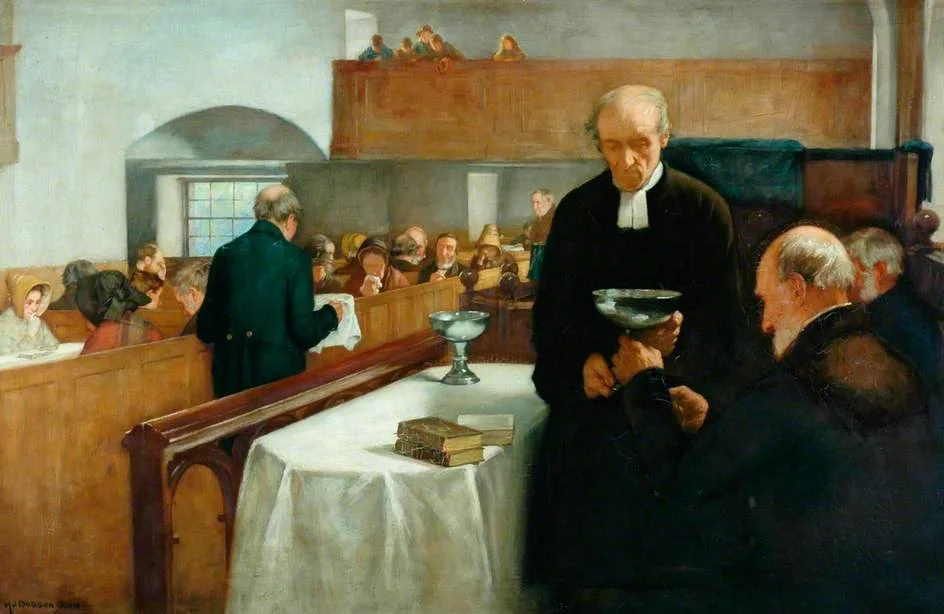
Communion
James Dodson
United Presbyterian Tracts, No. 21.
COMMUNION.
[by Dr. James G. Carson]
[Pittsburgh: United Presbyterian Board of Publication]
[1900]
We aim to establish the following proposition, viz:
“The Church should not extend communion in sealing ordinances to those, who refuse adherence to her profession or subjection to her government and discipline—or, who refuse to forsake a communion which is inconsistent with the profession that she makes.”
In treating of any controverted subject, it is important and even indispensable that we should carefully “distinguish between things which differ.” For want of this many mistakes and misapprehensions have occurred—and nowhere more frequently than on this subject of communion. There is no more common fallacy of reasoning than that which is styled in logic the “undistributed or ambiguous middle term” of argument—that is, applying what is admitted or proved in
[Page 2]
regard to a term or phrase taken in one sense, to the same term or phrase taken in a very different sense, without noting the transition from one meaning to the other. Thus in regard to this subject of communion, the failure to observe the distinction between the term fellowship when applied to the Church visible and when applied to the Church invisible, or, in other words, between Christian communion and Church communion, or ecclesiastical fellowship—has been the fruitful source of errors and mistakes, and the cause of much fruitless and even bitter controversy. Certain it is that the want of observing this distinction has exposed our Church and its position on this subject to much unmerited odium and reproach. We have been stigmatized as bigoted, narrow-minded, illiberal, exclusive, as unchurching and unchristianizing all other denominations and their members, because we refuse to admit them to our communion, or to join with them in the communion of the Lord’s Supper.
Now we propose to show that the principle which we have enunciated is one which every
[Page 3]
church deserving of the name is bound in consistency to carry out, and which is practically carried out almost universally by every particular church, and that the departures from it are only occasional and very rare, and hence manifestly exceptional. And
First. What is the communion here referred to?
Answer. It is not Christian communion, or the communion of Saints—for this is that fellowship which ought to exist and does exist among all Christians by virtue of their union to Christ, their common Head, by the indwelling of his Spirit, which cannot be interrupted by denominational distinctions or separations, by distance of time or place, and which can neither be limited or regulated by ecclesiastical law, but is regulated by Christ himself, who admits to or excludes from it, according to his own omniscience of the state and frame of the individual worshipper. Evidently the communion referred to in our article is not internal but external—not Christian, but Church fellowship—for
[Page 4]
this latter is the only subject of ecclesiastical regulation. But
Secondly. What is meant by the Church?
Answer. (1) Not the invisible Church, which is “composed of all the elect who have been, are, or shall be gathered into one, under Christ the Head,” whether in heaven or on earth; between whose members a constant, uninterrupted communion is maintained independent of all human organizations or regulations. But evidently
(2.) It is the visible Church which, in the language of our confession, “is composed of all those throughout the world that profess the true religion, together with their children.” Nor is it of that communion among the members of this visible Church which consists in their common observance of the same ordinances of worship or in the mutual interchange of the offices of love and beneficence as they have opportunity. This is the communion of which the Confession of Faith treats in chapter xxvi. sec. 2, and which it is there declared, and I suppose will be admitted by all, “should be extended, as God
[Page 5]
offereth opportunity, unto all those who in every place call upon the name of the Lord Jesus.” (See the passages of Scripture quoted in proof of this section.) There can therefore be no discrepancy between the Confession and this article of our testimony, because they relate to two entirely different subjects. For
Thirdly. It is to be observed that the communion referred to, relates to the visible Church in her present divided condition, and not to the Church Catholic, or Universal Church, as she is represented and contemplated in the New Testament, organically one in the profession of the truth, as she existed in her first organization, and as we believe she will ultimately exist during the Millennium. Whether this divided state of the Church is right or wrong, or whether any particular denomination has a right to exist as a separate organization, does not enter into the present inquiry. We have a right to assume, and we do assume in our proposition in reference to our own Church, that we are justified in maintaining an or-
[Page 6]
ganization separate from other branches of the true or Catholic Church of Christ—and so we suppose other denominations assume regarding their organizations. This question of communion is not peculiar to us as a denomination, but belongs to every denomination or separate Church to settle; and which, as we shall see, every Church does determine and regulate by principles and rules peculiar to itself as a distinct organization, as one in some respects independent of every other.
The communion, therefore, of which we speak, is that external fellowship in the observance of sealing ordinances, particularly the Lord’s Supper, which in the present divided state of the visible Church may be extended or withheld, according to the distinctive rules and regulations of each denomination.
This communion, our declaration states, should not be extended by the Church, by any Church, to two classes:
1. To those “who refuse adherence to her profession, or subjection to her government and discipline;” that is, who refuse to become members of the Church—those who are not members.
2. To those “who refuse to forsake a communion which is inconsistent with the profession which she makes;” that is, who are members of other churches from which
[Page 7]
she maintains a separation, in keeping up a distinct organization in the same place at the same time.
The first relates to the terms of admission to membership in the Church—the second, to the question of inter-communion or occasional communion between the members of different denominations—two very distinct and different questions, and yet closely connected—both being determined and settled on the same principles. Thus it appears that our proposition contemplates the present divided state of the Church as an existing fact, and simply declares what is the duty of any Church under these circumstances, if she would be faithful to and consistent with the principles of her own organization. The whole question goes back to and involves the right or duty of our branch of the Church to separate or continue separate from other branches which are regarded as Evangelical, that is, true Churches of Christ; if the latter can be justified, then the maintaining of a separate communion in the ordinance of the Lord’s Supper follows as a necessary consequence. The two statements in the declaration, therefore, though separate and distinct in themselves, become one in reality—the latter being included in the former—and so may be considered as one.
[Page 8]
The simple proposition then which we are called on to prove, is that the Church is bound to confine the communion in sealing ordinances to its members; which in the present divided state of the Church, requires each denomination, so long as it remains separate from other evangelical denominations, to restrict its communion to its own membership. This is the principle of restricted or close communion, as it is called, as maintained by our Church, and the whole of it. It will be seen that this principle differs materially from that of the Baptist Church, which in effect unchurches all other denominations by refusing to recognize their members as members of the Church of Christ. On the contrary, while recognizing other branches of the visible Church as true Churches of Christ, we yet claim the right, and even duty, of maintaining a separate organization in the same place and at the same time, and so of maintaining a separate communion.
BADGE OF MEMBERSHIP.
First. Because admission to sealing ordinance in any church is the distinctive badge of membership in that church. Now I suppose it will be admitted by all, that any rite or privilege which is the highest privilege
[Page 9]
and distinctive badge of membership in any society, ought to be restricted to the members of that society. If, therefore, admission to sealing ordinances, particularly the Lord’s Supper, be regarded as the distinctive privilege and badge of membership in the Church, then it follows that this privilege ought to be restricted to the members of the Church. That it is so regarded, appears from the all but universal practice of our voluntary Churches. In State Churches, it is true—or in places where Church and State are united—it is not possible for the Church to preserve this distinction between her own members and those who make no profession of religion; but even then the members of the parish are admitted to the communion table because they are regarded as members of the Church—the parish and the Church being co-extensive. In this country, however, where the Church is free to exercise its spiritual authority for the admission or exclusion of members, and among the Free Churches of Europe, the fact of admission to membership or exclusion from it, either permanently or temporarily, is indicated by admission to, or exclusion from, the Lord’s Supper. This is the well recognized distinction between the Church and the world—between those who simply attend church and
[Page 10]
the members—between adherents and communicants. When any are received into membership in any Church, they are recognized as such by admission to sealing ordinances; and when any are excluded or suspended from membership, they are thereby excluded from the Lord’s Supper—thus plainly showing that communion in this ordinance is regarded as the distinctive badge and highest privilege of membership in any Church, and ought to be and practically is extended only to those who profess adherence to the Church’s profession and subjection to her discipline—that is, to her members.
But further, this communion in sealing ordinances is not only a distinction between those who are and those who are not church members, but also between different denominations or churches. Hence it is a common thing to designate any particular branch of the church as a communion, referring evidently to the communion of the Lord’s Supper; as, for example, the Methodist communion, the Presbyterian communion. This recognizes the fact that the Lord’s Supper is not only a Christian ordinance, and as such common to all Christian churches, but also, in an important sense, an ecclesiastical or church ordinance, in which is exhibited not
[Page 11]
only the difference between the church and the world, but also between the different branches of the visible church itself. Each denomination claims and exercises the right of admitting to or excluding from it, according to its own particular rules of government and discipline, even while admitting that it is the Lord’s table; and all that we plead for is the impartial and consistent application of these rules of discipline to those outside, as well as to those inside of her pale; in other words, restricting her communion to her own members. Any other course than this, if followed out to any extent (which, thanks to men’s logic being stronger than their theories, it is not), would be subversive, not only of all discipline, but even of the church’s organization itself as a distinct denomination. For if a church does not apply her rules of discipline or admission to her communion in the Lord’s Supper to those outside of her own pale, then she ought not to apply those same rules to those within—to her own members. To do so is to make a discrimination against her own members, and in favor of members of other churches; and thus it might, and doubtless often does, occur in the practice of intercommunion or occasional communion, that persons are at one time excluded from the Lord’s table by the appli-
[Page 12]
cation of the rules of discipline of a particular church to them as members of that church, and, at another time, those same persons, or others like them, are invited and admitted to that communion, because they belong to another evangelical denomination—a most absurd inconsistency. For example, a church which disciplines its own members, or excludes them from its fellowship at the Lord’s table for rum-selling, slave-holding, or even promiscuous dancing, will cordially invite the same persons to her communion table when they are members of another church whose rules do not exclude these practices. As long, therefore, as churches maintain separate communions, administered according to each one’s distinctive rules, the only impartial and consistent course is that which we advocate, and which as a general rule is followed by almost all churches: to restrict communion in sealing ordinances to their own members. And if this is, and ought to be, the general rule, there is nothing either in reason or Scripture to justify an occasional departure from it, unless in cases where the circumstances are so extraordinary as to place them outside of all rules. We have hitherto been reasoning on the supposition that separate organizations involve separate communions, a suppo-
[Page 13]
sition which all practically, if they do not theoretically, admit. We say all, for the idea, sometimes broached and attempted to be carried into effect, of establishing a kind of universal church or communion, in which all evangelical denominations could unite while still retaining their separate organizations, is only the dream of a disordered imagination, or unionism run mad, and is not likely to meet with very general acceptance among right-thinking people. Thus we have shown that the communion of the Lord’s Supper is the highest privilege and the distinctive badge of membership in any church, by the acknowledgment and practice of all churches in admitting to or excluding from it according to each one’s own rules of discipline, and that the impartial and consistent carrying out of this principle would limit the communion in each church entirely, as it is now generally, to its own members.
COMMUNION IN A JOINT PROFESSION.
Secondly, the communion of the Lord’s Supper ought to be restricted by each church to its own members, because this communion includes in it a public, joint adherence to the same profession of faith, and subjection to the same rule of obedience on the part of
[Page 14]
those who unite in the observance of this ordinance—which can only be truthfully done by the members of the same church.
We have already seen that there is in this ordinance not only Christian communion, but also church fellowship. The former takes place only among believers—is founded on their union to Christ, and so partaking of the same body and blood (I Cor. x: 16) by the same faith, is invisible, and regulated only by Christ himself. The latter, and the one of which we speak, is that external, visible fellowship, which all who unite in the observance of this ordinance, whether true believers or not, have with each other in their joint profession of faith in Christ and obedience to him. All communion is founded on agreement. This joint profession must have some common standard of faith and duty, in which all are agreed or united. What is that standard? Does any one say it is the Word of God, which contains the doctrine and law of Christ to be believed and obeyed? Admitted. But the question arises, Is it that Word as interpreted by each individual, or as interpreted by the Church? If it is the private interpretation of each individual, then there is no communion, for there is no common standard of agreement. It must, therefore, be that public and authoritative inter-
[Page 15]
pretation of the Word of God by the Church in her standards and Book of Discipline which constitutes the bond of union among her members, and so the common standard of agreement. That visible fellowship or communion which the members of the Church have with each other in the ordinance of the Supper consists in and is measured by their agreement in the same public profession of their faith and subjection to the same rule of duty, which, as we have said, can only be the declared profession and discipline of the Church administering the ordinance. Hence this communion can only be extended by the Church to her own members—who only can consistently and honestly unite in this public profession. To extend it to “those who refuse adherence to her profession, or subjection to her discipline, or who refuse to forsake a communion which is inconsistent with that profession, would be so far to disturb that communion and make it impossible. The question is not whether there is agreement in their private views and feelings among those who sit down to the same table—for that is known only to God—but whether there is agreement in their public profession. If there is, and that public profession is the recognized profession or standard of the Church, then only those who can honestly
[Page 16]
join in that profession can consistently join in the observance of that ordinance which, as we have seen, is the badge of membership in any particular church or communion. As this is an important point, let us examine it a little more closely. The question arises, Is there, on the part of the members of the Church, a public profession of adherence to and agreement in the standards of the Church in the observance of the Lord’s Supper?—or is it simply a profession of the fact that they are Christians—believers in Christ—that is made in this ordinance? If it is only the latter, then all who are recognized as Christians are entitled to this privilege, and must be admitted and invited to participate in the observance of this ordinance whenever and wherever administered. This is the position taken by the advocates of Catholic communion. The plan is that this is the Lord’s table, to which all his children have a right because they are his children, and to refuse any one who is recognized as a Christian is to deny him that to which he has a right. It is confidently affirmed that the Church has no right to exclude any whom Christ himself admits to his table. This sounds specious, and is, in fact, the principal—we might almost say the only—argument in favor of Catholic as opposed to restricted
[Page 17]
communion. But when examined closely it will be found to have only the appearance of soundness. It can only be consistently maintained and carried out by confounding or denying the distinction between the visible and invisible Church—between Christian and Church communion—and is in fact maintained and carried out only by those who adopt what is called the Puritan theory of the Church. Here I shall quote from an author who elsewhere advocates open or Catholic communion, and therefore cannot be suspected of prejudice in favor of our position on this subject. I quote from Hodge’s Theology, vol. 3, page 543 and onward. The quotation is somewhat condensed, but presents his views fairly: “The answer to the question, What are the qualifications for adult baptism, or (what is the same) admission to the Lord’s table? resolves itself into the question, What are the qualifications for church membership? The answer to that question it is evident must be determined by the views taken of the nature and prerogatives of the Church. Now there are three generic views of the Church.
“The first is the Romish theory, derived from the ancient Theocracy, and from the analogy between the Church and a civil commonwealth, viz., that all born within its
[Page 18]
pale are ipso facto its members, and entitled to all its privileges, its sacraments and ordinances—not in virtue of their character, but in virtue of their birthright. This theory obtains not only in Catholic countries, but in all those countries in which Church and State are so united that the head of the State is also the head of the Church, and where membership in the Church is a condition of citizenship in the State. This is the case in Prussia, was the case for centuries in England, and is so to a great extent to this day. Every Englishman, unless he voluntarily makes himself an exception, has a right to all the services of the Church.” I suppose there are few in this country among the evangelical churches who would plead for admission to the Lord’s table according to this theory—allow the State to prescribe the qualifications for admission to this privilege of church membership. But
2. “The second general theory of the nature of the Church is that which for convenience sake may be called the Puritan”—which prevails among the Independents and Congregationalists. “According to them the visible Church consists of the regenerate, and it is the duty and prerogative of the Church to sit in judgment on the question whether the applicant for admission to the
[Page 19]
sacraments is truly born of God.” In reference to this theory Dr. Hodge justly remarks, that “as Christ has not given his people the power to search the heart, he has not imposed upon them the duty which implies the possession of any such power.” Therefore, he adopts the third, or what he calls the common Protestant theory, which is expressed in the Westminster Standards, and which we have already quoted, viz.: “That the visible Church consists of all those who profess the true religion, together with their children,” and on it makes this remark: “The common Protestant doctrine is that nothing authorizes us to refuse a man admission to the Church which would not justify his exclusion if already a member of it.” And the difference between this theory and what is called the Puritan theory, is just the difference between Catholic and restricted communion. In the language of Dr. Hodge: “According to the one view the Church is bound to be satisfied in its judgment that the applicant is truly regenerate. According to the other, no such judgment is expressed or implied in receiving any one into the fellowship of the church”—that is to the sacrament or communion of the Lord’s Supper. Now, if this be the true theory of the Church, as we believe it is, and if it be true that “as
[Page 20]
Christ has not given his people the power to search the heart, he has not imposed upon them the duty which implies the possession of any such power,” and if it be so that in receiving an applicant to the fellowship of the Church in the Lord’s Supper no judgment is expressed or implied in regard to his being “truly regenerate,” (that is a true Christian); then it follows that the church cannot admit to or exclude from its privileges on the ground of a man’s state as regenerate or unregenerate, but only on the ground of his external character and profession, of which alone she is competent to judge. It is true, there is an important sense in which none but Christians, the truly regenerate, have a right to the Lord’s table, and that all God’s children, in this sense, have that right. But it is a right in foro Dei—in the presence or judgment of God—which Christ alone can decide, and which he does decide. This is a matter of which the individual himself is the sole judge at the bar of conscience, and all that the Church can do is to press the injunction of the apostle on all applicants for this privilege. Let a man examine himself, and so let him eat of this bread, and leave the responsibility of deciding with the individual. For the Church to decide that a man is a Christian, and so ad-
[Page 21]
mit him to the Lord’s table, implies the power to decide that he is not, and so exclude him, which is contrary to the express prohibition of Christ in the parable of the tares, and also to his own example in admitting Judas to all the privileges of the other disciples as long as his outward character and conduct was consistent with his profession. That which the Church, therefore, can judge and determine respecting those whom she receives to her communion, and the only thing which she can determine, is competency of knowledge, soundness of profession, and correctness of character and walk, which go to make up a credible outward profession of faith in Christ and obedience to him. And, as we have already seen, the only standard by which this judgment can be made, is the Word of God as she understands and interprets its teachings in her standards of doctrine, worship and discipline. The conclusion, therefore, follows, by an irresistible inference, that those who sit down to the same table in any church do unite in a professed agreement in the public profession of that church as agreeable to and founded on the Word of God so far as they have attained to the knowledge of that word, and that the Church not only has a right, but is bound to limit this privilege to those who adhere to
[Page 22]
her profession and are subject to her discipline, or to her own members. In affirming this we do not claim that all who are warrantably admitted to the Lord’s table, or to the privilege of church membership, have an intelligent understanding and belief of all the principles of the Church’s profession: for many, perhaps the most of them, especially when first admitted, may be but weak in the faith and knowledge of the Gospel. But so far as they know and understand the principles of the Word of God they are agreed in the profession of their faith and do not reject or oppose any of the principles of the Church’s profession. There is a great difference between those who are weak in the faith and those who determinedly oppose the principles of the Church’s profession, or who refuse to forsake a communion that is inconsistent with that profession. The one we are to receive, the other we cannot and ought not to admit to our fellowship.
Thus then it appears, that in the Lord’s Supper as administered by any particular Church, besides the Christian communion, which is enjoyed by them as believers, there is an external, visible fellowship on the part of all those who join in its observance as a church ordinance, which consists in their agreement in a common public profession, which can be
[Page 23]
no other than that profession which the Church makes as a distinct organization separate from other branches of the Church. It follows, therefore, that this communion can only be extended to its own members, because they only can truthfully and consistently join in this public profession. But it is in the
CHARACTER OF THE CHURCH AS A WITNESS
that all the arguments for restricted communion meet and terminate. It is only when this distinctive characteristic and consequent obligation of the visible Church as a witness for the truth is lost sight of or ignored, that the plea for Catholic or occasional communion acquires any force or plausibility.
3. We argue, therefore, that communion in sealing ordinances ought to be restricted by the Church to its own members, because in no other way can she be faithful to her obligation as a witness for the truth of Christ.
That this character belongs not only to individual Christians who are called martyrs or witnesses, but to the Church as one organized body, will, I suppose, scarcely be denied.
That this is the main distinctive object and design of the organization of the visible
[Page 24]
Church appears from the name given to her in the singular number, “the light of the world,” “the pillar and ground of the truth.” For it is by holding up, and “holding forth the word of life,” as a witness for the truth of God in her public profession or testimony, that she acts as the light of the world—as the pillar and ground of the truth. The same thing appears from the character given the disciples of Christ as soldiers, whose duty it is to “fight the good fight of faith,” to “war a good warfare,” to “contend earnestly for the faith once delivered to the saints.”
There is a great battle going on in the world between truth and error—between right and wrong—between the kingdom of Christ and the kingdom of Satan; and in this conflict, Christ, as her Divine Head and Leader, employs his Church in her visible organization as his army for overthrowing the kingdom of Satan, and establishing his kingdom in the earth. The weapons of this warfare are not carnal, but spiritual, the truth of God, which is “mighty through God to the pulling down of the strongholds of error” and sin, and the establishment of “righteousness and peace and joy in the Holy Ghost,” in the hearts of men and so in society. This weapon she wields in her organized capacity as a witness, not only for the preservation
[Page 25]
but also the propagation of the truth by her public testimony in its behalf and against the contrary error and sin. And so it is said of these martyrs or witnesses, that “they overcame by the blood of the Lamb and the word of their testimony”—that public joint testimony in which they all united, and which they sealed with their blood, not “loving their lives unto the death.” But this point is so plain we need not dwell upon it. The only question is, how far does the obligation extend? To what extent is the Church to bear witness to the truth? To this I think only one answer can be given—
1. In general, to the whole truth as she attains to the knowledge of it. The commission given to the Church runs in these words, “Go, disciple all nations, teaching them to observe all things whatsoever I have commanded you.” There are those who maintain that the Church’s testimony should be limited to those fundamental articles of faith and principles of duty which are essential to salvation, in which, therefore, all Christians can unite. But it is evident that the obligation of this duty of the Church must be co-extensive with the reason and ground of it. This reason or ground is the divine authority which extends equally to all things whatsoever he has commanded to be received and
[Page 26]
observed—to the least as well as the greatest. So says Christ, Matt. v. 19, “Whosoever therefore”—and this applies to the Church as well as to individuals—“shall break one of these least commandments and shall teach men so, he shall be called least in the kingdom of heaven; but whosoever shall do and teach them”—that is the least as well as the greatest—“he shall be called great,” etc. Let it be remembered that it is not the importance of any principle to the salvation of the soul, which constitutes the reason or measures the force of the obligation of a witness in bearing testimony, but simply that it is a part of the truth or law of Christ on which his authority is stamped, and which is recognized by the Church as a part of that truth or law. Every principle of God’s Word may not be equally important to be known and believed in order to salvation; but we may safely affirm that every principle of that Word, when known and acknowledged to be of divine authority, is of equal importance to the integrity of the system and to the honor of Christ, and therefore of equal obligation to be received and maintained by the Church. Indeed, those truths and principles, which in themselves are regarded as of minor importance, may by the circumstances of the Church become the prominent
[Page 27]
and pre-eminent ones in her testimony. Which leads me to remark
2. That the Church is to be a witness especially for the present truth—that is the truth which is now opposed and denied, and which becomes, therefore, in an eminent sense, the “word of Christ’s patience.” The most important point for the time to be maintained and defended, is the point attacked. The most important part of a witness’ testimony is that which bears upon the point at issue, so the most prominent part of the testimony of the Church or any particular church for the time, is that part of the divine truth or law which is at present assailed or denied—and the greater and more extensive the opposition, the greater is the obligation of Christ’s witnesses to be faithful to him and his cause in that particular. Matters of doubtful disputation ought not to be admitted into the Church’s testimony; for, these being matters of indifference which are not clearly revealed in the Word of God, or mere matters of opinion and human authority, do not involve the authority of Christ or the honor of his name. But whenever a principle is acknowledged by the Church to be a truth of Christ, or an evil exists which is admitted to be a violation of his law as she understands it, then the fact that the one is denied
[Page 28]
and the other defended, even by men and churches sound and right in other things, does not render those points matters of “doubtful disputation”—to be dropped out of sight and eliminated from the testimony of the Church—but as every one can see, renders the obligation to maintain and defend the truth and oppose error and evil more imperative on those who would be faithful to and “stand up for” Jesus. So our fathers in Scotland and England regarded the matter in the 17th century when they refused to conform in what might be regarded as points of minor importance respecting church government, but suffered the loss of station and property, and even life itself, rather than compromise the rights of Christ’s crown and covenant. And who will say that they were not justified in their course, even though the points involved are still matters of dispute among Christian men and churches? The fact is that this principle is so well recognized by all the churches of the Reformation, that it has found practical expression in, and given ground or occasion for most, if not all, the denominational divisions which at present exist in the Protestant Church. Which leads me to remark
3. That the only way by which the Church, or any particular church, can maintain a
[Page 29]
faithful and consistent testimony in behalf of any truth or law of Christ, is by making it a term of communion. As already intimated, many, if not most, of the present divisions among Protestant evangelical churches—just as the Protestant Church itself—originated in the felt obligation resting on those who wished to be faithful as witnesses for Christ, to separate from those, who, though they were recognized as belonging to the true Church of Christ, yet had corrupted or perverted the truth of God in doctrine or worship. The very design, therefore, of their organization as a distinct and separate branch of the Church of Christ, and so maintaining a separate communion, was as faithful witnesses to preserve and maintain the principles of truth and duty thus denied. On this principle have acted dissenters of all kinds, whether Baptists, Methodists or Presbyterians; and this, their felt obligation to be faithful as witnesses for the truth and law of Christ, is the only thing which warrants or justifies such separation and its continuance, without which they would be self-condemned as schismatics. Now in order to carry out the design of their separate organization, and to justify their position and their right to exist as a distinct branch of the Church of Christ, each of these bodies finds it necessary to
[Page 30]
set forth the principles of their organization in a public testimony and rules of order and discipline in which they are embodied. In this public profession all the members of the church is supposed to unite, as it is the testimony of the church as a body—composed of the private members as well as the officers.
Now, we ask: How can a church, thus separated from others by the very design of its organization, and claiming that it not only has a right to exist, but is bound to maintain its separation for a distinct and definite purpose—how, we ask, can it make that purpose effective, or carry out its design as a faithful, consistent witness for its peculiar distinctive principles, without making those principles terms of communion, or, in other words, requiring those whom she admits to the highest privilege of membership to adhere to her profession and to be subject to her discipline? It may be affirmed without fear of successful contradiction, that when a church ceases to make any article of her profession a term of communion, she thereby ceases to be a witness for that principle. In word she may hold to it, as some churches before the rebellion held to the evil of slavery, but by admitting slaveholders and their apologists to their communion they
[Page 31]
practically contradicted and denied those public utterances, and made them a dead letter—for this simple reason, that actions speak louder than words. The churches of Asia were rebuked, not for any unsoundness of profession, but because they had among them—allowed in their communion—those who held and taught doctrines and practices contrary to the principles of their profession. It was found necessary by those who would not be partakers of the sin of slavery to separate from the communion of the Presbyterian Church and form an organization styled the Free Church. Now, what would have been the value of their professions of sincerity if they had still admitted slaveholders and those who abetted the evil to their communion? What value has the testimony of any Church against intemperance and in favor of temperance which allows rum sellers and rum drinkers in her communion, whether they are her own members or members of other evangelical churches? What would be the value of our testimony against secret societies if their members were not excluded from our communion? The Church is not responsible for the private heresies or sins of those admitted to her communion, but when any one is known to hold and maintain principles and
[Page 32]
practices contrary to the Word of God, according to her profession, whether he be an officer or private member, she becomes the partaker of his error or sin, and is unfaithful to her own profession when she allows, and as long as she allows, him in her communion at the Lord’s table. Now, supposing he be cut off and excluded from her fellowship and goes and joins another branch of the Church which, as a body, holds and maintains the same doctrines and practices, does the fact of his becoming a member in good standing in another Church change the character and effect of admitting him again to her communion, and make it different from what it was when he was one of her own members? Every one can see the inconsistency of such a course. The only way, therefore, by which a Church can make her testimony for the truth of her profession practically effective is by excluding from her communion those who, whether as individuals or as members of other churches, are engaged in a stated and determined opposition to any of the principles of that profession. The practice of discriminate or occasional inter-communion tends to break down all discipline and thus nullify the effectiveness of the Church’s testimony for the truth and right, and against error and wrong. We
[Page 33]
conclude, therefore, as we begin, that “the Church should not extend communion in sealing ordinances to those who refuse adherence to her profession or subjection to her government and discipline, or who refuse to forsake a communion which is inconsistent with the profession which she makes.”
OBJECTIONS.
It may be asked, Are there no exceptions to this rule—no cases when a session may admit one who is not a member of the Church, or who is a member of another Church?
We answer that no Church can make provision for exceptions, either in her testimony or rules of discipline, without constituting those exceptions into a rule. The very fact that they are exceptional cases, places them outside of all rules—and each case must be decided on its own merits. When, therefore, a session in the exercise of that discretion which belongs to all courts in the application of the law of the Church decides that any particular case is extraordinary and exceptional, it thereby decides that it is outside of the rule, and so one to which the law is not applicable. But no session or any other court, not even the General Assembly, has rightful power or discretion to admit a case
[Page 34]
which violates or is inconsistent with the plain meaning of the organic law or rule of the Church. This would be a virtual repeal or nullification of the law. Such we believe to be the true and obvious meaning of the deliverance of the General Assembly at Argyle in 1868, which is so often quoted as releasing the stringency of this article of the testimony.
Again, it is objected that in heaven we will be all one, and commune together there: and why not here? We answer, it is just because we are not come to heaven, and we are not one in our views and beliefs, which renders the present separation or division of churches necessary.
If the Church were what it ought to be and what it eventually will be, organically one even here on earth, then we could, as we will one day, all sit down together in the kingdom of God. It is the present divided condition of the Church which renders this separate communion necessary.
Other objections might be noticed, but they have either been answered in the foregoing discussion, or are such as may be easily disposed of by the application of the principles there laid down.
We have thus attempted the vindication in this article of our testimony—not by appeal-
[Page 35]
ing to personal or partisan considerations, or by denunciations of other individuals or churches, but by an appeal to principles which are universally recognized and accepted as applicable to all churches, assuming that they are justified in maintaining their separate organizations. And we humbly and respectfully submit these considerations to the candid and impartial judgment of our brethren in our own Church and in other churches who are concerned to know what faithfulness to the cause and truth of our common Master requires at our hands—whether as individuals or as churches. May the Lord himself own his truth, and pardon and overrule our errors and mistakes; and to his name shall be the praise.
[Publisher Page.]
UNITED PRESBYTERIAN BOARD OF PUBLICATION,
55 NINTH ST., PITTSBURGH.