Doctrines of Grace
James Dodson
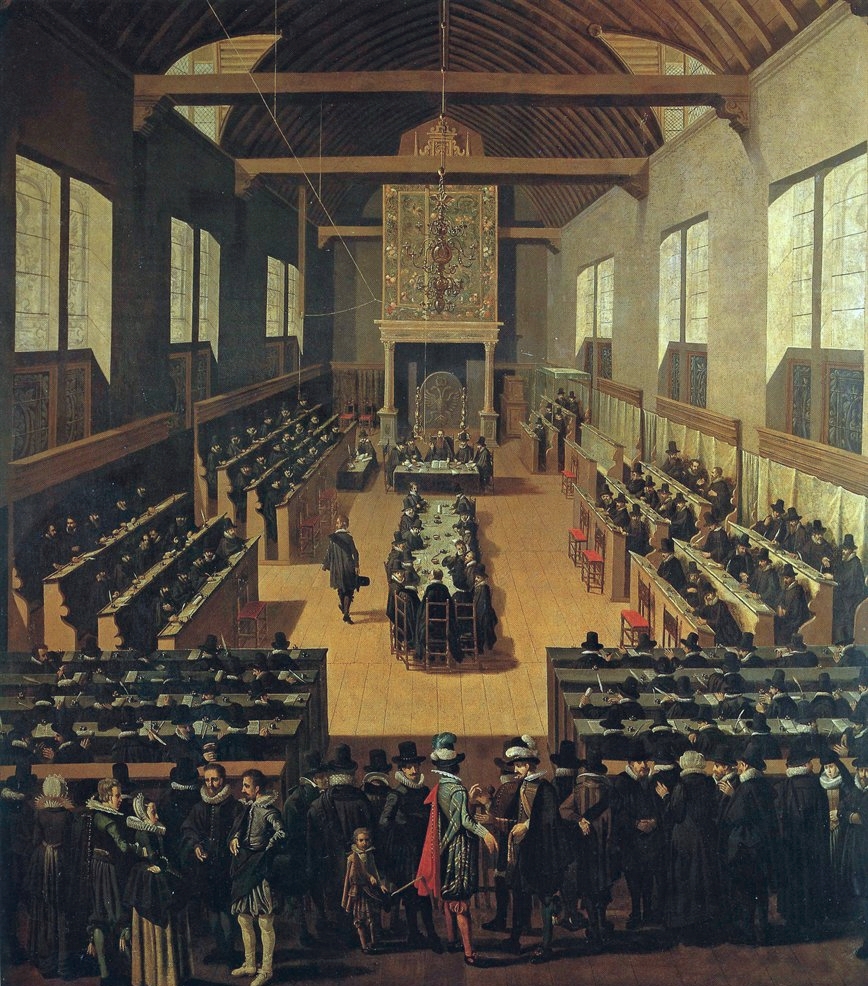
The Synod of Dort, from whence come the Canons of Dort defending the five controverted points against the Arminians.
THE DOCTRINES OF GRACE HOMEPAGE.
“The grace of God is the undeserved favour of God, or it is that whereby God favoureth his creature without any desert of his. The Apostle doth intimate this much, Ephes. i.9, in that he putteth no difference between these words, grace and a good pleasure; for whereas he saith in that verse, that God hath elected us according to his free grace, it seems to be spoken in the same sense and meaning with that with which he said before in that same chapter, ver. 7, In him we have redemption according to the riches of his grace.”—Robert Rollock, A Treatise of God’s Effectual Calling. (1603).
Works on the Doctrines of Grace:
The Bondage of the Will.-1525-Martin Luther.-This is one of Luther’s most important works. It demolishes the counter claims of Erasmus and sets forth the true state into which man has fallen out of which he cannot draw himself because his will is captive to the world, the flesh and the devil. It presents a very strong view of predestination.
Of the True, Real, and Safe Grounds of Encouragement to Believe in Jesus Christ; or, Upon What Warrants a Sinner May Adventure to Rest and Rely Upon Christ for Salvation.-1649-George Gillespie.-A short but very important essay by Gillespie on the nature and extent of the atonement. In it, he shows that the notion that the atonement was of universal scope is destructive to the Gospel and the undermines the exercise of true saving faith.
The Sum of Saving Knowledge:-1650-David Dickson and James Durham.-This is a compendium of theology set in a practical format for the instruction and use by the people of the Church of Scotland. It contains a very full account of covenant theology together with application.
A Letter on Psalmody. Shewing, that Human Composures Ought Not to be Used in Christian-Worship, in Singing the Praises of God.-1790-Robert Jack.-This 1790 Philadelphia pamphlet by Robert Jack comprises three distinct theological treatises: a polemical “Letter on Psalmody” defending the exclusive use of the biblical Psalms in public worship against human compositions (particularly the paraphrases of Isaac Watts); a substantial lecture exposition on Jesus as “the Mediator of the new Covenant” (Hebrews 12:24), delineating the Covenant of Works, the Sinaitic Covenant, and the Covenant of Grace; and a brief practical discourse describing the Christian grace of hope as a theological virtue accompanying salvation.
Memoirs of the Life of John Howie: Who Lived in Lochgoin, Parish of Fenwick, and died January 5th, 1793. Containing a Series of Religious Exercises, Soul Soliloquies, Meditations, and an Account of the Lord’s Goodness to him in general.-1796-John Howie.-This spiritual autobiography chronicles the intense religious exercises, physical afflictions, and profound inner turmoil of John Howie of Lochgoin during the final years of his life. Howie meticulously records his struggles with “predominate evils,” his fear of death, and his oscillations between spiritual despair and the comforting application of specific scripture promises—such as Micah 7:18-19 and Mark 2:5—culminating in a solemn covenant renewal in 1792. Throughout his narrative, he reflects on the duties of prayer, praise, and testimony-bearing, lamenting the widespread defection and deadness of the contemporary church while adhering to the strict principles of the Covenanted Reformation. The volume is supplemented by the dying testimony and persecution narrative of his great-grandfather, James Howie, which connects John’s personal piety to the family’s legacy of suffering during the “Killing Times,” and concludes with a list of subscribers who funded the publication.
A Dialogue Concerning the Atonement, Between a Calvinist and a Hopkinsian;-1803-William Gibson.-This dialogue was written as a defence of his earlier published sermon against the doctrine of Hopkinsianism. In it, he assails the Hopkinsian minister Leonard Worcester, especially challenging him with respect to his doctrine of the atonement. The result is a very good discussion of the Reformed doctrine of limited atonement.
The Doctrine of the Atonement.-1810-Alexander M'Leod.-This series of articles appeared in The Christian's Magazine. M’Leod gives a very good explanation of the orthodox doctrine of the atonement together with a defense of limited atonement, or particular redemption. This was written in the midst of the Hopkinsian controversy and presents a soundly Calvinistic view.
Historical Sketch, &c.-1817-James Renwick Willson.-An informative, if uneven, treatment of the history of the doctrine of the atonement. This portion of the book contains Willson’s historical insights together with a wealth of information about numerous early American Reformed and Presbyterian bodies complete with an outline of their controversies.
Review of Gardiner Spring on Election.-1817-Alexander McLeod.-In this review, McLeod demonstrates the confusion of Spring’s thought on the matter of election. This muddled thinking is the result of Gardiner Spring’s closeted reception of Hopkinsian views which distort Calvinism into a strange form of Arminianized supralapsarianism.
Review of Two Pamphlets Related to the Hopkinsian Controversy.-1817-Alexander McLeod.-In this review, McLeod takes on the various errors of Hopkinsianism more directly and begins to expose their errant Calvinism. It is regrettable that their pretensions to supralapsarianism made 19th century Calvinists of the high Calvinism of the earlier Reformers. Nonetheless, Hopkinsian views of the atonement smack of hypothetical redemption.
Review of a Defense of Hopkinsianism in the Presbyterian Church.-1817-Alexander McLeod.-Choosing to interact with a book by Matthew La Rue Perrine, a Presbyterian pastor, in New York, McLeod discovers some of the worst reasoning and pernicious errors presented as old Presbyterian doctrine in new dress. What he has found is Hopkinsianism, an error that advocates a perverted form of supralapsarianism and weds it to a view akin to the heresy of hypothetical redemption.
The Grace of the Abrahamic Covenant.-1818-James Milligan.-In this chapter, Milligan mounts a defense of the Abrahamic covenant as an administration of the Covenant of Grace. This, too, is a weakness in Anabaptist theology. Once it is understood that Abraham was taken into the same Covenant of Grace as is revealed in the New Testament, it becomes easy to see how it contains instruction for Christians today.
Remarks on the Duration of Future Punishment.-1821-Samuel Brown Wylie.-In this series of articles, Wylie explains why there is no injustice in God for punishing what seem to be finite sins with an infinite duration. He reminds his readers that all sin is against an infinite God and His infinite majesty. There is, in this discussion, an excellent discuss of what makes the same physical action in one case virtuous and in another vice. Wylie moves from related topic to related topic, discussing particular redemption in some detail, including examining texts usually asserted to teach universal redemption. He ends with an instructive discussion of the nature of the Mediatorial reign of Christ and a philological assault on Universalism.
Remarks on the Providence of God.-1822-Alexander McLeod.-In this article, McLeod explores the doctrine of providence and he does so with an eye to discussing the place of evil and sin in the providential government of God. His concern is to preserve the doctrine of an all pervading providence while explaining why God is neither the author nor approver of the sinfulness of men.
Argument on the Arminian Controversy. [Published in Overture.]-1836-Reformed Presbyterian Church, in America.-This Overture, prepared by Rev. Moses Roney, a member of the Synod, presents an excellent overview of the Arminian controversy in its history and doctrine. It presents a vigorous defense of Calvinism following the order of the “five points” as discussed at Dort. His discussion on the Arminian assertion of “common grace” is particularly helpful.
Lutheranism and Calvinism.-1844-Jean-Henri Merle D’Aubigne (1794-1872).-In this essay, D’Aubigne examines the peculiar principles of both the Lutheran and Reformed Reformations. He has many helpful insights and explains why the Reformed should be respectful toward Lutheranism without losing its own excellence.
Use of the Doctrine of Election.-1851-James W. Shaw.-An interesting article designed to help the reader understand why the doctrine of election is useful. It a doctrine which, when properly improved, is one of comfort and assurance for the believer.