Reid A Cameronian Apostle I.
James Dodson
A CAMERONIAN APOSTLE.
CHAPTER I.
1669–1700.
SETTING SAIL.
Reasons for present work—Birth at Barncauchlaw, 1669—Glenhead Confession of Faith—Minnigaff Records and Tombstones—Boyhood and Youth—College Days—Relations to United Societies at College—Reasons for entering the State Church—Divinity Studies—His Scholarship and Piety.
I PROPOSE, in this volume, to give as full an account as the documents within my reach permit, of the life of John Macmillan. Although few, comparatively, know or care much about the subject, there are more reasons than one for undertaking this task.
For one thing, no attempt at a complete life of this remarkable man has, so far as I know, ever been made, if we except the brief sketch by Mr. Thomson of Hightae in the Reformed Presbyterian Magazine.* This account of Macmillan is characteristically accurate, but it does not go into minute detail. Mr. Thomson’s investigations are embodied in the present work, while a considerable mass of additional matter has been
_____
* See the volumes for 1869 and 1870.
10 A Cameronian Apostle.
obtained. The notices of Macmillan in works on Scottish Church History are very meagre. In Cunningham, for instance, he has hardly more than one short paragraph allotted to him.* And this contains simply a discreditable piece of gossip. In these circumstances, and considering the renewed interest taken at present in questions of Church government and establishment, there seemed to be some room for a detailed treatment of a career which covers so interesting a period as that embraced between 1690 and 1750.
Again, the personality and position of Macmillan seem worthy of some degree of consideration. He was, undoubtedly, a man of unusual force and determination. He was the first of that group of stalwart Scotsmen, of whom it has been well said:—“The Macmillans, the Fairleys, the Thorburns, the Hendersons, the Rowatts, the Symingtons, the Goolds, were not little men. Most of them were men of stature, men of presence, even corporeally, and all preachers of the gospel and witnesses of the truth. They were men who would have adorned and enriched any Church in the world.”† For many years he fought the battle of the Covenants alone, and he fought it on lines of policy and wisdom. I have tried to indicate his position among the “Suffering Remnant” by calling him “a Cameronian Apostle”; for, during the long period of thirty-six years, he was the sole ordained minister among the scattered congregations of the “Society” people. The name seems not unfitting, and it receives a certain sanction from the authority of Dr. Cunningham, who styles him the “high-priest” of the Societies. Such a designation could only be given to one who held a very important position among his followers. On this ground, therefore, he deserves a memorial.
_____
* Cunningham’s Ch. Hist., ii., 228; Fasti, ii., under Balmaghie.
† Rev. J. M‘Dermid, 1875.
Setting Sail. 11
Further, Macmillan’s story is also the record of the development of a most interesting side of Scottish Church life. He may be said, indeed, to have made the history of what, at last, became the Reformed Presbyterian Church. This is so true, that that Church long bore the popular name of the “Macmillanites.” And the name of Macmillan is bound up with more than one congregation still existing.*
It may be added, that as one born and bred in the province of Galloway, in fact, a true “Galloway man,” Macmillan has a special interest for the large class of readers who now relish and seek after Galloway lore. Also, the writer of this volume humbly conceives that, as an unworthy successor in the cure of Balmaghie, he has some degree of official function in his present undertaking. At all events, he is laying his stone upon the memorial cairn of one who, whatever his faults may have been, was once the idol of the whole parish, and whose memory is even yet green around and within the parish church.
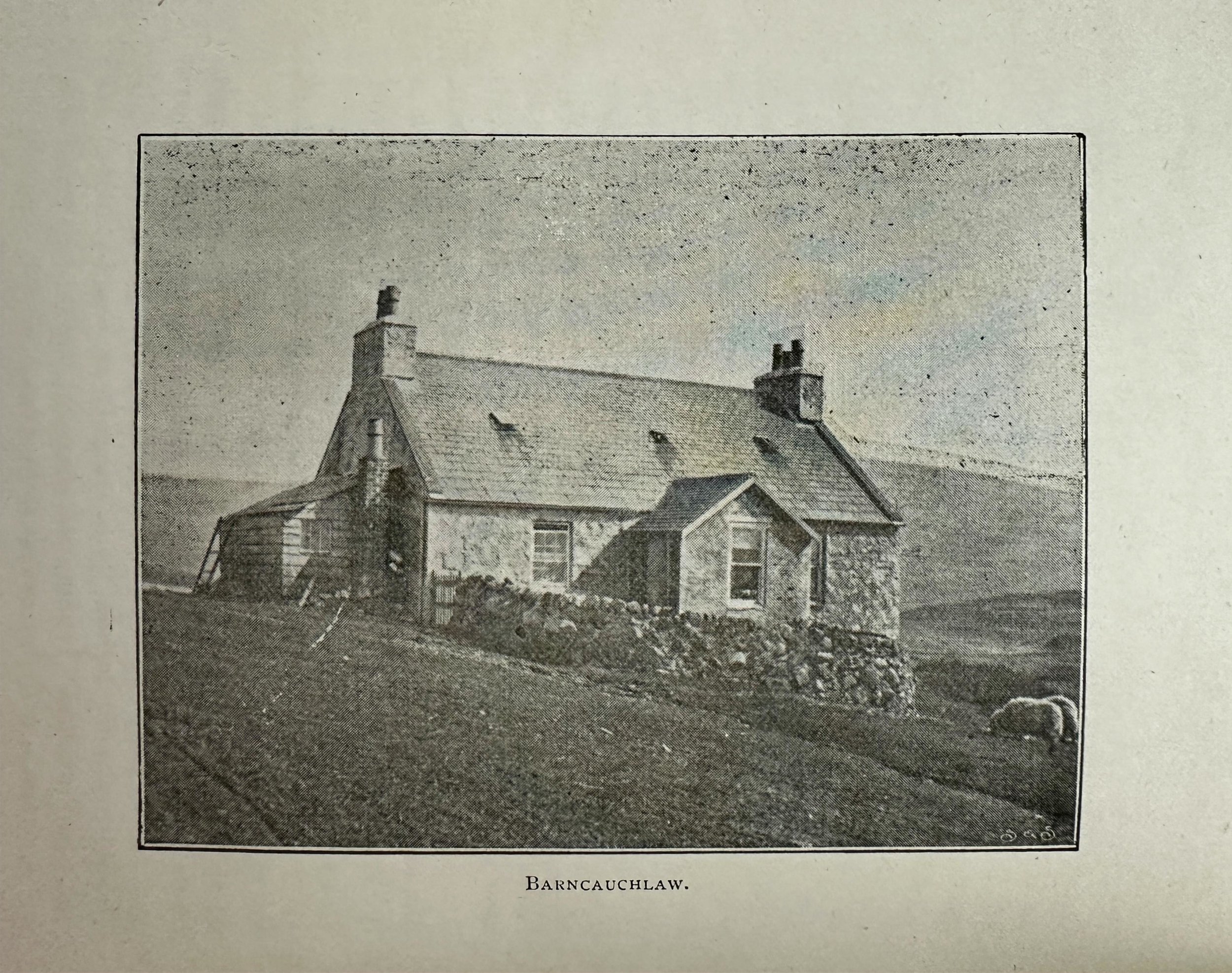
The received statement as to Macmillan’s birth is that it took place at Barncauchlaw, a solitary hill-farm in the parish of Minnigaff, Kirkcudbrightshire, in the year 1669. This was the year in which the “Assertory Act” of Charles II. was passed, declaring the King’s “supremacy over all persons and in all causes ecclesiastical”: the first Act repealed at the Revolution. The old house of Barncauchlaw is still standing, although it has been much added to. It lies about four miles from Newton-Stewart, and 4½ miles further on is the tall column which commemorates the learning and genius of Murray. The visitor reaches the little steading by a steep pathway up the hillside, and on arriving at the summit he finds himself confronting a vast expanse of mountain scenery. Hill after hill rolls away
_____
* e.g., Macmillan Church, Castle-Douglas; Great Hamilton Street Church, Glasgow.
12 A Cameronian Apostle.
toward the horizon. The prospect on a summer day is full of a peaceful charm. In the dead of winter it is distinctly sublime, but at the same time somewhat appalling. In the winter of 1895, these mountainous wilds were wrapped for weeks in snow. An idea of the scene may be gathered from the homely fact, that 4000 sheep encamped close to the farmhouse, driven down from their high pasture-lands by the tremendous drifts. Sheep-farming has been the industry pursued all around from time immemorial. The farmer often does not know the exact acreage of these wild lands, or even the exact number of his sheep. Barncauchlaw is only one among many lonely steadings dotting the landscape. In most of these there have been, or are, families of the name of Macmillan.* There are Macmillans at Palgown and Glenhead still, and there used to be Macmillans in Dallas. Curiously enough, there is no recoverable tradition that there were Macmillans in Barncauchlaw, where the birth of the Reformed Presbyterian Father is generally located.
Entering the farm kitchen, one sees the old interior, very little altered in 200 years. The wide ingle-neuk still remains, though the great oaken beam overhead was removed some years ago. Within this warm corner the little fellow doubtless sat at evening time, when his father conducted the unfailing worship. In another part of the old house a small chamber may be seen, where possibly he first saw the light. From the little narrow window there is a glorious view of the hills. Till quite lately, there were Cameronians living here, and the lamented Mr. Goold of Newton-Stewart paid regular pastoral visits. Now, the inmates wend their way to the parish church of Minnigaff.
_____
* Nicholson (Book of the War Committee, p. 74,) says:—“. . . at one time M‘Millan was the predominant name in nearly all the upper district of the Stewartry.” The name is common in Newton-Stewart among families and on public buildings, such as the Macmillan Hall.
Setting Sail. 13
There is a remarkable lack of authorities, near the time, for the usual account of Macmillan’s birth. The first time the statement appears in print, so far as I can find, is in the Scots Magazine of 1753, the year of Macmillan’s death. Apparently it has been faithfully copied by succeeding writers, such as J. H. Thomson and Mr. Hutchison. While accepting the usual date and place, I think it right to mention that, as to the place, there is evidence of a different impression among Macmillan’s own contemporaries. In the preface to the Presbytery’s Examination, printed in 1705, the following curious passage occurs:—
“When this man was under trials before the Presbytery, though the brethren knew that since he had been a boy he was a separatist, till that some years preceding that time, he broke off therefrom, and attended on the public ordinances; yet they knew not that he had ever been so bigot a separatist as indeed he was; the brother, in whose parish he was born, and lived when a separatist, who is now again a member of the Presbytery of Kirkcudbright, having been then a member of the Presbytery of Wigtown, by the annexing of his parish thereto. . . .”
The statement here is valuable, coming so near the actual time. It fixes the place of birth in some parish which had been recently re-annexed to the Kirkcudbright Presbytery. In the Records of that Presbytery, which begin in 1700, it is minuted on March 18, 1701, that Kells had been re-annexed. Macmillan was licensed to preach on November 26, 1700, when, of course, the minister of Kells was not a member of the Presbytery. The impression among the members was, that he had been born and brought up in Kells within the knowledge of Andrew Ewart, who was ordained there in 1692 at the age of 31.* At that date, if born in 1669, Macmillan would be 23 years old, and
_____
* Fasti, ii.: Synod Records.
14 A Cameronian Apostle.
could scarcely be said to have been a “boy.” At his license he would be 31 years old.
Kells is the next parish to Minnigaff, and possibly the passage above quoted is reconcilable with the Barncauchlaw tradition, if we suppose that Macmillan, though born in Minnigaff, had early removed to Kells and been employed there on some farm. We may conjecture that at the Revolution he “broke off” and attended Kells church, so that he came within the intimate knowledge of Mr. Ewart.
The minute of Presbytery, August 20, 1700, when his trials for license began, says:—
“Mr. John Macmillan, . . . having lived in the bounds from his nativity, except the time of his being at the college, . . . being well known and of good report among the brethren and in the bounds . . .”
At this date, Kells does not appear in the sederunts; but “the bounds” may refer to the Synod of Galloway’s bounds, or it may be a natural slip, as Kells had formerly been in the Presbytery’s bounds. But Minnigaff never was.
On the whole, these passages seem to suggest, at the least, that Macmillan had spent his boyhood and early years in the parish of Kells, although perhaps born in the neighbouring parish, Minnigaff.*
In visiting the farm of Glenhead, in Minnigaff, I found a very old copy of the Confession of Faith in the possession of the tenant, Mr. John Macmillan.† It is probably the original print. On a fly-leaf are written several names, by way of family
_____
* This is Mr. Thomson of Hightae’s view, Ref. Presby. Mag., 1869, p. 306.
† See, for a genial reference to this gentleman, Mr. Crockett’s characteristic preface to Men of the Moss-hags, 1895.
Setting Sail. 15
register, subscribed by Alexander Macmillan, 27th December, 1732. I copy these names, so far as legible:—
[Part torn or burned] — born 1664.
John M‘Millan, — „ 1682.
James M‘Millan, — „ 1692.
Mary M‘Millan, — „ 1715.
On another leaf is a note, as follows:—
“James M‘Millan aught this book,
God give him grace thereon to look;
And I grant it may be restored to my son John M‘Millan at my death; as witnesseth my hand the 12 of February, 1732.
“JAMES M‘MILLAN.”
If the John of this volume was the future minister, his birth took place in 1682; and at license in 1700, he would be only eighteen years old. He might well have been born at Barncauchlaw still, since it is but a dozen miles away from Glenhead. If it be urged that eighteen is an age too youthful for license, we have only to quote the following remarkable figures from the Scots Worthies, taken at random:—
JOHN WELSH, born 1570, minister at Selkirk, Kirkcudbright, and lastly at Ayr, in 1590: aged 20.
JAMES MITCHELL, born 1621, A.M. at 18.
ANDREW GRAY, born 1634, licensed at 19.
HUGH BINNING, became Professor of Philosophy in Glasgow University at 19.
HUGH M‘KAIL, born 1640, licensed when about 20.
To which may be added—
THOMAS BOSTON, born 1676; A.M. in 1694, at 18.*
Now-a-days, license to preach is not granted till the age of 21. Principal Tulloch, as Mrs. Oliphant relates, was kept back because he was not of age. “Why was I not born two months
_____
* Dr. Andrew Thomson’s Thomas Boston of Ettrick, p. 36.
16 A Cameronian Apostle.
sooner?”* he writes, in a letter to his future wife, when he had passed his “trials for license,” but had got no license after all. But in the seventeenth century, mere striplings were employed as domestic “chaplains,” and were frequently admitted to the position of probationers. Macmillan himself, when he applied for license, was described as “chaplain to the Laird of Broughton.”† Thomas Boston was in a similar position at Kennet before he had reached the age of twenty.‡
A careful examination of the Minnigaff Kirk-Session Records discloses no relevant fact, unless it be deemed such that a “John M‘Millan in Craigencallie” was a member of the Kirk-Session in 1699. A still more searching inspection of the silent memorials in Minnigaff churchyard, in which the present able and scholarly minister, Mr. John Reid, gave valuable help, shows that there is absolutely no mention of Barncauchlaw or Glenhead. By common tradition, the family stones are two in number, but the older does not go back further than 1747, when it records the death in that year of “Martin M‘Millan in Kirkland,” aged 50; of Anthony, who died in 1760; and of Anthony’s father, James, who died in 1763, aged 71. This last was therefore born in 1692, and is perhaps the “James M‘Millan” of the Glenhead Confession of Faith. The stone is said to be “erected by Patrick M‘Millan in Claycroft,” and by “James M‘Millan and Anthony his son in Caldons, and William M‘Millan and Patrick his son in Woodland, and William M‘Millan, son to the said Martin.” Here, as was remarked already, is no word of Glenhead, but Caldons is near that farm, and families shift from place to place. The only thing certain is, that the parish was full of Macmillans. The universal belief
_____
* Mrs. Oliphant’s Life of Principal Tulloch, p. 26.
† Presby. Rec., Aug. 20, 1700.
‡ Dr. Thomson’s Boston of Ettrick, p. 39.
Setting Sail. 17
is, that these were the original stock. The second and modern stone commemorates “Basil M‘Millan, mercht. in Newton Stewart,” who died in 1843, aged 72, and was the munificent donor of the fine Macmillan Hall. On the older stone is massed a remarkable body of symbols. At the top is something very like a mitre. Then there are the cross-bones, skull, hour-glass with wings, coffin, and cherub, along with floral carvings. It is worthy of note, that John Macmillan, the subject of our inquiry, had a brother named James,* to whom Wodrow refers as having on one occasion approached the Presbytery in a vain attempt to effect an accommodation.† To conclude these remarks, which are placed here in the faint hope that some further light may yet be thrown on the question of the birthplace, Nisbet in his Heraldry states that Andrew Macmillan of Arndarroch, in the barony of Earlston, Dalry, appears in a writ dating 1569; and Nicholson‡ adds that our John Macmillan was descended from the same family. Then, in 1587, there was a “John M‘Mollan” in Brockloch, Carsphairn. Nicholson also mentions “William M‘Millan of Caldove, in Balmaclellan,” as a sufferer in the prelatic times. Is Caldove an error for Caldons? The subject must be left in this doubtful state, but it is at least clear that Macmillan belonged to no mean family, and yeoman as he was, had very ancient blood in his veins.
What has already been quoted from contemporary documents reveals the interesting fact, that Macmillan’s boyhood was spent among the strictest party of the Covenanters. It may be assumed, that his parents were members of the United Societies formed in 1681. Their special principles, according to Mr. Hutchison, were “separation from all other Presbyterians who accepted the Indulgences, or in any way held communion with the Indulged, or ceased to be open witnesses; and separation
_____
* See p. 15.
† Analecta, i. 290.
‡ War Committee, p. 74, note.
18 A Cameronian Apostle.
from the State, as expressed in the Sanquhar Declaration. Along with this, adhesion to the doctrinal standards of the Church, and to the whole attainments of the Second Reformation, was required.”* The terms of communion were extremely strict. No one was received, or continued in fellowship, who “paid cess, locality, or militia-money to the civil authorities, or stipend to the curates or indulged clergy.”† The taking of any oath or bond to the Government was forbidden. The members might not appear in any law-court, or in short have any dealings, either by themselves, or by their agents, with the existing powers in Church and State.
Brought up as he was from childhood in these principles, we can understand how strong a hold they must have taken on Macmillan’s mind and heart. His earliest experience must have been that of attending the hill-meetings, at which the Covenanters assembled for worship. He must have listened continually to the keen discussions and arguments regarding the Church, in which they delighted. And sterner aspects were not wanting. The Sanquhar Declaration was swiftly followed by a “Proclamation against Field Conventicles,” denouncing death and confiscation of goods against the preachers. It was provided, also, that any person refusing to disown Renwick’s subsequent Declaration upon oath, might be immediately put to death. Later, orders were given to “turn out all the wives and children” of forfeited Covenanters, if it should appear that they had held any communication with their husbands or parents. It became a crime, not only to attend such assemblies, as those of the Society people, but also to have any human intercourse with those who did so. What was called intercommuning, a sort Scottish boycotting, laid its victims under a ban, and made them hunted outcasts. The darkest hour, as is well known,
_____
* History, p. 57.
† Ibid.
Setting Sail. 19
came in 1685, a date graven on many tombstones in the south of Scotland. At this time, Macmillan may have been a lad of sixteen, engaged in pastoral work on a sheep-farm in Kells or Minnigaff. He was old enough to be deeply impressed with the fate which overtook more than one poor peasant in the Stewartry. He must have heard, how Adam M‘Quhan, “sick of a fever,” was “taken out of his bed and carried to Newtown of Galloway (Newton-Stewart), and the next day most cruelly and unjustly shot to death . . . for his adherence to Scotland’s Reformation, Covenants, National and Solemn League.”* He must have known the story of the first outbreak of hostilities, between the Scottish Covenanters and the Government, at Dairy in 1666. He probably knew that parish thoroughly, since his own family had sprung from Arndarroch, in the barony of Earlston.† And so, he had perhaps seen the “Whig Hole” at Altrye, where many Covenanters took refuge. His relation, William Macmillan of Caldow in Balmaclellan, a Covenanting preacher, had been twice arrested and imprisoned. The whole circumstances of his boyhood and youth tended to deepen his sentiment in favour of the sufferers. The very blood in his veins was Covenanting blood.
No wonder that, “since he had been a boy, he was a separatist.” The contrast between the ragged footsore preacher of the “Hill Folks,” and the parish minister who had accepted the Indulgence and enjoyed manse, glebe, and pension, must have appealed to any enthusiastic youth. Still more, the spectacle of Christian men and women being hunted to church under penalties, to endure the ministrations of a hated “Curate” like Peter Peirson of Carsphairn, would excite in his heart a hot indignation.
_____
* See tombstone in Kells Churchyard: Gibson’s Inscriptions, p. 276.
† Nisbet’s Heraldry: War Committee, p. 75, note.
20 A Cameronian Apostle.
Macmillan, no doubt, received the usual education of boys of his degree. We shall have reason, later on, to remark that he had probably suffered from the stormy times in which he spent his school-days, as well as the great distances in these extensive parishes. Schools, also, had largely fallen into decay before the Revolution. To the end of his life, he shewed weakness in spelling and grammatical niceties; but these were common features among the highest classes of the day. The long interval during which (if we accept 1669 as the year of his birth), he was engaged in secular work, probably tending sheep on some desolate hill-farm, must already have affected his chances of rapid progress when he at length went up to Edinburgh University in 1695.
The Matriculation Register under that year shews his signature, spelled as in the Glenhead Confession—
John M‘millan.
Four years before, Thomas Boston had written his name in the same book. But he came almost fresh from Duns Grammar School, a lad of fifteen. Indeed, he would have entered in 1689, but for want of the necessary funds.* Macmillan on the contrary, according to the received account, was twenty-six years old when he signed his name and paid his first fee. In his case, too, it may be that want of money had delayed his entrance. But I rather incline to think, that the Revolution was the true cause of the appearance of the tall, serious countryman in those halls of learning. While Church affairs were unsettled, and the Societies had to seek training, and even ordination, for their preachers in Holland, it was a practical impossibility for most Scottish youths to secure the needful qualifications. Two or three, like Lining and Boyd, had been sent to Holland and educated at the expense of the Societies.† James Renwick was
_____
* Boston of Ettrick, p. 38, 33.
† Hutchison, p. 108.
Setting Sail. 21
another such protégé. But Macmillan had no such fortune, and so, he had waited for the settlement of affairs which at length came in 1690. Why did he not go up sooner? It is only possible to surmise, that the thought of becoming a preacher grew up more strongly in his mind after the re-establishment of Presbyterian government. He began to hope, that the Church would now afford him a sphere in which he could conscientiously labour. He dreamed, that the Church of Cameron and Renwick would yet be seen in all its freedom and purity, and that the scattered flocks of the hillsides and barns would find a home at last. It is not at all unlikely, that he had, by this time, begun to take a part in the religious meetings, which he had attended from boyhood. And some of the brethren may have urged him not to neglect the gift that was in him, at a time when ministers, holding their views, seemed likely to be scarce. There is ample proof,* that he had held the office of an elder, before he sought license to preach. And elders, in those days, were expected to be men of prayer and gifts. Altogether, it is reasonable to suppose, that Macmillan’s movement toward the University was dictated by a natural vocation, and that it was delayed till 1695 by the obvious difficulties of the situation in Church and State.
Mr. Hutchison has fallen into error as regards the position of Macmillan at College. He says,†—“His parents seem to have belonged to the Established Church, and it was only when he entered on his Arts course in the University of Edinburgh, that he became connected with the Societies.” But we have seen that, according to contemporary evidence, he had been “from a boy a Separatist.” During the two years’ course in Arts, therefore, he simply stood where he was, remaining in full fellowship with his covenanting friends. The hour of decision had not
_____
* See Girthon Session Records, as quoted on p. [36].
† History, p. 140.
22 A Cameronian Apostle.
come. No step needed, as yet, to be taken contrary to the strict terms of their communion. It is doubtful if he even attended the parish churches at this period. The document already quoted says that he only “broke off” some years before his trials for license, and “attended on the Publick Ordinances.” Mr. Hutchison so far agrees, that he makes the rupture coincident with his entrance into the Divinity Hall. And this may well be so, since such entrance was a distinct breach of the terms of fellowship, forbidding the remotest dealing with the Establishment.
We conclude, then, that Macmillan, at his matriculation in 1695, was still a “Separatist,” and continued to be so till the close of his Arts curriculum. His progress was unusually rapid, as he graduated A.M. in 1697, when his name appears in the printed list of graduates as Joannes McMillan. Although the degree was not equal, in the amount of knowledge certified by it, to the M.A. degree of a later time, yet to have taken it after only two years’ study, and after a long time spent in farm-work, argued much industry and ability in the student. He must have put his whole heart into his books. Few men, going up from the country at his age, could have performed the like feat.
The subjects of study, according to Boston’s autobiography, were Latin and Greek, along with “logics, metaphysics, ethics, and general physics”*—in modern phrase, Logic and Metaphysics, Moral Philosophy, and Mathematics or Natural Philosophy. The Professor of this last was James Gregory, brother of and successor to David Gregory, one of Sir Isaac Newton’s friends and disciples, and the first to teach the Newtonian system in Scotland.†
Macmillan now took a step which he afterwards regretted keenly, although he maintained that his motives were pure. He
_____
* Boston of Ettrick, p. 34.
† J. H. Thomson in Ref. Presb. Mag., 1869, p. 306.
Setting Sail. 23
“broke off” from his Society connection in Kells or Minnigaff, as well as at college, and began to attend the parish church. As I have pointed out, he could not help himself. He had decided to give the Established Church a trial. There alone he could obtain the needful training and license to preach. In the Societies there was no hope of either, for they now held a strictly negative attitude, training no ministers, and simply waiting on events. He acknowledged afterwards that he had erred at this point. We shall ere long find him subscribing a very humble confession that he had “displeased the Godly Remnant and greatly offended them before I entered the ministry, and that in my leaving them when then joined with them.” But there is no word here of any discreditable motive such as is attributed to him in the Presbytery’s “Examination.” This is a pamphlet of no less than 60 closely-printed pages, written in defence of the Presbytery’s action regarding Macmillan. The author is simply styled a member of Presbytery, but it is practically certain that he was Andrew Cameron, a brother of the famous Richard Cameron who fell at Airsmoss. He was minister at Kirkcudbright, but had previously been minister at Carsphairn, so that he was familiar with Macmillan’s country, the Glenkens district. He is described as a man of “great piety and profound learning.”* He did not scruple, however, to write as follows: “. . . I have from an honest and judicious person, who had it from the man to whom Mr. Macmillan spake the words . . . he spake these words when he was following his studies, and began first to hear the ministers of this Church, viz., ‘that though he had left the Separating People, yet he was still of the same mind with them as formerly, but was obliged to leave them because he could not have a mean of livelihood amongst them.’”†
_____
* Fasti, in loco.
† Examination, p. 45.
24 A Cameronian Apostle.
This piece of gossip evidently refers to the critical time at which Macmillan had now arrived. So far he had remained in full connection with the Societies. Now he was induced to leave them and enter the Divinity classes of the Established Church. It is at this moment that he is reported to have made the statement used against him. Some such remark, I believe, he might have made very naturally and innocently, because there is not a shadow of doubt that his heart was always with his old associates. But how could he attain a cure of souls among them? They formed no Church. Their express contention was that they were a remnant of the true and faithful Church of Scotland, and that therefore they were not separatists at all. They could not train, license, or ordain a minister. Only one Church in Scotland could do so, and Macmillan had a literal “Hobson’s choice.” It was either the Established Church or none. With much hesitation and doubt he entered on a course which at once severed him from his friends. The damaging expression—“he could not have a mean of livelihood amongst them”—assumes a harmless air if we put modus vivendi in place of the misleading English phrase, “mean of livelihood.” I imagine that Macmillan used the common Latin phrase, and that he simply meant to say that, so far as professional training towards the ministry was concerned, the Societies could not help him beyond the Arts stage. At that point he must either abandon his hopes of the ministry or recognise the Established Church.
It is not for a moment admitted, however, that he was actuated by sordid motives. The charge was one frequently brought against him in later life by those whom he offended. It may be dismissed with contempt when levelled against a man who, so soon after obtaining a parish, perilled his whole professional position for the sake of what he deemed to be truth.
Setting Sail. 25
At a later period, when nearly ten eventful years had flown, he again sought and found a modus vivendi with the Societies. But it was so far from being a “mean of livelihood” that it was only after many years and hardships that a regular stipend was subscribed to the aging pastor.
In the Divinity Hall Macmillan pursued the same studies, in the same modes, as Thomas Boston had done a few years before him.* Hebrew was taught by Rule, and systematic theology by Campbell. Latin catechisms and treatises were still the vehicles of instruction. To this practice of catechetical teaching in Latin we trace Macmillan’s familiarity with the language, which he quotes frequently, but in a scrappy and technical fashion, much resembling a fashionable novelist’s use of French. It was at the Divinity Hall that he formed his little library of choice theological authorities. A reference to the Narrative shows that he had been grounded in Turretin, Poole, and the Confessional Theology. Disputations or discussions on Latin theses formed part of the class-work. The sole survival in our day is the Latin exegesis. This practice of discussing some Latin question was carried outside the class-room into the Presbytery. We shall find the Presbytery of Kirkcudbright appointing to its members what were called “common heads,” such as An bona opera sunt necessaria ad salutem, et quomodo? “Are good works needful for salvation, and if so, how?” This was propounded† to the minister of Balmaghie, who preceded Macmillan, and who bore the same name. “Common head” is communis locus, meaning simply a topic for discussion, a theological commonplace. To us, in our day, there seems something dry and profitless in such discussions, yet they tended to encourage study, and they gave even country ministers a certain
_____
* See Thomas Boston of Ettrick, p. 38, 39.
† See Presb. Rec., May 28, 1700.
C
26 A Cameronian Apostle.
grasp of the Latin tongue, which at least bestowed the appearance of learning.
There is no evidence, that Macmillan was much of a Greek or Hebrew scholar, so that the original tongues of Holy Scripture were probably little known to him. That he was a zealous Bible student, appears on every page of his Narrative. The actual amount of scholarship carried away by him from Edinburgh, it is not easy to estimate. In the Presbytery’s “Examination,” it is said—“ . . . as to his trials, they were too perfunctoriously and suddenly gone through, as the Presbytery is willing I should, in their name, acknowledge to the world. And therefore, they do justify the Lord, and own his Providence to be holy, in all the troubles and affliction they have had by this insufficient man’s misbehaviour in the Church. Yet I know that, which gave occasion to their proceeding as above in his trials, was the name that he got of piety in the bounds; and that they hoped he would be diligent in his studies.” . . . * Coming from a man of “great piety and profound learning,” this statement certainly bears an unfavourable air as regards Macmillan’s professional attainments. On the score of piety, it will have the greatest weight as coming from an opponent. But Cameron magnifies Macmillan’s piety at the expense of his learning, and roundly insinuates that the Presbytery let him off easily, in the hope that he would continue his studies.
It is no derogation from Macmillan’s character, to suppose that he may have found it hard to regain lost time. Let it be remembered, that at his entry to the Divinity Hall he was about 29 years old, and had for many years been occupied in farming. He probably knew no Hebrew at all, and of theological works it is likely that he had no great knowledge. True, he had taken his Master’s degree, but there is no reason to suppose that the
_____
* Examination, p. 43.
[Illustration: BARNCauchlaw.]
Setting Sail. 27
standard, then, was very high. On the whole, as we leave him at the close of his theological studies, we may conclude, that he had profited as much by them as was possible in his circumstances. And one fact shines out, even by the lamp of hostile evidence, that he was a man of noted and undoubted piety. His character, in fact, stood so high for godliness, that even men of “profound learning” were ready to overlook some deficiency in other respects. It is not likely, that we shall blame them, although they appear to blame themselves. In the choice of candidates for the Holy Ministry, we should no doubt like to see piety and learning combined; but where we cannot have both in any high degree, we should choose to have rather a little learning and a great deal of piety, than “profound learning” along with little piety, or none at all. Macmillan cannot be called unscholarly, since he received the imprimatur of his University. And it is quite certain that he was eminently a man of God, and so far fitted for the sacred profession which he had chosen.