The Kirk Above Dee Water II.
James Dodson
The Kirkyard. 29
II.
THE KIRKYARD.
THE reader is now invited to accompany me to the “auld kirkyard.” We enter by the rusty iron gate between massive stone pillars wreathed in ivy. Immediately on the left is the most imposing tomb in the place, that devoted to the family of Douglas, and “sanctioned by the heritors.” The present representative of the family is John Douglas, Esq., Bisley, formerly factor to Lady Hawke. The polished granite column which commemorates the Rev. Thomas Stevenson was erected by his widow, and is surmounted, like several others in this churchyard, by the funeral urn. The name of Crockett is now constantly associated with Balmaghie. Admirers of the “Stickit Minister” and the “Raiders” will like to visit the simple gravestones of the family, which, however, mostly spells its name Crocket. There are three stones bearing the name.
Still keeping to the left, one cannot fail to notice a fine runic cross, the work of the well-known Dumfries sculptor, Dods. It is all the more interesting because erected by a laird to the memory of a faithful man-servant. Near it stands a square column commemorating one of the parish benefactors—William Neilson—of whom it is recorded that “he was born in Meikle Dornald, 22nd Sept., 1772, died at Gatehouse-of-Fleet 8th Sept., 1857, and is buried here.
30 The Kirk above Dee Water.
His days were spent with care and industry in his native land and in America, being ever a zealous advocate for civil and religious liberty. He left a donation of Five Pounds per annum for the education of poor children not on the pauper list of the Parish.”
This tomb deserves attention as being sacred to one of the only two benefactors hitherto enjoyed by Balmaghie. The other was a Sergeant M‘Ghie, who is not buried here, and whose bequest is shared by the Parish of Balmaclellan.
On another face of the Neilson monument we read—“The Honourable John Neilson, Member of the Executive Council of Canada, born at Dornal 17th July, 1776, died at Cape Rouge, Quebec, 1st Feb., 1818, and is buried at Valcartier, near the City.” A notable family these Neilsons must have been, and Balmaghie is justly proud of them.
Rounding the corner of the church, we come to the consecrated ground, where custom was that Roman Catholics laid their dead. Just outside the wall, and beyond this sacred spot, the workmen engaged in digging a trench found in 1894 a human skeleton, lying with the face towards the west. The theory is that this had been a suicide, who, according to the inhuman practice of former days, was buried outside the holy ground,* and also, no doubt, laid in the reverse position to the faithful. Here it may be noted, that every gravestone in this place, as elsewhere in the kirkyard, stands facing the east, for reasons which do not require to be set down.†
In this dull corner, too, by a strange irony of events, it has been usual to inter still-born babes and those dying unbaptized—always at sundown and with scant ceremony. For such formerly no bell was tolled, and no prayer was
_____
* [People who committed suicide were not permitted burial within consecrated ground. ED.]
† [The was the Romish plan for burial, facing east, which is supposed to be toward Christ at His Second coming and for the resurrection of the body—so the dead will face Him when He comes. ED.]
The Kirkyard. 31
said. This last is now mended as far as may be. Here, too, in 1893, a poor tramp, found dead at Hensol in the snow, was buried with due reverence for a “dear brother departed.” He lies in his nameless grave, his tramping well ended.
A little further, we note a singular monument, which is indeed unique in our little churchyard. It is that erected to Mr Lockhart Mure of Livingstone, whose features are strikingly preserved in high relief on the stone. Four female heads, very gracefully carved, look out from the four corners. Mr Mure’s son informed me that his father’s face was very exactly reproduced.
Continuing our circuit, we soon reach a cluster of “thruch-stones” [“flat grave-covering stones”], as the old four-posters are called, dedicated to what was once the chief family in the parish—the M‘Ghies. This powerful sept owned almost the whole parish at one time, but bit by bit they parted with their lands, until now, and since the middle of the eighteenth century, they do not possess a single rood. Those buried here are M‘Ghies of Airds, probably the direct representatives of the M‘Ghies of Balmaghie. We need not remind the reader that Balmaghie itself means the Township of the M‘Ghie. One of these M‘Ghies—Alexander—married as his second wife Agnes, a daughter of Rev. William M‘Kie, the successor of Macmillan. Their daughter in turn died at Maxwelltown in 1847.
The last representatives were said to be two sisters, who long resided at Burnside, near Lochenbreck, but are both for some years deceased.
Quite near the great M‘Ghie stones is the “Ministers’ Corner.” Here are clustered together no fewer than four
32 The Kirk above Dee Water.
ministers, three of them incumbents of Balmaghie. It is but doing my duty to name these in order:
(1) John M‘Millan, died 26th July, 1700, aged 37; with his wife, Catherine Williamsone, died 31st August 1700, aged 37.
(2) William M‘Kie, died 30th Jan., 1763, aged 84; with his wife and children.
(3) James Henderson, died 1838—unmarried.
This spot was sacred to the manse family. Here we find buried two out of the great Macmillan’s three wives. His first wife was Jean Gemble, died in 1711, aged 38. Next, the doughty Covenanter made a high social connection, as the following epitaph shows:—“Here ly the Remains of Mistress May Gordon, daughter of Sir Alexander Gordon of Earlstoun, formerly Spouse to Edward Goldie of Craigmwie, and thereafter to the Rev. Mr Jo. M‘Millan, Minister of the Gospel in Balm’Ghie, who departed this lyfe May 5th, 1723—of her age 43.”
There follow some verses, which will be found in the end of this chapter. This stone purports to have been “Renewed by Andrew and William Galloway of Sandhills, Great-great-grandsons, 1843.”
Macmillan’s third wife was Grace Russell, but her place of burial is uncertain.
A touching domestic episode is suggested by another stone in the “Ministers’ Corner.” It is to the memory of a son of the Rev. Philip Morison, minister from 1777 to 1803. This son, John Morison, died at the early age of 12, and his father’s pen it was, doubtless, which traced the following eulogy:—“He was a youth of good capacity and
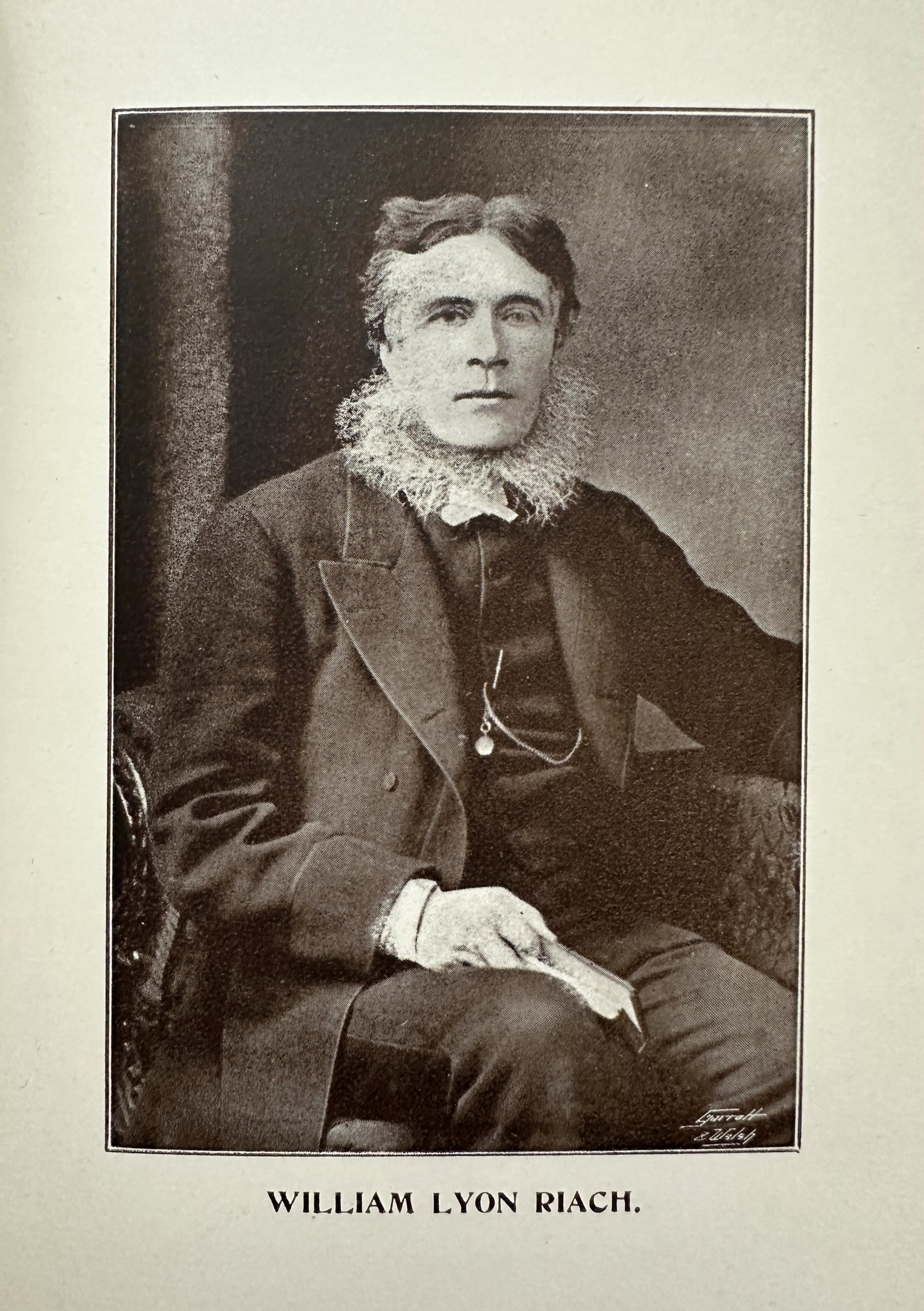
[Illustration: WILLIAM LYON RIACH.]
The Kirkyard. 33
of the most amiable dispositions, which endeared him to his fond parents while he lived, and made him to be deeply regretted by them when he died. Hunc tantum ostendebant Fata terris [The Fates only showed him to the earth]. Providence was pleased to show him but for a short while on earth, and to take him away in mercy at an early period from the evil to come.”
Here, too, is buried Mrs Philip Morison, the poor lad’s mother, who died in 1799.
No other clerical tombs stand here except that of Nathaniel M‘Kie, minister at Crossmichael, a son of Wm. M‘Kie. As already stated, Thomas Stevenson lies a long way off, nearer to the manse. And of the eleven ministers of the parish since 1694 four are buried elsewhere, two cannot be traced, and two survive. Of the four lying in distant cemeteries, one (the alter Macmillan) is interred at Dalserf beneath an imposing monument; one (Dr. Martin) lies in the “Ministers’ Yard” at Monimail; one is in Hamilton (Mr Gibson); and the fourth (Dr. Freeland) rests somewhere in America.
As there is a corner, quite near the old demolished church, for the parish clergy, so a special retreat has been found for the Free Church ministers. It is naturally a good way off from the former, and but one pastor as yet reposes here, beneath a handsome monument, erected by his people and their friends. He was the Rev. John Johnstone, for 22 years F. C. minister in the parish, and author of a singular poem on the “Disruption” of 1843. Near at hand the present F. C. minister—Rev. A. B. Craig—has selected a burying-place, where already a little child is at rest. A Free Church elder, who died with awful suddenness in the fields while talking to Mr Craig, is
C
34 The Kirk above Dee Water.
buried close by. And here others of like religious profession desire to rest.
Returning to Mr M‘Kie’s ivy-grown monument, we find quite near it the well-known stone commemorating in verse the “two Davids Hallidays,” shot down on the parish border in 1685. The lines will be found at the end of this chapter, but we now copy the prose inscription:—
“Here lies David Halliday, portioner in Meifield, who was shot upon the 20 of Febr. 1685, and David Halliday, once in Glengape, who was likewise shot upon the 11 of July 1685, for their adherence to the principles of Scotland’s Covenanted Reformation.”
Close to this is another covenanter—Alexander Charters, died 1715, aged 53, who, however, did not receive the martyr’s crown. His memorial was erected by Robert Charters, whose own quaint epitaph occupies the lowest part of the stone:—
“Here lies the Dust of Robert Charters, who was valued by all competent Judges a man of Excellent Sense and Great Integrity. He died in the Service of Lady Greenlaw, June 24, 1764.”
There are also some quaint rhymes, to be found with the collection at the end. The only remaining martyr’s stone is at some distance. It bears the inscription:—
“Here lies George Short, who was pursued and taken and instantly shot to death under cloud of night in the paroch of Tongueland, by Grier of Lag and the Earle of Annandale, because of his adherence to Scotland’s Reformation, Covenants, National and Solemn League, 1685.”
The Kirkyard. 35
We now throw together some miscellaneous notes on the “Kirkyard.” The frequent occurrence of great ages will strike the observer. Three score and ten is quite a common attainment in Balmaghie. Four score is also frequent. There are at least three instances of ninety years and upwards. William M‘Clachrie, one of M‘Kie’s elders, died in 1798, aged 90. William Milligan died in 1775, at 92; his brother, Paul, in 1768, at 86. The oldest I can find is William M‘Gowan, died 1883, at 94. To the last he was able to read Spurgeon’s weekly sermon. On the other hand, death has had its victims in early life. There are two inscriptions—the shortest in the churchyard—which in this respect are full of pathos. The one is a small granite block with the words—“Blanche Edwards died July 5, 1873, aged 20. Thy will be done.” The other is even shorter—“Catherine Ward died 4th March, 1828, aged 25.” Blanche Edwards was a governess at Livingstone. Who Catherine Ward was I cannot learn. Her whole story is on the tiny fragment, about a foot square, which marks her grave.
There are many commemorated here whose dust has mingled with foreign soil. Here is a list of some foreign places named on tombstones:—St. Lucia, San Diego, Antigua, Jamaica, Bergen Neck in New Jersey, Granada, Tobago, Demerara.
I have mentioned the discovery of a supposed suicide’s remains outside the hallowed ground. A different kind of tragedy is set forth in the inscription recording how “David M‘Lellan, of Antigua, merchant, aged 34, and William Moffat, preacher of the Gospel, aged 30,” were
36 The Kirk above Dee Water.
drowned in Carlingwark Loch on 4th July, 1801, by the “oversetting of a pleasure boat.”
One curious aspect of these mortuary records is the occurrence of what may be called lapsed lairds and lapsed names. By the first I mean the names of persons once heritors in the parish, whose fortunes have since sorely declined. Three stones at least belong to such. The names are William Kelvie, Esq. of Crae, died 15th May, 1820; William Burnet of North Quintinespie, died 1855; and David Clark of Slogarie. Till lately all three had living descendants in the parish.
Of lapsed names of places the following occur:—Craig-croft, Mill-house, Fine View, Dubbidale (where Mr Dickson, dyer, resided), Longley, Highpark, Bush o’ Bield, Wood-foot, Hill of Grange, Ironganoch (Erngenoch). These represent either houses demolished, or houses whose name has been changed by new owners.
The oldest stone in the churchyard is that placed above the martyr, George Short, which most probably dates from 1685.
There is a curious uneven slab of whinstone now erected in the ground, which I found to have the following mysterious inscription:—“John M‘Kinel in Barnbord aught this ston, Janu. (?), 1731, as propr right.” Gravestones were evidently coveted at that time, and this John M‘Kinel deemed it wise to earmark this rough slab for his own burial. But man proposes and God disposes. The stone was found lying in a corner, and John M‘Kinel’s remains are without a monument after all.
Another curiosity is a stone dating from 1768, which has the following symbols crowded together on one face:
The Kirkyard. 37
—Cherub with outspread wings, cross-bones, skull, coffin, and hour-glass with wings. I have not seen this winged hour-glass anywhere else.
Symbols are not numerous, and usually conventional—the urn, broken column, cross. One stonemason’s tomb has the square and compasses. The cherub occurs several times. The customary phrases are found—Requiescat in pace [Rest in peace] (generally on Roman Catholic tombs), Memento mori [Remember that you must die], and the ordinary texts of Scripture.
The churchyard poetry is an interesting feature. I have chosen to keep it to the last, and to add now a collection of these elegiac verses.
VERSES IN BALMAGHIE CHURCHYARD.
1. Beneath this stone two Davids Hallidays
Doe lye, whose souls now sing their Maker’s praise;
To know if curious passengers desire
For what, by whom, and how they did expyre:
They did oppose this nation’s perjurey,
Nor would they joyn with lordly prelacy:
Indulging favours from Christ’s enemies
Quench’d not their zeal. This monument then cryes—
These were the causes, not to be forgot,
Why they by Lag so cruelly were shot.
One name, one cause, one grave, one heaven do ty
Their souls to that one God eternally.
Martyr’s Stone, 1685.
2. Here lies beneath this humble monument
The precious dust of an exalted Saint:
A Mary rightly nam’d, whose gracious heart
Ev’n from her youth still chose the better part:
High Birth, Health, Honour, could not make her proud,
But Grace and Vertue made her Great and Good;
For piety and prudence liv’d renown’d,
And now is with Immortal Glory crown’d.
To Mistress May Gordon, second wife of John Macmillan, 1723. (Probably composed by himself).
38 The Kirk above Dee Water.
3. Alas! we fondly thought that heaven designed
His bright example mankind to improve:
All they should be, was pictured in his mind,
His thoughts were virtue, and his heart was love.
To John Milroy, aged 17, 1826.
4. In Memory of William M‘Caa and his wife Elizabeth M‘Menzies, who died in Airds of Kells. He, on 13th July 1816 in the 60th year of his age. And she, five days afterwards, in her 52d year. Leaving nine surviving children to lament the loss of their affectionate Parents.
While sad remembrance paints the scene of wo,
Our tortur’d breasts their anguish will reveal:
In spite of consolation, tears will flow,
And silent tell the poignant grief we feel.
5. This humble grave, tho’ no proud structure grace,
Yet honest truth adorns the sacred place;
For ’neath this sod, entomb’d in hallow’d dust,
Lyes one who was in all his dealings just.
Lo! fond remembrance drops a pious tear,
And holy friendship stands a mourner here.
To Nathaniel Bodden by his Widow, 1826.
6. Fresh in the morn, the Summer’s rose
Hangs withering ere ’tis noon:
We scarce enjoy the balmy gift,
But mourn the pleasure gone.
To John Morison, aged 12, by his father, Rev. Philip Morison, 1778. M‘Kie’s Epitaph, 1763.
7. The mem’ry of the just is blest,
How precious is his name;
It is like new-blown roses sweet,
For ever lasts his Fame.
The man of God, whose light and life
Much serv’d Religion’s cause,
In dark Oblivion should not ly,
But have his just Applause.
The Kirkyard. 39
O Balmaghie! lament thy loss;
But boundless grief is vain;
Thy much-lov’d Pastor is gone home—
Death to the Saints is gain.
Live as he liv’d, and Death shall soon
Transport you to the Shore
Of endless life, where heavenly Souls
Shall meet to part no more.
8. Beneath this gently polish’d stone
Is treasured precious clay—
Clay that shall shine bright as the sun
At the great rising day.
True to the Church, like rocks unmoved
In rough and stormy seas,
Was Alexander Charters still,
In reeling, staggering days.
Parents and children to the cause
Of Christ were always true,
And with a heaven of endless joy,
They are rewarded now.
Alexander Charters, died 1707, aged 53.
9. Remember, man, as you go by,
As you are now, so once was I;
As I am now, so must thou be,—
Prepare thyself to follow me.
Alexander Livingstone, died 1771, aged 71.
10. If youthful innocence the laurel gains,
It’s hers, lies here in death’s domains;
Her virtues and her worth unknown,
The Rose was pluck’t when scarcely grown.
Spouse of James M‘Clacharty in Boreland, died 1794.
11. Slow pac’d consumption, with insidious sway,
Seized on her frame, and drained her life away;
From lingering pain she kindly was reliev’d,
And slept in Him in whom she had believ’d.
Agnes Andrew, Glenlochar, died 1835, aged 29.
40 The Kirk above Dee Water.
NOTE TO CHAPTER II.
The following, from an old Balmaghie boy, may be interesting:—
“Sept. 25, 1893. . . . I was once in the church, 36 years ago, then a lad of 12 years of age. I have no recollection of the preacher; but I have a distinct remembrance of mice, their dirt, and dust. Again, I was there 22 or 23 years ago (perhaps less), at the funeral of an aunt from Laurieston. Nothing impressed me then but a bad road over which we had to go to church for burial. Only, I was interested in seeing them all . . . drink whisky and eat biscuits before starting.
“I visited the place last June, and what a change—in it or me, I cannot tell. The churchyard was well kept, and all about was tidy and clean, and I was charmed with the situation, and was amazed, as I wandered through the tombstones, to find it the resting-place of so many relations. Besides the nameless graves of a grandfather and grandmother, . . . I felt as if I had returned to my youth, and could see and talk to the men and women whose tombstones recorded that they were not; and to a grandfather whom I never knew, as he died before my father had knowledge of him. There is a strange, awful, pathetic interest in wandering about the place where your forbears lie, and whose existence you were never acquainted with. I felt I had a claim on the place. What an ideal spot to sleep one’s long last sleep in! Death seemed to me that day to have nothing to do with Balmaghie churchyard, but a desirable place to rest in peace. Such a peace I should think William Nicol had in his mind when he penned the poetical protest against the place where they buried his brother Robert:—
‘Do his bones repose on his native hills?
Is his spirit soothed by the dashing rills,
Where the heather waves, and the free winds come?
Is this the place of the poet’s tomb?
‘No!—
Nor tree, nor flower, o’er his lowly bed
Their bright Spring tears, or sere leaves, shed;
For ’mid countless graves and a city’s gloom,
Sleeps Nature’s child in a nameless tomb!’”