The Kirk Above Dee Water I.
James Dodson
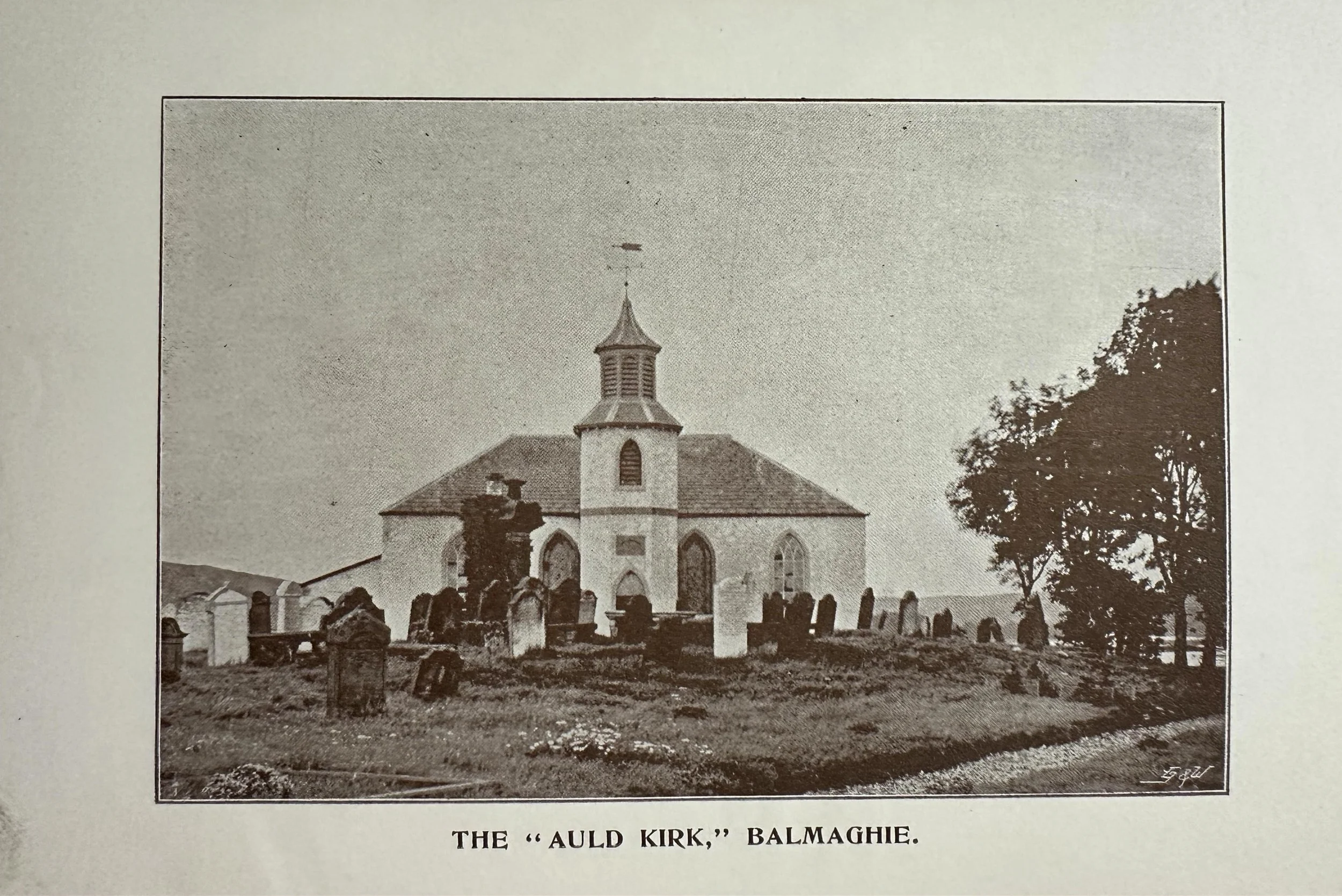
[Illustration: THE “AULD KIRK,” BALMAGHIE.]
I.
THE KIRK ABOVE DEE WATER.
SUCH is the homely name by which our Galloway folk know the little “harled” kirk which stands on a slight eminence above the Dee. The nearness of the river lends a picturesque colour to our local phrases, of which the above is one. A Balmaghie man goes through the Water of Dee to reach Crossmichael Village. To a Crossmichael man the minister of this parish is “the man across the water.” The Church and the River are linked together not unfitly, since each is a symbol of eternity and peace.
In this opening “Notice” some particulars may properly be given regarding Balmaghie Church. The present building is probably only the second erected at this commanding spot since the Reformation. Of the first church only a small part of the eastern gable was preserved at the time when the second and existing one was built in 1794. In Galloway there is a hereditary covetousness of stones for building purposes, and perhaps a slight confusion at times in regard to meum and tuum [mine and thine]. We know how the fine Threave ruin was being despoiled [of its stones] to furnish forth byres and dykes [cowsheds and boundary walls], when the authorities interposed and saved a remnant. The tiny old kirk of “Balmakethe” was almost entirely rased, less fortunate in this respect than Anwoth, Parton, and some others. What still stands owes its immunity to the circumstance
B
18 The Kirk above Dee Water.
that a fine monument to William M‘Kie had been built into the gable about 1763. The heritors of that olden time spared this fragment out of respect for Rev. Mr M‘Kie. The remainder they destroyed out of respect to their own purses, and applied the stones in raising the present church.
This older church, judging by the ground plan still traceable on the kirkyard turf, must have been of small size. It was probably about 18 yards long and 12 yards broad, and cannot have held more than a hundred people, even when seated close together on “cutty stools.” That it was a pre-Reformation edifice seems certain from the fact that it lay due east and west. It is therefore the chancel end which is preserved, if chancel there was. Behind the M‘Kie monument lay the simple altar or Communion table. The pulpit was perhaps at the right hand side. I have never been able to find any stone bearing such marks as would identify its connection with this the church of Macmillan, but doubtless such are somewhere in the present building. It was in this quaint little narrow church, with its tiny belfry and small windows, that that great man made his public stand for the Covenants for 28 years. The bell by which he called his attached flock together was not the same as that which now hangs in the present tower. This bears the date 1794, and the brief inscription “Presented to the Parish of Balmaghie by Thomas Gordon, Esq.” Probably the “bethral” or “bedral” [i.e., the beadle, a church officer, or parish servant] of the time tolled the bell by means of a long rope hanging loosely from the gable, and offering strange temptations to restless childhood or mischievous youth.
The Kirk above Dee Water. 19
There was no vestry, the manse being so near. This pastoral abode also is mostly demolished. It consisted, probably, of two double rooms on the ground floor, and attics to correspond. There was, perhaps, a cellar, where the good man kept his peats. From this modest dwelling he issued gravely at the canonical hour each Lord’s Day, the “books” having first been carried up by the beadle. I have in my care the very Bible which thus travelled to and fro between manse and church in 1778, when Philip Morison was minister. It is of smaller size than the one now in use, much more closely printed, and much worn and dogseared at the end of S. Luke’s Gospel and the beginning of S. John’s. Either the preacher placed his notes there, or else he was used to dwell much on the death and resurrection of our Lord. Which is, indeed, the main duty of every Christian preacher. The Bible in question was printed at Edinburgh in 1752 by “Adrian Watkins, His Majesty’s Printer.” It has a copious appendix of Biblical antiquities, and the authorised metrical Psalms. There are no paraphrases or hymns, however, for the excellent reason that none such had yet been approved by the General Assembly.
When the minister appeared at the foot of the brae [hill], the beadle, as in duty bound, saluted his arrival with a lusty bout of ringing on the little bell. The lingering gossips in the kirkyard hastily bundled into church, and the solemn exercises began.
In a more ancient time, however, the bell rang at eleven o’clock forenoon as well as at twelve. Either the minister or a “reidar” [“reader”] occupied a profitable hour in reading and commenting on Holy Scripture. In 1560 Thomas Chapman
20 The Kirk above Dee Water.
was “reidar,” [“reader”] with a stipend of “XX lib.” (£20) from the revenues of the Abbey of Holyrood. The tenacious grip of old customs appears in the fact that still, as then, the bell is rung at eleven a.m., though few now remember the original reason. Across the Dee Water the bell of Crossmichael (or “Crossmeikle”) church rings at ten a.m., while in some other riverside parishes it is set swinging as early as eight or nine a.m. Thus, along the green meadow-flats of Dee, an unbroken chain of sacred sound might be traced, each hour of the Sabbath morning being punctuated by a call to prayer.
In 1794 the present church was built, and a new manse arose about the same time. Both were erected on new sites. The new church was placed almost north and south, with a small quaint bell-tower at the south; the wooden louvre boards of which at once became a haunt of starlings, while the revolving vane afforded them an agreeable and airy point of view. Starlings monopolise the wooden turret still. The eastern roof proved irresistible to thousands of bees, who buzzed all the summer’s day around the east door, and crept in and out of the crevices between the huge heavy slates. The bees of Balmaghie Kirk may be said to be famous in the Stewartry, and were a constant source of both profit and loss—the profit accruing to the incumbent as a rule, while neighbouring bee-keepers complained badly at swarming-time that “oor bees are awa’ over the water to Balmaghie Kirk.”
The gathered honey was removed periodically in large quantities, and is said to have been of excellent quality. A large brown stain on one corner of the white plastered roof showed where the busy workers kept their store.
The Kirk above Dee Water. 21
The congregation instinctively lifted their eyes to this spot whenever the Psalm* was given out which sings of
“Honey, honey from the comb,
That droppeth. . . .”
Alas! the bees of Balmaghie Kirk are creatures of the past. Though perishing in hundreds inside the church every week, they had boldly held their ground, and even vastly multiplied, till the fatal centenary came (1894), when the work of improvement swept them finally away. In September of that year there was a Homeric conflict between the Builder and the Bee. The plaster had been dislodged, and exposed numberless hosts armed for the fray. Three days the battle raged. On the one side it was waged with a smoke-test machine discharging volumes of sulphurous acid; on the other the dauntless bees had only their natural weapon. The issue could not be doubtful. Not a bee was left to tell the tale. Great masses of honeycomb were torn from the beams, as Samson tore it in his day from the lion’s ribs. Since then desolation reigns in the once busy home of the Kirk Bee. The poor insect has been most thoroughly disestablished and disendowed. May the omen be averted!
The swallow is no infrequent attender at Balmaghie Kirk. More than once, on some still hot morning, during service, the congregation have been startled by a rapid flicking of wings against the skylights in the “lofts.” It was a “wandering bird” which had flown in at the open door. To preach with this tiny, restless creature darting back and forward in front of one’s pulpit was a somewhat severe test of mental concentration. There was a sore
_____
* Psalm xix. 10.
22 The Kirk above Dee Water.
temptation to follow the graceful creature’s flashing flight from end to end. None at such moments failed to recall our fine old Psalm*—
“The swallow also for herself
Hath purchased a nest—
Ev’n thine own altars . . .”
Certainly such visitants were less troublesome than the hosts of crawling, buzzing bees which were once so familiar as members of our congregation. There is no record of any one being stung; but tradition remains of one incumbent who spent his time in church, when already an old man and past preaching, in dexterously catching and killing the humming insect. And the present minister once had a narrow escape, if his beadle may be trusted. “I wis awfu’ feart for ye the day,” said the old man; “there wis a big bumble-bee bizzin’ aboot yer heid time o’ sermon, an’ I was feart ye wud maybe pit oot yer haun’, in preachin’ like, ye ken, and the beast wad stang ye!” †
Like other churches, Balmaghie Kirk shelters its share of owls and bats. For long a white owl resided there, and might at times be seen flitting, ghost-like, round the fields near at hand. On one occasion of repairs as many as 39 bats were counted (and killed), each suspended head downwards from a rafter. Owls and bats are generally the symbols of utter desolation, but here they take refuge because the spot has an unusual sacred quiet. The little precinct of the glebe, lying in a ring-fence around the church and manse, is a safe sanctuary not only for such winged creatures, but for the timid and anxious hare and the retiring hedgehog.
_____
* Psalm lxxxiv.
† [“I was terribly afraid for you today,” said the old man; “there was a big bumblebee buzzing about your head during sermon-time, and I was afraid you might maybe put out your hand, as you do when preaching, you know, and the creature would sting you!” ED.]
The Kirk above Dee Water. 23
Let us complete this natural history of the Kirk above Dee Water. There is a significant fact still to set down. The only verses ever penned by any of its incumbents, which have attained a world-wide circulation, were those of the well-known Twelfth Paraphrase, pointing a moral for “indolent and slothful” people from the example of the ant. Why Dr Samuel Martin did not rather choose to employ the bee for the edifying purpose it is not easy to see; unless it arose from the curious circumstance that the bee is only four times* mentioned in the Bible, and in three out of these four cases it is spoken of with evident distaste. The Paraphrases, of course, required a suitable scripture text, and there is none such about the bee. Certainly bees have always been a far more familiar sight to the good people of Balmaghie Kirk than ants.
Enough has been said of the creeping and flying things which have made their home here. Unhappily, modern requirements tend to discourage these harmless visitants. In 1894, one hundred years after the present church was built, a most complete renovation was begun and carried out. By dint of pushing on the work, all was completed in a sort of fashion before that year closed. The church was re-opened on 30th December, and those who had left it on the closing Sunday found themselves ushered into what is practically a new building. The little nave has been lengthened, bringing out more clearly the cruciform shape. At the end of it a fine three-light window of stained glass, prepared by Mr Arthur Dix of London, is at once the object of attention on entering at the main door. The central light shows the Crucifixion, with the words, “It
_____
* Deut. i. 44; Judg. xiv. 8; Ps. cxviii. 12; Isa. vii. 18.
24 The Kirk above Dee Water.
is finished.” On the right of the Cross, in a side-light, is the mother of our Lord, with scroll, “Woman, behold thy Son.” On the left has been depicted the Beloved Apostle, the text being, “Son, behold Thy Mother.” A memorial brass on the sill contains the following inscription:—“To the Glory of God, and in loving memory of my mother, who died 2nd Dec., 1893—This window is erected by J. R. Hutchison.”
This window is much admired by competent judges for the beauty and charm of the figures, and especially for the softened light which it admits.
At the opposite end, as of old, is the pulpit—an oaken one—standing on a slightly raised platform, with a recess containing a harmonium behind it. The upper wall behind the pulpit is entirely concealed by a large screen of wood, in three panels. The centre contains the Apostle’s Creed and Lord’s Prayer. The side panels are filled with the X. Commandments. The pulpit and screen are designed after those in S. George’s, Albemarle Street, London, by Mr Gibson of Edinburgh. In front of the pulpit stands a small Communion Table of dark oak, with a carved border. The choir are accommodated on each side, within a high wooden enclosure. There is some good wrought-iron work in the pulpit railing.
On either side of the pulpit and screen is a narrow stained glass window. That on the right of the minister has a medallion of S. Andrew, the patron saint of Balmaghie. On the left is S. Peter with the keys.
On the pulpit is a memorial brass with the following inscription:—“To the Glory of God, and in loving memory of my mother, Annette Mary Hay Thomson née Craufuird,
The Kirk above Dee Water. 25
born 1819, died 2nd Dec., 1893—This Pulpit, Screen, Side Windows, and Communion Table, are erected by Graham Hutchison of Balmaghie. O ye spirits and souls of the just, bless ye the Lord, praise Him and magnify Him for ever.”
The whole area has been re-seated in pitch pine, and the old stiff and straight pews are replaced by wider and more comfortable ones. The ancient lofts remain almost unchanged, and are thought to be somewhat out of harmony with the general effect. An extremely good ceiling of pine has taken the place of the old white plaster roof, the main coupling beams being now exposed.
It is not unworthy of mention that both ventilation and heating have been thoroughly secured, the one by “Tobin’s tubes” and Boyle’s roof-ventilators*—the other by a system of high-pressure hot-water pipes.
A small vestry and porch were added. These, though not, perhaps, an architectural feature, have been found a great advantage and comfort to pastor and people.
The sole relic almost of the old interior, if we except the walls and “lofts,” is a large pair of “ladles,” or long-handled collecting-boxes, made of fine Memel pine. The old Communion Table has found a refuge for its last days in the vestry. And two massive pewter plates still keep guard in the “lofts,” awaiting the offerings of such as ascend beyond reach of ladle. They bear the date 1782.
The renovation of Balmaghie Church cost about £1000, mostly derived from voluntary contributions. The result is to make it, internally, “a place to worship God in, not a bare barn,” as a friendly parishioner one day remarked. Much may yet, however, be done to complete
_____
* [Tobin’s tubes These were vertical ventilation tubes introduced by Henry Tobin. They brought fresh air from outside into a room, usually directing it upward so the incoming cold air would rise and mix before descending, rather than blowing directly on people. Boyle’s roof-ventilators These were roof-mounted ventilators used to extract foul or warm air from the building. They worked by wind action and air movement at the roof level, drawing stale air upward and out.]
26 The Kirk above Dee Water.
the sacred work. The side walls of the nave should have narrow pointed windows of stained glass, two pairs on each side. The present incumbent here sets it down, without further remark, that each pair could be introduced for a sum of about £30 or less. A single window could be inserted for about £15. Externally the little tabernacle on the hill is scarcely altered at all. No one, looking at the outside, would dream that so much care and money had been expended within. But this is not wholly an unwelcome feature, since the work has been done not “to be seen of men,” but to give glory to God.
The Kirk above Dee Water. 27
NOTE TO CHAPTER I.
The following tablets are also to be found in Balmaghie Church:—
I.
Sacred to the memory of the Reverend Alexander Gibson, minister of this Parish, who was born at Lanark 3rd April, 1800, and died 5th August, 1846, at Almeida Hill, Hamilton, where his mortal remains are deposited. Blessed are the dead which die in the Lord, from henceforth: Yea, saith the Spirit, that they may rest from their labours, and their works do follow them.—Rev. xiv. 13.
This Tablet is erected by his widow.
II.
Sacred to the memory of Major James Graham, fourth son of Sir James and Lady Catherine Graham of Netherby, Registrar-General for 39 years. Born 13th September, 1804; died 20th May, 1888. The righteous live for evermore: their reward also is with the Lord, and the care of them is with the Most High.—Wisdom of Solomon v. 15.
III.
TO THE GLORY OF GOD,
AND IN MEMORY OF
JOHN MACMILLAN, A.M.,
Born at Barncauchlaw, Minnigaff, 1669:
Ordained Minister of the Parish of Balmaghie 1701;
Accepted the Pastorate of the United Societies 1706,
Which office he laboriously discharged for 47 years:
Died at Broomhill, Bothwell, 1753. Buried in
Dalserf Churchyard.
A Covenanter of the Covenanters:
A Father of the Reformed Presbyterian Church:
A Faithful Minister of JESUS CHRIST.
This Tablet is placed here by his Great-great-grandson,
JOHN GRIEVE, M.D., Glasgow: 1895.
28 The Kirk above Dee Water.
Spelling of the Name Macmillan.—Macmillan graduated A.M. at Edinburgh University in June, 1697, and signed the Roll as follows:—
JOANNES MᶜMILLAN.
But in 1695 he signed the Matriculation Register thus:—
JOHN MᶜMILLAN.
At the meeting of Commission of General Assembly at Edinburgh, June 9, 1704, he signed his statement thus:—J. MACKMILLAN. The same also a month later.
On 14th August, 1706, he signed his “Submission” to the United Societies thus:—J. M‘MILLAN.
On the Dalserf Monument it is MACMILLAN. But on the ancient fragment placed there by himself to the memory of two daughters and a son, it is spelled MᶜMILLAN once more, as in his college days. So it stands, also, in the epitaphs to his first wives in Balmaghie Churchyard.
Dr Grieve and I decided, with the valuable advice of Dr Goold of Edinburgh and Professor Laidlaw, to adopt the full form Macmillan in the memorial brass.
There is little doubt, however, that the most ancient form was simply M‘Millan.