Kirk in the Craigs VIII.
James Dodson
64
CHAPTER VIII.
SOME CRAIGS STUDENTS.
No excuse is necessary for introducing an account of some of these students. Their after history was largely determined, no doubt, by the influence of their Professor’s teaching and character. As they were scattered over the land, and abroad, they could not fail to think gratefully of the seat of the Theological Hall, where in part, or wholly, they had been trained in sacred learning.
MR JOSIAS ALEXANDER came from Belfast. His name only occurs once in the list of the Stirling Hall—in the year 1805. He was settled in his native city as the first R. P. minister. He was singularly popular and most successful in the work of his ministry. He died at the age of 41, beloved by his congregation and the community at large.
ANDREW SYMINGTON, A.M., who studied at Stirling in 1805-6 and 7, was ordained in Paisley in 1809, and died there in 1853. He used to speak with veneration of the Professor of theology at whose feet he had sat in the vestry of the Craigs Church. He was an eminent
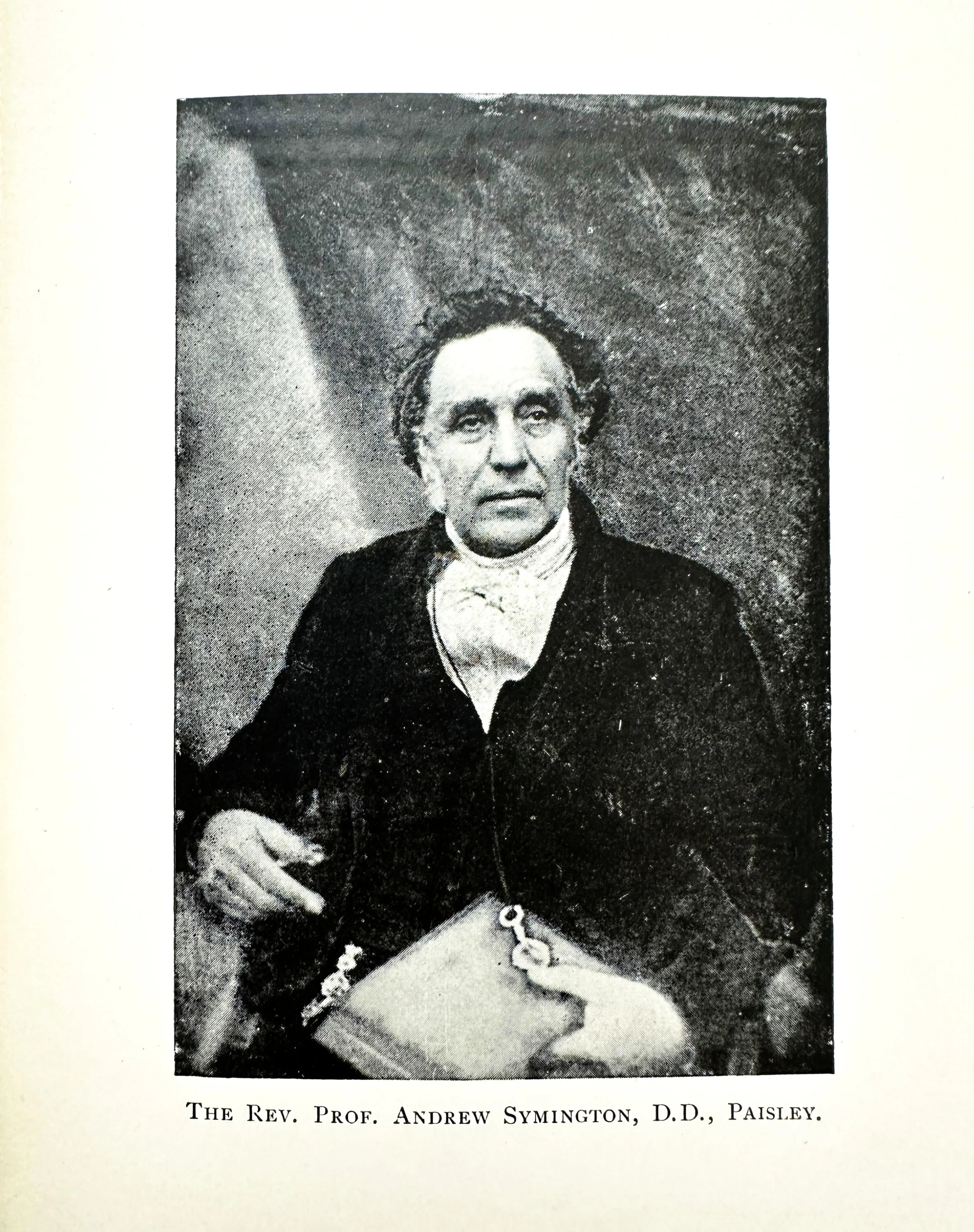
[Illustration: THE REV. PROF. ANDREW SYMINGTON, D.D., PAISLEY.]
65
minister in his day, and in 1820 was elected to succeed Mr McMillan in the Professorship. It is told that on one occasion, a student stated, when entering his name on the roll of the Moral Philosophy Class in the University of Edinburgh, that he came from Paisley. Professor Wilson (Christopher North) immediately began to ask about his old friend Symington, whom he described as exactly as if he had been a regular hearer of his from Sabbath to Sabbath. “Christopher” wound up, as a climax to his eulogy, by saying “that Dr Symington was the only exception that he knew to the aphorism of Scripture that a prophet is not without honour save in his own country, for, wherever he was, he could not but gather round him the respect and homage of all.” Professor Symington, while prominent as a minister and as a man, seems to have fairly captivated the hearts of his students. He was witty as well as wise.
One of his students had a habit, when delivering his exercises in the class, of catching hold of his forelock. The awkwardness of this gesture was pointed out to him. The student replied that Sir William Hamilton used to do the same. “Ah!” said the Professor, “but he was a philosopher, and would often need to be in touch with ‘Locke on the understanding.’”
The Rev. J. H. Thomson of Hightae, Dumfriesshire, one of the greatest living authorities on Covenanting History and Literature, furnishes me with some interesting notes as to
66
Dr Symington’s influence as a Professor. He says, “I studied a session under Dr John Brown of the United Presbyterian Church; occasionally I attended Dr Eadie; I had a session under Dr John Duncan in the New College, but the influences under Dr Andrew Symington were far more moulding. You came most closely to him. In manner, he was courtly and winning—in Theology, he seems to have read everything, and in his conversation and life, he was experimental theology embodied. He knew Hebrew, although his pronounciation was different from what I had learned. You could not make a mistake without his detecting it.”
The profound respect in which Dr Andrew was held in Paisley was evidenced by the fact that on the occasion of a riot in the town, during which many roughs perambulated the streets, smashing windows and other property; with one consent they passed the Professor’s house, leaving it unharmed. After his death, in 1853, the Theological Hall Committee, while claiming for this old Craigs student “a true vein of original and native genius,” said it was a simple fact that “since the Revolution, the grave never closed over a man to whom the Church was under deeper obligation.”
ARCHIBALD ROGERSON studied at Stirling in 1805-6-7 and 8. He came from Darvel, Ayrshire. He was ordained to the ministry in his native place in 1810. Mr Rogerson was an excellent pastor, and a capital man of business. He was Clerk to the Synod for about 30 years. He died at Darvel in 1850.
67
ROBERT WINNING, A.M., attended Mr McMillan’s classes 1816, 1817, and 1819. He was ordained at Eaglesham in 1826. He was a great favourite as a man and as a minister. He died in 1856.
MR JOHN SPROTT studied here for at least three sessions—1805-6-7. In a biographical notice of him which I have seen, it is stated that he studied for four sessions at the Divinity Hall. This would make him a student at Stirling in 1803 as well as in the years mentioned. He came from the farm of Caldons, in the parish of Stoneykirk, Wigtownshire, where he was born in 1780. At the age of 20 he entered the University of Edinburgh, where he studied for four years. Then came his Divinity course, and his license as a preacher in 1809. He did not take any appointment in this country, although called in 1810 by the congregation at “Water of Orr” (Urr), Kirkcudbrightshire. Later on he joined the Synod of Relief. In 1818 Mr Sprott sailed for New Brunswick. For two years he preached throughout Nova Scotia, and was ordained at Windsor in that province. From 1825 to 1849 Mr Sprott laboured at Musquodoboit. From that date onward he went on preaching tours in the States, Newfoundland, and Nova Scotia. This student in the Craigs of Stirling died in 1869, when almost 90 years old. He was without doubt one of the great founders of Scottish Christianity in the lower provinces of British North America. He cannot be forgotten over the wide region in which he laboured; it may be
68
that some of our “kin beyond the sea” may come to know that he is remembered in one of the places of his youth.
Mr Sprott was such a remarkable man that we cannot pass him by with only a statistical notice. He took high testimonials with him from this side of the water. One of them said he was “a man of genius.” This testimony was true. For one thing he had a fine start in life. He had the physical frame of a sturdy, if not tall, Galloway farmer’s son. Bodily infirmity did not touch him till he was over 80. He needed all his strength in his adventurous life. He used to say near the close of his days that “his horse had been in almost every stable in the province of Nova Scotia.”
“He had crossed rivers,” says a writer in the Presbyterian Witness of Halifax, Nova Scotia, “on floating cakes of ice. Once the floor of the house where he was preaching gave way and the whole congregation was precipitated to the bottom of the cellar. On one occasion his horse and waggon went over the side of a bridge and fell into the stream below; and on another, over the edge of a declivity, where a tree arrested their downward course, and his life was saved. In the forest the bear and the moose frequently crossed his path; and once on Sheet Harbor road a pack of wolves pursued his dog, and chased him under the horse’s feet.”
Mr Sprott used to say he had “a memory like a camel.” Thus, he could not forget his Stirling
69
theology. But when it came forth in the practical work of his ministry, it came through a large nature and a rich imagination. His great principle was to advance his Master’s cause everywhere and in all companies. He could be solemn, humorous, satirical, and again serious, in as many sentences. Unconventional sometimes to a degree, Mr Sprott tried to see good in everything. He had no patience with small ecclesiastical differences, so he used to say that “there were many things in the Church of England which Presbyterians would do well to imitate.”
One can imagine how the settlers in lonely places would welcome the visits of this fine, healthy, breezy Christian. An evening in a log cabin, with him as guest, would be a treat of exceeding rarity. Stories of his youth in Galloway, with anecdotes of its Raiders; the fine times he had, when, as a youth, he travelled long but not weary miles to attend Communion services; recollections of Auld Reekie and its College when the century was opening; how he had enjoyed Professor McMillan’s preaching on the Sabbaths in the Kirk, and profited by that good man’s lectures in the College in the Craigs of Stirling; his perils and dangers and joys as he travelled by sea or land—all these and more would fill, with laughter and tears, the too short evening spent in the stillness of the primeval forest; then the Psalm, and the Chapter, and a specimen of the fine devotional utterance of this big human heart; and then, rest. The growl of
70
a passing bear might waken the women folks in the night, but not Mr Sprott.
Why has not a collection of this man’s letters which he wrote to the Halifax and Wigtownshire papers been got together? They deserve something better than oblivion. Take, as a specimen, this extract from one of them. It may help us to realise the scene at “the back of the desert” in the days of the old Craigs Communions in the King’s Park.
The scene is Newton-Stewart, the occasion the Sabbath of a communion season.
“At an early hour on the Sabbath the Rev. James Reid appeared on the green, with a bunch of grey-headed elders at his back. They had a grave appearance, with deep-reflecting foreheads, and could scarcely have stopped short of Calvinism, even if they had wished it. A few minutes were spent at the tent-door, in cordial salutations, in shaking hands with the strange ministers, and kind enquiries after each other’s welfare. The service commenced with a storm of music which made the hills echo; for though they had not that cultivated taste for sacred music which our congregations have in Nova Scotia, yet, they all joined in the singing, and did the best they could.
“The action sermon was usually on the sufferings of Christ, and though little new was to be expected here, yet there was often a vigour and freshness in the description, so that I imagined I saw the vinegar countenances of the Pharisees who condemned him, the helmets of
71
the soldiers, and the big tears rolling down the cheeks of the fishermen of Galilee. When the minister descended from the tent to the head of the table, to offer up the consecration prayer, such a stillness prevailed that you might have heard the buzzing of a fly, or the falling of a needle. It was indeed a solemn moment and a lovely sight, to see 150 people of some standing in religion, slowly moving to the Lord’s table, and taking into their hands the memorials of his love, and the seals of their pardon; such a sight could not fail to do a reflecting man some good. There the flowers of affection bloomed, which, in full bloom, are to adorn the paradise above.”
At the close of the same letter Mr Sprott tells out his sentiments as to the old and new lands, both of which he loved. He is writing to a friend in Glasgow:—“I feel no regrets at leaving my native land. I have enjoyed abundance of mercies in my adopted country, yet I sometimes envy your happier lot in remaining among your kindred and your people. You are preaching the gospel in an old settled country, improved by the labour of centuries, in sight of the towers of the University, and near John Knox’s monument. I am sowing the seeds of truth in a new soil, manured with the leaves of the forest, and lately reclaimed from the wandering redskins. When you die you will be gathered to the City of your fathers’ sepulchres. I must sleep in the green woods, and my bones must mingle with the dust of the emigrant and the Indian, and other children of the forest. But on the morn-
72
ing of the Resurrection our Saviour’s voice shall be heard over all the kingdoms of the dead, and a way shall be open to our Father’s house from every land.” Twice during his ministry in Nova Scotia he revisited Scotland. These visits occurred in 1834 and 1844. He called them “pilgrimages of affection.”
It must have been on the latter of these that an incident occurred which will go a good way to show what the old minister meant when he sent Mr Sprott away in 1818 with a letter in his hand saying he was a man of genius.
In 1844 there was great discussion and heated in the land over the refusal of sites for Free Churches. Mr Sprott got an account of the substance of the contention from Dr Goold, and he was astonished that any laird should refuse a site for the erection of a place where God was to be worshipped. He turned to his informant and said with great emphasis, “Why, sir, the Indian will spread his fur for the white man to worship on.” Dr Guthrie, when the remark was reported to him, said that that was the best thing that had been said on the sites question.
Mr Sprott’s life was active and picturesque all through. In characteristic phrase he used to say, even when old, that “he found idleness very inconvenient.”
Mr Sprott was thrice married. His second son by his third wife is the Rev. George Washington Sprott, D.D. of North Berwick, an eminent authority on the literature, and specially the liturgies, of the Scottish Church.
73
DAVID ARMSTRONG studied at Stirling in 1809-10-11, and 12. He came from the upland region of Eskdalemoor. He was settled at Glasgow (Calton congregation) in 1815. He was in the succession of John McMillan II. His congregation developed into the present Great Hamilton Street Church. He died in 1838. He was a man of unaffected piety and solid worth.
HUGH YOUNG studied here for five sessions, beginning in 1812. He was a native of Ayrshire. He entered at Glasgow University in 1807. He was a most painstaking student there and at the Hall. After finishing his studies he was licensed in 1817, and ordained at Laurieston, 1822. After a quiet, earnest—and, in its later days—somewhat troubled ministry of 40 years, he died suddenly when about to start for his Sabbath duties on Sabbath morning, 20th April, 1862.
PETER MACINDOE, A.M., studied here for four consecutive sessions, of which 1814 was the first. He was a native of the parish of Glassford, Lanarkshire. When young, he often attended the ministrations of Dr Mason of Wishawtown. The distance he had to walk was about nine miles, and he had to ford the Clyde going and returning. He studied at Glasgow University, where he graduated M.A. Then came his course of Divinity in the Craigs of Stirling. He had three calls presented to him—from Eaglesham, Loanhead, and Chirnside. He accepted the last, and was ordained in 1819. In 1839 he
74
succeeded Mr Adam Brown at Kilmarnock; and was created D.D. in 1846. For some years Dr Macindoe edited “The Scottish Advocate.” He was a somewhat prolific author—one of his minor publications being a sermon occasioned by the death of the Rev. James M‘Kinlay, D.D., of Kilmarnock—apropos of whose settlement, in 1786, Burns wrote his poem, “The Ordination.” Dr Macindoe spent some of his closing days at Bridge of Allan. He died at Troon in 1850.
WILLIAM SYMINGTON’S name appears on the roll of the Stirling Hall for four successive years from 1814. He was a brother, and ten years the junior, of Andrew Symington, to whom reference has already been made. A strong exuberant youth he must have been when at the Paisley Grammar School. Referring to his youthful scrapes, a servant in his father’s house once said, in respect of his aspirations—even at that early age—towards the work of the ministry, “They’ll be scant o’ wood for the tabernacle, if they take thee to make a pin o’t.”
In 1810 William began his studies in Glasgow University, which he attended for four years, latterly with distinction. Then he came to Stirling for his Theology. “The picturesque situation and environs of the ancient town,” says his son, the late Rev. Dr A. Macleod Symington of Birkenhead, “and its stirring associations, had many charms for him. For four successive sessions he here ‘sat at the feet of Gamaliel,’ and found, as so many have done, his Hall days to be among the happiest of his
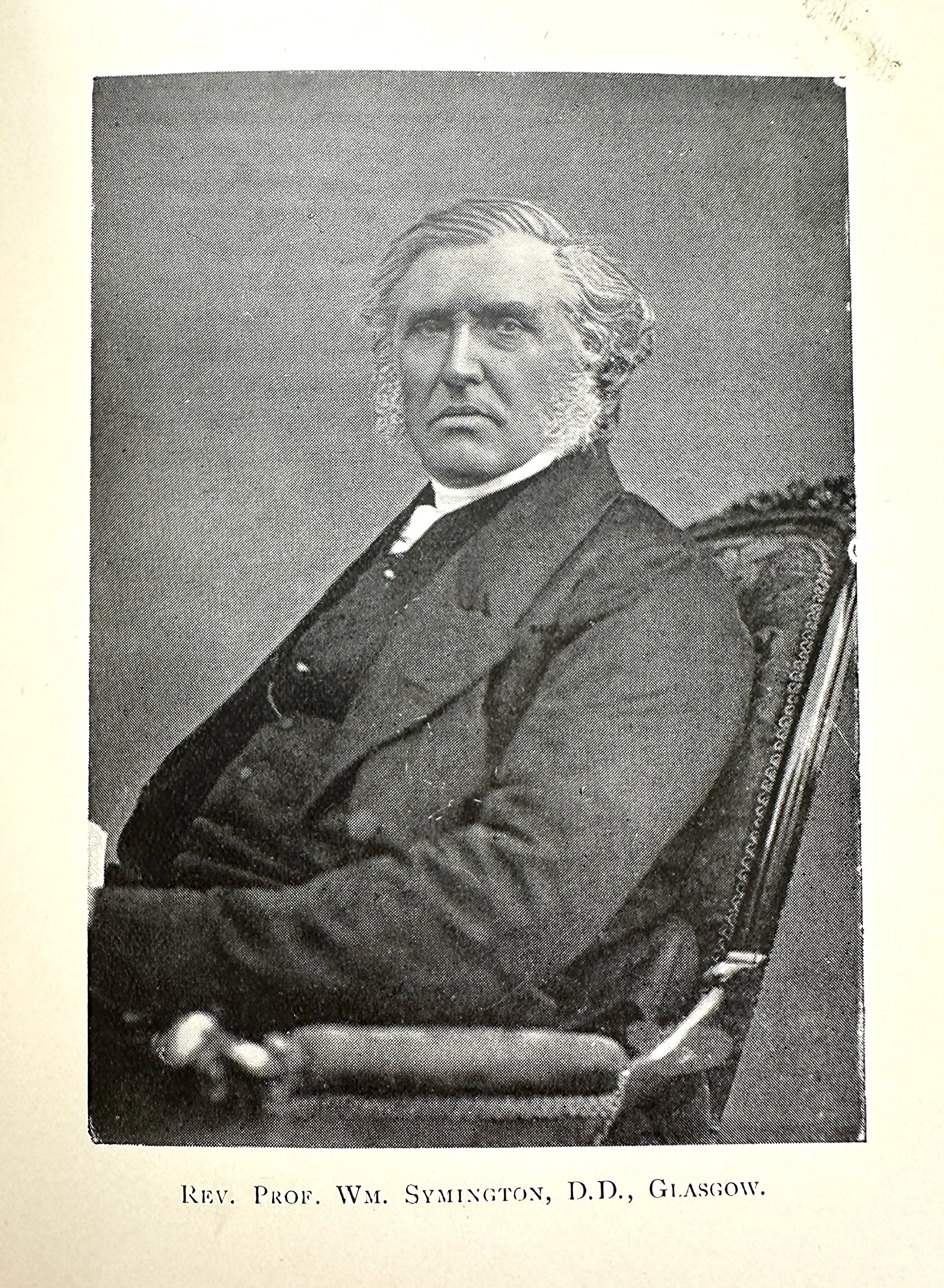
[Illustration: REV. PROF. WM. SYMINGTON, D.D., GLASGOW.]
75
life.” After being licensed in 1818, he got himself equipped with pony and saddlebags, and set forth among the vacancies of the Church. His pony—in his diary he always calls him “The Irishman”—carried him from Perthshire to Galloway, and from Berwick to the Western Highlands. Competing calls reached him from Airdrie and Stranraer, which latter he accepted. His ordination took place in August, 1819. As a specimen of early steamboat travelling, take this account of how the young minister got from Renfrew to Stranraer, in the steamer “Rob Roy”:—
“We came to Greenock about eleven o’clock, but had to wait nearly five hours on the mending of the boiler. We left Greenock at four, and were at sea all night. The wind was what sailors call ‘half a gale,’ and it was right ahead. Every passenger on board was sick. I occasionally left my place and scrambled up on deck to gratify myself with whatever could be seen—the lights on different parts of the coast, the island of Arran, the rock Ailsa, &c. We got to Loch Ryan soon after break of day, and were landed at Stranraer about six o’clock on Sabbath morning.”
The ministry which began after that voyage was a notable one. Mr Symington was most popular as a preacher. Sir Andrew and Lady Agnew of Lochnaw and Lady Hay of Dunraggat were glad occasionally to find seats among the crowd who waited on his ministry. What Dr Chalmers was at that time to Glasgow, what
76
Dr Andrew Thomson was to Edinburgh—similar in many ways was William Symington in Wigtonshire and Galloway.
An incident illustrative of this point occurred at the ordination of the fourth minister of the Craigs in 1876. The minister of his boyhood—the late Rev. Dr Crichton of Inverbrothock Free Church, Arbroath—was introduced by him to a son of the subject of the present notice—also a Dr William Symington. Dr Crichton said to him—“Sir, I used, when a boy, to journey with my people to hear a minister of your name preach at Irongray, near Dumfries. He was a great evangelical preacher, when that kind of preaching was rare.” “That man, sir,” said Dr Symington, “was my father.” There was a curious link here between three generations. That I should have been ordained to the ministry by one whose father’s influence had so powerfully told upon the minister who baptized me, struck me at the time as remarkable.
1839 was marked by three notable events in the life of William Symington. He published his book, “Messiah, the Prince;” he was created D.D. by the University of Edinburgh; he removed from Stranraer to Glasgow. From that time to 1862 Great Hamilton Street Church had a Christian orator for its minister; and Glasgow had no better advocate of Christian truth, nor a more high-toned philanthropist. Dr Symington was a great friend of Dr Chalmers. The proposal in the Senatus of Edinburgh University to confer the degree of D.D. on
77
Mr Symington was proposed by him, and seconded by Dr Welsh. No wonder then that when the Disruption came Dr Symington not only sympathised largely with the movement, but actually walked in the historical procession from St. Andrew’s Church to Cannonmills. When any one said he wondered why Dr Symington did not then join the Free Church, he used to say—“With a great sum they purchased their freedom, but I was free-born.” In 1854 Dr Symington, this old Craigs student, was called to fill the chair of Systematic Theology on the death of his much lamented brother, Dr Andrew. Dr Goold at the same time was appointed to a new chair of Biblical Literature and Church History. His success as an author, his lucidity and power as an expositor, his inbred dignity of manner, tempered with the courtesy of a Christian gentleman, marked him out for academical position. So amply did he fulfil and surpass expectation, that, when he died in 1862, good people of all denominations mourned over him, while the Church he had served and adorned felt and expressed all the sadness of a widow’s woe. For a successor, the Synod had again to turn to the Craigs of Stirling, where so long before Dr William Symington had been trained.
JOHN MILWAIN was born at Stonykirk, Wigtonshire; studied at Stirling 1815-17-19. He had three calls, and chose Douglas Water, where he was ordained in 1822. He resigned, through failing strength, in 1859. Mr Milwain was an enthusi-
78
astic Covenanter. “Undervalue,” said he, “our covenanting ancestors as you please; call their patriotism rebellion, their zeal bigotry and intolerance, if you choose; yet it will remain an incontrovertable fact till the day of doom, that we owe all our privileges—civil and religious—all the freedom of the British constitution, to the stern and uncompromising spirit of the ‘true blue Presbyterians.’”
WILLIAM ANDERSON, A.M., studied at the Stirling Hall for only one session—that of 1816. He was born near Coleraine, Ireland; studied with distinction at the University of Glasgow; occupied the pulpit of Professor McMillan during the time he spent at Bath in 1819; was settled at Loanhead near Edinburgh in 1820. He had a long ministry of nearly 45 years, during which he was never laid aside from his pulpit duties. He died in 1866, and is buried at Lasswade.
JOHN CAMPBELL, from Lorn, studied Divinity at Stirling during session 1819. He finished his course of theological training at Paisley, under Dr A. Symington.
Mr Campbell was ordained at Newton-Stewart in 1830. After that date he ministered to the people of his native district. He was a simple, unobtrusive man. He died at Balchuan, Argyllshire, in 1867, in his 82nd year.