Kirk in the Craigs IX.
James Dodson
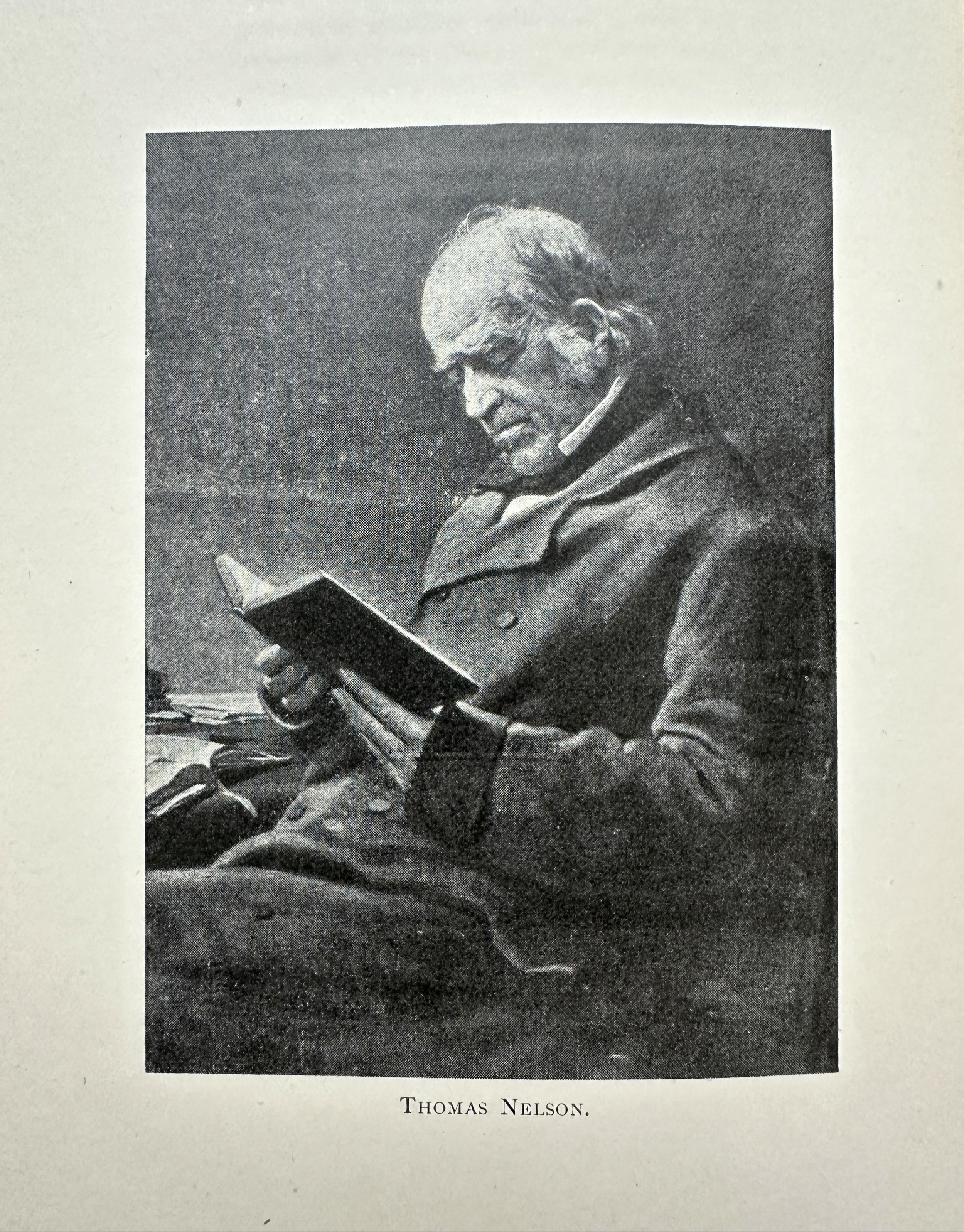
[Illustration: THOMAS NELSON.]
79
CHAPTER IX.
SOME CRAIGS FOLKS.
THOMAS NELSON was born at Throsk, near Stirling, in the year 1780. When Ebenezer Erskine left the Church of Scotland in 1733, with a large following, Nelson’s grandmother was of the company. This was not wonderful, because for generations piety of the deep old type had been one of the traditions of the Nelson family. Thomas’s father worked a small farm, and in addition was occasionally employed at a neighbouring brick and tile work. He was a good but not ambitious man. He was a manager of the Craigs Kirk. His name appears variously as William Nilson, Neilson, Nielson, and Nelson. He and his wife—like-minded in religious matters, but more active—joined the old Dissenters in Stirling—probably in 1766. Their son Thomas was born in 1780, and was baptized by Mr McMillan. I have seen it stated that he was the first child baptized by that eminent minister.
Like Hugh Miller—next to whose grave he is buried in the Grange Cemetery, Edinburgh—Thomas Nelson could have written an interesting chapter on his “Schools and Schoolmasters.” In those days, educational facilities—especially
80
in country places—were of the most limited description. Thomas was first introduced to the mysteries of learning by a worthy lady at the Throsk, named Mrs Abercrombie. But her tuition did not lead him far beyond the alphabet. His second school—its master is nameless—was one where reading and writing only were taught. Arithmetic lay outside the purview of the teacher. When the supply of reading ran short, as it was bound to do in those days, new devices had to be resorted to to fill up the time. One of these is noteworthy. His master, for lack of other exercise, caused Thomas to practise the art of reading a book upside down. This accomplishment is now rare. So small was this primitive educational establishment, that on one occasion the attendance was for some time reduced to one pupil. That pupil was Thomas Nelson. Can we wonder then that on sultry summer days part of the school time was spent by both in the arms of Morpheus! Such is the fact, and it suggests to us another picture—containing not so many figures, it is true, as the famous “Village School,” painted by Thomas Webster, R.A.—but the figures it does comprise more peaceful both in tone and pose than that by the famous academician. Mr More was Thomas Nelson’s third teacher. He had a good deal of ability and patriotism. Under him his promising pupil made much progress. Bannockburn field was not far away. Mr More would doubtless fire the Scottish ardour of his scholars by accounts of the valour of Bruce and Wallace.
81
But Nelson was the hero of the hour. Instead of ancient history, the teacher used to regale his pupils sometimes for a whole forenoon by relating such modern exploits as Nelson’s at the Battle of the Nile. The heart of the Throsk youth would glow with pride at the thought that he shared the hero’s name—for although then and for years afterwards Thomas spelled his name Neilson, yet in Scotland long ago the pronunciation of both forms was the same. At the age of 16, the pupil of Mr More became a teacher himself. He was young for such an office, but he kept good order, and we may vouch for his faithfulness. At the time at which we have now arrived—about 1796—ambitious youths in this country were thinking much about pushing their fortunes abroad. A favourite project was to emigrate to the West Indies. It was not so long before this that Burns had written in view of his own intended emigration—“Will you go to the Indies, my Mary?” There was a vessel lying at Alloa bound for that distant land. In it, it had been arranged that Thomas should bid good-bye to the Throsk and to Scotland. He packed his few belongings, and, accompanied by his father, set out for South Alloa. On the way, among other matters of conversation, this question was asked by his godly parent—“Thomas, my boy, have you ever thought that where you are going you will be far away from the means of grace?” The lad reflected, and replied—“No, father, I never thought of that, and I won’t go.” This incident shows the deep hold that religious
82
considerations had upon this young man’s heart. The man who made—humanly speaking—these deep impressions upon him was, according to his own testimony, the Rev. John McMillan. Mr Nelson never ceased to cherish the profoundest veneration for the minister of his early years, both on account of the dignity of his personal character and his high-toned spiritual ministrations. To the glad surprise of the mother, no doubt, two wayfarers instead of one returned to the humble Throsk cottage. The emigration scheme being out of the way, the next question was about an immediate means of livelihood. Thomas all his life was one who must be “diligent in business.” He got employment in a distillery at Craigend, but the work was distasteful, and he gave it up on that account, and also because he could not reconcile it with his conscience to work on the Sabbath. An incident of this period of his life deserves mention. At a colliery near by, Symington, the engineer, whose engine was first used for purposes of navigation, was manager. Mr Miller of Dalswinton had requested Symington to construct an engine to be so applied. Thomas Nelson was one of the friends who sailed with the Inventor in a model steamboat on Carron-water. It is worth while noting also in this connection that Henry Bell of Helensburgh was a friend of Thomas—who sailed with him in the “Comet,” his first steamer. Reluctant to leave his early haunts, Thomas Nelson then tried to get a situation in a pottery near home, but his
83
father gave him no encouragement in this direction. At length Nelson set out for London, where he had great difficulty in obtaining employment. After honourably discharging his obligations to his landlady he was reduced to a single coin. Even this he parted with to a beggar. In his penniless condition he accosted every likely-looking gentleman he met, and asked if he knew of any situation open to a lad like himself. Soon he heard of a place in the office of a publisher in Paternoster Row. He applied for it, and was successful. The work was most congenial to one of his tastes, for he had always loved books, especially those of a religious character. This part of Mr Nelson’s career was brightened by the acquaintance of one who, like himself, rose to eminence—the late Alderman Kelly—who became Lord Mayor of London. When young Nelson prospered to some extent, like the canny Scot he was, he determined to lodge his savings in the Bank of England. After a time he required some of the money, and made out a cheque for the amount. But he could not get the money because he had signed his name Neilson, and he was entered on the Bank books as Nelson. To get the money he had to conform. So it comes about that the famous firm bearing his name is Thomas Nelson and not Thomas Neilson & Sons. Telling the story to M. S. Tait, Esq., Glasgow, Mr Nelson added, with the twinkle of a joker, “and thus, like the great naval hero of the same name, I lost an ‘i’ in the service of my country.” In
84
the metropolis he did not forget the early precepts of his home, nor the godly counsels of his spiritual father in the Craigs of Stirling. With others like-minded—all of the old Covenanting stock—he carried on a prayer meeting. All the while he must have kept up correspondence with Mr McMillan, for at Hamilton, in 1804, there was a representation from him asking that a minister should be sent to London for a time to give the members of the Praying Society a supply of Gospel ordinances. The Rev. John Reid was sent to London for five Sabbaths in 1805, and, at the suggestion of the Society, a short statement of principles was drawn up and printed, “as a habile mean for promoting a knowledge of the Reformation principles of the Church of Scotland.” Obtaining an agency for a publishing house in London, Thomas Nelson started for Edinburgh in 1808. In July of that year he came back to the Throsk with two objects in view. One was, to see a brother who was ailing at the time. The other was, that the Sacrament was to be dispensed at Stirling, by the venerable minister who baptized him, on the third Sabbath of that month. So he came to the Craigs, and was admitted to the full Communion of the Church. He had never forgotten the minister and friend of his earlier years. For—as Dr Goold has beautifully put it, in a biographical sketch in the Reformed Presbyterian Magazine for May, 1861—“in London, his heart deeply imbued with the holy associations of his boyhood, fondly turned
85
to the humble congregation of the Craigs at Stirling as the Jerusalem which all the splendours of Babylon could not induce him to forget.” Thomas Nelson would be of the company in the Well Green on the occasion when Mr McMillan came down from Viewforth accompanied by the Rev. Messrs John Reid, John Fairley, and William Goold—and Mr James Reid, Probationer, whom the Presbytery had appointed to assist at that Communion Season at Stirling. Mr Nelson’s name appears on the Roll of the Edinburgh congregation in 1809. In 1811 he was chosen an elder. Until his death, in 1861, his busy life was filled up to the measure of his strength with various forms of Christian usefulness. Precentor, Treasurer, Representative Elder in the Church Courts—in these and other ways he was a tower of strength to the Christian community he loved so well.
The great publishing house associated with the honoured name of Thomas Nelson arose from humble beginnings. Many will remember the picturesque old tenement at the West Bow, Edinburgh. It was an old timber-fronted “land,” each storey projecting outwards farther than that below it. In the little piazza at the corner of the Bow and the High Street Thomas Nelson started his first book store, which was soon filled with second-hand volumes. Among others, the students at the University soon found it to their advantage to deal with him. The late Rev. Dr Crichton told me that the sterling integrity of Mr Nelson commended him
86
and his wares to them. What he stated to be the price of a given volume they knew must be just. The business grew, and by-and-bye Mr Nelson began in a small way as publisher. Curwen, in his “History of Booksellers,” says that “Nelson in his little corner shop off the West Bow, commencing with a humble reprint of ‘The Vicar of Wakefield,’ arrived in time at the more ponderous honour of Josephus.” Reprints of standard religious works such as Paley, Leighton, and Romaine followed. These were so cheap that booksellers would have nothing to do with them, so that for a time they had to be sold by auction at fairs throughout the country.
At first Mr Nelson resided in Trotter’s Close, near his place of business. He soon removed to Gordon House, on the site of the Assembly Hall, while his business was transferred to the famous old palace of Mary of Guise, on the site of the Free Assembly Hall and the New College. In 1843 the firm—his sons William and Thomas had ere this joined as partners—removed to the commodious premises at Hope Park, which great establishment perished by fire in 1878. The beautiful, complete, and well-ordered place of business at Parkside, with its hundreds of employees, bears emphatic testimony to the success which attends well-directed effort carried out on the foundation of good principle. All over the English speaking world, the name of the boy from the Throsk is known, and it is a synonym for honest, substantial, beautiful work.
87
For the last twenty-five years of his life Mr Nelson was pretty much an invalid—except from 1843 to 1850, when he enjoyed a respite from illness. One of his sons—the late Rev. Dr John Nelson of Greenock—has left behind him a beautifully written sketch of his father’s closing days, which was published in the Christian Treasury for 1861. It shows him as the suffering yet rejoicing saint, and abounds with passages which manifest his deep religious experience. Prayer was the vocabulary of his heart.
A ministerial friend who had called one day, and on account of another engagement, could not find time for the exercise of devotion, was reminded of this on the occasion of his next call with the words—“We will take the prayer first to-day.” When he was informed of his rapidly approaching end, after receiving the message, he calmly remarked, taking up his New Testament—“Now, I must finish my chapter.” Mr Nelson died at Abden House, Edinburgh, on the 23rd March, 1861.
At the Union Assembly—that of 1876—when the Free and Reformed Presbyterian Churches of Scotland became one, I had the pleasure of being kindly entertained by the widow of him whose early history was so intimately and sacredly bound up with the Craigs congregation. I cannot forget my hostess. She seemed to me the very model of a Christian lady—sweet, managing, motherly. Then, and on subsequent occasions, I had the privilege of meeting all the members of Thomas Nelson’s family.
88
WILLIAM (named after his grandfather, the old Craigs manager) was full of his projects for the completion of his restoration of historical portions of Edinburgh Castle at the Assembly time of 1887. He explained them all to Provost Swan of Kirkcaldy and myself as we perambulated the ferneries at Salisbury Green. The Provost (that “lump of love,” as the late Henry Drummond of Stirling, father of the late Professor Drummond, used to call him) regaled us on the same occasion with reminiscences of the time when Thomas Carlyle was his teacher. Mr Nelson was anticipating then an autumn tour in Greece. But on the very day he was to sail, one touched him, and said, “Friend, come up higher.”
THOMAS—who deserves the grateful remembrance of the generations of school children, for he was the originator of the extensive series of school-books which have found their way round the world—he also has joined the majority, but he has left by his princely benefaction to the poor, a permanent reminder of his name. The Pulpit Bible still in use in the Craigs was presented by him to the congregation, when my predecessor was settled in 1849.
The Rev. Dr JOHN NELSON (successor to Dr Patrick Macfarlane, and predecessor of Dr Hugh Macmillan of Greenock), a saintly, lovable, accomplished minister, died in 1878, only six weeks after his mother, whom he devotedly loved, was called to her rest.
89
JAMES, always of a shy, retiring, but most kindly disposition, has left us; and so, of the family, only the daughters remain—one the widow of the Hon. George Brown of Toronto; and the other, Miss Nelson, who retains the dwelling of her father and mother, with its beautiful prospect past Arthur’s Seat and over Duddingston Loch, to where North Berwick Law stands sentinel—looking up the Forth, and out into the sea.
GEORGE M. BROWN, Esq., a grandson of the founder, to whom I am indebted for kind and valuable help, has, meantime, a chief hand in carrying out worthily the traditions of the house of Thomas Nelson & Sons.
ALEXANDER PEARSON belonged to the Dunblane quarter of the congregation. So far as I can gather, he was what was called in the Cathedral city an “agent” for the manufacturers. I take this to mean that he distributed yarn to weavers and had it returned to him in the form of cloth, he paying them for their labour.
I do not know when he joined the congregation, or when he was called to office therein. The first entry containing his name is of date April 8th, 1803. Judging from the regularity with which his name appears as officiating at the plate, I should think he deserves notice as a most exemplary member of the Craigs Church. The late ex-Bailie Shearer told me that Mr Pearson and his company from Dunblane used
90
to pass Bridge of Allan with such regularity that the good folks there used to set their clocks on the Sabbath mornings by them.
To save shoe-leather in the old days, some of the people used to walk bare-footed. When they came to the Old Bridge they used to dip their feet in the river, and then, having put on stockings and shoes, pass through the town to the Kirk. The reverse process, excluding of course the washing, was performed at the Bridge on their homeward way. Mr Pearson showed his attachment to the congregation by a considerable legacy, as we shall see further on. It goes without saying that he was a man of piety. He was also a man of tact, of which the following story furnishes ample proof.
On one occasion, Mr Pearson was in the Edinburgh district, whether at a Presbytery meeting as a representative elder or at a communion I cannot tell,—I favour the latter supposition. He came home from Leith by steamer. It was in the early days of this mode of conveyance, and, as in the case of Dr Wm. Symington’s voyage from Renfrew to Stranraer, even a short journey took a considerable time. Among the passengers were a military captain and his company on their way to Stirling Castle. The soldiers were a rough, swearing, drinking lot; how to administer a rebuke pleasantly yet effectually was the problem which exercised the mind of the good elder. At length he boldly advanced to them and said—“The day is wearing on, and our journey is a long one, what do you say, lads, to
91
while away the time with guesses?” The suggestion was hailed as a happy one, and the proposer of the amusement was asked to begin. This was the first “guess” that he proposed:—“What is it that some men are constantly doing, that the devils cannot do?” There was much perplexity and many vain attempts at a solution. At last all the soldiers gave it up. On being appealed to for the answer, “Well,” said the worthy Craigs elder, “Some men are constantly doing what the devils cannot do, for the devils cannot ask their Maker to damn them.” This was a sermon without sermonising. There might be more “guesses” on the journey—I cannot say as to that—but profanity would not be ventured on again in such a presence. Mr Pearson died in the spring of 1838. On 13th April of that year the Kirk Session say that they “have to record the death of A. Pearson, for many years elder in the congregation, and feel called to bear their testimony to his piety and faithfulness as a member and office-bearer in the church.”
MR PETER JAFFREY or JEFFREY was a most exemplary member, manager, and elder in the Kirk in the Craigs of Stirling. He had a farm at the Throsk, and besides, carried on business as a brick and tile maker. He enjoyed, as he richly deserved, the esteem of all who came in contact with him for his sterling business qualities and his admirable Christian character. If anything were needed in the form of active or financial
92
help, Mr Jeffrey’s name in the old treasurers’ books always stands among the foremost. For many long years he was preses of the congregation. Mr Jeffrey died in 1842. His loss is noticed in a few pregnant words by the Kirk Session. They say:—“He was a man of extensive Christian experience, sound and unaffected piety, and enlightened zeal and fidelity in the cause of Christ.”
To John Wordie, Esq., Glasgow, a “Captain of Industry,” and a warm friend of Art, as well as an enthusiastic “Son of the Rock,” I am indebted for particulars of some of Mr Jeffrey’s family.
THOMAS carried on the farm at the Throsk. He died unmarried at Lenzie, in 1883.
JOHN and DAVID carried on business as brewers in Edinburgh. The latter is now the only surviving son, and he has vivid recollections of the strict training of his early days. In a letter of his which I have seen, Mr Jeffrey gives the old Craigs folks the character of having been “extremely narrow but very upright.” When for any reason there was no preaching in the Craigs, Mr Jeffrey remembers that the whole family were ordered home—an order which was honoured in the breach by some, and in the observance by others.
It was a Craigs member from the direction of the Throsk of whom the story is told, that having been met on his way home during Church hours by a neighbour, and having been reminded that there were other places of worship in Stirling,
93
open if the Craigs Kirk was shut for the day, replied—“Ah! but I like to eat my dinner oot o’ a clean dish.”
There are still narrow ways of apprehending the duty of faithfulness.
WILLIAM was minister of the Parish of Riccarton, near Kilmarnock.
The eldest of Mr Jeffrey’s daughters was ANNIE (Mrs M‘Ewan) of Alloa. The only survivors of her family are Mrs James Younger, Alloa, and William M‘Ewan, Esq., M.P., the donor of the splendid M‘Ewan Hall to the University of Edinburgh—a princely gift, amounting, in money value, to over £100,000.
JANET (the second of that name) became the wife of William Wordie, Esq., Glasgow. Messrs John and Peter Wordie are her sons. She still survives, at an advanced age.