Kirk in the Craigs XII.
James Dodson
105
CHAPTER XII.
THE THIRD MINISTER.
PROFESSOR WILLIAM BINNIE, M.A., D.D.
Binnock or Binning (now Binnie) is an old West-Lothian name. Robert Bruce gave William Binnock or Binning “A crow’s flight of land” for taking Linlithgow Castle from the English. Barbour, in his Bruce, says that the said William Binning was “dour and stout.” From the stock of this doughty wight came the third minister of the Kirk in the Craigs of Stirling. When John McMillan I. removed from Balmaghie to the Upper Ward of Lanarkshire, it was the Rodger of Foulyett for the time being—the ancestor of Mr Binnie, through his grandmother Margaret Rodger—who removed his belongings.
Thomas Binnie, the father of the subject of the present notice, began life in a humble way. By strict integrity, hard work, and the stern covenanting piety that was in him, he came to honour and usefulness. “Binnie Place” in Glasgow bears the name of its well-known builder. He is one of the “Hundred Glasgow men” of whom the western metropolis is proud.
106
To read the privately-printed memoir of him by his son Thomas—the well-known property valuator in Glasgow—is, for a mind that can appreciate a record of sterling worth, a positive pleasure.
William, the second son of the elder Thomas, was born on 20th August, 1823. He entered at Glasgow University in his fourteenth year, and took the degree of M.A. at the close of his arts course. Having studied Theology for the usual number of sessions at Paisley, under Dr Andrew Symington, Mr Binnie proceeded to Berlin, where he sat, as a student of Church History, at the feet of the famous Neander. He turned ill there—so ill that his worthy father had to go and bring him home. The young student thus regretfully missed a course of study at Bonn, to which he had looked forward with much interest. This was in 1846. He was licensed by the Glasgow Presbytery as a preacher of the Gospel in 1847.
On 12th March, 1849, the Craigs congregation—David Yellowlees, Esq., and Peter Drummond, Esq. (of Viewforth), being witnesses of the proceedings—called Mr William Binnie to be their minister. On 25th May of the same year, Mr Binnie was settled at Stirling. His own minister, the Rev. Professor William Symington, D.D., of Glasgow, ordained him.
Those of us who have seen Venice know what the late R. L. Stevenson means when he says of the “Queen of the Adriatic,” that “She counts lovers in her train.” Stirling, too, can boast of many such. From the day of his settlement
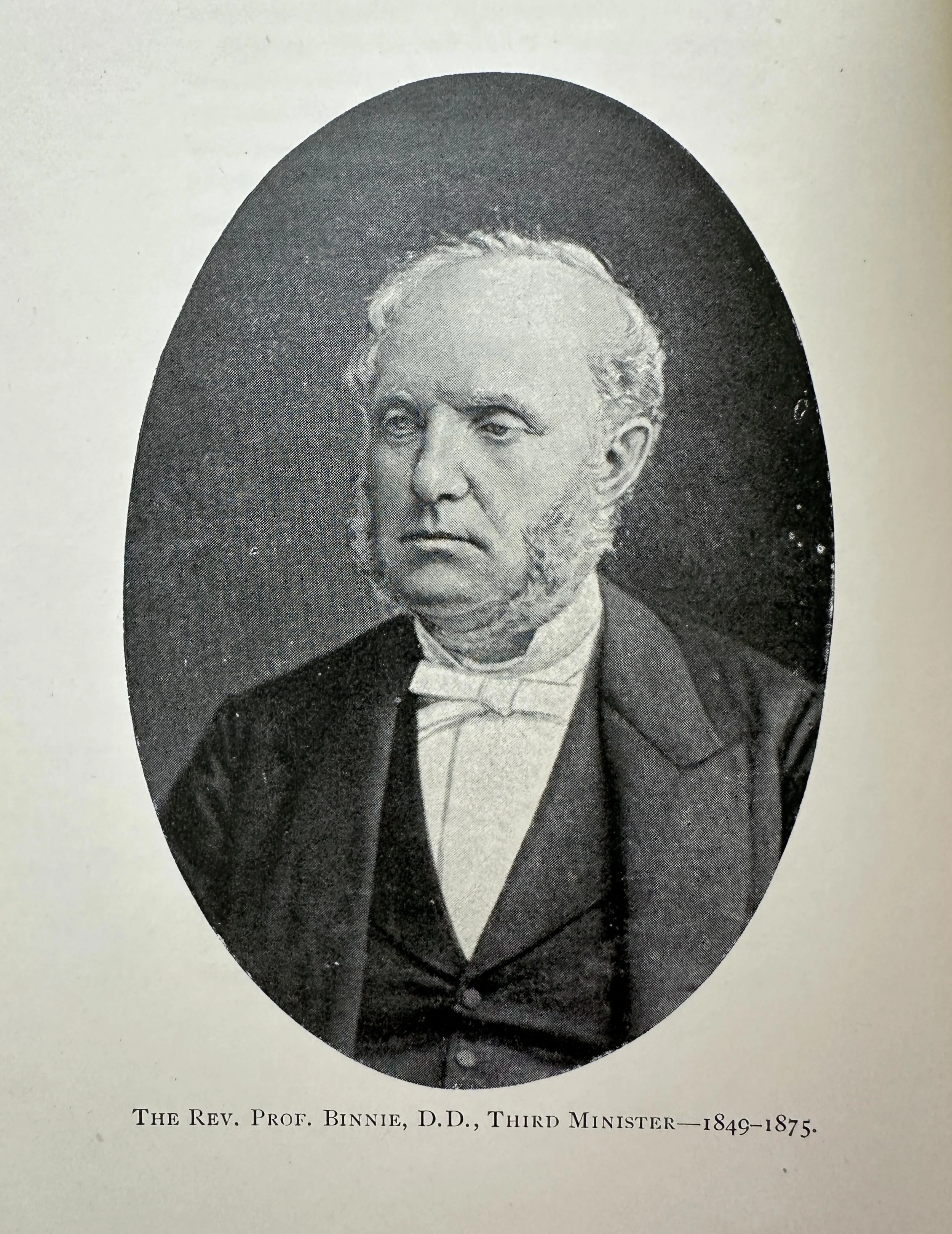
[Illustration: THE REV. PROF. BINNIE, D.D., THIRD MINISTER—1849-1875.]
107
here, Mr Binnie was of the number. On the afternoon of that day, the young minister—his mind impressed with the solemn services which meant so much for him—strolled round our venerable Rock Walk, to see the surroundings of his sphere of labour. Coming in view of the Georgian chain, blue with distance, and of the Castle slopes, bright with green leaves, he raised his hat and gave thanks to God who had sent him to such a beautiful place. This little incident was characteristic of a life-long attitude of thankful devoutness toward nature and nature’s God.
As a minister of Christ, and as a pastor, Mr Binnie laboured tenderly and faithfully. With no pretentiousness, but with abundant fulness, he set forth by his lips and life the doctrines taught and the duties enjoined by the Divine Word. Thoughtful people found in him an acceptable guide, while cultured minds relished the sweet reasonableness of his matter and method. In devotional utterance the tongue spake clearly of what the heart knew experimentally and well.
In the general business of his denomination in Presbytery and Synod, Mr Binnie, from his character and abilities, could not fail to play a quiet but very influential part.
For twenty-six years he remained in this community, increasingly gathering round him the profound respect of the population. On the death of Professor Symington, in 1862, the Synod came back to the [seat] of the College in
108
the Craigs of Stirling for a new Professor of Systematic Theology and Homiletics, and appointed Mr Binnie to the chair. In the work of training the students preparing for the ministry of the Reformed Presbyterian Church, Drs Goold and Binnie (who was created D.D. by Glasgow University in 1866) were associated until the end of the 1875 session. In 1870 Dr Binnie gave to the world his well-known book on the Psalms. The work was based on a series of lectures delivered from time to time in the Kirk in the Craigs. Speaking of this production, the late Mr Spurgeon said that in his judgment it is “a highly valuable work.” “Dr Binnie,” he continues, “reviews with great skill and intense devotion the various sacred poems contained in the Book of Psalms, and gives the general run and character of each one. His work is unlike any other, and supplies a great desideratum.” In our good town, Professor Binnie’s worth was fully recognised. To the front in every good work to which he could give a helping hand, he was appointed, in 1873, to the responsible position of Chairman of the first Burgh School Board—a post which he occupied until his removal from Stirling. Dr Binnie did excellent service in this regard, the lines he laid down—especially the direction of religious training—being still adhered to.
At the August Commission of the General Assembly of the Free Church of Scotland, in 1875, the Rev. Dr Beith of Stirling, Convener of the Committee on the Election of Professors,
109
reported that out of 63 Presbyteries that had sent in nominations for the new chair of Church History at Aberdeen, 53 had nominated Dr Binnie—33 of these proposing him as their only candidate, under the Mutual Eligibility Act. Dr Beith, in a singularly happy and discriminating speech, proposed the election of his friend and fellow-townsman—taking occasion, as he was so well qualified to do, to comment on his various acquirements. The deliverance was unanimously agreed to. At a meeting of the Reformed Presbytery of Glasgow, held on 14th September, 1875, Dr Binnie expressed his intention of accepting the call to Aberdeen.
There was much sorrow among the members of the Craigs congregation at the prospect of losing their teacher and friend. Still, perceiving that without his seeking, a door of honour and usefulness had been opened for him, they not only offered no objection to his translation, but determined to mark his departure with an expression of their love for Dr and Mrs Binnie. This they did on 14th October, 1875. A wider circle was interested in Dr Binnie’s removal to “the Granite City.” On 26th October the Doctor, with his wife and family, was entertained to a public breakfast—the Rev. Dr Beith in the chair—when presentations were made—“as an expression of the esteem of the community for his consistent character as a Christian gentleman and minister, respect for his abilities and attainments, and high appreciation of his services as first Chairman of the School Board of the Burgh.”
110
On 3rd November, 1875, Dr Binnie was inducted as Professor of Church History in the Free Church College, Aberdeen.
Until the year of his sudden and lamented death Professor Binnie served the Church which had honoured him with great faithfulness. The students felt that in him they had not only a teacher but a friend. In Aberdeen Dr Binnie served for three years on the School Board, giving freely there what he had gathered in Stirling. The Free West Congregation and its ministers—Rev. Dr (now Professor) Laidlaw and Rev. G. W. Thomson, M.A.—found his services most valuable among young and old. As an elder, his many visits to the sick and sorrowing were always a source of comfort and strength. Towards the close of September, 1886, Dr Binnie went for a short visit to his brother Thomas in his native city of Glasgow. He died there very suddenly on 22nd September at the age of 63.
There was great mourning over the unexpected event in both branches of the Church to which he belonged, and especially in the places in which he had laboured. All who had known him even slightly felt and said that a life in which were blended Christian helpfulness, and charity, and dignity, had been taken by Him who gave. I can think of no better way of summing up the life and labours of this eminent minister of the Kirk in the Craigs than by giving here the minute of the Free Church Synod of Aberdeen of October 12th, 1886. It was drawn
111
up by a committee consisting of the late Rev. Principal Brown, D.D., Professor Salmond, D.D., Professor Iverach, D.D., and the Rev. G. W. Thomson, M.A.:—
“The Synod desires to record its sense of the loss which the Church has sustained by the death of Dr William Binnie, professor of Church History and Pastoral Theology in the Free Church College, Aberdeen. Though a most loyal and attached member and minister of the Free Church, the earlier years of Dr Binnie’s ministry were spent in the Reformed Presbyterian Church of Scotland, which he served both as pastor of a congregation in Stirling and as one of its theological professors. It was in 1875, before the union of the Reformed Presbyterian Church with the Free Church—but when that union was known to be in the near future—that he was appointed by the Free Church to a chair in the College here. His appointment was felt to be a matter of singular satisfaction at the time, both because it was a graceful recognition by the larger body of the scholarship of the Reformed Presbyterian Church, and because it brought to the teaching staff of the Free Church a distinct accession of strength. Dr Binnie amply justified the hopes that were entertained at his appointment. He brought to the discharge of the duties of his chair intellectual gifts of a high order, extensive acquirements as a theologian, unfailing good sense, conscientiousness, courtesy, dignity, and above all faith in Christ immovably firm. As a scholar and
112
teacher his brethren regarded him with much respect, but it was especially his personal character that secured for him the universally high esteem in which he was held. None who made his acquaintance failed to recognise in him a genuine unobtrusive Christian man, kindly, wise, devout, adorning the doctrine of God our Saviour in all things. Dr Binnie’s contributions to literature have not been extensive. His book on the Psalms, which it was one of the last labours of his life to revise and enlarge, is widely recognised as of great value. That volume, however, was properly the outcome of his duties when occupying a pulpit, and he has not been spared to give to the world the fruits of his studies as a Professor of Church History. Those who knew him well are aware that he was unusually well qualified to deal with many portions of history, perhaps especially with the history of the Church of Christ in Scotland. But he always worked slowly; he was fastidious in composition, and he had no consuming ambition, and it may be that even had his life been prolonged he might not have written very much. There are some who think that his really admirable hand-book on ‘The Church’ has not yet obtained the recognition it deserves. Dr Binnie’s death was very sudden. He died almost instantaneously while absent from home on a visit to friends. But the consolation is left to all who loved him, and especially to his sorely bereaved, that the call found him fully prepared. It is known that he had familiarised himself
113
with the thought of death, and anticipated that it might be sudden, and with perfect calmness and confidence had committed himself to Christ, whom he had known from his youth and sought to serve all his life.”
In 1850, Dr Binnie was married to Miss Janet Fairbairn—a sister of the late Rev. John C. Fairbairn of Allanton Free Church, Berwickshire. Mrs Binnie, an admirable and accomplished helpmeet, predeceased her husband by only a few months. Their family consists of three sons and four daughters. Mr Thomas F. Binnie is the Manager of the Scottish-American Mortgage Company, Edinburgh; William is settled in Texas; John Fairbairn, the third son, is a surgeon of eminence in Kansas City, Missouri, U.S.A. The eldest daughter is the wife of the Rev. James Hunter, B.D., Lauriston.
The manse in Albert Place was sold in 1855. During his residence in Stirling, Dr Binnie resided first at Forth Place, then at 25 Albert Place—which house, with that adjoining, was built by Dr Binnie’s father. Shortly before his translation to Aberdeen, Dr Binnie removed to 10 Gladstone Place.
The following is a list of Dr Binnie’s separate publications. It does not include magazine articles. During the editorship of Dr Andrew Cameron, he contributed many papers to the Christian Treasury.
114
The Church Discipline of the Scottish Reformation. . . . 8vo. pp. 8 Ter-Centenary of the Scottish Reformation as commemorated at Edinburgh, 1860. With Introduction by Dr Begg. Edited by Dr Wylie. Edinburgh, 1860.
The Spiritual Jurisdiction of the Church. With an Appendix on the Cardross Case. London; Edinburgh; and New York. 1860. 8vo. pp. 32
The First Christian Synod. A Sermon preached at the opening of the Reformed Presbyterian Synod in Edinburgh, May 6, 1861. Published at the request of Synod. T. Nelson & Sons. 1861. . . . 8vo. pp. 31
Introduction to a new edition of “The Ecclesiastical Catechism,” by Dr Alex. M‘Leod, New York. Paisley: 1868. . . . 8vo. pp. 120
The Psalms: Their History, Teachings, and Use. London: 1870. . . . 8vo. pp. viii.+400
Recent Attempts to Eliminate Supernatural Revelation from the Holy Scriptures. . . . 8vo. pp. 18 Lectures on Revealed Religion by Professors and Ministers of various Denominations. Delivered under the auspices of the Glasgow Y.M.C.A., 1872-3. With Preface by Dr. Jamieson. Glasgow. N.D.
Rev. William H. Goold, D.D., Martyrs’ Free Church, Edinburgh. . . . 4to. pp. 6 Disruption Worthies: A Memorial of 1843. Edinburgh, London. N.D.
Introduction, Notes and Questions to a new edition of Paley’s “Horæ Paulinæ.” London: 1879. . . . 8vo. pp. 240
The Proposed Reconstruction of the Old Testament History. Aberdeen. 1880. . . . 8vo. pp. 32
The Church. Edinburgh: 1882. . . . 8vo. pp. 6+152 Handbooks for Bible Classes.
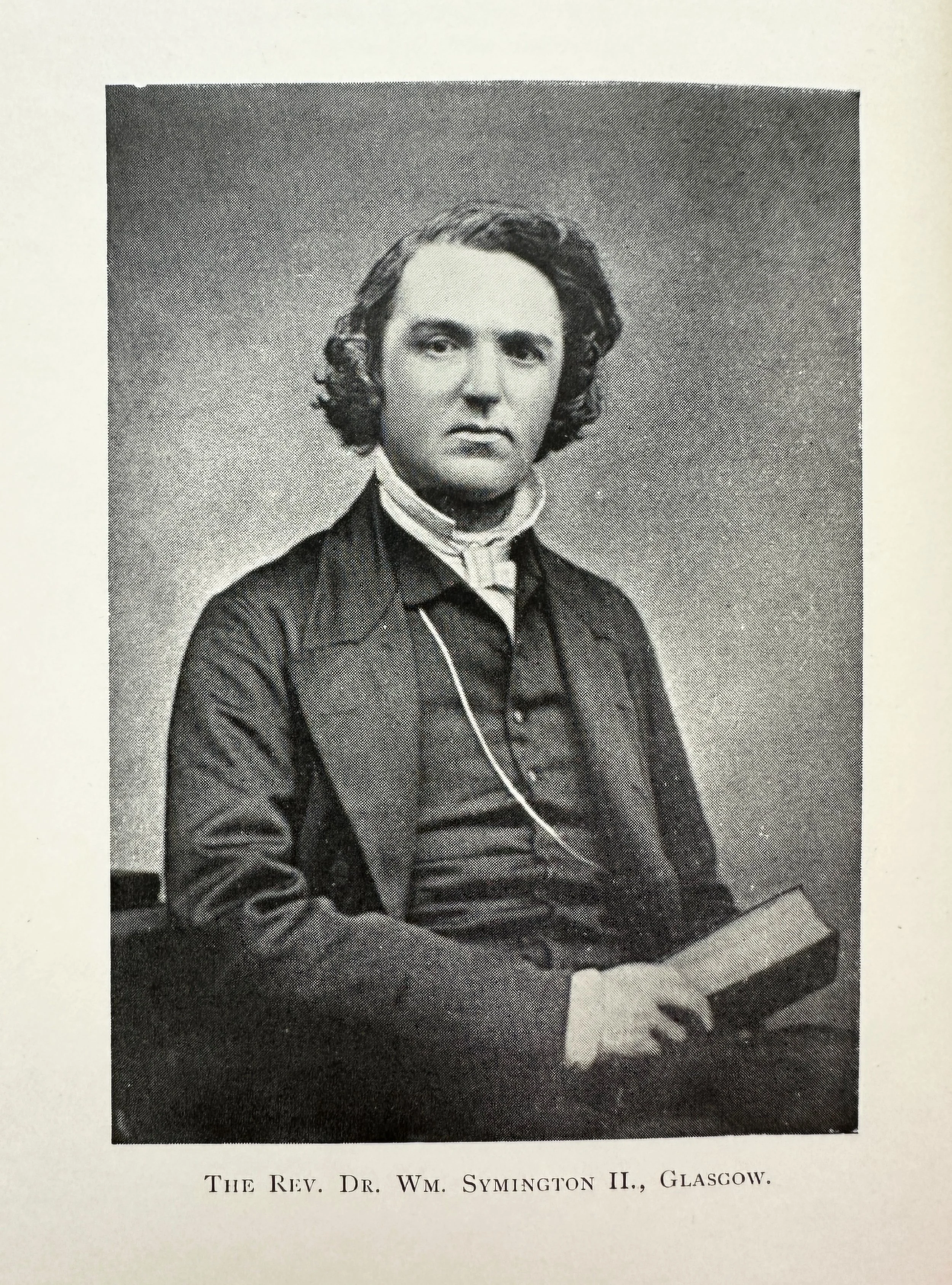
[Illustration: THE REV. DR. WM. SYMINGTON II., GLASGOW.]
115
Zinzendorf. Edinburgh: 1883. . . . 8vo. pp. 247—288 Lecture VII. Second Series of The Evangelical Succession Lectures, delivered in Free St. George’s, Edinburgh.
The Psalter. . . . A new edition, revised, enlarged, and compared throughout with the Revised Version of the Old Testament. London, 1886. . . . 8vo. pp. xiv.+414
Sermons. London and New York, 1887. 8vo. pp. 7+278 Posthumous.
For the third time in 97 years there was a vacancy in the Kirk in the Craigs of Stirling. It did not last long. The present minister, after the usual training in Arts in Glasgow University, and in Theology in the Free Church College, Glasgow, was acting at the time of his call to Stirling as assistant in Kinning Park Free Church, Glasgow. The union between the Free and Reformed Presbyterian Churches was approaching. The R.P. Presbytery of Glasgow had no difficulty in hearing the trials, and settling over one of their congregations a probationer of the Free Church. After all the preliminaries had been harmoniously settled, the ordination was proceeded with on 9th March, 1876. The Rev. Dr. William Symington II., of Great Hamilton Street, Glasgow, ordained and gave the charges to minister and people. His scholarly cultured style of address charmed and edified the many ministers and people who gathered on the occasion. At the social functions which followed, Thomas Binnie, Esq., Glasgow,
116
and the late Rev. John M‘Diarmid of Glasgow presided. The fourth minister of the Craigs was introduced to his people by the late Rev. John Hamilton—formerly of the R.P. Church, Renton—then of the Free West Church, Glasgow. After the union so happily consummated, at the Assembly in May, 1876, the name of the congregation became that of Craigs Free Church. At the June meeting of the Free Presbytery of Stirling Mr. Ormond and his elder, the late Mr. John Fergusson, were formally recognised as members of the Court, through the Rev. Dr. Beith.
On Sabbath, 10th March, 1878, Centenary Services were held. Professor Binnie officiated forenoon and evening, and his successor in the afternoon. On the evening of Monday, 11th March, a history of the congregation was given by the Rev. D. D. Ormond, the Chairman. This history it was proposed to publish, and the late Thomas Nelson, Esq., agreed to send it forth to the world. But the MS. perished in the flames when the Hope Park premises were destroyed in the autumn of 1878. This was looked upon as an unfortunate event at the time. The present volume, as it turns out, is more than a successor to that which perished.
The other proceedings at the centenary meeting were of special interest. The addresses of the late Rev. Dr. Goold, of the Rev. Dr. Frew of the United Presbyterian Church, St. Ninians, and of the Rev. John Chalmers, M.A., Stirling,
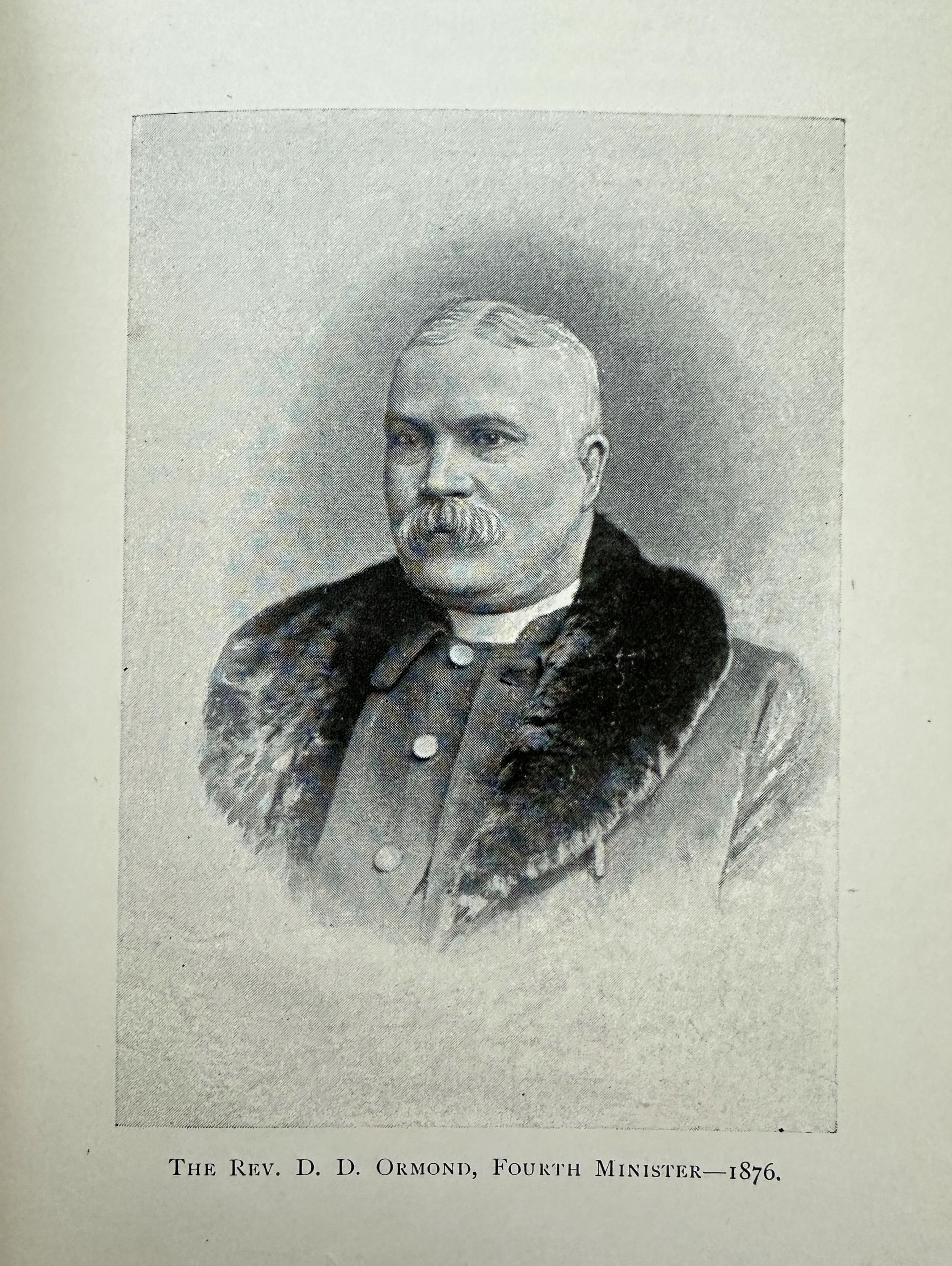
[Illustration: THE REV. D. D. ORMOND, FOURTH MINISTER—1876.]
117
dealt with the ecclesiastical situation of the time, while local colour was added through the historical and social incidents brought out in the remarks of the Rev. Messrs. M‘Diarmid and Hunter, and of Mr. James Robertson, Writer, Glasgow, a son of an old Craigs elder.
The work in the Craigs of Stirling goes on quietly. It is believed that the best traditions of the past are retained, while the loyalty of the congregation of the united church, of which for 21 years it has formed part, is not less than it was in former days to the smaller body with which it was connected. Through all the years of its history, the Gospel has been preached, and loved.
It may be of interest to note that on 9th March, 1897—the 21st anniversary of his settlement in Stirling—the present minister was appointed Moderator of the Reformed Presbyterian Synod (quoad civilia) in the succession of Prof. M‘Millan, who was first Moderator in 1811.
In 1892 he was called to the Clerk’s Chair of the Free Presbytery of Stirling, thus taking up a line of ecclesiastical activity pursued by the second minister of the Craigs. During the present year (1897) he has been placed in the succession of the third minister—Prof. Binnie—who was the first Chairman of the School Board of the Burgh of Stirling.
FINIS.