Kirk in the Craigs XI.
James Dodson
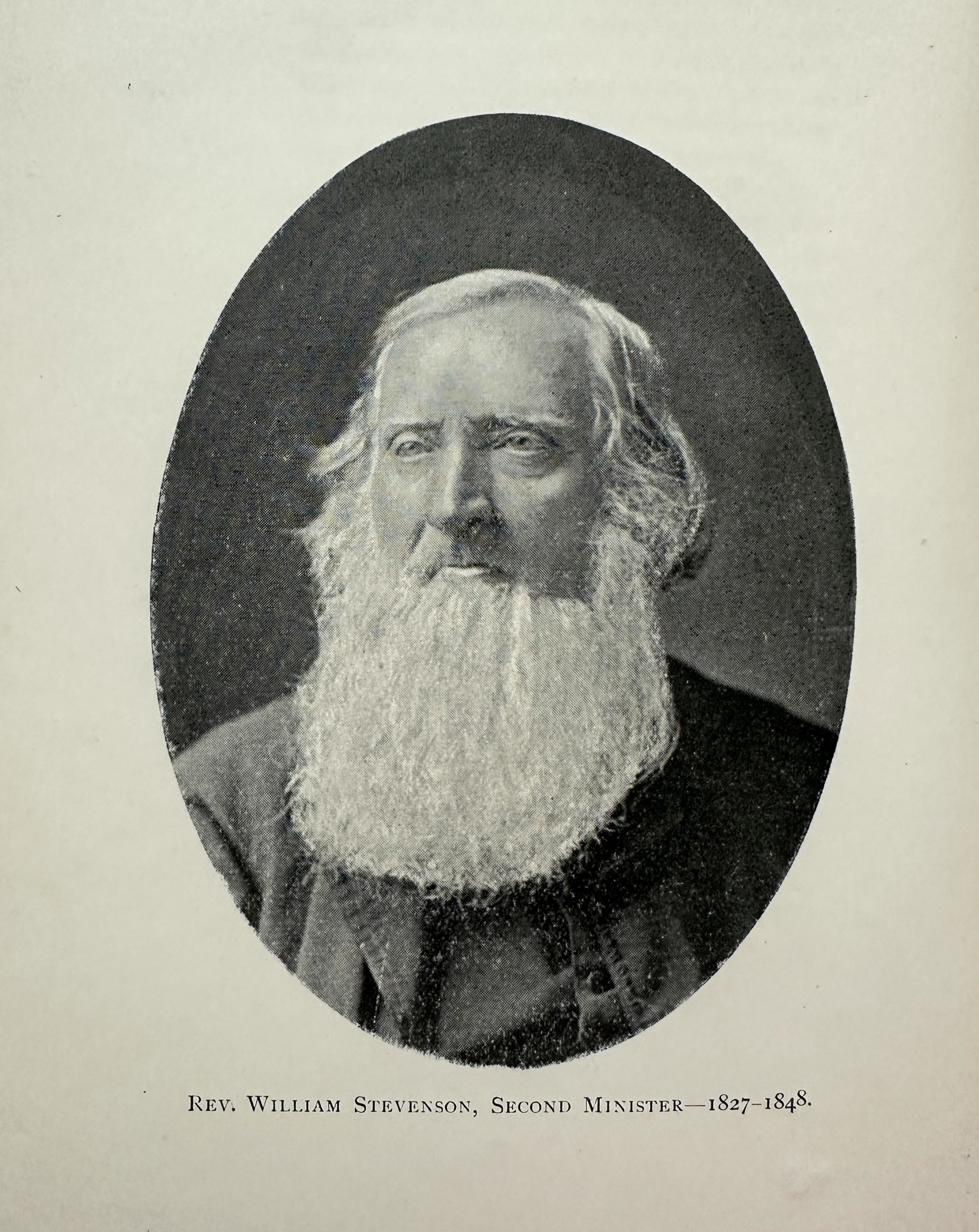
[Illustration: REV. WILLIAM STEVENSON, SECOND MINISTER—1827-1848.]
101
CHAPTER XI.
THE SECOND MINISTER.
THE REV. WILLIAM STEVENSON.
The third attempt to terminate the long vacancy was successful.
Mr WILLIAM STEVENSON accepted a call to Stirling on 15th May, 1827, and was harmoniously settled here on 12th September. At his ordination the Rev. Stewart Bates of Kelso (afterwards Dr Bates of Glasgow) preached a sermon from 2 Timothy ii. 15., which was published; while the Rev. J. Milwain (of Douglas-Water) “gave a lengthened and suitable address to the minister and people.”
I have not seen a copy of Mr Bates’s sermon. Likely it would not occupy so many pages of print as that preached at the ordination of the first minister. But one may be assured that the eloquent minister from the Border would give a good one. Mr Milwain’s addresses were not published. The note above gives about them is Mr Stevenson’s own. He would be required to stand during the delivery of one of them. He would thus note its length. Being at rest during the second, he would be at leisure to note its suitability.
102
Mr Milwain, in any case, would not be open to the rebuke administered by a veteran hearer to a young preacher, who, after a short sermon of about an hour, ventured to say—“I conclude,” “No, no, young man, stand to your time.” Three quarters of an hour in the old days of Professor M‘Millan’s father was considered only as an introduction, giving room for the complaint, “It was unco scrimpit wark.”
The long vacancy had—as was inevitable in a congregation so widely scattered—considerably depleted the membership. But Mr Stevenson for many years had a considerable hold upon the community. He had a fine presence. Old people have told me often that he was an eloquent exponent of Divine truth. On entering the pulpit, his practice was to begin the service by a commentary on the signs of the times, and the aspects of Divine Providence. For many at that time this was the equivalent of the weekly religious newspaper. No wonder it was welcomed. Then came a “preface” on the first Psalm that was given out. This was done that the people might “sing with the understanding.” When the sermon was reached, full justice was done to the subject, both as to elaboration and quantity. A fine gospel text like that about the “corn of wheat” sometimes took three Sabbaths until its import was exhausted. There was plenty for distant members to talk over on their long journey home.
Mr Stevenson organised afresh the fellowship societies in the various “quarters” of the congregation.
103
Besides, he was a capital man of business. He kept the minutes pro tempore of the Kirk Session. But his tempus lasted all his time. Mr Pearson was nominally Session-Clerk, but that worthy man contented himself with making history in a small way: he left his minister to write it. The minutes kept by Mr Stevenson are models of compact statement. He would have satisfied Matthew Arnold himself on the point of lucidity. Mr Stevenson also acted for some years, from 1845, as Clerk to the Glasgow Presbytery.
During the long vacancy (from 1819-1827), a great help came to the congregation from a legacy of £225 nett bequeathed by Mr Robert Millar (of Hillhead), who resided at Newhouse.
At the death of Mr Alexander Pearson’s widow in 1838, it was found that she, in harmony with her late husband’s intentions, had left £400 to the congregation, to which husband and wife were so deeply attached. The advice of Mr James Chrystal was taken in 1843 as to whether this money could be legally devoted to the building of a manse. Mr Chrystal thought it could, and a manse, planned by Mr Calder of Stirling, was erected. It is No. 6 Albert Place. Mr Galbraith, the Town Clerk, drew up the title deeds. Mr Shanks Moir, advocate, and Mr Gifford, attorney, both of Edinburgh, seem to have given some advice on the subject, for which the thanks of the managers are duly recorded.
Up to 1844, Mr Stevenson resided in St John
104
Street. When he was married in 1831 to a daughter of the Rev. William Goold of Edinburgh, the congregation agreed to pay his house rent, but now he was accommodated in a permanent dwelling belonging to the congregation. Well on in the forties some circumstances personal to Mr Stevenson occurred, which tended to mar his usefulness in the congregation and in the community. The end of the matter was that Mr Stevenson left Stirling in the year 1848. He went to Dundee, where, having laboured for some time, he was called to minister to the congregation in 1852. Subsequently, Mr Stevenson proceeded to Australia, where he preached and taught with much acceptance. He died so recently as 1879 at South Yarra, a suburb of Melbourne, at the age of 79.
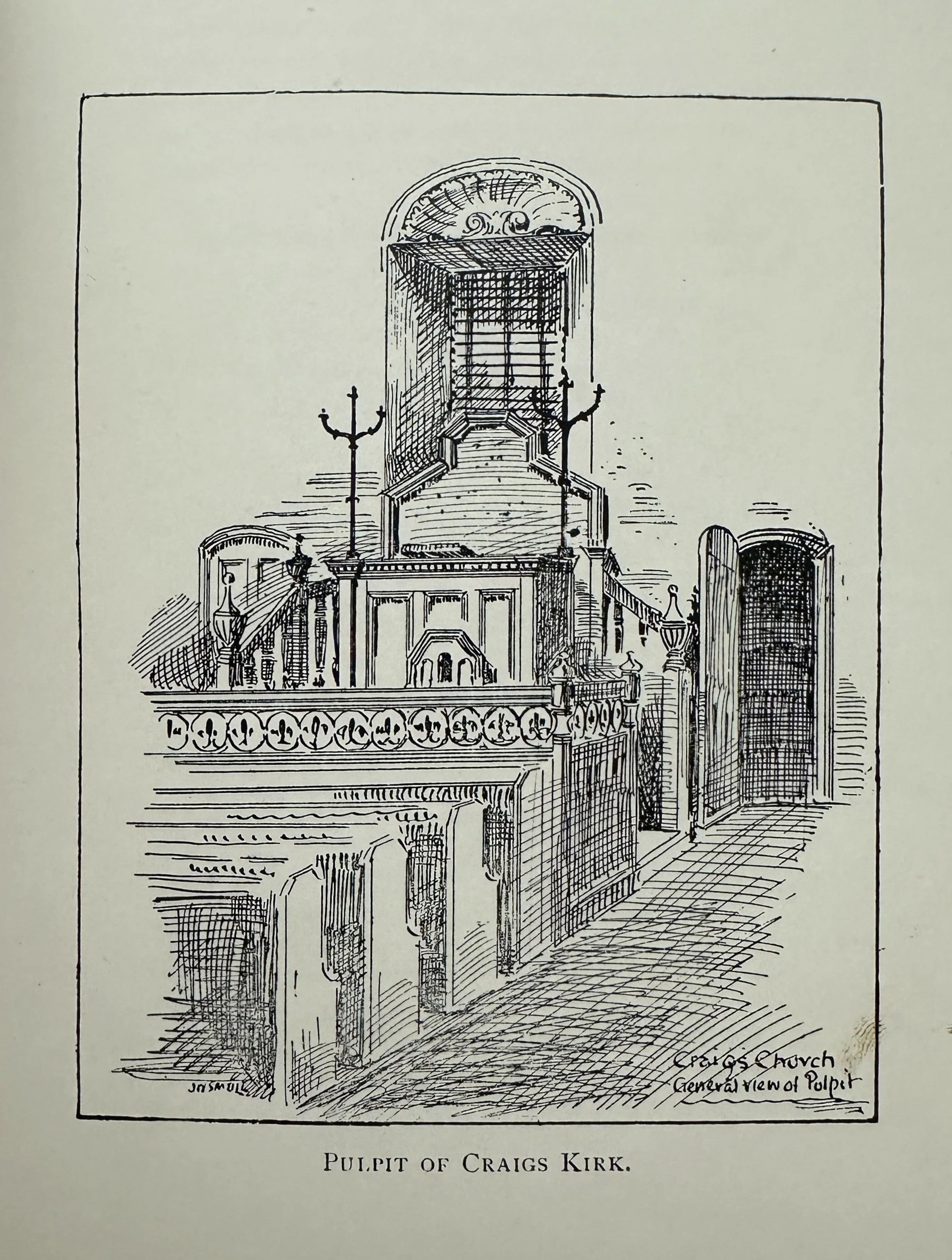
In 1846-7 the internal arrangements of the Church were changed. The old pulpit was on the wall towards the street. Its successor was placed at the east end of the building, and the pews were arranged to face it. Mr Henry Baldie’s account for the improvements amounted to £215. Still further changes for the better were effected in 1874, when the Hall was built. Robert Taylor’s walls were pierced with larger openings by the persevering efforts of ex-Bailie Ronald, Stirling. It was not until 1881 that the present most comfortable arrangements—both for minister and people—were made, at an expense of £225.
[Illustration: PULPIT OF CRAIGS KIRK.]