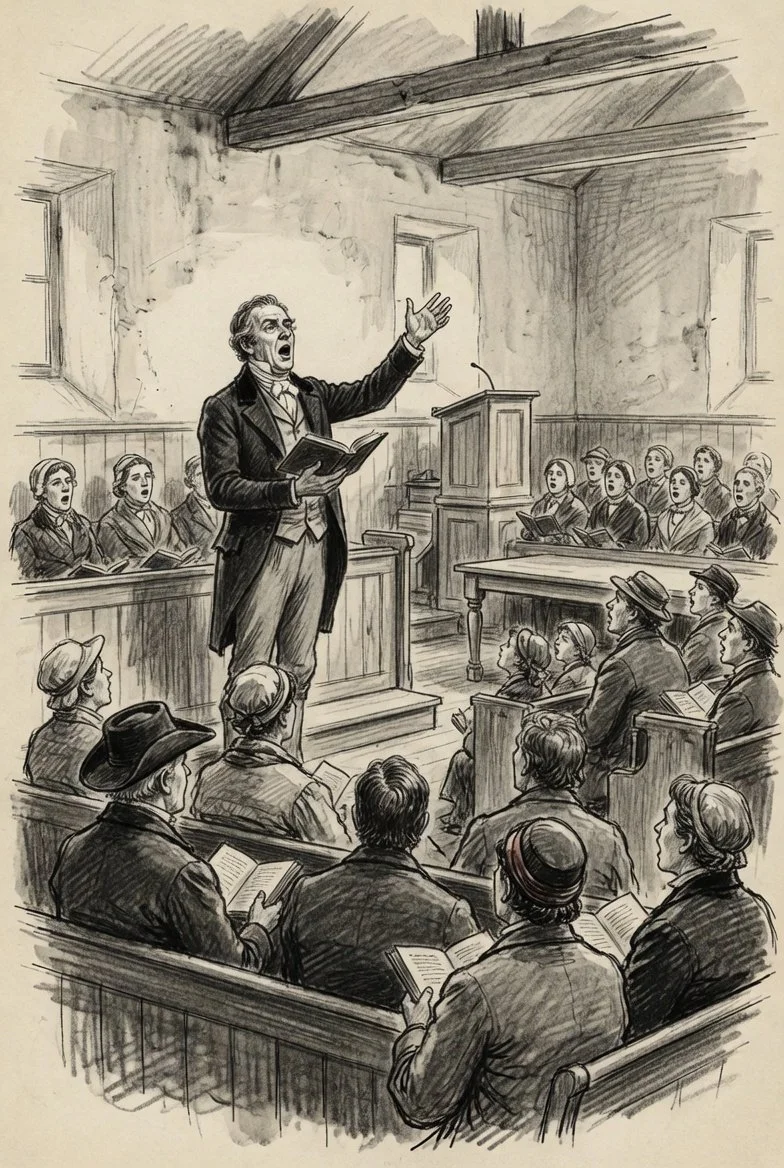
The True Psalmody;
James Dodson
OR,
THE BIBLE PSALMS
THE CHURCH’S ONLY MANUAL OF PRAISE.
PHILADELPHIA:
WILLIAM S. YOUNG, 1023 RACE STREET.
1859.
ADVERTISEMENT.
THE ministers and elders of the Reformed and United Presbyterian Churches of Philadelphia, believing that the times demand a full presentation of the subject herein discussed, held a meeting in the Cherry Street Church, Aug. 16th, 1858, at which, Revs. J. M. Willson, J. T. Cooper, and Robert J. Black, were appointed a Committee to prepare, from existing treatises, a work in favour of the exclusive use of the Scripture Psalmody as the matter of the Church’s praise. Rev. William Sterret was subsequently added to the Committee. At an adjourned meeting, having presented an outline of the work, the Committee were unanimously authorized to proceed with its publication. The names of the ministers present, are as follows: Revs. J. M. Willson, S. O. Wylie, David M‘Kee, William Sterret, Robert J. Black, S. P. Herron, A. G. M‘Auley, Francis Church, J. B. Dales, D. D., J. T. Cooper, D. D., G. C. Arnold, Robert Armstrong and T. H. Beveridge. Elders:—Robert Orr, John Evans, R. Skilton, Wm. Blakely, Dr. A. S. M‘Murray, Henry Floyd, William Crawford, Wm. Brown and others.
FRANCIS CHURCH, Chairman.
G. C. ARNOLD, Secretary.
CONTENTS.
[Three Prefaces from the Irish Edition of 1861.]
BELFAST:
PRINTED AND PUBLISHED BY JAMES JOHNSTON
W. M‘COMB, C. AITCHISON, AND M. POLLOCK, BELFAST; D. ROBERTSON, AND CURRY AND CO., DUBLIN; R. HAMILTON, LONDONDERRY; A. ELLIOT, EDINBURGH; GEO. GALLIE, GLASGOW; ALEX. GARDENER, PAISLEY.
1861.
[Original 1859 Edition]
INTRODUCTION, . . . . PAGE vii
THE BOOK OF PSALMS—COMPLETE MANUAL OF PRAISE.
Presents the most comprehensive delineation of the perfections of God, and of the character of His government, . . . 13
In Three Persons, . . . 15
Furnishes a full and accurate exhibition of man’s real state and character before God, . . . 19
The Psalms are full of Christ, . . . 24
Contain the richest fund of Christian experience, . . . 34
The most eminent Christians and Christian teachers have ever so testified, . . . 35
THE BOOK OF PSALMS HAS THE SEAL OF DIVINE APPOINTMENT, WHICH NO OTHER HAS.
Divinely appointed, . . . 46
iii
iv CONTENTS.
No other Psalms have such appointment, . . . 60
The Church of Christ, one under both Testaments, . . . 69
NO WARRANT FOR MAKING OR USING ANY OTHER HYMNS IN THE WORSHIP OF GOD.
I. Arguments used in behalf of such warrant.
That Scripture sanctions it, . . . 72
That hymns have the sanction of long and extensive use in the Church, . . . 97
The argument from analogy—from the use of our own words in prayer, . . . 125
A part of our Christian liberty, . . . 132
Used by godly men, . . . 140
Hymns may be read, &c., with edification, . . . 141
II. Arguments against the use of Hymns.
None but inspired Psalms used during the Old Testament economy, . . . 144
There is no authority by which we can be called upon to sing hymns, . . . 145
The use of hymns sets aside the Psalms, . . . 147
Hymns are sectarian, . . . 149
It has been found impracticable to frame an acceptable and permanent book of hymns, . . . 151
The advocacy of hymns has led to great errors, . . . 159
The use of hymns has led to the abandonment very largely of congregational and family singing in praise of God, . . . 168
CONTENTS. v
OBJECTIONS TO THE USE OF THE PSALMS CONSIDERED.
That they speak of a Saviour to come, . . . 184
That they are encumbered with Old Testament allusions, &c., . . . 188
That they are not adapted to a revival of religion, . . . 196
That they are hard to understand, . . . 199
That they are unsuitable for children, . . . 202
That the Psalms are not adapted to the condition of every worshipper, . . . 203
That Churches which use hymns are more prosperous than such as do not, . . . 204
That the spirit of some of the Psalms is unchristian, . . . 206
If we use the Psalms, why not sing the titles, &c.? . . . 216
REMARKS UPON THE “SCOTTISH VERSION” OF THE PSALMS.
It has been subjected to the most careful examination as to its fidelity, . . . 218
It may claim to be a faithful rendering, . . . 222
“Imitations” of the Psalms are to be compared with it in this respect, . . . 223
It has been largely approved by men of acknowledged taste, though, of course, susceptible of improvement, as is our English Bible, . . . 225
APPENDIX, . . . 229