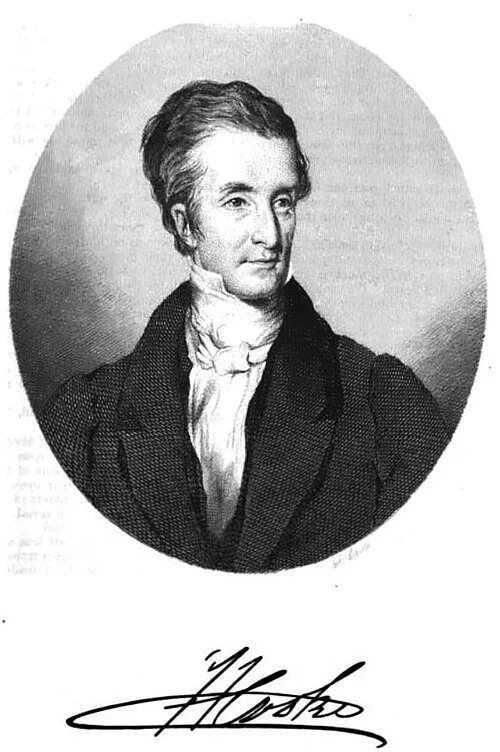
Preface by the Rev. Henry Cooke, D.D., LL.D.
James Dodson
HAVING been requested to write a Preface to a reprint, in Ireland, of an American treatise on the Psalmody of Christian worship, I have most cheerfully complied;—partly on account of the importance of the subject—partly on account of the talent displayed in the work—and partly that, by a detail of my own experience, I may add my humble testimony to a great principle.
My earliest recollection of family and public psalmody is that of the exclusive use of the English version of the Biblical Psalms, authorized by the Reformed Church of Scotland. In our Presbyterian Churches, so far as my knowledge extends, others were unknown. When I entered the ministry, in 1807, the Scottish selection of Paraphrases and Hymns had come into partial use; and influenced by the feeling in their favour, I was gradually led to adopt them. The principle of their use once adopted, the way to others was opened to an unlimited extent; for, if these paraphrases and hymns be good for public worship, it follows that others may be as good, or better. Accordingly, at one time of my ministry, I dedicated both time and pains to selecting, from all accessible sources, an additional volume, with an essay, embodying a defence of its use in private or in public worship. I need scarcely add, that I believed
4 PREFACE.
my arguments—which were partly original, and partly derivative—to be unanswerable.
I shall now detail, and as briefly as may be, the circumstances that first led me to doubt, and finally to reject my former conclusions.
Having been appointed to a short missionary tour, I left my home in good health, but was taken suddenly ill, and, during a month, was unable to return; and it was when “wearisome nights were appointed to me, and tossings to and fro until the dawning of the day,” that, in frequent solitude, I was thrown, almost entirely, on the resources of memory. But with that faculty God had sufficiently endowed me; and the psalms committed in school-boy days, and paraphrases and hymns of riper years, presented ready subjects of meditation. And it was then, that, all unexpectedly, yet irresistibly, it was impressed upon me, by experience and feeling, that the most celebrated hymns of uninspired men were, like Job’s friends, “miserable comforters,” when compared with the experience of Christ, in the days of humiliation, of which the Book of Psalms is the true prophetic picture.
And here I think it right to record the circumstances by which I was led to discover what I believe to be the true key to unlock the door of the psalms. In common with many of my brethren in the ministry, I had been accustomed to explain the morning psalm before singing, and, I believe, in common also with many, to interpret such psalms as the First (v. 1, 2, 3), and the Twenty-fourth (v. 3, 4) as elevated and elevating descriptions—not of what a believer has attained, or, in this life, can attain to, but of what he should always endeavour to at-
PREFACE. 5
tain. This canon of interpretation was almost constantly in use. Now the mind is seldom satisfied with an erroneous principle; mine, in this case, was not; for it seemed still a species of fiction. Yet I could not see my way to a better, and no man of my counsel led me. But I thought—I waited—and prayed for light; and the manner of my enlightenment was this. I had formerly, to some extent, studied botany and mineralogy; and was occasionally renewing my studies. During an excursion, a learned friend presented me a wild flower, and told me its name. I showed him another, and he could not name it. In colour and in form, it was very like the flower he had showed me, and I suggested a name derived from this partial similarity. But my friend, without hesitation, pronounced against the name, as the two plants, though like in some respects, essentially differed in others. A dear brother in Christ had lent me a new work of descriptive mineralogy, and we had compared specimens with descriptions; I often found it difficult to determine the name, though some of the external characters of the minerals agreed with the book. One principle, however, was adopted in all my enquiries and decisions: the mineral and the book must exactly agree. Now, it was after having attempted to explain the verses referred to in the Twenty-fourth Psalm; and when I was in the act of explaining, as best I could, the First Psalm, and while labouring to accommodate the description in the psalm with the state of all I knew of the attainments of the saints, that it occurred to me to say in my heart—is this the way we decide in botany and mineralogy? and my memory
6 PREFACE.
and my conscience answered no! Then said I, in my heart, there never has been a man answering, in all respects, to these descriptions. It was not Adam—Noah—Abraham—Moses—Paul; but was it not “the man Christ Jesus?” The veil was instantly removed from the Book of Psalms, and I saw therein Christ clearly. He was the man of the First Psalm—the man of the Twenty-fourth—the man of nearly the whole book. Now, while I set not up my own convictions as a rule or measure of the consciences of others, I cannot fail to pity those who can find, as they assert, so little of Christ in the inspired psalmody of the Bible, that they must seek and employ an uninspired psalmody as exhibiting Him more fully. Our Lord Himself found Himself in the psalms—(Luke xxiv. 44, 45)—and thereby “opened His disciples’ understanding, that they might understand the Scriptures.” Surely what was the clearest light to their eyes, should be light to ours. And, truly, I believe, there is one view of Christ—and that not the least important to the tired and troubled believer—that can be discovered only in the Book of Psalms—I mean His inward life. No eyewitness of the outward man—though an inspired evangelist—could penetrate the heart. But the Spirit who “searcheth the deep things of God,” has, in the psalms, laid open the inmost thoughts, sorrows, and conflicts of our Lord. The Evangelists faithfully and intelligently depict the sinless Man: the psalms alone lay open the heart of “the Man of sorrows.” The most pious productions of uninspired men are a shallow stream—the psalms an unfathomable and shoreless ocean.
PREFACE. 7
In conclusion, I beg to record, that two things confirmed my decision in favour of the exclusive use of inspired psalmody in public worship. First, the Biblical Psalms being inspired by the Holy Ghost, (2 Tim. iii. 16; 1 Peter i. 21,) in using them, there can be no error. Secondly, though in uninspired sacred poetry I had discovered many beauties and other excellencies, I never had discovered any compilations which I could pronounce free from serious doctrinal errors. This I perceived to be especially the case with not a few of the Paraphrases and Hymns, authorized by the Church of Scotland. If a doctrinal error be, at all times, dangerous, how much more when it is stereotyped in the devotions of the sanctuary!
H. COOKE.
BELFAST, April, 8th, 1861.