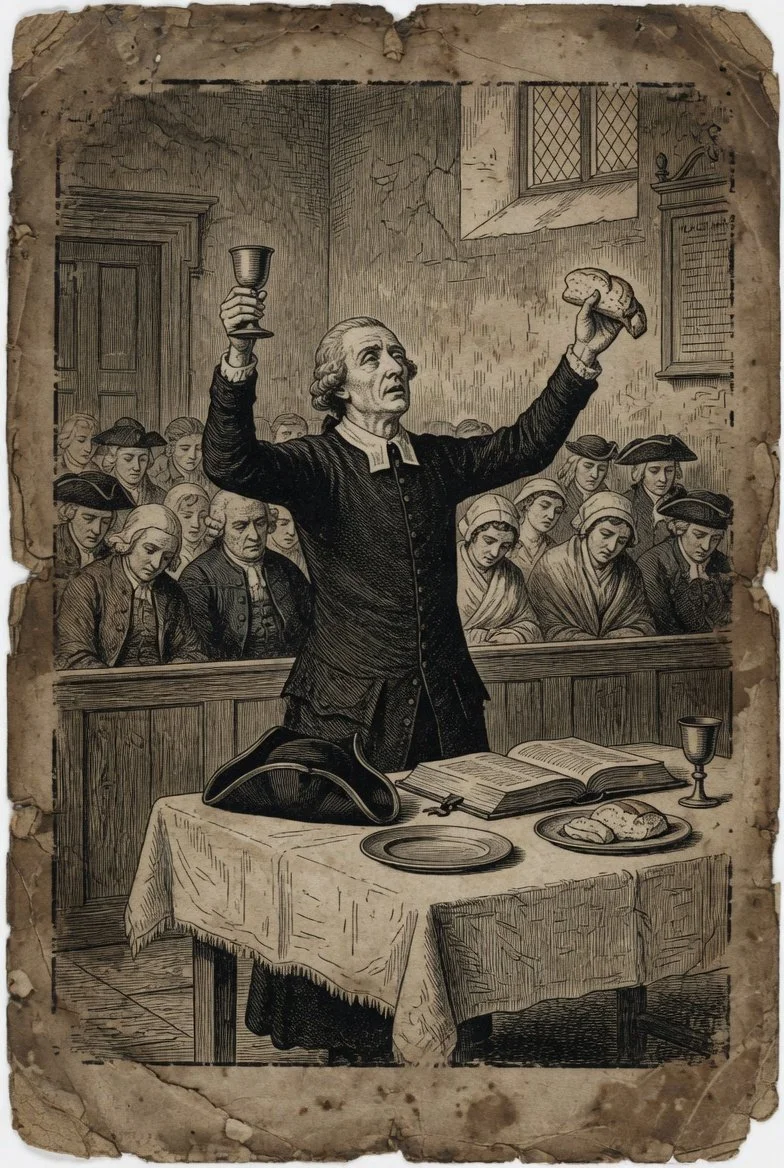
A Collection of Acts of the General Assembly Anent the manner of dispensing the LORD’s Supper.
James Dodson
To which is prefixed
Three parts of the BOOK OF COMMON ORDER, viz. On BAPTISM, the LORD’S SUPPER, and MARRIAGE; wrote by the Revd. Mr. JOHN KNOX in Geneva, and approven by the Church of Scotland in the first and second Reformation.
Taken from an Edition printed before the Psalms at Aberdeen, in the Year 1633.
Together with
Quotations from the Confession of Faith, Act and Testimony, Doctrine of Grace,—and six Questions to the unprejudiced Reader.
GLASGOW:
Printed by J. GALBRAITH, and to be sold by J. GILLIES at his shop above the cross, and the Booksellers in Town and Country.
MDCCLXXXIV.
[Page 3]
THE ORDER OF BAPTISM.
First note, for as much as it is not permitted by God’s word, that women should preach, or minister the sacraments; and it is evident, that the sacraments are not ordained of God, to be used in private corners, as charms, or sorceries; but left to the congregation, and necessarily annexed to God’s word, as seals of the same. Therefore, the infant which is to be baptized, shall be brought to the church, on the day appointed for preaching, and common prayer, accompanied with the father and god-fathers, so that after the sermon, the child being presented to the minister, he demandeth this question:
DO you here present this child to be baptized? earnestly desiring, that it may be ingrafted in the mystical body of Jesus Christ?
The answer. Yea, we require the same.
The minister proceedeth.
Then let us consider, dearly beloved, how almighty God hath not only made us his children by adoption, and received us into the fellowship of his church: but also hath promised, That he will be our God, and the God of our children, unto the thousandth generation. Which thing, as he confirmed to his people of the Old Testament, by the sacrament of Circumcision; so hath he also renewed the same to us in his New Testament, by the sacrament of Baptism; giving us thereby to understand that our infants appertain to him by covenant; and therefore, ought not to be defrauded of those holy signs and badges, whereby his children are known from Infidels and Pagans.
[Page 4]
Neither is it requisite, that all those who receive this sacrament, have the use of understanding and faith; but chiefly, that they be contained under the name of God’s people: so that remission of sins, in the blood of Jesus Christ, doth appertain unto them, by God’s promise. Which thing is most evident by St. Paul, who pronounceth the children begotten and born, either of the parents being faithful, to be clean and holy. Also, our Saviour Christ admitted children to his presence, embracing, and blessing them. Which testimonies of the Holy Ghost assure us, That infants be of the number of God’s people; and, that remission of sins doth also appertain unto them, in Christ. Therefore, without injury, they can not be debarred from the common sign of God’s children. And yet this outward action is not of such necessity, that the lack thereof should be hurtful to their salvation, if that prevented by death, they may not conveniently be presented to the church. But we having respect to that obedience which Christians owe to the voice and ordinance of Christ Jesus, who commanded to preach and baptize all, without exception, do judge them only unworthy of any fellowship with him, who contemptuously refuse such ordinary means, as his wisdom hath appointed to the instruction of our dull senses.
Furthermore, it is evident, that Baptism was ordained to be ministred in the element of Water: to teach us, That like as water doth outwardly wash away the filth of the body, so inwardly doth the virtue of Christ’s blood purge our souls from that corruption, and deadly poison, wherewith by nature we were infected. Whose venomous dregs, although they continue in this our flesh, yet by the merits of his death, are not imputed unto us; because the justice of Jesus Christ is made ours by Baptism. Not that we think any such virtue or
[Page 5]
power to be included in the visible water, or outward action: for many have been baptized, and yet never inwardly purged: but that our Saviour Christ, who commanded baptism to be ministred, will, by the power of his Holy Spirit, effectually work in the hearts of his elect, in time convenient, all that is meant and signified by the same; and this the scripture calleth Regeneration: which standeth chiefly in these two points: 1. In mortification, that is to say, A resisting of the rebellious lusts of the flesh. 2. In newness of life; whereby we continually strive to walk in the pureness and perfection, wherewith we are clad in Baptism.
And although we, in the journey of this life, be incumbred with many enemies, which in the way assail us; yet fight we not without fruit. For this continual battle, which we fight against sin, death, and hell, is a most infallible argument, that God the Father, mindful of his promise made unto us in Christ Jesus, doth not only give us motions and courage to resist them, but also assurance to overcome, and obtain the victory. Wherefore, dearly beloved, it is not only of necessity, that we be once baptized; but also it much profiteth, oft to be present at the ministration thereof: that we, being put in mind of the League and Covenant made between God and us, That he will be our God, and we his people; He our Father, and we his children, may have occasion, as well to try our lives past, as our present conversation; and to prove ourselves, whether we stand fast in the faith of God’s elect, or contrariwise, have strayed from him, through incredulity and ungodly living. Whereof if our conscience do accuse us, yet by hearing the loving promises of our heavenly Father, who calleth all men to mercy and repentance, we may from henceforth walk more warily in our vocation.
Moreover, Ye that be fathers and mothers, may
[Page 6]
take hereby most singular comfort, to see your children thus received into the bosom of Christ’s congregation; whereby you are daily admonished, that you nourish, and bring up the children of God’s favour and mercy, over whom his fatherly providence watcheth continually. Which thing, as it ought greatly to rejoice you, knowing that nothing can come unto them without his good pleasure: so ought it to make you diligent, and careful, to nurture and instruct them, in the true knowledge and fear of God. Wherein if ye be negligent, you do not only injury to your children, hiding from them the good will and pleasure of almighty God, their Father; but also ye heap damnation upon yourselves, in suffering his children, bought with the blood of his dear Son, so traiterously, for lack of knowledge, to turn back from him. Therefore, it is your duty, with all diligence, to provide, that your children, in time convenient, be instructed in all doctrine necessary for true Christians. Chiefly, that they be taught to rest upon the justice of Christ Jesus alone, and to abhor and flee all superstition, papistry, and idolatry. Finally, to the intent that we may be assured, that you the father, and the sureties, consent to the performance hereof, declare here before the face of this congregation, the sum of that faith wherein you believe, and will instruct this child.
Then the father, or, in his absence, the god-father, shall rehearse the articles of his faith: which done, the minister expoundeth the same as followeth.
The Christian faith, whereof now ye have briefly heard the sum, is commonly divided into twelve Articles. But that we may the better understand what is contained in the same, we shall divide it into four principal parts. The first shall concern God the Father: the second, Jesus Christ, our
[Page 7]
Lord: the third shall express unto us our faith in the Holy Ghost; and the fourth, and last, shall declare what is our faith concerning the church, and of the graces of God freely given to the same. First, of God we confess three things; to wit, that He is our Father Almighty, maker of heaven and earth. Our Father we call him; and so by faith believe him to be, not so much because he hath created us, for that we have common with the rest of the creatures, who yet are not called to that honour to have God to their favourable Father; but we call him Father, by reason of his free adoption, by which he hath chosen us to life everlasting, in Jesus Christ. And this his most singular mercy we prefer above all transitory and earthly things: for without this there is to mankind no felicity, comfort, nor any joy; and having this, we are assured, that by the same love, by which he hath once freely chosen us, he shall conduct the whole course of our life: that in the end we shall possess that immortal kingdom which he hath prepared for his chosen children. For from this fountain of God’s free mercy, or adoption, springeth our vocation, justification, continual sanctification, and finally, our glorification: as witness the apostle.
The same God, our father, we confess Almighty: not only in respect of what he may do; but in consideration that by his power, and godly wisdom, are all creatures, in heaven and earth, and under the earth, ruled, guided, and kept in that order which his eternal knowledge and will hath appointed them. And that is it which in the third part we do confess, That he is creator of heaven and earth, that is to say, The heaven and the earth, and the contents thereof, are so in his hand, that there is nothing done without his knowledge, neither yet against his will: but that he ruleth all
[Page 8]
things so, that in the end his holy name shall be glorified therein. And so we confess, and believe, that neither the devils, nor the wicked of the world, have any power to molest or trouble the chosen children of God, but in so far as it pleaseth him to use them as instruments, either to prove and try our faith and patience; or else, to stir us up to more fervent invocation of his name, and continual meditation of that heavenly rest and joy, which abideth us after these transitory troubles. And yet this shall not excuse the wicked, because they never look in their iniquity to please God, nor to obey his will.
In Jesus Christ we confess two distinct and perfect natures; to wit, the eternal Godhead, and the perfect Manhood joined together. So that we confess, and believe, That that eternal Word, which was from the beginning, and by the which all things were created, and yet are conserved, and kept in their being, did, in the time appointed in the counsel of his heavenly Father, receive our nature of a virgin, by operation of the Holy Ghost. So that in his conception, we acknowledge, and believe, that there is nothing but purity and sanctification; yea, even in so much, as he is become our brother. For it behoved him who should purge others from their sins, to be pure and clean from all spot of sin, even from his conception. And as we confess and believe him conceived by the Holy Ghost; so do we confess and believe him to be born of a virgin, named Mary, of the tribe of Judah, and of the family of David; that the promise of God, and the prophecy might be fulfilled; to wit, That the seed of the woman should break down the head of the serpent: and, That a virgin should conceive, and bear a child, whose name should be EMMANUEL; that is to say, GOD with us. The name JESUS, which signifieth a Saviour,
[Page 9]
was given unto him by the angel, to assure us that it is he alone who saveth his people from their sins. He is called CHRIST; that is to say, Anointed; by reason of the offices given unto him by God his Father: to wit, That he alone is appointed King, Priest, and Prophet. KING, in that, that all power is given to him in heaven and earth: so that there is none other but he in heaven nor earth, who hath just authority and power to make laws, to bind the consciences of men: neither yet is there any other that may defend our souls from the bondage of sin, nor yet our bodies from the tyranny of man. And this he doeth, even by the power of his word; by the which he draweth us out of the bondage and slavery of Satan, and maketh us to reign over sin, whiles that we live, and serve our God, in righteousness, and holiness of our life.
A PRIEST, and that perpetual, and everlasting, we confess him; because, that by the sacrifice of his own body, which he once offered up upon the cross, he hath fully satisfied the justice of his Father, in our behalf. So that whosoever seeketh any means besides his death and passion, in heaven, or on earth, to reconcile unto them God’s favour, they do not only blaspheme, but also, so far as in them is, renounce the fruit and efficacy of that his only sacrifice. We confess him to be the only PROPHET, who hath revealed unto us the whole will of his Father, in all things pertaining to our salvation. This our Lord Jesus, we confess to be the only Son of God; because there is none such by nature, but he alone. We confess him also to be our Lord; not only by reason that we are his creatures, but chiefly, because he hath redeemed us by his precious blood: and so hath got just dominion over us, as over the people whom he hath delivered from the bondage of sin, death,
[Page 10]
hell and the devil; and hath made us kings, prophets, and priests, to God, his Father.
We further confess, and believe, That the same our Lord Jesus was accused before an earthly judge, Pontius Pilate; under whom, albeit oft and diverse times he was pronounced to be innocent, yet he suffered the death of the cross, hanging upon a tree, betwixt two thieves. Which death, as it was most cruel and vile before the eyes of men, so was it accursed by the mouth of God himself, saying, Cursed is every one that hangeth on a tree. And this kind of death sustained he in our person, because he was appointed of God his Father to be our pledge, and he that should bear the punishment of our transgressions. And so we acknowledge and believe, That he hath taken away that curse and malediction which hanged on us by reason of sin. He verily died, rendering up his spirit into the hands of his Father, after that he had said, Father, into thine hands I commend my Spirit. After his death, we confess, That his body was buried; and, that he descended to hell. But because he was author of life; yea, very life itself, it was impossible that he should be retained under the dolours of death. And therefore, the third day he rose again, victor and conqueror over death and hell. By the which his resurrection, he hath brought life again into the world; which, by the power of his Holy Spirit, he communicateth unto his lively members; so that now, unto them, corporal death is no death; but an entrance into that blessed life, wherein our head, Jesus Christ, is now entered. For after that he had sufficiently approved his resurrection to his disciples, and to such as constantly abode with him to the death, he visibly ascended to heaven, being taken from the eyes of men, and placed at the right hand of God, the Father Almighty: where presently he remaineth in his glory, only
[Page 11]
Head, Mediator, and Advocate, for all the members of his body. Of which we have most special comfort: first, for that, by his ascension, the heavens are opened unto us, and an entrance made unto us; that boldly we may appear before the throne of our Father’s mercy. And secondly, in that we know that his honour and authority is given to Jesus Christ, our head, in our name, and for our profit and utility. For albeit that in body he be now in heaven; yet, by the power of his Spirit, he is present here with us; as well to instruct us, as to comfort and maintain us in all our troubles and adversity: from the which he shall finally deliver his whole church, and every true member of the same, in that day, when he shall visibly appear again, Judge of the quick and the dead. For this finally we confess of our Lord Jesus Christ, That as he was seen visibly to ascend, and so left the world, as touching that body which suffered, and rose again: so do we constantly believe, that he shall come from the right hand of his Father, when all eyes shall see him; yea, even those who have pierced him: and then shall he gather as well those which then shall be found alive, as those which before have slept: Separation shall be made betwixt the lambs and the goats, that is to say, betwixt the ELECT, and Reprobate: the one shall hear this joyful voice, Come, ye blessed of my Father, possess the kingdom which was prepared for you before the foundation of the world was laid. The other shall hear that fearful and irrevocable sentence, Depart from me, ye workers of iniquity, to the fire which never shall be quenched. And for this cause, this day in the Scriptures, is called, The day of refreshing; and, Of the revelation of all secrets: because that then the just shall be delivered from all miseries, and possessed in the fulness of glory. And contrarywise, the reprobate shall receive
[Page 12]
judgment, and recompence of their impiety, be it open or secretly wrought.
Now, as we constantly believe in God the Father, and in Jesus Christ, as before said; So we do assuredly believe in the Holy Ghost; whom we confess, God equal with the Father, and the Son: by whose working, and mighty operation, our darkness is removed, our spiritual eyes illuminated, our souls and consciences sprinkled with the blood of Jesus Christ, and we retained in the truth of God, even to our lives end. And for these causes we understand, that this eternal Spirit, proceeding from the Father, and the Son, hath in the scripture divers names: sometimes called Water, by reason of his purgation, and giving strength to this our corrupt nature, to bring forth good fruit: without whom, this our nature should utterly be barren; yea, it should utterly abound in all wickedness. Sometimes the Spirit is called Fire, by reason of the illumination, and burning heat of fire, which he kindleth in our hearts. The same Spirit also is called Oil, or Unction, by reason that his working mollifies the hardness of our hearts, making us receive the print of that image of Christ Jesus, by whom only we are sanctified. We constantly believe, that there was, is, and shall be even till the coming of our Lord Jesus, a church which is holy, and universal; to wit, The communion of saints. And this church is holy; 1. Because it receiveth free remission of sins, and that by faith only in the blood of Jesus Christ. 2. Because it being regenerate, it receiveth the Spirit of sanctification, and power to walk in newness of life, and in good works, which God hath prepared for his chosen to walk in. Not that we think the justice of this church, or of any member of the same, ever was, is, or yet shall be, so full, and perfect, that it needeth not to stoop under mercy; but because
[Page 13]
that the imperfections are pardoned, and the justice of Jesus Christ imputed unto such as by true faith cleave unto him. Which church we call Universal, because it consisteth and standeth of all Tongues and Nations; yea, of all estates and conditions of men and women, whom God of his mercy hath called from darkness to light, and from the bondage and thraldom of sin, to his spiritual service, and purity of life: unto whom he also communicateth his Holy Spirit; giving unto them one faith, one head, and sovereign Lord, the Lord Jesus, one baptism, and a right use of sacraments: whose heart also he knitteth together in love, and Christian concord. To this church holy and universal, we acknowledge and believe three notable gifts to be granted. 1. Remission of sins, which by true faith must be obtained in this life. 2. Resurrection of the flesh, which all shall have, albeit not in equal condition. For the reprobate, as before is said, shall rise, but to fearful judgment and condemnation, and the just shall rise to be possessed in glory. And this resurrection shall not be an imagination, or that one body shall rise for another: but every man shall receive in his own body, as he hath deserved, be it good or evil. 3. The just shall receive the life everlasting, which is the free gift of God, given and purchased to his chosen, by Jesus Christ, our only head and Mediator; to whom, with the Father, and the Holy Ghost, be all honour and glory, now and ever. Amen.
Then followeth this Prayer.
Almighty and everlasting God, which of thine infinite mercy and goodness, hast promised unto us, that thou wilt not only be our God, but also the God and Father of our children: we beseech thee, that as thou hast vouchsafed to call us to be partakers of this thy great mercy, in the fellowship of faith: so it may please thee to sanctify
[Page 14]
with thy Spirit, and to receive into the number of thy children, this infant, whom we shall baptize according to thy word; to the end that it coming of perfect age, may confess thee the only true God, and whom thou hast sent, Jesus Christ; and to serve him, and be profitable unto his church, in the whole course of its life: that after its life ended, it may be brought as a lively member of his body, unto the full fruition of thy joys in the heavens, where thy Son, our Saviour Christ, reigneth world without end; in whose name we pray, as he hath taught us: Our Father, which art in heaven, &c.
When they have prayed in this sort, the minister requireth the child’s name: which known, he saith,
N. I baptize thee, in the name of God the Father, of the Son, and of the Holy Ghost. Amen.
And as he speaketh these words, he taketh water in his hand, and layeth it on the child’s fore-head: which done, he giveth thanks, as followeth.
FOR as much, most holy and merciful Father, as thou dost not only beautify and bless us with common benefits, like unto the rest of mankind; but also heapest upon us, most abundantly, rare and wonderful gifts: of duty we lift up our eyes and minds unto thee, and give thee most hearty thanks, for thine infinite goodness; who hast not only numbered us amongst thy saints; but also of thy free mercy, dost call our children unto thee; marking them with this Sacrament, as a singular Token and Badge of thy love. Wherefore, most loving Father, though we be not able to deserve this so great a benefit, yea, if thou wouldst handle us according to our merits, we should suffer the punishment of eternal Death and Damnation: yet even for Christ’s sake we beseech thee, that thou wilt confirm this thy favour more and more towards us, and take this infant into thy tuition, and de-
[Page 15]
fence, which we offer and present unto thee, with common supplications: and never suffer it to fall into such unkindness, whereby it should lose the force of Baptism: but that it may perceive thee continually to be its merciful Father, through thine Holy Spirit, working in its heart; by whose divine power it may so prevail against Satan, that in the end, obtaining the victory, it may be exalted into the liberty of thy kingdom. So be it.
THE LORD’S SUPPER.
Upon the day the LORD’S SUPPER is ministred, which commonly is used once a month, or as often as the congregation shall think expedient, the Minister useth to say as followeth.
LET us mark, dear brethren, and consider, how Jesus Christ did ordain unto us his holy Supper, according as saint Paul maketh rehearsal, (1 Cor. 11.) saying, I have received of the Lord, that which I have delivered unto you: to wit, That the Lord Jesus, the same night that he was betrayed, took bread: and when he had given thanks, he brake it, saying, Take ye, eat ye: This is my body, which is broken for you. Do you this, in remembrance of me. Likewise, after supper, he took the cup, saying; This cup is the New Testament (or Covenant) in my Blood. Do ye this, so often as ye shall drink thereof, in remembrance of me. For, so often as ye shall eat this bread, and drink this cup, ye shall declare the Lord’s death until his coming. Therefore, whosoever shall eat this bread, and drink this cup of the Lord unworthily, he shall be guilty of the body and blood of the Lord. Then, see that every man prove and try himself; and so let him eat of that bread, and drink
[Page 16]
of that cup. For whosoever eateth and drinketh unworthily, he eateth and drinketh his own damnation, for not having due regard and consideration of the Lord’s body.
This done, the Minister proceedeth to the exhortation.
DEARLY beloved in the Lord, for as much as we be now assembled, to celebrate the holy communion of the body and blood of our Saviour Christ, let us consider these words of Sainct Paul, how he exhorteth all persons, diligentlie to try and examine themselves, before they presume to eat of that Bread, and drinke of that Cup: For as the benefit is great, if with a true penitent heart, and livelie Faith, we receive that Holie Sacrament, for then wee spiritually eat the Flesh of Christ, and drink His Blood: then we dwell in Christ, and Christ in us: wee bee one with Christ, and Christ with us; so is the danger great, if we receive the same unworthilie: for then wee be guiltie of the Bodie and Blood of Christ, our Saviour: wee eat and drinke our own damnation, not considering the Lord’s Body: wee kindle God’s wrath against us, and provoke Him to plague us with divers diseases, and sundrie kinds of death.
And therefore, in the Name and authority of the eternal God, and of his Son Jesus Christ, I excommunicate from this table, all “Blasphemers of God, all idolaters, all murderers, all adulterers, all that be in malice, or envy, all disobedient persons to Father, or mother, princes or magistrates, pastors or preachers; all thieves, and deceivers of their neighbours: and finally, all such as live a life directly fighting against the will of God:” charging them, as they will answer in the presence of him who is the righteous Judge, that they presume not to prophane this most holy table. And yet this I pronounce, not to seclude any penitent person, how grievous so-
[Page 17]
ever his sins before have been; so that he feel in his heart unfeigned repentance for the same: but only such as continue in sin, without repentance. Neither yet is this pronounced against such as aspire to a greater perfection, than they can in this present life attain unto.
For, albeit we feel in ourselves much frailty and wretchedness, as that we have not our faith so perfect, and constant, as we ought; being many times ready to distrust God’s goodness, through our corrupt nature; and also, that we are not so throughly given to serve God, neither have so fervent a zeal to set furth his glory, as our duty requireth, seeing still such rebellion in ourselves, that we have need daily to fight against the lusts of our flesh. Yet, nevertheless, seeing that our Lord hath dealt thus mercifully with us, that he hath printed his gospel in our hearts, so that we are preserved from falling into desperation and misbelief; and seeing also, that he hath endowed us with a will, and desire, to renounce and withstand our own affections; with a longing for his righteousness, and the keeping of his commandments: we may be now right well assured, that those defaults, and manyfold imperfections in us, shall be no hindrance at all against us, to cause him not to accept and impute us as worthy to come to his spiritual table. For the end of our coming thither, is not to make protestation, that we are upright, or just in our lives; But, contrarywise, we come to seek our life and perfection in Jesus Christ: acknowledging in the mean time, that we of ourselves, be the children of wrath and damnation.
Let us consider then, that this Sacrament is a singular medicine, for all poor sick creatures; a comfortable help to weak souls; and that our Lord requireth none other worthiness on our part, but that we unfeignedly acknowledge our naughtiness
[Page 18]
and imperfection. Then, to the end that we may be worthy partakers of his merits and most comfortable benefits; which is the true eating of his flesh and drinking of his blood; let us not suffer our minds to wander about the consideration of these earthly and corruptible things, which we see present to our eyes, and feel with our hands; to seek Christ bodily present in them, as if he were inclosed in the bread or wine: or, as if the elements were turned and changed into the substance of his flesh and blood. For the only way to dispose our souls to receive nourishment, relief and quickening of his substance, is, to lift up our minds by faith, above all things worldly and sensible, and thereby to enter into heaven; that we may find and receive Christ where he dwelleth; undoubtedly very God, and very man; in the incomprehensible glory of his Father. To whom be all praise, honour and glory, for ever. Amen.
The exhortation ended the Minister cometh down from the pulpit, and sitteth at the table; every man and woman, in like manner, taking their place as occasion best serveth, then the Minister taketh bread, and giveth thanks, either in the words following, or the like in effect.
O Father of mercy, and God of all consolation, seeing all creatures do acknowledge and confess thee as governor and Lord, it becometh us, the workmanship of thine own hands, at all times to reverence and magnify thy godly Majesty: first, for that thou hast created us to thine own image and similitude: but, chiefly, because thou hast delivered us from that everlasting death and damnation, into which Satan drew mankind, by the mean of sin: from the bondage whereof, neither man nor angel was able to make us free: but thou O Lord, rich in mercy, and infinite in goodness,
[Page 19]
hast provided our redemption to stand in thine only and well-beloved Son: whom, of very love, thou gavest to be made man, like unto us in all thing, except sin; that in his body he might receive the punishment of our transgression; by his death, to make satisfaction to thy justice; and by his resurrection, to destroy him that was the author of death; and so to bring again life to the world, from which the whole off-spring of Adam was most justly exiled.
O Lord, we acknowledge that no creature is able to comprehend the length and breadth, the deepness and height, of that most excellent love, which moved thee to show mercy, where none was deserved; to promise, and give life, where death had gotten the victory; to receive us into thy grace, when we could do nothing but rebel against thy justice. O Lord, the blind dulness of our corrupt nature, will not suffer us sufficiently to weigh thy most ample benefits. Yet, nevertheless, at the commandment of Jesus Christ, our Lord, we present ourselves to this table, which he hath left to be used in remembrance of his death, until his coming again, to declare and witness before the world, that by him alone we have received liberty and life; that by him alone thou acknowledgest us thy children and heirs; that by him alone we have entrance to the throne of thy grace; that by him alone we are possessed in our spiritual kingdom, to eat and drink at his table; with whom we have our conversation presently in heaven; and by whom our bodies shall be raised up again from the dust, and shall be placed with him in that endless joy, which thou, O Father of mercy, hast prepared for thine elect before the foundation of the world was laid. And these most inestimable benefits we acknowledge and confess to have received of thy free mercy and grace, by thine only beloved
[Page 20]
Son, Jesus Christ. For the which, therefore, we thy congregation, moved by thine Holy Spirit, render all thanks, praise, and glory, for ever and ever. Amen.
This done the minister breaketh the bread, and delivereth it to the people: who distribute and divide it amongst themselves according to our Saviour Christ’s commandment; likewise giveth the cup. During which time, some place of scripture is read, which doth lively set forth the death of Christ: to the intent, that our eyes and senses may not only be occupied in these outward signs of bread and wine, which are called the visible word: but that our hearts and minds also may be fully fixed in the contemplation of the Lord’s death, which is by this holy sacrament represented. And after the action is done, he giveth thanks, saying,
MOST merciful Father, we render to thee all praise, thanks, and glory, for that it hath pleased thee, of thy great mercy, to grant unto us, miserable sinners, so excellent a gift and treasure, as to receive us unto the fellowship and company of thy dear Son, Jesus Christ, our Lord; whom thou hast delivered to death for us, and hast given him unto us, as a necessary food and nourishment unto everlasting life. And now we beseech thee also, O heavenly Father, to grant us this request, That thou never suffer us to become so unkind, as to forget so worthy benefits, but rather imprint and fasten them sure in our hearts, that we may grow and increase daily more and more in true faith, which continually is exercised in all manner of good works. And so much rather, O Lord, confirm us in these perilous days, and rages of Satan: that we may constantly stand, and continue in the confession of the same, to the advancement of thy glory, who art God over all things, blessed for ever: so be it.
[Page 21]
The action thus ended, the people sing the ciii. Psalm, My soul, give laud, &c. or some other, of thanks-giving: which ended, one of the blessings before mentioned is recited: and so they rise from the Table, and depart.
To the Reader.
IF so be that any would marvel, why we follow rather this order, than any other, in the administration of this sacrament; let them diligently consider, That first of all we utterly renounce the error of the Papists: Secondly, we restore unto the sacrament its own substance, and to Christ his proper place. And, as for the words of the Lord’s Supper, we rehearse them, not because they should change the substance of the bread or wine; or that the repetition thereof, with the intent of the sacrifice, should make the sacrament, as Papists falsely believe; but they are read, and pronounced, to teach us, how to behave ourselves in that action; and, that Christ might witness unto our faith, as it were with his own mouth, that he hath ordained these signs to our spiritual use and comfort. We do first, therefore examine ourselves according to St. Paul’s rule, to prepare our minds, that we may be worthy partakers of so high mysteries. Then, taking bread, we give thanks, break, and distribute it, as Christ our Saviour hath taught us. Finally, the ministration ended, we give thanks again, according to Christ’s example. So that without his word and warrant, there is nothing in this holy action attempted.
THE FORM OF MARRIAGE.
After the banns, or contract, have been published three several days in the congregation,
[Page 22]
(to the intent, that if any person have interest, or title to either parties, they may have sufficient time to make their challenge) the parties assembled at the beginning of the sermon; and the minister, at time convenient, saith as followeth:
DEARLY beloved brethren, we are here gathered together, in the sight of God, and in the face of his congregation, to knit and join these parties together in the honourable estate of matrimony; which was instituted, and authorised by God himself in paradise; man being then in a state of innocence. For what time God made heaven and earth, and all that is in them, and had created and fashioned man, after his own similitude and likeness; unto whom he gave rule, and lordship over all the beasts of the earth, fishes of the sea, and fowls of the air, he said, It is not good that man live alone; let us make him an helper, like unto himself. And God brought a fast sleep upon Adam, and took one of his ribs and shaped Eve thereof. Giving us thereby to understand, That man and wife are one body, one flesh, and one blood: signifying also unto us, the mystical union which is between Christ and his church: for the which cause, man leaveth his father and his mother, and taketh him to his wife, to keep company with her. The which also we ought to love, even as our Saviour loveth his church: that is to say, His elect, and faithful congregation, for the which he gave his life.
And semblably also it is the wife’s duty, to study to please and obey her husband; serving him in all things that are godly and honest, for she is in subjection, and under the governance of her husband so long as they continue both alive.
And this holy marriage being a thing most honourable, is of such virtue and force, that there-
[Page 23]
by the husband hath no more right, or power, over his own body, but the wife; and likewise the wife hath no more power over her own body, but the husband; forasmuch as God hath so knit them together in this mutual society, to the procreation of children, that they should bring them up in the fear of the Lord, and to the increase of Christ’s kingdom.
Wherefore, they that be thus coupled together by God, cannot be severed, or put apart, unless it be for a season, with consent of both parties, to the end, to give themselves the more fervently to fasting and prayer: taking diligent heed in the mean time, that their long being apart, be not a snare, to bring them into the danger of Satan, through incontinency. And therefore, to avoid fornication, every man ought to have his own wife, and every woman her own husband. So that as many as cannot live chaste, are bound, even by the commandment of God to marry; that thereby the holy temple of God, which is our bodies, may be kept pure, and undefiled. For since our bodies are now become the very members of Jesus Christ, how horrible and detestable a thing is it, to make them the members of an harlot? Every one ought, therefore, to keep his vessel in all pureness, and holiness. For, Whosoever polluteth and defileth the temple of God, him will God destroy.
Then the minister speaketh to the parties which are to be married, on this wise.
I require, and charge you, as ye will answer at the day of judgment, when the secrets of all hearts shall be disclosed, That if either of you do know any impediment why you may not lawfully be joined together in matrimony, that ye confess it; For be ye well assured, that so many as are coupled otherwise than God’s word doth allow, are not joined together by God; neither is their matrimony lawful.
[Page 24]
If no impediment be declared, then the Minister saith to the whole Congregation, as followeth:
I take you to witness, who are here present; beseeching you all, to have good remembrance hereof. And moreover, if here be any of you, who knoweth, that either of these parties be contracted to any other; or knoweth any other lawful impediment, let them now make declaration thereof.
If no cause be alledged, the Minister proceeds, saying,
FORasmuch as no man speaketh against this thing, You N. shall protest, here, before God, and his holy congregation, That you have taken, and now are contented to have, M. here present, for your lawful wife; promising to keep her, love her, and intreat her in all things, according to the duty of a faithful husband: forsaking all other, during her life: and briefly, to live in an holy conversation with her; keeping faith and truth in all points, according as the word of God, and his holy gospel doth command.
Answer. Even so I take her, before God, and in the presence of this his holy congregation.
The Minister saith also to the Spouse:
YOU, M. shall protest, here before the face of God, and in the presence of this his holy congregation, that ye have taken, and are now content to have, N. here present, for your lawful husband: promising to him subjection, and obedience: Forsaking all other, during his life: and finally, to live in an holy conversation with him; keeping faith and truth in all points, as God’s word doeth prescribe.
Answer. Even so I take him, before God, and in the presence of this his holy congregation.
The Minister then saith,
GIVE diligent ear, then, to the gospel, that ye may understand how, the Lord would have
[Page 25]
this holy contract kept, and observed; and how sure and fast a knot it is, which may in no wise be loosed; according as we are taught, in the xix. chapter of St. Matthew’s gospel: when the Pharisees came to Christ, tempting him, and saying, “Is it lawful for a man to put away his wife, for every cause? And he answered, and said unto them, Have ye not read, that he which made them at the beginning, made them male and female? and said, For this cause shall a man leave father and mother, and cleave unto his wife; and they twain shall be one flesh. What therefore, God hath joined together, let no man put asunder.”
If ye believe assuredly these words, which our Lord and Saviour did speak, according as ye have heard them now rehearsed, out of the holy gospel, then may ye be certain, that God hath even so knit you together, in this holy state of wedlock. Wherefore, apply yourselves to live together in Godly love, Christian peace, and good example: ever holding fast the bond of charity, without any breach: keeping faith and truth the one to the other; even as God’s word doth appoint.
Then the Minister commendeth them to God, in this, or such like sort.
THE Lord sanctify and bless you: The Lord pour the riches of his grace upon you: that ye may please him, and live together in holy love, even to your lives end. So be it.
Then is sung the cxxviii. Psalm, Blessed art thou that fearest God, &c. or some other to the same purpose. Which ended, the minister blesseth the whole congregation, and so they depart.
[Page 26]
Act of Assembly, Sess. 5th, holden the last of Decr. 1562.
It is concludit that an uniforme order sall be taken or kepit in the ministration of the Sacraments and solemnization of marriages and burials of deid, according to the Kirk of Geneva.
From the First BOOK of DISCIPLINE.
The second Head of Sacraments.
TO Christ Jesus his holy gospel truly preached, of necessity it is, that his holy sacraments be annexed, and truly ministred, as seals and visible confirmations of the spiritual promises contained in the word, and they be two, to wit, Baptism, and the holy supper of the Lord Jesus, which are then rightly ministred, when by a lawful minister, the people, before the administration of the same, are plainly instructed, and put in mind of God’s free grace and mercy, offered unto the penitent in Christ Jesus: when God’s promises are rehearsed, the end and use of sacraments preached and declared, and that in such a tongue as the people do understand: when farther to them is nothing added, from them nothing diminished, and in their practice nothing changed besides the institution of the Lord Jesus, and practice of his holy apostles.
And albeit the order of Geneva which now is used in some of our churches, is sufficient to instruct the diligent reader how that both these sacraments may be rightly ministred, yet for an uniformity to be kept, we have thought good to add this as superaboundant.
In baptism we acknowlege nothing to be used except the element of water only, that the word and declaration of the promises ought to proceed we
[Page 27]
have said before, wherefore whosoever presumeth in baptism to use oil, salt, wax, spittle, conjuration and crossing, accuseth the perfect institution of Christ Jesus, of imperfection. For it was void of all such inventions devised by men, and such as would presume to alter Christ’s perfect ordinance ye ought severely to punish.
The table of the Lord is then most rightly ministred when it approacheth most near to Christ’s own action. But plain it is, that at supper Christ Jesus sat with his disciples; and therefore do we judge that sitting at a table is most convenient to that holy action, that bread and wine ought to be there, that thanks ought to be given, distribution of the same made, and commandment given that the bread should be taken and eaten, and that all should likewise drink of the cup of wine, with declaration what both the one and the other is, we suppose no godly man will doubt. For as touching the damnable error of the papists, who dare defraud the common people of the one part of that holy sacrament, to wit, of the cup of the Lord’s blood, we suppose their error to be so manifest, that it needeth no confutation: neither yet intend we to confute any thing in this our simple confession: but to offer public disputation to all that list, to oppugn any thing affirmed by us.
That the minister break the bread, and distribute the same to those that be next unto him, commanding the rest, every one with reverence and sobriety to break with other, we think it nearest to Christ’s action, and to the perfect practice, as we read in Saint Paul; during the which action we think it necessary, that some comfortable places of the scripture be read, which may bring in mind the death of Christ Jesus, and the benefit of the same. For seeing that in that action we ought chiefly to remember the Lord’s death, we judge the scriptures
[Page 28]
making mention of the same, most apt to stir up our dull minds then, and at all times. Let the discretion of the ministers appoint the places to be read as they think good. What times we think most convenient for the administration of the one and of the other of these sacraments, shall be declared in the policy of the Church.
Act Sess. 17. December 10. 1638.
The Assembly at Glasgow, declaring the five Articles of Perth to have been abjured and to be removed.
THE Assembly remembering the uniformity of worship which was in this Kirk, before the articles of Perth, the great rent which entered at that time, and hath continued since, with the lamentable effects, that it hath produced, both against Pastours, and professours, the unlawfulnesse and nullitie of Perth Assembly already declared by this Assembly, and that in the necessarie renewing of the confession of Faith in February 1638. the practice of novations introduced in the worship of God, was suspended, till they should be determined in a free generall Assembly: and that in the same year at his Majesty’s command some had subscribed the confession of Faith, as it was professed when it was first subscribed: For these causes the Assembly entered into a diligent traial of the foresaid articles, whether they be contrare to the confession of Faith, as it was meaned & professed in the years 1580, 81, 1590, and 1591. And findeth that first in generall: in the confession of Faith we professe, We willingly agree in our consciences to the form of Religion of a long time openly professed by the Kings Majestie, and whole body of this Realm in all points, as unto God’s undoubted truth and verity, grounded only upon his written word, and therefore abhor and deteste all contrary Religion and Doctrine, but chiefly all kinde of
[Page 29]
papistrie in general and particular heads, even as they were then damned and confuted by the word of God and Kirk of Scotland, and in special the Romane Antichrist his five bastard sacraments, with all rites ceremonies and false doctrine, added to the ministration of the true Sacraments, without the word of God, his cruel judgment against Infants departing without the Sacrament, his absolute necessity of baptism, and finally, we detest all his vain allegories, rites, signes, and traditions brought into the Kirk without, or against the word of God, and doctrine of this true reformed Kirk, to the which we joyne our selves willingly in Doctrine Faith Religion, Discipline, and use of the holy Sacraments, as lively members of the same in Christ our Head; promising and swearing, &c.
And that these five articles are contrarie to the Religion then professed, were confuted by the word of God, and Kirk of Scotland, or are rites, and ceremonies, added to the ministration of the true Sacraments, without the word of God, or nourish the popish judgement against Infants departing without the Sacrament, of absolute necessitie, of Baptisme or rites, signes, and traditions brought into the Kirk, without or against the word of God, and doctrine of this true reformed Kirk.
And next, in particular, concerning festival dayes, findeth, that in the explication of the first head, of the first book of Discipline, it was thought good that the feasts of Christmas, Circumcision, Epiphanie, with the feasts of the Apostles, Martyres and Virgine Mary, bee utterly abolished, because they are neither commanded nor warranted by Scripture, and that such as observe them be punished by civil Magistrates. Here utter abolition is craved, and not reformation of abuses only, and that because the observation of such feasts hath no warrant from the word of
[Page 30]
God. In the general Assembly holden at Edinburgh Anno 1566. the large confession of Helvetica was approved, but with special exception against the same five dayes, which are now urged upon us. It was not then the Popish observation only, with the Popish opinion of worship and merit, which was disallowed; for so the reformed Kirks in Helvetia did not observe them, but simpliciter all observation. For this end was read a letter in Latin, sent at that time by some of our divines to certain divines in these parts to this purpose. In the Assembly holden 1575. in August, complaint was made against the Ministers and Readers beside Aberdeen; because they assembled the people to preaching and prayers upon certain festival days. So that preaching and prayers upon festival dayes was judged rebukable. It was ordained likewise, that complaint be made to the Regent, upon the town of Drumfries, for urging and convoying a Reader to the Kirk with Tabret and Whistle, to read Prayers, all the holy dayes of Christmas, upon the refusal of their own Reader. Among the articles directed by this Assembly to the Regent: It was craved that all holy dayes hereto-fore kept holy, beside the Lords day, such as Yoole day, and Saints dayes, and such others may bee abolished, and a certain penaltie appointed for banqueting, playing, feasting upon these dayes. In the Assembly, holden in April, Anno 1577. It was ordained that the visitors with the advice of the Synodal Assembly, should admonish Ministers, preaching or ministring the communion at Easter, or Christmas, or other like superstitious times, or Readers reading, to desist, under the pain of deprivation. In the ninth head of the first book of Discipline, the reason is set down against Easter Communion. Your honours are not ignorant how superstitiously the people run to
[Page 31]
to that action at Pasche-even; as if the time gave vertue to the Sacrament, and how the rest of the whole year, they are careless and negligent as if it appertained not to them, but at that time only. And for this reason, other times were appointed by that book for that holy action. In the Assembly holden 1596. begun in March 1595. at which time the Covenant was renewed, superstition and idolatrie breaking forth in observation of festival dayes; setting out of bone-fires, singing Carols, are reckoned amongst the corruptions which were to be amended: And the Pulpits did sound from time to time, against all shew of observing any festival day whatsoever, except the Lord’s day.
Concerning kneeling at the Communion: findeth that in the confession of Faith prefixed before the Psalms, and approved by our Kirk in the very begining of the reformation, we have these words, Neither in the ministration of the Sacraments, must we follow men; but as Christ himself hath ordained, so must they be ministred. In the large confession of Faith chap. 23. It is required as necessary, for the right ministration of the Sacraments, that they be ministred in such elements, and in such sort, as God hath appointed, and that men have adulterate the Sacraments with their own inventions: So that no part of Christ’s action abideth in the original purity. The judgement of our reformers, who drew up the large Confession, was by clear evidents shewed to be contrary to this gesture in the act of receiving the Sacrament. In the order of celebrating the Lord’s Supper, prefixed before the Psalmes in meter, sitting and distributing by the Communicants, are joined: as likewise by the second head of the first book of Discipline, as nearest to Christ’s own action, and to his perfect practice, and most convenient to that holy action, and all inventions
[Page 32]
devised by man are condemned, as alterations and accusations of Christ’s perfect ordinance; Ministers were enjoyned by act of Assembly in December 1562. To observe the order of Geneva, that is the English Kirk at Geneva: where Master Knox had been some time Minister, in the ministration of the Sacraments. This act was renewed in the Assembly holden in December 1564. where Ministers are referred to the order set down before the Psalms, for ministration of the Sacraments; which is all one with the former: for that was the order of the English Kirk at Geneva.
In the Parliament holden Anno 1567. It was declared that whosoever did not participate of the Sacraments, as they were then publickly administrate in this reformed Kirk, ought not to be reputed members of this Kirk. The act for the King’s oath at his coronation, to maintain the due administration of the Sacraments, as they were, then ministred, Anno 1567. was ratified Anno 1581. At which time the short Confession, adhering to the use of the Sacraments, in the Kirk of Scotland, was subscribed: as also Anno 1592. after the second Subscription to the confession of Faith. In the Parliament 1572 an act was made against such as did not participate of the Sacraments as they were then rightly ministred: But the gesture of kneeling in the act of receiving, putteth the ministration of the Sacraments used in this Kirk out of frame; whereby it is clear that whatsoever gesture or rite, cannot stand with the administration of the Sacraments as they were then ministred and were ministred ever since the reformation, till the year 1618. must be condemned by our Kirk as a rite added to the true ministration of the Sacraments without the word of God, and as a rite or tradition brought in without, or against the word of God, or doctrine of this reformed Kirk.
[Page 33]
III. Concerning Confirmation. The Assembly findeth it to be comprehended in the clause of the confession, where the five bastard Sacraments are condemned. And seeing Episcopacy is condemned, imposition of hands by Bishops falleth to the ground. And in all the acts for catechising or examination before admission to the communion, no inkling of imposition of hands.
IV. Concerning the administration of the sacraments in private places, or private baptism, and communion; findeth that in the book of common order, set down before the Psalms, it is said, That the Sacraments are not ordained of God to be used in private corners, as charmers and sorcerers use to doe, but left to the Congregation. In the Assembly holden at Edinburgh in October Anno 1581. the same year and Assembly, that the confession of Faith was subscribed: It was ordained, that the Sacraments be not administered in private houses, but solemnly according to good order hitherto observed. The Minister of Tranent was suspended at that time, for baptizing an infant in a private house: but confessing his offence, he was ordained to make his publick repentance in the Kirk of Tranent, before he be relaxed. Another Minister was to be tried, and censured, for baptizing privately, and celebrating the Communion upon Pasch-day, at the Assembly holden in October 1580. Which acts and censures make manifest, that our Kirk abhorred whatsoever fostered the opinion of the necessity of Baptism, and giving of the Sacrament, as a viaticum.
All which, and many other acts, grounds, and reasons, being at length agitated, and with mature deliberation pondered, and liberty granted to every man to speak his mind; what could be said further, for the full satisfaction of all men.
[Page 34]
The matter was put to voicing, in these words: Whether the five articles of Perth, by the confession of Faith, as it was meaned and professed in the year 1580. 1581. 1590. 1591. ought to be removed out of this Kirk: The whole Assembly all in one consent, one onely excepted, did voice that the five articles above specified were abjured by this Kirk, in that Confession, and so ought to be removed out of it: And therefore prohibiteth and dischargeth all disputing for them, or observing of them, or any of them in all time coming, and ordains Presbyteries to proceed with the censures of the Kirk against all transgressours.
☞ The act 1664, we could not procure; but as that act is ratified by this act, the reader may be satisfied that they are of the same tenor.
Quest. 1. This act bears in its title, That it is declaring the five articles of Perth to have been abjured and removed. Yet, Can it be denied that the taking of the Elements, before prayer, is approven of and appointed by this assembly, in the body of the act?
Assembly at Edinburgh, Aug. 30. 1739. Sess 23.
Act anent advising with Synods and Presbyteries, before determination in Novations.
THE General Assembly considering, that the intended Reformation being recovered, may be established, ordains, That no innovation, which may disturb the peace of the church, and make division, be suddenly proponed and enacted: but so as the motion be first communicate to the several Synods, Presbyteries and Kirks, that the matter may be approved by all at Home, and commissioners may come well prepared, unanimously to conclude a solid deliberation upon these points in the General Assembly.
[Page 35]
Assembly at St. Andrews and Edin. Aug. 6. 1641
Sess. 14.
Act anent Novations.
SINCE it hath pleased God to vouchsafe the liberty of yearly General Assemblies, it is ordained, according to the Acts of Assembly at Edinburgh 1639, and Aberdeen 1640, That no novation in doctrine, worship and government be brought in, or practised in this Kirk, unless it be first propounded, examined and allowed in the General Assembly; and that transgressors in this kind, be censured by Presbyteries and Synods.
Paragraph of the National Covenant.
AND finally, we detest all vain allegories, rites, signs and traditions brought in the kirk, without or against the word of God, and doctrine of this true reformed kirk; to the which we join ourselves willingly, in doctrine, faith, religion, discipline, and use of the holy Sacraments, as lively members of the same in Christ our Head; promising and swearing by the great name of the LORD OUR GOD, That we shall continue in the obedience of the doctrine and discipline of this kirk, and shall defend the same, according to our vocation and power, all the days of our lives; under the pains contained in the Law, and danger of both body and soul in the day of God’s fearful judgment.
Solemn League and Covenant.
I. THAT we shall sincerely, really, and constantly, thro’ the grace of God, endeavour, in our several places and callings, the preservation of the reformed religion in the Church of Scotland, in doctrine, worship, discipline and government,
[Page 36]
in doctrine, worship, discipline and government, according to the word of God, and the example of the best reformed churches: and shall endeavour to bring the churches of God, in the three kingdoms, to the nearest conjunction and uniformity in religion, confession of faith, form of church-government, directory for worship and catechizing; that we, and our posterity after us, may, as brethren, live in faith and love, and the Lord may delight to dwell in the midst of us.
Quest. 2. When the National Covenant was solemnly sworn, in the years 1638, 39 and 40, and the Solemn League and Covenant in the years 1643 and 44. Were not covenanters sworn to maintain that doctrine, worship, discipline and government, attained to, at the first reformation, in the Church of Scotland, approven of, at the second reformation, particularly, in the year 1638?
Paragraph of the Act approving the Confession of Faith, Aug. 27th, 1647. Sess. 23.
AND the said Confession being, upon due examination thereof, found by the assembly to be most agreeable to the word of God, and in nothing contrary to the received doctrine, worship, discipline and government of this kirk.
Paragraph of the Act approving the Larger Catechism, July 2d, 1648. Sess. 10.
“Do find, upon due examination thereof, that the said Catechism is agreeable to the word of God, and in nothing contrary to the received doctrine, worship, discipline and government of this kirk.”
[Page 37]
Par. of the Act approving the Shorter Catechism, July 28. 1648. Sess. 19.
“Do find, upon due examination thereof, that the said Catechism is agreeable to the word of God, and in nothing contrary to the received doctrine, worship, discipline and government of this kirk: and therefore approve the said Shorter Catechism.”
Par. of an Act for establishing and putting in execution of the Directory for the public worship of God, February 3d, 1645. Sess. 10.
“It is also provided, That this shall be no prejudice to the order and practice of this kirk, in such particulars as are appointed in the books of discipline, and acts of General Assemblies, and are not otherwise ordered and appointed in the directory.”
Quest. 3. Is there the least hint, in any of these acts of the General Assembly, that the taking of the elements, before prayer, was contrary to the received doctrine, worship and government of the Church of Scotland? Or, If it had been objected to, Is it not rational to think, that it would have been disapproved of by the memorable compilers of the Act and Testimony, and Doctrine of Grace?
Quotations from the Directory, Page 493.
The elements being now sanctified by the word and prayer, the minister, being at the table, is to take the bread, in his hand, and say, in these expressions, or other the like, used by Christ or his apostles upon this occasion.
‘According to the holy institution, command, and example of our blessed Saviour Jesus Christ, I take this bread, and having given thanks, I break it, and give it unto you (There the minister,
[Page 38]
‘who is also himself to communicate, is to break the bread, and give it to the communicants) Take ye, eat ye; This is the body of Christ which is broken for you; Do this in remembrance of him.
In like manner the minister is to take the cup, and say, in these expressions, or other the like, used by Christ or the apostle upon the same occasion;
‘According to the institution, command, and example of our Lord Jesus Christ, I take this cup, and give it unto you (Here he giveth it to the communicants) This cup is the New Testament in the blood of Christ, which is shed for the remission of the sins of many: Drink ye all of it.’
Quest. 4. Is it proper for ministers, at dispensing this solemn ordinance, to repeat, or read, the words of the institution in the order laid down by our blessed Lord? If so, Is it consistent for them to deviate from that order in distributing the elements? Or, How far do they agree to the Directory? Or, do they follow the words of institution in the proper sense?
Quotations from the Act and Testimony.
The government and discipline of the church was established according to pattern shown in the mount, in a due subordination of congregational elderships, presbyteries, and synods, unto general assemblies; the first book of Discipline, which contains many excellent reformation principles, written with a simplicity and plainness peculiar to reforming times; together with some other things that were in the judgment of the compilers of that book, adapted to the then state and circumstances of the church, was approven by the privy council of Scotland in the foresaid year 1560. The general assembly, Anno 1562, refused to admit one Mr Alexander Gordon to be superintendent of Galloway, till he should subscribe the same. And
[Page 39]
the general assembly, Anno 1638, in their act condemning the five articles of Perth, refer several times unto it; from whence it is plain, that it was received and approven by this church at our reformation.
That in the month of February 1638, notwithstanding of many threats and strong opposition of adversaries they renewed the National Covenant; and the power of God was present with them in such an eminent manner, that, within a few months thereafter, almost the whole land did chearfully and joyfully come under the oath of God. Here there was no force nor compulsion from the civil powers; all this was done voluntarily and cheerfully in the face of great opposition from a threatening and enraged court. Likewise, in the latter end of the foresaid year, a free and lawful general assembly met at Glasgow, who deposed all, and excommunicated some of the Prelates; recognized and approved the National Covenant; and Prelacy, with the five articles of Perth, were found and declared to be abjured by it; and several other laudable acts and constitutions were made for purging the house of God, and the advancement of reformation, as the acts of that assembly more fully bear.
Quest. 5. Whether or not do the compilers of the Act and Testimony approve of the several reforming acts of assembly? If so, Are their followers adhering to their footsteps in approving of them?
Quotations from the Doctrine of Grace.
In like Manner, in the Year 1638, our National Confession and Covenant was sworn and subscribed, in a Bond subjoined thereunto, whereby it was accommodated to their Circumstances and Situation
[Page 40]
the said Year: Afterwards, when the Assembly that met at Glasgow the same Year found and declared, that the five Articles of Perth, the Government of the Kirk by Bishops, and the Civil Places and power of kirkmen, were all contrary to our confession and covenant; it was again subscribed in the Year 1639, according to the foresaid Determination of that Assembly: likewise, the Solemn league and covenant, which was at first sworn through the three Nations, and particularly by all Ranks of persons in this land, in the year 1643; when it was afterwards renewed in Scotland: in the year 1648, it was sworn and subscribed, with a solemn Acknowledgment of the Breaches thereof, and with an Engagement to the duties contained therein: Which is also agreeable to Scripture pattern and Example, as Ezra, Chapters ix. and x and Nehem. Chap. ix. & x. where the Church and people of God, after a particular acknowledgment of their own sins, and the Sins of their Fathers, engaged themselves against the particular evils and Sins that prevailed among them, and to the duties incumbent upon them in their Situation and Circumstances at that Time: Therefore, conform to the above Scripture Examples, and agreeably to the above-mentioned laudable precedents in our own Church and Land; This Presbytery agree and resolve, that the NATIONAL COVENANT of Scotland and the SOLEMN LEAGUE and COVENANT of the three Nations, shall be renewed and sworn, in a MANNER suitable to the present CIRCUMSTANCES and SITUATION of this Church and Land; by all such as shall willingly offer themselves unto the Lord, in this solemn Work and Duty: And, for this End, they appoint that both Covenants shall be renewed in a solemn Acknowledgment of the publick Sins and Breaches of the same, and in a solemn Profession of our Faith, and Engagement unto the Duties contained in them.
[Page 41]
The Assembly that met at Westminster, with Commissioners from the Church of Scotland, agreed upon a Confession of Faith, Larger and Shorter Catechisms, the Form of presbyterial Church-Government, and of Ordination of Ministers with a Directory for the publick Worship of God; all which were received and approven by the General Assemblies of this Church, in the Manner expressed in the several Acts adopting the same.
That the present and succeeding Generations in this Land, are bound, as aforesaid, by the National Covenant of Scotland, and the Solemn League and Covenant of the three Nations, firmly and constantly to adhere unto the Doctrine, Worship, Presbyterial Church-Government, and Discipline of the House of God, laid down in his Word, contained in our Standards, and sworn to in these solemn Covenants.
In like manner, we promise and swear, That by all Means which are lawful and warrantable for us, according to the Word of God, the approven and received Standards of this Church, and our known Principles, we shall, in our several Stations and Callings, endeavour the Reformation of Religion in England and Ireland, in Doctrine, Worship, Discipline and Government, according to the Word of God; and to promote and advance our covenanted Conjunction and Uniformity in Religion, Confession of Faith and Catechisms, Form of Church-Government, and Directory for Worship, as these were received by this Church.
Quest. 6. Four worthy ministers were thrust out of the Church of Scotland, other four joined them who were members of the national church. They licensed and ordained several worthy men to the ministry. The Revd. Mr. Adam Gibb was a member of the presbytery held at Stirling 1743,
[Page 42]
when the bond for renewing our Covenants, in a way and manner agreeable to our present situation and circumstances—was compiled—Had the Revd. Mr. Gibb any private sentiments anent the manner of dispensing the sacrament of the Lord’s Supper which he concealed till about the year 1778, when he was the first who avowed from the Press his approbation of another form of dispensing this holy ordinance than what that Revd Presbytery then practised and ratified by that act?—And, Is it not rational to think that Covenanters were swearing to that very form of worship they then professed?
A P P E N D I X.
From Mr. FISHER’S Catechism.
Quest. 19. What were the actions of Christ, the first administrator, which ministers are to imitate and copy after in dispensing this sacrament?
Answ. After his example they take the bread and the cup; they bless these elements; they break the bread, and give both the bread and the wine to be distributed among the communicants.
Query. Was not every member of the Associate Synod concerned in compiling the materials of this Catechism before the division, altho’ the charge of publishing this part fell upon the Revd Mr. James Fisher?
T H E E N D.